A round closes and a number appears in the plan. Eight sellers this year, or six, or twelve. The number came from a model that divided a revenue target by an assumed quota, and it is now a commitment that somebody has to execute against.
The hiring that follows goes wrong more often than it goes right, and almost never because the candidates were weak. It goes wrong because of sequence and pace, who was hired first, and how many at once.
These searches suit a contingency sales recruiting arrangement for reasons set out below, and the wider case for the model in a growth plan is covered in how contingency recruiting transforms sales hiring for growth-driven employers. This article is about the post-funding moment specifically: the order the roles should be filled in, and how fast. Sizing a team against a revenue number is a different exercise, and so is the decision to add a second layer of management.
Dan Fantasia, CEO of Treeline, Inc., treats the first commercial hires after a raise as a test of whether the company knows what it is selling and to whom. From his perspective a founder who cannot describe the last five wins in the same terms does not yet have a motion to hand over, and hiring sellers before that description exists is how a year of runway gets spent discovering it.
What Sales Hiring After Funding Gets Wrong First
Three errors account for most of the damage, and all three are decisions rather than accidents.
Hiring quota carriers before a repeatable motion exists. If the founder has been selling, the question is not whether they can stop; it is whether what they did can be written down. Which buyer, with which problem, triggered by what, convinced by which proof. Where that cannot be articulated, a new seller is being asked to discover it, which is a different job requiring a different and scarcer person.
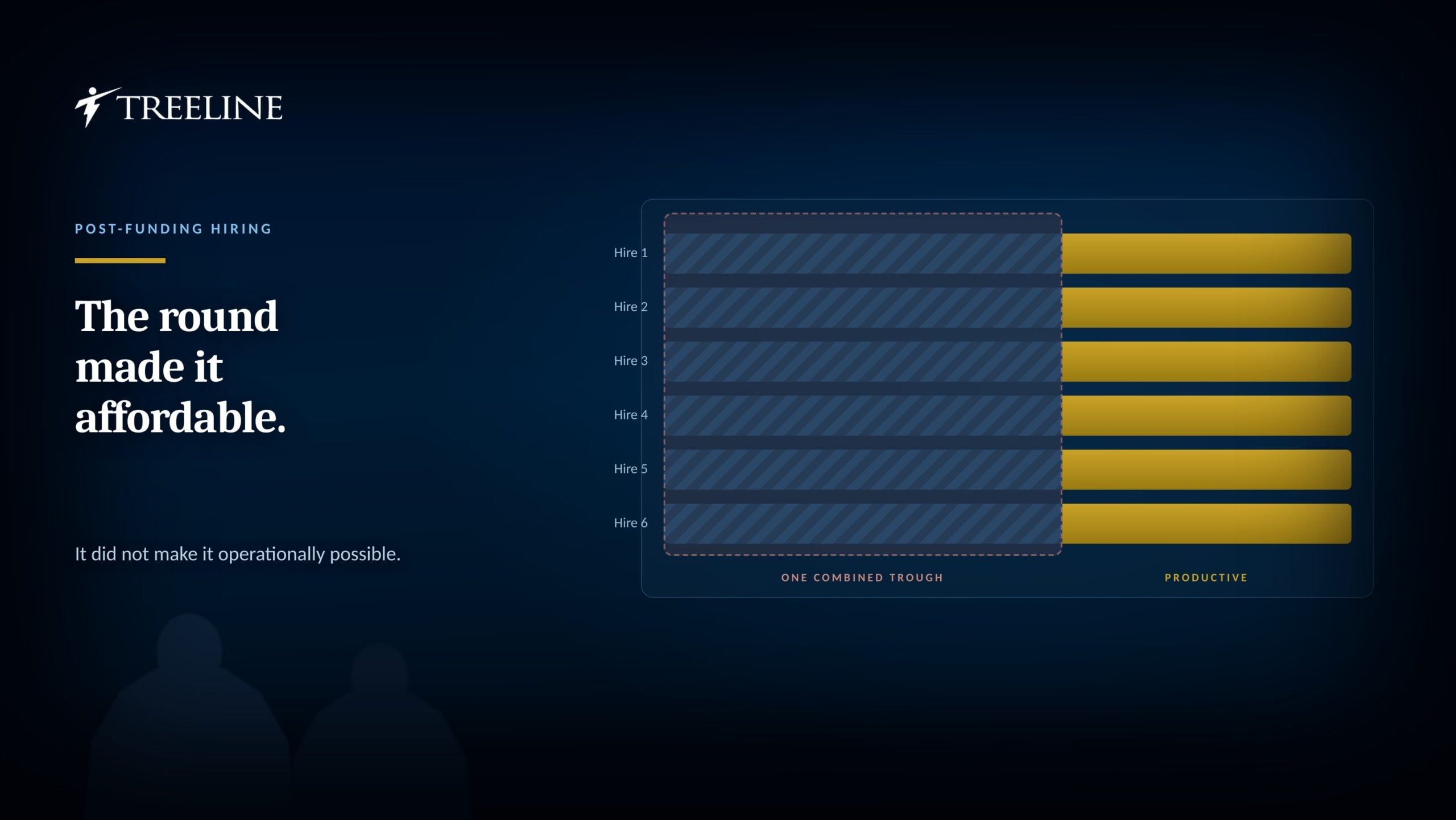
Hiring the whole plan at once. A funding round makes it financially possible to hire six people in a quarter. It does not make it operationally possible. Six simultaneous ramps mean six people needing attention from the same small group, and no early signal about whether the profile was right, because nothing has been tested sequentially.
Hiring for the company the round implies rather than the company that exists. Post-raise confidence pulls in candidates from organizations with marketing engines, enablement teams and inbound pipeline. Many of them are excellent and were excellent inside infrastructure that is not there yet.
Why the Round Creates a Deadline the Market Did Not Set
The board expects the plan to be executed, which produces pressure to show headcount quickly because headcount is visible and revenue lags. The deadline is real but it is internal, and the market it is being applied to has not changed.
The consequence is that hiring becomes the proof of progress. A company that is behind on revenue can point to a filled team, and the gap between those two facts widens for two or three quarters before it becomes undeniable. By then the runway spent is substantial and the diagnosis is harder, because it is no longer clear whether the problem was the people, the sequence or the motion.
Fantasia’s perspective is that the honest early metric is not headcount but whether anyone other than a founder has closed a deal without founder involvement. He recommends treating that as the gate for further hiring, because it is the first evidence that the motion exists outside the people who invented it.
How Sales Hiring After Funding Should Be Sequenced
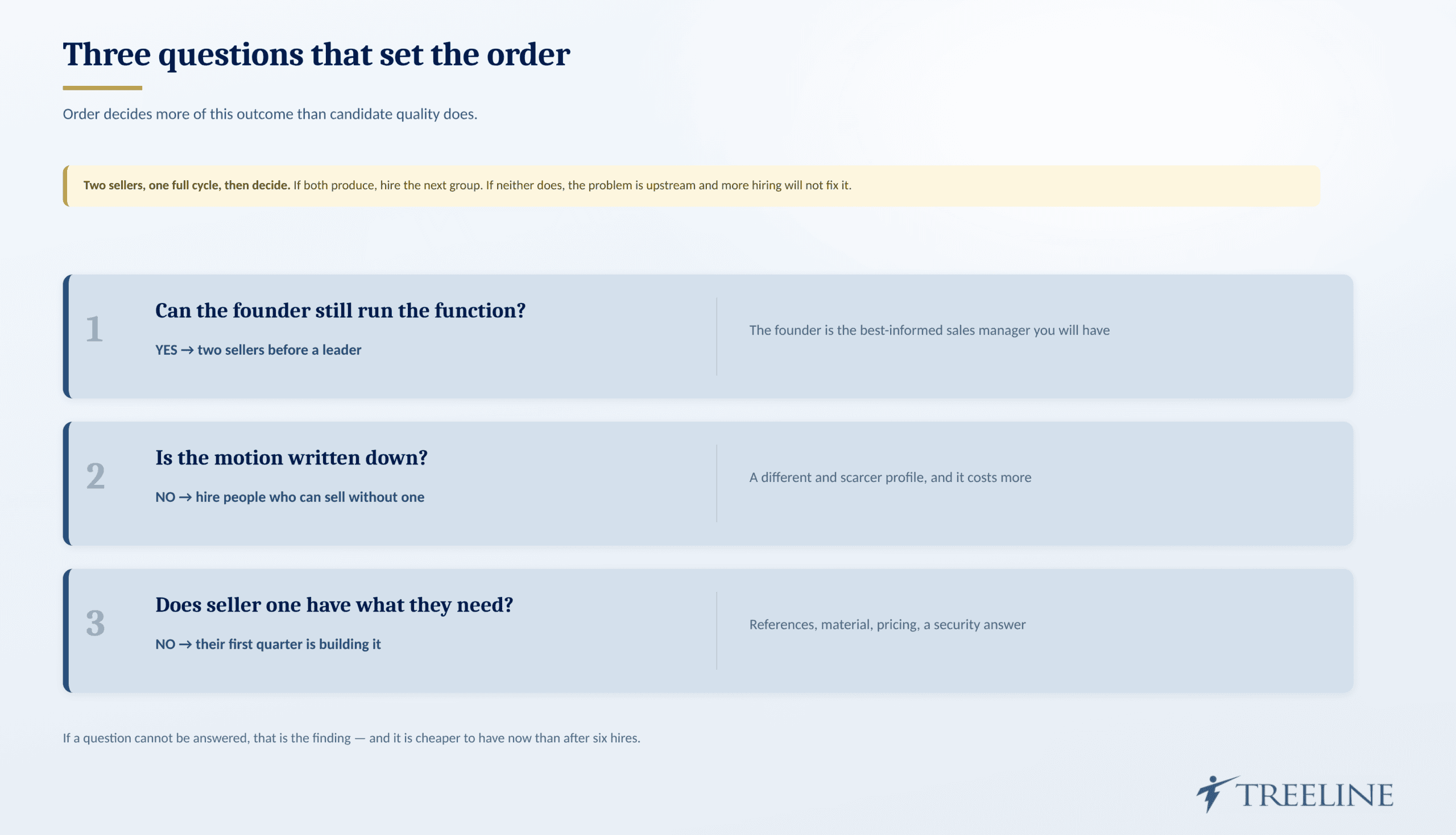
the-order-questions.png: Three gating questions and the hiring order each answer produces
Order matters more than almost anything else, and three questions settle it.
Can the founder still run the function? If yes, hire two sellers before a leader. The founder is the cheapest and best-informed sales manager the company will ever have, and a leader hired over an undefined motion will spend their first two quarters doing discovery the founder could have done faster.
Is the motion written down? If not, the first hires should be people who can sell without one, and the company should accept that their job includes documenting what works. That is a specific profile and it costs more than a seller who executes a playbook.
Does the first seller have what they need to succeed? References, material, pricing, a defensible answer on security or compliance where the market demands one. If the honest answer is no, the first hire will spend a quarter building those and should be measured accordingly.
The pattern that works in most cases is two sellers first, kept for a full cycle, then a decision: if both produce, hire the next group and consider a leader; if neither does, the problem is upstream and more hiring will not fix it; if one does, work out what was different before repeating anything.
Why Ramp, Not Budget, Sets the Hiring Rate
Every seller has a ramp during which they consume salary and produce little. That is normal and it is priced into any sensible plan. What is frequently not priced is that ramps overlap.
Hiring six people in one quarter creates a single deep trough: six salaries, six onboarding loads on the same few people, and no revenue contribution for several months. Hiring two, then two, then two produces a shallower and shorter trough, earlier information about whether the profile was right, and the chance to change the profile before paying for it six times.
The constraint that should set the rate is onboarding capacity, not budget. A company with one person who can train, ride along and review deals can effectively ramp perhaps two sellers at a time. Hiring four means two of them are learning from nobody, which is where the first year of attrition comes from.
Fantasia emphasizes that the ramp assumption in the plan should be checked against the company’s actual history rather than a benchmark. His operating perspective is that founders usually underestimate ramp in their own business by a meaningful margin, and that a plan built on an optimistic ramp will look like a people problem several months before it is recognized as a planning one.
What Sales Hiring After Funding Has to Test
Five questions discriminate well for early-stage commercial hires.
Building versus inheriting. Ask what existed when they arrived and what they built. The answer separates a seller who created pipeline from one who worked a territory that was already producing.
Selling without proof. Ask how they sold when the company had no recognizable name and few references. Strong candidates describe substitutes they constructed, a pilot structure, a narrow proof point, a borrowed credibility source. Weak ones describe persistence.
Documentation instinct. Ask what they wrote down that others then used. Early sellers who leave something behind are considerably more valuable than equally productive ones who do not, because the second hire inherits it.
Tolerance for the real conditions. Ask what they would need in the first ninety days, then say plainly what will and will not exist. Watch what happens. Candidates who adjust their plan in the conversation are reading the situation; candidates who repeat their plan unchanged are not.
Runway literacy. Strong early-stage candidates ask about burn, runway and what the next raise requires. A candidate who does not ask has either not thought about it or does not intend to stay long enough for it to matter.
Where Sales Hiring After Funding Finds Candidates
Three pools supply most of these hires, and the risk profile differs sharply.
Sellers from companies one stage ahead are the most common target and the most variable outcome. They have seen the stage the company is heading into, which is genuinely useful, and they frequently relied on infrastructure that does not yet exist. Test specifically for what they did before that infrastructure arrived.
Early-stage specialists, people who have repeatedly been among the first commercial hires, are the best fit and the smallest population. They are comfortable without a playbook, they document, and they are realistic about what is missing. They are also expensive, and some of them are better at the first year than the third.
Sellers from large organizations bring discipline, process and often genuine skill, and carry the highest adjustment risk. The hardest part is not the absence of resources but the absence of a known answer. Candidates who find that energizing do well; candidates who find it frustrating leave in month seven.
What Sales Hiring After Funding Asks of the Founders
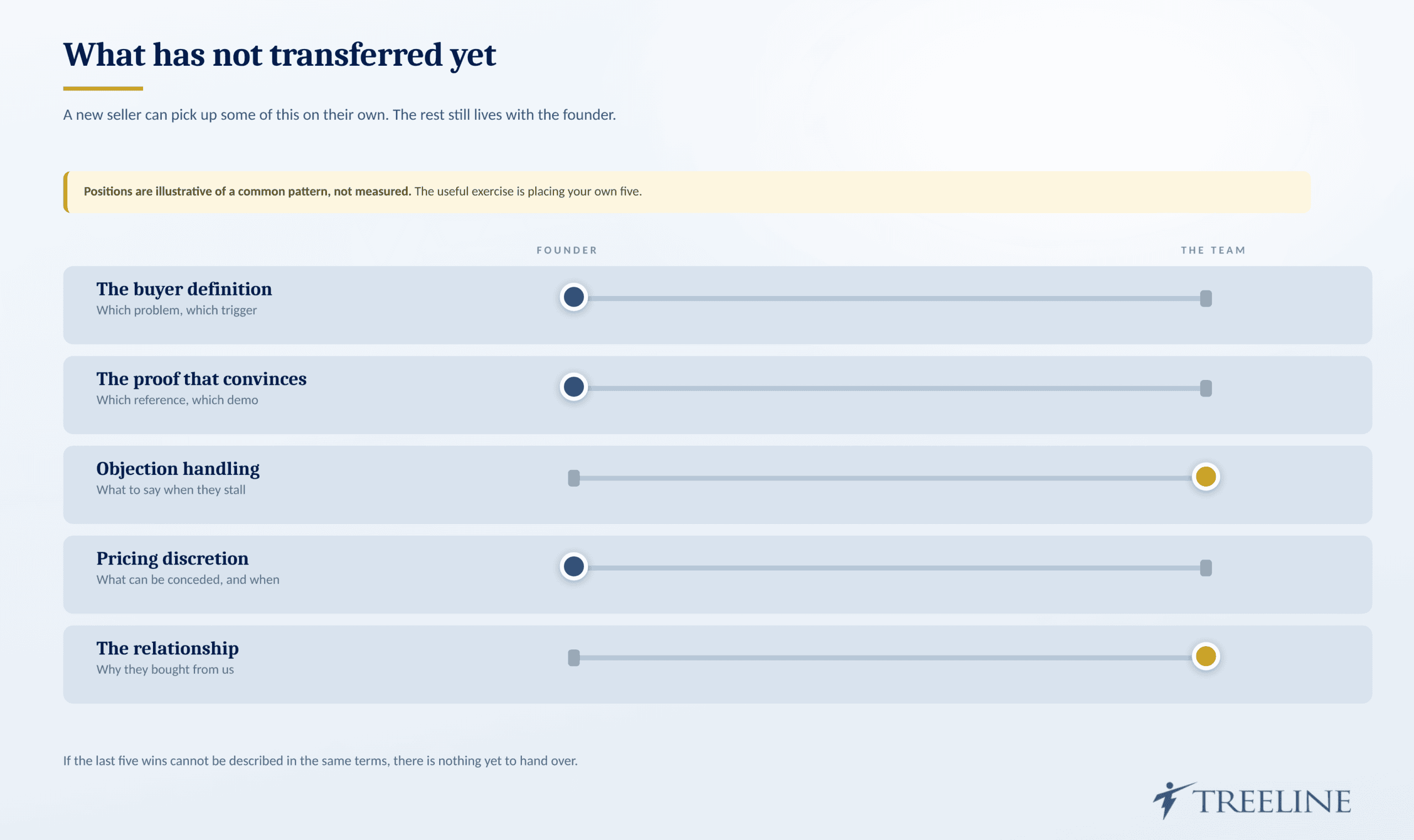
what-the-founder-still-holds.png: What still sits with the founder and has not transferred to anyone else
Three things should exist before the first search opens, and a fourth before the second wave.
A written description of the motion, however short. Who buys, what triggers it, what convinces them, what the objections are and how they were handled. If this cannot be written, that is the finding, and it is better to discover it now than after six hires.
An honest statement of what is missing. Candidates will find out anyway, and the ones worth hiring respond better to accuracy than to optimism. A role described accurately as hard attracts a different and better candidate than one described as ready.
A named person who owns onboarding and has the time to do it. Not nominally, with hours in the week.
And before the second wave, evidence that the first hires worked. Repeating a hiring pattern that has not yet produced a non-founder-led win is how a round gets spent.
How Sales Hiring After Funding Should Handle Compensation
A round changes what a company can offer and, more dangerously, what it feels able to offer.
Cash compensation tends to inflate immediately after a raise, because the money is visible and the
urgency is real. The cost of that is not the first hire’s package; it is the band. A first seller
brought in well above where the market sits sets a reference point for everyone hired afterwards,
and a company that corrects it later has to explain to its newest people why they are paid less
for the same job.
Equity is the lever that is usually underused. Early commercial hires are taking a genuine risk,
and a package weighted toward ownership attracts the candidates who believe in the outcome and
quietly filters out the ones treating the role as a salaried stopgap. It only works if the company
is willing to explain the numbers, how many shares, against what total, at what valuation, and
founders are often more reluctant to do that than candidates are to ask.
Variable compensation needs a different treatment at this stage. A standard split assumes a
quota that has been tested, and the first sellers are carrying numbers derived from a model rather
than from history. Guaranteeing a portion of variable pay through the ramp costs little, removes a
distraction, and stops the first two hires from being punished for the company’s own planning
error.
Fantasia recommends deciding the band before meeting candidates rather than after. His view is
that packages negotiated under post-raise urgency are the ones a company spends the following year
correcting, and that the correction is harder on morale than the original gap would have been.
Reading the First Two Quarters
Revenue is a lagging and noisy signal this early. Four other things are not.
A non-founder-led closed deal, which is the single clearest evidence that the motion transfers. Written artifacts the next hire can use. A pipeline built by the seller rather than handed to them, with real stage reasoning. And a consistent story across the sellers about why deals are won and lost, because when two sellers describe the same market differently, one of them is wrong and the company does not yet know which.
A team with those and a modest number is working. A team with a good number driven entirely by founder-closed deals has not yet tested anything.
Frequently Asked Questions
Should we hire a sales leader or sellers first?
If the founder can still run the function, hire two sellers first. A leader brought in over a motion nobody has defined will spend their first two quarters doing discovery the founder could do faster, and that is expensive at this stage.
Why not hire the whole plan at once?
Because ramps overlap. Six simultaneous starts create one deep trough, saturate whoever is onboarding, and produce no early signal about whether the profile was right. Staggered hiring gives you the chance to change the profile before paying for it six times.
What caps the number of starts per quarter?
Onboarding capacity rather than budget. A company with one person who can train and review deals can ramp roughly two sellers at a time. Beyond that, the extra hires are learning from nobody, which is where early attrition comes from.
Is a seller from a bigger company a safe bet?
They bring real discipline and the highest adjustment risk. The difficulty is less the missing resources than the missing answers. Some find that energizing; those who do not tend to leave around month seven.
Is the playbook written well enough to hand over?
When the last several wins can be described in the same terms, which buyer, what trigger, which proof, what objection. If the founder cannot write that down, a new seller is being asked to discover it, which is a different and scarcer hire.
What should we tell candidates about what is missing?
The truth. They will find out regardless, and an accurately described hard role attracts a better candidate than an optimistically described easy one. Candidates who adjust their ninety-day plan when told the real conditions are reading the situation correctly.
Why pay per hire instead of retaining a firm?
Because plans change. The fee attaches to a hire rather than a search, several roles can be worked in parallel, and if the company pauses after the first two hires to check whether the profile was right, that pause costs nothing.
Should the first leadership search be retained?
For the first commercial leader, where the candidate universe is small, the appointment shapes everything built afterwards, and the company may not want the search visible in a market where its investors and competitors are watching.
Hire the Second Seller Before the Sixth
Sales hiring after funding is one of the few situations where doing less, more slowly, is usually the faster route. The round makes speed affordable and the board makes it attractive, and both of those pull toward a pattern, hire the plan, fill the seats, show progress, that removes the company’s ability to learn anything before it has spent the money.
Two hires, kept for a full cycle, answer the questions that matter: does the motion transfer, was the profile right, and can anyone other than a founder close. A company that has those answers can hire the rest quickly and confidently. A company that skips them will have six people and the same three questions, several quarters later and with less runway to answer them.
Share This Story, Choose Your Platform!
Related Posts

What our happy clients are saying
Treeline Inc. provided us with the most candidates that aligned with our needs and were of the highest quality.

Dr. Jeffrey Klein Head of North America Sales, Satchel Pulse
Treeline Inc.’s collaborative, flexible, and communicative approach resulted in a smooth partnership. Beyond their recruitment expertise, their unique sourcing model was efficient and effective.

Sera Holt Director of Operations, LNS Research
Their professionalism was outstanding. Treeline Inc. was extremely thorough and ensured that we were on the same page before they started looking for candidates. They listened to us and did a great job working with the candidate to close out the process.

Cate Grant AVP Customer Success, Nasdaq
Thanks to Treeline Inc.’s intricate and thorough screening process, the company is able to hire six high-quality candidates that fit perfectly in the company’s culture. The team is highly receptive to concerns, and internal stakeholders are impressed with their unique recruitment abilities.

Anna McKean Sales Recruiter, Insider Intelligence
Treeline Inc. has been qualified individuals throughout a five-year-long engagement. They’ve made numerous placements of talented and qualified individuals for our business.

Michele St Laurent VP of HR, The Institute for Applied Network Security

Let Us Help You Source the Sales Talent You Need
Whether you’re building a team or replacing a key role, our Candidate Sourcing Platform provides a fast, flexible, and employer-focused solution.
Tell us more about your business and how we can help.
Treeline Inc.
Your Award-Winning Sales Recruitment Partner
15 Lincoln Street, Suite 314, Wakefield, MA 01880