A field seller’s week is invisible and a manager finds out how it went a quarter later. An inside seller’s week is the opposite: every call is logged, every conversation is timed, every stage change is dated, and anyone who wants to know what happened on Tuesday can find out before lunch on Wednesday.
That inversion changes the entire hiring problem. When the work is unobservable, the assessment has to establish self-direction up front because supervision never will. When the work is completely observable, self-direction matters much less, the cadence supplies the structure, and what matters instead is whether this person’s numbers move when someone shows them what to change. One role is hired on independence. The other is hired on coachability and throughput, and treating them as the same search with a different location is the most common way an inside sales hire goes wrong.
This article covers what that means for the search. These roles are commonly filled under a contingency sales recruiting arrangement, where the fee is payable only on a hire, and the trade-offs against an exclusive engagement are set out in contingency hire vs retained search. The opposite motion, the field seller who owns a geography and closes in the room, is covered in outside sales recruiting. If the team being built is specifically distributed, the remote-specific version of this problem has its own treatment in hiring remote inside sales reps, and hiring the person who will run the team is a separate search covered in how to hire an inside sales manager.
Dan Fantasia, CEO of Treeline, Inc., describes inside sales as the one sales environment where a hiring mistake announces itself early enough to be fixed. His point is not that the hires are easier. It is that the feedback arrives in weeks rather than quarters, and a company that builds its assessment around that fact gets more out of each hire than one that treats an inside seat like a smaller version of a field seat.
What Inside Sales Recruiting Assesses That a Field Search Does Not
Three capabilities carry an inside seller, and the first one is frequently not on the scorecard at all.
Movement under correction. The defining advantage of a logged environment is that a manager can see exactly which stage is leaking and say so on Thursday. The capability that converts that advantage into revenue is the seller’s willingness to change what they are doing by Friday. Candidates vary enormously here, and the variation has nothing to do with how good their numbers were at the last company, a seller with excellent numbers who arrived at them through a method they cannot articulate will resist a change they do not understand.
Throughput without decay. The job involves doing a similar thing many times in a day, and the quality of the fortieth conversation matters as much as the quality of the fourth. Some candidates sustain this and some do not, and the ones who do not are often the most impressive in a first interview, because a single high-stakes conversation is exactly where they perform best.
Conversation control in a short window. An inside seller usually has a few minutes to establish why the call should continue. That is a specific and trainable skill, distinct from the longer-form consultative ability that a field or enterprise seller needs, and a candidate strong at one is not automatically strong at the other.
What matters much less here than in a field search: independent week-structuring, trip planning, territory judgment, and the comfort with solitude that a sparse patch demands. Screening hard for those in an inside search filters out capable candidates for no reason.
The Cadence Arithmetic Nobody Does Before the Search

Before opening a requisition, somebody should be able to state the ratio chain: how many attempts produce a conversation, how many conversations produce a meeting, how many meetings produce an opportunity, and how many opportunities close. Most companies hiring their third or fourth inside seller cannot, and the consequence is that they hire against a feeling rather than a gap.
The arithmetic matters because it tells you which seller you need. A team whose attempt-to-conversation ratio is weak has a reach problem, and needs people who are effective at getting picked up at all. A team that converts conversations well but loses opportunities late has a closing problem, and hiring more top-of-funnel energy will produce more wasted meetings rather than more revenue. These are different candidates. Without the ratios, the panel argues about who was most impressive instead of who fixes the constraint.
It also sets a realistic quota. An inside sales number is reverse-engineered from the ratio chain and the working hours available, and a quota built on an optimistic conversion assumption produces a sequence of hires who all appear to fail. When several inside hires underperform in the same way, the usual cause is the plan rather than the people.
Fantasia’s observation from running these searches is that a company able to state its own ratio chain gets a materially better hire, because the brief stops being a personality description and becomes a specification. The firms that cannot state it are usually not short of candidates; they are short of agreement about what the role is supposed to fix.
Why the Highest Activity Numbers Are the Wrong Signal
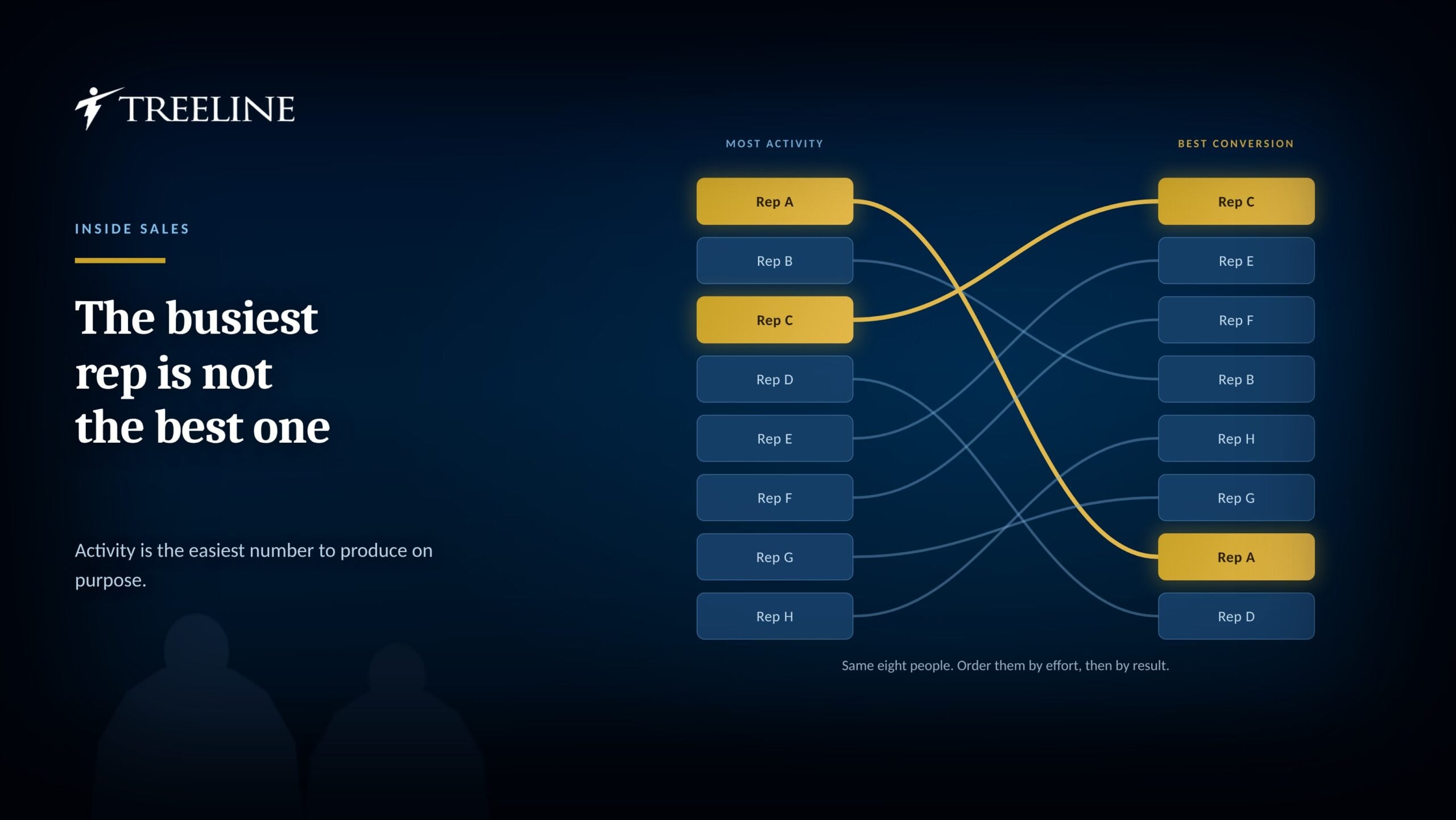
Activity is the most available number on an inside sales résumé and the least informative. It is also the easiest to optimize for, which is precisely the problem.
Dial counts, emails sent and sequence completions are measures of input. When a previous employer measured and rewarded them, candidates adapted, which is a rational response to a scorecard and not a character flaw, but it means the number describes the employer’s incentive design as much as the candidate’s ability. A seller with very high activity and ordinary conversion learned to produce the measured thing, and will do exactly that again under a new scorecard.
Two more signals deserve less weight than they get.
Quota attainment without the ratio context. An inside seller who hit 130 percent on a team with strong inbound flow and a well-qualified lead source has demonstrated something different from one who hit 95 percent working cold lists. Without knowing what fed the pipeline, the percentage is close to meaningless.
Tenure in a highly engineered environment. Some inside sales organizations are so well instrumented that the seller is executing a system designed by someone else, the sequence, the talk track, the objection handling and the handoff rules all arrive prebuilt. That experience is valuable, and it does not establish that the person can work where those things do not exist yet. If the role on offer is at a company still building the motion, this is the single most important thing to probe.
What Inside Sales Recruiting Should Test
The advantage of this role is that much of it can be observed directly rather than discussed, and the interview should take that advantage.
A live call block, not a role-play. Where it is practical, a short structured exercise using a real list and a real product beats any hypothetical. What is being assessed is not whether they book something; it is how they open, how quickly they adapt after the first two attempts fail, and whether attempt six sounds like attempt one or like someone who learned something.
A correction test. Give specific, concrete feedback during the process, on the opening, on a question they asked, on how they handled an objection, and then watch the next attempt. A candidate who incorporates it immediately is showing the capability the role most depends on. One who defends the original approach is showing something too.
Their own ratio chain. Ask them to state their numbers at each stage of their last role, from attempt through close. Strong candidates know these because they were managed on them. The follow-up matters more: which ratio was their weakest, what they tried, and whether it moved.
A stage diagnosis. Describe a team whose conversations convert well but whose opportunities stall, and ask what they would look at. This separates sellers who understand the mechanics of a funnel from sellers who have only ever executed their part of one.
One recording they would not choose. Candidates who have worked in recorded environments can usually describe a call that went badly and what they changed afterward. The specificity of that answer is hard to manufacture.
Where Inside Sales Recruiting Finds Candidates

The population is large, which makes this a filtering problem rather than a scarcity problem, the opposite of most searches in this series.
Sales development representatives ready to close. The most common and most reliable source. They have the cadence habit and the resilience; what they lack is experience owning an outcome rather than a handoff. The useful question is whether they have ever been accountable for something after the meeting was booked.
Inside sellers at companies with a harder sale. Someone selling a complex product to a skeptical buyer moving to an easier one usually performs well. The reverse move is riskier and is often the real reason a strong-looking hire stalls.
Retail, hospitality and service backgrounds with high conversation volume. Underused and frequently excellent for the top of the funnel. They arrive with conversational stamina and an absence of bad habits, and they need the commercial structure taught.
Field sellers wanting to come off the road. They bring deal judgment and often struggle with the cadence, because the rhythm is genuinely different and the autonomy they are used to is gone. Workable, and it should be tested rather than assumed.
Customer success and support with a commercial instinct. People who already handle objections all day and have never been allowed to ask for anything. A development hire that works more often than its reputation suggests.
It is also worth hiring with the next seat in mind. Inside sales is where most mid-market and enterprise account executives come from, so the candidate who looks slightly overqualified for the opening may be the one who fills a more expensive seat in eighteen months without an external search.
Why Inside Sales Recruiting Suits the Contingency Model
Four features of this search align unusually well with a contingency arrangement, and the alignment is stronger here than for most roles in this series.
The hiring happens in cohorts. Inside sales teams expand by several seats at once rather than one at a time, which means the work is repeatable against a stable profile. A firm that has placed into the same motion before is reusing a calibrated screen rather than starting over, and the company pays per hire rather than per search.
The population is large and reachable. This is not a mapping exercise against forty companies; it is a filtering exercise against thousands of candidates. Non-exclusive arrangements work well where the constraint is screening quality rather than access.
The feedback loop is short. An inside hire’s trajectory is readable within weeks, which means the quality of a recruiting partner’s screening becomes visible quickly, across several placements. That is exactly the condition where paying on outcome is reasonable.
The roles are not confidential. Nothing about adding inside capacity requires discretion, which removes the clearest argument for a retained engagement.
The limit worth naming: a first inside sales hire into a company that has never run the motion is a different proposition. There is no ratio chain, no manager who has done it, and no scorecard, and that search benefits from more consulting than a placement fee usually buys. Fantasia’s consistent position is that the arrangement should follow the shape of the population and the sensitivity of the role, and a first-of-kind build is one of the cases where the reasoning points toward a more structured engagement.
What Inside Sales Recruiting Asks of the Employer
Four things sit with the hiring company, and candidates at this level screen employers harder than most hiring teams expect.
A lead source the seller can describe. The first question a good inside candidate asks is where the pipeline comes from. “Marketing is working on it” is an answer, and it is one that loses the strongest candidates to the competitor who can describe a list, a source and a volume.
A ramp with a number. Inside sales ramps are short compared with field roles, which makes vagueness here less forgivable rather than more. State what months one through three look like in earnings, and state what happens if the ratios are not yet where the plan assumed.
Honest instrumentation. If calls are recorded, say so at offer stage. If activity is reported daily, say that too. Sellers who have worked under heavy surveillance and disliked it will decline, which is the correct outcome for both sides, and discovering it in week two is how a good hire becomes a short tenure.
A route out of the seat. Inside sales roles with no visible progression lose their best people around month fourteen, usually to a competitor offering the next title. A company that can describe what the strong performer does next retains the hires it worked hardest to make.
Reading the First Ninety Days
The logged environment means progress can be read early and precisely, and there is no excuse for waiting a quarter to form a view.
By week two, activity should be at or near the team’s standard, not because volume is the goal, but because reaching baseline throughput is the first evidence the person can sustain the rhythm. By week four, the attempt-to-conversation ratio should be approaching the team median; this is the earliest meaningful quality signal and the one that moves fastest with coaching. By week eight, conversations should be converting to meetings at a rate within reach of the team, and anything well below it points at the conversation itself rather than the list. By week twelve, a pipeline consistent with the ratio chain and the first closed business, depending on cycle length.
The failure signatures are legible and specific. High activity with a conversation ratio that does not move after four weeks of coaching is the clearest one, and it usually means the person is executing volume rather than adjusting. A conversation ratio that is fine while meetings do not materialize points at the ask rather than the opening. Activity that drifts down after week six, with the earlier numbers unexplained, usually means the initial pace was not sustainable.
Fantasia’s test at ninety days is whether any number has moved as a direct result of something a manager said. If one has, the hire is coachable and the rest is time. If nothing has, the company has hired someone who will deliver exactly what they delivered in week one for as long as they stay.
Frequently Asked Questions
How does hiring an inside seller differ from hiring a field seller?
The observability inverts. A field seller’s week leaves no record, so the assessment has to establish self-direction that supervision will never be able to supply. An inside seller’s week is logged in full, so the cadence supplies the structure and the decisive capability becomes whether their numbers move when a manager tells them what to change.
What does a very high activity number usually tell you?
Because it measures input, and inputs are what candidates optimize when an employer rewards them. Very high activity alongside ordinary conversion usually means the person learned to produce the measured number, which is a rational response to a scorecard, and a strong predictor that they will do the same thing again under a new one.
What should a company know about its own funnel before opening the search?
The ratio chain: attempts to conversations, conversations to meetings, meetings to opportunities, opportunities to closed. Those ratios identify which constraint the hire is meant to relieve. Without them, a panel ends up debating who was most impressive rather than who fixes the actual problem.
Can a sales development representative step into a closing seat?
Often, and it is the most reliable single source. They already have the cadence habit and the resilience. What they have not had is accountability for an outcome after the handoff, so the question worth asking is whether they have ever owned anything past the booked meeting.
How do you test coachability rather than just asking about it?
Give specific feedback during the process, on the opening, on a question they asked, on an objection they handled, and then watch the very next attempt. Incorporating it immediately is the capability the role depends on most. Defending the original approach is an answer too, and an early one.
Is somebody from a highly instrumented sales organization a safe hire?
Only if the destination is similarly built. In the most engineered environments the sequence, the talk track and the handoff rules all arrive prebuilt, so the seller has been executing a system designed by someone else. That is genuinely valuable experience, and it does not establish that they can work where those things do not exist yet.
Why do several inside hires sometimes underperform in the same way?
Because the quota was reverse-engineered from an optimistic conversion assumption rather than from observed ratios. When a pattern of failure repeats across different people, the plan is the more likely explanation than the hiring, and the ratio chain is where to look first.
What should be visible by the end of the first month?
Throughput at or near the team standard within two weeks, and an attempt-to-conversation ratio approaching the team median by week four. That ratio is the earliest meaningful quality signal and the one that responds fastest to coaching, which makes it the most useful early read on whether the hire is working.
State Your Ratios Before You Write the Scorecard
The advantage of inside sales is that almost everything is measured. The recurring mistake is hiring as though none of it were, screening for the independence a field role demands, rewarding the activity numbers that are easiest to game, and setting a quota from an assumption nobody checked against the funnel.
Write down the ratio chain. Decide which link the hire is supposed to strengthen. Then run a process that tests the thing a logged environment actually rewards, which is whether this person gets better when someone tells them how.
Share This Story, Choose Your Platform!
Related Posts


What our happy clients are saying
Treeline Inc. provided us with the most candidates that aligned with our needs and were of the highest quality.

Dr. Jeffrey Klein Head of North America Sales, Satchel Pulse
Treeline Inc.’s collaborative, flexible, and communicative approach resulted in a smooth partnership. Beyond their recruitment expertise, their unique sourcing model was efficient and effective.

Sera Holt Director of Operations, LNS Research
Their professionalism was outstanding. Treeline Inc. was extremely thorough and ensured that we were on the same page before they started looking for candidates. They listened to us and did a great job working with the candidate to close out the process.

Cate Grant AVP Customer Success, Nasdaq
Thanks to Treeline Inc.’s intricate and thorough screening process, the company is able to hire six high-quality candidates that fit perfectly in the company’s culture. The team is highly receptive to concerns, and internal stakeholders are impressed with their unique recruitment abilities.

Anna McKean Sales Recruiter, Insider Intelligence
Treeline Inc. has been qualified individuals throughout a five-year-long engagement. They’ve made numerous placements of talented and qualified individuals for our business.

Michele St Laurent VP of HR, The Institute for Applied Network Security

Let Us Help You Source the Sales Talent You Need
Whether you’re building a team or replacing a key role, our Candidate Sourcing Platform provides a fast, flexible, and employer-focused solution.
Tell us more about your business and how we can help.
Treeline Inc.
Your Award-Winning Sales Recruitment Partner
15 Lincoln Street, Suite 314, Wakefield, MA 01880