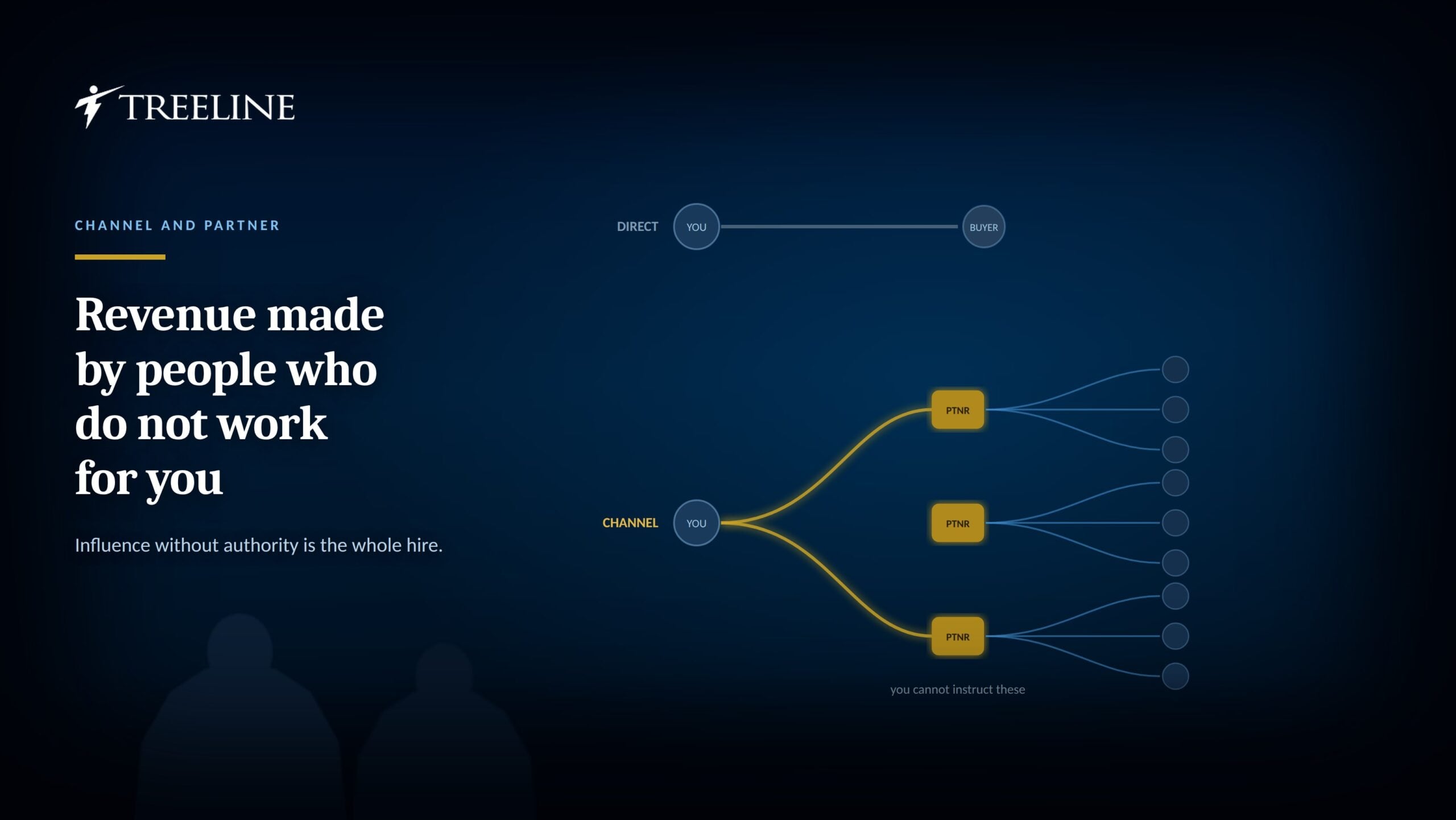
A direct seller owns the customer relationship, controls the deal, and is measured on what they personally closed. A channel seller owns none of those things. They sell through a reseller, distributor, systems integrator or agency partner, which means the revenue they are accountable for is produced by people who do not work for them, who carry competing products, and who can reasonably ignore them.
That difference is the whole of the hire. The profile that succeeds here is built on influence without authority, and it is almost the inverse of what a strong direct seller is good at. Most companies run this search under a contingency sales recruiting arrangement because the fee is payable only on a hire, which matters when the requirement is one the organization has not written before, and the broader case for that structure in a growth-stage hiring strategy applies here with one adjustment: the assessment has to change, not just the sourcing.
Dan Fantasia, CEO of Treeline, Inc., locates the difficulty of this hire in the measurement rather than in the market. From his perspective the standard sales interview rewards people who can describe deals they personally closed, which is precisely the evidence a channel candidate will not have.
What Channel Sales Recruiting Is Actually Searching For
This article is about the manager and director layer, the people who own a partner set and the programme around it, rather than channel account executives carrying individual partner-sourced quota. The assessment differs between the two, and conflating them is a common reason a shortlist looks wrong without anyone being able to say why.
Strip away the titles and the role divides into four jobs that look similar on paper and need different people.
Recruiting partners. Signing new resellers, integrators or agencies. This is closest to direct selling, you are convincing a business to commit, but the sale is a partnership rather than a product, and the close is the beginning rather than the end.
Activating partners. Taking a signed partner who is doing nothing and getting them to produce. Most partner programmes have a long tail of signed-and-dormant relationships, and the person who can wake them up is rare.
Managing productive partners. Running the relationship with partners who already sell: joint planning, forecast accuracy through a channel, escalation, and the steady work of staying front of mind against competing products.
Programme design. Tiering, margin structure, deal registration, certification requirements, market development funds. This is operational and strategic rather than relational, and it is frequently bundled into a role that is otherwise relationship work.
A requirement that lists all four without ranking them produces candidates strong in different pairs and no basis for comparing them. The useful first step is deciding which two matter in the first year.
Why Direct Sellers Fail the Channel Sales Recruiting Test
The substitution is common because it looks reasonable, and it fails for reasons that are structural rather than about effort.
A direct seller is trained to control the process. In the channel, control does not exist, you can influence a partner’s priorities, resource their team, and make yourself easy to sell with, but you cannot instruct them. Sellers who are accustomed to driving a deal find this intolerable within two quarters.
The feedback loop is also much slower. A direct seller sees the result of their work in a quarter. A channel manager who invests in enabling a partner may see the return three quarters later, through deals they never attended. People who need visible personal attribution struggle with that.
And the unit of work changes. A direct seller manages opportunities; a channel manager manages a portfolio of businesses, each with its own economics, its own competing priorities and its own internal politics. That is closer to account management or business development than to selling.
There is a related error in the other direction. Companies sometimes assume a channel hire will also carry some direct accounts, on the reasoning that the person is a seller and the accounts need covering. That arrangement reliably produces a direct seller who occasionally thinks about partners, for the same reason the player-coach arrangement produces a seller who occasionally coaches: the direct deals are immediate, personally attributable and under their control, while the partner work pays out next year through someone else.
The inverse is also true and worth saying: a strong channel person dropped into a direct quota frequently underperforms, because the habits that make them effective, patience, enablement, playing a long game through others, are the wrong habits when you personally have to close.
The Titles and What They Usually Mean
Channel roles carry inconsistent titles, and the same words describe different jobs at different companies. A few patterns are worth knowing before reading a shortlist.
Channel manager or regional channel manager is usually field relationship work against a defined partner set in a territory. This is the most common shape and the one most companies mean when they open a channel role.
Partner manager or strategic partner manager frequently means fewer, larger relationships with more depth, joint business planning, executive alignment, sometimes co-selling into named accounts.
Director of channel or distributor channel typically carries programme responsibility alongside relationships, and at distributor level it involves managing a tier of organizations who themselves have resellers beneath them. That is a different and more abstract job than managing resellers directly.
Alliances usually means technology or strategic partnerships rather than resale, integrations, joint solutions, co-marketing, and the revenue connection is more indirect still.
Client partner and agency partnerships appear in services and media businesses and sit closer to account management than to channel in the resale sense.
The practical consequence is that title-based screening is unreliable here in the same way it is for operations roles. What matters is the partner type, the depth of relationship, and whether programme mechanics are in scope.
What to Test For, and Why the Usual Questions Fail
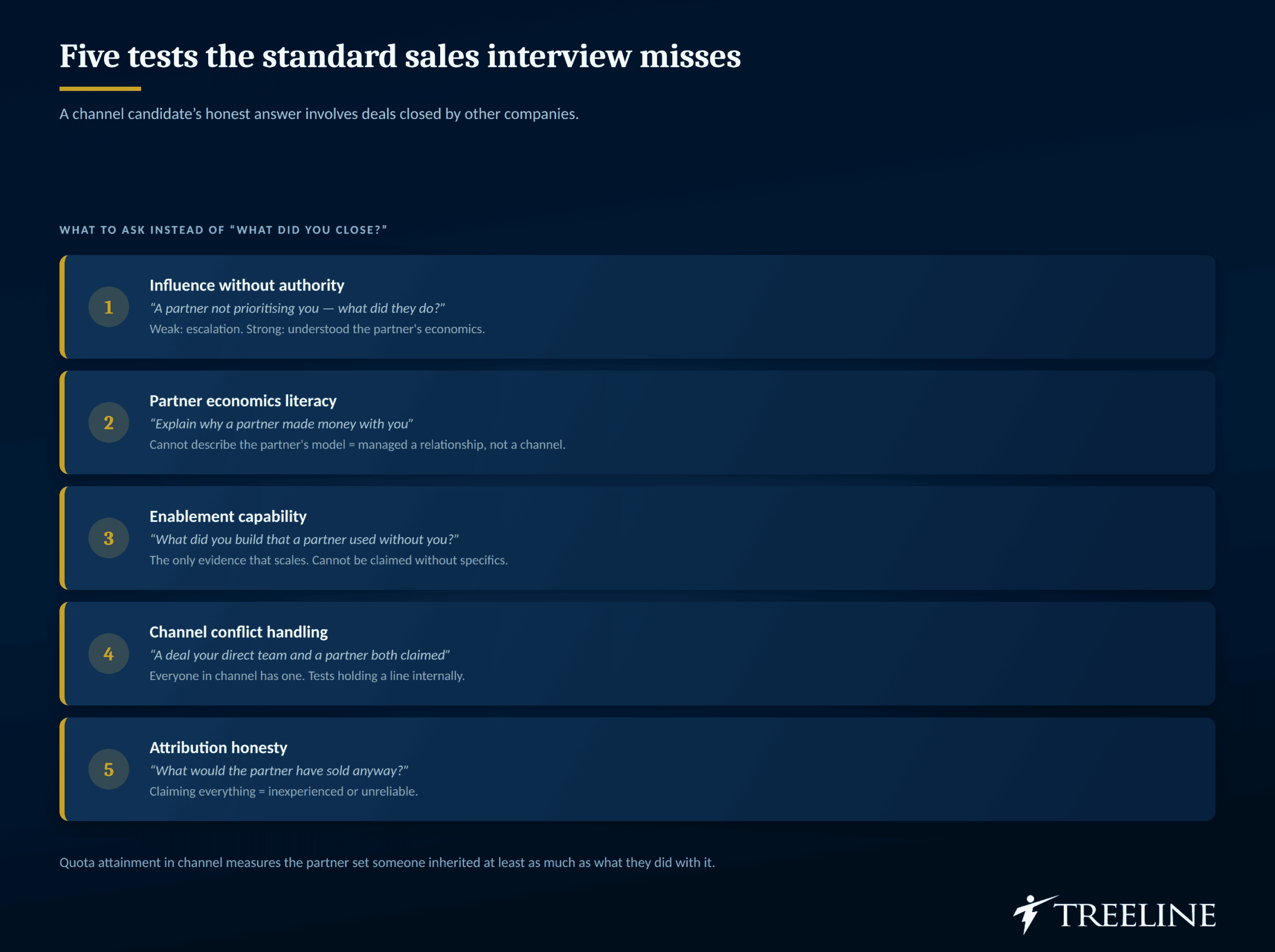
The standard interview asks what the candidate closed. A channel candidate’s honest answer involves deals closed by other companies, which sounds evasive and is in fact the job.
Better questions test for the specific capability.
Influence without authority. Ask about a partner who was not prioritising their product and what they did about it. Strong answers involve understanding the partner’s own economics, what their sellers get paid on, what their pipeline looks like, where the product fits their margin, rather than escalation or pressure.
Partner economics literacy. Ask them to explain why a particular partner made money with them. A candidate who cannot describe the partner’s business model has been managing a relationship rather than a channel.
Enablement capability. Ask what they built that a partner used without them present. Collateral, a certification path, a pitch a partner’s seller could deliver alone. This separates people who sold alongside partners from people who made partners self-sufficient.
Channel conflict handling. Ask about a deal where their direct team and a partner both claimed the account. Everyone in channel has one. The answer reveals whether they can hold a position with internal colleagues, which is half the job.
Attribution honesty. Ask what share of their number they personally influenced versus what the partner would have sold anyway. Candidates who claim everything are either inexperienced or unreliable; the honest answer is usually uncomfortable and specific.
Fantasia singles out the enablement question as the most predictive of the five. His reasoning is that building something a partner uses when you are not in the room is the only evidence that scales, and it is the thing a candidate cannot claim without specifics.
Where Channel Sales Recruiting Finds Its Candidates
The population is smaller than direct sales and sits in identifiable places.
Competitors and adjacent vendors selling through the same partner set are the obvious first pool, and the value is relationships: someone who already has credibility with the partners you need shortens the ramp from a year to a quarter.
The partner side itself is the most underused pool. People who have worked inside a reseller, distributor or integrator understand the economics from the other direction, which is the single most useful knowledge in the role. They frequently have never worked vendor-side and are interested in doing so.
Alliance and business development functions produce candidates who are strong at partner recruitment and programme design, sometimes weaker at the week-to-week relationship work.
And direct sellers with a partner-attached history, people who have run deals jointly with integrators, can convert, provided they wanted to rather than were moved. The question to ask is simple and revealing: what did they like about working through a partner? A candidate who answers in terms of reach and leverage is describing the job; one who answers in terms of the partner bringing them deals is describing a lead source, which is not the same thing. That distinction matters and is knowable by asking.
What the four share is that they are employed, performing and not applying to postings. Reaching them is a relationships problem, which is the practical argument for engaging contingency recruiters who work the function rather than advertising the role.
The Partner Type Changes the Profile
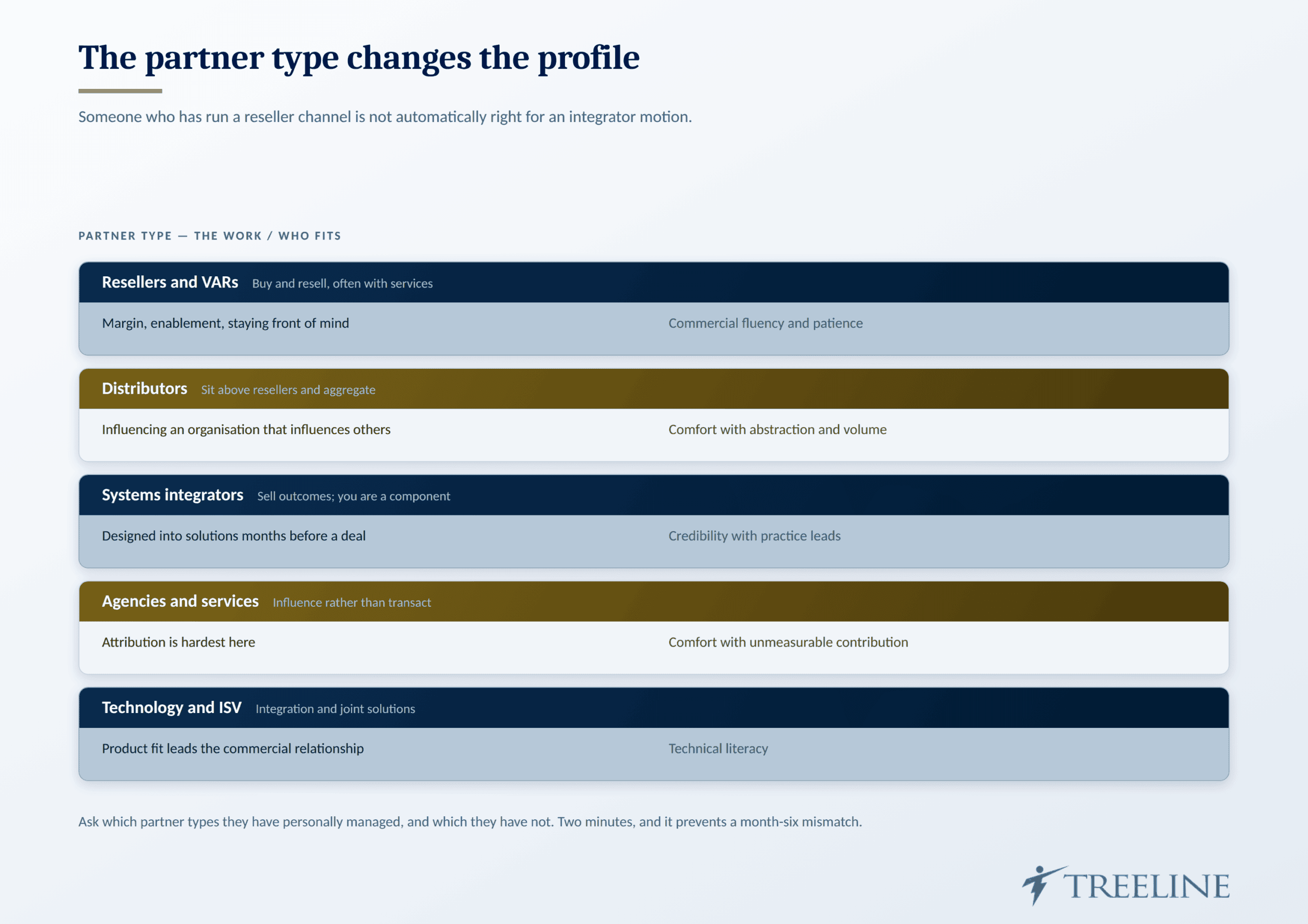
Not all channels are the same, and the partner type shapes which candidate fits more than company size does.
Resellers and VARs buy and resell, often with services attached. The work is margin, enablement and staying front of mind in a catalogue that includes your competitors. Candidates need commercial fluency and patience.
Distributors sit above resellers and aggregate. Managing them is a tier removed from the end customer, you are influencing an organization whose job is to influence others. This suits people comfortable with abstraction and volume rather than individual relationships.
Systems integrators and consultancies sell outcomes, and your product is a component. The relationship is often with practice leads rather than sellers, and the work involves getting your product designed into solutions months before any deal appears.
Agencies and service partners typically influence rather than transact, and attribution is hardest here. The candidate has to be comfortable with a contribution that is real and difficult to measure.
Technology and ISV partners involve integration and joint solution work, where the commercial relationship is secondary to the product fit.
A candidate who has run a reseller channel is not automatically right for an integrator motion, and the mismatch surfaces around month six when the approach that worked before produces nothing. Asking which partner types they have personally managed, and which they have not, takes two minutes and prevents it.
Why Channel Sales Recruiting Suits the Contingency Model
The fit rests on three characteristics of the role rather than on a general preference.
The requirement is frequently first-of-kind. Many companies open a channel role having never had one, or having had one that did not work. The specification changes during the search as the company works out whether it needs partner recruitment or partner activation. Under a structure that charges only on placement, that discovery costs nothing.
The population is reachable and not confidential. This is not a search requiring exclusivity or a documented census. It needs somebody who knows which vendors and which partner organizations hold the right people.
The role may correctly not be filled. A meaningful share of these searches should end with the company concluding that the channel strategy is not ready, no margin structure, no deal registration, nothing for a partner to make money on. A firm paid only on placement absorbs the cost of reaching that conclusion.
Treeline sets out the commercial terms of that arrangement separately; what matters here is that the uncertainty sits on the firm rather than on the employer.
What a Channel Hire Is Actually Expected to Change
Being concrete about the first year’s work makes the profile question easier to settle, because the four jobs produce different plans.
If the answer is more partners, the hire is a recruiter and the plan is outbound: identifying the right partner organizations, understanding what each would gain, and signing them. Measurable, relatively fast, and worth very little on its own if the signed partners then do nothing.
If the answer is existing partners producing more, the hire is an activator and the plan is diagnostic before it is relational. Which partners are dormant and why, is it margin, is it their sellers not knowing how to pitch, is it a competing product with better support? Each cause has a different remedy and the diagnosis takes a quarter.
If the answer is fewer, better partners, the hire is being asked to rationalise, which includes telling some partners they are being deprioritised. This is politically harder than it sounds and needs executive cover agreed in advance.
If the answer is the programme itself, the hire is operational and the plan is structural, tiering, margin, registration, certification, with relationship work secondary for the first year.
Most companies want all four and will say so. Forcing a ranking surfaces disagreement between the chief revenue officer and whoever owns partnerships today, and that disagreement is considerably cheaper to resolve before a search than after a hire.
A channel hire cannot create a channel programme from nothing, and this is where most of these roles fail before the person arrives.
Margin or commission a partner can see. If a partner cannot calculate what they make, they will sell something they can. This is the most common missing piece and the most fatal.
Deal registration. Without it, a partner who invests in an opportunity can lose it to your direct team or to another partner, and they will stop investing after the first time.
A position on channel conflict. Which accounts are direct, which are partner-led, and what happens when both appear. An unwritten answer means the new hire spends their first year litigating individual deals.
Something a partner can sell without you. If every deal requires your sales engineer on the call, you do not have a channel; you have a referral arrangement with extra steps.
Executive patience. Channel revenue is slow to start and compounds. A leadership team expecting direct-sales timelines will conclude the hire failed somewhere around month seven, which is roughly when the work starts producing. The practical way to buy that patience in advance is to agree the first-year measures before the hire starts, so that month seven has something to report other than revenue.
Fantasia presses employers on the margin question before anything else in these searches. His working test is whether the company can state, in one sentence, what a partner earns on a typical deal, and he reads an inability to answer as a sign the search is premature rather than difficult.
Channel Conflict, and Why the Candidate Will Ask
Any experienced channel candidate will ask how conflict is handled, and the quality of your answer tells them more about the role than the job description does.
The situation is unavoidable: a partner registers an opportunity, and your direct team is already working the same account, or wants to. Whoever wins, somebody loses revenue they believed was theirs.
Three positions are workable. Partner-led by segment, where defined account tiers or geographies are channel-only and direct sellers are compensated neutrally on them. First-registration-wins, which is clean and requires genuine discipline when a large account is at stake. Or explicit co-selling with a split, which is the most common and the most administratively heavy.
There is a fourth position worth naming because some companies adopt it by accident: direct-first, where the direct team has right of refusal on any account. It is coherent, it is occasionally correct in early-stage businesses, and it should be stated openly rather than discovered. Partners can work with a direct-first vendor if they know that is the rule; what they cannot work with is believing otherwise and finding out mid-deal.
What does not work is deciding case by case. Partners learn quickly that outcomes depend on who escalates hardest, and the ones with alternatives stop registering deals.
The candidate is asking because they have been burned. A company that has not decided its position is asking the new hire to establish one while simultaneously building relationships that depend on it, and strong candidates recognise that sequencing problem immediately.
Compensation, and Why It Is Harder Here
Paying a channel person is genuinely more difficult than paying a direct seller, and getting it wrong produces predictable behaviour.
The attribution problem is first. Channel revenue is produced jointly, and deciding what the channel manager influenced is contestable. Paying on all partner-sourced revenue rewards someone who inherited productive partners; paying only on new partner revenue punishes the person who keeps existing partners productive.
A workable structure separates the components. A base reflecting that this is a long-cycle relationship job. A variable element on the revenue through their partner set. And a bonus on specific leading indicators, partners activated, certifications completed, joint pipeline created, which are the things the person actually controls.
Fantasia’s working test on compensation is whether the plan would still make sense if the person’s best partner left. He uses it because a plan that collapses on one departure is paying for inheritance rather than for the work, and that distinction is visible in the structure before anyone is hired.
The common failure is applying the direct seller plan unchanged. It produces a channel manager who chases the few partner deals they can personally influence and ignores the enablement work that produces revenue in year two.
One more consideration: a channel person’s package is frequently weighted more toward base than a direct seller’s, and companies that benchmark the two against each other conclude the channel person is overpaid on base. They are not; they are paid for a different risk profile.
A Worked Comparison of Two Candidates
An illustration makes the assessment problem concrete. This is constructed rather than drawn from specific candidates.
Two people reach a final round for a regional channel manager role.
The first carried a partner number of four million and hit it two years running. Their deck is strong, they present well, and they can name the partners in their territory. Asked what they built that a partner used without them present, they describe joint calls they attended and a quarterly business review template their company provided. Asked about a dormant partner, they describe escalating to the partner’s leadership. Asked what share of their number the partners would have sold anyway, they say the growth was all theirs.
The second carried three and a half million against a four million number. They can explain, for two specific partners, what those partners’ sellers are compensated on and where the product sits in their margin stack. They built a one-page objection sheet their partners’ reps use unaccompanied, and they can describe a partner that went from nothing to a hundred thousand a quarter and exactly which change caused it. Asked about attribution, they estimate that perhaps half their number would have happened without them and name which half.
On the standard interview the first candidate wins. On the five tests above the second is clearly stronger, and the gap is in the evidence that scales, something built, economics understood, honest attribution.
Neither candidate is fictionalised to be obviously right. The first may well be competent; the issue is that nothing in their answers distinguishes competence from a favourable territory, and the interview as usually run cannot tell.
The point is not that quota attainment is irrelevant. It is that in channel it measures the partner set someone inherited at least as much as what they did with it, and a process that stops at the number cannot tell the two apart.
The First Year, and How to Read It
Because the lag is long, the review needs measures that appear before revenue does.
In the first quarter the question is diagnosis. Which partners are productive, which are signed and dormant, and why. A new channel hire who has not produced a segmented view of the partner base by month three has not done the first piece of work.
By six months the measures are activity-based and real: partners activated, joint business plans agreed, certifications completed, pipeline registered. None of these is revenue and all of them precede it.
At twelve months revenue through the channel becomes meaningful, and the useful comparison is not against direct but against the same partner set a year earlier. Comparing channel revenue to direct revenue at this stage is the most common analytical error in these programmes: the two have different cost structures, different margins and different time constants, and a channel that is compounding will look weak against a direct team that is merely running.
The signal that something is wrong is a channel manager whose results come entirely from two or three partners who were already productive. That is relationship maintenance rather than channel development, and it will stop growing.
When Channel Sales Recruiting Is Really Filling Two Roles
A requirement that covers both partner recruitment and programme design is frequently two jobs, and recognising it early saves a year.
Recruitment and activation are relational, field-facing and travel-heavy. Programme design, tiering, margin structure, deal registration mechanics, portal and certification, is operational and desk-based. The people who are excellent at one are rarely excellent at the other, and a company that hires for both gets whichever the candidate prefers.
Below a certain scale one person has to cover both, and that is a legitimate constraint. The honest version is to say which half will get the attention and to accept the other will be partial.
Above that scale the split is clear: a channel manager or director owning relationships, with programme mechanics owned by someone in operations.
The test is whether the first year’s priorities are mostly about signing and activating partners, or mostly about building the structure those partners will operate inside. Those are different hires.
The First Ninety Days
Because a channel hire produces nothing visible for two quarters, the opening period benefits from being structured rather than left to the person to invent.
The first month is inventory. Every signed partner, when they last transacted, what they sold, who owns the relationship on both sides, and whether anyone has spoken to them this year. Most companies discover during this exercise that their partner count and their active partner count differ by a factor they had not appreciated.
The second month is diagnosis on the dormant tail. Not outreach, diagnosis. A partner who signed and never sold did so for a reason, and the reasons cluster: margin that never justified the effort, sellers who were never trained, a champion who left, or a competing product with better support. Each has a different remedy and only one of them is solved by enthusiasm.
The third month is a plan with names in it. Which partners to invest in, which to maintain, which to let go, and what each of the first group needs specifically. A plan that treats the partner base as undifferentiated is a plan that will spread effort evenly across organizations with very different potential.
The employer’s job during this period is introductions and patience. Introductions because relationships transfer faster when handed over than when cold-started, and patience because the natural question at month three, what revenue has this produced, has no good answer yet and asking it pushes the hire toward the few deals they can personally influence.
Choosing a Firm for This Search
Firm selection matters more than on a direct seller search, because the assessment is where most of the value sits.
Ask how many channel searches they have run and what the roles actually were, partner recruitment, activation, programme, or a blend. A firm that treats channel as a variant of direct sales will screen on quota attainment, which is the wrong filter.
Ask which partner organizations they would approach. A firm that names the reseller and integrator side as a candidate pool understands the market; one that only names competing vendors is working from a narrow view.
Ask what they would tell a candidate is difficult about the role. On a channel hire the honest answer usually involves the maturity of the programme, and a firm that glosses it will produce an acceptance and an early departure.
Ask also how they would screen before submitting. On this role the specific answer matters: a firm that says it will test for enablement evidence and partner economics understanding has thought about the assessment, while one that describes checking quota attainment and partner relationships has described a direct sales screen with the word partner inserted.
And ask what would make them say the role is not ready. Given the margin and deal-registration preconditions above, this is a question with a real answer on this search, and a firm paid only on placement has a commercial reason to avoid giving it.
Frequently Asked Questions
How is channel sales recruiting different from hiring a direct seller?
The capability being tested is different. A direct seller controls the deal and is measured on what they personally closed. A channel seller produces revenue through partner organizations they cannot instruct, so the assessment has to test influence without authority, partner economics literacy and enablement rather than quota attainment.
Can a strong direct seller move into channel?
Sometimes, and the distinguishing factor is whether they wanted to. Sellers accustomed to controlling a process often find channel intolerable because control does not exist and the feedback loop runs three quarters rather than one. Those with a partner-attached deal history who actively chose the move convert most reliably.
What should we test in interview?
Five things: how they handled a partner who was not prioritising their product, whether they can explain a partner’s own economics, what they built that a partner used without them present, how they handled a channel conflict with their direct team, and how honestly they attribute revenue between their influence and what the partner would have sold anyway.
Where do channel candidates come from?
Competing and adjacent vendors selling through the same partners; the partner side itself, people inside resellers, distributors and integrators, which is the most underused pool; alliance and business development functions; and direct sellers with genuine partner-attached experience who chose the move.
What has to exist before we hire?
Margin a partner can calculate, deal registration, a written position on channel conflict, something a partner can sell without your sales engineer present, and executive patience for a revenue curve that starts slowly. Missing the first one is the most common and most fatal gap.
Why does the contingency model suit this role?
Because the requirement is frequently first-of-kind and changes during the search, because the population is reachable and the role is not confidential, and because a meaningful share of these searches should end with the company concluding the channel strategy is not ready. A fee payable only on placement puts that uncertainty on the firm.
How should a channel role be compensated?
Not on the direct seller plan. Separate the components: a base reflecting a long-cycle relationship job, a variable on revenue through their partner set, and a bonus on leading indicators they control, partners activated, certifications completed, joint pipeline created. Expect the base weighting to be higher than a direct seller’s.
How do we judge the hire in the first year?
By measures that appear before revenue. A segmented view of the partner base by month three, then partners activated, joint business plans, certifications and registered pipeline by six months. Revenue becomes meaningful at twelve. Results concentrated in two or three already-productive partners is maintenance, not development.
When to Hire Direct First Instead
The honest version of this article includes the case for not making the hire, because a channel programme started too early consumes more than it returns.
Three conditions suggest waiting. If the direct team has not yet established what the product sells against and why it wins, there is nothing to teach a partner, enablement requires a repeatable story and the story comes from direct selling first. If the product still requires significant configuration or services that only your own team can deliver, partners cannot transact independently and the channel becomes a referral arrangement. And if the addressable market is small enough that your direct team can cover it, a channel adds margin cost without adding reach.
The counter-case is geography and segment. A company that cannot economically cover a region, a vertical or a customer size with direct headcount has a genuine reason to build a channel, and that reason holds even at modest scale.
The decision is worth making explicitly because the alternative is a channel programme that exists because a competitor has one. Those programmes get a hire, eighteen months and a disappointed executive team, and the person who took the role carries a failure that was structural.
A firm that works this market should be willing to say this during an intake conversation rather than after a placement, which returns to the selection question above.
Decide Which Half of the Role Matters First
Treeline, Inc. is a sales-only executive search firm based in Wakefield, Massachusetts, working exclusively on building sales organizations. Our contingency sales recruiting service carries no upfront cost and no fee unless you hire, and we deliver your first candidate within three days of launching a search.
If you are opening a channel or partner role, the useful first conversation is about what a partner earns on a typical deal. Get in touch and we will tell you plainly if the programme is not ready for the hire.
Share This Story, Choose Your Platform!
Related Posts
What our happy clients are saying
Treeline Inc. provided us with the most candidates that aligned with our needs and were of the highest quality.

Dr. Jeffrey Klein Head of North America Sales, Satchel Pulse
Treeline Inc.’s collaborative, flexible, and communicative approach resulted in a smooth partnership. Beyond their recruitment expertise, their unique sourcing model was efficient and effective.

Sera Holt Director of Operations, LNS Research
Their professionalism was outstanding. Treeline Inc. was extremely thorough and ensured that we were on the same page before they started looking for candidates. They listened to us and did a great job working with the candidate to close out the process.

Cate Grant AVP Customer Success, Nasdaq
Thanks to Treeline Inc.’s intricate and thorough screening process, the company is able to hire six high-quality candidates that fit perfectly in the company’s culture. The team is highly receptive to concerns, and internal stakeholders are impressed with their unique recruitment abilities.

Anna McKean Sales Recruiter, Insider Intelligence
Treeline Inc. has been qualified individuals throughout a five-year-long engagement. They’ve made numerous placements of talented and qualified individuals for our business.

Michele St Laurent VP of HR, The Institute for Applied Network Security

Let Us Help You Source the Sales Talent You Need
Whether you’re building a team or replacing a key role, our Candidate Sourcing Platform provides a fast, flexible, and employer-focused solution.
Tell us more about your business and how we can help.
Treeline Inc.
Your Award-Winning Sales Recruitment Partner
15 Lincoln Street, Suite 314, Wakefield, MA 01880