A contingency hire is a placement made under an arrangement where the search firm is paid only if you hire someone they introduced. No retainer, no instalments, no fee if the search produces nothing. That much most employers already know, and it is the part that makes the model attractive on first contact.
What follows is the part that decides whether the arrangement works for you: what each side is actually obligated to do, what the fee trigger really covers, what the guarantee excludes, and the specific conditions under which this is the wrong instrument regardless of how appealing the economics look. Treeline sets out the arrangement itself in its contingency sales recruiting service, and the structural alternative in its comparison of contingency and retained search.
Dan Fantasia, CEO of Treeline, Inc., defines the arrangement by what it does not oblige rather than by what it costs. From his perspective the useful question at the outset is what happens if nobody is hired, because the answer reveals how each side will behave for the entire engagement.
What Is a Contingency Hire in Commercial Terms
Strip it to the mechanics and there are four terms that matter. Everything else in a standard agreement is administrative.
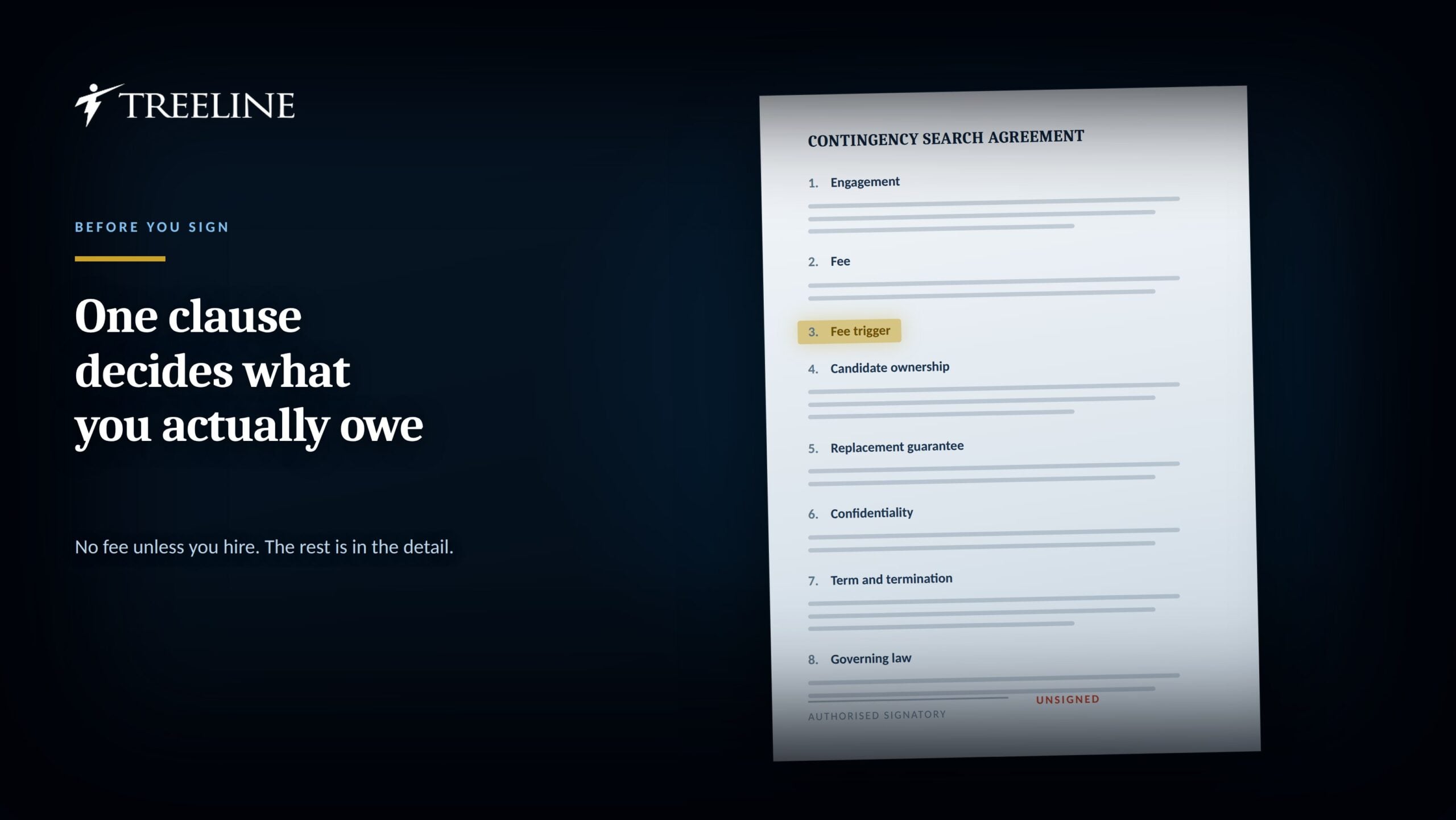
The fee trigger is a hire, not an introduction, not an interview, not an offer. If your process produces no hire, nothing is owed. If it produces a hire of someone the firm introduced, the fee is due on a defined event, usually the start date, sometimes the acceptance date, and the difference matters for cash flow.
The fee basis is a percentage of first-year compensation, with 25 percent a common standard for professional sales roles. Which components count is the part to pin down: base only, base plus target variable, or total including signing bonus and equity. On an enterprise sales role where variable is half the package, that definition changes the invoice materially.
Candidate ownership establishes that the firm introduced a particular person, and for how long that claim persists. Typically six to twelve months from introduction. This is the clause that causes the most disputes and the one employers read least carefully.
The replacement guarantee provides a remedy if the hire leaves within a defined window. Its headline length matters far less than its exclusions.
None of that describes the working method, the intake, mapping, screening and interview support that determine whether a search produces anything. Treeline sets out that sequence separately in its account of the contingency executive search process.
What Is a Contingency Hire Not Obligating Either Side to Do
This is where the arrangement differs most sharply from what employers assume, and being explicit about it prevents most disappointments.
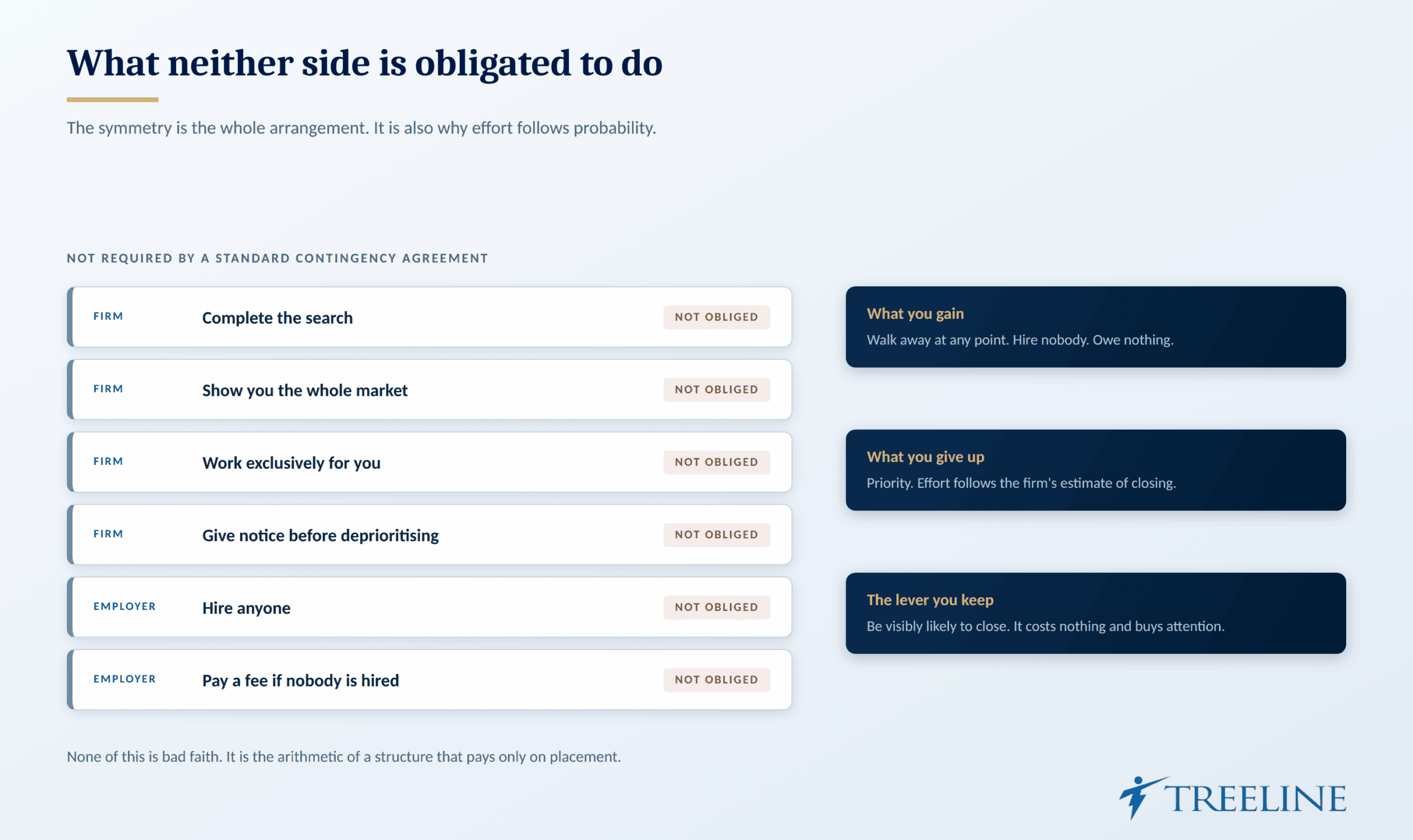
The firm is not obligated to complete the search. They can work it for three weeks, conclude it is unlikely to close, and quietly reallocate effort to another client. No notice is required and none is usually given. You will experience this as the search going quiet.
The firm is not obligated to show you everyone. There is no deliverable requiring a documented map of the qualified market, because nothing pays for producing one.
The firm is not obligated to work exclusively for you. Another client may be recruiting for a comparable role, and the same candidate may be presented to both.
And you are not obligated to hire. You can interview everyone submitted and hire nobody, and owe nothing. That is the transfer that makes the model attractive, and it is genuinely valuable when a requirement is uncertain.
What both sides gain from that symmetry is flexibility. What both sides lose is commitment, and the practical consequence is that effort follows probability on one side and attention follows urgency on the other.
Fantasia draws a line between a firm that declines a search and one that accepts it and does not work it. He regards the first as useful information and the second as the real risk in the model, which is why he suggests asking a prospective firm directly what would make them tell you no.
Where the Money Actually Sits in the Arrangement
It helps to see the arrangement from the firm’s side, because their economics explain most of what you will experience.
A contingency firm carries the entire cost of a search that does not close, recruiter hours, outreach, screening conversations, scheduling, and recovers nothing. Their business therefore runs on a portfolio: enough concurrent searches that the ones which close subsidise the ones which do not.
That has three consequences you will feel. Effort is allocated to searches most likely to close, so your position in that ranking determines how quickly your work gets done. A recruiter carrying a dozen live assignments will work the three with the clearest requirement, the most credible band and the fastest decision path. And a search that looks unwinnable is abandoned quietly rather than reported, because there is no contractual obligation to report it and no fee in saying so.
None of that is bad faith. It is the arithmetic of the structure, and an employer who understands it can use it deliberately, by being the client whose search visibly closes, which costs nothing and buys real attention.
Reading the Fee Trigger Properly
Three specifics inside the fee clause are worth establishing before signing, because each is a common source of a disputed invoice.
What compensation counts. Base, base plus on-target variable, or total including signing and equity. Ask for a worked example against your actual band rather than accepting a definition in the abstract.
When it becomes payable. On acceptance or on start date. For a candidate serving a long notice period the gap can be two months, and the firm’s preference is usually acceptance.
What happens if the hire never starts. A candidate who accepts and then withdraws before day one is a real scenario, and agreements differ on whether a fee is owed, refunded or credited.
A fourth is worth adding for sales specifically. If the role’s compensation is restructured after the offer, variable shifted to base, or a guarantee added for the ramp period, establish whether the fee recalculates.
When a Contingency Hire Is the Right Instrument
Framed as conditions rather than as a general recommendation, the model fits well when several of the following are true.
- The requirement is well understood. You can describe the deal shape, the buyer, and what the person must change. Firms work searches they can visualise.
- The band is authorised and realistic. Nothing kills a contingency search faster than a number that was aspirational.
- You can decide quickly. The model’s main advantage is speed, and a slow internal process forfeits it entirely.
- The role is not confidential. The current occupant knows, or the seat is genuinely open.
- A shortlist is sufficient. You need viable candidates, not a documented census of the market.
- The requirement may change. An uncertain role definition is cheaper to test here than under a retained fee.
- You are hiring more than once. Continuity compounds, and the second search with the same firm should be materially faster.
The strongest case combines the first three. An employer with a clear requirement, an honest band and a fast decision path gets more from this arrangement than from any other, because every one of those factors raises the firm’s estimate of closing and therefore the effort they allocate.
When a Contingency Hire Is the Wrong Instrument
The boundary matters more than the endorsement, and four conditions push decisively the other way.
Confidentiality. If the current occupant does not know they are being replaced, a non-exclusive arrangement is structurally unsuited to it. Several firms touching a small market will leak, and in enterprise sales the qualified population is small enough that the leak reaches the incumbent. The damage exceeds any saving. Treeline compares the two structures directly in contingency hire versus retained search.
You need the whole market documented. Where a board or an investor expects evidence that every credible candidate was considered, no contingency arrangement produces that, because nothing funds the documentation of people who were not converted.
The decision path is slow or undefined. If feedback takes a week and an approver appears late, the model underperforms for reasons unrelated to sourcing, and the firm will deprioritise you without saying so.
The requirement is genuinely unprecedented. A first-of-kind role needs definitional work before searching, and that work is not funded by a placement fee.
What Is a Contingency Hire Guarantee Actually Covering
Most agreements carry a replacement guarantee, commonly thirty to ninety days. The length is the least informative part of it.
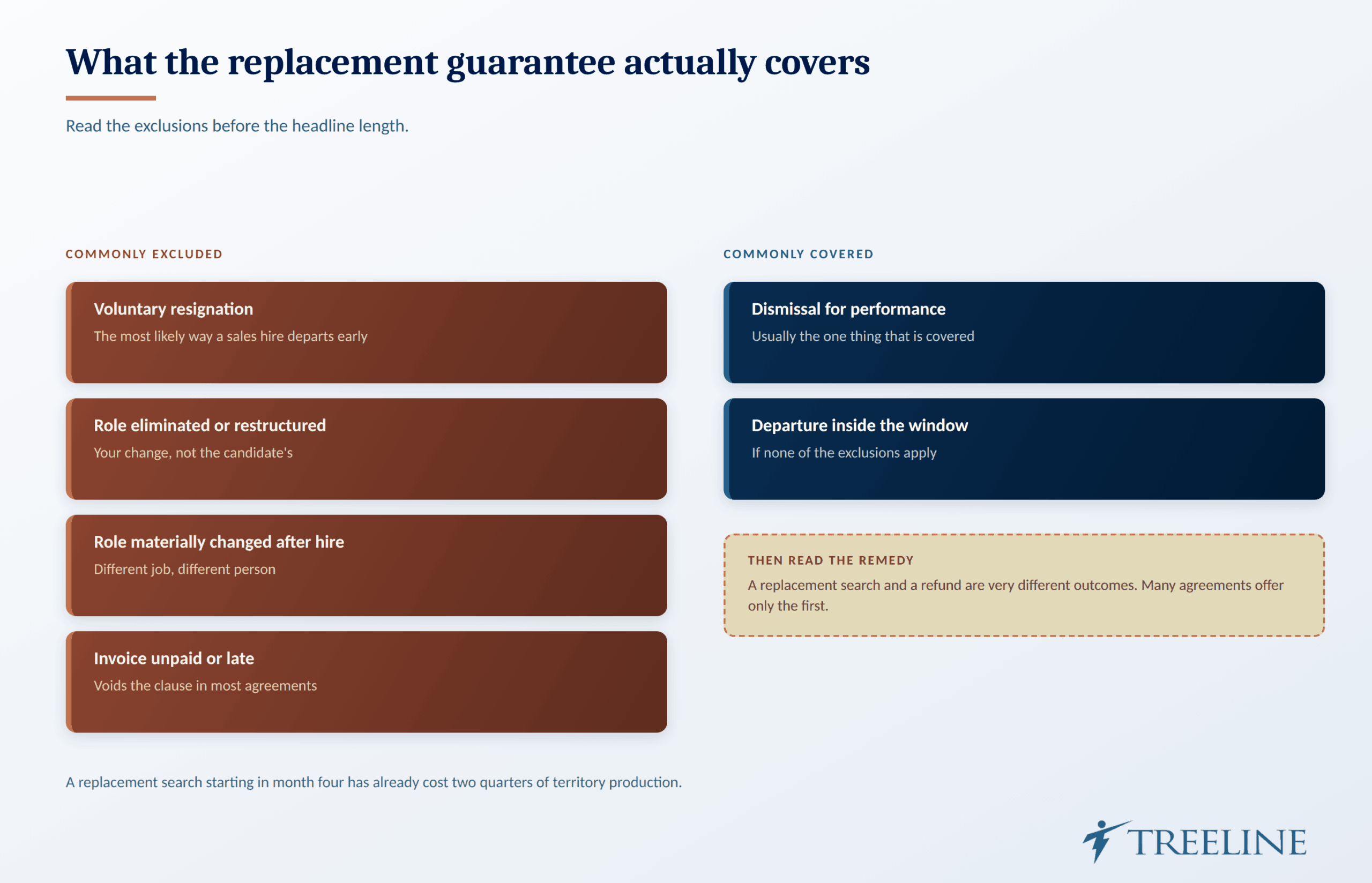
Read the exclusions first. Voluntary resignation is frequently carved out, which is the most likely way a sales hire departs early. Restructuring or elimination of the role is usually excluded. A role that changes materially after the hire often voids it. And an unpaid or late invoice will void it in most agreements.
Then read the remedy. A replacement search and a refund are very different outcomes, and many agreements offer only the first. A replacement search starting in month four has already cost two quarters of territory production that no remedy recovers.
Then read the conditions on the replacement itself. Some agreements limit it to one attempt, some require the same requirement and band, and some exclude it if the original search took longer than a defined period.
A guarantee is best read as a statement of the firm’s confidence rather than as protection. Asking how often it has been invoked, and what the firm concluded, is more informative than the clause itself.
The Candidate Ownership Clause
This is the term employers skim and later regret, and it deserves its own examination.
Ownership means the firm has established that it introduced a particular person to you, and that if you hire that person within a defined window, the fee is due, regardless of how the hire eventually happened.
Three scenarios recur. A candidate submitted and rejected applies directly nine months later; whether a fee is owed depends on the window. A candidate already in your applicant tracking system is submitted by the firm; whether prior contact defeats the claim depends on how introduction is defined. And a candidate is submitted by two firms within days of each other, which is common on narrow searches and is resolved by whichever agreement defines priority more clearly.
The clauses worth negotiating are the window length, what counts as an introduction, a résumé sent, or a conversation arranged, and a carve-out for candidates already in your pipeline with a documented prior date.
None of this is unusual to ask for, and a firm that resists specifying it is describing how the relationship will run.
Fantasia warns that ownership disputes almost always originate in the first week rather than at the point of hire. His practical suggestion is to acknowledge each submission in writing with a date, since a clear record at introduction removes the ambiguity that disputes depend on.
Why Non-Exclusivity Is Priced, Not Free
Employers read non-exclusivity as a feature they receive at no cost. It is more accurate to see it as something both sides pay for.
You gain the right to walk away, to engage others, and to hire nobody. The firm gains the right to reallocate effort without notice and to present the same candidate elsewhere. Those two are the same transaction seen from either side.
What it costs you is priority. A firm with exclusive access to a search has a materially higher expected return and will invest accordingly, more outreach, more persistence on hard-to-reach candidates, more willingness to spend a week on a single person. The same firm working non-exclusively will not, because the arithmetic does not support it.
That is why time-boxed exclusivity is worth considering on a genuinely difficult role. Thirty to sixty days of sole access changes the effort calculation without committing you to a retained fee, and if the firm does not deliver in that window you have learned something and are free.
The Interview Your Side Owes
Because the arrangement obliges the firm to nothing, the employer’s side of it carries more weight than the paperwork suggests.
Three commitments cost nothing and change the outcome materially. Return interview feedback within a business day or two, with a specific reason rather than a general impression. Hold interviewer availability while a search is live, so a strong candidate appearing on Monday can be seen that week. And settle the decision path before the search opens, including who approves and what happens when that person is away.
An employer who does those three becomes visibly likely to close, which moves them up the firm’s allocation ranking. An employer who does none of them will be worked when there is capacity, and will experience that as the market being difficult.
There is a fourth that is harder and worth doing: resolve the internal candidate question before the external search starts. An unresolved internal contender slows the process in ways candidates detect, and a firm that works out what is happening will reduce effort accordingly.
Multiple Firms on the Same Requirement
The non-exclusive nature of the arrangement invites employers to engage several firms, and on most sales roles this works against them.
On a narrow enterprise requirement the qualified population is small. Four firms working it will approach substantially the same people within the same fortnight, with four different descriptions of your company and four different characterisations of the compensation. The candidate concludes the company is struggling to hire and that the role is being shopped, and that impression persists into your next search.
There is also an effort effect. Each firm’s probability of being paid falls as the number of competitors rises, so each invests less. Four firms at reduced effort frequently produce less than one firm working properly.
The case where parallel firms do help is a broad requirement with genuine volume, several similar roles, a large qualified population, and no reputational risk from repeated approaches. That is a different situation from a single enterprise account executive search.
A middle option is worth knowing about: time-boxed exclusivity. Granting one firm sole access for thirty to sixty days raises the effort they will commit without committing you to a retained fee, and it gives you a clean basis for judging them.
What Changes Between the First Hire and the Third
The arrangement described here is the same on every engagement, but the experience of it should not be.
By the third search with the same firm, intake should take half as long because the deal shape, the buyer and the decision path are already understood. Submissions should stop missing on criteria explained during the first search. And the firm should occasionally bring you someone speculatively, a strong candidate who has become available for a role you have not opened.
That last behaviour is the clearest signal that the relationship has moved beyond transactional, and it only appears when a firm expects continuity. It is also the main argument against rotating firms for a marginally better percentage: the accumulated context is invisible on an invoice while the discount is not.
The honest counterpart is that if none of this has happened by the third engagement, it will not happen later, and that is a reason to change firms rather than to persevere.
What This Costs Beyond the Fee
The fee is the visible number and frequently not the largest one, and a sensible comparison accounts for both.
The vacancy is the first. For a quota-carrying enterprise seat, the annual number divided across the year and multiplied by the months the seat stays open produces a figure that usually dwarfs the placement fee. Colleagues absorb less of an open territory than employers assume, because they protect their own numbers first.
Internal time is the second. Every candidate reaching a hiring manager consumes the most expensive calendar in the sales organisation. A firm submitting fifteen people has transferred its filtering work onto your team while still charging a placement fee, and that transfer is invisible in any cost comparison based on the fee alone.
The mis-hire is the third and largest. A seller who leaves at month ten has consumed the vacancy cost twice, plus the ramp investment, plus whatever happened to the accounts in between.
There is a fourth that employers almost never count: the cost of the search that did not close. Internal time was still spent, intake conversations, résumé review, first-round interviews, and produced nothing. Under this arrangement no fee is owed, which is the point of the model, but the hours are gone either way. Running two unsuccessful searches before a successful one means the real cost of the eventual hire includes all three.
Set against those three, negotiating a point or two off the percentage is rarely where the value sits. The larger lever is how much filtering the firm does before anyone reaches your calendar.
What Happens When the Search Produces Nobody
The scenario the arrangement is built around deserves its own treatment, because it is more common than employers expect and the aftermath is where the relationship is decided.
A search closes without a hire for one of four reasons. The qualified population at that band genuinely does not contain someone available, a market answer. The requirement described two jobs and no single person fits, a definition answer. The process moved too slowly and the candidates who were interested went elsewhere, a process answer. Or the firm never really worked it, an effort answer.
Those four have completely different remedies, and the useful thing to extract from a failed search is which one applied. A market answer means changing the band or the geography. A definition answer means splitting the role. A process answer means fixing your own calendar before engaging anyone again. An effort answer means changing firms. Treating all four as the same outcome, the search failed, try someone else, guarantees repeating whichever one actually occurred. A firm worth keeping will tell you, including when the answer implicates them. A firm that attributes every failure to a tough market is protecting the relationship rather than informing it.
The employer’s obligation here is to ask before re-engaging. Running the same requirement again with a different firm, without establishing why the first attempt failed, reproduces the failure at the cost of another two months.
There is one outcome worth naming separately. Occasionally the honest conclusion is that the role should not be filled externally at all, that the right answer is an internal promotion with support, or a restructure that removes the need. A firm paid only on external placement has no incentive to say that, which is exactly why it is worth asking directly.
How a Contingency Hire Differs From Staffing and RPO
Employers occasionally conflate three arrangements that behave differently, and the distinction affects what you should expect.
Contingency search places a permanent employee, is paid on placement as a percentage of first-year compensation, and is non-exclusive. The firm carries the risk that no hire results.
Staffing or contract placement supplies a worker who remains on the agency’s payroll, billed hourly with a margin. Useful for temporary capacity; not a route to a permanent enterprise seller.
Recruitment process outsourcing contracts a provider to run part or all of your hiring function, typically paid a fixed or per-hire fee under a longer agreement. It suits volume and consistency rather than a single difficult search.
The practical marker: contingency is transactional and risk-shifted, RPO is operational and committed, staffing is a different product entirely. An employer wanting one and buying another is usually disappointed for structural reasons rather than because the provider underperformed.
What Employers Get Wrong When They Ask What Is a Contingency Hire
Four misconceptions recur and each has a cost.
The first is treating “no fee unless you hire” as meaning “no cost unless you hire”. Internal time is spent either way, and a poorly filtered search spends a great deal of it.
The second is assuming non-exclusivity is free. It lowers the firm’s expected return and therefore their effort, which is a real price paid in attention rather than in currency.
The third is reading the guarantee as insurance. It caps a fee, not a loss, and the loss is mostly in lost territory production.
The fourth is expecting market coverage. A shortlist is the deliverable. Employers who wanted a census and received a shortlist conclude the firm underperformed when the firm delivered exactly what the arrangement funds.
Fantasia’s test for whether an employer is matched to the model is whether they can say what they would do if the search produced nobody. He observes that employers with a clear answer use the arrangement well, while those without one usually needed the commitment of a retained structure and had not recognised it.
Negotiating Terms Without Negotiating the Fee
Most employers put their negotiating energy into the percentage, which is the least useful variable in the agreement.
A point off the fee on a single hire is a modest saving. Meanwhile the terms that actually affect outcome and risk are usually accepted as presented: the compensation definition the percentage applies to, the ownership window, the guarantee exclusions, and whether a named person runs the search.
Several of those are more valuable than the discount. Narrowing the fee basis from total compensation to base plus target variable can exceed a two-point reduction on an enterprise package. Shortening the ownership window from twelve months to six removes a real future liability. Adding a carve-out for candidates already in your pipeline prevents the most common dispute outright.
Firms will generally move on terms more readily than on rate, because rate sets a precedent across their client base and terms do not. That asymmetry is worth using.
One caution: pushing the fee down materially on a difficult search is counterproductive. It lowers the firm’s expected return, which lowers effort, on the one assignment where effort matters most.
What to Establish Before You Sign
A short list, none of it unusual, and all of it cheaper to settle now than to dispute later.
- The fee percentage and exactly which compensation it applies to, with a worked example against your band.
- When the fee becomes payable, and what happens if the hire never starts.
- The candidate ownership window, what counts as an introduction, and a carve-out for candidates already in your pipeline.
- The guarantee’s exclusions and remedy, in that order.
- Who runs the search by name, and how many other assignments they carry.
- What is screened before submission, expressed as specific disqualifiers.
- Whether you are engaging one firm or several, decided deliberately rather than by drift.
An employer who arrives with that list changes the character of the engagement immediately, because it signals that the terms will be read rather than filed.
A Worked Comparison of the Two Structures
Setting the arrangements side by side on the same requirement makes the choice concrete. This is an illustration rather than data from specific engagements.
Take a single enterprise account executive seat, not confidential, with a settled requirement and a hiring manager who can meet candidates within a week.
Under a contingency arrangement, the firm begins immediately, works the search alongside others, and submits a small number of screened candidates. If nobody is hired, the employer has spent internal hours and no fee. If someone is hired, the fee is a percentage of first-year compensation payable on start. The employer carries the risk that effort is reallocated if the search looks difficult.
Under a retained arrangement on the same seat, the firm is paid in instalments regardless of outcome, commits to completing the search, and produces a documented view of the market including the people who declined and why. The employer carries the risk of paying for a search that does not close, and gains certainty that it will be worked to completion.
On this particular seat, clear requirement, open role, fast decisions, the contingency structure is the better instrument, because the main thing the retained fee buys is commitment on a search that is already likely to close.
Change one variable and the answer flips. Make the role confidential, and the non-exclusive structure becomes actively harmful. Make the decision path slow, and the contingency firm quietly deprioritises. The structure does not have a general answer; it has an answer per situation.
What Good Looks Like Three Weeks In
Because nothing in the agreement obliges the firm to report, the employer has to look for the signals themselves. Three weeks is early enough to act.
Has the firm told you something you did not want to hear? A partner three weeks into a real search has formed a view about the band, the scope or the decision path. Silence on all three usually means the search is not being worked.
Are submissions converging? Each round should visibly narrow against your feedback. If the fourth candidate repeats the first one’s defect, either the feedback lacked specificity or it is not reaching the person sourcing.
Do you know why people declined? Declines contain information about your band, your positioning and your reputation in the market, and they arrive long before any hire does. A firm that reports only progress is withholding the most useful output it has.
Is the person you met still running it? Handover mid-search without notice is common under this structure precisely because nothing prohibits it, and it effectively restarts the assignment.
Four honest answers at week three are worth more than any status report, and there is still time to fix what they surface.
What Is a Contingency Hire Worth Testing Against: A Short Decision Rule
If the requirement is clear, the band is honest, the decision path is fast and the role is not confidential, a contingency hire is very likely the right instrument, and the remaining question is which firm rather than which model.
If the role must stay confidential, or you need the market documented, or your internal process cannot move within days, the model will underperform regardless of the firm, and a retained or hybrid structure is the better fit.
If the requirement itself is unclear, neither model fixes that. Define the role first; the search is cheaper and faster afterwards under either arrangement.
Frequently Asked Questions
What is a contingency hire in simple terms?
A permanent placement made under an arrangement where the search firm is paid only if you hire someone they introduced. No retainer, no instalments, and no fee if the search produces nobody. The fee is a percentage of first-year compensation, commonly 25 percent for professional sales roles.
What is a contingency hire not obligated to include?
The firm is not obligated to complete the search, to show you the whole market, or to work exclusively for you. You are not obligated to hire. That symmetry is what makes the arrangement flexible and also what means effort follows the firm’s estimate of closing.
How is the fee calculated?
As a percentage of first-year compensation, but which components count varies, base only, base plus target variable, or total including signing and equity. On an enterprise sales role where variable is a large share of the package, that definition materially changes the invoice. Ask for a worked example against your actual band.
What does the replacement guarantee actually cover?
Less than employers expect. Voluntary resignation is frequently excluded, which is the most likely way a sales hire departs early, and so are restructuring and a materially changed role. The remedy is often a replacement search rather than a refund. Read the exclusions before the headline length.
Should we engage several firms at once?
Rarely on a narrow enterprise role. The same small population receives multiple approaches with inconsistent descriptions of your company, and each firm invests less as its odds of payment fall. Parallel firms suit broad requirements with real volume. Time-boxed exclusivity is a useful middle option.
When is a contingency hire the wrong choice?
When the search must stay confidential, when you need a documented view of the entire market, when your decision path cannot move within days, or when the requirement is genuinely unprecedented and needs definitional work first.
What is candidate ownership and why does it matter?
It establishes that the firm introduced a particular person and for how long the claim persists, usually six to twelve months. It is the clause that generates the most disputes. Negotiate the window, what counts as an introduction, and a carve-out for candidates already in your pipeline with a documented prior date.
Is the fee the main cost of a hire?
Usually not. Vacancy cost on a quota-carrying seat typically exceeds it, internal interview time is substantial and invisible, and a mis-hire costs more than both combined. The larger lever is how much filtering the firm does before candidates reach your calendar.
Work Out Which Instrument Fits Before You Engage Anyone
Treeline, Inc. is a sales-only executive search firm based in Wakefield, Massachusetts, working exclusively on building sales organizations. Our contingency sales recruiting service carries no upfront cost and no fee unless you hire, and we deliver your first candidate within three days of launching a search.
If you are weighing the arrangement for an upcoming role, the useful first conversation is about confidentiality, decision speed and how settled the requirement is. Get in touch and we will tell you plainly if a different structure suits it better.
Share This Story, Choose Your Platform!
Related Posts


What our happy clients are saying
Treeline Inc. provided us with the most candidates that aligned with our needs and were of the highest quality.

Dr. Jeffrey Klein Head of North America Sales, Satchel Pulse
Treeline Inc.’s collaborative, flexible, and communicative approach resulted in a smooth partnership. Beyond their recruitment expertise, their unique sourcing model was efficient and effective.

Sera Holt Director of Operations, LNS Research
Their professionalism was outstanding. Treeline Inc. was extremely thorough and ensured that we were on the same page before they started looking for candidates. They listened to us and did a great job working with the candidate to close out the process.

Cate Grant AVP Customer Success, Nasdaq
Thanks to Treeline Inc.’s intricate and thorough screening process, the company is able to hire six high-quality candidates that fit perfectly in the company’s culture. The team is highly receptive to concerns, and internal stakeholders are impressed with their unique recruitment abilities.

Anna McKean Sales Recruiter, Insider Intelligence
Treeline Inc. has been qualified individuals throughout a five-year-long engagement. They’ve made numerous placements of talented and qualified individuals for our business.

Michele St Laurent VP of HR, The Institute for Applied Network Security

Let Us Help You Source the Sales Talent You Need
Whether you’re building a team or replacing a key role, our Candidate Sourcing Platform provides a fast, flexible, and employer-focused solution.
Tell us more about your business and how we can help.
Treeline Inc.
Your Award-Winning Sales Recruitment Partner
15 Lincoln Street, Suite 314, Wakefield, MA 01880