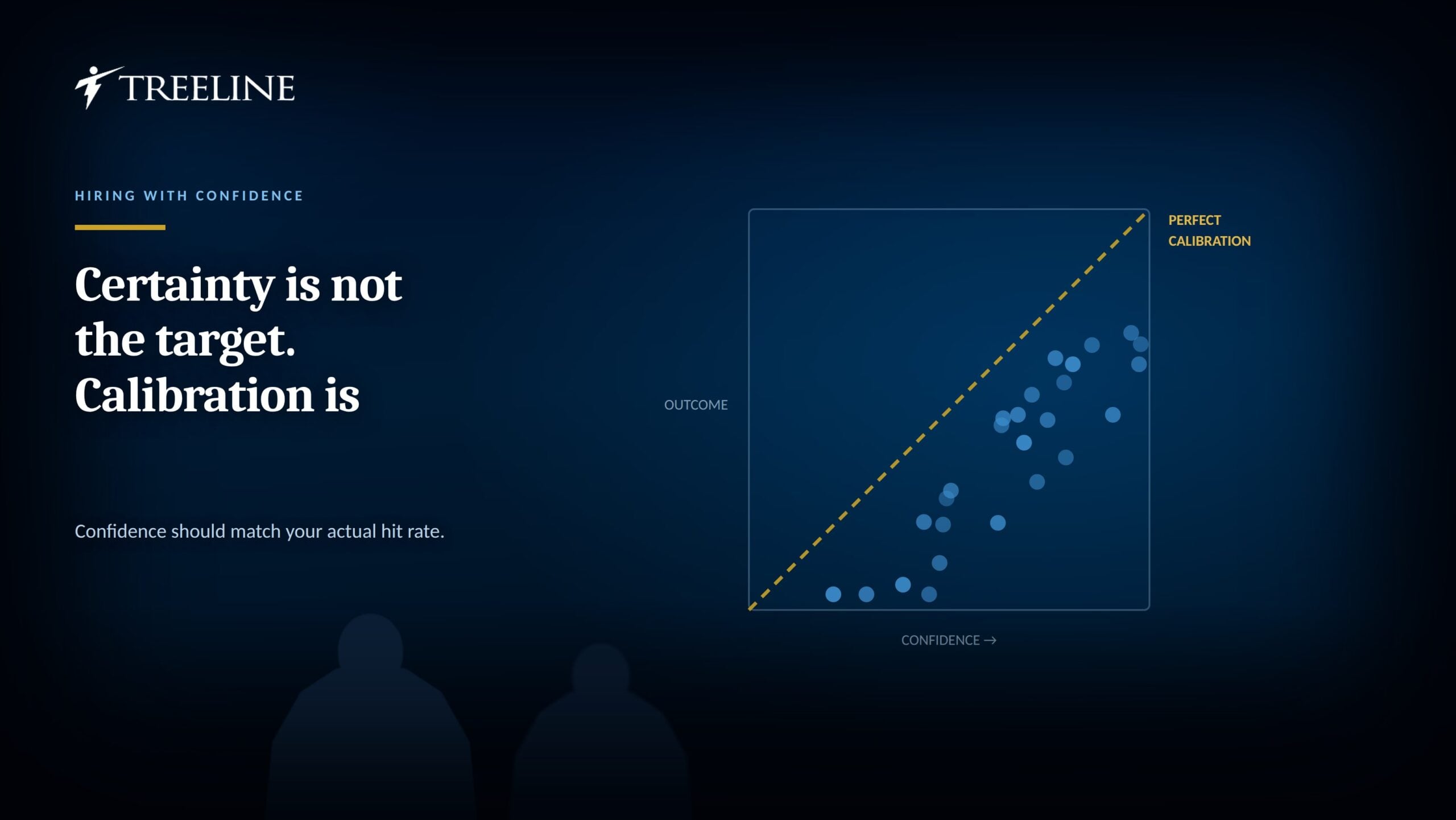
Confidence in hiring is usually treated as a feeling to be maximised, and that is the wrong objective. The useful goal is calibration, confidence that matches your actual hit rate. This is the part a contingency recruiting agency is best placed to help with, and the part most often mis-sold. A team that feels certain about every hire and is right two-thirds of the time is badly calibrated, and so is a team that agonises over decisions it consistently gets right. Both cost money, in opposite ways.
There is an established distinction that makes the failure precise. The U.S. Department of the Interior’s Assessment Practices Guide sets out that any assessment tool used to select employees must be both reliable and valid, and defines reliability as consistency, the same applicant producing consistent scores across multiple administrations. Validity is a separate property: whether the thing being measured is the thing that predicts performance. A hiring process can be highly reliable and entirely invalid. Four interviewers who agree completely have demonstrated consistency, and consistency is what most hiring teams mistake for confidence.
Agreement Is Not Accuracy
The mechanism is worth spelling out because it operates invisibly and it feels like rigour.
Four people interview a candidate in similar formats, asking similar questions, forming impressions from the same performance. They reconvene and agree. The organisation reads that agreement as four independent confirmations, when it is closer to one observation repeated four times. Nothing was triangulated, and the shared conclusion may be shared because the shared method has a shared blind spot.
Sales hiring has a specific version of this. Interviewing well is a genuine skill, and it is a skill sales professionals train. A candidate who presents fluently, builds rapport quickly and handles objections smoothly will impress every interviewer, consistently, whether or not they can run a nine-month enterprise deal. The process is highly reliable at detecting presentation quality. It is not measuring what the job requires.
Calibration means noticing the difference. A team confident because everyone agreed has confidence in its consistency. A team confident because it has checked its past predictions against what actually happened has confidence in its accuracy, and only the second kind is worth acting on.
Where Confidence Comes From, and Which Sources Are Sound
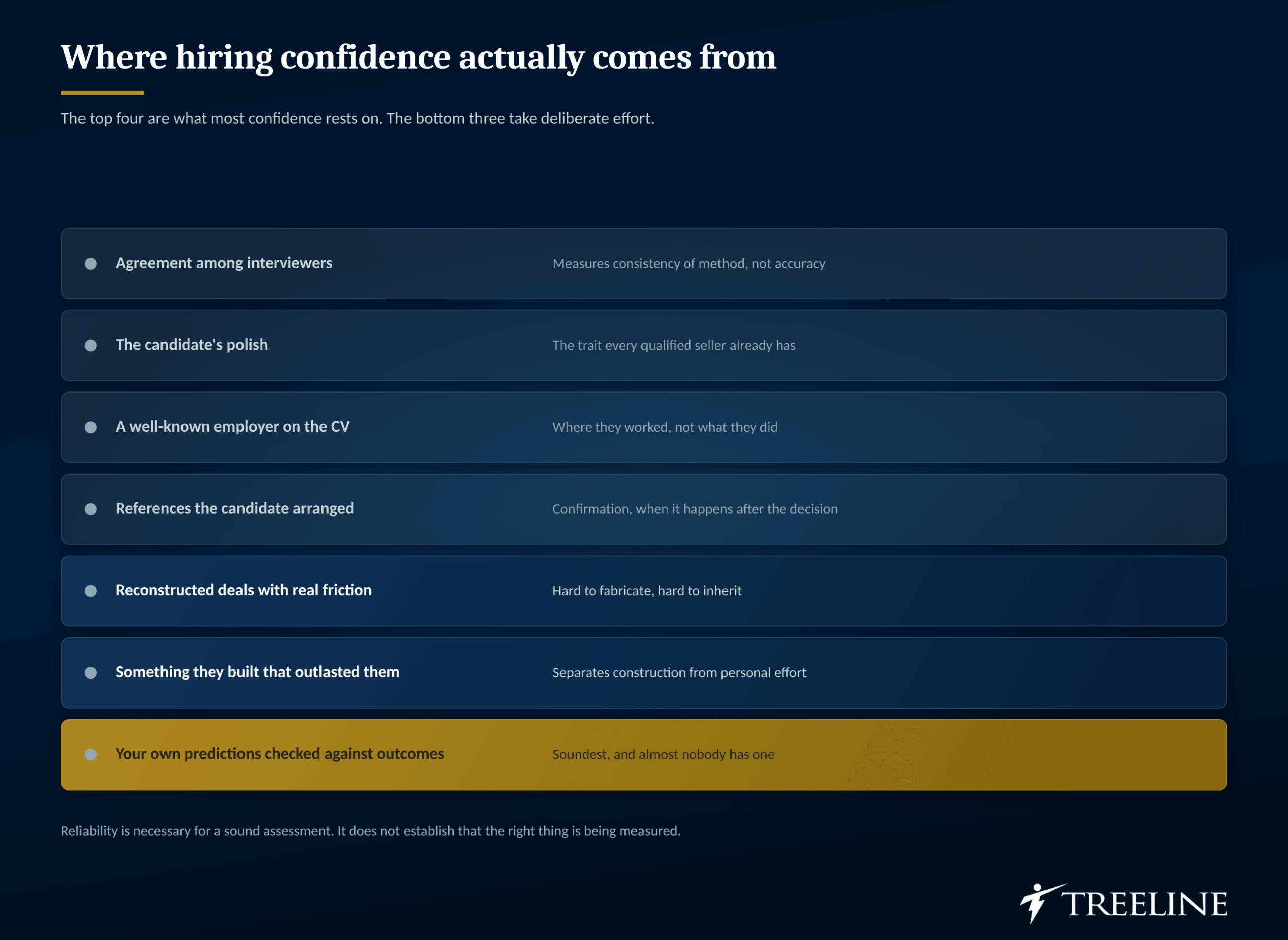
Not all confidence is unfounded, and separating the sources is the practical work. Ranked from weakest to soundest, they look like this.
- Agreement among interviewers. Weakest source. Measures consistency of method, not accuracy.
- The candidate’s polish. Actively misleading for sales roles, since it is the trait most correlated with interview performance and least with deal execution.
- A well-known employer on the résumé. Borrowed credibility. Tells you where someone worked, not what they did there.
- Reference conversations arranged by the candidate. Confirmation rather than assessment when they happen after the decision.
- Reconstructed deals with specific friction. Sound. Hard to fabricate and hard to inherit.
- Evidence that something they built outlasted them. Sound. Distinguishes construction from personal effort.
- A track record of your own predictions checked against outcomes. Soundest, and almost nobody has one.
The list is uncomfortable because the first four are what most hiring confidence actually rests on, and the last three take deliberate effort to produce.
There is a further reason worth naming, which is that the weak sources are socially easier. Agreement in a room is pleasant; disagreement requires someone to hold a position against colleagues. A process that rewards consensus will produce consensus, and the organisation will experience that as alignment rather than as information loss.
Why the Weak Sources Dominate
If the sound sources of confidence are known, the obvious question is why hiring teams keep relying on the weak ones. The answer is structural rather than careless.
The weak sources are available immediately and require no preparation. An impression forms during a conversation; a base rate has to be constructed from records nobody kept. Agreement emerges from a meeting already scheduled; a track record of predictions requires somebody to have written something down a year ago and to be willing to read it back.
The weak sources also feel like more evidence than they are. Four interviewers is four times the input, which is intuitively persuasive and statistically misleading when all four looked at the same thing in the same way. The intuition that more observers means more information is correct only when the observations are independent, and interview panels are usually designed to make them dependent, same résumé, same brief, same format, often the same day.
And the weak sources carry no discomfort. Reading back a confident prediction that turned out wrong is unpleasant, and organisations quietly stop doing things that produce that experience. This is the most common reason calibration records get started and abandoned.
Recognising this changes what to do about it. The remedy is not to try harder at judgment, which is where most hiring improvement effort goes. It is to make the sound sources as cheap and automatic as the weak ones, which is a process problem with a small fixed cost.
Fantasia holds that hiring teams improve faster from writing things down than from any change to how they interview. His reasoning is that judgment cannot improve without feedback, and an organisation that keeps no record of what it predicted has arranged for the feedback never to arrive.
Overconfidence and underconfidence both misprice risk, and the remedies are opposite, so diagnosing which one you have matters.
The Two Failure Modes Cost Differently
Overconfident teams shorten processes, skip verification, and treat a strong impression as sufficient. The cost arrives eleven months later as a performance conversation, and it is expensive: a vacant territory twice over, a ramp investment written off, and accounts handled poorly in between.
Underconfident teams add interview rounds, request more candidates, and defer decisions. The cost arrives immediately and is easier to miss because it looks like diligence. Strong candidates withdraw, the process signals indecision to a market that talks, and the eventual hire is often the person who was still available rather than the person who was best.
Both are calibration failures rather than character flaws, and both are fixable with the same instrument: a record of what you predicted and what happened.
Fantasia sets the diagnostic as a question about direction rather than degree. His suggestion is to look at the last four hires and ask whether the ones that worked were the ones the group felt most certain about, because a team whose certainty does not correlate with outcomes is not measuring anything.
What a Contingency Recruiting Agency Can and Cannot Supply
Being precise here matters, since the general claim that a partner brings confidence is exactly the unfalsifiable language worth avoiding.
Contingency recruiters can supply comparison. Running many similar searches produces a base rate, what a band actually buys, how often a profile like this succeeds, which characteristics predicted failure at other companies. A single employer hiring once or twice a year cannot construct that, and without a base rate there is nothing to calibrate against.
Contingency search firms can supply disconfirming effort. Asked to look for reasons a leading candidate is wrong, an external party can do it without appearing disloyal to the hiring manager who championed them.
A firm can supply the awkward observation. Telling a company that its process is measuring polish, or that its band is short, or that its requirement describes two roles, is straightforward for an outsider and career-limiting for an insider.
What a firm cannot supply is the decision. Nor can it supply calibration on your behalf, that requires your own record of predictions and outcomes, which nobody else can keep for you. A partner that claims otherwise is selling certainty, which is the thing this article argues against.
Confidence About Compensation and Timing
Calibration is usually discussed in terms of candidate quality, but two other judgments carry as much weight and are checked even less often.
The first is the band. Most companies are more confident about what a role should pay than the evidence supports, because the figure was inherited from the last person in the seat or from a national benchmark that averages every industry together. The check is straightforward: what did the last three candidates who declined say about money, and what did the eventual hire actually accept relative to the original range. Two or three consistent data points are worth more than any survey, and most organisations have them and have never assembled them.
The second is timing. Employers routinely predict that a search will take a certain number of weeks and are routinely wrong in the same direction. The interesting part is that the error is usually internal rather than market-driven, the delay sat in scheduling and decision-making, not in sourcing. A team that has recorded where the days actually went on the last two searches will forecast the next one far better, and will also know which intervals are worth attacking.
Both of these have the same character as the candidate question. The information required already exists inside the organisation; nobody has written it down in a form that permits a comparison. Fifteen minutes after each search produces a record that improves every subsequent one.
There is a partner dimension here as well. A firm working your market continuously has a base rate on both, what bands are closing at, and how long comparable searches take, and it is worth asking for both explicitly rather than accepting a general assurance that the market is competitive.
Building the Record That Makes Confidence Meaningful
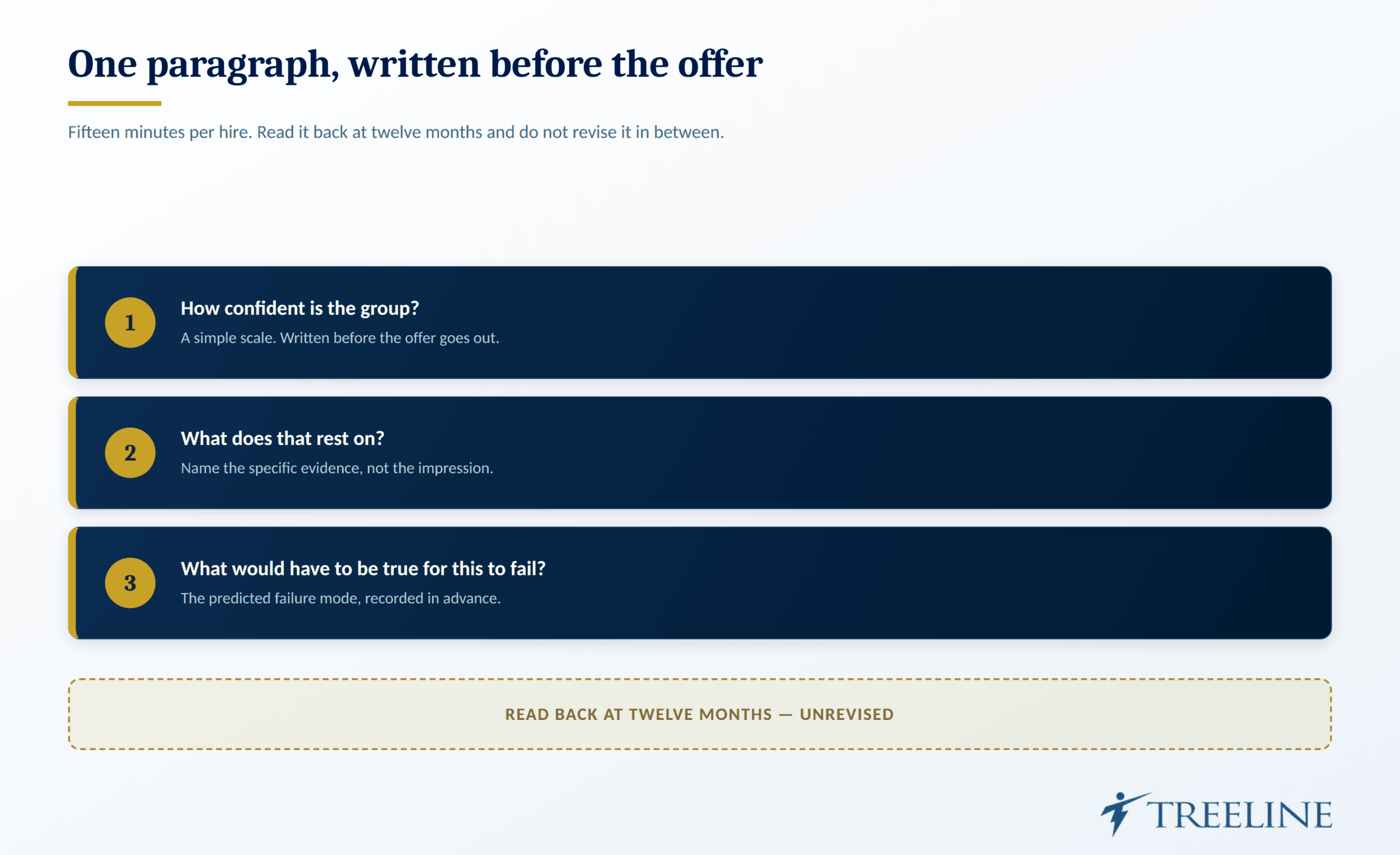
The instrument is simple enough that its rarity is surprising, and it costs about fifteen minutes per hire. Three fields do the whole job.
Before extending an offer, write down three things: how confident the group is on a simple scale, what specifically the confidence rests on, and what would have to be true for this hire to fail. One paragraph is enough. Seal it, in the sense of not revising it later.
At twelve months, read it back. The questions are whether the confidence was warranted, whether the stated basis turned out to be the thing that mattered, and whether the predicted failure mode was the one that materialised or something nobody named.
After four or five hires a pattern appears, and it is usually specific rather than general. Some teams discover that their confidence is highest for candidates from large organisations and that those hires underperform. Some discover the opposite. Some find that the concern they raised and dismissed is the one that recurs. None of that is knowable without the record, and all of it is actionable once it exists.
The reason this is rare is not difficulty. It is that reading back a confident prediction that turned out wrong is uncomfortable, and organisations quietly avoid instruments that produce that experience.
What the Employer Brings to the Assessment
A calibrated process is not something a firm installs. Several of its components sit entirely inside the company, and naming them prevents the expectation that a partner can deliver the whole thing.
- A written statement of what the role must change, agreed before candidates appear, so that assessments have a shared target.
- One competency per interviewer, assigned in advance rather than left to emerge.
- Ratings submitted before the debrief, which is the cheapest way to preserve independent judgment.
- A named person whose job is to argue against the leading candidate, with standing to do it.
- A recorded prediction at offer stage, including what would have to be true for the hire to fail.
- A rejection reason recorded for every final-stage decline, since that half is where the pattern usually hides.
- A twelve-month read-back, scheduled at the time of hire rather than remembered later.
None of these requires software, additional headcount, or a longer process. Most of them shorten it, because a team that knows what it is assessing stops adding rounds to compensate for not knowing.
The reason to list them explicitly is that an employer who supplies these gets materially better work from the same partner than one who does not. The firm’s contribution is comparison, disconfirmation and honest early signal; the decision architecture is yours, and no engagement fixes a process that has none.
Where the Gap Is Widest: Enterprise Sellers
The general argument becomes concrete on this role, where the gap between what impresses and what predicts is at its widest.
An enterprise account executive candidate is a professional communicator selling the most familiar product they have. They will be articulate about their wins, comfortable under questioning, and skilled at establishing rapport with each interviewer. Every one of those traits is real, useful in the job, and almost useless as a differentiator, because the entire qualified population has them.
Confidence built on those impressions is therefore confidence in something that does not vary across candidates. What varies is whether they personally ran the deals they describe, whether they can operate without the support structure they had, and whether the buyer they are credible with resembles yours.
Two things narrow the gap in practice. Reconstructing a specific lost deal in detail produces friction that cannot be rehearsed, since candidates prepare their wins and rarely prepare their losses. And asking what they expect to be unable to reproduce in your environment separates those who have thought seriously about the move from those who are simply interested in it.
A useful discipline is to write down, before the final conversation, what would change the group’s mind. If nothing would, the process has stopped assessing and started confirming, and the confidence it produces is not information.
What the Search Partner Should Be Asked to Contribute
Given the division above, there are specific things worth asking a partner to supply, and they are more concrete than most engagements request.
Ask for the base rate on your profile. How many comparable searches have they run in the past year, how many closed, and what characterised the ones that did not. This is a number they either have or do not, and the answer is informative either way.
Ask what they expect you to get wrong. A firm that has watched many companies assess the same role has seen the common errors, and for sales roles the answer is usually some version of over-weighting presentation.
Ask them to argue against the leading candidate at final stage. This is an unusual request and an easy one to grant, and it produces information a hiring manager who championed the candidate cannot generate themselves.
Ask what they would need to see to be confident. Their answer reveals whether they assess against evidence or against impression, and it can be compared with your own list before either party has met a candidate.
None of these takes long, and all four move the engagement from supplying candidates toward supplying the inputs to a better decision, which is the part an employer cannot construct alone.
Calibrating the Requirement, Not Just the Candidate
Confidence about a candidate rests on confidence about the role, and the second is examined far less often.
Most requirements contain a mixture of things that genuinely predict and things that were inherited from the last job description. Years of experience, a named industry, a familiar employer, a particular tool, each narrows the population and few of them earn their place. A requirement nobody has audited produces a shortlist that looks reassuring and may be selecting on the wrong variables entirely.
The audit is quick. For each criterion, ask what would go wrong without it and roughly what share of the qualified population it removes. Criteria that remove a lot and cannot answer the first question are preferences, and preferences should not be used to reject.
This is also where an outside view is most useful, because contingency executive recruiters running similar searches can say which criteria correlate with success in comparable companies and which are simply conventional. That is a base rate applied to the requirement rather than to the candidate, and it is available for the cost of asking.
Making Interviewer Observations Independent
Since the core failure is dependent observations mistaken for independent ones, the practical fix is to make them genuinely independent, which is cheaper than it sounds.
Assign each interviewer a distinct competency rather than an overall verdict. One person tests deal ownership, another tests how the candidate handles a stalled process, another tests whether they can operate without the support they previously had. Four assessments of four things are worth considerably more than four assessments of one thing.
Vary the format, not just the questions. A conversation, a reconstruction exercise, and a written response to real material sample different capabilities. A candidate who performs consistently across three formats has told you something; a candidate who performs consistently across three conversations has told you they are good at conversations.
Collect ratings before anyone speaks. This is the single highest-return change available and costs nothing: a short written rating submitted in advance preserves the independence that a debrief otherwise destroys within the first two minutes.
And in the discussion, treat disagreement as the most valuable output rather than a problem to resolve. When two interviewers who assessed different things reach different conclusions, that gap contains real information, and averaging it away discards the only genuinely independent signal the process produced.
A caution about how far to take this. Independence has a limit: interviewers still need a shared understanding of what the role requires, or the four assessments measure four things nobody agreed were important. Independence of observation, shared definition of the target.
Confidence in the Decision to Decline
Calibration applies in both directions, and the decision not to hire deserves the same scrutiny as the decision to proceed.
Declining a finalist is easier than hiring one, carries no visible cost, and is therefore under-examined. A team that rejects on a vague sense of fit has made a decision it cannot review later, because nothing was written down that could be checked.
The remedy is symmetrical with the one above. Record the specific reason for each rejection at final stage. Over several searches the pattern becomes visible, and it is frequently uncomfortable, candidates rejected for a reason that later proves irrelevant, or a criterion applied to some finalists and not others.
There is a particular version worth naming. Rejecting every candidate because none is perfect is not a high standard; it is usually an unresolved disagreement about what the role requires, expressed as candidate assessment. When a third consecutive shortlist is declined, the productive conversation is about the requirement rather than about the people.
There is a third cost that belongs to neither category, and it lands on candidates. A poorly calibrated process is experienced from the outside as arbitrary, strong people rejected without a reason they can understand, weaker ones advanced past them. In a small market where the qualified population talks to each other, that impression persists well beyond the individual search, and it is paid for by whoever runs the next one.
The Cost of Being Wrong in Each Direction
Calibration is ultimately an economic question, and putting rough figures against each failure clarifies which one to worry about in your situation.
An overconfident mis-hire on an enterprise account executive costs the vacancy twice, once before the person arrived and again while they underperformed, plus the ramp investment, the management attention, and whatever happened to the accounts in between. It surfaces late, typically as a performance conversation somewhere around month ten, by which point a year of territory production has gone.
An underconfident process costs differently. The direct loss is the candidates who withdrew during the additional rounds, and those are disproportionately the strong ones, since they have alternatives. The indirect loss is reputational in a small market: a process that visibly cannot decide is described to peers, and the next search starts from a worse position.
Which dominates depends on your situation. A company hiring one enterprise seller a year should worry more about the mis-hire, since a single bad outcome is a large share of the year. A company hiring six should worry more about the slow process, because the cumulative loss of strong candidates across six searches outweighs any individual mistake.
That is a useful conclusion because it means the right amount of caution is not a fixed quantity. It depends on volume, on how quickly a mistake would be detected, and on whether the market you recruit from is one where your reputation compounds.
Where Confidence Should Be Low and Usually Is Not
Some situations warrant more uncertainty than teams typically feel, and recognising them is part of calibration.
A first-of-kind hire is a prediction about a role nobody in the organisation has observed. Confidence should be lower than for a replacement, and it usually is not, because the excitement of a new capability substitutes for evidence.
A candidate moving between very different company sizes is making a transition that fails often and for reasons that are hard to detect in interview. The support structure they relied on may be invisible to them.
A hire made under time pressure at the end of a long search carries the accumulated fatigue of the process. Confidence at that point is frequently relief rather than judgment.
And a candidate who resembles a previous successful hire triggers pattern-matching that feels like evidence. The resemblance may be to characteristics that had nothing to do with the earlier success.
A Common Objection
The reasonable challenge to all of this is that hiring volumes are too small for any of it to be statistically meaningful, and the objection has force.
Four or five hires a year is a tiny sample. Any pattern drawn from it could be noise, and a team that over-interprets five data points may end up more confidently wrong than before. That is a genuine risk and worth acknowledging rather than dismissing.
Two things answer it. First, the exercise is not primarily statistical. Writing down what you expect and reading it back changes behaviour even when the sample is too small to support a conclusion, because it forces the basis of a judgment to be stated explicitly at the moment it is made. A prediction that cannot be articulated is usually a prediction that will not survive examination.
Second, small samples are exactly the argument for using an external base rate alongside your own. A firm running thirty comparable searches a year has the volume a single employer lacks. Combining a small internal record with a larger external one is more informative than either alone, and it is the specific reason to ask a partner for their numbers rather than their assurances.
The honest limit is that neither produces certainty, and a process claiming to should be treated with suspicion. What they produce is a better-founded estimate, which is all calibration ever offers.
One Habit Worth Keeping Between Searches
Everything above assumes a search is underway. The habit that compounds fastest, though, operates between them.
After each hire, spend fifteen minutes recording four things: what the requirement turned out to actually need, which candidates were strong but unavailable and why, what the declines said about your positioning, and where the days went. Store it somewhere the next search will find it.
The value shows up on the second and third searches rather than the first. A team that opens a new requisition with the previous search’s record in front of them starts from a position no amount of effort can reconstruct from memory a year later, and it also gives a search partner something specific to work from at intake rather than a job description.
There is a related benefit that is easy to miss. Because the record contains near-miss candidates with dates and reasons, it converts a dead end into a future pipeline. Someone who declined in March because of a vesting date is a live prospect in November, and nobody will remember that without a note.
The Final Test
If a single question could be asked of a hiring process, it would be this: what did you predict last time, and were you right?
An organisation that can answer has a record, has read it back, and has some idea whether its confidence tracks its accuracy. Everything else in this article follows from that one habit, the independent observations, the disconfirming effort, the audited requirement, the recorded rejection reasons. Each exists to make the answer to that question more informative.
An organisation that cannot answer is not necessarily hiring badly. It simply has no way to know, which means its confidence is a feeling rather than an estimate, and it will keep making the same category of error without the error becoming visible.
The same question is worth putting to a prospective search partner, and it is a fair one to expect an answer to. A firm that tracks what it predicted about the candidates it placed is doing the same work on its own side, and a firm that does not is offering judgment it has never checked.
What Changes Once You Are Calibrated
The payoff is not a feeling of certainty, which is the wrong target, but a set of practical improvements that follow from knowing your own hit rate.
Processes get shorter where confidence is justified. A team that knows its assessment reliably identifies strong enterprise sellers can stop adding rounds, which speeds decisions and wins candidates.
Processes get more careful where confidence is not justified. Knowing that a particular kind of candidate has consistently disappointed changes what gets tested rather than how long the process runs.
Disagreements become productive. When a panel splits, a calibrated team knows whose judgment has historically been accurate on which dimension, which is far more useful than averaging opinions.
And the relationship with a search partner changes character. An employer who can say what they have historically got wrong is a different client from one who cannot, and firms respond to that by engaging with the substance rather than managing the relationship.
Frequently Asked Questions
Why is agreement among interviewers a weak signal?
Because it measures reliability rather than validity. Four people using similar formats to assess the same performance produce one observation repeated, not four independent checks. If the shared method has a blind spot, the agreement reflects the blind spot. Reliability is necessary for a sound assessment but does not establish that the right thing is being measured.
What does calibration mean in hiring?
Confidence that matches your actual hit rate. Feeling certain and being right two-thirds of the time is poor calibration, and so is agonising over decisions you consistently get right. The target is accuracy of self-assessment, not the elimination of doubt.
How do we find out whether we are over- or underconfident?
Look at the last four hires and ask whether the ones that worked out were the ones the group felt most certain about. If certainty does not correlate with outcomes, the process is not measuring anything useful. Going forward, record confidence and its stated basis before each offer and read it back at twelve months.
Can a recruiting partner give us confidence?
They can supply the inputs: a base rate from running many similar searches, deliberate effort to find disconfirming evidence, and the willingness to say something uncomfortable early. They cannot supply calibration itself, which depends on your own record of predictions and outcomes.
Why is polish misleading for sales candidates specifically?
Because presenting well is a trained skill in the profession, so effectively the whole qualified population has it. A trait shared by every candidate cannot differentiate between them, yet it dominates interview impressions. What varies is whether they personally ran the deals they describe and whether they can operate without the support they previously had.
Should we also review candidates we rejected?
Yes, and it is the more neglected half. Record the specific reason for each final-stage rejection. Over several searches the pattern is often uncomfortable, and rejecting every shortlist usually indicates an unresolved disagreement about the requirement rather than a high standard.
When should our confidence be lower than it feels?
On first-of-kind hires, on candidates moving between very different company sizes, on decisions made under end-of-search fatigue, and on candidates who resemble a previous success. Each triggers a sense of evidence that is not evidence.
What is the smallest useful step?
Before your next offer, write one paragraph: how confident the group is, what that rests on, and what would have to be true for this hire to fail. Read it back in twelve months. Four of those produce a pattern you cannot get any other way.
Start With What You Got Wrong
Treeline, Inc. is a sales-only executive search firm based in Wakefield, Massachusetts, working exclusively on building sales organizations. Our contingency sales recruiting service carries no upfront cost and no fee unless you hire, and we deliver your first candidate within three days of launching a search.
If you are planning a sales hire, the most useful thing you can bring to a first conversation is an honest account of what your last search got wrong. That is the part that tells us what to test for.
Share This Story, Choose Your Platform!
Related Posts

What our happy clients are saying
Treeline Inc. provided us with the most candidates that aligned with our needs and were of the highest quality.

Dr. Jeffrey Klein Head of North America Sales, Satchel Pulse
Treeline Inc.’s collaborative, flexible, and communicative approach resulted in a smooth partnership. Beyond their recruitment expertise, their unique sourcing model was efficient and effective.

Sera Holt Director of Operations, LNS Research
Their professionalism was outstanding. Treeline Inc. was extremely thorough and ensured that we were on the same page before they started looking for candidates. They listened to us and did a great job working with the candidate to close out the process.

Cate Grant AVP Customer Success, Nasdaq
Thanks to Treeline Inc.’s intricate and thorough screening process, the company is able to hire six high-quality candidates that fit perfectly in the company’s culture. The team is highly receptive to concerns, and internal stakeholders are impressed with their unique recruitment abilities.

Anna McKean Sales Recruiter, Insider Intelligence
Treeline Inc. has been qualified individuals throughout a five-year-long engagement. They’ve made numerous placements of talented and qualified individuals for our business.

Michele St Laurent VP of HR, The Institute for Applied Network Security

Let Us Help You Source the Sales Talent You Need
Whether you’re building a team or replacing a key role, our Candidate Sourcing Platform provides a fast, flexible, and employer-focused solution.
Tell us more about your business and how we can help.
Treeline Inc.
Your Award-Winning Sales Recruitment Partner
15 Lincoln Street, Suite 314, Wakefield, MA 01880