An executive sales hire is usually judged on a single number twelve months later: revenue up or revenue down, the leader still in post or not. That number is a net figure, and net figures conceal almost everything that actually happened. This is the gap contingency executive recruiters are best placed to close, because underneath a modest improvement there may be four strong sellers who left, three better ones who joined because of the new leader, a comp plan that was rebuilt, and a forecast that finally became honest. Underneath a modest decline there may be the same activity with the timing running the other way.
Labour statistics make this point more clearly than any hiring anecdote. The U.S. Bureau of Labor Statistics reports in its Business Employment Dynamics series that in the third quarter of 2025, gross job gains represented 5.6 percent of private-sector employment while gross job losses represented 5.7 percent, expanding establishments gained 5.9 million jobs and contracting ones lost 6.1 million, with a further 1.6 million gained at opening establishments and 1.5 million lost at closing ones. Over an earlier period the programme records gross gains of 7.4 million against gross losses of 7.2 million, producing a net employment gain of 210,000. A net figure of that size sits on top of nearly fifteen million individual movements. The proportions inside a single sales organisation are different, but the structure is identical, and it is the structure that misleads.
Dan Fantasia, CEO of Treeline, Inc., observes that most companies review a leadership hire by looking at the one number that reveals the least. His preference is to ask what moved in both directions during the first year, on the grounds that a leader who changed nothing and held the number flat has usually delivered a worse outcome than one who caused visible disruption and ended in the same place.
The Net Number Hides the Work
Consider two sales organisations twelve months after a leadership change, each with revenue up four percent.
In the first, the leader inherited a functioning team, changed very little, and rode an existing pipeline. Nobody left. The forecast remained as unreliable as before. The comp plan still rewards the behaviour that produced last year’s problem. The four percent came from the market rather than from anything the leader did, and next year the organisation is in exactly the position it was in before the hire.
In the second, the leader removed two underperformers in month three, lost a third who did not want to be managed closely, rebuilt the qualification standard, recruited two sellers from a competitor, and reset the forecast so that the number the board sees is now real. The four percent came despite absorbing that disruption, and the organisation is materially stronger going into the following year.
Identical net outcome, opposite quality. An employer measuring only the net figure will rate them the same and will draw the wrong conclusion about what to look for in the next hire.
This is the first thing a good search partner changes, and it happens before a single candidate is contacted: the definition of what success will look like has to include the gross movements, not just the net.
What Gross Flows Look Like Inside a Sales Organisation
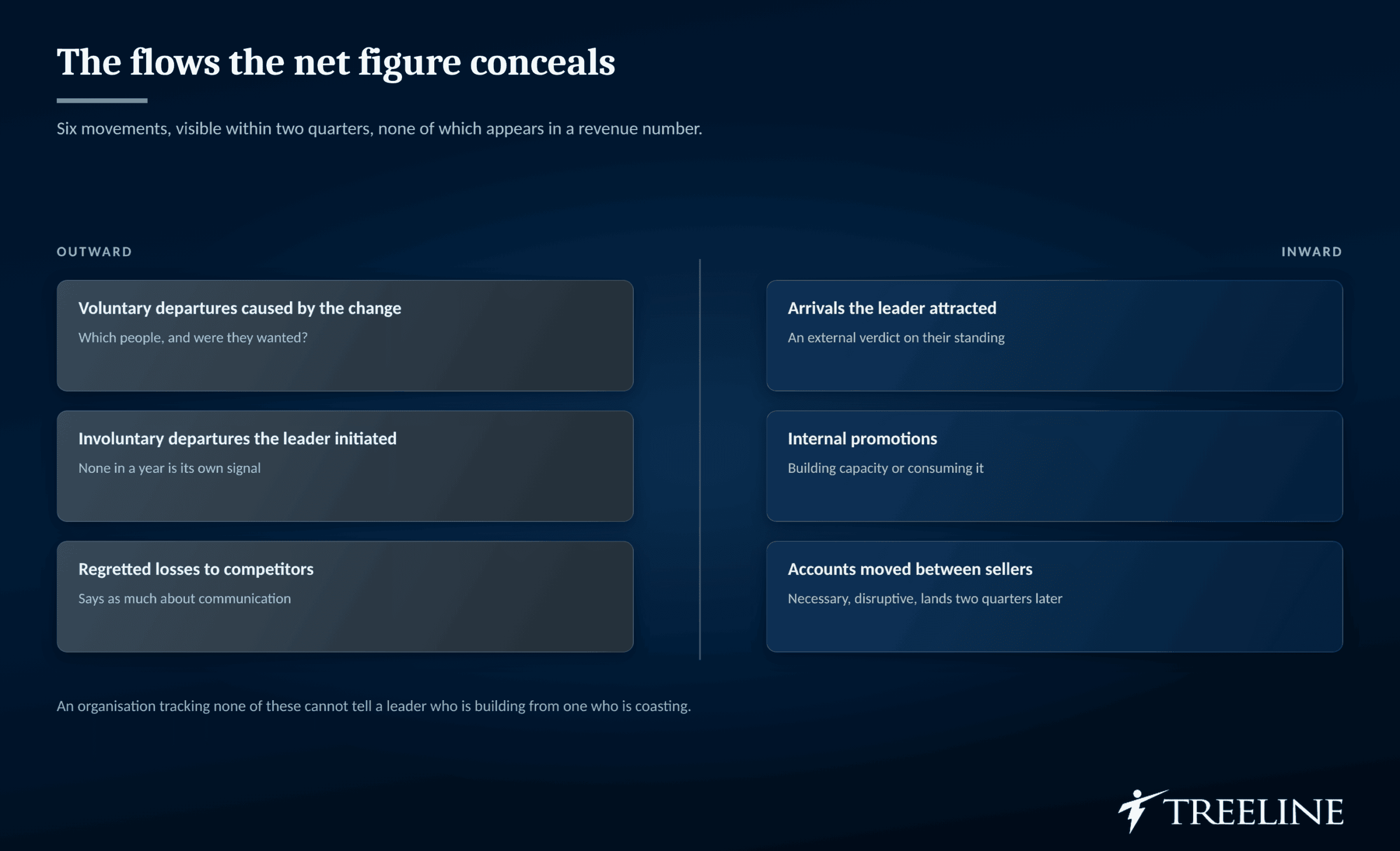
Naming them makes them observable, and most are visible within two quarters. They divide into outward and inward movements.
- Voluntary departures caused by the change. Some are healthy, some are expensive, and the distinction is whether the people who left were the ones you wanted to keep.
- Involuntary departures the leader initiated. A leader who makes no personnel decision in twelve months has either inherited an unusually strong team or is avoiding the hardest part of the job.
- Regretted losses to competitors. These carry information about how the change was communicated as much as about the leader.
- Inbound arrivals the leader attracted. Strong leaders bring people with them, and the number who follow is one of the better external verdicts available.
- Internal promotions. Whether anyone grew into a larger role indicates whether the leader is building capacity or consuming it.
- Accounts moved between sellers. Territory reassignment is often necessary and always disruptive, and the effect lands two quarters later.
An organisation that tracks none of these has no way to distinguish a leader who is building from one who is coasting, which means it also has no way to learn what to hire for next time.
Two of these deserve a note about interpretation, since both are routinely read backwards. Departures the leader initiated are frequently treated as a warning sign by boards and are usually the opposite: a leader who has made no personnel decision in a year has either been unusually lucky in what they inherited or is deferring the least comfortable part of the role. And arrivals the leader attracted are sometimes viewed with suspicion as empire-building, when the willingness of former colleagues to follow someone is one of the few genuinely external verdicts on their competence available to you.
Why the Net Figure Became the Default
It is worth understanding why organisations settle on the least informative measure, because the reasons are structural rather than careless.
Revenue is already collected. It requires no additional instrumentation, it is reported to the board every quarter, and it is the number the leader was ostensibly hired to move. Every other measure described here has to be assembled deliberately by somebody who has decided it matters.
There is also a timing problem. The gross flows resolve on different schedules. A departure is visible immediately; whether it was a good departure takes two quarters to establish. A comp plan change shows its effects a year out. Forecast accuracy needs several quarters of data before a trend exists. Revenue, by contrast, arrives monthly and feels like an answer.
And there is a political dimension. Examining gross flows means asking who left and why, which implicates decisions made by people still in the building. The net figure is comfortable precisely because it does not require anyone to be specific.
None of this makes the net figure wrong. It makes it insufficient on its own, and the practical remedy is small: decide before the hire which three or four flows will be tracked, and assign somebody to record them. The cost is an hour a quarter, and it converts a leadership review from an argument about impressions into a conversation about evidence.
Where Contingency Executive Recruiters Actually Change the Outcome
It is worth being precise about the mechanism, because the general claim that a good recruiter produces better hires is exactly the sort of unfalsifiable statement worth avoiding.
The first change is at definition. Contingency executive search firms that work one market continuously carry a sample no single employer has. Contingency executive recruiters who work sales leadership continuously have seen what happens after these hires across many companies, which a single employer has not. That accumulated view is what allows a partner to say that the requirement as written describes two jobs, or that the profile being described has a predictable failure mode in an organisation of this size.
The second is at screening for the gross flows rather than the net, which is where contingency recruiters earn their keep. A candidate’s revenue record is the net figure. What they built, who they promoted, who followed them, and what survived their departure are the gross ones, and they are considerably more predictive.
The third is at the point of honest information transfer. A leader who arrives believing the pipeline is healthier than it is will make decisions on that basis for two quarters. Whether a candidate hears an accurate account of the situation before they accept is largely determined by whoever is managing the conversation.
And the fourth is after the offer. The interval between acceptance and the end of the first quarter is where a meaningful share of executive hires quietly go wrong, and a partner who stays engaged hears about problems earlier than the employer will.
Fantasia frames the recruiter’s contribution as a matter of information rather than access. In his account the searches that produce good outcomes are the ones where both sides knew what they were getting, and the ones that fail are usually those in which somebody’s optimism went unchallenged.
A Worked Reading of One Year
An illustration makes the difference between net and gross concrete. This is a constructed example rather than data from a specific company.
A twelve-person sales organisation appoints a new leader. Twelve months later revenue is up three percent, which the board reads as underwhelming.
The gross flows tell a different story. Two sellers were removed in months three and four, both of whom had missed for six consecutive quarters. One strong performer left in month five, unwilling to accept a rebuilt territory. Three hires arrived between months six and nine, two of them recruited from a competitor by the leader personally. One existing seller was promoted to manage the mid-market team. Forecast accuracy moved from routinely thirty percent optimistic to within ten percent. And the qualification standard was rewritten, which reduced reported pipeline by a third while raising conversion.
Read together, three percent growth was achieved while replacing a quarter of the team and absorbing the productivity cost of five transitions. The organisation entering year two is substantially stronger than the one that entered year one, and none of that appears in the headline number.
The counterfactual matters too. Had the leader changed nothing, the same organisation might well have posted five percent on the existing pipeline and entered year two with the same problems intact. The higher number would have been the worse outcome.
Screening for What Someone Built
Since gross flows are what predict, the assessment has to test for them, and that changes the questions.
The standard executive interview asks about results: what number they carried, what they delivered against it, how the team performed. All of those are net figures reported by the candidate about themselves, and they are the least verifiable information in the conversation.
The alternative is to ask what changed on their watch and what survived them. Which people did they promote, and where are those people now? What did they inherit, and what was different when they left? Did the segmentation, the qualification standard or the forecast discipline they introduced persist after their departure, or did it collapse?
That last test is the strongest available, and it is checkable through references in a way that revenue claims are not. Things that persisted were built into the organisation. Things that collapsed were held together by the individual’s personal effort, which does not scale and does not transfer to a new company.
A useful complement is to ask about the people who left. A leader who cannot name anyone who departed during their tenure is either describing an unusually stable situation or has not been candid. One who can describe a departure, explain whether it was the right outcome, and say what they would do differently is demonstrating exactly the reflective capacity the role requires.
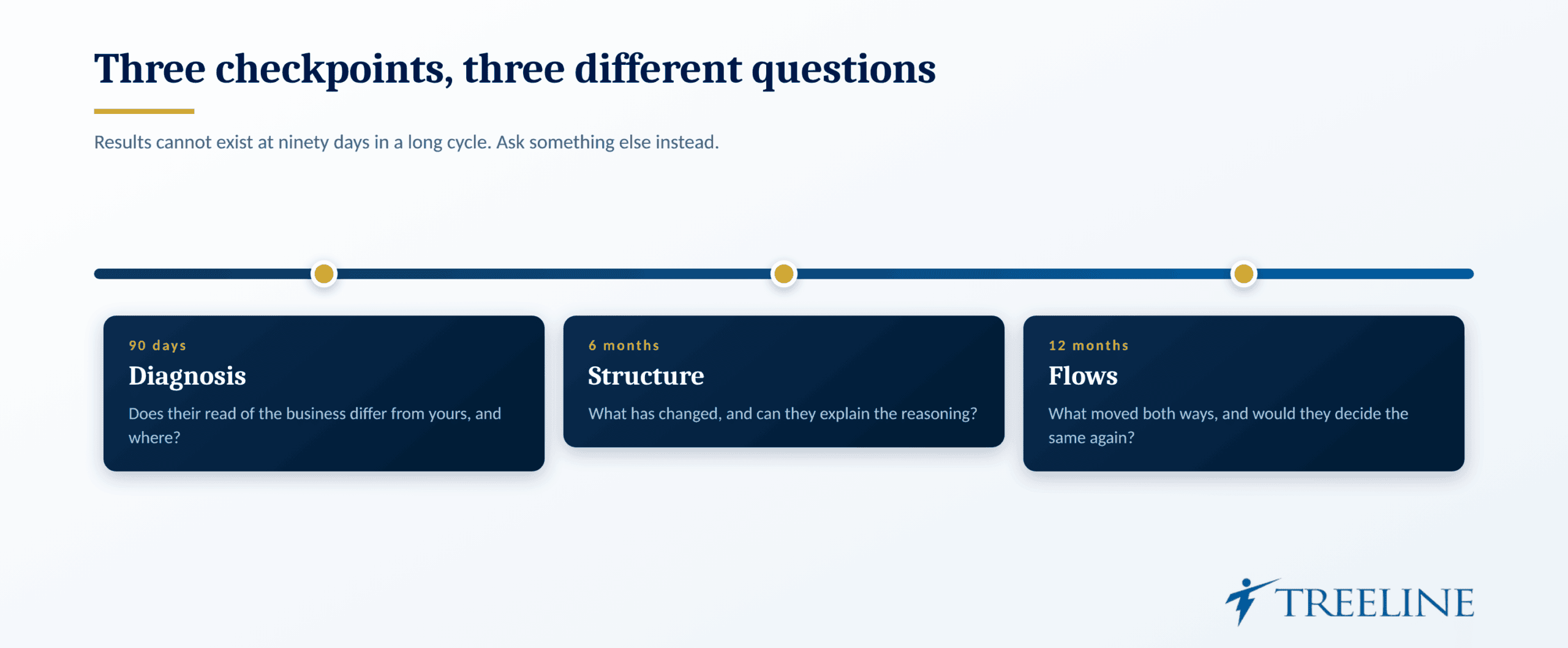
Rather than a single review at twelve months, the useful pattern is three checkpoints, each asking something the previous one could not.
- At ninety days, the question is not about results, which cannot exist yet in an enterprise cycle. It is whether the leader’s diagnosis matches what the organisation believes about itself, and where it differs. A leader who has found something nobody internally had noticed is doing the job. One whose assessment simply echoes the brief they were given may not have looked.
- At six months, the question is whether anything structural has changed and whether the leader can explain the reasoning. Comp plan, segmentation, qualification standard, forecast cadence, team composition. Change without explanation is thrashing; explanation without change is analysis.
The six-month mark is also the right moment to check whether the leader has been given what they were promised. Executive hires are frequently made with commitments attached, a headcount allocation, a marketing budget, authority over the comp plan, and those commitments erode quietly under other pressures. A leader failing to deliver against a scorecard while the resources behind it were withdrawn is not a hiring failure, and establishing that at six months is considerably more useful than discovering it at eighteen.
- At twelve months, the question is what the gross flows were and whether the leader would make the same decisions again. This is also the point at which the original scorecard should be re-read, since organisations routinely discover they are judging a leader against expectations that were never written down.
None of these requires elaborate measurement. All of them require somebody to have written down what was expected before the hire started, which is the step most often skipped.
What the Candidate Should Be Told
Outcomes are shaped as much by what a leader knows on arrival as by who they are, and this is the part of the process an employer most often gets wrong out of optimism rather than dishonesty.
An executive candidate deciding whether to join is making a judgment about whether the number is achievable. If the pipeline is thinner than presented, if marketing’s contribution has been overstated, if two of the six sellers are on performance plans, if the board’s expectation differs from the chief executive’s, each of those changes the calculation, and each is routinely softened during a search.
The softening rarely survives contact with reality. A leader who discovers in month two that the situation is materially different from the one described makes two adjustments: they revise their plan, and they revise their assessment of whether they can trust what they are told. The second is more damaging and harder to repair.
The counterargument is that full disclosure loses candidates. Sometimes it does, and those are usually candidates who would have departed in month nine. A strong leader told plainly that the pipeline is weak and the team needs rebuilding will often find that more attractive than a comfortable situation, because the scope of the opportunity is larger.
This is one of the clearer arguments for a search partner. A recruiter can convey difficult information earlier and more credibly than the hiring executive can, and can test how a candidate responds to it before anyone is committed.
Certain patterns are invisible in the net figure and obvious once the flows are examined.
A leader producing acceptable revenue alongside heavy voluntary departure of good people is borrowing from next year. The number holds while the team hollows out, and the collapse arrives after they have moved on.
A leader with no departures at all, voluntary or otherwise, is frequently avoiding the personnel decisions the role exists to make. This reads as stability and is often stagnation.
A leader who has recruited heavily from their previous employer may be building a strong team or may be importing a system that does not fit. The distinguishing evidence is whether the arrivals are performing rather than how many there are.
And a leader whose forecast accuracy has not improved after a year has not addressed the thing most boards actually needed, regardless of what happened to revenue.
The Half That Sits Inside the Company
A search partner can improve the odds. Several of the largest determinants of outcome sit entirely inside the company.
The scorecard has to describe what must change rather than what the role involves. A leader assessed against a job description will be judged later against a standard nobody agreed.
The first ninety days need to be defined as a learning period rather than a proving one. Pressure to demonstrate impact early pushes new leaders toward visible changes rather than correct ones, and a comp plan rewritten in month two by someone who has not seen a full quarter is usually reversed by month eight.
Access to real information has to be granted quickly. Four quarters of pipeline data, win-loss records and forecast accuracy handed over before the start date compress the diagnosis phase substantially.
And the expectations of the chief executive and the board have to be reconciled with each other before the leader arrives, because a leader caught between two different definitions of success will fail one of them regardless of ability.
Fantasia distinguishes between onboarding a leader and orienting one. Orientation is a schedule of introductions; onboarding is deliberately arranging for the new leader to hear the things nobody volunteers, which usually means putting them in front of the people most likely to disagree with them.
Executive Search and Enterprise Sales Capability
A leadership hire is ultimately judged on whether the organisation beneath it can sell, so the two questions are connected more tightly than the org chart suggests.
Most executive sales hires are made because something in the selling motion is not working. The leader is expected to fix it, and the fixing is largely done through other people, the enterprise account executive team they inherit, develop, replace or expand. That means the outcome of the leadership hire is substantially determined by whether that layer improves.
This has a practical consequence for how the search is framed. A candidate’s answer to what they would do about the enterprise account executive team in the first six months is more diagnostic than any general statement about leadership philosophy. It reveals whether they assess individually or in aggregate, whether they will coach or replace, and how quickly they intend to act.
It also explains a common sequencing error. Companies sometimes hire a senior leader to fix a team that has never been given a defined motion to execute, and the leader spends their first year building something that should have existed before they arrived. Treeline covers the related sequencing question in its discussion of contingency solutions for hard-to-fill sales roles.
The Cost of a Leadership Mis-Hire, Counted Properly
The reason outcome measurement deserves this much attention is that the downside is asymmetric and it compounds through other people.
A seller who does not work out costs a territory for a year. A sales leader who does not work out costs the decisions they made while there. They hired people who are now yours. They set a comp plan the team has organised around. They changed the segmentation, dropped a channel, or committed to a forecast the board planned against. Reversing those takes longer than the tenure did.
There is a second-order effect that lands after the departure and is usually attributed elsewhere. Strong performers watch a leadership change closely. A leader who arrives, disrupts, and leaves within eighteen months frequently takes some of the existing team with them, either recruited directly, or prompted to look by the instability. That attrition shows up a quarter or two later and is rarely traced back.
Then there is the position the next search starts from. A company replacing a leader who did not last is recruiting in a market that knows. Candidates ask what happened, and they ask people other than you. The honest account is uncomfortable; the evasive one is detectable, since the previous incumbent is usually reachable.
Set against all of that, the additional effort in defining the scorecard and tracking a few flows is trivially small. The asymmetry is the argument: the measurement costs an hour a quarter, and the failure costs two years.
Sales recruiting contingency arrangements have a bearing on outcomes, though a smaller one than either advocates or critics usually claim.
Paying only on placement transfers the risk of a search that does not close, and for a leadership role that risk is real. It also produces genuine urgency on scheduling and decisions, which matters because good leadership candidates are rarely available for long.
What the structure does not do is guarantee assessment quality. A firm paid on placement has an incentive to find someone acceptable, and the discipline that resists it comes from the firm rather than from the model. This is why the questions worth asking contingency search firms are about behaviour rather than fee structure, what they have declined, what they would tell you not to do, whether they will say a candidate is wrong when everyone likes them.
There is also a boundary worth naming once. Where a search must remain confidential, a non-exclusive arrangement is the wrong instrument regardless of how good the firm is, and Treeline sets out that distinction in its comparison of retained search versus contingency search.
When the Leader Is Right and the Timing Is Wrong
Not every disappointing outcome is a hiring failure, and separating the two matters because they have different remedies.
A capable leader arriving during a product transition, a funding gap, or a market contraction may do everything correctly and still miss. The gross flows will show the work, decisions made, people developed, discipline installed, while the net figure stays flat or falls. An organisation reading only the net will conclude it hired badly and will replace someone who was building something.
The inverse also happens. A leader arriving as a strong product cycle begins can post excellent numbers while changing nothing, and be promoted on the strength of a market they did not create.
Distinguishing them requires asking what would have happened without this person. It is an imprecise question and it is better than not asking. Look at whether the improvements are attributable to specific decisions with dates attached, or whether they appeared alongside a market movement that would have arrived anyway.
This is also where an external partner has a genuine informational advantage. A firm running similar searches across several companies can say whether what you are experiencing is unusual or is happening everywhere, and that context is difficult to obtain from inside a single organisation.
Almost nobody reviews an executive search once it has closed, which is why the same mistakes recur.
A short debrief with the partner, held after the twelve-month mark rather than at placement, should establish which parts of the original requirement turned out to matter, which were noise, what the successful candidate had that the runners-up lacked, and whether the assessment predicted what actually happened.
That last question is uncomfortable and valuable. If the leader is succeeding for reasons nobody identified during the process, the assessment was lucky rather than good, and the next search should test for the thing that turned out to matter.
Contingency recruiting relationships that include this conversation are demonstrating something. A firm that treats a placement as the end of its involvement is describing a transaction, which may be all you need, but it is worth knowing which one you have bought.
Fantasia warns against reviewing only the hires that failed. His point is that a successful outcome can conceal a poor process just as easily as a failed one can conceal a good process, and reviewing only failures teaches an organisation to avoid its last mistake rather than to make better decisions.
Building the Scorecard Backwards From the Flows
If gross flows are what should be measured, the scorecard is easier to write than most organisations find it, because the flows suggest their own criteria.
Start from the end. In twelve months, what should have moved in each direction? If the answer includes replacing two underperformers, then the scorecard needs a line about the willingness and speed of personnel decisions, and the assessment needs to test for evidence that the candidate has made them before. If the answer includes building a second-line manager, the scorecard needs a line about developing people, and the reference questions should ask who they promoted.
Written this way, three things happen. The scorecard becomes short, because vague aspirations do not survive the translation into a directional flow. It becomes testable, because each line implies specific evidence. And it becomes a shared document, because the exercise forces the chief executive and the board to agree on what should change before a candidate hears about the role.
The common objection is that a growing organisation cannot know twelve months ahead what it will need. That is partly true and mostly an argument for revisiting the scorecard rather than for not writing one. A scorecard revised deliberately in month six is a working instrument; an unwritten expectation revised silently is how leaders end up judged against a standard nobody agreed to.
When the Outcome Was Decided Before the Hire
Some executive sales hires cannot succeed, and recognising the conditions in advance prevents an expensive year.
A role with authority over the number but not over the comp plan, the territory design or the hiring is a role in which the leader is accountable for outcomes they cannot influence. Strong candidates detect this in interviews and decline; the ones who accept are frequently those with fewer options.
A company where the founder continues to run sales informally after appointing a leader has created a structure in which the leader can only fail politely. This is common and rarely acknowledged during a search.
A revenue plan that the market cannot support will not be rescued by leadership. The leader inherits a number built from a spreadsheet rather than from a pipeline, misses it, and departs having been set an impossible task.
There is a variant worth naming because it is harder to see: a role in which the previous holder was successful and left for reasons unrelated to the job. The organisation concludes the seat is straightforward, sets expectations accordingly, and underestimates how much of that success rested on relationships and knowledge that departed with the person. The next leader inherits the same title and a materially harder job.
And a company on its third sales leader in four years has a pattern that a fourth hire will not break. The productive response is to establish what is common across the three departures before running another search.
What to Ask a Firm About Outcomes
Framed around outcomes rather than process, a handful of questions separate firms quickly and can be asked in a first conversation.
- What happened to the last three leaders you placed? Not whether they are still there, but what changed on their watch.
- Which of your placements did not work out, and what did you conclude? Every firm has them; the answer describes their capacity for review.
- How would you test whether a candidate builds or inherits? Listen for questions about what survived their departure.
- What would you tell a candidate is difficult about this role? A firm that cannot name a drawback will present the opportunity generically.
- Will you stay involved through the first ninety days, and how? Practice varies widely and is rarely specified in a proposal.
- What would make you tell us not to hire any of the finalists? A firm with no such threshold is supplying rather than assessing.
The last question is the one most likely to produce a revealing pause. A firm paid on placement has an obvious incentive to find someone acceptable, so an articulated threshold that survives its own commercial interest is worth more than any claim about rigour.
Frequently Asked Questions
How should we judge an executive sales hire after a year?
Not on the net revenue figure alone, which hides almost everything that happened. Look at the gross flows: who left voluntarily and whether they were people you wanted to keep, what personnel decisions the leader made, who joined because of them, whether anyone was promoted, and whether forecast accuracy improved.
Is it a bad sign if people leave after a new sales leader arrives?
Not by itself. Some departure is expected and some of it is healthy. The question is which people left and why. Losing underperformers is the leader doing the job; losing your strongest sellers is a signal worth investigating quickly.
What can contingency executive recruiters actually influence?
Four things: how precisely the requirement is defined, whether screening tests for what a candidate built rather than what they inherited, whether the candidate receives an honest account of the situation before accepting, and whether problems in the first quarter surface early. None of these guarantees an outcome; all of them shift the odds.
When should the first review happen?
At ninety days, and it should be about diagnosis rather than results, since results cannot exist yet in a long sales cycle. The useful question is whether the leader has found something the organisation had not already told them.
Does the fee structure affect the quality of an executive hire?
Less than is usually claimed. Paying on placement transfers the risk of a search that fails to close and creates urgency, both of which are real advantages. It does not create assessment discipline, which comes from the firm’s own standards rather than from the commercial arrangement.
Why do some executive sales hires fail regardless of the person?
Usually because the role was structured so that the leader carried accountability without authority over the comp plan, territory or hiring; because a founder continued running sales informally; because the revenue plan was never achievable; or because an unaddressed pattern caused the previous departures.
What should we hand a new sales leader before their start date?
Four quarters of pipeline data, win-loss records, and honest forecast accuracy figures. This compresses the diagnosis period and reduces the chance of decisions being made on an optimistic picture during the first two months.
Should we review a search that produced a good hire?
Yes, and it is the more informative review. A successful outcome can rest on a poor process, and organisations that only examine failures learn to avoid their last mistake rather than to decide better. Ask which parts of the requirement mattered and whether the assessment predicted what actually happened.
Look at Both Directions Before You Judge the Hire
Treeline, Inc. is a sales-only executive search firm based in Wakefield, Massachusetts, working exclusively on building sales organizations. Our contingency sales recruiting service carries no upfront cost and no fee unless you hire, and we deliver your first candidate within three days of launching a search.
If you have a sales leadership hire ahead of you, the conversation worth having first is about what you will measure at twelve months. Get in touch and we will work through the scorecard before we discuss candidates.
Share This Story, Choose Your Platform!
Related Posts


What our happy clients are saying
Treeline Inc. provided us with the most candidates that aligned with our needs and were of the highest quality.

Dr. Jeffrey Klein Head of North America Sales, Satchel Pulse
Treeline Inc.’s collaborative, flexible, and communicative approach resulted in a smooth partnership. Beyond their recruitment expertise, their unique sourcing model was efficient and effective.

Sera Holt Director of Operations, LNS Research
Their professionalism was outstanding. Treeline Inc. was extremely thorough and ensured that we were on the same page before they started looking for candidates. They listened to us and did a great job working with the candidate to close out the process.

Cate Grant AVP Customer Success, Nasdaq
Thanks to Treeline Inc.’s intricate and thorough screening process, the company is able to hire six high-quality candidates that fit perfectly in the company’s culture. The team is highly receptive to concerns, and internal stakeholders are impressed with their unique recruitment abilities.

Anna McKean Sales Recruiter, Insider Intelligence
Treeline Inc. has been qualified individuals throughout a five-year-long engagement. They’ve made numerous placements of talented and qualified individuals for our business.

Michele St Laurent VP of HR, The Institute for Applied Network Security

Let Us Help You Source the Sales Talent You Need
Whether you’re building a team or replacing a key role, our Candidate Sourcing Platform provides a fast, flexible, and employer-focused solution.
Tell us more about your business and how we can help.
Treeline Inc.
Your Award-Winning Sales Recruitment Partner
15 Lincoln Street, Suite 314, Wakefield, MA 01880