The usual case for a contingency hire is that it costs nothing unless you hire. That is true and it is the least interesting part. The more useful property is that it defers commitment to the moment of the hire itself, which matters because growing organizations revise their hiring plans far more often than they expect to, and every search launched under a commitment structure locks in a decision that the business may have already moved past.
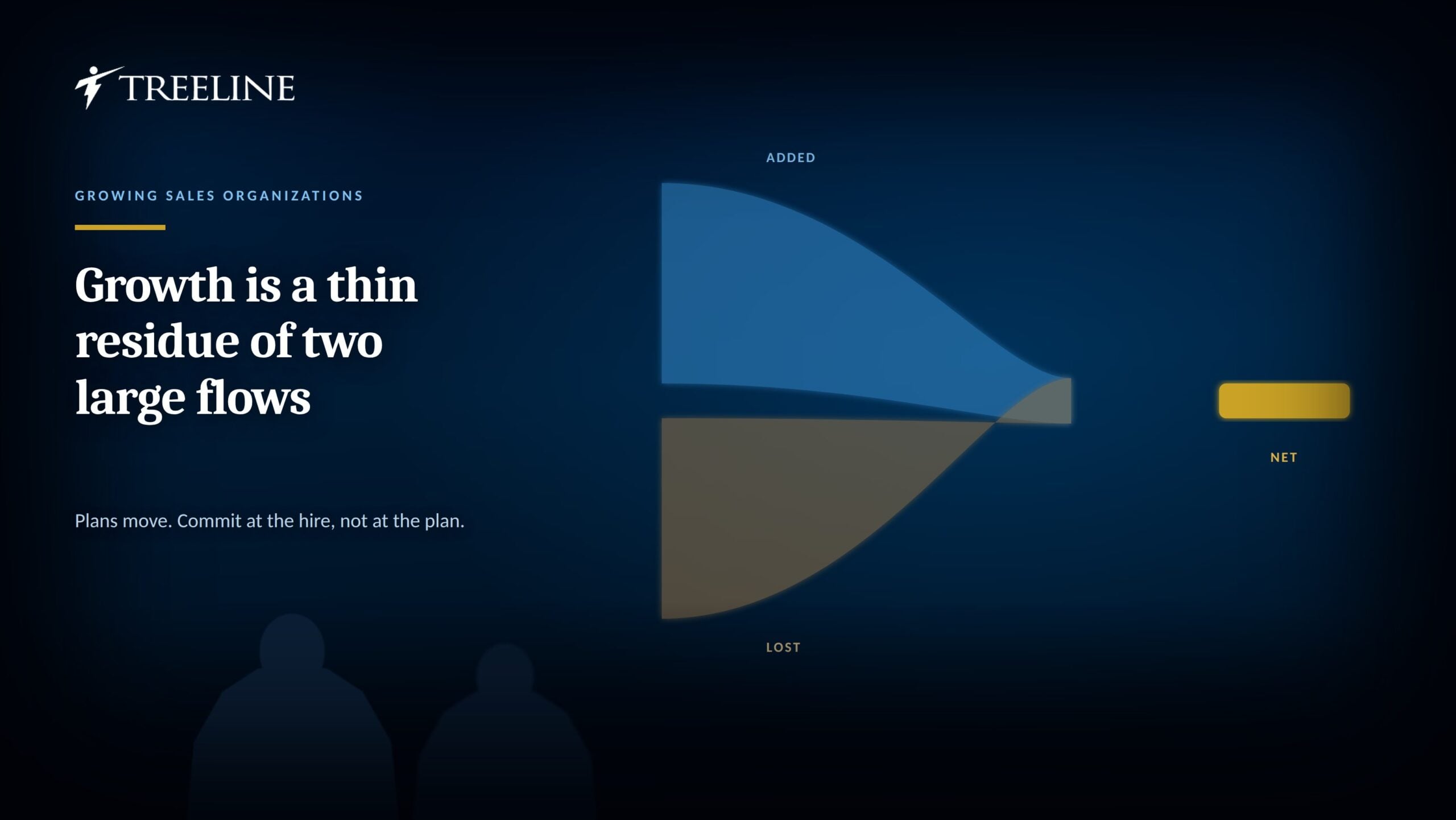
That instability is not a failure of planning. It is a feature of how employment actually behaves. The U.S. Bureau of Labor Statistics reports in its Business Employment Dynamics series that in the third quarter of 2025, gross job gains from expanding and opening private-sector establishments were 7.5 million while gross job losses from contracting and closing establishments were 7.6 million, with gross gains representing 5.6 percent of private-sector employment and gross losses 5.7 percent.
The net change is the small difference between two enormous opposing flows. That is economy-wide rather than a description of any one company, but the structural lesson transfers directly: what looks like steady growth from outside is, up close, a great deal of adding and subtracting. Dan Fantasia, CEO of Treeline, Inc., treats a hiring plan as a forecast rather than a schedule.
From his perspective the sensible question for a growing company is not how many people it will hire this year but how confident it is in the third and fourth of those roles, because the answer usually determines which engagement structure is appropriate.
Growth Is Lumpier Than the Plan Says
Every growing sales organization has a headcount plan that shows smooth addition, two in Q1, three in Q2, three in Q3. Almost none of them execute it that way. What actually happens is that a large deal closes and pulls a hire forward. Or a funding round slips and the second cohort is deferred. Or someone unexpectedly resigns and a planned expansion hire quietly becomes a backfill.
Or the company enters a new segment and the profile written in January no longer describes what is needed in June. None of these are unusual. Taken together they mean the plan is a statement of intent whose later entries carry much less confidence than its early ones, and yet organizations frequently commit to all of it at once, structurally and financially, at the start of the year.
The consequence shows up as waste that nobody records. A search launched for a role that changes shape produces candidates assessed against a standard that no longer applies. A search launched for a role that disappears produces nothing at all, and under a retained structure the fee is still due.
What Actually Changes a Headcount Plan
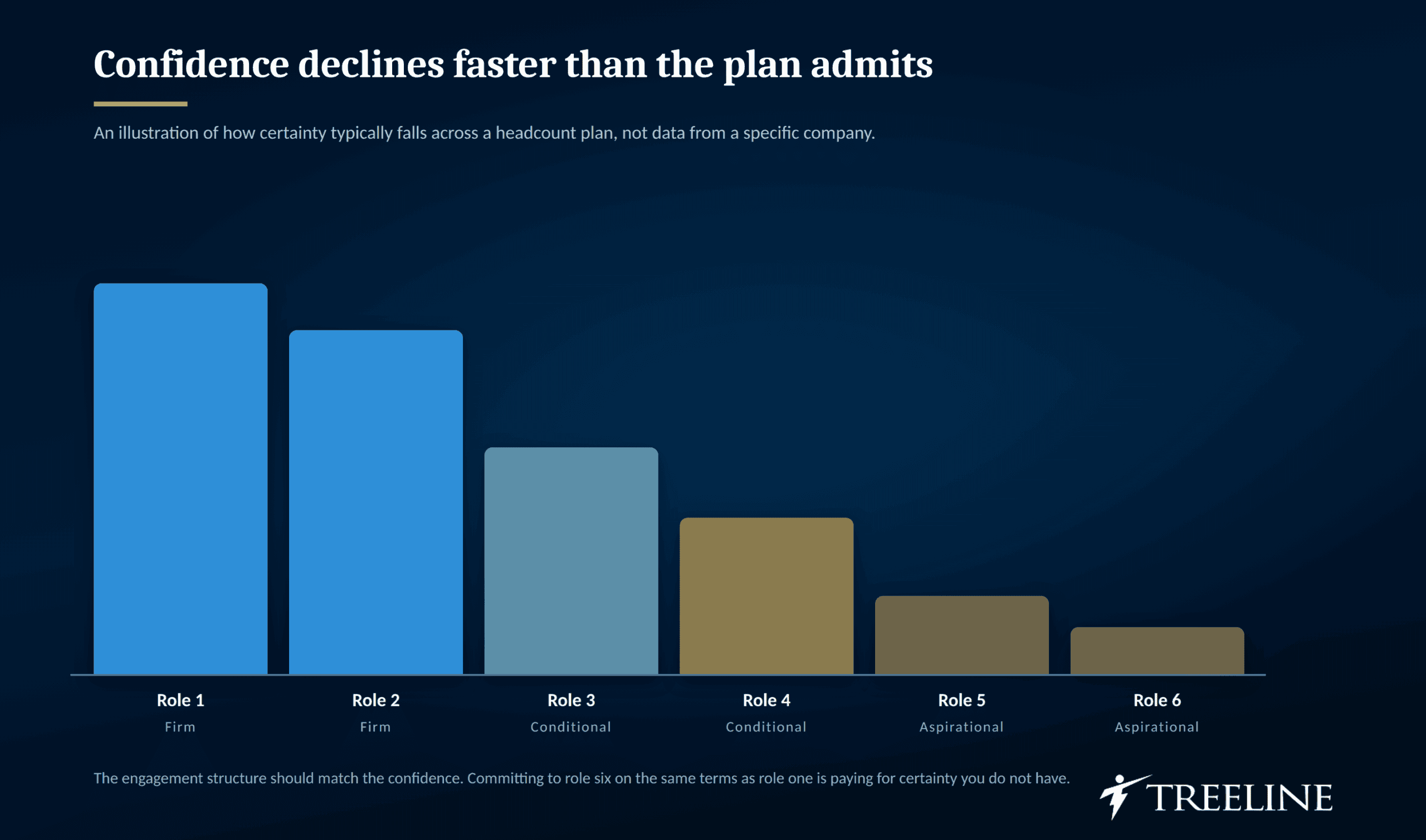
Being specific about the sources of change makes it easier to judge which parts of a plan are firm, and confidence typically falls across a plan as shown below.
- Revenue arriving differently than forecast. A large deal closing early creates capacity to hire; a slipped quarter removes it, usually with little notice.
- A change of segment or motion. Moving upmarket changes the profile substantially, and the change is often decided after the requisition was approved.
- Unplanned attrition. Every departure converts an expansion hire into a backfill and reshuffles the sequence.
- Funding and board decisions. A round, an acquisition, or a change in the plan the board approved can move headcount in either direction within weeks.
- Management capacity. A manager who was going to absorb three new reports takes on a different responsibility, and the team cannot grow past what someone can actually manage.
- A hire that does not work out. One early mis-hire consumes the attention that the next two hires needed.
- A competitor’s move.
A rival entering your segment, or losing a leader, can change both the urgency and the availability of candidates within a quarter. Worth noting that most of these move the plan in both directions. Growing companies tend to plan for the upside version, a deal closes, hire faster, and to treat the downside version as an exception rather than as an equally likely branch.
Building a plan that only works if the favourable revisions happen is the most common way a hiring year goes wrong. The first two or three roles in a plan are usually real. Beyond that, confidence declines quickly, and the engagement structure should reflect that rather than treating all of them as equally certain.
A Contingency Hire Is an Option, Not a Commitment
This is the property that matters, and it is worth stating precisely. Under a contingency arrangement, the employer has acquired the right to hire without the obligation to do so, and without payment unless it happens. A search can be started, paused, redefined or abandoned, and the financial consequence of each is the same: nothing.
That is genuinely valuable when the underlying plan is uncertain, and the value rises with the uncertainty. For a role the company is certain about, the flexibility is worth little because it will not be used. For the fourth role in a plan that depends on a funding event, it is worth a great deal. Four specific freedoms follow, and they are the practical content of the model.
- You can start earlier than you are certain. Because launching costs nothing, a search can begin while the decision is still being confirmed, which recovers weeks that would otherwise be lost waiting for certainty.
- You can redefine mid-search. When the segment shifts, the requirement can be rewritten in a conversation rather than a contract amendment.
- You can pause without penalty. A slipped quarter pauses the search rather than wasting a paid engagement.
- You can abandon it entirely.
If the role disappears, the cost is the internal time already spent and nothing else. Fantasia’s view is that the most underused of these is starting early. He points out that companies routinely wait for formal approval before beginning a search that costs nothing to begin, and then absorb six weeks of vacancy that the approval delay created rather than the market.
What the Option Costs
Presenting optionality as free would be dishonest, and the price is paid in a currency that is easy to overlook. You pay in priority. Contingency recruiters paid only on placement allocate effort toward searches they believe will close. A search the client has described as provisional, or one attached to a plan that keeps moving, is worked accordingly, and nobody will tell you where you sit in the queue unless you ask.
You pay in relationship depth. Contingency search firms that expect a search to be abandoned invest less in learning your business, which reduces the quality of what comes back and makes the next engagement start from a lower base. And you pay in market impression. Every search that starts and stops touches candidates.
A company that approaches an experienced seller, engages them for three conversations and then goes quiet has made an impression on someone whose peers are your next candidate pool. This is the cost that growing companies underestimate most, because it does not appear until the following search. The practical mitigation is to be honest about confidence at intake.
Telling a partner that two of four roles are firm and two depend on a funding event produces better behaviour than presenting all four as certain and then cancelling half.
Reading the Plan the Way a Recruiter Does
It is worth seeing a headcount plan from the other side of the table, because it explains behaviour that otherwise looks arbitrary. A firm receiving four requisitions from a growing company is making a private assessment of how many will close. That assessment is built from signals the client rarely notices: whether the compensation bands are approved for all four or only the first, whether the hiring managers exist yet, whether the profiles are described in enough detail to search against, and whether the company has cancelled searches before.
The assessment then determines effort allocation, and it is rarely communicated. A firm that concludes two of four will close will work two of four, and the client experiences this as inconsistent service rather than as a rational response to what they signalled. The productive move is to make the assessment explicit rather than leaving it to inference.
Stating plainly which roles are firm, which are conditional, and what the condition is gives a partner something accurate to plan against, and it usually produces more effort on the firm roles rather than less, because the firm roles are now clearly identified. Fantasia’s position is that ambiguity about a plan costs a growing company more than a modest budget would.
His observation is that a client who says two roles are certain and two depend on a funding decision gets both handled sensibly, while a client who presents four certain roles and cancels two gets treated as a four-role client who cancels half, which is a materially worse position to be in next time.
The Constraint Nobody Budgets: Onboarding Capacity
There is a limit on growth that has nothing to do with recruiting and frequently binds before the market does. A sales organization can only absorb new people as fast as someone can onboard, coach and manage them. A manager with four reports who takes on four more has not doubled their capacity; they have halved their attention per person, and the effect lands on the existing team as well as the new one.
This produces a specific failure that looks like a hiring failure and is not. A company hires three sellers in a quarter, all three ramp slowly, and the conclusion drawn is that the candidates were weak. The more likely explanation is that nobody had time to onboard them, and the same three people joining across two quarters would have performed differently.
The planning implication is that hiring capacity should be stated as a constraint alongside budget. A useful rule of thumb is to ask who specifically will spend time with each new hire in their first month, by name, and to stop adding roles at the point where that question has no answer. This is also where a contingency recruiting agency should be pushing back rather than accepting the requisitions.
A firm that takes four roles when the organization can absorb two is optimising for its own pipeline.
What Happens to a Paused Search
Pausing costs nothing financially, which is exactly why companies do it casually. It is not free in other currencies, and understanding what actually happens makes the decision better. Candidates already in process are the immediate casualty. Someone three conversations deep who is told the role is on hold will usually not return when it resumes, because they have either accepted something else or concluded the company is disorganised.
A pause of two weeks loses some of the pipeline; a pause of two months loses most of it. The market memory is the longer-lived cost. In a narrow segment the same people are approached repeatedly, and a company that has previously engaged and then gone quiet is a harder sell the next time. This is the specific reason to communicate a pause properly rather than letting a search fade out.
The recoverable part is the definition work. The scorecard, the calibration, the reasons candidates were rejected, all of that survives a pause if somebody writes it down. Most companies do not, and a resumed search restarts at the beginning. Three things make a pause much cheaper. Tell candidates in process directly, with a reason and an honest timeline.
Tell the firm what would restart it. And keep the written definition so the restart is a resumption rather than a new search.
Cohorts Versus Continuous Hiring
Growing organizations tend to hire in bursts, and there is a real trade-off between batching and spreading that is worth deciding deliberately. Hiring a cohort has genuine advantages. Onboarding can be run once for several people. New joiners learn from each other and the shared start date creates cohesion. Interview loops can be compressed because the panel is already calibrated.
It also concentrates risk. Everyone ramps at the same time, meaning a productivity trough arrives all at once. Everyone reaches the point of judging whether the role matched the pitch simultaneously. And if the onboarding was poor, it was poor for the entire cohort rather than for one person. Continuous hiring spreads both the load and the risk, and it allows each hire to be informed by what was learned from the last.
Its cost is repetition: the same intake, the same calibration, the same interview overhead, over and over. There is a version of the cohort problem specific to enterprise selling. Because the ramp is long, a cohort of enterprise account executives produces a revenue trough that lasts two or three quarters rather than one, and if the cohort was hired to meet a number, the number is missed during precisely the period the hiring was meant to fix.
Spacing the hires means the trough is shallower and the first arrival is contributing while the second ramps. The reasonable middle for most growing sales organizations is small cohorts of two or three, spaced far enough apart that the first group is contributing before the next arrives. That is also the pattern a contingency structure supports best, because each wave can be re-decided rather than pre-committed.
Why the Enterprise Seat Has to Be Filled Ahead of Demand
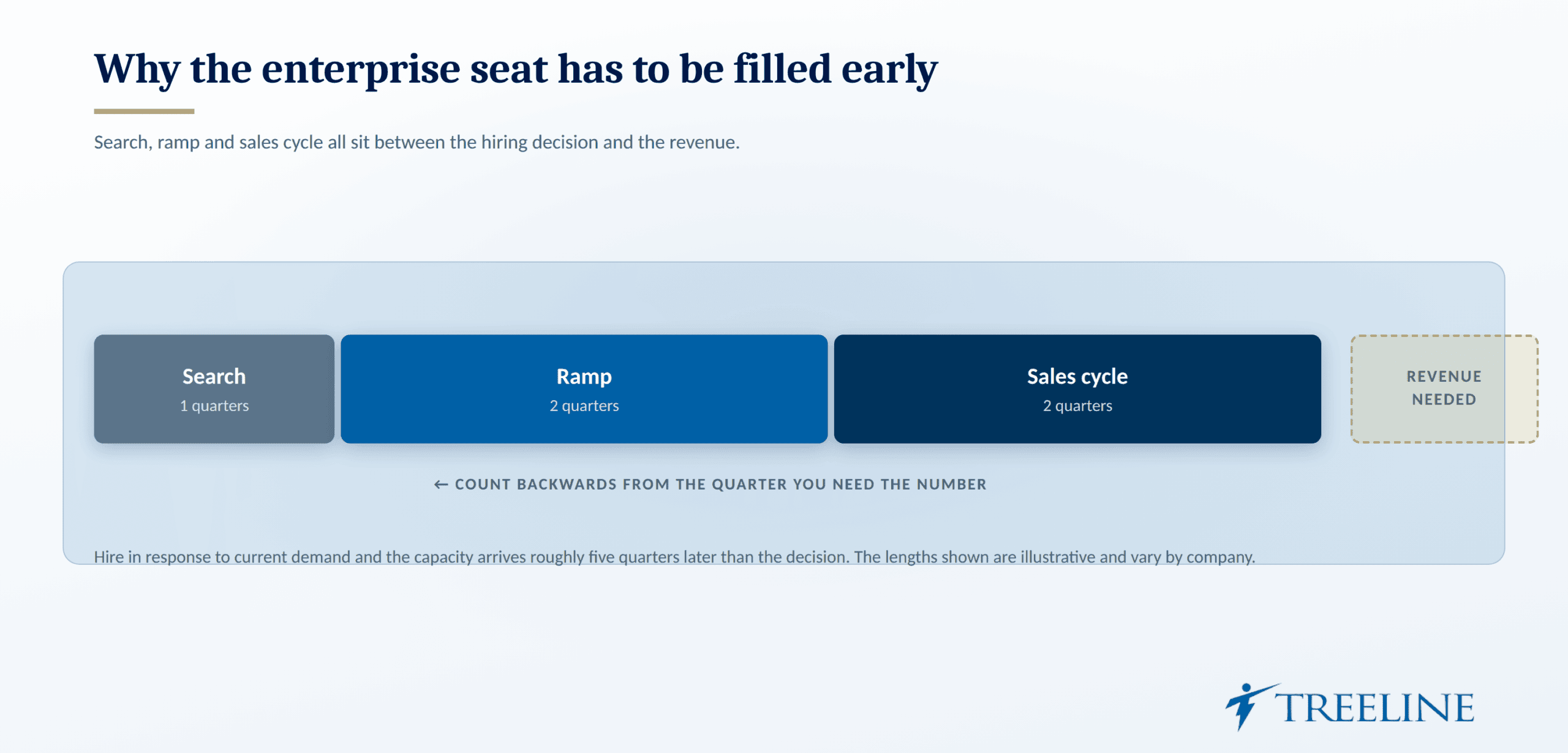
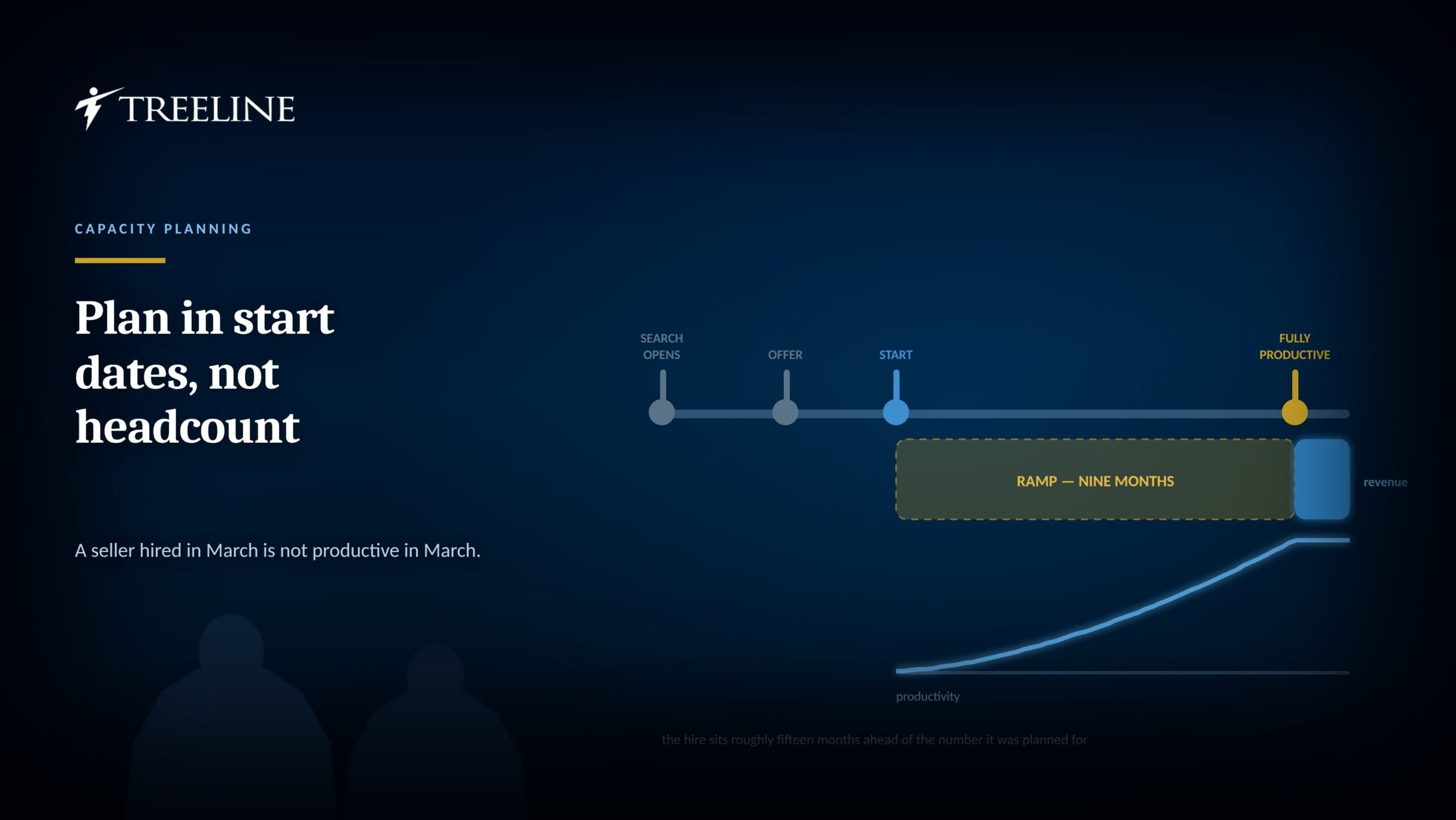
Everything above is complicated by a timing property specific to complex sales, and it is the single most common planning error in growing organizations. An enterprise account executive hired today does not produce revenue for two to three quarters. The cycle is long, the pipeline has to be built from a standing start, and the first closed deals arrive well after the ramp period most compensation plans assume.
This means the hiring decision has to lead the revenue requirement by roughly the length of the sales cycle plus the ramp, often four quarters or more. Adding the search itself, the full sequence looks like this. Growing companies routinely get this backwards. They wait until the revenue plan requires additional capacity, then hire, then discover the capacity arrives more than a year after it was needed.
The correction is to treat enterprise account executive hiring as a forward-looking investment decision rather than a response to current demand. That reframing has a budgeting consequence worth naming. An investment made four quarters ahead of the revenue it supports will look expensive in the quarter it is made, because the cost is present and the return is not.
Companies that evaluate sales hiring on a quarterly basis therefore systematically underhire for long-cycle roles, then over-correct once the shortfall appears, which produces the cohort problem described above. Judging enterprise hiring on an annual or rolling basis rather than a quarterly one removes most of that oscillation.
That in turn makes the case for optionality stronger rather than weaker. Hiring ahead of certainty is necessary because of the lag, and hiring ahead of certainty is exactly the situation a commitment structure handles badly. A contingency arrangement lets a company begin the search at the point the need becomes probable rather than the point it becomes certain, which for this role is the difference between capacity arriving on time and arriving a year late.
There is a compensation consequence attached. If an enterprise account executive genuinely cannot close inside two quarters, a plan that pays them as though they can will produce an early departure that is recorded as a hiring failure and was actually a plan design failure. Fantasia emphasises that the ramp lag should be written into the hiring plan explicitly rather than assumed.
His practical suggestion is to work backwards from the quarter the revenue is needed, subtract the sales cycle, subtract the ramp, and subtract the search, because the resulting date is usually earlier than anyone expected and explains why last year’s plan missed.
The Backfill Problem Growing Companies Underestimate
A plan built entirely from expansion hires will be wrong, because some of the year’s hiring capacity is consumed by replacing people who leave. The arithmetic is worth doing once. If a sales team of twenty loses even a modest share of its people in a year, several searches are backfills before a single expansion hire happens.
Those backfills are not optional, they arrive unpredictably, and they compete for exactly the same interview capacity, management attention and recruiter effort as the growth roles. The planning failure is treating the two as separate budgets. In practice they draw on one pool, and the pool is defined by how many searches the organization can actually run at once, which is usually two or three, not the number of open requisitions.
There is a compounding version. Attrition tends to cluster after a comp plan change, a territory reshuffle, or a manager departure, all of which are more common in a growing company than a stable one. That means backfill demand is highest precisely when expansion demand is also highest. Two practical adjustments help. Assume some proportion of the plan will be consumed by replacement rather than growth, and say so when the plan is approved.
And decide in advance which expansion hires get deferred if a backfill lands, because that decision made calmly in January is better than the same decision made under pressure in May.
Sequencing Under Uncertainty
When the plan is uncertain, the order of hiring matters more than the total, because each hire changes what the organization can absorb next. The general principle is to hire the role that most increases capacity to make the next hire successful. Sometimes that is a seller. Frequently it is not, a first sales operations hire, or someone to document what is working, can raise the productivity of every subsequent hire more than one additional quota carrier would.
It also helps to sequence by information. Early hires reveal whether the requirement was right. Hiring one enterprise account executive and watching their first ninety days tells you more about whether the profile is correct than hiring three simultaneously and discovering the same thing three times. A third principle is to sequence by what you will learn about the market.
If there is genuine doubt about whether a profile exists at your compensation, running that search first answers the question while the rest of the plan is still adjustable. Running it last means discovering a structural problem at the point when there is no time left to respond to it. And it helps to sequence by reversibility.
Roles that are easy to redirect if the plan changes should come before roles that lock the organization into a structure. A specialist hire for a segment the company may exit is a commitment disguised as a headcount decision.
What Growing Companies Should Ask a Firm to Commit To
Because the employer is committing to nothing financially, it is reasonable to ask the firm to commit to something operationally. These are the things worth agreeing at intake.
- What arrives in the first two weeks, specifically, on each live search.
- Who runs each search, by name, if several are running at once.
- How a redefinition is handled when the segment or profile changes mid-search.
- What happens to candidates if we pause, including who tells them and what they are told.
- What carries over between searches, the scorecard, the near-miss candidates, the decline reasons.
- Where our searches sit against their other work, and what would move them up.
- When they would tell us to stop, whether because the band is short or the plan is not real.
None of these cost the firm anything to agree, and a firm reluctant to commit to any of them is describing how the engagement will actually run.
Signals the Plan Is Not Real
A few indications suggest a headcount plan will not survive contact with the year, and noticing them early prevents wasted searches. The compensation band has not been approved for the later roles, only the earlier ones. The plan was built from a revenue target rather than from a capacity assessment. Nobody can name who will manage the people in the second half of the plan.
The profile for the later roles is described in the same words as the earlier ones despite the segment changing. And the plan has not been revised at all since it was written, which usually means it is not being used rather than that it is accurate. Each of these is a reason to treat the later roles as provisional, and to say so to a search partner rather than discovering it at cancellation.
There is a constructive version of this check that takes an hour. Go through the plan role by role and mark each one as firm, conditional, or aspirational, then write the condition next to every conditional entry. The exercise usually reveals that fewer roles are firm than the document implies, and that several conditions are the same event, a funding decision, a segment call, a manager being hired, which means the plan has fewer independent branches than it appears to.
That is useful to know before committing to anything, and it is the single most valuable hour a growing company can spend on its hiring year.
The Second and Third Hire Into the Same Profile
There is a specific efficiency available to growing companies that almost none of them collect, and it applies whenever the same profile is hired more than once. The first search into a profile pays for the learning. What the hiring manager actually rejects, as distinct from what the job description says. Which competitors’ people transfer well.
What the compensation conversation runs into. Where candidates cool. All of that is discovered at real cost the first time. The second search into the same profile should be materially cheaper in both attention and elapsed time, and it will be if the learning was captured. Concretely: a written scorecard that survived contact with real candidates, a short list of the disqualifiers that actually fired, the stated reasons for any declines, and the near-miss candidates with dates.
The reason this rarely happens is that nobody owns it. The search closes, the hiring manager returns to their number, and six months later the same profile is briefed from memory. The fix costs fifteen minutes at the end of a search. It also changes what to expect from a partner. A firm running the second search into the same profile should need a shorter intake and produce a more accurate first submission.
If they do not, the accumulated context is sitting nowhere, and that is worth raising before the third.
Judging the Model After a Year
The honest evaluation of a contingency arrangement in a growing company is not the fee per hire, and it is worth deciding in advance what you will look at. Count how many searches were launched and how many produced hires, and separate the failures into two categories: searches the market did not answer, and searches the company abandoned.
Those have completely different implications. The first is a question about your requirement or your band. The second is a question about your planning, and it is the one growing companies tend to attribute to the firm. Then look at whether the later searches were better than the earlier ones. Faster intake, fewer misses on the same recurring criteria, submissions that needed less correction.
If the fourth engagement felt like the first, the accumulated context is not being retained by either side, and that is worth fixing before adding more volume. Finally, look at what it cost in attention rather than fees. A model that produced hires cheaply while consuming an enormous amount of your hiring managers’ time has not been efficient, however good the invoice looked.
What the Model Looks Like at Different Stages
The argument shifts as a company grows, and it is worth being explicit about where it applies most. At the earliest stage, when the first two or three sellers are being hired, the requirement is genuinely unproven and the plan is genuinely volatile. Optionality is worth the most here, and the cost, lower priority, is partly offset by the fact that the searches are usually simpler.
In the middle, where a motion exists and the company is adding to it, the profile is understood and the plan is more stable. Here the case rests less on flexibility and more on the ordinary arguments about reach and screening. A partner accumulating context across repeated searches into the same profile is producing most of the value.
At larger scale, with a steady, predictable intake of the same role, the calculation can invert. The setup cost of repeated engagements starts to exceed what an embedded or exclusive arrangement would cost, and the flexibility being paid for is no longer being used because the plan no longer moves. The practical signal for that transition is straightforward: when you can predict next year’s sales hiring within a role or two, and have been right for two years running, you have stopped being the kind of organization this article is about.
When to Commit Instead
Optionality is not always the right purchase, and there are situations where a commitment structure produces a better outcome. When a role is genuinely certain, confidential, and senior, retained rather than contingency executive search buys exclusivity, a documented market map, and a firm contractually obliged to complete the search.
The flexibility being given up would not have been used. When a company is hiring at volume into a stable, well-understood profile, an embedded or exclusive arrangement can be more efficient than repeated contingency engagements, because the setup cost amortises across many hires. And when previous contingency engagements have repeatedly stalled, the honest diagnosis may be that the company is not an attractive client to work, in which case committing something, whether an upfront fee or exclusivity, buys the priority that the pay-on-placement structure was not producing.
Where This Argument Has Limits
It would be one-sided to present optionality as universally correct, and a few honest limits are worth stating. The model assumes the market can produce candidates at the compensation offered. Where it cannot, no engagement structure helps, and the flexibility to pause and restart simply distributes the same failure across more quarters.
It also assumes the company can decide. A contingency arrangement rewards employers who move quickly, and a growing organization whose decision-making is slow gets the worst of both structures, the low priority that comes with pay-on-placement, and none of the speed advantage that is supposed to compensate for it. And it assumes a degree of self-awareness about the plan.
The freedom to abandon a search is valuable when used deliberately and corrosive when used repeatedly without acknowledgement, because the market cost accumulates quietly while the financial cost stays at zero. A company that has cancelled several searches and cannot say why has a planning problem that the engagement model is masking rather than solving.
The reasonable summary is that a contingency hire model suits a growing organization that is honest about its uncertainty, decisive within its searches, and competitive on what it offers. Where any of those three is missing, the structure is not the thing to fix first.
Frequently Asked Questions
Why does a contingency hire model suit a growing company specifically?
Because it defers commitment to the moment of the hire, and growing companies revise their plans frequently. A search can be started, redefined, paused or abandoned at no financial cost, which matches a plan whose later entries are genuinely uncertain. For a company whose hiring is stable and predictable, that flexibility is worth much less.
What does the flexibility actually cost?
Priority, mainly. Firms paid on placement work the searches they expect to close, and a provisional-sounding requirement moves down the queue without anyone saying so. It also costs relationship depth and, if searches start and stop repeatedly, your standing with candidates who were approached and then heard nothing.
How many roles in a headcount plan are usually real?
In practice the first two or three, with confidence declining after that. The useful discipline is to say so explicitly to a search partner rather than presenting the whole plan as equally firm, because an honest confidence statement produces better behaviour than a cancellation does.
How far ahead should we hire an enterprise account executive?
Work backwards from the quarter you need the revenue, then subtract the sales cycle, the ramp, and the search itself. For complex sales that frequently totals five quarters or more, which is why hiring in response to current demand reliably delivers capacity late.
Should we hire in cohorts or continuously?
Small cohorts of two or three, spaced so the first group is contributing before the next arrives, suit most growing sales organizations. Large cohorts concentrate the ramp trough and the onboarding risk; fully continuous hiring repeats the setup cost on every search.
What limits how fast we can grow the team?
Usually onboarding capacity rather than the market. A manager who doubles their reports has halved their attention per person, and the effect lands on the existing team too. A practical test is to name who specifically will spend time with each new hire in their first month, and to stop adding roles when that question has no answer.
Is contingency ever the wrong choice for a growing company?
Yes, when the role is certain, senior and confidential, when hiring at volume into a stable profile where an exclusive arrangement amortises better, or when repeated contingency engagements have stalled and buying priority through some form of commitment is the honest remedy.
What should we tell a recruiting partner about an uncertain plan?
The truth, at intake. Which roles are firm, which depend on an event, and what that event is. A partner who knows two of four roles are provisional will structure their effort sensibly. A partner who discovers it through cancellations will price the next engagement accordingly, if they take it at all.
Talk Through Your Hiring Plan
Treeline, Inc. is a sales-only executive search firm based in Wakefield, Massachusetts, working exclusively on building sales organizations. Our contingency sales recruiting service carries no upfront cost and no fee unless you hire, and we deliver your first candidate within three days of launching a search. If you have a headcount plan for the year, the useful conversation is about which parts of it are firm and which are conditional, and how far ahead the enterprise roles need to start.
Get in touch and we will work backwards through it with you.
Share This Story, Choose Your Platform!
Related Posts


What our happy clients are saying
Treeline Inc. provided us with the most candidates that aligned with our needs and were of the highest quality.

Dr. Jeffrey Klein Head of North America Sales, Satchel Pulse
Treeline Inc.’s collaborative, flexible, and communicative approach resulted in a smooth partnership. Beyond their recruitment expertise, their unique sourcing model was efficient and effective.

Sera Holt Director of Operations, LNS Research
Their professionalism was outstanding. Treeline Inc. was extremely thorough and ensured that we were on the same page before they started looking for candidates. They listened to us and did a great job working with the candidate to close out the process.

Cate Grant AVP Customer Success, Nasdaq
Thanks to Treeline Inc.’s intricate and thorough screening process, the company is able to hire six high-quality candidates that fit perfectly in the company’s culture. The team is highly receptive to concerns, and internal stakeholders are impressed with their unique recruitment abilities.

Anna McKean Sales Recruiter, Insider Intelligence
Treeline Inc. has been qualified individuals throughout a five-year-long engagement. They’ve made numerous placements of talented and qualified individuals for our business.

Michele St Laurent VP of HR, The Institute for Applied Network Security

Let Us Help You Source the Sales Talent You Need
Whether you’re building a team or replacing a key role, our Candidate Sourcing Platform provides a fast, flexible, and employer-focused solution.
Tell us more about your business and how we can help.
Treeline Inc.
Your Award-Winning Sales Recruitment Partner
15 Lincoln Street, Suite 314, Wakefield, MA 01880