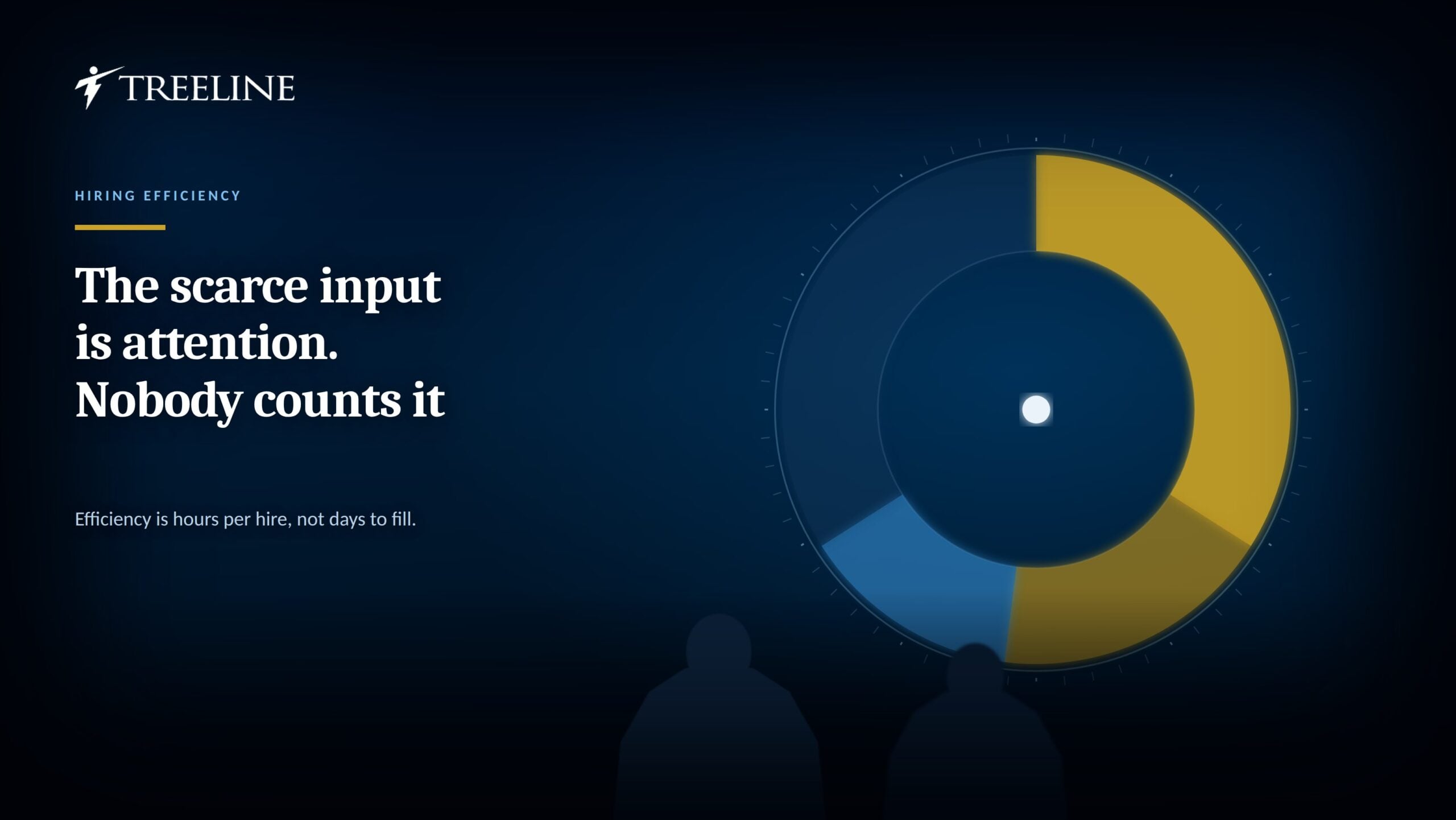
Efficiency in hiring is almost always discussed as speed, and that is the wrong measure. Efficiency is output per unit of input, and the input that constrains sales hiring is not calendar time or fee budget. It is the attention of the small number of expensive people who have to assess candidates, the hiring manager, the interviewers, the executive who approves the offer.
A contingency placement firm improves efficiency to the extent that it reduces how many of those hours are consumed per hire, and a search can get faster while getting less efficient if the speed was bought by putting more people in more rooms. That input has a price, and it is higher than most companies assume. The U.S. Bureau of Labor Statistics reports in its Employer Costs for Employee Compensation release that total employer compensation costs for private industry workers averaged $46.60 per hour worked in March 2026, with wages and salaries at $32.60 and benefits at $14.01, benefits accounting for just over 30 percent of the total.
More usefully for this purpose, the same release puts total employer compensation for private industry workers at $89.70 per hour worked at the 90th wage percentile. Those are economy-wide figures rather than sales-specific ones, so they are a floor rather than a benchmark, but they establish the point: an hour of a senior person’s attention is not free, and hiring consumes it in quantities nobody counts.
Dan Fantasia, CEO of Treeline, Inc., treats hiring efficiency as a question of what reaches the hiring manager rather than how quickly it reaches them. From his perspective the most expensive thing a recruiting partner can do is forward candidates, because every unqualified person who reaches a calendar converts the client’s most limited resource into nothing.
Efficiency Is Not the Same as Speed
The two get conflated because they often move together, but they can move in opposite directions and frequently do. A search can be made faster by adding people to the process. Run two panels in parallel, bring in a third interviewer to cover a gap, have the hiring manager screen a longer list personally over a weekend.
Elapsed time falls. Total hours consumed rises, and those hours came out of the revenue organisation. A search can also be made more efficient while getting slower. A firm that screens harder submits fewer candidates, which means fewer interviews and fewer wasted hours, but the first submission may take longer to arrive.
Time-to-fill worsens. The cost of the hire, properly counted, falls. Neither pattern is inherently right. What matters is knowing which one you are buying, because the two measures point at different remedies and most employers only track the one that is easier to see.
The Input That Is Actually Scarce
Consider what a sales hiring process actually spends. Money is spent, but the fee is a known number that appears once. Calendar time is spent, and it matters mainly through vacancy cost. Attention is spent continuously, is drawn from the people least able to spare it, and appears on no report anywhere. That last point is the reason it goes unmanaged.
A hiring manager who spends eleven hours in a month interviewing enterprise account executive candidates has spent eleven hours not coaching a struggling rep, not inspecting a slipping deal, and not running the forecast. The opportunity cost lands on the number they are accountable for, which means a badly run hiring process degrades the performance of the team it was meant to strengthen.
There is a compounding version of this that gets overlooked. When hiring consumes a manager’s month, the quality of their attention in the interviews themselves falls. Assessments get shallower, notes get thinner, and the decision that follows rests on worse information, which raises the chance of a mis-hire and another search.
Pricing an Hour of Attention
Putting a number on it changes the conversation, and the arithmetic is simple enough to do in a meeting. Take the fully loaded hourly cost of the people involved. The BLS figures above give a defensible floor: roughly $90 per hour worked at the 90th wage percentile in private industry, once benefits are included. For an experienced sales manager or director in a competitive market the real figure is higher, and the honest way to handle that is to use your own compensation data with something like the 30 percent benefits loading the ECEC release reports rather than pretending an hour costs the base salary rate.
Then count the hours a single search actually consumes. Intake and requirement definition. Résumé review. Screening calls that a firm should have absorbed. First-round interviews. Second and third rounds. Debriefs. Reference conversations. Offer discussions. Scheduling overhead, which is real and invisible. For a moderately complex sales hire with four interviewers, thirty to fifty hours of collective senior time is a reasonable expectation, and it is easy to reach double that when screening has not been done properly upstream.
At a fully loaded rate, the attention cost of a search is frequently comparable to the placement fee, and unlike the fee, it is paid whether or not anyone is hired. Fantasia’s observation is that employers negotiate hard on the fee and never price the attention, which produces decisions that look prudent and are not. He recommends counting the hours on the last completed search before the next fee conversation, because the two numbers turn out to be closer than anyone expects.
An Attention Budget for a Sales Search
Setting a budget before the search opens changes behaviour more than any process change, because it forces a decision about what the expensive people will and will not do. A contingency hire changes the arithmetic here rather than removing it, since the internal assessment hours remain yours either way. A workable budget names three things.
First, the maximum number of candidates any interviewer will meet, not per week, but for the whole search. Second, who does not need to be in the loop, which is the harder half. Third, what has to be true for a candidate to reach each stage. The third item is where most of the saving comes from. If a candidate reaching the hiring manager must already have been assessed against deal size, sales motion, and compensation fit, then a manager who meets four people is meeting four viable ones.
If those checks happen during the manager’s interview instead, the manager is doing screening work at a hiring manager’s hourly cost. Two practical rules make a budget stick. Interviewers who are not assessing a defined competency do not attend. And any stage that has never once eliminated a candidate should be removed, because it is consuming attention without producing information.
Who Pays, and Why That Matters
Attention has an owner, and the reason hiring processes drift toward inefficiency is that the person who designs the process is rarely the person whose hours it consumes. Talent acquisition typically owns the process. Interview stages get added because a stakeholder asked to be involved, because a previous hire failed and a round was added in response, or because the loop was inherited.
Each addition is individually reasonable and costs the designer nothing. The hours land on the hiring manager and the interviewers, who absorb them alongside a number they are accountable for. Because nobody bills those hours anywhere, the accumulation is invisible until someone is visibly overloaded, at which point the response is usually to reduce the number of candidates rather than the number of hours per candidate, which is the wrong lever, because it lowers the quality of the shortlist while leaving the inefficiency untouched.
There is a straightforward correction. Whoever designs the loop should have to state its total hour cost before it is approved: number of stages, number of interviewers, expected candidates, multiplied out. That figure is usually surprising the first time anyone computes it, and the conversation it produces is more productive than any general appeal to move faster.
It also changes what an external partner is being asked for. An employer who knows their loop consumes forty hours per hire is in a position to ask a firm which of those forty it will remove, and to hold them to it.
Where the Hours Go That Should Not
These are the specific leaks, and they recur across companies with remarkable consistency.
- Résumé review by the hiring manager. The most expensive person in the process performing the cheapest task in it, usually because the filtering upstream is not trusted.
- Screening calls that duplicate the recruiter’s. Two conversations covering the same ground because nobody wrote down what the first one established.
- Interviewers without an assigned competency. Four people all assessing overall impression produce one assessment at four times the cost.
- Rescheduling. Every cancelled interview costs the preparation twice and pushes the whole loop.
- Debriefs without pre-submitted ratings. A forty-minute discussion that would have taken fifteen if everyone had written their view down first.
- Candidates who reach a final round with an unresolved compensation gap. Every hour spent on them was spent on an outcome that could not happen.
- Interviews scheduled before the scorecard was agreed. Everyone assesses something slightly different and the debrief becomes a negotiation about criteria rather than about candidates.
- Re-litigating the requirement mid-search.
Each redefinition invalidates the assessments already made and quietly restarts the process. None of these are exotic. What they share is that they are invisible in a time-to-fill number and obvious in an hours-per-hire number.
What a Contingency Placement Firm Absorbs
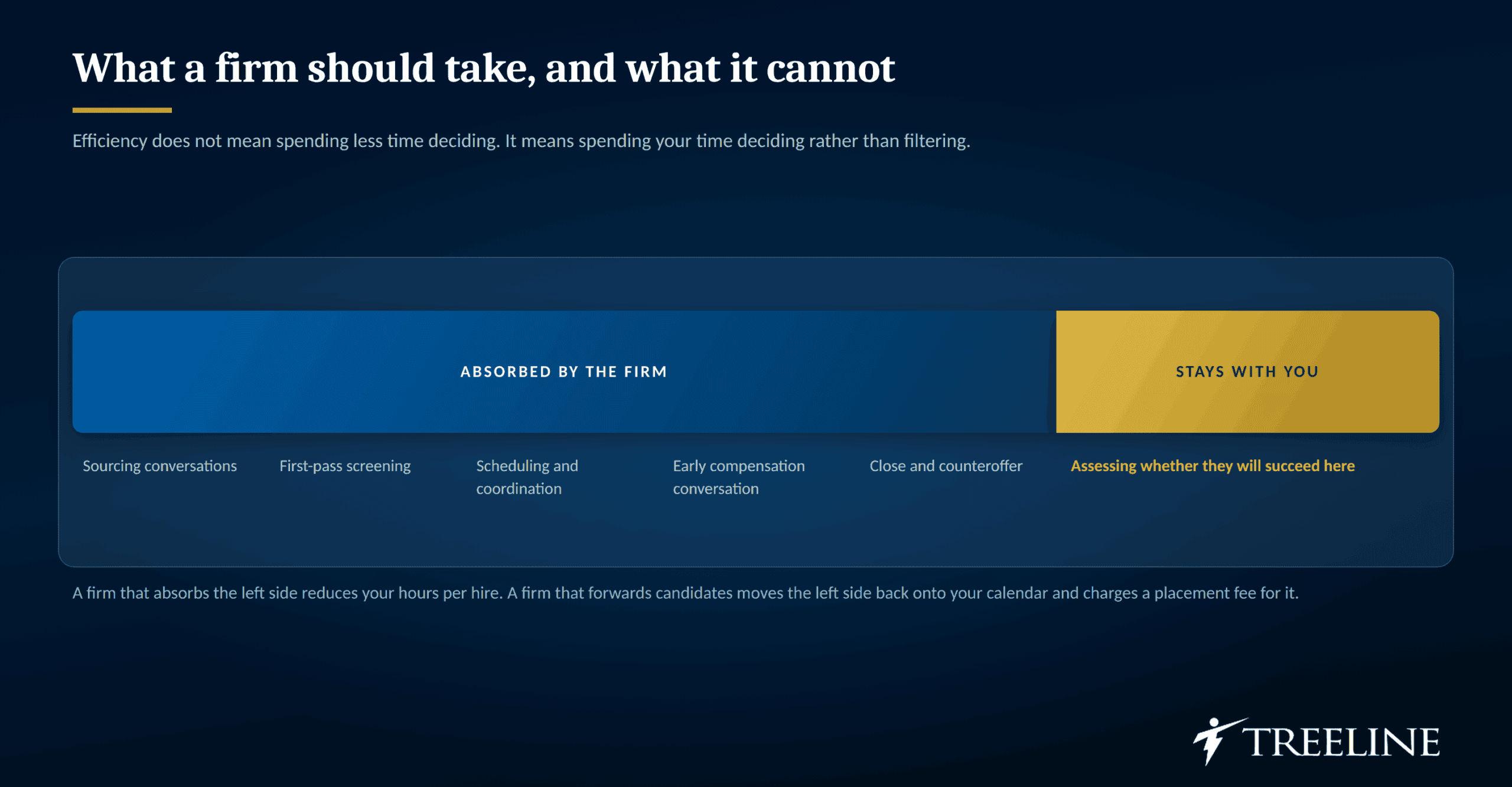
The value of a contingency recruiting agency, framed in these terms, is specific rather than general. Contingency recruiting removes the sourcing conversations entirely, including the large majority that go nowhere. For a role where most qualified people are employed and not looking, that is a substantial volume of work that would otherwise sit with someone internal.
Contingency recruiters absorb first-pass screening, which is where the hours-per-hire number is mostly won or lost. A firm that submits four candidates for three interviews has removed the filtering burden. A firm that submits fifteen has moved it onto your team while charging a placement fee for the privilege. It absorbs scheduling and coordination, which is unglamorous and consumes more hours than anyone credits, particularly across multiple interviewers and time zones.
It absorbs the compensation conversation early, so that candidates with an unbridgeable gap never reach a final round. Contingency executive search firms working senior roles typically handle this at first contact, because at that level a late discovery costs several people’s afternoons. And it absorbs the close, preparing candidates, anticipating counteroffers, managing the period between acceptance and start date.
That work happens outside your organisation entirely. The division looks like this. What it cannot absorb is the assessment itself, which is the part that should consume your attention. Efficiency does not mean spending less time deciding. It means spending your time deciding rather than filtering.
The Submission Ratio Is an Attention Metric
Read in this light, the submission-to-interview ratio stops being a quality indicator and becomes a cost one. If a firm submits ten candidates and you interview two, eight sets of résumé reviews and internal discussions were consumed producing nothing. If a firm submits four and you interview three, the same hire arrives having spent a fraction of the attention.
The difference between those two engagements is not visible in the fee and is very visible in the calendar of the person who runs your sales team. This is also why judging a recruiting partner on submission volume inverts the incentive you actually want. Volume is cheap for the firm to produce and expensive for you to absorb.
A firm that rejects most of the market before you see anyone is doing the work you are paying for, and the honest way to check is to ask how many candidates they considered and declined before the first submission arrived. There is a caveat worth holding. A very low submission count paired with a very long wait can mean the firm is not working the search rather than filtering it well.
Read the ratio together with time to first submission; the combination you want is few candidates, arriving quickly, which only a firm with existing relationships in your market can produce. Fantasia frames submission volume as a transfer of cost rather than a measure of effort. His practical suggestion is to ask a prospective firm how many people they reviewed before the first submission arrived, because the answer describes where the filtering will happen and therefore whose hours will pay for it.
Designing the Loop for Fewer Hours, Not Fewer Steps
Cutting interview stages is the obvious move and usually the wrong one, because it removes information rather than waste. The better approach is to redesign what each stage does. A single ninety-minute structured conversation that reconstructs two real deals in detail replaces three shallow forty-minute interviews and produces more evidence, not less.
That is a reduction of roughly an hour of candidate time and several hours of collective interviewer time. Assigning each interviewer a defined competency has a similar effect. Four people assessing different things generate four independent assessments. Four people assessing general fit generate one assessment, redundantly, at four times the cost.
Pre-submitted written ratings shorten debriefs substantially and improve them, because the discussion starts from independent views rather than converging on whoever spoke first. And batching interviews into a single block removes both waiting and preparation overhead, since interviewers context-switch once rather than four times.
Fantasia’s view is that the loop should be designed around what each stage is capable of eliminating. His test is to ask, for every stage, when it last caused a candidate to be rejected, and to remove any stage where nobody can remember an instance.
How a Tight Process Reads to a Candidate
Optimising a process around internal hours has an external consequence that is easy to miss, and getting it wrong costs more than the hours saved. A candidate experiences your process as a sample of your company. A loop that is tight, coordinated and well-briefed reads as an organisation that functions. A loop that is short because nobody could be bothered reads as indifference, and experienced sellers distinguish between the two easily.
The distinguishing features are small and cheap. Interviewers who have read the résumé rather than opening it in the meeting. Questions that do not repeat across four conversations. A scheduler who confirms rather than proposing and disappearing. Feedback that arrives when it was promised. None of those consume additional hours; several of them save hours.
There is a version of efficiency that damages the candidate experience specifically, which is compressing everything into the minimum number of touchpoints. A candidate weighing a significant career move needs enough contact to form a view of the people they would work with, and denying them that in the name of efficiency loses candidates at final stage, which is the most expensive place to lose one.
The reconciliation is that internal hours and candidate contact are not the same quantity. A candidate can spend four hours with your company while your company spends six, if those hours are well designed. The waste is in duplication and coordination, not in the conversations the candidate values.
Enterprise Account Executive Searches Cost the Most Attention
This role deserves separate treatment because it consumes senior attention at a higher rate than any other individual contributor hire, and for structural reasons. The assessment is genuinely harder. Establishing whether an enterprise account executive can run a multi-stakeholder deal requires reconstructing real opportunities in detail, and that cannot be done in a thirty-minute conversation by someone who has not sold in that motion.
It usually requires the person who runs the enterprise team personally, which is the most expensive attention in the building. The interview loop is also wider. An enterprise seller frequently meets marketing, sales engineering, and sometimes a customer success or product counterpart, because those relationships determine whether they can operate.
Each of those is an hour of someone senior. And the qualified population is small, which means more sourcing conversations per viable candidate. If that work sits internally, it consumes a disproportionate share of a leader’s month for a single seat. The consequence is that the case for a contingency placement firm is strongest exactly here, not because the role is senior, but because the ratio of screening work to assessment work is at its most unfavourable.
An employer who absorbs enterprise account executive sourcing internally is paying senior management rates to do recruiting coordination, and the cost lands on the same number the hire was meant to improve.
The Multi-Hire Case
Everything above compounds when a company is hiring several sellers rather than one, and the compounding runs in both directions. The favourable direction is that fixed costs amortise. The intake conversation, the scorecard, the calibration of what a good candidate looks like, these are paid once and reused across every subsequent hire in the same profile.
A firm running four searches for the same role should be materially more efficient on the fourth than the first, and if it is not, the learning is not happening. The unfavourable direction is that assessment hours scale linearly and hit the same small group of people. Four enterprise account executive hires in a quarter is not four times one search’s inconvenience; it is a sustained draw on the same manager’s calendar during the quarter they are also expected to hit a number.
This is where hiring plans quietly fail, not because candidates could not be found, but because the organisation could not absorb the assessment load. Two mitigations are worth planning in advance. Distribute assessment across more than one qualified interviewer so the load does not concentrate, accepting that this requires calibrating those interviewers first.
And stagger the searches deliberately rather than launching them together, since simultaneous launches produce simultaneous final rounds. A partner should be part of this conversation rather than receiving four requisitions and working them in parallel. Asking how they would sequence four searches, and why, is a reasonable test of whether they are thinking about your capacity or their pipeline.
Measuring Hours per Hire
The measurement is straightforward and almost nobody does it, which is why it is worth doing. For your next search, have each participant log time in three buckets: reviewing candidates, interviewing, and everything else including scheduling, debriefs and internal discussion. Rough numbers are fine; the precision that matters is which bucket dominates.
Then compute two figures. Total senior hours per hire, and the proportion of those hours spent on candidates who were not hired. The second is the waste number, and in most companies it is above seventy percent, which is not automatically bad, since assessment necessarily involves rejecting people, but it becomes bad quickly when the rejections happen at the wrong stage.
The pattern to look for is where in the funnel the rejected-candidate hours were spent. Hours spent rejecting people at first-round stage are the system working. Hours spent rejecting people at final-round stage are a screening failure upstream, and that is a conversation to have with your partner. Track it across three searches and the number becomes actionable.
Track it once and it is an anecdote.
Efficiency Between Searches, Not Just Within Them
Most of this article treats a single search in isolation, which is how companies usually think about hiring and part of why the same hours get spent repeatedly. Consider what gets thrown away at the end of a typical search. The scorecard, which took real work to define. The calibration between interviewers about what a strong answer sounds like.
The list of candidates who were good but not selected, or who were strong and unavailable. The reasons offers were declined. Six months later a similar role opens and most of that is reconstructed from memory, badly. Retaining it is cheap. A half-page record of what the role required and what decided it. A short list of near-miss candidates with dates and the reason each did not proceed.
The stated reasons for any declines. Fifteen minutes of work at the end of a search that removes several hours from the next one. The same logic applies to the external partner. A firm that has run three searches for you should need a shorter intake, produce a more accurate first submission, and require less correction than on the first.
If each engagement starts from zero, you are paying the setup cost repeatedly, and that is a reason to consolidate rather than to rotate firms for a marginally better fee. There is an honest limit. This only pays off if the roles are genuinely similar. Accumulated context about enterprise sales hiring transfers poorly to a completely different function, and a firm claiming otherwise is describing a general capability rather than a specific one.
Where Efficiency Becomes False Economy
Pushed too far, this argument produces worse hiring, and the failure modes are worth naming. Removing assessment to save hours is the obvious one. A shorter loop that no longer surfaces whether someone can run your deal motion has not become efficient; it has become cheap, and the mis-hire that follows costs more than every hour saved.
Delegating the assessment entirely is the subtler one. A firm can absorb sourcing, screening, coordination and closing. It cannot decide whether a person will succeed in your organisation, and an employer who outsources that has confused efficiency with abdication. Optimising for the manager’s calendar at the candidate’s expense is the third.
Compressing a candidate’s experience into one rushed conversation may save internal hours and lose the candidate, and strong people read a thin process as a signal about the company. And treating every stage as removable eventually removes the one that was doing the work. This is why the test is whether a stage has ever eliminated someone, not whether it feels necessary.
Fantasia’s position is that the waste number is more diagnostic than the total. He points out that a high share of hours spent on candidates who were not hired is normal and healthy at the front of a process and alarming at the end, so the useful question is never how much time was spent but at which stage it was spent.
A Worked Example of the Arithmetic
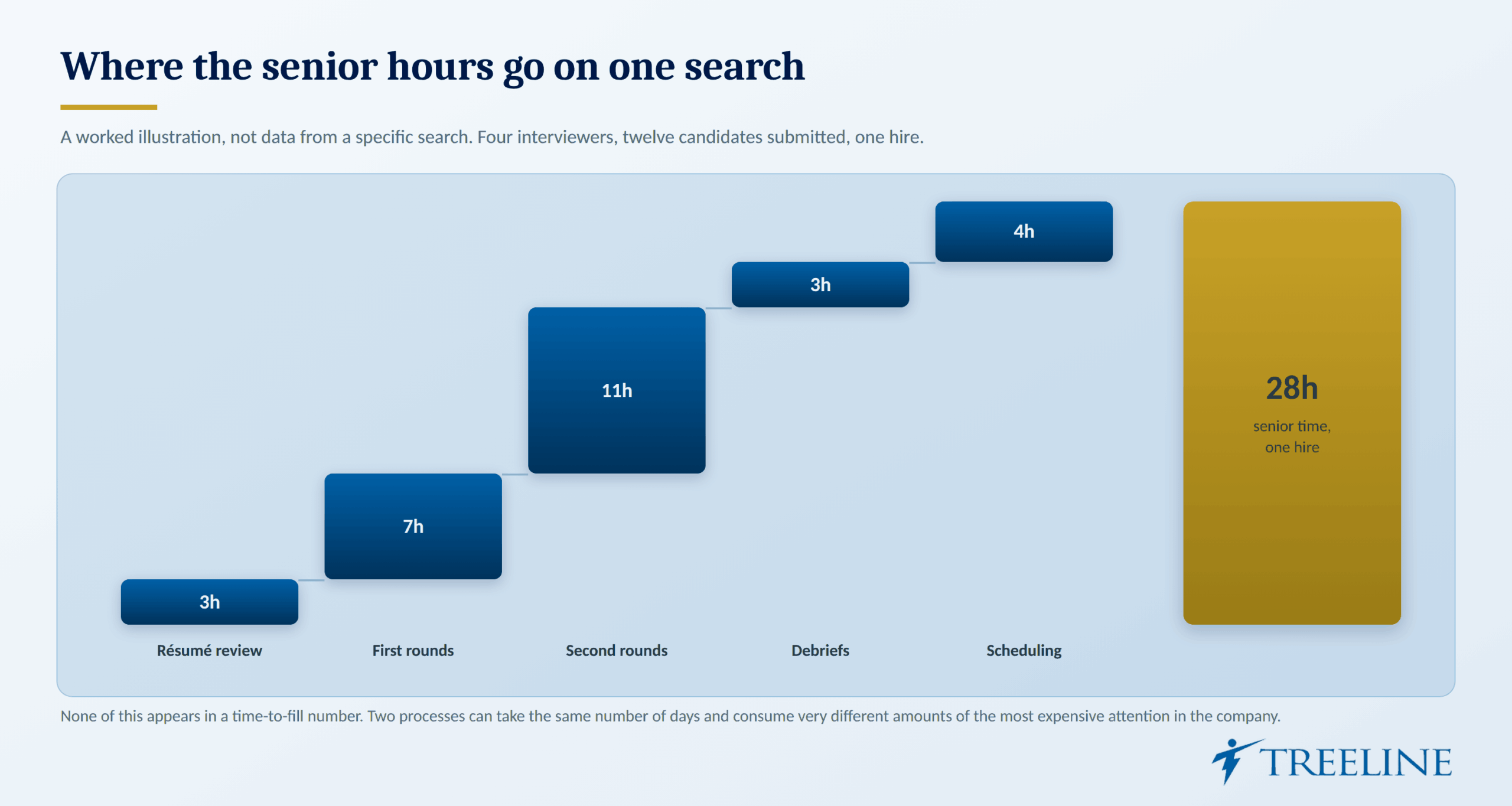
Putting numbers to it makes the argument concrete, and the following is an illustration rather than data from a specific search. Suppose a company runs an enterprise account executive search with four interviewers. Twelve candidates are submitted, of whom five are interviewed in a first round, three go to a second, and one receives an offer.
Count the hours. Résumé review across twelve candidates at fifteen minutes each is three hours. Five first-round interviews at an hour, plus preparation and notes, is around seven hours. Three second rounds involving three interviewers each is roughly eleven hours. Debriefs add three. Scheduling and internal discussion, honestly counted, add four.
The total is close to twenty-eight hours of senior time for one hire, distributed as shown below. Now change one variable. A firm that submits five well-screened candidates instead of twelve removes roughly two hours of review and, more importantly, removes two first-round interviews that were never going to progress, around four hours.
The same hire arrives having consumed about twenty-two hours instead of twenty-eight. At a fully loaded senior rate, that difference is not trivial, and it recurs on every search. It is also invisible in a time-to-fill number, which is the point: the two processes might have taken exactly the same number of days.
When Spending More Attention Is Correct
There are situations where the efficient answer is to spend more, not less, and recognising them prevents a real error. A first-of-kind hire justifies extra attention because the requirement is unproven, and the hours spent defining it are cheaper than the hours spent assessing against a wrong definition. A hire who will build a team justifies it, because the cost of getting it wrong is multiplied by everyone they subsequently hire.
A candidate who is genuinely borderline justifies it, though the extra spend should buy a different kind of evidence rather than another conversation covering the same ground. And a search following a failed hire in the same seat justifies it, because the diagnosis of what went wrong is worth more than the hours it consumes.
The common thread is that additional attention should be spent on deciding, never on filtering. Filtering is the work to move outside; deciding is the work to keep. There is one more case worth naming, because it looks like inefficiency and is not. Time spent at the very start defining what the role must change is the highest-return attention in the whole process, and it is the first thing cut when a requisition feels urgent.
An hour spent there removes several later, because every subsequent assessment is measured against a clear standard rather than an evolving one. Employers who feel they cannot spare that hour almost always spend it anyway, distributed across six interviews as confusion.
What to Ask Before You Engage
Framed as an attention question rather than a fee question, the intake conversation with any prospective firm changes shape. These are the things worth establishing.
- What will you screen for before we see anyone? Listen for specific disqualifiers rather than a general commitment to quality.
- How many candidates do you expect us to interview per hire? A firm that cannot estimate this has not thought about your cost.
- Who schedules? Coordination consumes more hours than anyone credits, and it is entirely delegable.
- When do you discuss compensation with candidates? Late discovery of a gap wastes every hour spent on that candidate.
- What will you hand over about each submitted candidate? A written assessment against the scorecard removes duplicate screening on our side.
- What do you need from us, and how many hours will that take? A firm that answers honestly is describing a real process.
- How will the fourth search differ from the first?
If the answer is that it will not, the relationship is transactional and should be priced that way. The last question is the one that separates firms. A partner accumulating context across searches becomes cheaper in attention terms over time. A partner starting fresh each time does not, regardless of what happens to the fee.
Frequently Asked Questions
What does hiring efficiency actually mean?
Output per unit of input, where the binding input is the attention of expensive people rather than calendar time. A useful measure is senior hours consumed per hire, and specifically what share of those hours were spent on candidates who were not hired. Time-to-fill measures something different and can improve while efficiency worsens.
How much does an hour of hiring attention cost?
More than the base salary rate, because benefits add roughly 30 percent to employer cost in private industry. BLS puts total employer compensation for private industry workers at $46.60 per hour worked on average and $89.70 at the 90th wage percentile, which is an economy-wide floor rather than a sales-specific figure. Use your own compensation with a benefits loading for a real number.
What should a contingency placement firm take off our plate?
Sourcing conversations, first-pass screening, scheduling and coordination, the early compensation conversation, and the close including counteroffer preparation. What it should not take off your plate is the assessment itself, deciding whether someone will succeed in your organisation is the part your attention should be spent on.
Is a low submission count a good sign?
Usually, provided the first submission still arrives reasonably quickly. Few candidates arriving fast indicates a firm working from existing relationships and filtering properly. Few candidates arriving very slowly can indicate a firm that is not working the search. Read the two numbers together rather than either alone.
How do we reduce hours without lowering the bar?
Redesign stages rather than removing them. One structured ninety-minute conversation that reconstructs real deals replaces three shallow interviews and yields more evidence. Assign each interviewer a defined competency so assessments are independent rather than redundant. Collect written ratings before debriefs. Batch interviews into a single block.
Which interview stages should we cut?
Any stage that cannot be shown to have eliminated a candidate. If nobody can remember the last time a given round changed an outcome, it is consuming attention without producing information. That test is more reliable than judging which stages feel important.
Why is an enterprise account executive search more expensive in attention terms?
The assessment requires reconstructing complex deals, which usually needs the sales leader personally. The loop is wider because the seller must work with marketing, sales engineering and other functions. And the qualified population is small, so there are more sourcing conversations per viable candidate. The screening-to-assessment ratio is at its least favourable.
What is the single number worth tracking?
The share of senior hours spent on candidates who were not hired, broken down by the stage at which they were rejected. Hours spent rejecting at first round are the system working. Hours spent rejecting at final round indicate a screening failure upstream, which is a specific and fixable problem.
Count the Hours on Your Last Search
Treeline, Inc. is a sales-only executive search firm based in Wakefield, Massachusetts, working exclusively on building sales organizations. Our contingency sales recruiting service carries no upfront cost and no fee unless you hire, and we deliver your first candidate within three days of launching a search. If you want a straight read on whether your process is efficient, count the senior hours your last completed search consumed and where they went.
Get in touch and we will tell you which of those hours we would expect to take off you, and which ones should stay with you.
Share This Story, Choose Your Platform!
Related Posts


What our happy clients are saying
Treeline Inc. provided us with the most candidates that aligned with our needs and were of the highest quality.

Dr. Jeffrey Klein Head of North America Sales, Satchel Pulse
Treeline Inc.’s collaborative, flexible, and communicative approach resulted in a smooth partnership. Beyond their recruitment expertise, their unique sourcing model was efficient and effective.

Sera Holt Director of Operations, LNS Research
Their professionalism was outstanding. Treeline Inc. was extremely thorough and ensured that we were on the same page before they started looking for candidates. They listened to us and did a great job working with the candidate to close out the process.

Cate Grant AVP Customer Success, Nasdaq
Thanks to Treeline Inc.’s intricate and thorough screening process, the company is able to hire six high-quality candidates that fit perfectly in the company’s culture. The team is highly receptive to concerns, and internal stakeholders are impressed with their unique recruitment abilities.

Anna McKean Sales Recruiter, Insider Intelligence
Treeline Inc. has been qualified individuals throughout a five-year-long engagement. They’ve made numerous placements of talented and qualified individuals for our business.

Michele St Laurent VP of HR, The Institute for Applied Network Security

Let Us Help You Source the Sales Talent You Need
Whether you’re building a team or replacing a key role, our Candidate Sourcing Platform provides a fast, flexible, and employer-focused solution.
Tell us more about your business and how we can help.
Treeline Inc.
Your Award-Winning Sales Recruitment Partner
15 Lincoln Street, Suite 314, Wakefield, MA 01880