The argument for contingency sales recruiting in a competitive market is not really about fees. It is about who carries the risk that a search does not close. When the market is tight, the probability that any given search produces a hire falls, and the difference between paying regardless of outcome and paying only on success stops being a pricing detail and becomes the main term of the deal.
Before accepting that a market is competitive, though, it is worth checking. The U.S. Bureau of Labor Statistics publishes two measures that turn the question into something observable. The first is the location quotient, which its Occupational Employment and Wage Statistics overview defines as the ratio of an occupation’s share of employment in a given area to that occupation’s share of employment nationally, an occupation making up 10 percent of employment in one metro area against 2 percent nationally would have a location quotient of 5.
The second is the spread between percentile wages, where a percentile wage estimate marks the value below which a given share of workers fall. Read together, those two tell you more about your hiring conditions than any general commentary about a tough market. Dan Fantasia, CEO of Treeline, Inc., regards the choice between search models as a question about who should absorb uncertainty rather than about which is cheaper.
From his perspective the sensible test is to ask what happens if the search does not produce a hire, and to notice that the answer differs enormously between the two structures precisely when the market makes that outcome most likely.
Make “Competitive Market” a Measurement
Employers describe markets as competitive on the basis of recent frustration, which is a poor instrument. Two searches that went badly may reflect the market, or a compensation band, or a slow process. Separating those requires data that exists and is free.
Location Quotient Tells You Where the People Are
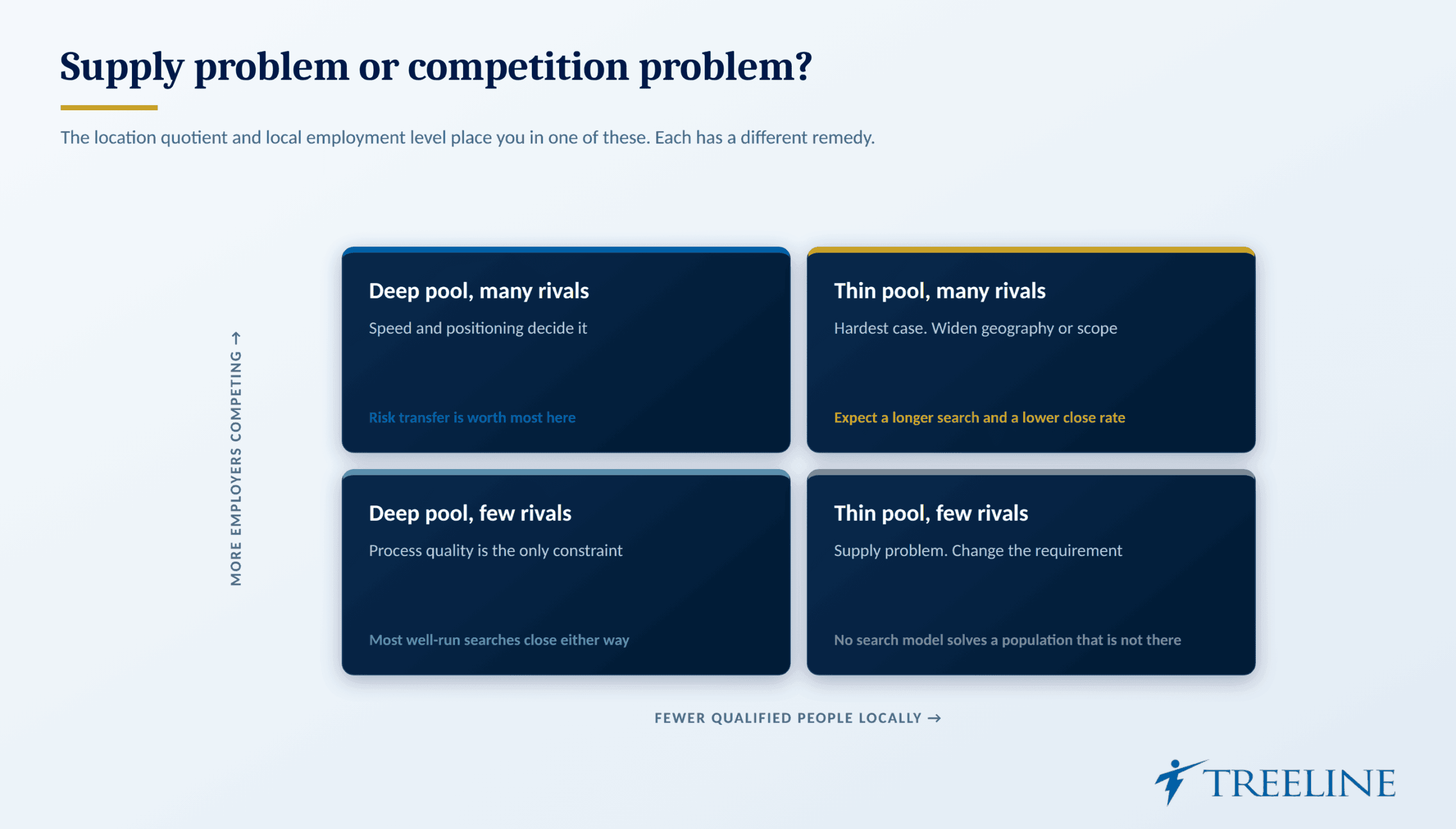
The location quotient compares the local concentration of an occupation with the national picture, and it is more informative than a raw headcount. A high figure means the occupation is unusually concentrated in your area. That cuts both ways, and the ambiguity is the useful part. A deep local pool means more qualified people within commuting distance.
It also means more employers competing for them, because those employers are why the concentration exists. A low figure means the reverse: fewer competitors, but also fewer candidates, and a stronger case for looking beyond the immediate geography or accepting a remote arrangement. Neither reading points automatically to one search model.
Combined with the local employment level it places you in one of four situations, shown below. What the number does is replace a guess with a fact, and it frames the right follow-up question, whether your difficulty is a supply problem or a competition problem, because those have different remedies.
Wage Spread Tells You How Hard Employers Are Fighting

The distance between the median and the upper percentiles is the closest available proxy for competition at the top of a market. Where the 75th and 90th percentile wages sit far above the median, employers are paying substantial premiums for the better end of the distribution, which is what competition looks like in wage data.
Where the distribution is compressed, the market is paying roughly the same for most practitioners, and money is a weaker lever than it appears. A typical sales wage distribution is right-skewed, as below. Two cautions matter here, and both are stated by BLS itself. Percentile wages should not be averaged across occupations, because combining unequal distributions produces a figure that does not mean what it appears to mean.
And the OEWS programme does not release some percentile wages for especially high-paying occupations, which is directly relevant to senior sales roles: the published figure may be a ceiling imposed by the data rather than a description of the market. An employer benchmarking a role whose real earnings sit above that ceiling is reading a truncated distribution.
What the Data Cannot Tell You
Neither measure captures the thing that most determines your experience, which is how many employers are actively hiring the specific profile you want, right now. Occupational data is broad. The published category for sales representatives contains people selling wildly different things to wildly different buyers, and the subset who can run your motion is invisible inside it.
The data also lags, since OEWS estimates are constructed from panels collected over a three-year period. This is precisely the information a firm working your market continuously does have, and it is worth being explicit that it is the complement to the public data rather than a substitute for it. Use the published measures to establish the structure of the market, and a specialist partner to establish its current temperature.
Fantasia’s view is that most employers skip the structural question entirely and go straight to the anecdotal one. He suggests spending an hour with the public data before the first conversation with any firm, because an employer who knows whether they face a supply problem or a competition problem asks materially better questions and is much harder to sell to.
Running the Check on Your Own Role
The measures above are only useful if you actually pull them, so it is worth being concrete about how. Start by choosing the occupational code that best contains your role, accepting that the fit will be imperfect. For most quota-carrying sales roles the relevant categories are the sales representative groupings; for people-managing roles it is the sales manager category.
Then pull three things for your metropolitan area: the employment level, the location quotient, and the wage percentiles. Read them in that order. Employment tells you the absolute size of the local pool, which is the number most employers guess wrongly and usually guess high. The location quotient tells you whether that pool is unusually deep or thin relative to the country, which is what determines whether looking outside your geography is likely to help.
The percentiles tell you what the market pays across the distribution, and specifically how much separates the middle from the top. One interpretive caution. A large local pool in a broad occupational category does not mean a large pool for your requirement, and the gap between the two is where most hiring frustration originates.
The published data describes an occupation; you are hiring for a motion. Treat the numbers as establishing the outer boundary of what is possible rather than as a description of your candidate set.
What Competition Actually Does to a Search
Competition changes the arithmetic of a search in a way that is worth stating plainly, because it is what makes the model choice consequential. In a loose market, most well-run searches close. The qualified population is reachable, candidates are receptive, and the main variable is how well the employer executes. Under those conditions the difference between paying upfront and paying on placement is largely a cash-flow question.
In a tight market, a meaningful proportion of well-run searches do not close. The candidate takes another offer, accepts a counteroffer, or decides the timing is wrong. Nothing was done badly; the outcome simply did not arrive. Once that probability is material, the question of who absorbs it dominates everything else about the commercial structure.
This is also why comparing the two models on headline cost misleads. A retained fee is paid whether or not the outcome arrives. A contingency fee is a payment made only in the state of the world where you got what you wanted. Those are different instruments, and in a market where the failure state is more likely, the difference is worth more.
Contingency Sales Recruiting as Risk Transfer
Framed properly, a contingency engagement transfers a specific risk from the employer to the firm, and it is worth being precise about which one. The risk transferred is outcome risk on that search. If the market cannot produce someone who fits at the compensation offered, the firm has spent weeks of effort and receives nothing.
The employer has spent internal time, which is real, but no fee. Several things follow from that structure.
- The firm is underwriting your requirement. A firm that accepts a search is making a judgment that it can be closed. A firm that declines, or that pushes hard on the band or the scope before accepting, is telling you something about the requirement that is worth hearing.
- Effort follows probability. Because payment depends on the outcome, contingency recruiters allocate attention toward searches they expect to close. This is the price of the transfer, and it is discussed below.
- The incentive on closure is genuine. It produces real urgency on scheduling, feedback and offer decisions, which is exactly what a competitive market rewards.
- The risk is not eliminated, only moved.
Your vacancy cost continues regardless of who bears the fee risk, and that cost is usually larger than the fee. The last point deserves emphasis, because employers frequently optimise the fee and ignore the vacancy. For a quota-carrying seat, the annual number divided across the year and multiplied by the months the seat stays empty is the figure that should anchor the conversation.
What You Pay for the Transfer
Presenting risk transfer as free would be dishonest. The employer pays for it in a currency other than money, and understanding that currency is what makes the model work in your favour. You pay in priority. A firm carrying several searches works the ones most likely to close first. If your band is uncompetitive, your scope is vague, or your decision process is slow, your search quietly moves down the queue and you will rarely be told directly.
In a competitive market this effect is amplified, because the firm has more opportunity to reallocate. You pay in exclusivity, or rather in the absence of it. Non-exclusive engagements mean no firm is contractually committed to completing your search, and none is obliged to produce a market map showing what they did not find.
And you pay in information asymmetry. The firm knows how hard your search is proving. You see submissions, not the conversations that did not happen, which is why asking about declines and their stated reasons matters more here than anywhere else. The practical response is to make yourself the search that gets worked first: pre-authorise the band, commit interview slots, return feedback quickly, and tell the firm plainly what you are committing to.
That is not a favour to the recruiter. It is how you buy priority in a structure where priority is the scarce good. There is a way to make the priority question explicit rather than leaving it to inference. Ask the firm directly, at intake, where your search would sit against the others on their desk and what would move it up.
A firm that answers candidly is describing a real allocation process and giving you the levers. A firm that says every client gets the same attention is describing something that cannot be true of any business paid on outcomes, and the answer tells you how much of the rest of what they say to discount. Fantasia argues that employers in competitive markets consistently negotiate the wrong variable.
His observation is that a percentage point on the fee is worth far less than being the client whose search a firm opens on Monday morning, and that the second is available to any employer willing to be easy to work with.
Where Enterprise Account Executive Hiring Sits on This Spectrum
The general argument lands hardest on this role, which is worth working through because the numbers behave differently from most. An enterprise account executive search sits in the most adverse combination of conditions. The qualified population is small, defined less by job title than by the ability to run a specific motion into a specific buyer.
Almost all of those people are employed and performing, which means they are not applying anywhere. And because they are performing, their current employers will move to keep them. Under those conditions the probability that any individual search closes is genuinely uncertain, and it is uncertain for reasons largely outside the employer’s control.
That is the textbook case for transferring outcome risk rather than absorbing it. There is a second-order point that matters more than it appears. Because the qualified population is small, the same people are approached repeatedly by different employers. How your opportunity is described, and by whom, becomes part of your standing in a market you will return to.
A firm that has a relationship with those people is not only more likely to reach them; it is more likely to be answered. This is also where contingency executive recruiters working a defined segment separate themselves from generalists, because the relationship is the asset and it cannot be assembled on demand. The practical consequence is that for an enterprise account executive requirement, the choice of firm matters more than the choice of model.
Contingency is usually the right structure. Whether the specific firm holds live relationships in your segment is what determines whether the structure produces anything.
What Changes About the First Conversation
A competitive market changes the outreach itself, not just the process that follows, and this is where an enterprise account executive search differs most from a mid-market one. In a loose market, a well-written description of an opportunity does much of the work. In a tight one, the people you want receive several such messages a week and have stopped reading them.
What earns a reply is evidence that the sender understands the specific world the candidate operates in, the buyer they call on, the competitor they lose to, the structural problem their current employer has. That is not a copywriting improvement. It is a knowledge requirement, and it is the reason market-specific depth outperforms reach under competition.
A firm that has placed into your segment repeatedly can open a conversation in a way that a firm working from a keyword search cannot, and in a market where the population is small and heavily approached, the first conversation is most of the contest. There is a corollary worth stating. If your search partner’s outreach is generic, you are not competing on equal terms with employers whose partner’s outreach is not, regardless of how good your opportunity actually is.
What Competitive Markets Do to Compensation
Competition expresses itself in pay before it expresses itself anywhere else, and reading that correctly prevents a common error. The error is treating a competitive market as a reason to raise the band alone. Compensation needs to be competitive enough to remove itself as an objection, and beyond that point additional money buys less than employers expect, because the candidate’s current employer can respond in kind within a day.
The more durable levers in a tight market are the ones a counteroffer cannot match: the territory as it will actually exist, the manager the person will work for, the honesty of the pipeline description, and the speed of the process. Those are not free, but they are not budget items either. There is a data point worth checking before setting any band.
If the role’s real earnings sit above the level at which OEWS stops publishing percentile detail, the public benchmark is truncated and will read low. Using it uncorrected produces a band that looks generous against the data and uncompetitive against the market, a specific and avoidable failure.
Why the Same Market Feels Different to Different Employers
Two companies hiring the same profile in the same city routinely report opposite experiences, and the explanation is rarely luck. The visible variable is compensation, and it matters, but it is usually not the largest one. The larger differences are in how quickly the company decides, how clearly it can describe the role, whether its reputation among sellers is good, and whether the person the candidate would report to is someone they would want to work for.
None of those appear in market data, and all of them are within the employer’s control. This produces a useful reframing. A market is competitive in the abstract, but your position within it is specific to you. An employer who is easy to say yes to experiences a tight market as merely busy. An employer who is slow, vague and hard to read experiences the same market as impossible, and concludes that talent is scarce when the accurate conclusion is that they are being outcompeted by companies facing identical conditions.
The diagnostic is straightforward and slightly uncomfortable. If you are losing candidates to companies with similar products and similar pay, the differentiator is process and positioning rather than the market. That is a better problem to have, because unlike the market it is something you can change this quarter.
Structuring the Engagement When the Market Is Tight
A few structural choices materially change outcomes under competition, and they are worth deciding deliberately rather than defaulting into.
- Prefer one firm with depth over three with reach. On a narrow requirement, multiple contingency search firms reach the same small population with inconsistent descriptions of your opportunity, dispute ownership, and each reduce effort as their odds of payment fall.
- Consider time-boxed exclusivity. Granting one firm sole access for thirty to sixty days raises the effort they will invest without committing you to a retained fee, and it gives you a clean basis for judging them.
- Agree what triggers a change of approach. A named date and a named condition beats a vague sense that things are going slowly.
- Ask for the declines, with reasons. In a competitive market this is the most valuable output of the search, and it arrives before any hire does.
- Decide the internal candidate question first.
An unresolved internal contender slows the external process and is read by candidates as hesitancy.
The Cost of an Empty Seat Under Competition
Vacancy cost is worth recalculating in a competitive market, because the usual estimate understates it in two specific ways. The standard calculation takes the seat’s annual quota, divides it across the year, and multiplies by the months the seat stays open. That is a reasonable starting point and it is already larger than most fee conversations assume.
The first understatement is coverage. Colleagues are assumed to absorb an open territory, and they partly do, but they protect their own numbers first, and accounts that need active development get triaged out. In a competitive market those are precisely the accounts a rival is calling on while nobody answers, so the loss is not merely deferred revenue but transferred revenue.
The second is compounding. An enterprise territory decays when unattended. Pipeline built over several quarters does not pause; relationships go quiet, champions change roles, and renewals approach without anyone tending them. A seat empty for four months does not cost four months of production, because the recovery period after the hire arrives is longer than the vacancy itself.
Set against those two effects, the fee conversation usually resolves itself. This is not an argument that fees are unimportant, it is an argument that they are the smaller number, and that employers routinely spend their negotiating energy on the smaller number while the larger one accumulates in the background.
Signals You Are Losing the Market
These are the indications that the problem has moved beyond process and into positioning, and they are visible early enough to act on. Strong candidates declining the first conversation at a high rate points to compensation, reputation or how the opportunity is being described, not to sourcing. Candidates engaging then cooling after meeting the hiring manager points to a gap between how the role was pitched and how it was presented.
Offers declined for reasons other than money point to something structural in the role. And repeated losses to the same competitor point to a positioning problem that a recruiter cannot solve alone. Each of these has a different remedy, which is why collecting the stated reasons matters. Treating all of them as a sourcing failure produces more candidates and the same outcome.
Fantasia emphasises that a competitive market punishes ambiguity faster than it punishes a modest compensation package. His practical test is whether the hiring manager can describe the first year of the role in two minutes without notes, because a candidate weighing several options will choose the one they can picture.
The Internal Alternative Deserves a Fair Hearing
Before accepting the cost and uncertainty of an external search in a tight market, it is worth testing the internal option properly rather than dismissing it as a compromise. The case against promoting internally is usually that the person is not ready. That is sometimes true and is often shorthand for something narrower: they lack one specific piece of experience, and the organisation has not asked whether that piece can be supplied another way.
A strong performer promoted with an experienced advisor alongside them, or with a defined gap covered by a peer, frequently outperforms an external hire who spends two quarters learning the product, the accounts and the people. The case for external hiring is real and worth stating too. An outside hire brings comparison, knowledge of how the work is done elsewhere, which an internal promotion cannot.
Where the problem is that the current approach has stopped working, that comparison is precisely the thing you are buying. The honest way to decide is to run both in parallel and be explicit about it, including with the internal candidate. Telling them plainly that an external search is running, and what would make them the choice, is better on every dimension than the common alternative of leaving it ambiguous and hoping they do not notice.
They notice. There is a commercial note attached. A search partner paid on external placement has no incentive to raise this option, which is a reason to raise it yourself and a reasonable question to ask them directly.
What a Competitive Market Does to Retention
There is a consequence of competition that shows up after the hire rather than during the search, and it changes how the whole exercise should be judged. In a tight market your new enterprise account executive remains a target. The same firms that competed for them will approach them again, and the approaches intensify once they have demonstrated success in your territory.
A hire made in a competitive market is therefore not a closed transaction; it is the start of a retention problem that most employers do not plan for. Two implications follow. The first is that the reason someone joined matters enormously for whether they stay. A candidate who moved for money will move again for money, and in this market someone will offer it.
A candidate who moved because the territory was better, the manager was credible, or the product was winning has a reason that persists. The second is that the compensation plan needs to remain competitive rather than merely being competitive on the day of the offer. A plan that was market-leading two years ago and has not been revisited is an invitation, and the person most likely to notice is your strongest performer.
This is also a reasonable thing to ask a search partner about. A firm that stays in contact with the people it has placed hears about dissatisfaction earlier than you will, and whether they tell you is a fair question to put before you engage them.
When to Change the Requirement Instead
Sometimes the honest conclusion is that the market has answered, and continuing to search is a way of avoiding a decision. If the profile you have described genuinely does not exist in sufficient numbers at the compensation available, the options are to change the compensation, change the profile, change the geography, or change the scope.
Running a fourth search against the same requirement is not one of them. Changing the profile is the option employers consider last and should often consider first. A requirement built from the previous incumbent’s résumé frequently includes attributes that were incidental to their success. Removing one or two of those can expand the qualified population substantially without lowering the standard on the things that actually predict performance.
Changing the geography is the second. If the role can be performed remotely, the relevant market is not local, and a location quotient that looked discouraging becomes irrelevant. And occasionally the right answer is to promote internally and hire beneath the person, which converts a hard search into an easier one. A search partner whose fee depends on an external placement will not always volunteer that, which is one reason to ask directly what they would do if they were not being paid to find someone.
What to Expect From a Firm Under These Conditions
Setting expectations honestly at the outset prevents most of the friction that develops in a difficult search, and a competitive market makes that conversation more important rather than less. Expect fewer submissions and better ones. A firm that responds to a hard market by increasing volume is transferring the filtering back to you, and that is the wrong direction when your hiring manager’s calendar is the constraint.
Expect the first submission to take longer than it would in a loose market. The early conversations are persuasion rather than screening, and persuading an employed, performing seller to consider a move is not a same-week activity. Expect to hear about declines, with the stated reasons. In a competitive market this is the search’s most valuable output before a hire exists, and a firm that only reports progress is filtering out the information you most need.
Expect pushback on the requirement. A firm underwriting the outcome has a direct interest in telling you early if the band is short or the scope is really two jobs, and a firm that accepts everything without challenge is either exceptionally confident or not thinking about whether it will be paid. And expect a straight answer when the market has said no.
The most useful thing a partner can do in a genuinely difficult search is tell you that the requirement, not the sourcing, is the obstacle, and to say it in week three rather than month four.
Frequently Asked Questions
How do I know whether my sales market is actually competitive?
Check two published measures before relying on impressions. The location quotient shows whether the occupation is concentrated in your area relative to the national picture, and the spread between the median and upper percentile wages shows how much employers are paying for the better end of the distribution. Both are published by the Bureau of Labor Statistics and both are free.
Why does contingency suit a competitive market specifically?
Because competition raises the chance that a well-run search does not close, and contingency places that outcome risk with the firm rather than the employer. You pay only in the state of the world where you got what you wanted. In a loose market, where most searches close anyway, that difference matters much less.
What is the catch with contingency recruiting firms?
Effort follows probability. Because payment depends on placement, firms work the searches they expect to close first, and a vague requirement or a slow decision process moves you down the queue without anyone telling you. The remedy is to be the easy client: pre-authorised band, committed interview slots, fast feedback.
Should we engage several contingency recruiters at once in a tight market?
Usually not on a narrow requirement. The same small population gets approached repeatedly with inconsistent descriptions of your company, candidate ownership becomes disputed, and each firm invests less as its odds of payment fall. One firm with genuine depth in your segment generally outperforms three working the periphery.
Does a competitive market mean we simply have to pay more?
Compensation has to be competitive enough to stop being an objection, but beyond that point it is a weak lever, because a candidate’s current employer can match money quickly. Territory quality, the hiring manager, honest pipeline description and process speed are what a counteroffer cannot replicate.
Why might published wage data understate what we need to pay?
The OEWS programme does not publish some percentile wages for especially high-paying occupations, so for senior sales roles the top of the published distribution can be a limit of the data rather than a description of the market. Benchmarking against a truncated distribution produces a band that reads generous and competes poorly.
When is a contingency hire the wrong approach in a competitive market?
When the search must be confidential, since a non-exclusive search touching a small population will leak. Also when you need a documented view of the entire market rather than a viable shortlist, or when your internal decision process cannot move quickly enough for the speed advantage to exist.
What should we do if three searches in a row have failed?
Stop running the same search. Establish from the declines whether the obstacle is compensation, positioning, scope or process, then change that variable. Most often the productive change is to the profile itself, since requirements built from a previous incumbent’s background usually contain attributes that were incidental rather than predictive.
Talk Through Your Market Before Your Next Search
Treeline, Inc. is a sales-only executive search firm based in Wakefield, Massachusetts, working exclusively on building sales organizations. Our contingency sales recruiting service carries no upfront cost and no fee unless you hire, and we deliver your first candidate within three days of launching a search. If your last search was harder than expected, the useful first conversation is about whether you are facing a supply problem or a competition problem, because the two have different answers.
Get in touch and we will give you a straight read on your segment.
Share This Story, Choose Your Platform!
Related Posts


What our happy clients are saying
Treeline Inc. provided us with the most candidates that aligned with our needs and were of the highest quality.

Dr. Jeffrey Klein Head of North America Sales, Satchel Pulse
Treeline Inc.’s collaborative, flexible, and communicative approach resulted in a smooth partnership. Beyond their recruitment expertise, their unique sourcing model was efficient and effective.

Sera Holt Director of Operations, LNS Research
Their professionalism was outstanding. Treeline Inc. was extremely thorough and ensured that we were on the same page before they started looking for candidates. They listened to us and did a great job working with the candidate to close out the process.

Cate Grant AVP Customer Success, Nasdaq
Thanks to Treeline Inc.’s intricate and thorough screening process, the company is able to hire six high-quality candidates that fit perfectly in the company’s culture. The team is highly receptive to concerns, and internal stakeholders are impressed with their unique recruitment abilities.

Anna McKean Sales Recruiter, Insider Intelligence
Treeline Inc. has been qualified individuals throughout a five-year-long engagement. They’ve made numerous placements of talented and qualified individuals for our business.

Michele St Laurent VP of HR, The Institute for Applied Network Security

Let Us Help You Source the Sales Talent You Need
Whether you’re building a team or replacing a key role, our Candidate Sourcing Platform provides a fast, flexible, and employer-focused solution.
Tell us more about your business and how we can help.
Treeline Inc.
Your Award-Winning Sales Recruitment Partner
15 Lincoln Street, Suite 314, Wakefield, MA 01880