Growing companies gravitate toward the biggest name in their local market for a reason that is mostly sound and partly mistaken, and searching for the largest contingency executive search firm in MA is usually a proxy for a more specific question. The sound part is that a firm operating at scale in one region has usually been doing it long enough to know who is good, who is available, and what things cost.
The mistaken part is treating size itself as the qualification. Size is a proxy for market depth, and proxies fail in predictable ways, which is why the useful question is not who is largest but what specifically you are buying, and how you would know whether you received it. That distinction matters most when you are hiring against a local benchmark.
Compensation for sales leadership varies substantially by geography, and national figures are a starting point rather than an answer: the U.S. Bureau of Labor Statistics reports a median annual wage of $138,060 for sales managers as of May 2024, but that covers every state, industry and company size in the country. For a Massachusetts benchmark, the BLS publishes state occupational employment and wage estimates, and an employer setting a band for a Boston-area role should be reading those rather than a national median, or asking a search partner who reads them for a living.
Dan Fantasia, CEO of Treeline, Inc., regards regional depth as a claim that should be tested in the first conversation rather than accepted from a credential. His preference is for employers to ask a prospective partner to describe the local market back to them, the companies, the compensation, the reasons people move, because a firm that genuinely works a region can do that unprompted, and one that does not will reach for its size instead.
What the Largest Contingency Executive Search Firm in MA Can Actually Offer
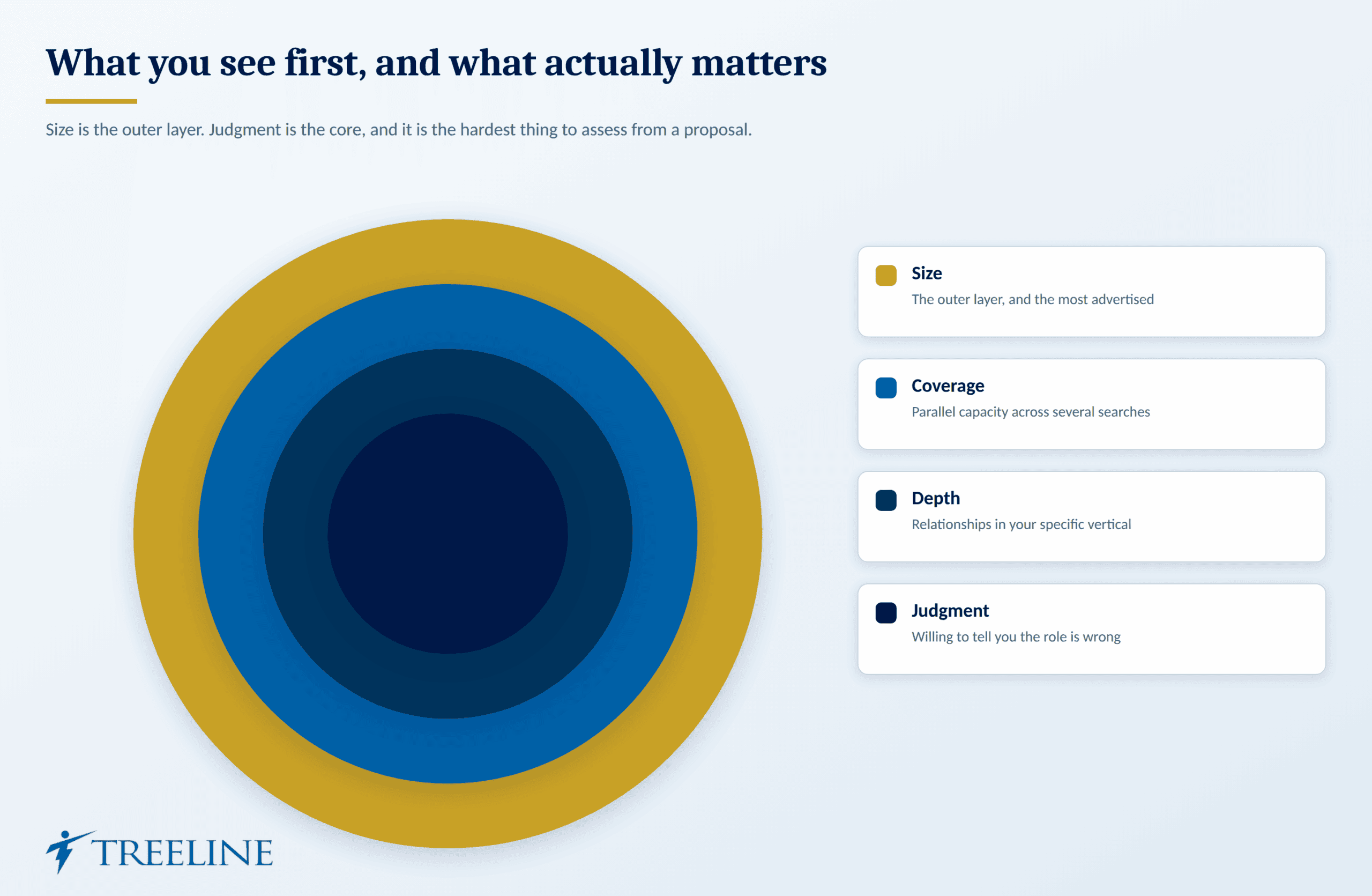
Strip away the superlative and there are four things a large regional firm plausibly has that a small one does not. Each is worth something, and each has a limit. Ranked by how much they actually matter, they nest as shown below.
- Accumulated relationships. Years of placing into the same market produce a network of people previously placed, previously interviewed, and referred. This is the most valuable asset and the hardest to fake.
- Comparative pricing knowledge. A firm running many searches in one geography knows what a band actually buys there, which an employer running one search a year cannot know.
- Bench capacity. Scale means a search does not stall because one recruiter is on holiday or oversubscribed, and it means several roles can run in parallel during a hiring push.
- Continuity.
A firm that will still exist in three years can maintain a relationship between searches, which is where much of the compounding value sits. There is a further asset that scale can produce and rarely advertises: a record of what happened after each placement. A firm that has placed sixty sales leaders in one region over a decade knows which profiles lasted, which failed, and what the failures had in common.
Very few firms assemble that systematically, but the ones that do can answer questions no proposal covers, whether people from a particular kind of company tend to struggle in smaller organisations, or whether a given profile reliably departs at eighteen months. It is worth asking directly whether such a record exists, because the answer is usually revealing either way.
The limits are equally real. Accumulated relationships in one vertical do not transfer to another; a firm with deep technology sales relationships may have almost none in medical devices. Bench capacity can mean your search is handed to a junior recruiter while the person who won the business moves on. And a large firm running many searches has more opportunity to deprioritise yours quietly if it looks harder than average.
The Problem With Choosing on Size
There is a specific failure pattern behind size-led selection, and it is worth naming because it is common and expensive. An employer shortlists the three largest firms in the region, receives three similar proposals, and chooses on fee or on who responded fastest. The engagement then produces a shortlist assembled by whoever had capacity that week, judged against a job description nobody challenged.
When it does not work, the conclusion drawn is that the firm was wrong, and the next search repeats the process with a different large firm. What went missing is the diagnostic step. The most valuable thing a search partner does happens before sourcing: establishing whether the role as described is the role you need, whether the band supports it, and whether the decision path can move at the speed the market requires.
None of that correlates with firm size, and none of it appears in a proposal document. There is also an availability problem that scale can conceal. A large firm’s relationship bank is real but not uniformly distributed. Depth in one vertical says nothing about depth in another, and the honest answer to “do you know this market?” is sometimes no.
A firm confident enough to say so is more useful than one that treats every requisition as within its coverage. The practical correction is to evaluate the specific people who will run your search rather than the organisation that employs them. Ask who does the work, what they placed most recently in your category, and what they would change about your requirement.
Those three answers separate firms more reliably than headcount does.
What Growing Companies Actually Need
Companies in a growth phase have a hiring problem that differs from a stable organisation’s, and it is not primarily about volume. The defining feature is that the requirement keeps moving. A company that raises capital, enters a new segment, or doubles headcount in eighteen months will define a role in January that no longer describes the job by June.
The territory changes, the buyer changes, the product changes, and the person who fits the original description may be the wrong hire by the time they start. That has three consequences for the choice of partner. The first is that intake has to be repeatable and cheap. A firm that requires a lengthy formal process to redefine a requirement will slow you down.
A partner who already understands the business can absorb a change in a phone call. The second is that judgment matters more than process. In a stable organisation, a well-documented search process produces consistent results. In a company where the answer keeps changing, you need a partner willing to say the role you have described is now two roles, or that the profile you wanted in January is no longer the profile you need.
The third is sequencing. Growing companies frequently hire in the wrong order, a vice president before there is anything for them to manage, or three individual contributors before anyone is designing the motion they will run. A partner who has watched this happen at twenty companies has an informed opinion about it, and offering that opinion is part of what you are paying for.
Fantasia’s view is that the most useful thing a search partner does for a growth-stage company is occasionally decline to run the search as briefed. His test is whether the firm has ever told a client to hire a different role first, because a partner who takes every requisition as written is optimising for the fee rather than the outcome.
Why the Massachusetts Market Behaves Differently
Regional character is often described in marketing terms and rarely in operational ones. A few features of this market genuinely change how a search runs.
- It is small enough that people know each other. The population of experienced enterprise sales leaders across the Boston area is not large, and many of them have worked together, competed against each other, or reported to the same people. That has two consequences: backchannel references are unusually easy to obtain, and a poorly handled search becomes known quickly.
- Reputation travels faster than in a bigger market. A company that runs a slow, disorganised process, or that treats candidates carelessly in the final round, will find the next search harder. In a market this size, that is not an abstraction.
- Commuting geography is a real constraint. The difference between an office inside Route 128 and one well outside it changes the candidate pool materially, and hybrid expectations vary enough between companies that they need to be stated explicitly rather than assumed.
- Sector concentration cuts both ways. Dense clusters mean a rich local pool of people who understand a given buyer. They also mean your top candidates are being approached by companies two miles away, and that non-compete and confidentiality questions arise more often because the relevant employers are neighbours.
- The border matters less than people assume.
Southern New Hampshire and northern Rhode Island are within reach for many roles, and a firm that treats the state line as the edge of its market is describing its own limits rather than the candidate pool’s.
Sequencing: The Order of Sales Hires
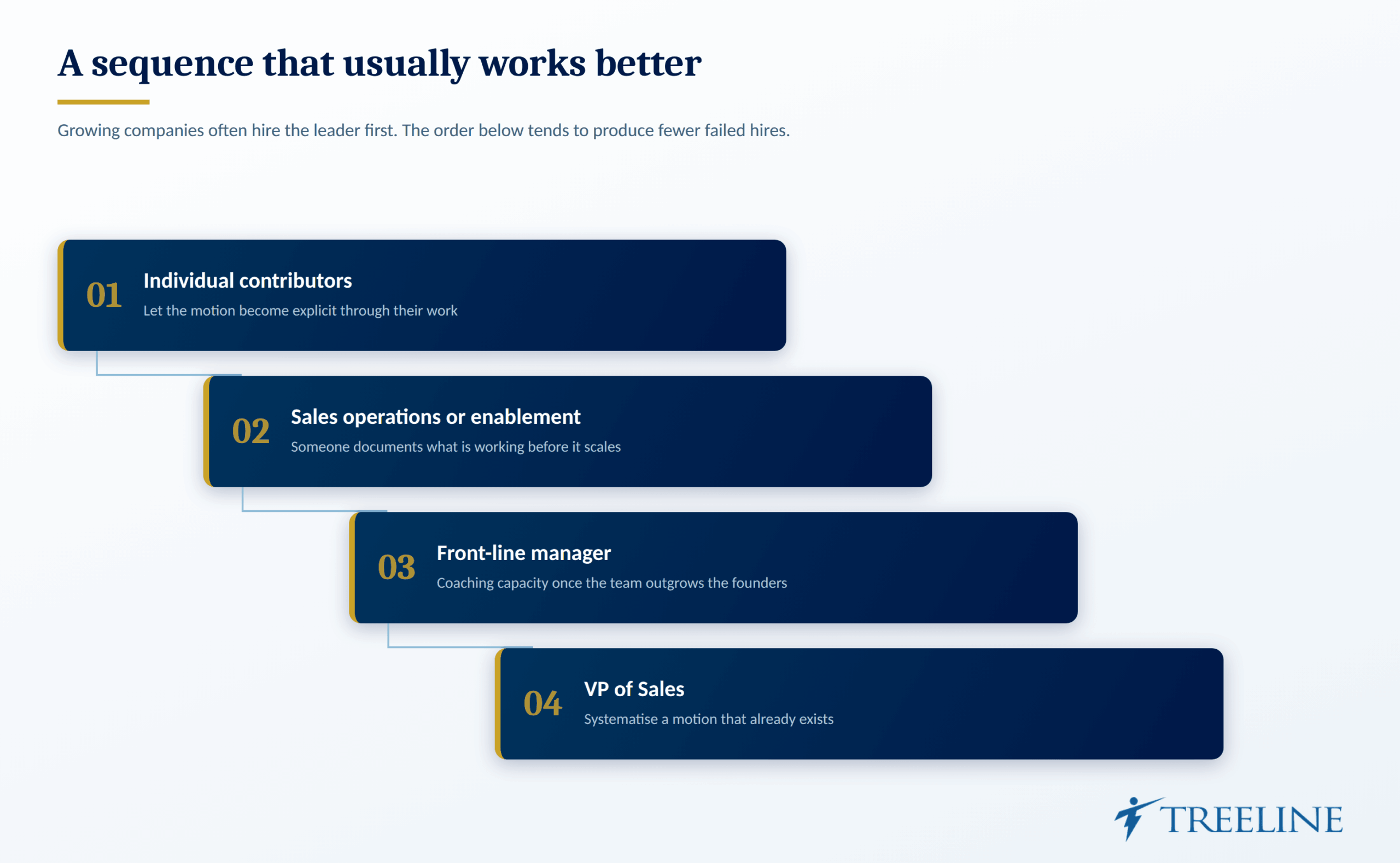
The most consequential advice a partner gives a growing company is often about order rather than selection, and it is the part employers most frequently skip. A recurring pattern looks like this. The founders have been selling. Revenue is growing, they are stretched, and the instinct is to hire a vice president of sales to take it over.
But if nobody has yet written down which customers close and why, the new leader spends two quarters reconstructing knowledge that lives in the founders’ heads, and the company concludes the hire was wrong. The alternative order, shown below, is often better: hire one or two strong individual contributors first, let the motion become explicit through their work, then hire the leader who will systematise it.
That leader is also easier to recruit, because a company that can describe its sales motion is a more credible proposition than one that cannot. The opposite error also occurs. A company hires four sellers into a market with no established motion, watches three of them fail, and concludes the market is hard. What it actually lacked was somebody designing the territory, the qualification criteria and the enablement those sellers needed.
There is no universal correct order, which is precisely why the question is worth putting to a partner who has watched it play out repeatedly. The useful conversation is not who to hire but what has to be true before that hire can succeed.
What Enablement and Onboarding Do to the Result
Search partners are judged on who arrives, and they should be, but a meaningful share of hiring outcomes is determined after the start date by things the employer controls entirely. For a growing company the risk is specific. A new seller joining an organisation of twelve arrives into a company where processes are informal, documentation is thin, and the honest answer to most questions is that somebody knows but it is not written down.
An experienced hire from a larger organisation can find that disorienting, and the ramp stretches while they reconstruct context. Three low-cost corrections make a visible difference. Write down the last ten closed deals, with who bought, why, and what nearly stopped it, that is the fastest available substitute for institutional memory.
Decide before the start date who the new hire’s first five internal conversations will be with, including the people likely to disagree with them. And set a ninety-day expectation that is about learning and pipeline construction rather than closed revenue, particularly for enterprise cycles that cannot close inside a quarter regardless of ability.
None of this is a recruiting activity, but all of it changes the retention number that a recruiting partnership will eventually be judged on.
How to Test Local Depth in One Conversation
Every firm claims regional expertise. These questions establish quickly whether it exists, because a genuine specialist answers from memory and a generalist offers to research and return.
- Which companies in our category have changed sales leadership in the last year, and what happened afterwards?
- What does our band actually buy in this market, and how does that differ from the national figure?
- Who would you approach first, described by situation rather than by name?
- Which competitors do we most often lose candidates to, and why?
- What is our reputation among sales leaders here?
- Where would you draw our commuting boundary, and what does that do to the pool?
- Which of our requirements would you challenge before we launch?
Two follow-ups are worth adding, because they separate genuine local knowledge from a well-briefed answer. Ask what has changed in this market over the past two years, compensation, hybrid expectations, which sectors are hiring and which are not. A firm working the region continuously will have a view; one that has read a report will generalise.
Then ask what they got wrong recently. Anyone active in a market has misjudged something, and the willingness to name it is the strongest available signal that the rest of the answers are honest. The reputation question is the uncomfortable one and the most valuable. Employers are usually the last to learn how they are perceived by the candidates they most want, and a firm willing to answer plainly in a first meeting is demonstrating the behaviour you want throughout the engagement.
Reading a Proposal Properly
Proposals from search firms are close to interchangeable, which is itself informative. A few things are worth extracting from one before signing.
- Who runs the search, by name. Not the account lead. The person doing the sourcing and screening, and what they have placed in your category.
- What the guarantee actually covers. The headline period matters less than the exclusions, voluntary resignation, restructuring, a role that changes after the hire, and whether the remedy is a replacement or a refund.
- How candidate ownership is defined and for how long. If you later hire someone the firm introduced eleven months ago through a different channel, what happens?
- What is included beyond introduction. Reference checking, offer support, contact between acceptance and start date. Practice varies widely and is rarely specified.
- What compensation the fee percentage applies to. Base only, base plus target variable, or total including signing and equity. The difference is substantial at leadership level.
- What happens if the requirement changes.
For a growing company this is not hypothetical, and a firm that treats a redefinition as a new engagement will slow you down. None of these are unusual asks, and a firm that resists specifying them in writing is telling you how the relationship will run.
What Scale Genuinely Buys, and What It Costs
It is worth being even-handed about the tradeoff, because both directions have real merits. A larger firm brings parallel capacity, a deeper relationship bank, pricing knowledge across many searches, and the likelihood of still being there next year. Those are not trivial, particularly for a company planning several hires over eighteen months rather than one.
A smaller firm brings the person who won the business actually running the work, fewer competing priorities, and often a sharper focus on a single vertical. For a company hiring one hard role in a narrow niche, that focus frequently beats scale. The honest summary is that scale helps most when you have volume, continuity, or breadth across several functions, and matters least when you have one difficult, highly specific search.
Employers routinely choose on size when their actual situation calls for focus. There is a middle path that employers underuse. Nothing prevents engaging a larger firm for the roles where throughput matters and a specialist for the one search that is genuinely hard, provided the boundaries are stated so the same candidates are not approached twice with different descriptions of the same company.
In a market where the qualified population is small and people talk to each other, that coordination is not administrative housekeeping; it is the difference between looking like a company that knows what it wants and looking like one that does not. Fantasia’s position is that the question of firm size is downstream of a question most employers skip, which is how many searches they realistically expect to run in the next two years.
He recommends deciding that first, because the honest answer usually makes the choice of partner obvious and occasionally reveals that no external partner is needed at all.
What Candidates Are Evaluating While You Evaluate Them
Employers tend to treat a search as a one-directional assessment, and in a market this small that assumption is expensive. An experienced sales leader considering a growing company is running their own diligence in parallel, and it is more thorough than most employers expect. They are asking former employees what the culture is actually like.
They are checking whether the last person in the seat left voluntarily. They are forming a view on whether the revenue plan is achievable, because their compensation depends on it and their reputation depends on it more. Several things move that assessment, and none of them costs money. A hiring manager who can describe the pipeline honestly, including its weaknesses, reads as credible; one who presents only upside reads as either uninformed or evasive, and experienced sellers are professionally trained to detect the difference.
A process that moves quickly signals a company that makes decisions. Written clarity about the first year signals a company that has thought about the role rather than reacted to a gap. The inverse is also true and worth stating plainly. A candidate who withdraws late in a process has usually learned something during it, and that something is frequently more useful than the hire would have been.
A partner who can find out what it was, and will tell you, is providing intelligence you cannot get any other way, because candidates rarely give the real reason directly to the employer. This is also where the density of a small regional market compounds. The candidate who withdraws describes the experience to peers, and those peers are the pool for your next search.
Treating the process as reciprocal is not courtesy; it is the cheapest possible investment in the searches that follow.
The Stage Problem
“Growing company” covers situations that need genuinely different things, and conflating them causes most of the mismatches. An early-stage company hiring its first sales leader is buying judgment about a role it has never had. The requirement is unproven, will change, and the compensation package usually leans on equity that the candidate must be helped to evaluate.
Contingency structures fit this well because the definition can be revised without renegotiating a contract. A company scaling an established motion is buying throughput and consistency. Here the requirement is well understood and the value is in filtering, speed and parallel capacity. Scale genuinely helps. A private-equity-backed company under a value-creation plan is buying speed against a fixed timeline, often with a board watching.
The constraint is rarely candidate availability; it is the decision path, and the useful partner is the one who compresses it. A company recovering from a failed leadership hire is buying discretion and accuracy. The market usually knows what happened, the next search is harder, and the honest handling of the previous failure is part of the pitch to candidates rather than something to conceal.
What This Costs and How to Think About It
Fee conversations tend to happen in isolation from the numbers that make them meaningful, which is why they are usually resolved badly. Contingency fees are a percentage of first-year compensation, payable only on a hire, with 25 percent a common standard for professional sales roles. For a growing company that figure can look large in isolation, particularly when several hires are planned.
The comparison that makes it legible is the cost of the seat staying empty. For a quota-carrying role, a reasonable working estimate of vacancy cost is the annual quota divided across the year and multiplied by the months the seat is open, then discounted for whatever coverage colleagues genuinely provide, which is usually less than assumed, because they are protecting their own numbers first.
Run that arithmetic before the fee negotiation and the relative sizes of the two numbers are usually clarifying. The second comparison is the mis-hire. A seller who leaves at month ten has consumed the vacancy cost twice, plus ramp investment and management attention, plus whatever happened to the accounts they handled in between.
This is the honest argument for a partner who rejects most of the market before submitting anyone, and it is why a high volume of submissions is a cost rather than a service. The third is the internal cost that nobody books. Every unqualified candidate reaching a hiring manager consumes an hour of the most expensive time in the company, and a partner who filters badly is transferring their work onto your team while charging you for having done it.
Where the Regional Advantage Disappears
Local depth is an advantage until the search stops being local, and several situations move it. If the role can be performed from anywhere, the relevant market is national and a regionally concentrated network is a smaller advantage. If the required domain expertise exists mainly in another geography, the local pool may simply not contain the person.
If the search must be confidential in a market where everyone knows each other, the density that usually helps becomes a liability, and a retained structure fits better than a non-exclusive one, a distinction Treeline sets out in retained search versus contingency search. And if you are hiring at the very top of the organisation, the population is small enough nationally that geography stops being the organising principle at all.
One further case deserves mention because it is increasingly common. A company headquartered here but selling into a market concentrated elsewhere may need a seller embedded in that other market rather than a local hire who travels. The regional firm can still be the right partner, but only if it is candid about the limits of its own network and willing to say when the search should be run somewhere else.
That candour is rarer than it should be, and it is worth asking for explicitly at intake rather than discovering it in week six.
Building a Relationship That Survives Between Searches
The compounding value of a regional partnership accrues between engagements, and most employers never collect it because the relationship is transactional by default. Consider what a firm working your market continuously is accumulating on your behalf whether or not you have an open role. They are meeting people who would fit your organisation.
They are watching which of your competitors are struggling, because that is where movement originates. They are seeing what compensation is actually closing at, not what job postings advertise. Almost none of that reaches an employer who only calls when a seat opens. A light structure captures most of it. A short conversation each quarter, with no requisition attached, in which the firm reports what has moved in the market and you describe what is coming.
That costs an hour and materially shortens the next search, because the partner starts from context rather than from intake. The reciprocal obligation matters too. Employers who share what happened to previous hires, who thrived, who left, and why, are giving a partner the feedback that makes the next shortlist better.
Employers who go silent after a placement are teaching the firm nothing, and then wondering why the fourth search feels like the first. There is a caveat worth stating. This only works with a firm you expect to keep, which brings the earlier question back into focus: if you genuinely expect one search every three years, transactional is the honest arrangement and there is no reason to pretend otherwise.
What to Agree Before Engaging
Whatever the size of the firm, these should be settled before a search launches. Employers who arrive with them get usable candidates materially faster.
- The role’s real scope, including whether it is one job or two.
- The band, checked against local rather than national data, with the variable structure specified.
- The commuting or hybrid expectation, stated rather than assumed.
- The decision path, with names, and what happens when the approver is unavailable.
- The internal candidate position, resolved either way.
- How many searches you expect over the next two years, since that determines whether continuity or focus matters more.
- What the first year is supposed to produce, agreed internally before it is described externally.
Fantasia emphasises that the commuting and hybrid expectation is the item employers most often leave vague and the one that most reliably wastes a shortlist. He suggests writing it down in a single sentence before the search opens, because a candidate discovering the real expectation in a final interview usually withdraws, and the withdrawal is recorded as a fit problem rather than a briefing failure.
Signals That the Engagement Is Going Wrong Early
Most disappointing searches were identifiable in the first three weeks. Before the specific signals, one general point: the useful question is not whether candidates have arrived but whether the partner’s understanding of the requirement is visibly improving. A search that is going well feels like a narrowing conversation.
A search that is going badly feels like a series of unrelated submissions. Most disappointing searches were identifiable in the first three weeks, and the signals are consistent enough to be worth watching for deliberately. The first is a first submission that arrives fast and misses badly on the same dimension the intake conversation emphasised.
That usually indicates the requirement was heard as a job description rather than as a problem, and the correction is a conversation rather than more candidates. The second is submissions that do not converge. Each round of feedback should visibly narrow the next batch. If candidate six repeats candidate one’s defect, either your feedback lacks specificity or it is not reaching the person doing the sourcing, and on a large firm’s bench those are different failures with different fixes.
The third is silence about the market. A partner genuinely working your search is hearing declines, and those declines contain information about your band, your positioning and your reputation. A firm that only reports progress is filtering out the most useful thing it has. The fourth is a change of personnel without notice.
If the recruiter you met has been replaced by someone you have not spoken to, the accumulated context has gone, and the search has effectively restarted without anyone saying so. The fifth is reluctance to discuss the searches that did not close. Every firm has them. A partner willing to describe one, and what they learned, is behaving like the kind of partner worth keeping past the first engagement.
Frequently Asked Questions
Does firm size actually matter when choosing a contingency executive search firm?
It matters for volume, parallel capacity and continuity between searches. It matters much less for a single difficult search in a narrow niche, where focus and vertical depth usually beat scale. The better question is how many searches you expect to run over the next two years, since that determines which of the two you need.
What should growing companies look for in a Massachusetts search partner?
Demonstrated knowledge of the local market rather than claimed expertise: which companies have changed leadership recently, what your band actually buys locally, how your commuting boundary changes the pool, and what your reputation is among candidates here. A genuine specialist answers those in a first call.
How is Contingency Sales Recruiting different from retained search?
Contingency firms are paid only when you hire and produce a strong shortlist; retained firms are paid in instalments regardless of outcome and produce a documented map of the whole market plus exclusivity. You are choosing between a shortlist and a census, and confidentiality is usually the deciding factor.
What do contingency recruiting firms charge?
Fees are a percentage of the hire’s first-year compensation, payable only on a hire, with 25 percent a common standard for professional sales roles. There is no retainer. Confirm which components of compensation the percentage applies to and what voids the replacement guarantee, since both vary between firms.
Should we set our compensation band from national data?
Use national figures for orientation and local estimates for the actual band. The BLS publishes state-level occupational employment and wage estimates, which are a better reference point for a Massachusetts role than a national median that averages every state and industry together.
Can one firm handle several sales hires at once?
A larger firm generally can, and that parallel capacity is one of the strongest arguments for scale. Ask specifically who will run each search, since the person who won the business is not always the person doing the work.
When does a contingency hire become the wrong approach?
When the search must be confidential, when you need a documented view of the entire market rather than a shortlist, or when your internal decision process cannot return feedback quickly enough for the speed advantage to exist.
How quickly should we expect to see candidates?
That depends on how narrow the requirement is and how well the partner already knows your market, so a single number would be misleading. What is predictable is that a firm working from existing relationships produces a first submission considerably faster than one starting a search cold.
Talk Through Your Next Sales Hire
Treeline, Inc. is a sales-only executive search firm based in Wakefield, Massachusetts, working exclusively on building sales organizations. Our contingency sales recruiting service carries no upfront cost and no fee unless you hire, and we deliver your first candidate within three days of launching a search. If you are planning sales hires over the next few quarters, the useful first conversation is about sequencing, which role to fill first and what it should be responsible for.
Get in touch and we will give you a straight read on the local market for it.
Share This Story, Choose Your Platform!
Related Posts


What our happy clients are saying
Treeline Inc. provided us with the most candidates that aligned with our needs and were of the highest quality.

Dr. Jeffrey Klein Head of North America Sales, Satchel Pulse
Treeline Inc.’s collaborative, flexible, and communicative approach resulted in a smooth partnership. Beyond their recruitment expertise, their unique sourcing model was efficient and effective.

Sera Holt Director of Operations, LNS Research
Their professionalism was outstanding. Treeline Inc. was extremely thorough and ensured that we were on the same page before they started looking for candidates. They listened to us and did a great job working with the candidate to close out the process.

Cate Grant AVP Customer Success, Nasdaq
Thanks to Treeline Inc.’s intricate and thorough screening process, the company is able to hire six high-quality candidates that fit perfectly in the company’s culture. The team is highly receptive to concerns, and internal stakeholders are impressed with their unique recruitment abilities.

Anna McKean Sales Recruiter, Insider Intelligence
Treeline Inc. has been qualified individuals throughout a five-year-long engagement. They’ve made numerous placements of talented and qualified individuals for our business.

Michele St Laurent VP of HR, The Institute for Applied Network Security

Let Us Help You Source the Sales Talent You Need
Whether you’re building a team or replacing a key role, our Candidate Sourcing Platform provides a fast, flexible, and employer-focused solution.
Tell us more about your business and how we can help.
Treeline Inc.
Your Award-Winning Sales Recruitment Partner
15 Lincoln Street, Suite 314, Wakefield, MA 01880