Most employers engaging a search firm for the first time have a rough idea that candidates will appear and a much vaguer idea of what happens in between. That vagueness is expensive. It is the reason briefs get accepted that should have been challenged, the reason a slow week in the middle of a search goes unnoticed until it has cost a candidate, and the reason two firms running the same assignment can produce completely different outcomes while describing their work in identical language.
This is a stage-by-stage account of what actually happens, who owns each step, and where the process breaks. It is written for a sales organization hiring into enterprise roles, long cycles, multiple stakeholders, security and procurement review, multi-year agreements, rather than for high-volume hiring where the mechanics are different. It assumes a contingency sales recruiting arrangement, where the fee is payable only on a hire; if you are still weighing that against a retained search, that comparison comes first.
Dan Fantasia, CEO of Treeline, Inc., views a search as a sequence of handoffs rather than a single engagement. From his perspective the useful question at any point is not how the search is going but which side currently holds the work, because almost every stalled assignment turns out to be sitting with someone who did not know it was theirs.
What the Contingency Executive Search Process Actually Covers

The term describes a commercial arrangement and a working method at the same time, and conflating them causes most of the confusion.
The commercial part is straightforward. A fee is payable only if the employer hires someone the firm introduced. No retainer, no staged payments, no fee if the search produces nothing. That is the whole of the financial structure, and it is the part employers usually understand before they start.
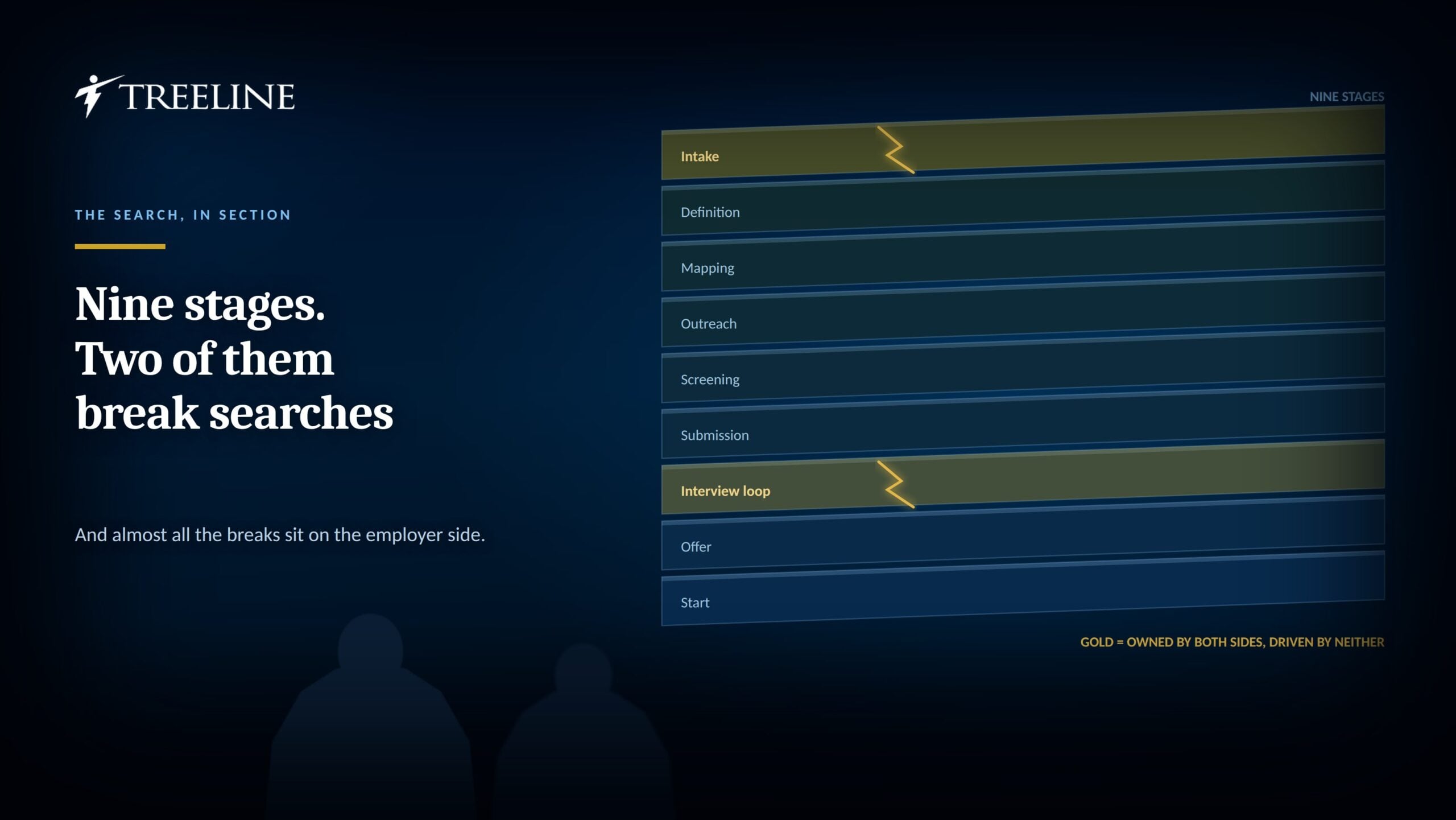
The working method is what this article covers. It runs from the intake conversation through requirement definition, market mapping, outreach, screening, submission, interview support, offer negotiation, resignation and start. Nine stages, of which the employer directly owns four and jointly owns two more.
What sits outside the process is worth stating too. A contingency arrangement does not produce a documented map of every qualified person in the market, that is a retained deliverable, and the reasons are structural rather than a matter of effort. Treeline sets out the distinction in its comparison of retained search versus contingency search.
Stage One: Intake, and Why It Decides Everything After
The first conversation determines more about the outcome than any later stage, and it is the one most often rushed.
A useful intake does not start with the job description. It starts with what has to change. A company hiring an enterprise account executive because coverage is thin in a segment needs a different person from one hiring because the last incumbent could not get past procurement, even though both requisitions will read the same on paper.
The questions that matter are specific. What is the average contract value and how has it moved? How many stakeholders sign off, and which one kills deals? What proportion of pipeline is self-generated versus supplied? Is there sales engineering support, and at what ratio? What does the security review look like, and how often does it stall a deal? Who did this role last, what happened, and where are they now?
An intake that produces answers to those questions gives a firm something to search against. An intake that produces a list of responsibilities gives them a keyword search.
There is a second output that employers rarely expect: a list of things the firm thinks are wrong with the requirement. A good intake ends with disagreement about at least one criterion.
Where the Contingency Executive Search Process Defines the Target
Between intake and outreach sits a translation step that is invisible to the client and determines the quality of everything submitted.
The requirement gets converted into a set of screens: which companies are likely to contain the right people, which titles map to the work regardless of what they are called, what deal shape the candidate must have run, and what would disqualify someone regardless of how impressive they look.
Target-company logic is the part that varies most between firms. A weak version lists competitors. A strong version reasons about which organisations produce people who have done the specific thing, companies selling a similar deal size into a similar buyer with a similar amount of support, which is frequently not the obvious competitor set.
The disqualifier list matters as much as the target list. Writing down in advance that someone whose pipeline was entirely inbound will not work for a territory requiring self-generation saves three rounds of interviews later.
Fantasia’s perspective is that the search definition should be narrow enough to be wrong. He recommends testing it by asking whether the firm can name people it deliberately excluded and say why, on the grounds that a definition excluding nobody is a description rather than a specification.
What a Weak Intake Costs Later
The consequences of a rushed first conversation surface three weeks later, disguised as a sourcing problem.
A firm briefed on responsibilities searches for people who have held the title. A firm briefed on the operating problem searches for people who have solved it. Those two searches return overlapping but materially different lists, and the second one contains the candidates worth meeting.
The visible symptom is a first submission that looks reasonable and misses in a way nobody can articulate. Everyone agrees the candidates are not right; nobody can say what would make them right. That is almost always a briefing failure being experienced as a market failure, and adding candidates makes it worse.
The recoverable version is a second intake conversation held after the first submission, using the rejected candidates as the material. Saying precisely why each was wrong produces a better specification than any amount of upfront discussion, because concrete examples surface criteria that abstract discussion does not.
Employers sometimes resist this as backtracking. It is considerably cheaper than three more rounds against a definition that was never right.
Stage Three: Mapping the Market
Before anyone is contacted, the firm establishes who exists. For an enterprise sales role this is a smaller exercise than employers expect and a more precise one.
The qualified population for a specific enterprise account executive requirement is rarely more than a few hundred people nationally and often fewer. They are identifiable, they are mostly employed, and a firm working the segment continuously already knows a meaningful share of them.
What mapping produces is a prioritised approach order rather than a list. The ordering reflects who is likely to be receptive now, someone whose territory was recently carved, someone whose company was acquired, someone approaching a vesting date, someone whose manager just left.
This is the stage where a firm with existing relationships in the segment diverges most sharply from one starting cold. The list may be similar. The order, and the ability to get a reply, are not.
An employer can test this without asking for names. Ask the firm to describe, by situation rather than identity, the first three people they would approach and why each might move now. A firm that holds the market answers in specifics.
Why the Qualified Population Is Smaller Than It Looks
Employers consistently overestimate how many people could do a specific enterprise sales role, and the overestimate drives most unrealistic expectations about timing.
Start with everyone holding a plausible title. Remove those selling a materially different deal size, because someone running mid-market velocity deals has not operated a nine-month enterprise cycle with a security review in it. Remove those whose pipeline was entirely supplied, if the territory requires self-generation. Remove those whose buyer is unrecognisably different, since credibility with a chief information security officer does not transfer from credibility with a facilities director.
Then remove the ones who will not move. Most are performing, most are compensated adequately, and a majority of any given list is simply not available this quarter at any realistic package.
What remains for a specific requirement is frequently a few dozen people rather than a few hundred. That is not pessimism; it is the arithmetic that explains why response rate matters more than reach, and why a firm’s standing with those particular people determines the outcome more than the size of anyone’s database.
Stage Four: Outreach and the First Conversation
Contact begins, and for senior sales candidates this is the hardest stage in the process.
The people worth hiring receive several approaches a week and have stopped reading most of them. What earns a reply is rarely the content of the message. It is whether the sender is someone whose call this person takes, a recruiter they have dealt with before, someone who placed a former colleague, someone whose name carries a reference.
The first conversation is not a screen. It is a persuasion conversation in which the recruiter is establishing whether a reason to move exists, and the candidate is deciding whether this person is worth talking to again. Screening happens after interest, not before it.
Two things determine whether that conversation goes anywhere. Whether the recruiter can describe the role in terms the candidate recognises, the deal, the buyer, the support structure, not the company’s growth narrative. And whether they can answer the difficult question honestly when it comes, which it always does: why is this role open?
Employers can help here in a way they usually do not. Giving the firm the honest answer about the previous incumbent, including an unflattering one, is more useful than a polished version. The candidate will find out, and they will find out faster if the answer sounded rehearsed.
The Screening Step That Separates One Contingency Executive Search Process From Another
This is where most of the difference between firms lives, and where the employer’s hours are won or lost.
Proper screening on an enterprise sales role means reconstructing specific deals in enough detail to establish whether the candidate ran them or was present for them. Origination, the economic buyer, competing alternatives, where it stalled, what they personally did next, what procurement demanded, how long it took.
It also means establishing compensation reality early. A candidate whose expectation sits above the authorised band should not reach a final round; that discovery in week six has wasted everyone’s time and is entirely avoidable.
And it means testing the reason for moving. A candidate whose only stated reason is money will accept a counteroffer, and the recruiter usually knows this well before the employer does.
Volume is the signal to watch here. A firm submitting twelve candidates has not screened; it has forwarded. Every unqualified person reaching a hiring manager consumes the most expensive calendar in the sales organisation and produces nothing.
What Candidates Are Assessing While You Assess Them
The process runs in both directions, and the candidate’s evaluation is more thorough than most employers assume.
An experienced enterprise seller weighing a move is making a judgement about whether the number is achievable. They will ask about pipeline coverage, about the ratio of self-generated to supplied opportunity, about how many people carried this territory before and what happened to them. They will check with former colleagues. They will form a view on whether the revenue plan is realistic, because their income and their professional standing both depend on it.
Several things move that assessment and none costs money. A hiring manager who describes the pipeline honestly, including its weaknesses, reads as credible. One who presents only upside reads as uninformed or evasive, and sellers are professionally trained to detect the difference. A process that moves decisively signals an organisation that makes decisions.
The inverse matters too. A candidate who withdraws late has usually learned something during the process, and that information is more valuable than the hire would have been. A firm that can find out what it was, and will tell you, is providing intelligence available no other way.
Stage Six: Submission and What Should Arrive With It

A submission is not a résumé. A submission worth the fee arrives with a written assessment against the requirement agreed at intake.
That document should cover what the candidate has run that matches the deal shape, what they built that outlasted them, where they fall short of the specification and why the firm is submitting anyway, their compensation position, their stated reason for moving, and their availability including notice.
Without it the employer repeats the screening the firm was paid to do. With it the hiring manager reads four pages and knows which two candidates to meet.
Feedback flows back the other way and is the employer’s main lever on quality. A rejection recorded as “not the right fit” gives a firm nothing to recalibrate against. A rejection recorded as “ran six-figure deals but never through a security review” changes the next three candidates.
Fantasia emphasises that the submission document is the clearest available test of whether a firm is assessing or supplying. His practical suggestion is to ask for a sample before engaging, because a firm that writes one for every candidate can produce an anonymised example immediately and a firm that does not will offer to describe its process instead.
Reading a Submission Properly
A submission arrives and the temptation is to go straight to the résumé. The assessment document is where the useful information sits, and it rewards a specific reading order.
Start with where the firm says the candidate falls short. A submission listing no gaps is a sales document, not an assessment, and should be treated as one. A firm confident in its judgement names two or three weaknesses and explains why it is submitting anyway.
Then read the deal reconstruction. Look for friction, the stalled quarter, the competitor that nearly won, the procurement demand that reshaped the contract. Specific friction is difficult to fabricate and difficult to inherit; a smooth narrative usually means the candidate was present for the deal rather than running it.
Then the reason for moving. If it is compensation alone, plan for the counteroffer now rather than in week eight. If it is structural, territory, manager, product trajectory, scope, the move is considerably more likely to hold.
Finally the compensation position and notice. Both should be concrete numbers and dates. Vagueness in either field means the conversation has not happened yet, and it will happen at the worst possible moment instead.
Stage Seven: Interview Support, the Stage Nobody Plans
Between first interview and offer, the process passes back and forth repeatedly, and this is where searches most often decay quietly.
The firm’s work here is unglamorous: scheduling across several calendars, preparing the candidate on what each interviewer will probe, debriefing both sides after every round, and detecting hesitation before it becomes a withdrawal. Candidates tell recruiters things they will not tell a prospective employer, and a firm that is not asking is not collecting the most useful information in the search.
The employer’s work is to return feedback quickly and keep the loop tight. A week between rounds is normal and costly; in a market where the candidate is also talking to two other companies, it is frequently decisive.
Two failure modes recur. Interviewers who have not read the submission ask the candidate to repeat what is already documented, which reads as disorganisation. And a new stakeholder added in round three resets the assessment and signals internally that nobody agreed the process at the start.
Stage Eight: Offer, Counteroffer and Resignation
The offer is not the end of the search. For a performing enterprise seller it is the beginning of the hardest part.
Well-run firms do not present an offer cold. They establish the number the candidate will accept before it is formally made, which removes the negotiation from the moment when a decline is most damaging. A surprise at offer stage means the compensation conversation happened too late.
The counteroffer should be anticipated rather than reacted to. A producing enterprise account executive resigning will usually receive one within forty-eight hours, and it will usually be substantial. Whether it works depends almost entirely on why they were leaving: money-motivated moves reverse, structural moves hold.
The resignation conversation itself benefits from preparation. Candidates who have rehearsed it, decided in advance what they will say to a counteroffer, and set a date tend to complete the move. Candidates who resign without having thought it through are the ones who call three days later.
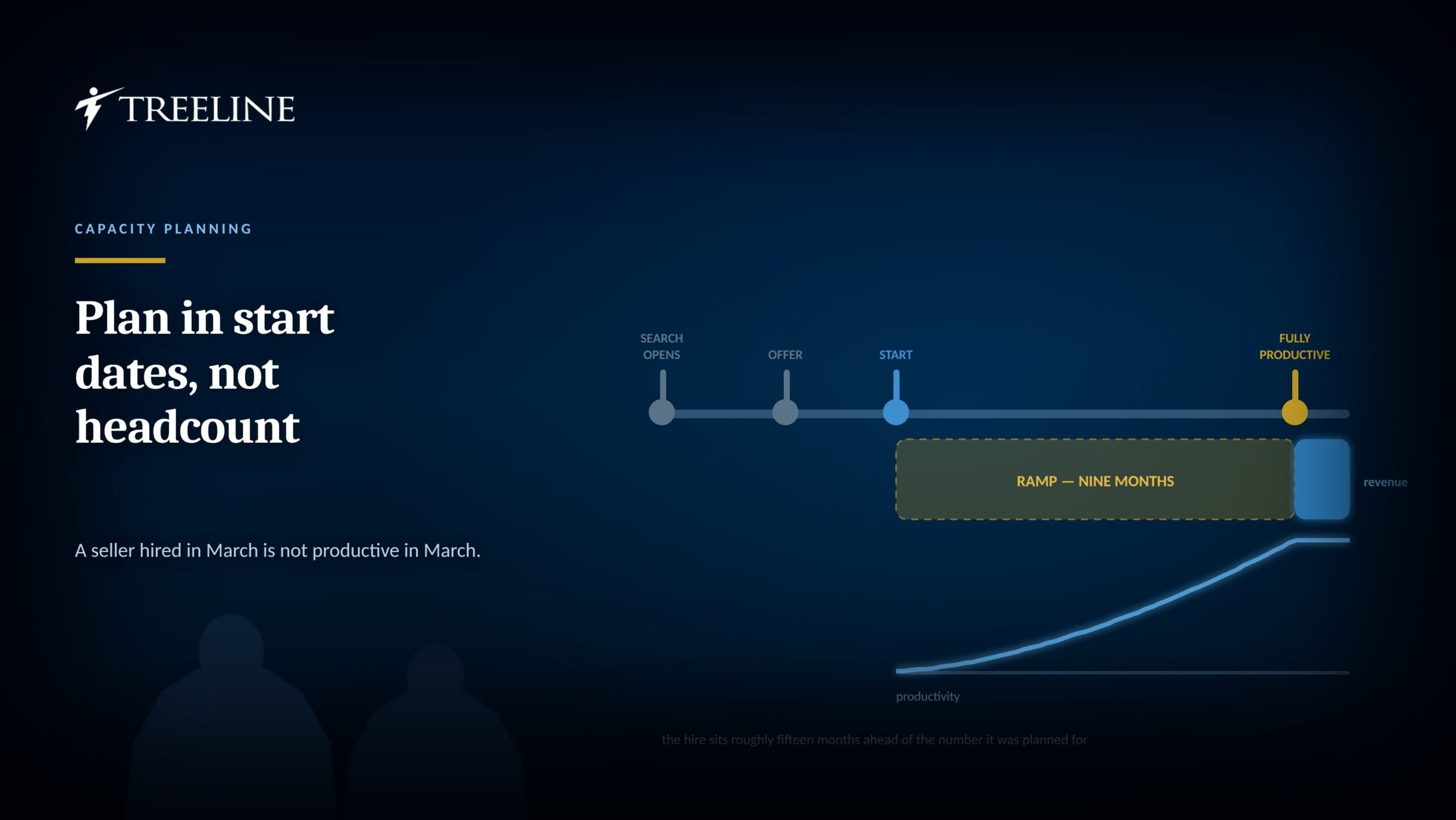
Then there is notice. An enterprise seller with live deals will often want to hand over responsibly, and the interval between acceptance and start is longer than in most functions. That window is when second thoughts form and when a competing employer who lost the candidate sometimes returns.
Stage Nine: Start Date and the Guarantee Period
The final stage is the one most often treated as administrative, and it carries real risk.
Between signature and start, the useful actions are small and effective: confirm the start date in writing rather than leaving it to be arranged, arrange one informal conversation with the future manager and one with a peer, and send the material that lets learning begin early, recent pipeline data, win-loss records, the territory as it will exist on day one.
Most contingency arrangements carry a replacement guarantee, and its headline length matters less than its exclusions. Read what voids it. Voluntary resignation, restructuring, a role that changes materially after the hire, and a missed invoice are common carve-outs, and the remedy, replacement search versus refund, varies between firms.
A guarantee is also a weak instrument compared with getting the hire right. A replacement search starting in month five has already cost two quarters of territory production that no fee arrangement recovers.
Fantasia’s operating perspective is that the guarantee should be read as a description of a firm’s confidence rather than as protection. He suggests asking how often it has been invoked and what the firm concluded, because a firm that tracks its own failures has a mechanism for improving and one that does not is relying on volume.
Where the Contingency Executive Search Process Breaks Most Often
Across a large number of searches the failure points are consistent, and all but one sit with the employer.
- Intake was a job description. The firm searched against responsibilities rather than against a problem, and the first submissions miss in a way nobody can articulate.
- The band was aspirational. Discovered in week six, after several candidates have been processed against a number that was never authorised.
- Feedback was generic. Three rounds of “not quite right” leave a firm guessing, so candidate six repeats candidate one’s defect.
- The decision path was undefined. An approver appears late, or the person who can say yes is unavailable for two weeks.
- An internal candidate was unresolved. The external process runs at half speed and candidates sense it.
- Submissions arrived without assessment. The employer re-does the screening and concludes the market is thin.
The single failure that belongs to the firm is submitting volume in place of judgement. Everything else on that list is fixable inside the hiring organisation, usually in an afternoon.
A Short Test of Whether the Process Is Working
Three weeks into a search, the following questions separate a working engagement from a drifting one, and none requires waiting for an outcome.
Has the firm told you something uncomfortable? A partner three weeks into a real search has formed a view about the band, the scope or the decision path, and a firm reporting only progress is filtering out its most valuable output.
Has each submission been better than the last? Feedback should visibly narrow the next batch. If candidate five repeats candidate one’s defect, either the feedback lacks specificity or it is not reaching the person doing the sourcing, different failures with different fixes.
Do you know why people declined? A live search generates declines, and those declines contain information about your band, your positioning and your reputation. A firm that cannot report stated reasons is not asking.
Is the person you met still running it? Mid-search handover without notice is a common and quiet cause of restarts.
Answering those four honestly at week three is worth more than any status report, and it leaves time to fix what it surfaces.
What the Employer Owns at Each Stage
Setting this out explicitly at the start prevents most of the drift.
The firm owns market mapping, outreach, first-conversation persuasion, screening, submission assessment, candidate preparation, and offer and resignation support.
The employer owns the requirement, the authorised band, interviewer availability, feedback turnaround, the decision path, and the final judgement about whether a person will succeed in the organisation.
Both own the intake conversation and the interview loop, which is precisely why those two stages produce the most confusion. A stage owned jointly and unassigned is a stage nobody is driving.
How Long Each Stage of the Contingency Executive Search Process Takes
Expectations are more useful than promises, and the honest version varies by stage rather than resolving to a single number.
Intake and search definition should take days, not weeks, a firm that cannot start within a few days of a proper briefing is telling you about its caseload.
Mapping and first outreach is where the variance lives. A firm holding relationships in the segment can produce a first genuine conversation quickly; a firm starting cold cannot, regardless of effort. This is the interval that most rewards choosing a specialist.
Screening to first submission should be short once conversations are happening, and a long gap here usually means the requirement is harder than either side acknowledged.
The interview loop is the employer’s, and it is the interval most often doubled by scheduling rather than by deliberation. Notice periods are fixed and should be planned around rather than negotiated.
A caution on promises: any firm quoting a precise total elapsed time before understanding the requirement is quoting an average, not an estimate.
What Changes on the Second and Third Search
The process described here assumes a first engagement. It compresses materially by the third, and knowing where tells you whether a partnership is working.
Intake should take half as long, because the firm already knows the deal shape, the buyer, the support structure and the decision path. A firm still asking foundational questions on search three has not been retaining context.
The search definition should need less correction. If submissions on the third search still miss on criteria explained during the first, the feedback loop is not functioning and no amount of additional briefing will fix it.
Mapping should start warmer. A firm working the segment continuously between engagements has been meeting people, tracking which competitors are unsettled, and noticing who has become receptive. That accumulation is invisible on an invoice and is the main reason continuity is worth more than a marginally better fee.
And the firm should start bringing candidates speculatively, someone strong who has become available for a role not yet open. That behaviour only appears when a firm expects the relationship to continue, and it is the clearest evidence that the partnership is real rather than transactional.
The honest counterpart: if none of this has happened by the third search, it will not happen later. That is a reason to change firms rather than to persevere.
When a Contingency Search Is the Wrong Instrument
Being clear about the boundary is part of describing the process honestly.
Where a search must remain confidential, the current occupant does not know they are being replaced, a non-exclusive arrangement is structurally unsuited to it. Multiple firms touching a small market will leak, and the damage exceeds any saving.
Where the requirement is genuinely unprecedented and the employer needs a documented view of everyone who could do it rather than a viable shortlist, the commercial structure does not support producing one.
And where the internal decision process cannot return feedback within days, the model’s main advantage does not exist. The search will underperform for reasons unrelated to sourcing.
What to Agree Before the Search Opens
A short written understanding removes most later friction, and none of it is unusual to ask for.
- Who runs the search, by name, and how many other assignments that person carries.
- What is screened before submission, expressed as specific disqualifiers rather than a general standard.
- What arrives with each candidate, including whether a written assessment is standard.
- How declines are reported, with the stated reason.
- Feedback turnaround, committed on both sides.
- The authorised band, settled and honest, including variable structure.
- What voids the guarantee, and whether the remedy is replacement or refund.
- Candidate ownership, defined and time-limited.
An employer who arrives with that list is a different kind of client, and firms respond to the difference immediately.
Running the Process Alongside an Internal Team
Most organisations of any size have internal recruiting capability, and the question is not whether to use a firm but how the two divide the work.
Internal teams are better at several things: employer brand, candidate experience, process administration, offer paperwork, and anything where the qualified population is large and reachable through inbound. They also hold institutional knowledge about what has been tried, who declined and why, and which sources produced hires that lasted.
External firms are better where the outcome turns on relationships and comparative judgement, narrow enterprise roles, first-of-kind hires, replacements in small markets, and anything where response rate rather than reach is the binding constraint.
Two failure modes recur when both are running. Companies sometimes give the firm the straightforward roles and keep the difficult ones in-house, which inverts the logic and wastes the fee. And companies sometimes run their own outreach into the same small population the firm is working, which produces duplicate approaches with inconsistent descriptions of the opportunity, the single fastest way to damage standing with the people you most want.
The division is worth agreeing explicitly at intake, including which candidates are off-limits to which side. It takes ten minutes and prevents the most avoidable friction in the whole arrangement.
Frequently Asked Questions
What are the stages of the contingency executive search process?
Nine: intake, search definition, market mapping, outreach, screening, submission, interview support, offer and resignation, and start with a guarantee period. The firm leads mapping, outreach, screening and offer support; the employer owns the requirement, the band, interviewer availability, feedback and the hiring decision. Intake and the interview loop are jointly owned, which is why they cause the most confusion.
How is this different from a retained search?
The commercial structure differs, no retainer, fee only on hire, and so does the deliverable. Contingency produces a strong shortlist; retained produces a documented map of the market plus exclusivity. Confidentiality is usually the deciding factor, because a non-exclusive search touching a small population will leak.
What should arrive with a submitted candidate?
A written assessment against the requirement agreed at intake: deal shape run, what they built that outlasted them, where they fall short and why they are being submitted anyway, compensation position, stated reason for moving, and availability. Without that document the hiring manager re-runs the screen the fee already covered.
Why do most searches stall?
Almost always inside the hiring organisation: an intake that was really a job description, an aspirational band discovered late, generic feedback that gives the firm nothing to recalibrate against, an undefined decision path, or an unresolved internal candidate. The one failure that belongs to the firm is submitting volume instead of judgement.
How many candidates should we expect to interview per hire?
Fewer than most employers assume. A firm that screens properly submits a small number, most of whom are worth meeting. High submission counts indicate a weak internal filter and transfer the screening burden back onto the hiring manager’s calendar.
When should compensation be discussed with candidates?
At first conversation, before anyone invests time. A candidate whose expectation sits above the authorised band should never reach a final round, and discovering that gap in week six is an avoidable waste of several people’s hours.
Does the replacement guarantee actually protect us?
Partially. Its headline length matters less than its exclusions, voluntary resignation, restructuring and a materially changed role are common carve-outs, and the remedy varies between replacement and refund. It is better read as a signal of the firm’s confidence than as real protection, since a replacement search starting in month five has already cost two quarters of production.
How long should the whole thing take?
It varies by stage rather than resolving to one number. Intake and definition take days. Mapping and first outreach vary most and reward choosing a specialist. The interview loop is the employer’s and is the interval most often doubled by scheduling. Notice periods are fixed. Any firm quoting a precise total before understanding the requirement is quoting an average.
Map Your Own Search Before You Start One
Treeline, Inc. is a sales-only executive search firm based in Wakefield, Massachusetts, working exclusively on building sales organizations. Our contingency sales recruiting service carries no upfront cost and no fee unless you hire, and we deliver your first candidate within three days of launching a search.
If you have a search opening soon, the useful first step is agreeing who owns which stage. Get in touch and we will walk the nine stages against your requirement before anyone looks at a candidate.
Share This Story, Choose Your Platform!
Related Posts


What our happy clients are saying
Treeline Inc. provided us with the most candidates that aligned with our needs and were of the highest quality.

Dr. Jeffrey Klein Head of North America Sales, Satchel Pulse
Treeline Inc.’s collaborative, flexible, and communicative approach resulted in a smooth partnership. Beyond their recruitment expertise, their unique sourcing model was efficient and effective.

Sera Holt Director of Operations, LNS Research
Their professionalism was outstanding. Treeline Inc. was extremely thorough and ensured that we were on the same page before they started looking for candidates. They listened to us and did a great job working with the candidate to close out the process.

Cate Grant AVP Customer Success, Nasdaq
Thanks to Treeline Inc.’s intricate and thorough screening process, the company is able to hire six high-quality candidates that fit perfectly in the company’s culture. The team is highly receptive to concerns, and internal stakeholders are impressed with their unique recruitment abilities.

Anna McKean Sales Recruiter, Insider Intelligence
Treeline Inc. has been qualified individuals throughout a five-year-long engagement. They’ve made numerous placements of talented and qualified individuals for our business.

Michele St Laurent VP of HR, The Institute for Applied Network Security

Let Us Help You Source the Sales Talent You Need
Whether you’re building a team or replacing a key role, our Candidate Sourcing Platform provides a fast, flexible, and employer-focused solution.
Tell us more about your business and how we can help.
Treeline Inc.
Your Award-Winning Sales Recruitment Partner
15 Lincoln Street, Suite 314, Wakefield, MA 01880