For thirty years, each new recruiting technology has arrived with the same prediction attached: this one removes the need for a recruiter. Job boards would let employers reach everyone directly. Applicant tracking systems would automate the screening. Professional networks would make every candidate visible. Matching algorithms would identify fit better than a person could. Each of those did something real, and none of them removed the constraint that actually binds a sales search, which is why contingency recruiting firms are still here.
The occupational data is a reasonable check on whether the prediction has held. The U.S. Bureau of Labor Statistics reports in its Human Resources Specialists profile, a category defined as people who recruit, screen, and interview job applicants and place newly hired workers, that employment is projected to grow 6 percent from 2024 to 2034, faster than the average for all occupations, with about 81,800 openings each year over the decade. This establishes that the work has not disappeared in the way three decades of predictions suggested it would.
Dan Fantasia, CEO of Treeline, Inc., argues that every recruiting technology has automated the abundant part of the work and left the scarce part alone. From his perspective, tools have made it far easier to identify who exists and no easier at all to persuade a specific employed person to take a call, which is where a sales search is actually won or lost.
Why Contingency Recruiting Firms Survived Each Wave
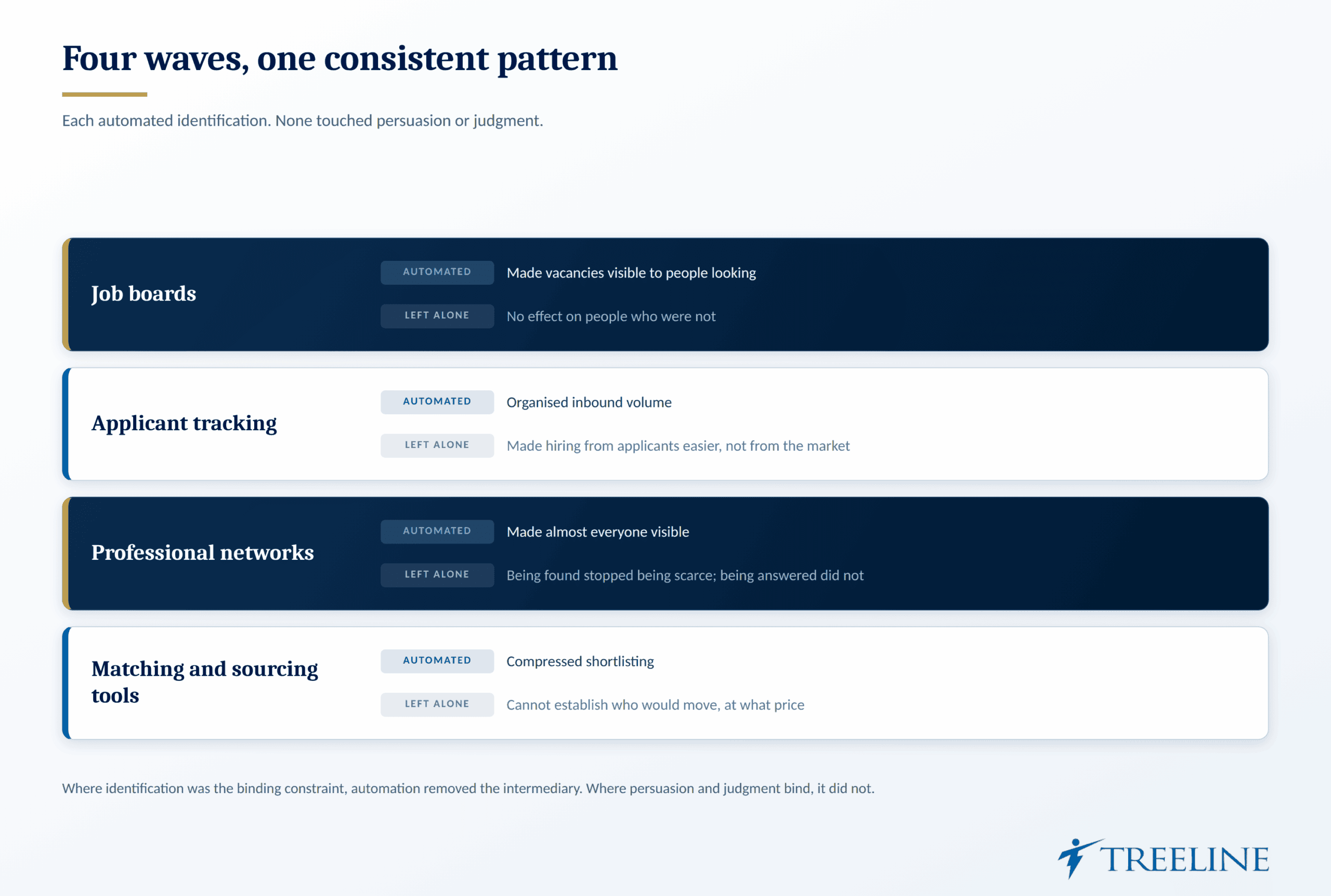
Being specific about what the technology did is more useful than arguing about whether it mattered, because the pattern across waves is consistent, as set out below.
- Job boards made vacancies visible to people looking for work. That solved a genuine distribution problem and had no effect on people who were not looking, which in sales is most of the qualified population.
- Applicant tracking systems organised inbound volume. They made a large application pool manageable and, in doing so, made it easier to hire from the applicant pool rather than from the market, which is a different and usually weaker source.
- Professional networks made almost everyone visible. Identification stopped being the constraint, and the constraint moved to response rate. When every seller can be found, being found stops being scarce and being answered becomes the scarce thing.
- Matching and sourcing tools compressed the shortlisting step. They generate candidate lists quickly and cheaply, which is valuable, and they cannot establish whether a particular person would move, at what price, and under what conditions.
Read together, the pattern is that each wave automated identification and left persuasion and judgment untouched. Those two are the expensive parts of a sales search, and they are the reason the intermediary persists.
One caution about the analogy. Recruiting differs from those markets in a way that cuts against the intermediary: the buyer in a hiring transaction is a repeat purchaser with an internal function already dedicated to the task, which is not true of most people booking travel or selling a house. That is precisely why the in-house question, addressed below, is the stronger challenge to the model than any technology has been.
The Same Pattern in Other Intermediated Markets
The recruiting case is easier to see against comparable markets, where the same sorting happened.
Travel agencies collapsed for simple bookings and persist for complex itineraries. Anyone can book a flight; assembling a multi-leg trip with constraints, contingencies and a relationship with suppliers is still worth paying for. Identification was automated and coordination was not.
Stock trading moved almost entirely to platforms for execution, while advice on what to hold did not. Placing an order was the abundant task; judgment about a specific situation remained scarce.
Real estate has resisted disintermediation more than most predicted, and for a related reason: listings became universally visible while the negotiation, the local knowledge and the management of a high-stakes emotional transaction did not.
The consistent pattern is that automation removes the intermediary wherever the intermediary’s value was information access, and leaves them in place wherever the value was judgment applied to a particular case. Sales recruiting sits in the second group, and that is a claim about structure rather than a claim about recruiters being irreplaceable.
Fantasia treats the comparison as diagnostic rather than reassuring. His reading is that any part of a recruiter’s work that could be described as looking things up has already been competed away, and the firms that did not notice are the ones that disappeared.
The Constraint That Has Not Moved
For an experienced sales professional, the sequence from “exists” to “hired” contains several steps, and only the first has been automated.
Existing is now trivially discoverable. Being reachable is easy. Being willing to have a first conversation is not, and it is the step where most searches actually fail. A performing seller at a company that is treating them adequately has no reason to answer a message from a stranger, and receives several such messages a week.
What produces an answer is rarely the content of the message. It is whether the sender is someone whose call this person takes, a recruiter they have dealt with before, someone who placed a former colleague, someone whose name carries a reference. That is a relationship asset, it accumulates over years, and no tool has found a way to manufacture it.
The steps after that are equally resistant. Establishing what would genuinely move someone requires a conversation they will be candid in. Judging whether a candidate can run a specific deal motion requires reconstructing real deals with someone who knows what to probe. Getting an offer accepted against a counteroffer requires having established the reason for leaving months earlier.
None of that is nostalgia about the human touch. It is a claim about what is scarce, and scarcity is what determines where value sits.
Why In-House Teams Have Not Replaced the Model Either
The stronger argument against external recruiters is not technological but organisational: build the capability internally and stop paying fees. Many companies have tried, and the results have been mixed for reasons that are structural rather than about talent.
An internal recruiter carries requisitions across functions. Engineering, finance, marketing and sales all draw on the same person, which makes deep market knowledge in any one of them difficult to sustain.
Internal pipelines are built from people who are visible to the company, applicants, referrals, and outbound to whoever appears in a search. That is a systematically different population from the one a specialist works, and it skews toward availability rather than quality.
Relationships built in-house belong to the company but decay with turnover, and talent acquisition teams turn over. A relationship bank that took four years to build can disperse in one.
And an internal recruiter is poorly positioned to tell a hiring executive that the band is uncompetitive or the loop is too slow. That conversation is easy for an outsider and career-limiting for an insider, which is why it happens less often than it should.
The honest counterweight is that internal teams are better at some things, cultural knowledge, employer brand, candidate experience, and cost at volume. The companies that get this right usually run both, with internal teams owning volume and process and external firms owning the narrow searches where relationships decide the outcome.
Fantasia separates the two functions by what they are optimising. In his account an internal team is built to serve the whole organisation consistently, while a specialist firm is built to go unusually deep in one market, and asking either to do the other’s job produces predictable disappointment.
The Part Employers Underestimate
Of the three things the fee purchases, the second is the one clients consistently undervalue, and it is worth expanding.
Comparative judgment sounds abstract until it produces something specific. A firm running fifteen similar searches a year knows that a particular band is closing at a certain level, that a certain kind of candidate reliably struggles when they move from a large organisation to a small one, that a competitor’s sales team is unsettled, and that a scope combining two responsibilities has failed at three other companies this year.
None of that appears in any dataset an employer can buy. It is a by-product of doing the work repeatedly in one market, and it is available to a client for the price of asking.
The reason it goes undervalued is that it arrives as conversation rather than as deliverable. An employer receiving a shortlist can see what they paid for; an employer receiving a warning that their scope is really two jobs frequently experiences it as an obstacle rather than as the most valuable output of the engagement.
What Happened to the Firms That Did Not Adapt
The industry did not survive intact, which is worth saying because it is evidence for the argument rather than against it.
A generation of agencies competed primarily on having a database and being able to produce names quickly. When producing names became free, that proposition disappeared, and so did many of those firms. The market consolidated toward two ends: large staffing operations competing on volume and price, and narrow specialists competing on depth in one segment. The undifferentiated middle largely went.
The firms that adapted did so by moving up the value chain toward the parts that resisted automation, filtering harder, developing genuine market opinions, staying in contact between engagements, and being willing to tell clients uncomfortable things. None of that is glamorous and all of it is expensive relative to sending résumés.
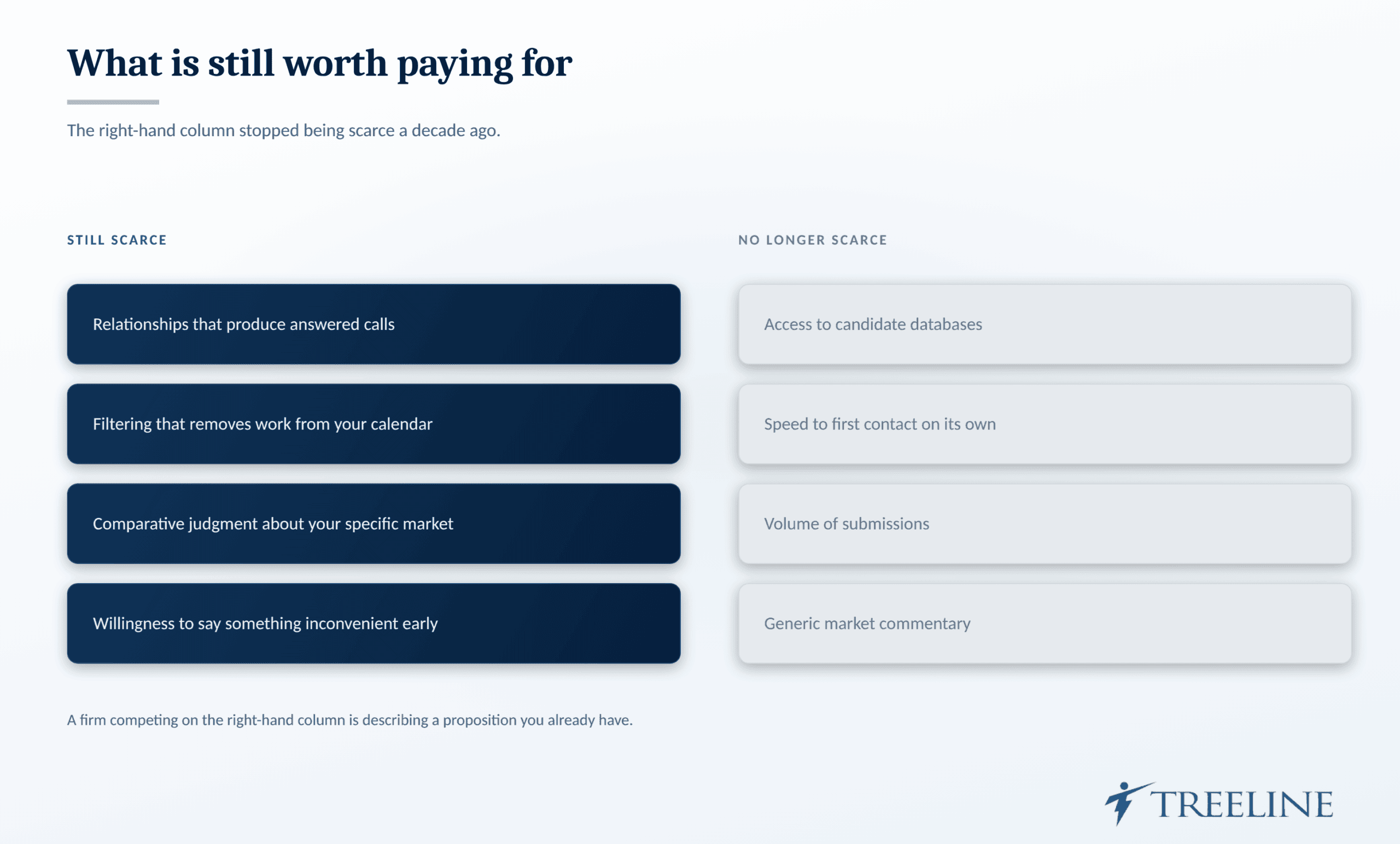
This matters for how an employer reads the market today. A firm still competing on network size and response speed is describing a proposition that stopped being scarce a decade ago. A firm competing on what it declines and what it knows is describing the part that survived.
What the Fee Actually Purchases
Framed against the alternatives, the fee buys three things that are difficult to acquire another way.
The first is access built over time. A contingency sales recruiter who has worked one market for years holds relationships that produce answered calls. That asset cannot be bought at the point of need, which is precisely why it retains value.
The second is comparative judgment. A firm running similar searches across many companies knows what a band buys, what a normal loop looks like, and which profiles fail in which environments. A company running one search a year has no comparison set and cannot develop one.
The third is risk placement. Payment on placement means an employer testing an uncertain requirement spends internal time but no fee if the market cannot produce someone. For a first-of-kind role or a difficult profile, that structure is doing real work.
What the fee does not buy is assessment discipline, which comes from the firm rather than the model, or a guarantee of outcome. Being clear about the boundary is part of why the model has survived scrutiny: firms that oversold it lost clients, and firms that described it accurately kept them.
The Compounding Nobody Prices
There is an asset in this market that no tool creates and no employer can buy quickly, and it explains why the leading firms tend to keep leading.
A recruiter who has worked one sales segment for a decade holds something specific: several hundred relationships with people who will take their call, accumulated knowledge of which companies treat sellers well and which do not, a record of who succeeded after moving and who did not, and a reputation among candidates that determines whether an approach reads as credible or as noise.
Each of those compounds. A placement made five years ago produces a candidate today, because the person placed has since moved into a larger role and refers colleagues. A candidate who was not right in 2021 becomes exactly right in 2026. A hiring manager who was placed by the firm becomes a client at their next company.
The compounding is why the market has not been flattened by cheap tooling, and it is also why it is difficult to enter. A new firm with the same software has none of it, and cannot acquire it faster than time allows.
For an employer, the practical reading is that continuity has more value than it appears to. Rotating firms for a marginally better rate resets the compounding each time, and the discount is visible on an invoice while the accumulated context is not.
Where Technology Has Genuinely Displaced the Model
An argument for durability that never concedes ground is not credible, and there are segments where the intermediary really has been displaced.
High-volume, low-specialisation hiring has largely moved in-house or to platforms. Where the qualified population is large, applications are plentiful, and screening can be standardised, an external firm adds cost without adding much.
Roles with published, transparent requirements and abundant supply have moved the same way. If a job can be described precisely and many people can do it, the market clears without an intermediary.
Junior hiring has shifted substantially toward direct channels, since early-career candidates are actively looking and therefore reachable through inbound.
The pattern in all three is the same: where identification was the constraint, automation removed the intermediary. Where persuasion and judgment are the constraint, it did not. Complex sales hiring sits firmly in the second category, which is the whole of the durability argument rather than an assertion about the industry being special.
How the Work Itself Has Shifted
Continuing to lead is not the same as staying the same, and contingency recruiting firms working sales today operate differently from those of a decade ago.
Sourcing has become cheap, so firms that competed on finding people have lost their advantage. For contingency recruiters the differentiation moved to filtering, to market judgment, and to closing. A firm submitting fifteen candidates is now demonstrating a weakness rather than effort, since producing fifteen names costs almost nothing.
Client expectations have risen accordingly. Employers increasingly ask what was screened before submission, what the firm would challenge in the requirement, and what they know about the market that the employer does not. Those questions were rare fifteen years ago.
The relationship has lengthened in the better cases. Firms that maintain contact between engagements have a real advantage over those that start cold each time, and clients have begun to notice the difference in how quickly a second search moves.
And the tooling is used rather than resisted. A specialist firm today uses the same sourcing platforms an internal team does; the difference is what happens after the list is generated, which is the part that was never the bottleneck.
Fantasia points out that the tools have raised the floor and left the ceiling untouched. His reading is that anyone can now produce a competent list of names, so producing one is no longer worth paying for, and the firms that survived are the ones whose value was never in the list.
Why This Bites Hardest on Enterprise Sales Hiring
The general argument concentrates on this role, because it sits at the extreme of every variable that resists automation.
The qualified population is small and defined by motion rather than title, so identification tools return a list that is mostly wrong in ways only a conversation reveals. The people on it are employed, performing, and approached regularly, so response rate rather than reach is the binding constraint. And the assessment requires reconstructing complex deals, which cannot be done from a profile.
There is a further effect specific to small populations. The same enterprise account executives are contacted repeatedly by multiple firms and multiple employers, which raises the cost of a generic approach. A message that reads as mass outreach does not merely fail; it makes the next approach from the same company harder.
The practical consequence for an employer is that the choice of firm matters more here than the choice of model. Contingency executive search is usually the right structure for an enterprise account executive search. Whether it produces anything depends on whether the specific firm holds live relationships in that segment, which is a question worth asking directly rather than inferring from a proposal.
The View From a Candidate’s Inbox
Looking at the same market from the candidate’s inbox explains the durability argument better than any account of what firms do.
A strong enterprise account executive receives several approaches a week. Most are visibly automated: the wrong segment, the wrong seniority, a personalisation token in the wrong place, or a description of an opportunity that could apply to forty companies. The volume of these has risen sharply as sourcing costs fell, which has had a predictable effect, the response rate to cold outreach has fallen, and the bar for what earns a reply has risen.
That dynamic is the reason cheaper identification has not weakened the intermediary. It has flooded the channel, and flooding a channel raises the value of being the sender who gets answered. An employer approaching the same person directly, once, without any prior relationship, is competing against that noise from a worse position than a firm that placed their former colleague two years ago.
There is a second-order effect worth naming. Because the population is small, poor outreach accumulates. An enterprise account executive who received three generic messages about the same company in a fortnight forms a view of that company, and that view persists into the next search. Employers rarely learn this happened, since the declines are recorded as a tough market.
The practical implication is that in this segment the quality of the approach is part of the employer brand, not just part of the sourcing process.
The Prediction Worth Taking Seriously
Dismissing every forecast of disintermediation would be its own kind of error, and there is a version of the argument that deserves engagement.
If a tool could establish, before any human contact, which specific people are likely to move in the next six months and why, that would attack the actual constraint rather than the identification step. Signals exist that correlate with movement, tenure patterns, company events, compensation cycles, territory changes, and a system that read them well would compress the persuasion problem substantially.
Two things temper it. The signals are noisy at the individual level, and being wrong is expensive in a small market, since a badly targeted approach damages standing with exactly the people you need. And the conversation that follows still has to happen with someone the candidate will be candid with, which returns to the relationship question.
The honest position is that the identification and prioritisation steps will keep getting cheaper, the persuasion and judgment steps will remain expensive, and the share of a search that an intermediary is paid for will keep narrowing toward those two. That is a smaller claim than the industry usually makes for itself, and it is the one supported by what has actually happened so far.
One Thing That Got Worse
Not every change has favoured employers, and one deserves naming because it is rarely acknowledged.
The cost of contacting a candidate fell to almost nothing, and the volume of contact rose accordingly. For a small, high-value population like enterprise sellers, that has degraded the channel for everyone. Response rates to cold approaches have fallen, which means the same opportunity requires more effort to communicate than it did a decade ago, whoever is communicating it.
This is a genuine cost imposed on employers by the technology that was supposed to help them. It has made direct outreach less effective at the same time as making it more available, and companies that measure only the availability conclude they can run the search themselves.
The compensating factor is that the degradation is uneven. Approaches from someone the candidate already knows have not lost effectiveness, which is why the relationship asset has appreciated rather than depreciated over the same period. That is an uncomfortable conclusion for anyone hoping technology would reduce hiring costs, and it is what the evidence supports.
What Has Not Changed at All
Alongside what shifted, several things about complex sales hiring are exactly as they were, and it is worth listing them because they explain the persistence more plainly than any argument about technology.
The strongest candidates are still employed and still not looking. That has been true throughout every wave and is the root of everything else.
Counteroffers still arrive, and still work when the reason for leaving was compensation. No tool has changed the arithmetic that makes a current employer move quickly to keep a producing enterprise account executive.
Judgment about deal motion still requires reconstructing real deals with someone who knows which follow-up question to ask. A profile shows where someone worked; it does not show whether they ran the deal or inherited it.
And employers still lose candidates to their own process more often than to the market. Slow feedback, a vague territory description, and an unresolved internal candidate cost more hires than sourcing failures do, which was as true in 1998 as it is now.
The through-line is that the difficult parts of hiring were never information problems. They were persuasion problems, judgment problems and coordination problems, and those have not become easier.
How to Use the Model Well Now
Given all of that, the practical question is how an employer should engage a contingency placement firm today, which differs from how they would have a decade ago. The split between what is still scarce and what is not points the way.
- Buy judgment, not reach. Ask what the firm would challenge in your requirement before asking how many candidates they can produce.
- Treat submission volume as a cost signal. Fifteen candidates is a transfer of screening work, not evidence of effort.
- Ask what they know that you do not. Compensation reality, why leaders leave companies like yours, which competitors are vulnerable.
- Use them where relationships decide it, and use internal capability where process and volume decide it.
- Keep the relationship warm between searches, since the compounding is where most of the value now sits.
- Expect them to say something uncomfortable early. A firm that only relays progress is withholding the part you cannot get elsewhere.
What Would Actually Displace It
Rather than asking whether the model survives, it is more useful to specify what would have to be true for it to stop mattering, since that gives an employer something to watch for.
Three conditions would do it. Identification of who is likely to move would have to become reliable at the individual level rather than the population level. The first conversation would have to be something a candidate is willing to have with a system rather than a person they trust. And judgment about deal motion would have to become codifiable well enough that an assessment could be run without someone who has sold in that motion.
The first is plausibly getting closer. The second and third are not obviously moving, and the second in particular runs against the direction of travel: as automated outreach has increased, candidate willingness to engage with anything that reads as automated has fallen.
An employer does not need to resolve this. What they need is to notice which parts of a firm’s proposition are already commoditised, lists, speed of first contact, database size, and to stop paying a premium for those while continuing to pay for the parts that are not.
Buying Discrimination Rather Than Capacity
Pulling the argument together into a purchasing position, the shift over the past decade has been from buying capacity to buying discrimination.
A decade ago an employer engaging a firm was substantially buying reach into a market they could not see. Today they can see the market, which means the transaction has changed even where the price has not. What is being purchased now is somebody else’s willingness to reject most of what they can see, and their standing with the small number of people worth approaching.
That reframing has practical consequences at every stage. At selection, ask about what a firm turns away rather than what it can produce. At intake, expect the requirement to be challenged and treat a firm that accepts it unchanged as a warning rather than as accommodation. During the search, read low submission counts as the service working rather than as inactivity. And at review, ask what the firm learned about your market that you did not already know.
None of this reduces the fee, and it is not meant to. It changes what the fee should be measured against, which is the only part an employer actually controls.
When the Model Is the Wrong Tool
Durability is not universality, and the boundaries are worth stating plainly.
Where a search must remain confidential, a non-exclusive arrangement is structurally unsuited to it regardless of the firm’s quality; Treeline sets out that distinction in its comparison of retained search versus contingency search.
Where an employer needs a documented map of every qualified person rather than a viable shortlist, the commercial structure does not support producing one, since a firm paid on placement has no reason to document the people it could not convert.
Where the requirement is genuinely unfilled after several attempts, another firm is rarely the answer. The variable to change is the requirement, the compensation, the geography or the scope.
And where the internal decision process cannot return feedback within days, the speed advantage that the model is built around does not exist, and the engagement will underperform for reasons that have nothing to do with sourcing.
A Reasonable Split of Responsibilities
For most companies the practical answer is neither wholly internal nor wholly external, and the division that works is fairly consistent.
Internal capability should own the things that benefit from being inside: employer brand, candidate experience, process design, offer administration, and any role where the qualified population is large and reachable through inbound. It should also own the accumulated record, what was tried, who declined and why, which sources produced hires that lasted.
External capability should own the searches where the outcome turns on relationships and comparative judgment: narrow enterprise roles, first-of-kind hires, replacements in small markets, and anything where the qualified population is small enough that response rate rather than reach is binding.
The division fails in two predictable ways. Companies sometimes hand external firms the easy roles to keep the difficult ones in-house, which inverts the logic and wastes the fee. And companies sometimes engage a firm for a narrow search while continuing to run their own outreach into the same small population, which produces exactly the duplicated, inconsistent approaches that damage standing.
Getting the split right is worth more than optimising either side of it, and it is a conversation most organisations have never explicitly had.
Frequently Asked Questions
Has recruiting technology reduced the need for contingency recruiting firms?
It has reduced the value of identification, which used to be a significant part of the service, and left persuasion and judgment untouched. Finding qualified sales professionals is now cheap; getting a specific employed person to take a call and assessing whether they can run your deal motion is not. The value has narrowed onto those two.
Why do companies still pay a fee when they can find candidates themselves?
Because finding was never the constraint for complex sales roles. The fee buys relationships that produce answered calls, comparative judgment from running many similar searches, and the transfer of risk on searches that do not close. None of the three can be acquired quickly at the point of need.
Should we build an internal recruiting team instead?
For volume hiring and process ownership, usually yes. Internal teams are better on cultural knowledge, employer brand and cost at scale. They are structurally weaker on narrow searches, because a recruiter carrying requisitions across functions cannot sustain depth in one market, and because telling an executive that the band is uncompetitive is easier for an outsider.
Where has technology genuinely replaced external recruiters?
In high-volume, low-specialisation hiring, in roles with transparent requirements and abundant supply, and in junior hiring where candidates are actively looking. The common factor is that identification was the binding constraint, and automation removed it. Complex sales hiring is not in that category.
What does a good firm do differently now compared with a decade ago?
It competes on filtering rather than sourcing, uses the same tools an internal team does, maintains relationships between engagements rather than starting cold, and expects to be asked what it would challenge in a requirement. Submitting large numbers of candidates has gone from looking like effort to looking like a weak filter.
Could AI eventually attack the real constraint?
Possibly, and it would do so by predicting which specific people are likely to move and why, rather than by identifying who exists. Signals that correlate with movement do exist. Two things limit it: the signals are noisy for individuals, and a badly targeted approach in a small market damages standing with the people you most need.
How should we choose a firm given all this?
On judgment rather than reach. Ask what they would change about the requirement, what they know about your market that you do not, how many candidates they reviewed before the first submission, and what would make them decline the search. Those answers separate firms; claims about network size no longer do.
Is a contingency hire still the right structure for senior sales roles?
For most sales roles up to and including vice president, yes, and the fee model is a separate question from assessment quality. Confidentiality is the real dividing line, along with whether you need a complete market map rather than a strong shortlist.
Ask What We Would Change First
Treeline, Inc. is a sales-only executive search firm based in Wakefield, Massachusetts, working exclusively on building sales organizations. Our contingency sales recruiting service carries no upfront cost and no fee unless you hire, and we deliver your first candidate within three days of launching a search.
If you are weighing whether an external firm still earns its place, the useful test is to send us a requirement and ask what we would challenge in it. That answer is the part no tool produces.
Share This Story, Choose Your Platform!
Related Posts


What our happy clients are saying
Treeline Inc. provided us with the most candidates that aligned with our needs and were of the highest quality.

Dr. Jeffrey Klein Head of North America Sales, Satchel Pulse
Treeline Inc.’s collaborative, flexible, and communicative approach resulted in a smooth partnership. Beyond their recruitment expertise, their unique sourcing model was efficient and effective.

Sera Holt Director of Operations, LNS Research
Their professionalism was outstanding. Treeline Inc. was extremely thorough and ensured that we were on the same page before they started looking for candidates. They listened to us and did a great job working with the candidate to close out the process.

Cate Grant AVP Customer Success, Nasdaq
Thanks to Treeline Inc.’s intricate and thorough screening process, the company is able to hire six high-quality candidates that fit perfectly in the company’s culture. The team is highly receptive to concerns, and internal stakeholders are impressed with their unique recruitment abilities.

Anna McKean Sales Recruiter, Insider Intelligence
Treeline Inc. has been qualified individuals throughout a five-year-long engagement. They’ve made numerous placements of talented and qualified individuals for our business.

Michele St Laurent VP of HR, The Institute for Applied Network Security

Let Us Help You Source the Sales Talent You Need
Whether you’re building a team or replacing a key role, our Candidate Sourcing Platform provides a fast, flexible, and employer-focused solution.
Tell us more about your business and how we can help.
Treeline Inc.
Your Award-Winning Sales Recruitment Partner
15 Lincoln Street, Suite 314, Wakefield, MA 01880