Almost everything a recruiting firm says about itself is unfalsifiable. Deep network, industry expertise, rigorous process, exceptional candidates, an employer comparing proposals is reading four versions of the same document, none of which can be checked. What genuinely separates the top 5 contingency search firms in any market is not in the claims at all.
It shows up in the constraints they accept: the searches they decline, the markets they stay out of, and the revenue they turn away to remain useful in one place. The standard for testing a claim is already well established outside this industry. The Federal Trade Commission’s guidance on truth in advertising holds that an advertisement must be truthful, not misleading, and where appropriate backed by evidence, and that the same standards apply regardless of where the advertisement appears.
That framework was written for consumer products rather than professional services, and applying it informally to a recruiting proposal is clarifying: for each sentence, ask what evidence would settle whether it is true. Most claims in this market do not survive the question, and the few that do are the ones worth choosing on.
Dan Fantasia, CEO of Treeline, Inc., notes that the claims easiest to make are the ones no client can check afterwards. His suggestion is to sort every statement in a proposal into two piles, what could be verified within ninety days and what could not, because the first pile is usually short and it is the only part that should influence a decision.
Sorting Claims by Whether They Can Be Checked
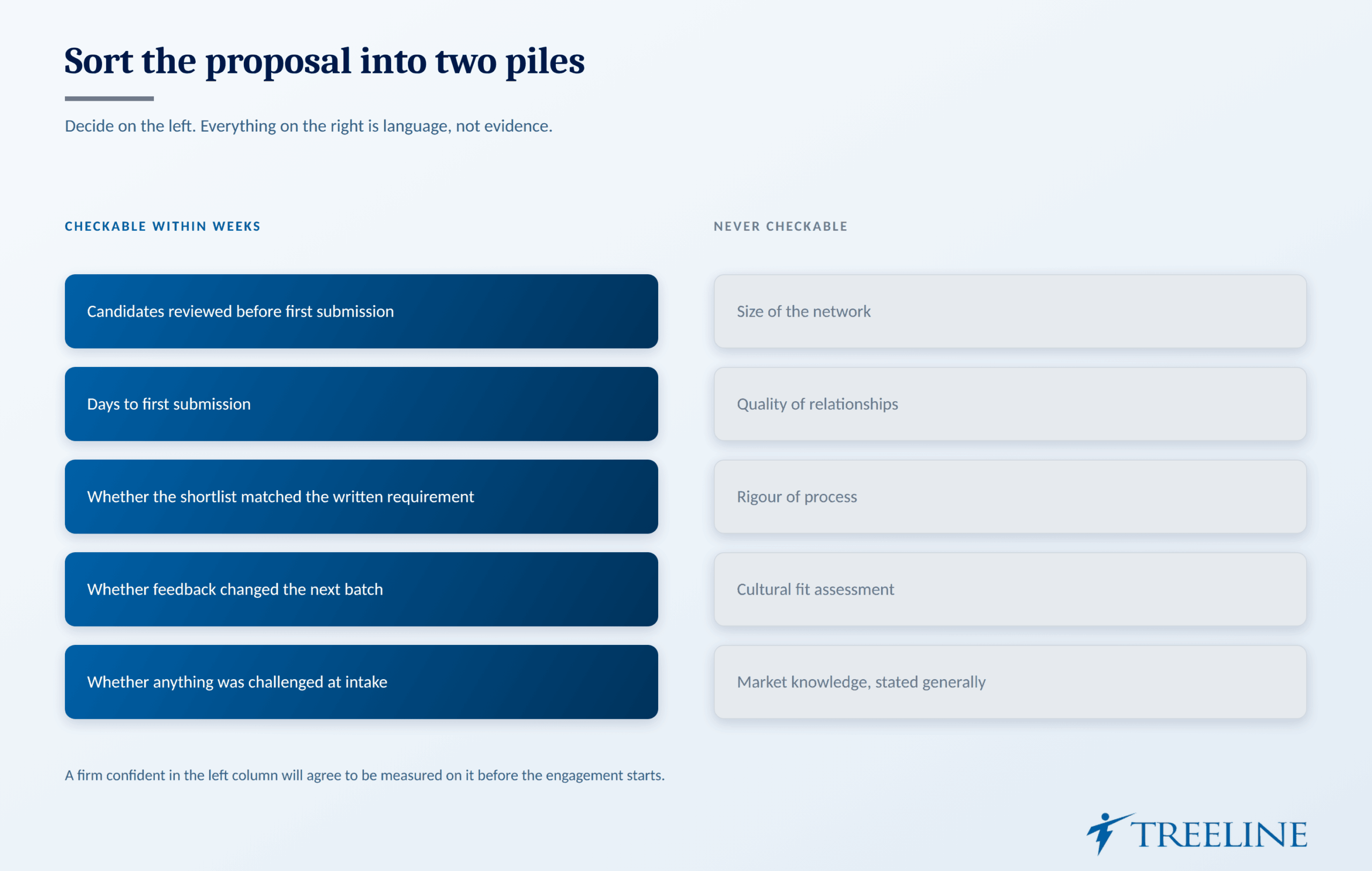
Run a proposal through this and the document shrinks considerably, as the sort below shows.
- Claims that can be checked quickly. How many candidates were reviewed before the first submission. How long the first submission took. Whether the shortlist matched the written requirement. Whether feedback was incorporated by the third candidate. Whether the firm challenged anything at intake. All of these are observable within a few weeks.
- Claims that can be checked eventually. Whether the hire was still performing at twelve months. Whether the second search was faster than the first. Whether near-miss candidates were retained and resurfaced later. These take longer but they are real.
- Claims that can never be checked.
The size of a network. The quality of relationships. Rigour of process. Cultural fit assessment. Market knowledge, stated in general terms. None of these produce evidence, which is precisely why they dominate the market’s language. The practical rule is to make the decision on the first two piles and treat the third as noise.
A firm confident in the checkable claims will agree to be measured on them before an engagement starts, which is itself a filter.
How the Top 5 Contingency Search Firms Accept Constraints Others Do Not
Contingency recruiting firms all describe themselves as specialized. The word means something only if it costs something, and the cost is visible. Contingency recruiters genuinely focused on one market cannot take a search outside it. When a client with a good relationship asks them to fill a marketing role or an engineering role, the answer has to be no, and that no is expensive.
A firm that says yes has revealed that focus is a description of its marketing rather than its operations. Real focus also constrains growth. A firm that recruits enterprise sales talent in a defined segment can only grow as fast as it can build recruiters who know that segment, which is slow. Growing faster means hiring people who do not know it yet and putting them on client work, which dilutes the thing being sold.
And it constrains revenue timing. Maintaining relationships with people who are not moving this year produces nothing this quarter. A firm optimising for the current quarter stops doing it, and the erosion is invisible until a search needs someone who would only have taken the call because of a conversation eighteen months ago.
The test is straightforward. Ask what the firm has declined recently and why, and ask what proportion of their work sits outside their stated specialty. A firm that has never declined a search is describing capacity, not focus. Fantasia draws a distinction between firms that specialize by choice and firms that specialize by accident of their client list.
In his experience the first group can describe the boundary of their market precisely and explain why it sits where it does, while the second discovers the boundary only when a search fails.
What the Strongest Firms Refuse to Do
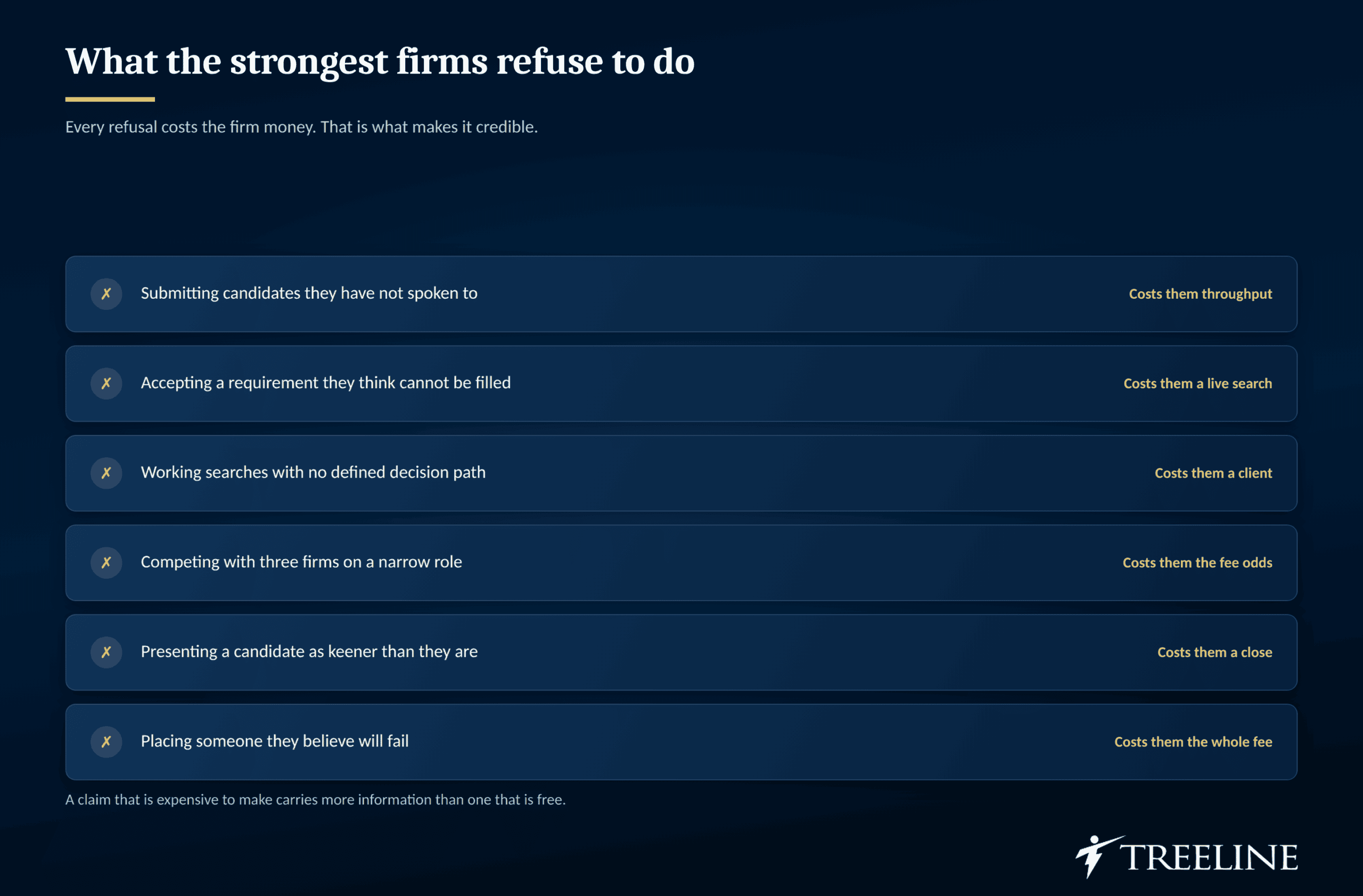
Framed as refusals rather than capabilities, the differences become concrete and checkable, and each carries a price.
- They refuse to submit candidates they have not spoken to. Forwarding a résumé costs the firm nothing and costs the client an hour. Firms that do it are converting your calendar into their throughput.
- They refuse to accept a requirement they believe cannot be filled at the compensation offered, rather than taking the search and hoping.
- They refuse to work searches where the decision path is undefined, because those consume effort and rarely close.
- They refuse to compete with three other firms on a narrow requirement, since the same small population then hears four inconsistent descriptions of one company.
- They refuse to present a candidate as more interested than they are, which is the most common quiet dishonesty in the industry.
- They refuse to stay silent about a client’s own contribution to a stalled search.
- They refuse to keep a search open once they believe it cannot close, rather than leaving it nominally active and quietly unworked.
There is a seventh that rarely gets mentioned because it costs the most: they refuse to place someone they believe will fail. A firm confident in its own judgment will occasionally tell a client that the candidate everyone likes is the wrong hire, knowing that saying so forfeits the fee on a search that was otherwise about to close.
Nobody advertises this, and it is the single clearest indicator of a firm that intends to be working with you in five years rather than this quarter. Each refusal costs the firm money in the short term. That is what makes them informative: a claim that is expensive to make is more credible than one that is free.
What a Genuine Differentiator Looks Like
Having argued that most claimed differences are not real, it is fair to describe what a real one looks like when it exists. A genuine differentiator has three properties. It is costly to the firm, which is why competitors have not simply copied it. It is observable by a client within a reasonable period, which distinguishes it from an assertion.
And it changes an outcome the client cares about rather than an input the firm cares about. Examples that meet all three are less exotic than the marketing suggests. A firm that caps searches per recruiter is accepting lower revenue per head, the client can verify the number, and it directly changes how much attention a search receives.
A firm that pays its recruiters partly on twelve-month retention rather than purely on placement is deferring its own income, the compensation structure can be described, and it changes who gets submitted. A firm that writes a full assessment against the requirement for every submitted candidate is spending hours that produce no fee, the document arrives or it does not, and it removes duplicate screening from the client’s side.
Compare those with the standard claims. A large network costs nothing to assert, cannot be observed, and changes nothing on its own. That contrast is the whole test, and it can be applied to any sentence in any proposal in about ten seconds.
Why the Language Converged
It is worth understanding why every firm sounds the same, because the explanation points at what to do instead of simply resenting it. Recruiting outcomes are noisy at low volume. A firm can run an excellent search that fails because a candidate’s partner would not relocate, and a careless one that succeeds because the right person happened to be free that month.
A client running one or two searches a year genuinely cannot distinguish skill from luck on outcomes alone. Into that gap flows capability language, because it fills the space that evidence cannot. And once one firm describes itself as having deep relationships and a rigorous process, every competitor must say something similar or appear to be claiming less.
The convergence is a market equilibrium rather than a conspiracy. The way out is not to demand certainty from small samples. It is to measure the things that are less noisy than the final outcome, how much was filtered before submission, how fast the first genuine candidate arrived, whether feedback changed the next batch, whether anything uncomfortable was said early.
Those vary far more between firms than placement rates do, and they are visible within weeks rather than years.
Reading a Proposal Against the Substantiation Test
Applying the standard from the opening to an actual document is a short exercise with a clarifying result. Take a typical proposal paragraph: a firm with deep relationships across the enterprise software market, a rigorous multi-stage screening methodology, and a track record of placing exceptional sales talent at high-growth companies.
Nothing there is false. Nothing there is checkable either, and that combination is the point. Now rewrite the same claims so they would be falsifiable. Deep relationships becomes a statement about how many people in your specific segment the firm has spoken to in the past year. Rigorous screening becomes a named set of disqualifiers applied before submission.
Track record becomes the number of comparable searches run in the last twelve months and how many closed. A firm can supply the second version if the first version was true. That is the whole test, and it takes one email to run. The response tells you two things at once: whether the claims have substance, and how the firm behaves when asked something inconvenient.
There is a fair caveat. Some of what a good firm knows genuinely cannot be evidenced to a prospective client, candidate confidences, relationships that would be damaged by disclosure, judgments accumulated over years. The distinction worth holding is between a firm that says a claim cannot be evidenced and explains why, and one that simply repeats the claim more emphatically.
Two Firms, Same Fee, Different Outcome
An illustration makes the practical difference concrete. This is a worked example rather than data from specific engagements. Two firms take the same enterprise account executive requirement at the same percentage. Firm A submits fourteen candidates over five weeks; the hiring manager reviews all fourteen, interviews six, advances two, and hires one.
Firm B submits five over six weeks; the manager reviews five, interviews four, advances two, and hires one. Both filled the seat. Both invoiced the same amount. Firm A consumed roughly nine more hours of the most expensive calendar in the sales organisation, and it took the manager’s attention during a quarter they were also carrying a number.
Firm A also reached fourteen people in a small market, nine of whom formed an impression of the company without ever being seriously considered. Nothing in either proposal would have predicted the difference. Firm A’s document probably emphasised responsiveness and breadth of coverage, both of which it delivered. The distinguishing variable was where the filtering happened, and that is exactly the sort of thing an employer can ask about in advance and almost never does.
The question that would have surfaced is one line: how many candidates do you expect us to interview per hire, and how many will you have reviewed to get there?
The Question That Reveals Most
Of everything an employer can ask a prospective firm, one question separates them faster than any other: describe a search you failed to fill, and what you concluded from it. The answers fall into recognisable categories. Some firms cannot produce an example, which means either very little history or an unwillingness to be candid.
Some produce an example in which the client was entirely at fault, which is occasionally true and rarely the whole story. And some describe a specific search, name what they misjudged, and explain what they changed afterwards. Only the third answer tells you anything. It demonstrates that the firm reviews its own work, that it can hold a client relationship while saying something uncomfortable, and that it has a memory beyond the current pipeline.
A useful follow-up is to ask what they would have needed from the client to make that search succeed. A firm that answers honestly is describing the working relationship you would actually have.
Depth Is Built Between Searches, Not During Them
The differences that matter accumulate when nobody is paying for them, which is why they are hard to fake at proposal stage. Consider what a firm working one segment continuously is doing in a month with no active search for you. Meeting people who are not moving. Tracking which competitors have changed leadership and what happened afterwards.
Noticing which companies have quietly stopped hiring. Learning what packages are actually closing rather than what postings advertise. Following up with someone they placed two years ago. None of that is billable. All of it determines whether a search launched next quarter starts from a shortlist or from a blank page. An employer can test for it without much effort.
Ask what has changed in your segment over the past year, compensation, hybrid expectations, which companies are hiring and which are not. A firm in the market continuously answers immediately and specifically. A firm that assembles knowledge per engagement generalises, and the generalisation is audible.
The Economics That Shape Behaviour
Understanding how contingency based recruitment makes money explains most of what you will experience, and the strongest firms are the ones whose behaviour departs from the incentive. Payment on placement creates a bias toward volume and toward searches likely to close. Left unchecked, that produces the pattern most employers recognise: a burst of candidates early, quiet persistence on the easy searches, and a slow fade on the hard ones.
Firms that resist this do specific things. They cap how many searches a recruiter carries, which limits revenue per head deliberately. They pay recruiters partly on quality measures rather than purely on placements. They decline work that would fill capacity but damage focus. And they invest in market presence that produces nothing for several quarters.
Every one of those choices reduces short-term earnings. An employer evaluating a contingency recruiting agency can ask about all of them directly. How many active searches does the person on my account carry? How are they compensated? What did you turn down last month? The answers are concrete, and a firm unwilling to give them has answered anyway.
As for fees, the market convention sits around a quarter of first-year compensation and is not where firms differentiate. Treeline sets out how that structure compares with the alternative in its discussion of retained search versus contingency search; the more useful line of questioning is what the fee buys in filtering rather than what the percentage is.
Fantasia cautions that a firm’s caseload per recruiter tells you more about your likely experience than its client list does. He puts it in terms of arithmetic rather than intent: a recruiter carrying a dozen live searches will work the three most likely to close, and no amount of goodwill changes what fits in a week.
The Enterprise Account Executive Case Narrows It Further
The general argument narrows sharply on this role, because the population is small enough that the firm’s actual standing in it becomes the deciding variable. For an enterprise account executive requirement, the qualified people number in the hundreds rather than the thousands, they are employed, and they are approached regularly.
Whether your opportunity gets a serious hearing depends less on how it is described than on who is describing it. Contingency executive recruiters with a five-year relationship get a conversation; a stranger gets a polite decline. This inverts the usual selection logic. Breadth of coverage, which looks like an advantage in a proposal, is close to irrelevant here.
What matters is whether the firm can name the twenty or thirty people who could plausibly do the job, and whether those people would take their call. There is a direct way to test it that stops short of asking for names. Ask the firm to describe, by situation rather than identity, the three people they would approach first and why each might be receptive now.
A firm that holds the market answers in specifics, someone whose territory was recently carved, someone whose company was acquired, someone approaching a vesting date. A firm that does not will describe a search strategy instead.
Who Actually Runs Your Enterprise Account Executive Search
One structural detail affects outcomes more than anything on a capability slide: whether the person who won the business is the person doing the work. In many firms they are different people, and the handover is invisible to the client. The principal who impressed you at the pitch moves to the next prospect, and an enterprise account executive search built on a nuanced requirement is worked by someone who was briefed second-hand.
Nothing dishonest has occurred, and the search proceeds from a weaker starting position than the employer believes. The remedy is to ask before signing, not after the first submission disappoints. Who runs it, what have they placed in this segment, how many live searches are they carrying, and will they be at the intake conversation.
All four are reasonable, all four are answerable in a sentence, and reluctance on any of them is itself informative. There is a related question about continuity. If that person leaves mid-search, what happens? A firm with an answer has thought about it; a firm without one has not, and mid-search recruiter turnover is a real cause of searches that quietly restart.
What an Enterprise Account Executive Hears From Four Firms
There is a consequence of multi-firm engagement that employers rarely see, because it happens entirely on the other side of the conversation. When three or four contingency firms work the same narrow requirement, the small qualified population receives several approaches about one company within a fortnight. The descriptions differ, because each firm has interpreted the brief slightly differently.
The compensation range is characterised differently. One recruiter emphasises the growth story, another the territory, another the equity. An enterprise account executive receiving these draws a reasonable conclusion: the company is struggling to hire, nobody there has decided what the role is, and the opportunity is being shopped.
None of that may be true, and all of it is now believed by exactly the people you most wanted. The employer never learns this happened. The declines are attributed to a tough market, the firms report that candidates were not interested, and the next search starts from a worse position in the same small community. This is the strongest practical argument for concentrating a narrow search with one firm, and it has nothing to do with loyalty or fee negotiation.
It is about what the market hears.
Compounding, or Its Absence, After Several Searches
Most of this article addresses selecting a firm. The differences that matter most, though, appear after the first engagement, and they are worth naming because they inform whether to consolidate or keep shopping. By the third or fourth search with the same partner, several things should have visibly changed. Intake should take half as long, because the context is established.
The first submission should arrive faster, because the firm has been maintaining relationships in your segment rather than starting cold. Submissions should stop missing on criteria you have already explained once. And the firm should be bringing you people speculatively, someone strong who has become available for a role you have not opened yet.
That last behaviour is the clearest evidence of a working partnership, and it only appears when a firm expects the relationship to continue. It is also the argument against rotating firms for a marginally better rate, because the accumulated context is invisible on an invoice while the discount is not. The inverse deserves stating plainly.
A partnership that has not improved by the fourth search will not improve later. If intake still takes as long, if the same defects recur, if nothing is ever volunteered between engagements, the learning is not happening and the relationship is worth ending rather than persevering with.
Running a Structured Comparison
If more than one firm is under consideration, a short structured process beats an impression formed across three sales conversations. Give each firm the same written requirement and ask for the same three things: which parts of it they would challenge, how many candidates they expect you to interview per hire, and what they would need from you to make it work.
The answers are directly comparable, which the usual pitch meeting is not. Then ask each to describe your market back to you, what has changed, what people are paid, why sellers leave companies like yours. This is the closest thing to a work sample available in vendor selection, and it takes twenty minutes. Finally, ask each what would make them decline the search.
Firms with a threshold describe it readily. Firms without one hear the question as an objection to be handled, and the difference in response is usually decisive. Record the answers before any candidates arrive. Impressions drift once a strong résumé lands, and the point of the exercise is to have written down what you thought before that happened.
When the Firm Is Not the Problem
Occasionally the honest conclusion of a firm comparison is that the problem is not the firm. If three searches have failed against the same requirement, a fourth firm will not fix it. The variable to change is the requirement, the compensation, the geography or the scope, and a partner worth having will say so rather than accepting the assignment.
If the role is genuinely confidential, the non-exclusive structure is wrong regardless of which firm runs it, a distinction Treeline sets out in its comparison of retained search versus contingency search. And if an internal candidate is a serious contender, running an external search to test them is defensible, but it should be stated as that.
Firms allocate real effort to searches they believe will close, and one being run to validate a decision already leaning internal will be worked accordingly once they work out what is happening.
Putting the Terms in Writing
Whichever firm is chosen, a few things should be settled in writing, and none of them is unusual to ask for.
- Who runs the search, by name, and how many other live searches that person carries.
- What is screened before submission, expressed as specific disqualifiers rather than a general standard.
- What arrives with each candidate, a written assessment against the requirement removes duplicate screening on your side.
- How declines are reported, including the stated reason, since in a tight market that is the most valuable early output.
- How candidate ownership is defined, and for how long after an introduction.
- What happens if the requirement changes, which for a growing company is not hypothetical.
An employer who asks for these is a different kind of client, and firms respond to that difference immediately.
The Other Half of the Equation
None of the differentiation described here operates in isolation. A firm capable of all of it will still produce mediocre results for a client who cannot supply the other half. The requirement has to be written as something searchable, the buyer, the deal shape, the pipeline reality, the support that exists, rather than as a list of responsibilities.
A firm working from a generic description is guessing, however good it is. Feedback has to be specific and prompt. A rejection recorded as not the right fit gives a partner nothing to recalibrate against, and three of those in a row will produce a fourth candidate with the same defect. The decision path has to exist before the search opens, with named people and committed availability.
Firms allocate effort toward searches that look likely to close, and a visible internal bottleneck moves you down the queue without anyone announcing it. And the compensation band has to be settled and honest. A firm that discovers in week six that the range was aspirational has wasted its own effort and yours, and the candidates who declined on money are not recoverable.
Employers who supply these get materially better work from the same firm than employers who do not. It is not favouritism; it is that the same hours produce more when the target is clear.
Frequently Asked Questions
Is there an actual ranking of the top contingency search firms?
No published ranking of contingency sales recruiting firms exists that an employer could verify, and phrases of that kind function as marketing language rather than as a citation. The practical substitute is to test claims that can be checked, filtering ratios, time to first submission, whether feedback is incorporated, and to discount the ones that cannot.
How can we tell whether a firm is genuinely specialized?
Look for evidence of cost. Genuine focus means declining searches outside the specialty, growing slowly enough to keep expertise intact, and maintaining relationships that produce no revenue this quarter. Asking what the firm has recently turned down, and why, surfaces this quickly.
What is the single best question to ask a prospective search partner?
Ask them to describe a search they failed to fill and what they concluded from it. Firms that cannot produce an example, or that place all blame on the client, are telling you how the relationship will run. A specific answer naming their own misjudgement is the one worth hearing.
Does a large candidate database matter?
Very little on its own. Databases are widely available and largely interchangeable; what determines whether a search works is whether a specific person will take a specific call. That comes from relationships built over years, which no database records.
Why is a high submission count a bad sign?
Because it usually indicates a low internal filter. Every unqualified candidate reaching your hiring manager consumes expensive time and produces nothing, so volume moves the screening burden onto you while the firm still charges a placement fee.
When would a smaller firm be the better choice?
On a single difficult search in a narrow niche, particularly where the principals do the work themselves rather than passing it on. Smaller firms also have proportionally more at stake in a new relationship. Scale wins when you need several parallel hires, continuity across years, or coverage across functions.
How should we compare two or three firms fairly?
Give each the identical written requirement and ask the same three questions: what they would challenge, how many interviews they expect per hire, and what they need from you. Then ask each to describe your market back to you. Record the answers before any candidates appear, since impressions drift once a strong résumé lands.
What matters more than the fee percentage?
What the fee buys in filtering. Two firms charging the same percentage can produce very different amounts of internal work for you, and the difference between four well-screened candidates and fifteen forwarded ones is far larger than a point or two on the rate.
Test the Claims Before You Choose
Treeline, Inc. is a sales-only executive search firm based in Wakefield, Massachusetts, working exclusively on building sales organizations. Our contingency sales recruiting service carries no upfront cost and no fee unless you hire, and we deliver your first candidate within three days of launching a search. If you are comparing firms, send us the same written requirement you are sending everyone else and ask what we would challenge in it.
That answer will tell you more than any proposal document.
Share This Story, Choose Your Platform!
Related Posts


What our happy clients are saying
Treeline Inc. provided us with the most candidates that aligned with our needs and were of the highest quality.

Dr. Jeffrey Klein Head of North America Sales, Satchel Pulse
Treeline Inc.’s collaborative, flexible, and communicative approach resulted in a smooth partnership. Beyond their recruitment expertise, their unique sourcing model was efficient and effective.

Sera Holt Director of Operations, LNS Research
Their professionalism was outstanding. Treeline Inc. was extremely thorough and ensured that we were on the same page before they started looking for candidates. They listened to us and did a great job working with the candidate to close out the process.

Cate Grant AVP Customer Success, Nasdaq
Thanks to Treeline Inc.’s intricate and thorough screening process, the company is able to hire six high-quality candidates that fit perfectly in the company’s culture. The team is highly receptive to concerns, and internal stakeholders are impressed with their unique recruitment abilities.

Anna McKean Sales Recruiter, Insider Intelligence
Treeline Inc. has been qualified individuals throughout a five-year-long engagement. They’ve made numerous placements of talented and qualified individuals for our business.

Michele St Laurent VP of HR, The Institute for Applied Network Security

Let Us Help You Source the Sales Talent You Need
Whether you’re building a team or replacing a key role, our Candidate Sourcing Platform provides a fast, flexible, and employer-focused solution.
Tell us more about your business and how we can help.
Treeline Inc.
Your Award-Winning Sales Recruitment Partner
15 Lincoln Street, Suite 314, Wakefield, MA 01880