
Most employers asking for experienced sales professionals are asking for two different things at once and have not separated them. One is preparation, someone who does not need to be taught how selling works. The other is relevance, someone whose particular experience predicts success in this specific role. The first is easy to find and mostly irrelevant beyond a threshold.
The second is scarce, is not measured in years, and is what contingency recruiting should actually be organised around. The official measure of the first is worth knowing about, because it makes the limitation explicit. The U.S. Bureau of Labor Statistics runs an Occupational Requirements Survey that publishes specific vocational preparation, defined as the amount of time required by a worker to learn the techniques, acquire the information, and develop the facility needed for average performance in a specific job, measured across nine levels from a short demonstration to over ten years.
Two words in that definition do the work. It is calibrated to average performance, and, as BLS states elsewhere, ORS requirements reflect what is necessary to perform the critical tasks of a job rather than the capabilities of individual workers. Experience requirements describe jobs. They do not describe people, and they say nothing about who will be excellent.
Dan Fantasia, CEO of Treeline, Inc., treats a years-of-experience requirement as a placeholder for a question nobody has finished asking. From his perspective the useful conversation begins when an employer replaces a number of years with a description of what those years must have contained, because the second version can be searched against and the first cannot.
Years Is a Proxy, and a Weak One
The reason experience gets expressed in years is that years are easy to verify and everything else is not. That convenience has costs. Above a modest threshold, additional years stop predicting much. A seller with four years running complex deals and one with eleven may differ enormously, and the direction of the difference is not reliably in favour of eleven.
The eleven may include seven years in a role where the territory did the work, or three years of the same year repeated. Years also correlate with things employers do not intend to select for. Longer tenures skew toward people who have operated inside larger, more established organisations, which is a specific kind of experience rather than a general quantity of it.
A requirement written as a number quietly imports that bias without anyone choosing it. And the number narrows the population without narrowing it usefully. Raising a requirement from six years to ten removes a large share of candidates, most of whom were excluded on a variable that was not predicting the outcome. That is a real cost paid for no gain.
The alternative is not to abandon experience as a criterion. It is to specify what the experience must contain, which buyer, which deal shape, which motion, which stage of company, and then to accept whatever number of years produces it.
What Actually Transfers Between Sales Roles
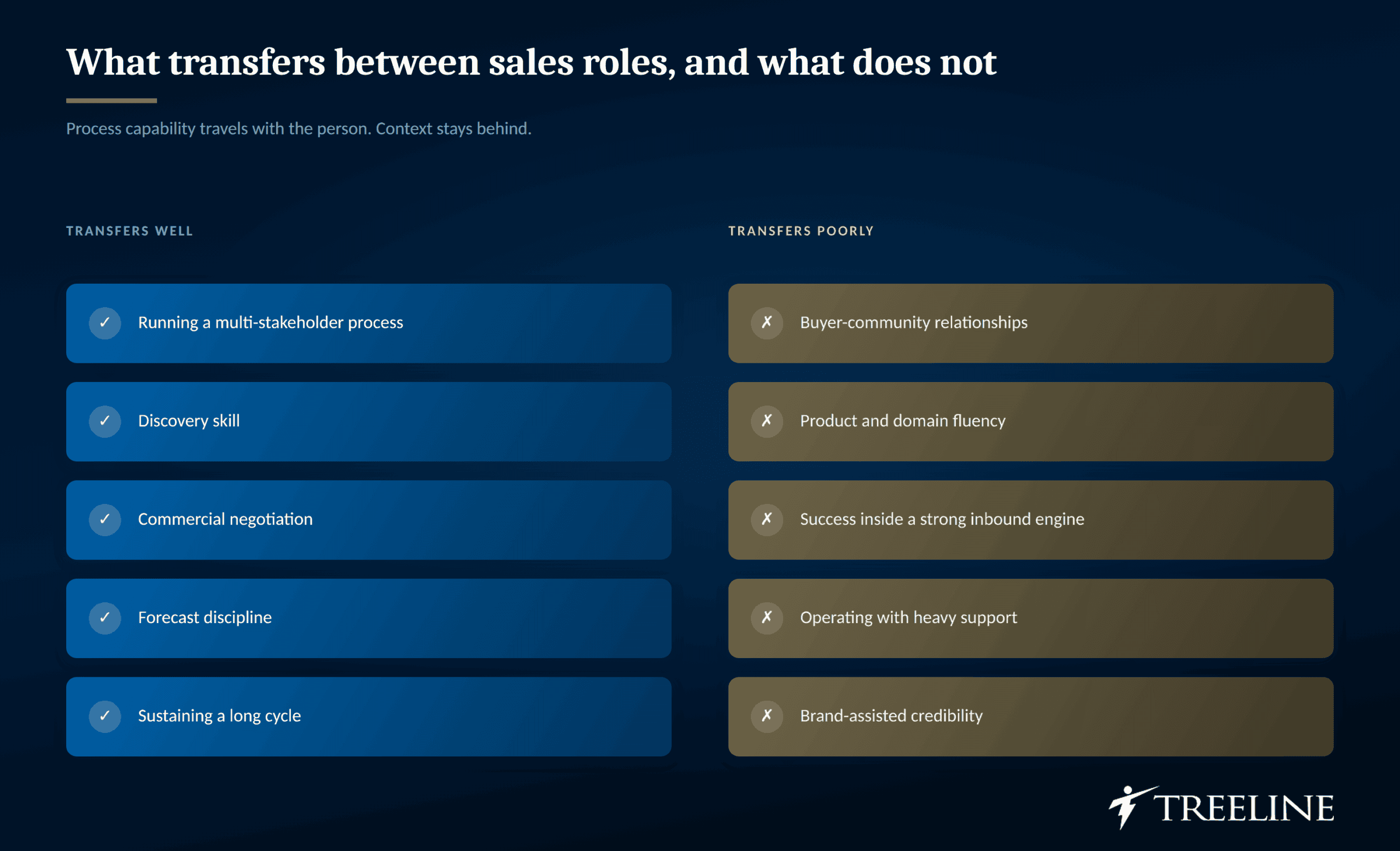
The practical question underneath “experienced” is transferability, and sales experience transfers unevenly in ways that are reasonably predictable. The split looks broadly like this.
What Transfers Well
- Running a multi-stakeholder process. The discipline of mapping an account, building consensus and sustaining momentum across quarters is largely portable across categories.
- Discovery skill. The ability to establish what a buyer actually needs, as distinct from what they asked for, moves with the person.
- Commercial negotiation. Handling procurement, pricing pressure and legal review is a learned capability that does not reset when the product changes.
- Forecast discipline. Someone who forecasts honestly in one company generally does so in the next, and this is one of the more reliable transfers.
- Working a long cycle without losing momentum.
Patience under a nine-month cycle is temperamental as much as learned, and it holds.
What Transfers Poorly
- Relationships in a specific buyer community. Genuinely valuable and genuinely narrow. A network in healthcare IT does not open doors in industrial manufacturing.
- Product and domain fluency. Rebuildable, but it takes time, and the time is often underestimated by both sides.
- Success inside a strong demand engine. A seller who converted abundant inbound may have limited experience generating pipeline, which is the whole job in a smaller company.
- Operating with heavy support. Sales engineers, enablement, a mature methodology and a proposal team all raise output. Removing them changes the job substantially.
- Brand-assisted credibility. Getting meetings because of the logo on the card is a real advantage that does not travel.
- An established internal network.
Knowing which engineer to call and which executive to escalate to is worth a great deal and has to be rebuilt from zero. There is a middle category worth naming separately, because it is where most misjudgement happens: methodology. A seller trained rigorously in one qualification framework carries genuine discipline, which transfers, alongside specific vocabulary and rituals, which do not.
Employers sometimes hire for the framework and get the vocabulary, then conclude the person was overrated when the underlying discipline was there all along and simply looked unfamiliar. The pattern is that process capability travels and context does not. An employer specifying experience should be describing the process capabilities they need and being explicit about which context-dependent advantages the candidate will lose on arrival.
Fantasia’s view is that most disappointing hires of experienced sellers are transfer failures rather than capability failures. He suggests asking directly, of every finalist, which parts of their previous success they expect to be unable to reproduce here, because a candidate who has thought seriously about the move will name two or three, and one who has not will insist everything transfers.
The Threshold Effect
There is a shape to how experience predicts performance, and understanding it explains why most requirements are set in the wrong place. Below a certain level of preparation, experience matters enormously. Someone who has never run a complex sale genuinely cannot do it on arrival, and no amount of aptitude substitutes for having been through the process a few times.
This is the region where the BLS notion of preparation time applies: there is a real quantity of learning that has to happen. Above that threshold, the curve flattens hard. The difference between a seller with five years of relevant complex-deal experience and one with twelve is dominated by other variables, judgment, work rate, coachability, how well their particular background matches your buyer.
Experience has stopped being the binding constraint and something else has taken over. The practical error is that employers set requirements far above the threshold and treat the excess as a safety margin. It is not free. Each additional year of requirement removes candidates who were past the threshold anyway, and the people removed are disproportionately those who progressed quickly, which is to say, often the better ones.
A more useful formulation is to name the threshold explicitly. Rather than ten years, specify that the candidate must have independently closed at least a handful of deals of a given shape and size. That is a floor, it is checkable, and it does not penalise someone who reached it in four years instead of nine. Fantasia’s observation is that the strongest sellers frequently have shorter résumés than the requirement asks for, because they were promoted or moved into larger scope faster than the average path.
His suggestion is to set the bar at demonstrated work rather than elapsed time, on the grounds that a requirement written in years systematically screens out people who progressed unusually quickly.
The Requirements That Shrink Your Market for No Return
Certain phrases appear in almost every sales job description and remove candidates without improving the hire.
- A minimum number of years. Discussed above; the most common and least predictive.
- Direct competitor experience. Narrows the population sharply, imports the competitor’s assumptions, and occasionally imports a non-compete problem.
- Experience selling to a named industry where the underlying buyer behaviour is common across several industries.
- A specific CRM or tooling requirement, which is learnable in a week and is being used as a screening shortcut.
- A degree requirement unrelated to what the person will sell.
- Continuous employment without gaps, which selects for circumstance rather than capability.
Each of these has a legitimate version. Competitor experience matters when the sales cycle genuinely depends on knowing a specific regulatory environment. Industry experience matters when credibility with the buyer is not transferable. The failure is applying them by default rather than by argument. Contingency search firms working a defined segment will usually push back on two or three of these at intake, because they can see the population each one removes.
A useful discipline is to attach a cost to each requirement. For every criterion, ask roughly what share of the qualified population it removes and what it buys in return. Criteria that remove a lot and buy little should be reclassified as preferences, and preferences should not be used to reject.
How Contingency Recruiting Reaches People Who Are Not Applying
There is a structural reason this population is difficult, and it explains what contingency recruiting is actually for. Experienced, effective sales professionals are, almost by definition, employed and performing. They are not browsing job boards, because their current situation is working and looking has a cost. They are also being retained deliberately by their current employers, who know exactly what they are worth.
This produces an asymmetry that inbound hiring cannot fix. The people who apply to a posting are, on average, more available than the people who do not, and availability correlates imperfectly with quality. An employer relying on applications is sampling the wrong end of the distribution and concluding that experienced people are scarce.
Contingency recruiting addresses this by working the other population entirely, people who are not looking, reached through relationships built over years rather than through advertising. What that firm is selling is not access to a database; it is the ability to have a first conversation that gets answered. Two things follow for how an employer should evaluate contingency recruiting firms.
The first is whether contingency recruiters can describe your market without being briefed on it. The second is what proportion of their placements came from people who were not actively looking, which is a question worth asking directly.
Where the Experienced Population Actually Sits
It helps to be concrete about who these people are, because “experienced sales professionals” is an abstraction that hides a very specific set of circumstances. Most of them are three to eight years into a role family they are good at, employed at a company they do not hate, hitting or near their number. Some are quietly frustrated by a territory that has been carved, a comp plan that changed, a manager who left, or a product losing ground.
Almost none of them have updated a résumé recently. That last detail has practical consequences. A person in this position cannot respond quickly to an opportunity even if interested, because they have no materials, no interview practice, and no story prepared about why they are looking. A process that expects a polished candidate on short notice is filtering for people who have been preparing to leave, which is a different group.
There is also a timing structure. Willingness fluctuates with the commission cycle, the vesting calendar, and the point in the fiscal year. The same person is a different prospect in November than in February. An employer running a single search in a single quarter is sampling whoever happens to be receptive that month, which is one of the underappreciated reasons two searches for identical roles can produce completely different candidate pools.
The implication is that reaching this population is a relationship activity conducted over time rather than a campaign run inside a requisition. That is the honest argument for working with a firm that is in the market continuously rather than engaging one when a seat opens.
Securing Is Different From Finding
The word in the title is “secure,” and it is the harder half. Finding an experienced seller is a sourcing problem. Securing one is a persuasion problem with a different set of failure modes. An experienced professional weighing a move is assessing risk more carefully than a junior one would, because they have more to lose.
They have a working territory, an established reputation internally, relationships with their manager and peers, and often unvested compensation. Against that, an outside opportunity has to offer more than a modest increase. What actually moves them tends to be specific rather than general. A territory with more addressable opportunity than their current one.
A product they believe wins more often. A manager they judge will make them better. A company trajectory that makes their equity meaningful. Scope that is a genuine step up rather than a lateral move with a different logo. What does not move them, reliably, is money alone, because their current employer can match it, quickly, and will.
This is where a contingency sales recruiter earns the fee, and it happens outside the employer’s view. Establishing the real reason someone would move, testing whether it survives contact with a counteroffer, and preparing the person for the resignation conversation are all work that determines whether the search produces a hire.
Fantasia emphasises that the reason for leaving has to be discovered rather than supplied. His practical test is whether the candidate can articulate, in their own words and without prompting, what would be better about the new situation, because a reason the recruiter has constructed for them will not survive the moment their current employer responds.
What an Experienced Enterprise Account Executive Is Actually Buying
This role concentrates everything above, which makes it a useful case to reason through. An experienced enterprise account executive is not primarily evaluating your company. They are evaluating whether they can hit a number in your territory, because their income and their professional standing depend on it. Every part of the process is read through that lens.
That changes which information matters. The honest state of the pipeline matters more than the marketing narrative. What the last person in the seat achieved, and why they left, matters more than the company’s growth rate. The ratio of self-generated to supplied pipeline matters more than the quota figure, because an experienced seller can compute what the quota implies once they know where the pipeline comes from.
It also changes the effect of vagueness. A less experienced candidate hears an imprecise answer and moves on. An experienced enterprise account executive hears it as a signal, because they spend their working life detecting when the other side of a conversation is avoiding something. Employers routinely lose exactly the candidates they most wanted by being non-specific about a territory, and then conclude the market was thin.
The productive response is to prepare the difficult answers rather than avoid them. A territory with a weak pipeline is not disqualifying if it is presented honestly alongside what is being done about it. The same territory presented as thriving, and then discovered in month two, produces a departure by month nine.
What This Means for a Territory Handover
For an experienced enterprise account executive the transition itself is part of what they are evaluating, and employers rarely think about it as a selling point. An experienced seller knows that the first ninety days determine the year. They will want to know what they inherit: which accounts are already in motion, what the previous holder left behind, whether there is a handover at all or whether the territory has been unattended for four months.
A company that can describe this clearly is materially more attractive than one that cannot, and the difference costs nothing to produce. There is also a signal in how the handover is organised. A structured transition suggests an organisation that plans; an absent one suggests the seat has simply been open. Experienced candidates read that accurately and price it into their decision, because they have joined companies of both kinds before.
The practical preparation is short. Write down the state of the territory as it will exist on the start date, including the parts that are unattractive. An enterprise account executive who joins knowing the pipeline is thin and the plan to rebuild it will stay; one who discovers it in week three will start taking calls again.
Writing the Requirement So It Can Be Searched
Everything above reduces to one deliverable: a requirement a search partner can actually work from. Most job descriptions cannot be worked from, which is why the first three submissions so often miss. A searchable requirement names four things. The buyer, by title and function, and what makes them hard to sell to. The deal, by average value, cycle length, number of stakeholders and whether procurement is involved.
The motion, meaning where pipeline comes from and what proportion the seller generates themselves. And the environment, meaning what support exists and what the person will have to do unaided. Written that way, the experience requirement falls out of the description rather than being imposed on it. If the buyer is a hospital procurement committee, domain credibility is a hard requirement and you have derived it rather than assumed it.
If pipeline is seventy percent self-generated, experience inside a strong inbound engine becomes a risk factor rather than a credential. It also produces a shorter document. Most job descriptions are long because they list responsibilities nobody screens against. A searchable requirement is often a page, and every line on it does work.
There is a test for whether you have written one. Hand it to someone who does not know the role and ask them which candidates it would exclude. If they cannot say, it is a description rather than a requirement, and the search will be run on the recruiter’s guesses about what you meant.
Testing Experience Rather Than Counting It
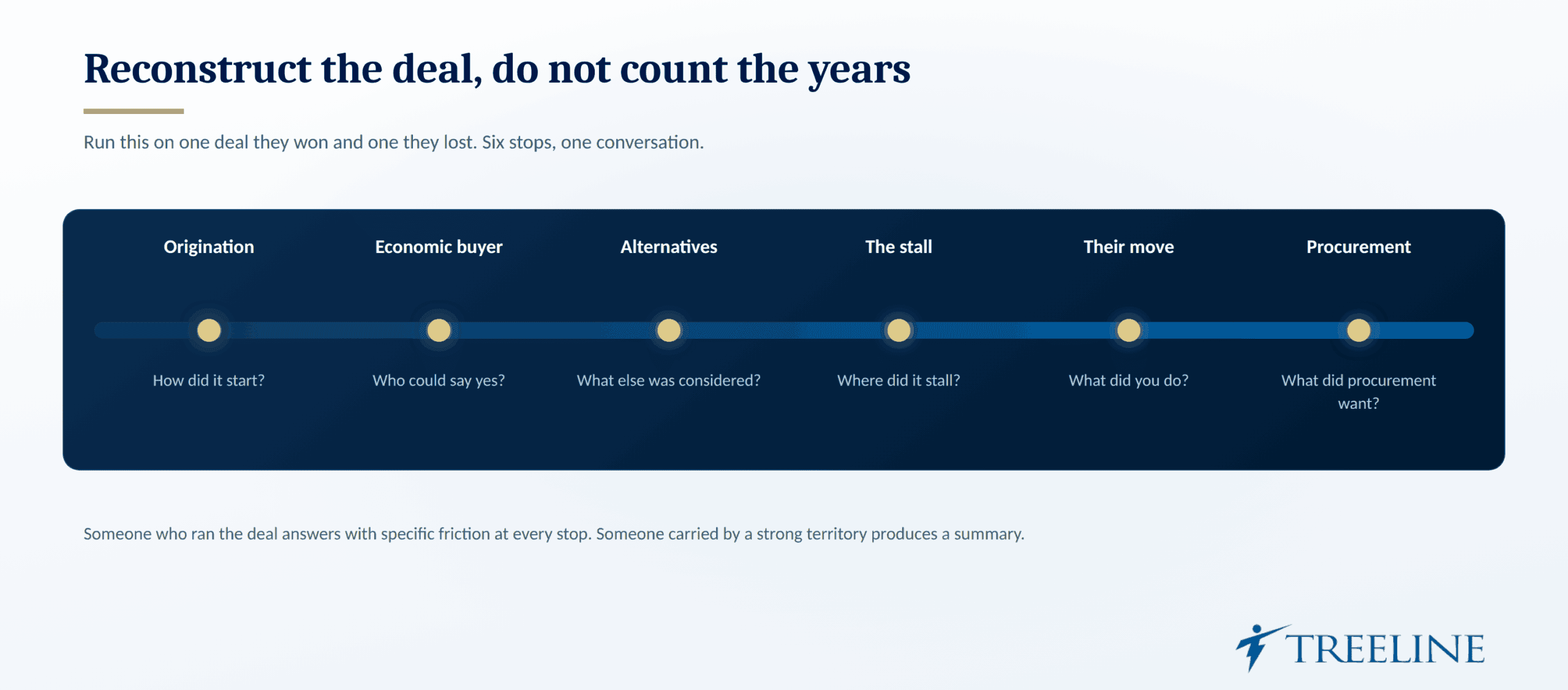
If years are a weak signal, something has to replace them, and the replacement is evidence about specific work. Six stops, run inside one conversation, do most of it. The most reliable method is deal reconstruction. Ask a candidate to walk through one closed deal and one lost deal in detail: how the opportunity originated, who the economic buyer was, what alternatives the buyer considered, where it stalled, what the candidate personally did, how pricing was handled, what procurement required, and how long it took.
Someone who ran the deal answers with specific friction. Someone who was carried by a strong territory produces a summary. A second method is asking what they built rather than what they hit. Did they create a territory plan, a qualification standard, a competitive battlecard that others used? Things that persisted after they left were built; things that collapsed were personal effort.
A third is asking about the failure. Every experienced seller has lost an important deal or missed a year. What they say about it, whether they can name what they got wrong without either deflecting or over-apologising, is more informative than any account of success. None of these takes longer than a conventional interview.
They simply use the time differently, and they produce evidence about capability rather than impressions about polish.
Reading a Résumé for Transfer Rather Than Tenure
Given that transferability is the real question, it is worth being specific about what to look for on the page before any conversation happens. Look at the trajectory of scope rather than the number of roles. Someone who moved from mid-market to enterprise, or from a single product to a portfolio, has demonstrated the ability to operate at increasing complexity.
Someone who held the same scope across three companies has demonstrated something different, which may be exactly right or may not. Look at the company stages. A seller whose entire career has been inside organisations above a certain size has never had to generate their own pipeline in a meaningful way, regardless of how impressive the logos are.
That is not disqualifying, but it is the specific question to probe. Look for what happened after they left. A résumé cannot tell you this, but a search partner working the market often can, whether the results survived, whether the team they built stayed, whether their departure was quiet or otherwise. And read the gaps and short tenures carefully rather than as automatic negatives.
A twelve-month stint can mean a poor hire on either side, a reorganisation, an acquisition, or a company that ran out of money. Experienced sales professionals accumulate these because sales organisations change frequently, and a policy of screening them out removes a large amount of good talent for a rule that predicts very little.
Fantasia’s position is that the résumé should be used to generate questions rather than to make decisions. His practical rule is that no candidate should be rejected on the document alone unless they fail a hard requirement that has been written down in advance, because everything else on the page is context that a fifteen-minute conversation would resolve.
Where Experience Is Genuinely Non-Negotiable
It would be one-sided to argue that experience requirements are always inflated. Several are real and should be held firmly. When the buyer will not take the meeting without domain credibility, prior experience in that domain is a hard requirement rather than a preference, and contingency executive recruiters working that vertical will tell you so directly.
This is common in clinical, regulated financial, and some public-sector sales. When the sales cycle involves a technical evaluation the seller must lead personally, and no sales engineering support exists, the technical depth has to arrive with the person. When the company cannot afford a ramp, a small team where the hire must contribute inside two quarters, prior experience with a closely comparable motion becomes necessary rather than desirable.
And when the role includes building something the company has never had, experience of having built it before is the specific thing being purchased, and a candidate who has only operated inside an existing system is a genuine mismatch. The distinguishing feature in all four is that the experience is doing identifiable work.
That is the test for whether a requirement is real: name what would go wrong without it. It is worth applying the same test to the softer requirements that accompany experience. Executive presence, resilience and coachability appear in most senior sales descriptions and are almost never defined. Each can be made concrete, presence becomes whether they can hold a room with a chief financial officer, resilience becomes how they behaved in the quarter that missed, coachability becomes whether they changed something specific after feedback.
Undefined, they function as permission to reject on impression, which is precisely the failure the rest of this article is trying to avoid.
What Happens After You Secure Them
Securing an experienced seller is not the end of the exercise, and the first year has failure modes specific to experienced hires that a less experienced person would not encounter. The first is that experience creates expectation on both sides. The company expects fast contribution because the person is experienced; the person expects a functioning environment because they have worked in one.
Where either assumption is wrong, disappointment arrives quickly and is usually mutual. The second is that experienced people arrive with methods. They have a way of qualifying, a way of forecasting, a cadence they trust. Where that conflicts with how the organisation works, one of them has to give, and the resolution is rarely explicit.
A new seller quietly running their own qualification standard alongside the company’s is a common and corrosive situation. The third is the ramp arithmetic. An experienced enterprise account executive joining a nine-month cycle will produce very little in two quarters no matter how good they are, and a compensation plan that does not acknowledge this creates a departure at month eight for reasons that have nothing to do with capability.
Three things reduce all of it. Agree explicitly what the first ninety days are for, and make it learning rather than closing. Surface the methodology conflict early by asking how they qualify and comparing it with how the team does. And structure the ramp so that early earnings are not punitive, since an experienced hire has options and will exercise them.
A search partner who stays in contact through this period hears about problems earlier than the employer does, because a new hire will voice a doubt to a recruiter that they will not raise internally in month two. Whether a firm does that, and whether they pass it on, is worth establishing before you engage them.
When Less Experience Is the Better Hire
There are conditions under which a less experienced candidate outperforms, and recognising them prevents an expensive default. A company whose motion is still forming may be better served by someone adaptable than by someone whose habits were formed in a mature environment. Experienced sellers arrive with a way of working, and if that way depends on support that does not exist, the experience becomes friction.
A territory that requires heavy self-generated pipeline sometimes favours hunger over polish, particularly where the alternative candidate’s experience came from a strong inbound engine. And a company that can genuinely develop people may get more from hiring for trajectory, provided it has a manager with the capacity to coach, a condition that is frequently assumed and rarely checked.
The honest caveat is that this only works when there is someone to do the developing. A less experienced hire placed under a manager with no time is not a cheaper hire; it is a slower failure.
What to Ask a Firm About This Population
Framed around experience specifically, the intake conversation with a prospective partner has a few questions that separate firms quickly.
- What proportion of your placements were people who were not actively looking? This describes whether they work the population that matters.
- Which of our requirements would you challenge? A firm that can name the ones that shrink the market without buying anything has thought about your search.
- How do you test for deal ownership rather than deal proximity? Listen for reconstruction of specific deals rather than quota attainment.
- What do you know about where people from our competitors tend to struggle? A firm working your segment has watched transfers succeed and fail.
- When in the year is this profile most reachable? Commission and vesting cycles are real, and a firm that tracks them is in the market continuously.
- What would you tell a candidate is difficult about this role?
If they cannot answer, they will present the opportunity generically and get generic responses. The last one matters more than it looks. Experienced sellers detect an over-polished pitch immediately, and a firm that cannot name a genuine drawback will lose exactly the candidates who were worth reaching.
Frequently Asked Questions
What does “experienced” actually mean in a sales job description?
Usually two things conflated: general preparation, meaning someone who does not need to be taught how selling works, and specific relevance, meaning experience that predicts success in this particular role. The first is common and matters only up to a threshold. The second is scarce and is not measured in years.
Why is a years-of-experience requirement a weak filter?
Because it is a proxy chosen for verifiability rather than predictiveness. Above a modest threshold, additional years stop predicting performance, and the requirement quietly selects for people from larger, more established organisations. It removes a large share of the population while buying little.
Which sales experience transfers between roles?
Process capability generally transfers: running multi-stakeholder deals, discovery, commercial negotiation, forecast discipline, and sustaining long cycles. Context usually does not: buyer-community relationships, product and domain fluency, success inside a strong inbound engine, heavy support structures, and credibility borrowed from a well-known brand.
How does contingency recruiting reach experienced sellers?
By working the population that is not applying. Effective, experienced sales professionals are usually employed and performing, so an inbound process samples the more available end of the market rather than the better end. A specialist firm reaches the rest through relationships built over years, which is what makes a first conversation get answered.
What actually persuades an experienced seller to move?
A territory with more addressable opportunity, a product that wins more often, a manager who will make them better, a credible company trajectory, or genuine scope expansion. Money alone rarely does it, because the current employer can match money quickly and usually will.
How should we test experience in interviews?
Reconstruct real deals in detail, one won and one lost, covering origination, the economic buyer, competing alternatives, where it stalled, and what the candidate personally did. Then ask what they built that outlasted their tenure, and what they got wrong in a deal that mattered. These take no longer than conventional interviews and produce evidence rather than impressions.
When is an experience requirement genuinely necessary?
When the buyer will not engage without domain credibility, when the seller must personally lead a technical evaluation without support, when no ramp is affordable, or when the role requires building something the company has never had. The test is whether you can name what would go wrong without it.
Should we ever hire someone less experienced for a senior sales role?
Sometimes, particularly where the motion is still forming, where heavy self-generated pipeline is required, or where a capable manager has the capacity to develop them. The condition that makes it work is that someone actually has time to do the developing, which is often assumed rather than verified.
Define the Experience You Actually Need
Treeline, Inc. is a sales-only executive search firm based in Wakefield, Massachusetts, working exclusively on building sales organizations. Our contingency sales recruiting service carries no upfront cost and no fee unless you hire, and we deliver your first candidate within three days of launching a search. If your last search struggled, it is worth checking whether the experience requirement was doing real work or simply narrowing the field.
Get in touch and we will go through it line by line before we look at a single candidate.
Share This Story, Choose Your Platform!
Related Posts


What our happy clients are saying
Treeline Inc. provided us with the most candidates that aligned with our needs and were of the highest quality.

Dr. Jeffrey Klein Head of North America Sales, Satchel Pulse
Treeline Inc.’s collaborative, flexible, and communicative approach resulted in a smooth partnership. Beyond their recruitment expertise, their unique sourcing model was efficient and effective.

Sera Holt Director of Operations, LNS Research
Their professionalism was outstanding. Treeline Inc. was extremely thorough and ensured that we were on the same page before they started looking for candidates. They listened to us and did a great job working with the candidate to close out the process.

Cate Grant AVP Customer Success, Nasdaq
Thanks to Treeline Inc.’s intricate and thorough screening process, the company is able to hire six high-quality candidates that fit perfectly in the company’s culture. The team is highly receptive to concerns, and internal stakeholders are impressed with their unique recruitment abilities.

Anna McKean Sales Recruiter, Insider Intelligence
Treeline Inc. has been qualified individuals throughout a five-year-long engagement. They’ve made numerous placements of talented and qualified individuals for our business.

Michele St Laurent VP of HR, The Institute for Applied Network Security

Let Us Help You Source the Sales Talent You Need
Whether you’re building a team or replacing a key role, our Candidate Sourcing Platform provides a fast, flexible, and employer-focused solution.
Tell us more about your business and how we can help.
Treeline Inc.
Your Award-Winning Sales Recruitment Partner
15 Lincoln Street, Suite 314, Wakefield, MA 01880