Hard-to-fill sales roles represent one of the most significant talent acquisition challenges organizations face. These positions, typically senior sales leadership, specialized sales expertise, or roles requiring specific industry knowledge, often remain open for months, costing organizations millions in lost revenue and productivity.
Traditional recruiting approaches struggle with hard-to-fill positions. Job board visibility doesn’t reach passive candidates. Extended timelines mean candidates are hired by competitors before your organization completes search processes. Generic recruiting doesn’t understand specialized sales requirements or industry-specific talent markets. Sales recruiting contingency has emerged as the solution specifically designed for hard-to-fill roles.
This comprehensive guide explores how sales recruiting contingency approaches solve the challenges that make certain sales positions difficult to fill, examining the methods, strategies, and frameworks that enable successful placement in roles where traditional recruiting fails.
Understanding Hard-to-Fill Sales Roles
What Makes a Sales Role Hard to Fill?
Hard-to-fill sales roles share specific characteristics that create recruiting challenges:
- Specialized Expertise Requirements: A medical device sales role requires healthcare industry knowledge; an enterprise SaaS role requires understanding of complex sales cycles and multiple decision-makers. The talent pool for specialized expertise is limited.
- High Experience Requirements: A VP of Sales role for a scaling software company might require 10+ years of SaaS sales leadership experience, ideally with exits or IPO experience. Candidates with this specific experience level are scarce.
- Geographic Constraints: A regional sales manager role might require someone based in a specific geography. Candidates willing and able to work in specific locations are limited.
- Compensation Challenges: A sales role with limited budget might be difficult to fill because compensation doesn’t match market rates for the experience required.
- Competitive Market Dynamics: In competitive talent markets, every desirable candidate has multiple opportunities, so by the time your organization completes interviews, candidates have accepted other offers.
- Reputation or Company Challenges: Sometimes positions are hard to fill because of organizational factors, poor reputation, leadership instability, compensation below market, or industry perception.
Why Traditional Recruiting Fails for Hard-to-Fill Roles
Traditional recruiting approaches are particularly ineffective for hard-to-fill positions. Timeline mismatch: traditional timelines of 3-6 months don’t match the urgency of hard-to-fill positions. Passive candidate access: most qualified talent in hard-to-fill markets is passive, not actively job searching, while traditional recruiting relies on job boards and active candidates. Specialized market knowledge: generalist recruiters lack the industry-specific expertise these positions require. Candidate quality issues: when positions remain open for months, recruiting standards sometimes lower, resulting in poor hiring outcomes.
How Sales Recruiting Contingency Solves Hard-to-Fill Position Challenges
Solution 1: Specialized Market Knowledge and Network Access
Sales recruiting contingency firms specializing in particular industries or sales disciplines develop deep expertise about talent availability in specialized markets. Industry-Specific Expertise: firms focusing on technology sales understand SaaS compensation and where to find qualified tech salespeople, while firms focusing on healthcare understand medical device sales expertise and regulatory knowledge. Passive Candidate Networks: contingency recruiting firms can reach into networks and engage candidates who would never be accessible through job boards or traditional recruiting. Market Intelligence: contingency recruiters know which candidates might be available, which organizations have salespeople considering moves, and what attracts specialized salespeople to opportunities.
Solution 2: Speed-to-Fill When Timeline is Critical
Hard-to-fill positions often need to be filled urgently. Revenue is at stake and market opportunities are time-sensitive. Sales recruiting contingency approaches deliver speed that traditional recruiting can’t match. Firms can activate their networks and present qualified candidates within 2-4 weeks because they have pre-existing relationships rather than starting from zero. Because they pre-qualify candidates before presentation, organizations can evaluate fewer candidates while maintaining quality, accelerating hiring decisions.
Solution 3: Rigorous Candidate Assessment and Quality Focus
For hard-to-fill positions, candidate quality is critical because poor hiring decisions are expensive. Risk alignment: contingency recruiting firms bear placement risk through guarantee structures, so the incentive to ensure placement success is powerful. Specialized assessment: recruiters assess capability specific to the industry, sales methodology, or customer complexity the role requires. Reference verification: firms often conduct rigorous reference checking, contacting past managers, peers, and customers to verify candidate claims.
Solution 4: Overcoming Compensation and Positioning Challenges
Hard-to-fill positions sometimes create compensation or positioning challenges. Market compensation data: when positions need compensation adjustment to be competitive, contingency recruiters provide data showing market rates. Opportunity positioning: recruiters work with organizations to position hard-to-fill opportunities compellingly, articulating genuine advantages and growth opportunities. Candidate communication: recruiters address compensation concerns and competitive factors in ways that help candidates evaluate opportunities realistically.
Sales Recruiting Contingency Strategies for Specific Hard-to-Fill Roles
Strategy for Hard-to-Fill Enterprise Sales Positions
Enterprise sales roles are frequently hard-to-fill because they require understanding complex sales cycles, managing multiple decision-makers, and navigating large procurement processes. Contingency recruiting firms specializing in enterprise sales focus on candidates with demonstrated success managing large, complex deals, assessing their ability to navigate multi-stakeholder sales processes. These positions typically attract experienced candidates within 3-4 weeks, compared to 4-6 months for traditional recruiting, with placement success rates typically above 90%.
Strategy for Hard-to-Fill Industry-Specialized Positions
Some hard-to-fill positions require specific industry expertise, such as medical device sales, pharmaceutical sales, healthcare technology sales, or financial services sales. Contingency recruiting firms focusing on industry-specialized sales recruit specifically from within those industries, maintaining networks of salespeople with genuine industry expertise. Organizations can be confident candidates understand industry-specific requirements because the recruiters specialize in those industries.
Strategy for Hard-to-Fill New Market Entry Positions
Sometimes hard-to-fill positions result from market entry challenges, filling sales teams for new geographic markets, new verticals, or new business models. Sales recruiting contingency firms identify salespeople with success in those markets who understand geographic territory development or vertical-specific challenges, accelerating market entry success rather than recruiting generalists and training them.
Strategy for Hard-to-Fill Leadership Positions
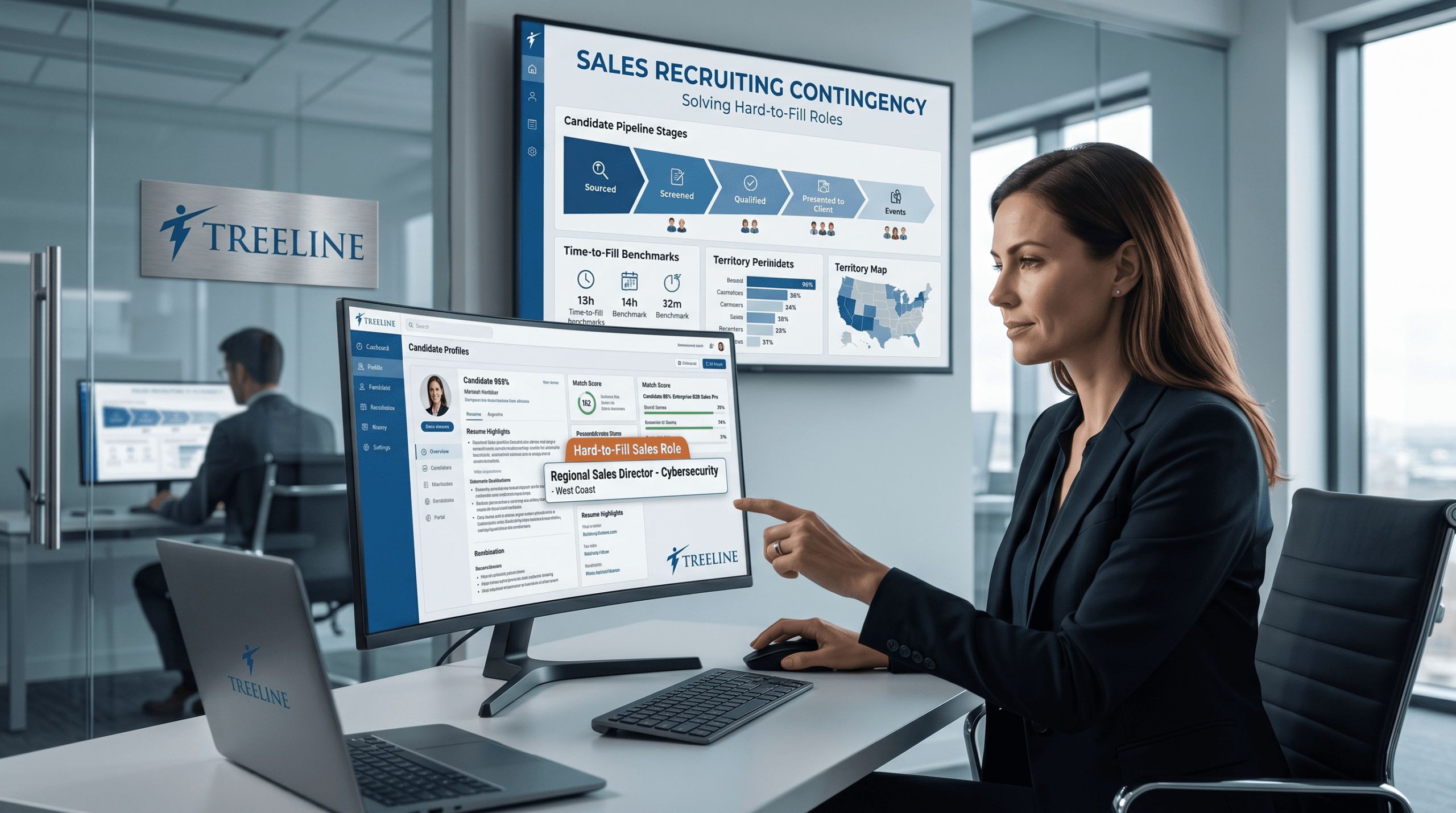
Sales leadership positions, VP of Sales, Chief Revenue Officer, Regional Sales Director, are often hard-to-fill because few candidates have the specific leadership experience required. Contingency recruiting firms focusing on sales leadership maintain networks of accomplished sales leaders and can identify candidates who’ve led organizations similar in size, scope, or business model to yours. These positions typically attract experienced leaders within 2-3 weeks, often passive candidates reached through trusted relationships.
Contingency Based Recruitment Process for Hard-to-Fill Roles
Phase 1: Opportunity Definition and Market Assessment
The process begins with detailed opportunity definition. Firms understand precise position requirements, not just “sales manager” but “sales manager for enterprise SaaS team managing $5M+ territory, leading 4-6 salespeople, with specific SaaS methodology experience.” They also provide honest market talent assessment, advising whether the position is realistically fillable at the specified compensation and timeline, and helping adjust requirements if needed.
Phase 2: Targeted Candidate Sourcing
Sourcing for hard-to-fill positions is highly targeted. Firms activate their networks, reaching candidates who match requirements and would never be accessible through job boards. For positions requiring specific expertise, they search more broadly, reaching into competitive organizations and identifying emerging talent, while engaging passive candidates with a compelling explanation of why the opportunity is worth considering.
Phase 3: Rigorous Assessment and Qualification
Assessment is particularly rigorous. Recruiters assess whether candidates genuinely have the expertise they claim through detailed questions about specific experiences, challenges, and results. They assess fit, cultural alignment, leadership style, and genuine interest, and conduct thorough reference checking through multiple perspectives.
Phase 4: Presentation and Placement
Qualified candidates are presented with detailed summaries explaining why they’re strong fits, what specific experiences match requirements, and why they’re qualified. Firms facilitate interviews, coordinate scheduling, and support the offer and negotiation process to ensure placement success.
Comparison: Traditional Recruiting vs. Sales Recruiting Contingency
Timeline Comparison
| Dimension | Traditional Recruiting | Sales Recruiting Contingency |
|---|---|---|
| Candidate presentation | 8-12 weeks | 2-4 weeks |
| Full hiring timeline | 4-6 months | 4-8 weeks |
| Speed advantage | Standard | 4-6x faster |
Cost Analysis for Hard-to-Fill Positions
| Factor | Traditional | Contingency |
|---|---|---|
| Upfront fee | 30% of compensation | 0% (performance-based) |
| Recruiter fee | N/A | 20-30% upon placement |
| Vacancy cost (VP Sales at $300K, $50K/month) | 5 months × $50K = $250K | 1 month × $50K = $50K |
| Total cost | 30% = $90K + $250K vacancy = $340K | 25% = $75K + $50K vacancy = $125K |
| Savings vs. traditional | — | ~$215K (63% total savings) |
Quality Comparison
| Factor | Traditional | Contingency |
|---|---|---|
| Candidate pre-qualification | Limited | Extensive |
| Specialized expertise assessment | Generalist | Specialist |
| Reference verification | Standard | Rigorous |
| Placement guarantee | None | 90+ days typical |
| Fit assessment rigor | Moderate | High |
Best Practices for Sales Recruiting Contingency Success with Hard-to-Fill Roles
- Engage contingency recruiting early: Don’t wait until hard-to-fill positions become desperate. Engage firms early when positions open, enabling time to source candidates and assess fits thoroughly.
- Provide detailed position specifications: The more detailed your specifications, the better firms can source targeted candidates. Vague specifications result in broader candidate pools and more evaluation burden.
- Understand realistic timelines: While contingency recruiting is faster, some hard-to-fill positions still require time. Understand realistic timelines based on specialty, market conditions, and candidate availability.
- Be responsive in the interview process: Match contingency recruiting speed with rapid internal decisions, interview within 2-3 days and provide feedback within 24 hours.
- Be willing to adjust requirements: If positions remain open, work with firms to assess whether requirements are realistic and whether compensation needs adjustment for the market.
- Support post-placement integration: Firms’ guarantees depend on early placement success, so support successful onboarding and early integration.
- Maintain ongoing contingency recruiting relationships: Rather than engaging only for crisis placements, maintain ongoing relationships and discuss anticipated hard-to-fill positions before they officially open.
Measuring Sales Recruiting Contingency Success
Key Metrics
Time-to-Fill: sales recruiting contingency should deliver 50-70% faster time-to-fill than traditional recruiting for hard-to-fill positions. Placement Success Rate: target 90%+ for contingency-filled positions. Candidate Quality: measure whether placed candidates perform, revenue contribution, quota attainment, cultural fit, retention. Cost-Per-Hire: calculate total cost including recruiter fees, vacancy costs, and any replacement costs; contingency typically costs 30-50% less than traditional recruiting on a total cost basis.
Benchmarking
Industry standards: enterprise sales positions typically fill within 3-4 weeks through contingency recruiting versus 4-6 months through traditional recruiting; specialized sales positions typically fill within 3-5 weeks through specialized contingency recruiting; and sales leadership positions typically fill within 2-4 weeks through contingency recruiting specializing in sales leadership.
Conclusion: Sales Recruiting Contingency as Essential Infrastructure for Hard-to-Fill Positions
Hard-to-fill sales roles represent significant organizational challenges, costing revenue, disrupting team productivity, and distracting leadership. Traditional recruiting approaches consistently struggle with these positions. Through specialized expertise, network access, speed, and quality focus, contingency based recruitment enables filling positions that traditional recruiting can’t solve. The organizations most successful at hiring have integrated sales recruiting contingency as core talent acquisition infrastructure rather than saving it for crisis situations. Discover how Treeline uses contingency recruiting to solve hard-to-fill sales position challenges.
Frequently Asked Questions About Sales Recruiting Contingency for Hard-to-Fill Roles
What makes a sales position “hard to fill” and how does sales recruiting contingency address this?
Hard-to-fill sales positions typically require specialized expertise, significant prior experience, geographic constraints, realistic compensation challenges, or face competitive market dynamics. Sales recruiting contingency addresses these challenges through specialized market knowledge, network access to passive candidates with specific expertise, and speed-to-fill that matches hard-to-fill position urgency. Contingency recruiting firms specializing in particular industries understand specialized talent markets and can access candidates traditional recruiting can’t reach.
How much faster is sales recruiting contingency compared to traditional recruiting for hard-to-fill positions?
Sales recruiting contingency typically delivers 50-70% faster time-to-fill than traditional recruiting for hard-to-fill positions. While traditional recruiting for specialized sales positions often takes 4-6 months, contingency based recruitment typically fills similar positions within 2-4 weeks. This speed advantage is possible because contingency recruiting firms maintain pre-existing networks of candidates with specialized expertise.
Why is contingency recruiting particularly effective for specialized sales expertise positions?
Contingency recruiting firms specializing in particular industries or sales disciplines develop deep market knowledge and networks of accomplished salespeople in those specialties. When hard-to-fill positions require specialized expertise, medical device sales, SaaS sales, enterprise software sales, fintech sales, these firms can access networks of qualified candidates unavailable through traditional recruiting, and they understand the capability requirements specific to those specialties.
How do contingency recruiting firms help with compensation and positioning challenges for hard-to-fill roles?
Contingency recruiting firms conduct market compensation research, providing data about what specialized talent actually commands. When hard-to-fill positions have unrealistic compensation, they provide benchmark data helping organizations adjust offers to be competitive. Additionally, they help position hard-to-fill opportunities compellingly, articulating genuine advantages and growth opportunities, informed by ongoing candidate conversations that reveal what attracts passive candidates.
What’s the total cost comparison between traditional recruiting and contingency recruiting for hard-to-fill positions?
While contingency recruiter fees are 20-30% of first-year compensation, total cost must include vacancy costs from extended timelines. For a VP of Sales at $300K+ compensation, a 5-month traditional search creates approximately $250K in vacancy costs, while a 1-month contingency search creates approximately $50K. Total cost for traditional recruiting (about $340K) typically exceeds total cost for contingency recruiting (about $125K), resulting in 30-50% total savings through contingency recruiting.
Share This Story, Choose Your Platform!
Related Posts

What our happy clients are saying
Treeline Inc. provided us with the most candidates that aligned with our needs and were of the highest quality.

Dr. Jeffrey Klein Head of North America Sales, Satchel Pulse
Treeline Inc.’s collaborative, flexible, and communicative approach resulted in a smooth partnership. Beyond their recruitment expertise, their unique sourcing model was efficient and effective.

Sera Holt Director of Operations, LNS Research
Their professionalism was outstanding. Treeline Inc. was extremely thorough and ensured that we were on the same page before they started looking for candidates. They listened to us and did a great job working with the candidate to close out the process.

Cate Grant AVP Customer Success, Nasdaq
Thanks to Treeline Inc.’s intricate and thorough screening process, the company is able to hire six high-quality candidates that fit perfectly in the company’s culture. The team is highly receptive to concerns, and internal stakeholders are impressed with their unique recruitment abilities.

Anna McKean Sales Recruiter, Insider Intelligence
Treeline Inc. has been qualified individuals throughout a five-year-long engagement. They’ve made numerous placements of talented and qualified individuals for our business.

Michele St Laurent VP of HR, The Institute for Applied Network Security

Let Us Help You Source the Sales Talent You Need
Whether you’re building a team or replacing a key role, our Candidate Sourcing Platform provides a fast, flexible, and employer-focused solution.
Tell us more about your business and how we can help.
Treeline Inc.
Your Award-Winning Sales Recruitment Partner
15 Lincoln Street, Suite 314, Wakefield, MA 01880