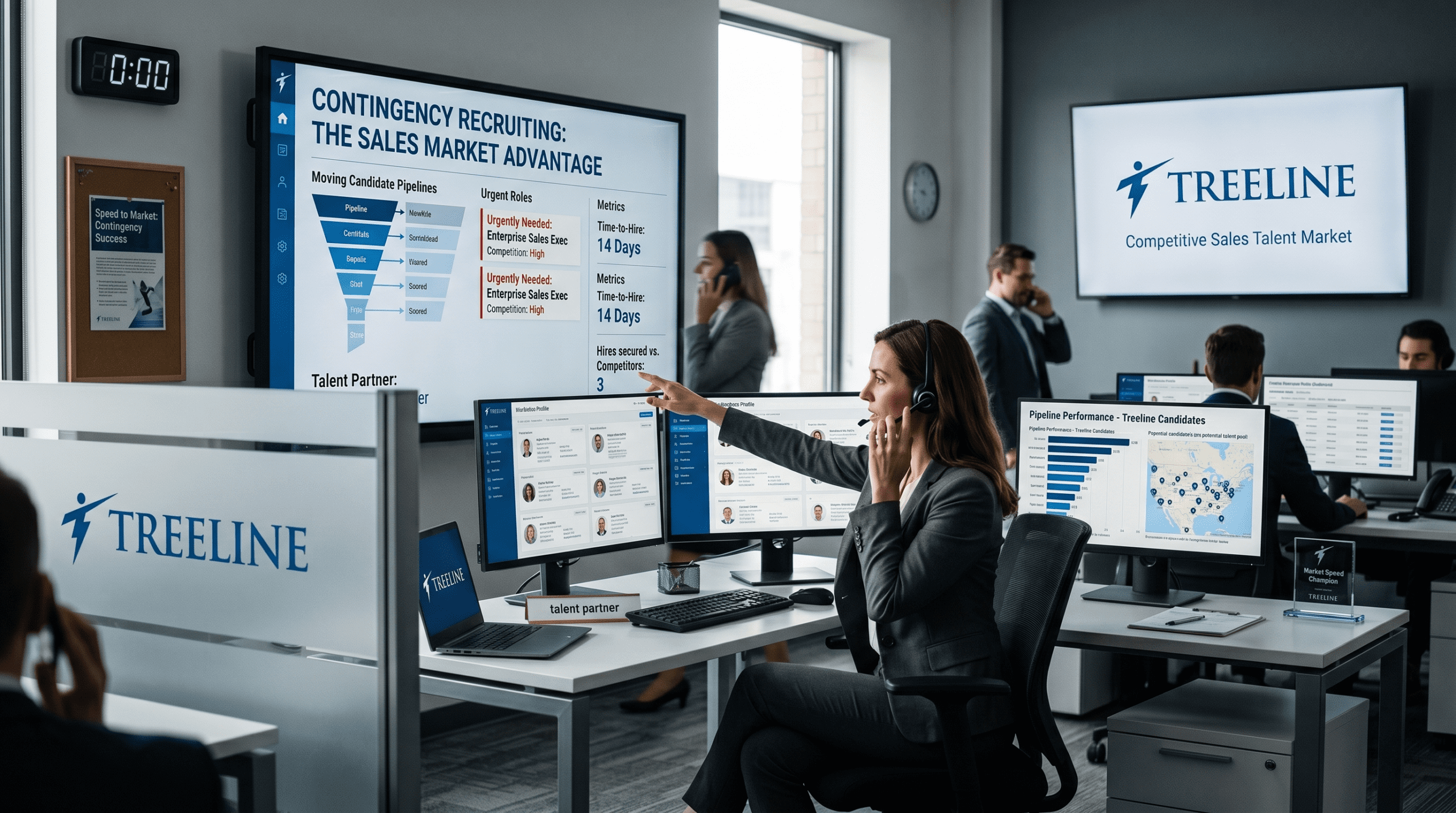
In today’s intensely competitive talent markets, organizations face unprecedented challenges in acquiring sales talent. Competition for exceptional salespeople has never been fiercer. The best sales executives have multiple opportunities available to them constantly. They’re not actively job searching, they’re being pursued by multiple recruiting sources simultaneously.
Traditional recruiting approaches, which rely on job board visibility, extended timelines, and linear processes, struggle in this environment. By the time a traditional search identifies a qualified candidate, that candidate has already received multiple offers from more aggressive competitors. Contingency recruiting has emerged as the recruiting approach specifically designed for this hyper-competitive talent landscape.
This comprehensive guide explores why contingency recruiting is effective in competitive sales markets, examining the specific advantages contingency recruiting delivers when competing for talent is most difficult. Whether you’re recruiting in technology, healthcare, financial services, or other competitive markets, understanding why contingency recruiting works when traditional approaches fail is essential to building successful sales organizations.
Understanding Competitive Sales Markets
Characteristics of Highly Competitive Talent Markets
Competitive sales markets have specific characteristics that create recruiting challenges. Low talent availability: exceptional sales talent is scarce and every qualified executive has multiple opportunities. High recruiter competition: multiple recruiting sources pursue the same talent. Candidate selectivity: strong candidates can afford to be picky about company size, growth trajectory, compensation, culture, and role fit. Rapid candidate absorption: talented salespeople are absorbed into new roles quickly, so the window of opportunity is narrow. Information asymmetry: candidates understand their market value and won’t accept below-market offers. Passive candidate focus: most talent is passive, employed and not actively seeking new roles.
Why Traditional Recruiting Fails in Competitive Markets
Traditional retained executive search struggles in highly competitive environments. Timeline misalignment: traditional search typically takes 3-6 months, by which point candidates are hired or lose interest, while top contingency search firms complete placements in 2-4 weeks. Network limitation: the best talent isn’t visible on job boards. Reactive approach: traditional recruiting waits for openings then begins searching, guaranteeing competition for every candidate. Candidate passivity: traditional recruiting struggles with passive candidates, precisely where the best talent exists. Process inflexibility: competitive markets demand flexibility and speed that standard processes can’t accommodate.
Why Contingency Recruiting Excels in Competitive Markets
Advantage 1: Pre-Existing Candidate Relationships
The most significant advantage of contingency recruiting in competitive markets is access to pre-existing relationships with accomplished sales talent. Contingency recruiters maintain relationships with passive candidates through years of relationship investment, ongoing value creation (market intelligence, career guidance, introductions), trust and credibility built through consistent positive interactions, and regular network activation that keeps relationships current. When your organization needs a VP of Sales immediately and recruiters can present candidates within days because they have active relationships with qualified candidates, the competitive advantage is decisive.
Advantage 2: Speed in Fast-Moving Markets
Speed is critical in competitive markets, where the window of opportunity is often measured in days. Contingency recruiting delivers rapid candidate presentation within 2-4 weeks, compressed decision-making because candidates are pre-qualified rigorously, responsive candidate movement where candidates schedule interviews quickly and make decisions efficiently, and eliminated recruitment delays at every stage. In competitive markets, speed to offer is often the determining factor in winning the talent competition.
Advantage 3: Specialized Market Knowledge
Contingency recruiting firms specializing in particular industries develop sophisticated understanding of competitive market dynamics. This includes compensation benchmarking (knowing which offers are competitive and which will lose candidates), real-time market intelligence about market shifts and talent movements, understanding of candidate expectations beyond compensation, and competitive positioning that articulates precisely why your opportunity is attractive to specific candidates.
Advantage 4: Network Depth and Specialization
In competitive markets, generic recruiting networks are insufficient. Specialized contingency recruiting firms provide access to hidden talent that isn’t accessible through traditional sources, industry-specific understanding of talent challenges and leadership requirements, relationship credibility that enables candidate engagement generalists can’t achieve, and competitive intelligence about who might be available and which leaders are contemplating changes.
Advantage 5: Financial Alignment in Competitive Markets
Contingency recruiting creates powerful incentives for recruiter focus and quality through performance-based compensation (recruiters are compensated only upon successful placement), risk sharing via guarantee structures (typically 90-day guarantees), a speed focus driven by placement-based compensation, and a quality focus on placement success rather than search volume, essential in competitive markets where hiring the wrong person costs significantly more than filling the role.
How Contingency Recruiting Wins in Specific Competitive Market Scenarios
Scenario 1: Technology and SaaS Sales Leadership
Technology and SaaS companies operate in hypercompetitive talent markets where the best candidates have multiple offers. Contingency recruiting wins because specialized firms maintain networks of accomplished SaaS sales executives, recruiters understand SaaS-specific challenges (sales cycle compression, land-and-expand models, high-velocity selling), they can present qualified candidates within weeks, and they understand compensation benchmarks in tech markets. Typical outcome: VP of Sales positions filled within 2-3 weeks through contingency recruiting versus 4-6 months through traditional recruiting.
Scenario 2: Healthcare and Life Sciences Sales
Healthcare sales leadership requires specific expertise in regulatory requirements, clinical relationships, and healthcare economics, and candidates with this expertise are scarce. Contingency recruiting wins because specialized firms focus exclusively on healthcare and life sciences talent, understand healthcare-specific success factors, maintain networks within specific therapeutic areas or sales channels, and can articulate healthcare-specific challenges to candidates. Typical outcome: medical device sales leadership positions filled within 3-4 weeks with candidates possessing specific healthcare expertise.
Scenario 3: Enterprise Sales in Highly Competitive Markets
Enterprise account executives with demonstrated success managing large deals are continuously recruited and rarely actively job search. Contingency recruiting wins because enterprise-focused firms understand enterprise sales complexity, maintain relationships with accomplished enterprise account executives, can reach passive candidates through trusted relationships, and understand what attracts enterprise sales talent (deal size, customer quality, territory opportunity, compensation structure). Typical outcome: enterprise account executive positions filled with high-quality candidates when traditional recruiting yields marginal candidates.
Contingency Recruiting Strategies That Win in Competitive Markets
Strategy 1: Speed-to-Market Execution
Successful contingency recruiting in competitive markets emphasizes immediate engagement (contact firms the moment hiring needs emerge), aggressive timeline communication, rapid internal decisions (interview within 2-3 days, provide feedback within 24 hours), and fast-track negotiation to move to offer quickly for compelling candidates.
Strategy 2: Network Activation
Leverage firm networks proactively through ongoing relationship discussions about your organization and talent needs, passive candidate targeting (identifying specific candidates and asking recruiters to reach out through their networks), and industry intelligence gathering about which competitors are hiring and where talent movements are occurring.
Strategy 3: Specialized Recruiter Engagement
In competitive markets, specialized contingency recruiting is superior to generalist recruiting. Engage firms with industry specialization in your specific market, sales discipline specialization (enterprise sales, sales engineering, inside sales), and maintain relationships with multiple specialized firms to create competition among partners and ensure capacity when hiring needs spike.
Strategy 4: Competitive Positioning
In competitive markets, opportunity positioning is critical. Understand candidate priorities by asking recruiters what attracts passive candidates, position your opportunity compellingly based on market intelligence (growth trajectory, leadership quality, compensation, opportunity scope), and address competitive concerns directly so passive candidates understand why your opportunity is superior to staying put.
Contingency Recruiting in Highly Competitive Markets: Metrics That Matter
Key Performance Indicators
Time-to-Fill: often the most critical metric; contingency recruiting typically delivers 50-70% faster time-to-fill. Candidate Quality: track placed executive performance, retention, and contribution, quality matters more than speed. Competitive Success Rate: track whether contingency recruiting is filling positions traditional recruiting couldn’t. Cost Per Hire: calculate total cost including vacancy costs, a faster placement saving one month of vacancy may cost less total despite higher recruiter fees.
Benchmarking Success
Benchmark your performance against industry standards (technology companies should expect 2-4 week VP of Sales placements; healthcare companies should expect 3-4 week specialized sales leadership placements), your historical performance (reducing a 5-month traditional search to 3 weeks is meaningful improvement), and candidate quality and retention, the best metric is whether placed executives succeed and stay.
The Business Case for Contingency Recruiting in Competitive Markets
Revenue Impact of Faster Hiring
When your VP of Sales position vacancy costs $40,000 monthly in lost revenue, reducing time-to-fill from 5 months to 3 weeks saves $150,000 in opportunity cost alone. A contingency recruiting fee of $75,000 becomes not an expense but an investment that pays for itself in 3 weeks of faster hiring. Speed isn’t a luxury in competitive markets, it’s a business necessity.
Talent Quality and Retention
Beyond speed, contingency recruiting delivers quality. When recruiters present candidates, they’ve vetted thoroughly, and candidates from top firms tend to stay longer and perform better. This quality difference compounds over years, retaining your VP of Sales for 4 years instead of 2 generates millions in additional revenue.
Conclusion: Why Contingency Recruiting Is Essential in Competitive Markets
In competitive sales markets, contingency recruiting has become not optional but essential. When competition for talent is intense, traditional recruiting approaches are simply insufficient. Contingency recruiting provides access to pre-existing relationships with passive talent, delivers speed that matches competitive market dynamics, provides specialized market knowledge enabling effective positioning, creates financial incentive alignment that drives recruiter focus, and enables organizations to compete effectively for talent despite being smaller or newer than competitors. For organizations serious about building strong sales teams in competitive markets, contingency recruiting has become core talent acquisition infrastructure. Explore how Treeline’s contingency recruiting approach wins in competitive sales markets.
Frequently Asked Questions About Contingency Recruiting in Competitive Markets
How does contingency recruiting win against traditional recruiting in competitive talent markets?
Contingency recruiting wins in competitive markets through speed (2-4 weeks versus 3-6 months), access to passive candidate networks that traditional recruiting can’t reach, specialized market knowledge enabling competitive positioning, and financial incentive alignment that drives recruiter focus. In competitive markets where the best candidates have multiple offers and can be selective, speed and network access are decisive competitive advantages. Traditional recruiting’s extended timelines and job board reliance are insufficient when passive candidates control the talent supply.
What makes contingency recruiting firm networks so valuable in competitive markets?
Contingency recruiters maintain relationships with passive candidates through years of consistent contact, regular value provision (market intelligence, career guidance, professional relationships), and trust-building through positive interactions. These relationships exist even when candidates aren’t actively seeking new roles. In competitive markets where the best talent is passive and unavailable through traditional recruiting, these pre-existing relationships provide access to talent no other recruiting source can reach. A single phone call from a trusted contingency recruiter can interest a passive candidate in an opportunity they wouldn’t have considered from unknown sources.
Why does speed matter so much in competitive sales markets when recruiting?
Speed matters in competitive markets because talented sales executives have multiple offers and opportunities available to them constantly. The window of opportunity to recruit specific candidates is often measured in days. If your organization takes weeks to schedule interviews or make hiring decisions, candidates accept other offers or lose interest. Additionally, in fast-moving markets, market opportunities emerge quickly and require immediate sales talent deployment. Contingency recruiting’s 2-4 week timelines enable responding to market opportunities on business timelines.
How should organizations balance cost and speed when using contingency recruiting in competitive markets?
While contingency recruiting fees (20-30% of first-year compensation) are higher than traditional recruiting percentages, total cost comparison must factor in vacancy costs from extended timelines, internal HR time, and recruiting restart costs if initial searches fail. A faster placement that saves one month of vacancy often costs less total despite higher recruiter fees. Additionally, competitive talent acquisition is a value-maximization exercise, not a cost-minimization one. The right sales leader can generate millions of dollars in revenue, so optimizing for speed and quality matters more than minimizing recruiter fees.
What should organizations do to maximize their contingency recruiting effectiveness in competitive markets?
To maximize effectiveness, engage specialized contingency recruiting firms rather than generalists, communicate urgency and timeline requirements clearly, provide detailed position specifications enabling focused recruiting, respond rapidly when candidates are presented (interview within 2-3 days, provide feedback within 24 hours), move quickly to offer for compelling candidates, maintain ongoing relationships with recruiters beyond single placements, leverage recruiters for market intelligence not just placements, and understand what attracts passive candidates so you can position your opportunity competitively. Success in competitive markets requires treating contingency recruiting firms as strategic partners, not transactional services.
Share This Story, Choose Your Platform!
Related Posts

What our happy clients are saying
Treeline Inc. provided us with the most candidates that aligned with our needs and were of the highest quality.

Dr. Jeffrey Klein Head of North America Sales, Satchel Pulse
Treeline Inc.’s collaborative, flexible, and communicative approach resulted in a smooth partnership. Beyond their recruitment expertise, their unique sourcing model was efficient and effective.

Sera Holt Director of Operations, LNS Research
Their professionalism was outstanding. Treeline Inc. was extremely thorough and ensured that we were on the same page before they started looking for candidates. They listened to us and did a great job working with the candidate to close out the process.

Cate Grant AVP Customer Success, Nasdaq
Thanks to Treeline Inc.’s intricate and thorough screening process, the company is able to hire six high-quality candidates that fit perfectly in the company’s culture. The team is highly receptive to concerns, and internal stakeholders are impressed with their unique recruitment abilities.

Anna McKean Sales Recruiter, Insider Intelligence
Treeline Inc. has been qualified individuals throughout a five-year-long engagement. They’ve made numerous placements of talented and qualified individuals for our business.

Michele St Laurent VP of HR, The Institute for Applied Network Security

Let Us Help You Source the Sales Talent You Need
Whether you’re building a team or replacing a key role, our Candidate Sourcing Platform provides a fast, flexible, and employer-focused solution.
Tell us more about your business and how we can help.
Treeline Inc.
Your Award-Winning Sales Recruitment Partner
15 Lincoln Street, Suite 314, Wakefield, MA 01880