The first sales manager is the only hire where the company has no internal reference point. Every subsequent leadership hire is measured against someone who held the seat. This one is measured against a founder or a chief executive who has been running sales informally, usually well, and usually without writing down how.
That absence of a reference point is what makes the role fail so often, and it is a definition problem long before it is a sourcing problem. Most companies run this search under a contingency sales recruiting arrangement, which suits a requirement nobody has articulated before, and which puts more weight on the firm’s willingness to challenge the scope, a standard Treeline sets out in its own approach.
Dan Fantasia, CEO of Treeline, Inc., separates the question of when to hire a founding sales manager from the question of who to hire, and treats the first as the one that decides the outcome. From his perspective most failed founding-manager hires were correctly identified as people and incorrectly timed as decisions.
When Founding Sales Manager Recruiting Should Actually Start
The trigger is rarely headcount, though headcount is what most companies use.
The real signal is that whoever currently runs sales has stopped doing the parts of their own job that matter. A founder spending two days a week on pipeline review, comp questions and deal escalation is not managing sales as a side activity; they have taken a second job and stopped doing half of the first one.
A second signal is that new sellers are arriving and not reaching productivity. One person can onboard one seller by proximity. Three arriving in a quarter need an actual process, and nobody builds a process while also carrying a number.
A third is that the forecast has become unreliable in a specific direction. When the person consolidating it is also the person selling the largest deals, optimism enters the numbers structurally rather than dishonestly.
The signal that is usually misread is team size. Four sellers with a clear motion and good hygiene may not need a manager. Two sellers in a company where nobody has defined qualification probably do, and the work is building the system rather than supervising the people.
Why Founding Sales Manager Recruiting Differs From a Replacement Search
The distinction matters because it changes the profile, and companies routinely search for the wrong one.
A replacement manager inherits a functioning apparatus: a comp plan, a forecast cadence, a qualification standard, a hiring loop. Their job is to run and improve it. A first manager inherits none of that, and their job is to build it while the number still has to be hit.
Those are different skills. A strong operator from a large organisation has run an apparatus somebody else built, often very well, and may never have built one. Dropped into a company with no infrastructure, they frequently wait for it to appear, then attempt to import the version from their previous employer at a scale it does not fit.
Conversely a builder placed into a mature organisation gets bored and starts changing things that were working.
The distinguishing question at interview is not what they managed but what existed when they arrived and what existed when they left. A candidate who can describe a comp plan they wrote, a qualification standard they introduced, or an onboarding process that survived their departure has built. A candidate who describes managing to targets within an established system has operated.
What the Founder Is Actually Handing Over
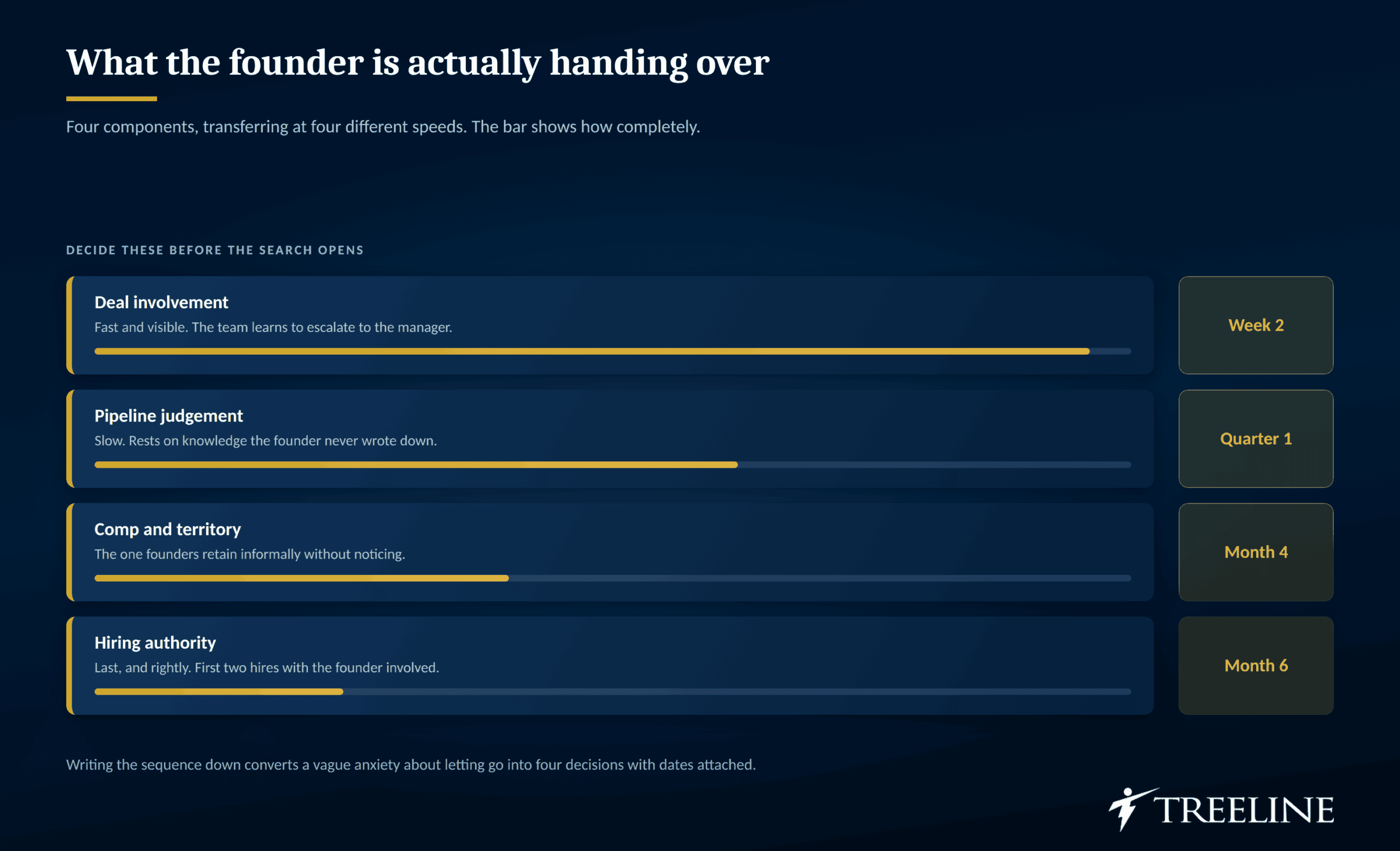
Naming the components makes the handover tractable, because “running sales” is four separate things and they transfer at different speeds.
Deal involvement transfers first and fastest. The founder stops joining every call, and within weeks the team learns to escalate to the manager instead. This is visible and easy to measure.
Pipeline judgement transfers slowly, because it rests on knowledge the founder has never articulated, which customers churn, which deals stall for real reasons rather than stated ones, which buyer signals mean nothing. A manager who has not absorbed this will misjudge the forecast for two quarters, and the only remedy is time spent together on live deals rather than a document.
Comp and territory authority should transfer explicitly and on a date, because it is the one component founders retain informally without noticing. A manager who cannot influence how their team is paid is not managing the thing that most determines behaviour.
Hiring authority transfers last in most companies and that is usually right. A founding manager should hire their next two people with the founder involved, after which the founder should withdraw.
Writing that sequence down before the search opens converts a vague anxiety about letting go into four decisions with dates attached, and it gives the candidate something concrete to evaluate during the process.
The Player-Coach Question
Almost every fouinding sales manager role is scoped as a player-coach, and it is worth being honest about why and about what it costs.
The reason is arithmetic. A small company cannot usually afford a non-carrying manager on top of the sellers it needs, so the role carries a reduced number alongside management responsibility. That is a legitimate constraint rather than a mistake.
The cost is predictable. Under pressure, the player half wins. Personal deals are urgent, visible and within the individual’s control; coaching is important, deferrable and invisible for two quarters. A player-coach who misses their own number is failing immediately; one who neglects coaching is failing slowly and will be told about it much later.
Three things make the arrangement workable. A quota materially below a full seller’s, not a token reduction. A written split of time that the chief executive actually protects. And a date at which the carrying portion drops, tied to team size rather than to a vague future.
What makes it fail is scoping a full quota plus management and hoping. The strongest candidates recognise that scope and decline it, which means the shortlist self-selects toward people with fewer options.
Fantasia’s rule on this is that a player-coach quota should be set at a level the company would be content to see missed. His reasoning is that if missing it would be a crisis, the company has not really hired a manager.
Founding Sales Manager Recruiting: Promote Internally or Hire Externally
This is the fork most companies face, and both answers are defensible depending on one variable: whether the motion is working.
If the motion works and the problem is capacity, sellers to onboard, deals to review, hygiene to maintain, promoting a strong internal seller is frequently right. They know the product, the buyer and the deals, and the gap is management skill, which can be supported.
If the motion does not work and the problem is that nobody has built a system, promoting a seller is usually wrong. They have never built one either, and you have removed your best producer from the field to have them learn management while inventing infrastructure. That combination fails reliably and costs you the seller as well.
There is a third option that goes underused: hire the manager externally and keep the strong seller selling, with an explicit path to management on the next expansion. Companies avoid this because they fear losing the seller. In practice sellers more often leave because they were promoted into a job they did not want and could not do.
The honest framing for the internal candidate is that management is a different job, not a reward for performance, and that the company will support them into it when the conditions are right rather than because they earned it.
Where These Candidates Currently Sit
Knowing where to look narrows the search considerably, and it is rarely where the title search points.
The largest pool is senior individual contributors who have informally led without the title, the person the team already asks for help, who onboarded the last two hires because nobody else would, who runs the pipeline review when the manager is away. They do not appear in a search for sales managers because they are not called one.
The second pool is team leads and first-line managers at companies one or two stages ahead of yours. They have seen a working system at a scale you are approaching, and some of them are blocked because the layer above is not moving. That blockage is the reason they will take a call.
The third is managers at companies going through disruption, an acquisition, a leadership change, a pivot. This group is receptive for reasons unrelated to your opportunity, and timing rather than persuasion determines whether you reach them.
What all three share is that they are employed, performing, and not applying to anything. A job advertisement reaches a fourth group entirely: people actively looking, which correlates with having been managed out somewhere. That is not a disqualification, but a search that relies only on inbound has sampled the wrong population for this role.
The Two Candidate Archetypes
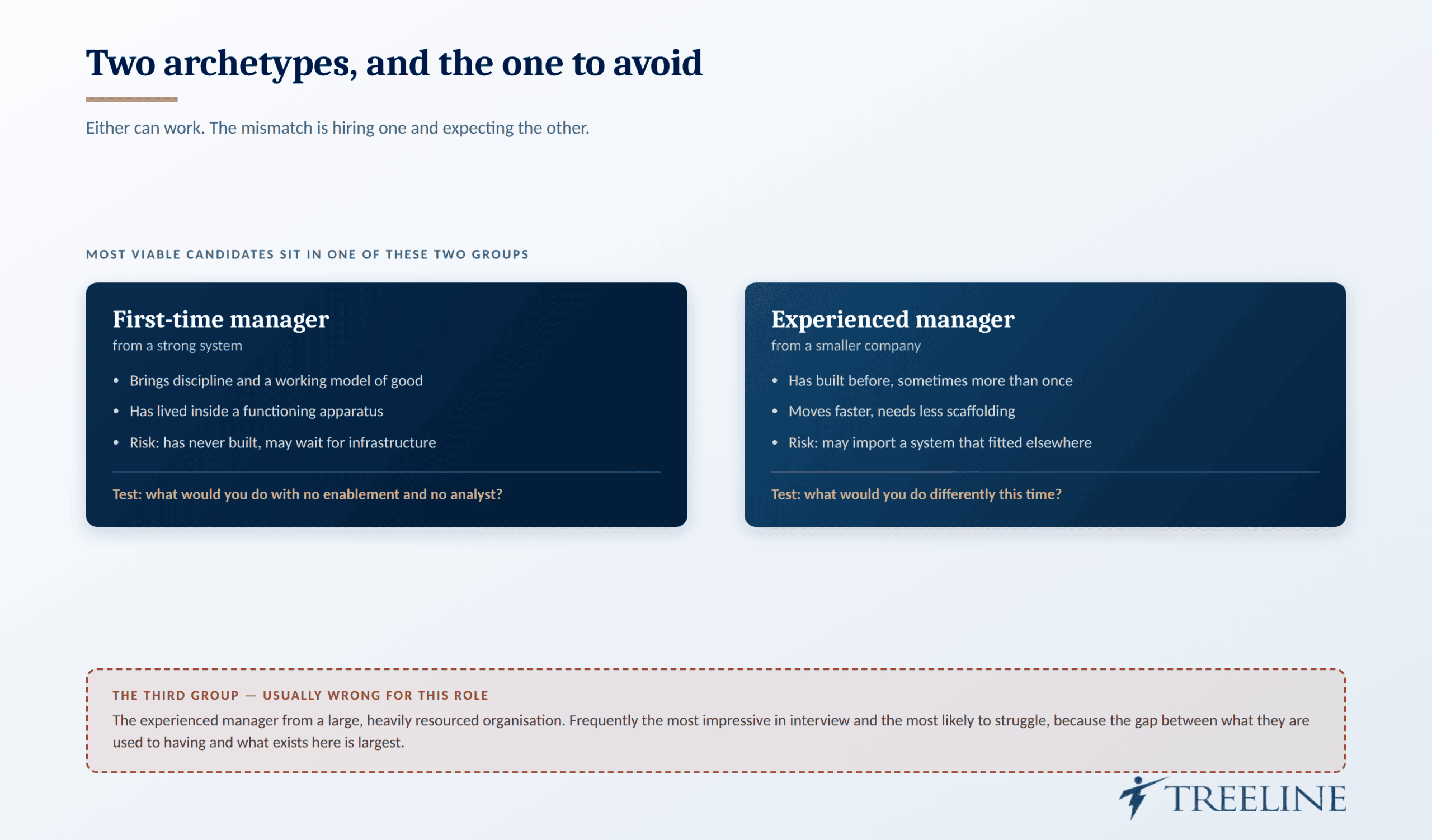
Most viable candidates fall into one of two groups, and knowing which you are talking to prevents a mismatch that surfaces in month five.
The first-time manager from a strong system. A senior seller at a well-run company, possibly a team lead, ready for their first full management role. They bring discipline and a working mental model of what good looks like, because they have lived inside one. The risk is that they have never built anything and may wait for infrastructure that will not arrive. Test by asking what they would do in the first month with no enablement function and no analyst.
The experienced manager from a smaller or earlier company. They have built before, sometimes more than once. They will move faster and need less scaffolding. The risk is the opposite: they may import a system that suited a different company, or they may be leaving because they were not able to scale past this stage. Test by asking what they would do differently from the last time they built one.
Either can work. The mismatch to avoid is hiring the first type and expecting building, or hiring the second and then constraining their authority to change things.
A third group appears in most shortlists and is usually wrong for the role: the experienced manager from a large, heavily resourced organisation. They are frequently the most impressive in interview and the most likely to struggle, because the gap between what they are used to having and what exists here is largest.
What Founding Sales Manager Recruiting Should Test For
The assessment differs from a senior leadership search because the failure modes are different.
Whether they have built rather than inherited. Covered above, and the single most predictive question.
Whether they can coach a deal they could not have closed themselves. A manager whose only technique is taking over the call will not scale a team. Ask them to describe coaching a seller through a deal in a motion they personally had not run.
Whether they will make a personnel decision. A first manager frequently inherits at least one person who should not be in the seat. Ask what they did about the weakest person on their last team and how long it took.
Whether they can operate without the support they had. No sales engineer, no enablement function, no analyst. Ask what they will not be able to reproduce here.
Whether they can be told no. A first manager will ask for headcount, tooling and comp changes, and will get perhaps a third of it. How they respond to the other two-thirds determines whether the relationship with the chief executive survives the first year.
Whether they want the job or the title. Some experienced sellers pursue management because it seems like the next step, then discover they miss selling. This is common and detectable if asked directly.
What the Role Should Be Paid
Compensation on a founding management hire is where companies most often discover their assumptions were wrong, and the structure matters more than the headline figure.
The starting question is what the role replaces. If the manager is taking work off a founder who was doing it badly at nights and weekends, the comparison is not to a senior seller’s package, it is to the value of the founder getting their own job back plus the productivity the team gains. Companies that benchmark only against seller compensation tend to underprice the role and then wonder why the shortlist is thin.
The structure question is how much of the package sits on team performance versus personal production. A player-coach carrying personal quota needs both, and the weighting signals what you actually want. Heavy personal weighting produces a senior seller who occasionally coaches. Heavy team weighting on someone still carrying a number produces frustration, because they are measured on something they can only partly influence while personally exposed on the rest.
A workable pattern is to weight personal production while the carrying portion exists, then shift decisively to team performance on the date the quota drops. Writing that transition into the offer removes a renegotiation later.
One caution worth naming: equity frequently does more work than base on this hire, because the candidate profile most likely to succeed is drawn to ownership of something they are building. That is not a reason to underpay cash, but it does mean an offer weak on equity will lose the builder archetype to a company offering it.
Where Contingency Executive Search Helps on This Role
Being specific matters, because the general claim that a firm improves the hire is not testable.
The most useful contribution is at definition, and it happens before any candidate appears. A firm that has run this search across many companies can say that the requirement as written describes a director rather than a first manager, or that the quota attached makes the role a seller’s job with a title. A single company doing this once has no comparison set.
The second is access to a population that is not looking. Strong founding-manager candidates are usually employed and performing, and the ones worth hiring are rarely browsing job boards. Contingency executive recruiters holding relationships in the segment can reach them; a job advert reaches people who are already dissatisfied, which is a systematically different group.
The third is the reality conversation with the candidate. Someone leaving a resourced organisation for a company with no infrastructure needs to understand that before they accept, and an external party can convey it more credibly than the hiring executive can.
The fourth is speed on a role where the window is narrow. The commercial structure, no fee unless you hire, means the firm carries the risk of a search that does not close, which matters when the requirement is one the company has never articulated before. Treeline sets out how that arrangement works in its contingency sales recruiting service.
What Contingency Executive Search Firms Cannot Fix Here
The boundary is worth stating, because this role has failure modes no search quality can address.
A firm cannot resolve whether the founder will actually let go, and this deserves stating plainly rather than diplomatically. This is the single largest cause of founding-manager failure and it is entirely internal. A founder who continues running sales informally after appointing a manager has created a structure in which the manager can only fail politely.
A firm cannot make an unachievable number achievable. A revenue plan built from a spreadsheet rather than from a pipeline will not be rescued by leadership, and the manager will be the one who departs.
A firm cannot supply authority the role does not have. A manager accountable for the number without influence over comp, territory or hiring is accountable for outcomes they cannot move.
And a firm cannot decide the player-coach split for you. They can tell you the scope is unrealistic. Whether you change it is yours.
There is a version of this worth watching for during the search itself. A firm that presents candidates without ever questioning the scope is not necessarily incompetent; it may simply be a firm that has learned clients dislike being challenged. The distinction matters because you are paying for judgement as much as for reach, and judgement that is withheld to preserve the relationship is judgement you did not receive.
Fantasia pushes back on companies that describe a founsing-manager search as hard to fill. In his experience the search is usually straightforward once the role has been defined honestly, and the difficulty employers report is more often a symptom of a scope that no competent person would accept.
What the Team Should Be Told
The existing sellers are the constituency most affected by this appointment and the one companies most often neglect during the process.
They will have noticed the search. In a small team, interview schedules and unfamiliar names on calendars are visible, and silence produces a worse narrative than an announcement. The productive version is to say plainly that the company is hiring a sales manager, why, and what it means for them.
The question they actually have is whether one of them was considered. If an internal candidate was passed over, that person needs a direct conversation before the external hire is announced, not after. Handled badly, this is the most common way a company loses a strong seller during a founding-manager hire.
The second question is whether their comp or territory changes. If the answer is not yet, say so and give a date. If the answer is possibly, say that instead of reassuring them falsely, because a manager who arrives and immediately contradicts a promise the founder made has started from a deficit.
There is also a case for involving one or two sellers in the interview process. It surfaces information the hiring executive will not get, whether this person can coach, and it gives the team a stake in the appointment succeeding.
How the Search Itself Runs Differently
Compared with hiring a senior sales leader, three things change in practice.
The candidate population is broader and harder to identify by title. The right person may currently be a senior individual contributor who has informally led, a team lead in a larger company, or a manager at a company one stage ahead of yours. Searching by title alone misses most of them.
The persuasion conversation is different. You are not offering scope or prestige; you are offering ownership and the chance to build. Candidates motivated by that are a specific group, and the pitch has to be honest about the absence of infrastructure rather than glossing it.
And the reference conversation matters more. For a first manager, the question worth asking former colleagues is whether the people they managed got better. That is answerable by the people who reported to them and by nobody else.
The First Ninety Days, Planned in Advance
Because the role has no predecessor, the onboarding has to be constructed rather than inherited, and doing it badly wastes the first quarter.
Weeks one to three should be diagnosis rather than change. The manager sits on calls, reads closed-lost records, talks to every seller and to the founder about what the motion actually is as opposed to what the deck says.
By week six they should present back what they found, including where their reading differs from the company’s. That difference is the most valuable output of the period and the main reason to hire someone from outside.
By the end of the first quarter one or two things should be built, not five. A qualification standard, a forecast cadence, an onboarding sequence. Building one thing properly beats starting four.
The founder’s job during this period is to hand over visibly. Deal escalations should route to the manager in front of the team rather than continuing to land in the founder’s inbox, and the first time the founder overrides the manager publicly, the appointment is materially weakened.
A Worked Sequence for a Small Team
An illustration makes the timing argument concrete. This is a constructed example rather than a specific engagement.
A company has four sellers and a founder who still closes the largest deals. Revenue is growing, the forecast is consistently optimistic by about a third, and two sellers hired six months ago have not reached productivity. The founder is spending roughly two days a week on sales management.
The instinct is to hire a manager immediately. The better sequence starts one step earlier: spend two weeks writing down what the motion actually is, who buys, what triggers a deal, what disqualifies one, what the stages mean. That document is imperfect and it is the thing the new manager will inherit instead of inheriting nothing.
Then decide the four handovers with dates. Deal escalation from week two. Pipeline judgement over the first quarter. Comp influence from month four. Hiring authority from month six with the founder in the loop for the first two hires.
Then scope the role. Four sellers means a genuine management job exists, so the player-coach quota should be light, enough to keep credibility with the team, not enough to dominate the week. Set the date it drops at six sellers.
Then open the search. Definition took two weeks; the search runs while the team continues as it was. The founder is not saved two days a week until month three regardless, so the two weeks cost nothing and change what the manager walks into.
The counterfactual is the common version: open the search immediately, hire a strong person into an undefined role, and spend the first quarter discovering the definitional problems with a salaried manager in the seat rather than on a whiteboard.
What It Costs When This Hire Is Wrong
The downside is asymmetric in a way that justifies spending longer on the definition.
A wrong founding manager costs the decisions they made while there. They set a comp plan the team organised around, hired people who are now yours, and changed the segmentation. Reversing that takes longer than their tenure did.
There is a second-order cost specific to this role. Sellers watch a first management appointment closely, because it tells them whether the company is becoming somewhere they can build a career. A manager who arrives, disrupts and leaves within a year frequently takes one or two of the existing team with them, and that attrition is usually attributed to something else.
And the next search starts from a worse position. Candidates ask why the last person left, and they ask people other than you.
Set against that, the extra two weeks spent writing an honest scope before opening the search is trivially cheap.
Signals Founding Sales Manager Recruiting Should Wait
Four conditions suggest waiting, and recognising them saves a wasted quarter.
The founder cannot describe, in two sentences, what the manager will decide that they currently decide. If the division of authority is unclear now, it will be contested later.
The compensation plan is unsettled. A manager arriving into a comp plan about to change will spend their first quarter defending something they did not design.
The team is one person. Managing a single seller is not a management job and both parties will know it within a month.
And the company has not decided whether it wants a builder or an operator. Those are different candidates, and searching for both produces a shortlist that satisfies nobody.
Measuring the Hire at Twelve Months
Because there is no predecessor to compare against, the review has to be constructed in advance or it collapses into whether revenue moved.
Revenue is the least informative measure on this particular role, because a founding manager’s first year is largely spent building things whose effect lands in year two. A manager who installed a qualification standard, rebuilt onboarding and removed one underperformer may show flat revenue and have done the job well. One who changed nothing and rode an existing pipeline may show growth and have done nothing.
Four questions are more useful. Did the sellers who were here a year ago get better, measured by something other than the number, cycle length, win rate, forecast accuracy? Did anyone new reach productivity faster than the last cohort did? Does the forecast now land within a tolerable range? And is the founder spending materially less time on sales management than they were?
That last one is the cleanest test of whether the hire worked, because it was the original reason for making it. A founder still running sales informally at month twelve has either hired the wrong person or not handed over, and distinguishing between those two is the most important thing the review can establish.
Write those four down before the manager starts. Organisations routinely discover at the review that they are judging someone against expectations nobody articulated.
Choosing Who Runs the Search
Firm selection matters more on this role than on a standard seller search, because the definitional work is most of the value.
Ask what they would change about the scope before they see a candidate. A firm that accepts the requirement as written on a founding-manager role either has not run many or is not going to tell you.
Ask how many founding-manager searches they have run in the past year, and what happened to those people. Still employed at twelve months is the minimum bar; what they built is the more useful answer.
Ask what they would tell a candidate is difficult about this role. A firm that cannot name a drawback will present the opportunity generically, and the strongest candidates will detect that immediately.
And ask whether they will say the role is not ready. Treeline sets out its own position on that standard in its explanation of why it approaches contingency sales recruiting the way it does.
Fantasia frames the choice of firm on this search as a question about willingness rather than capability. His view is that most competent firms can find candidates for a first-manager role, and the differentiator is whether they will tell a founder something the founder does not want to hear about the scope.
Frequently Asked Questions
When should we hire our first sales manager?
Not at a headcount threshold. The signals are that whoever runs sales informally has stopped doing the rest of their own job, that new sellers are arriving without reaching productivity, and that the forecast has become structurally optimistic because the person consolidating it is also selling the largest deals.
Should we promote a seller or hire externally?
It depends on whether the motion works. If it works and the problem is capacity, promoting a strong internal seller is often right. If the motion does not work and nobody has built a system, promoting a seller is usually wrong, they have not built one either, and you lose your best producer in the process.
Is a player-coach arrangement a mistake?
Not inherently; it is often a genuine financial constraint. It works when the quota is materially below a full seller’s, when the time split is protected by the chief executive, and when a date is set for the carrying portion to drop. It fails when a full quota is attached and the company hopes for the best.
What should founding sales manager recruiting test for?
Whether the candidate built rather than inherited, whether they can coach a deal they could not have closed themselves, whether they have made a real personnel decision, whether they can operate without the support functions they are used to, and whether they want management rather than the title.
What can a search firm actually influence on this role?
Four things: challenging the scope before candidates appear, reaching people who are not looking, giving the candidate an honest account of the missing infrastructure before they accept, and moving quickly. They cannot make the founder let go, make an unachievable number achievable, or supply authority the role does not carry.
Why do founding sales manager hires fail so often?
Most often because the founder continues running sales informally after the appointment, because the scope combined a full quota with management, because the revenue plan was never achievable, or because the company had not decided whether it wanted someone to build a system or operate one.
What should the first ninety days look like?
Diagnosis for the first three weeks, a presentation back at week six including where their reading differs from the company’s, and one or two things properly built by the end of the quarter rather than five started. The founder’s task is to route escalations to the manager visibly.
How do we know the role is not ready to open?
If the founder cannot describe in two sentences what the manager will decide that they currently decide, if the comp plan is about to change, if the team is a single seller, or if the company has not decided between a builder and an operator.
Define the Role Before You Open the Search
Treeline, Inc. is a sales-only executive search firm based in Wakefield, Massachusetts, working exclusively on building sales organizations. Our contingency sales recruiting service carries no upfront cost and no fee unless you hire, and we deliver your first candidate within three days of launching a search.
If you are approaching your first sales management hire, the conversation worth having first is about scope and timing. Get in touch and we will tell you plainly if the role is not ready yet.
Share This Story, Choose Your Platform!
Related Posts


What our happy clients are saying
Treeline Inc. provided us with the most candidates that aligned with our needs and were of the highest quality.

Dr. Jeffrey Klein Head of North America Sales, Satchel Pulse
Treeline Inc.’s collaborative, flexible, and communicative approach resulted in a smooth partnership. Beyond their recruitment expertise, their unique sourcing model was efficient and effective.

Sera Holt Director of Operations, LNS Research
Their professionalism was outstanding. Treeline Inc. was extremely thorough and ensured that we were on the same page before they started looking for candidates. They listened to us and did a great job working with the candidate to close out the process.

Cate Grant AVP Customer Success, Nasdaq
Thanks to Treeline Inc.’s intricate and thorough screening process, the company is able to hire six high-quality candidates that fit perfectly in the company’s culture. The team is highly receptive to concerns, and internal stakeholders are impressed with their unique recruitment abilities.

Anna McKean Sales Recruiter, Insider Intelligence
Treeline Inc. has been qualified individuals throughout a five-year-long engagement. They’ve made numerous placements of talented and qualified individuals for our business.

Michele St Laurent VP of HR, The Institute for Applied Network Security

Let Us Help You Source the Sales Talent You Need
Whether you’re building a team or replacing a key role, our Candidate Sourcing Platform provides a fast, flexible, and employer-focused solution.
Tell us more about your business and how we can help.
Treeline Inc.
Your Award-Winning Sales Recruitment Partner
15 Lincoln Street, Suite 314, Wakefield, MA 01880