Meta Title: Hiring a Vice President of Global Sales: Firm and Level Meta Description: Before choosing an executive search firm, settle the level. Here is what a Vice President of Global Sales owns, and when you actually need an SVP. Suggested URL: https://www.treelineinc.com/blog/hire-vice-president-of-global-sales-executive-search-firm/ Which Executive Search Firm Can Help Me Hire a Vice President of Global Sales?
The firm question is the second question. The first is whether you are actually hiring a vice president. That sounds pedantic until you have watched a search fail because of it. A company writes a requisition for a Vice President of Global Sales, engages a capable firm, and receives a slate containing two people who managed regional directors across four countries and three people who managed a dozen sellers with international accounts.
Both groups have held the title. Neither group is wrong. The company simply never decided which job it was filling, and the search firm was never told. Get the level right and most competent search partners can execute. Get it wrong and the best firm in the market will produce an unusable shortlist, on time and on budget.
Companies typically arrive at this search from one of these positions:
- International revenue has outgrown whoever was handling it alongside another role
- A regional leader is performing but has no counterpart in the other markets
- The company sells into several countries with no consistent motion or forecast
- A previous hire at this level did not work out and nobody has diagnosed why
- The founder or CEO has been the de facto global sales leader
- An SVP or CRO needs a layer beneath them to run day-to-day international execution
- The board has asked for international revenue to be forecast with the same rigour as domestic
Dan Fantasia, CEO of Treeline, Inc., views the level decision as a scoping problem rather than a budget one. From his perspective, employers should define the layer the new leader will manage before settling on a title, because a leader who manages sellers and one who manages leaders are drawn from different populations regardless of what the requisition says.
The cost of getting it wrong is not only the fee. The Society for Human Resource Management‘s 2026 recruiting benchmarking data reports a median cost-per-hire of $15,000 for executive positions and a median time-to-fill of 45 calendar days, with the median share of executive roles filled externally at 100 percent. A mis-levelled search consumes that twice.
This guide covers what the role owns, how to tell whether you need a VP or an SVP, why the title itself is unreliable, how to scope the brief, who takes these roles, and only then how to choose the firm.
What a Vice President of Global Sales Actually Owns
A Vice President of Global Sales generally owns execution across markets rather than the strategy that decides which markets exist. The typical scope:
- A revenue number across two or more countries, usually rolling up to an SVP, CRO, or CEO rather than sitting at the top of the revenue organisation
- Direct management of country managers, regional directors, or senior sellers, depending on company size
- Quota setting and territory design within a go-to-market model that has already been chosen
- Pipeline discipline and forecast accuracy across teams with different CRM habits
- Hiring and developing the selling layer, and often the first line of management beneath it
- Day-to-day partner or distributor management where those channels exist
- Execution of pricing policy, with escalation rights rather than final authority
The U.S. Department of Labor’s O*NET profile for sales managers describes work activities that include staffing organisational units through recruiting, interviewing and hiring; coordinating the work and activities of others; resolving conflicts and negotiating; monitoring and controlling resources; and judging the qualities of people.
Its task list includes determining price schedules and discount rates and reviewing operational records to project sales and determine profitability. That is an execution and people-management job with a commercial number attached. It is not a strategy seat, and candidates who want a strategy seat will tell you so in the second interview.
The layer beneath, and the layer above
The cleanest way to define this role is by naming the two layers that surround it. Beneath. Does this person manage individual sellers, front-line managers, or country leaders? Each answer implies a different candidate. Someone who has only managed sellers will struggle to develop managers. Someone who has run country leaders may find direct seller management a step backwards and leave within eighteen months.
Above. Does this role report to a CRO, an SVP of Global Sales, or the CEO? Reporting to a CRO usually means a defined execution mandate. Reporting to the CEO usually means the company has no revenue leadership above this seat, which makes it a larger job than the title implies, and candidates will price it accordingly.
If you cannot answer both questions in a sentence each, the search is not ready to open. Treeline’s Vice President of Sales job description template is a useful starting point for putting that scope on paper.
Vice President of Global Sales or Senior Vice President? How to Tell
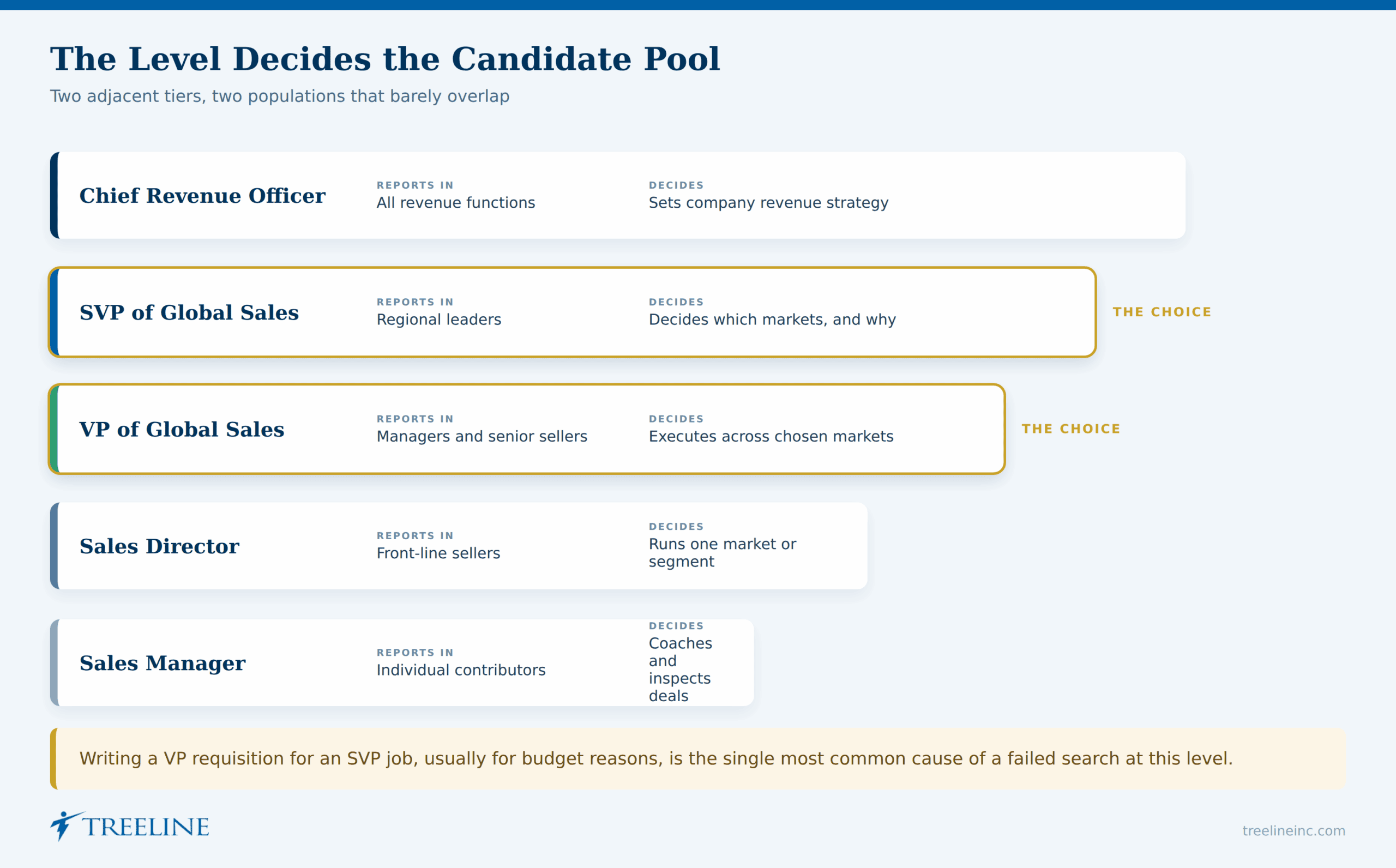
These are different jobs that share vocabulary. The diagram below places both against the layers around them. Signals that you need a vice president:
- There is already a CRO or SVP owning international strategy, and you need execution beneath them
- The team is small enough that the leader will still be close to deals and sellers
- The go-to-market model is settled and the problem is running it consistently
- You need someone who will build the first management layer, not redesign the region
- Budget realistically supports a VP band rather than an executive-team band Signals that you actually need a senior vice president:
- Nobody above this role owns international revenue
- The leader must decide which markets to enter or exit, not just perform in them
- Two or more regional leaders already exist and need consolidating under one accountable number
- The role sits on the executive team and presents to the board
- You expect the person to negotiate scope with product, finance, and legal rather than escalate to someone who does
There is also a hybrid case worth naming, because it is common and rarely discussed. Some companies genuinely need SVP-level judgement now and VP-level execution for the next two years, because the region is small but the decisions are not. In that situation you are not choosing between two candidate pools so much as looking for a specific profile: someone senior enough to make market-entry calls but willing to stay close to deals while the organisation is small.
That person exists, but the brief has to say so explicitly, and the compensation has to reflect the judgement rather than the headcount. The most common error is the second list being true while the first list is what gets written into the requisition, usually for budget reasons. That produces a search where strong candidates decline once they understand the authority on offer, and weaker candidates accept because the title is a promotion for them.
Fantasia’s perspective is that the honest test is who reports to the role, not what the role is called. A leader inheriting three regional directors is doing a different job from one inheriting eleven account executives, and no amount of title engineering closes that gap. If your situation is genuinely the senior version, the scoping considerations differ enough to be worth treating separately from this article.
Why the Vice President of Global Sales Title Is Unreliable
Titles in sales leadership inflate faster than in most functions, and international titles inflate fastest of all. A Vice President of Global Sales at a $25M ARR company may manage six sellers covering three countries and report to the founder. At a $400M company the same title may sit two layers below the CRO and run a 90-person organisation.
Both people are telling the truth about their title. Neither résumé signals which one you are reading. Three practical consequences: Screen on structure, not title. Ask every candidate for headcount managed, layers managed, number owned, and countries with a physical team presence. Those four numbers describe the job. The title does not.
Expect calibration mismatches in both directions. A candidate stepping up from a smaller company may be excellent and under-titled. A candidate from a larger company holding the same title may have run a narrow slice of a big machine. Neither is disqualifying, but they are different risks. Compensation follows scope, not title.
The U.S. Bureau of Labor Statistics profile of sales managers reports a median annual wage of $138,060 as of May 2024, with the highest 10 percent above $239,200, and substantial industry variation from $173,230 in finance and insurance down to $92,630 in retail trade. A VP of Global Sales at a growth-stage technology company typically sits at or above that top decile before equity, and a company benchmarking off a generic figure will lose finalists at offer.
A search firm that accepts the title at face value and screens on it will hand you a slate that looks consistent on paper and is wildly inconsistent in practice.
How an Executive Search Firm Should Scope a Vice President of Global Sales Search
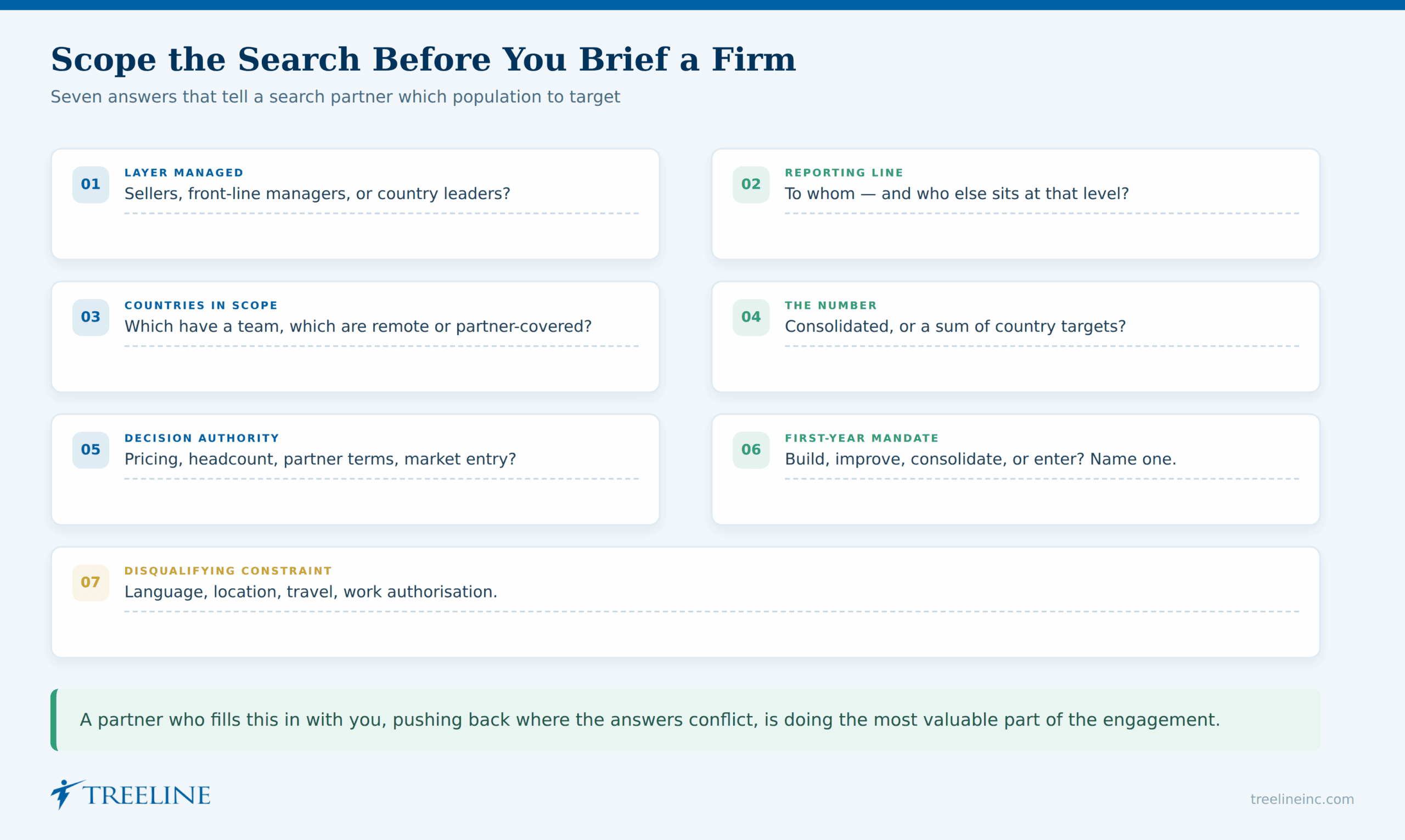
Scoping is the work that determines whether the shortlist is usable. It should happen before any candidate is contacted, and it should be written down. The brief should answer, in writing:
- Layer managed. Sellers, front-line managers, or country leaders.
- Reporting line. To whom, and who else sits at that level.
- Countries in scope. With a note on which have a physical team and which are covered remotely or by partners.
- The number. What it is today, what it is expected to be, and whether it is consolidated or a sum of regional targets.
- Decision authority. What the leader can approve alone: pricing exceptions, headcount, partner terms, market entry.
- First-year mandate. Build a management layer, improve productivity, consolidate regions, or enter markets. Naming one is more useful than listing all four.
- The disqualifying constraint.
Language requirements, location, travel expectation, or work authorisation. Stating it early narrows the pool honestly rather than late and expensively. A firm that fills this in with you, pushing back where the answers conflict, is performing the most valuable part of the engagement. A firm that takes the job description and moves to fees has told you what the search will be.
Fantasia recommends writing the operating condition before writing the job description. A brief that names the markets, the team layer, and the number the leader will own tells a search firm which population to target, while a title-led brief invites candidates who cannot be meaningfully compared.
Who Actually Takes a Vice President of Global Sales Role
Understanding candidate motivation is underrated in scoping, because it determines who will say yes. Three populations realistically take this role. The regional leader stepping up. Currently runs one country or region well, wants multi-market scope. Strong local credibility, unproven at managing peers who become reports.
Motivated by scope expansion and a path to SVP. Usually the best value if the mandate is execution rather than redesign. The lateral mover. Currently a VP of Global Sales elsewhere, moving for a better product, a shorter sales cycle, or a company with clearer trajectory. Lowest risk on capability, highest risk on motivation.
Establish early what is actually driving the move, because whatever it is will still be true in your environment if you do not address it. The step-down from a larger platform. Held a bigger title at a much larger company and is willing to take a smaller organisation for equity, autonomy, or a shorter commute to the decision-maker.
Can be exceptional. Can also arrive expecting infrastructure that does not exist. The diagnostic is whether they ask about resourcing constraints in the first conversation. What almost nobody takes: a role with a global title, a domestic reality, and no authority over the regions it nominally covers. If that is your situation, either fix it or describe it honestly and hire for what it is.
Treeline’s guidance on hiring a Vice President of Sales for a high-growth company and a Vice President of North American Sales at an international company covers adjacent versions of this scoping problem.
How to Assess a Vice President of Global Sales Candidate
Once the level is settled, assessment becomes a question of verifying scope rather than judging polish. Candidates at this tier interview well; the task is to establish what they actually ran. Useful questions:
- Draw me your last org chart. Who reported to you, and who reported to them?
- How many people were in the organisation when you arrived, and when you left?
- Which of those people did you hire, and which did you inherit?
- What was the number you owned, and was it consolidated or a sum of country targets?
- Which countries had a physical team, and which were covered remotely or through partners?
- What did you change about territory design or quota, and what happened to attainment afterwards?
- Describe a manager you promoted. What did they need to learn, and how did you develop them?
- Describe a manager you removed. How long did it take you to decide?
- What did you escalate to your boss rather than decide yourself?
- What would your successor say was unfinished?
Questions seven and eight matter more than they look. The difference between a strong senior seller and a genuine sales leader is whether they can develop and, when necessary, remove managers. Candidates who have only ever managed individual contributors tend to answer both in general terms. Question nine is the level test.
A candidate who escalated pricing exceptions and headcount was operating as a vice president. One who decided market entry and renegotiated partner terms was operating as an SVP, whatever the title said. References should cover both directions. A former manager speaks to judgement and forecast reliability. A former direct report, ideally someone who was themselves a manager, reveals whether the candidate built capability or simply supervised it.
What the first slate tells you about your brief
The first slate is diagnostic information about your own brief, not only about the firm. If the candidates vary wildly in scope, the level was never settled and the firm screened on title. If they are uniformly under-scoped, your compensation band is probably reading as a smaller job than you intend. If they are uniformly over-scoped and declining, you have written an SVP job and priced a VP. If they all come from one country, the firm’s international reach is narrower than described.
Treat the first slate as a checkpoint rather than a delivery. A good partner will present it with their own read on what the market response says about the brief, and will propose a specific adjustment. A weaker one will present five résumés and ask which you would like to interview.
How to Evaluate the Search Firm
With the level and scope settled, firm selection becomes a narrower question.
| Evaluation area | What to examine | Evidence to request |
|---|---|---|
| Level calibration | Whether they challenge VP versus SVP | Their unprompted read of your brief |
| Structural screening | Whether they screen on layers and headcount | How they would size a candidate’s actual scope |
| International reach | Which markets they source in directly | Named markets, and the ones they do not cover |
| Functional depth | Sales leadership searches, not general executive volume | Comparable placements, and how many are still in seat |
| Compensation guidance | A band before the search opens | Indicative range for your scope and industry |
| Search leadership | Who runs it day to day | Named consultant, available before signing |
| Off-limits | Companies they cannot approach | Written disclosure before contract |
| Process discipline | Slate size, timeline, cadence | Written milestones and a stalled-search plan |
Treeline’s perspective on using an executive search firm covers the broader trade-off between internal capability and outside search, and the guide on how to hire a vice president of sales covers the scoping fundamentals at this tier.
What to Ask Before You Sign
- Based on what I have described, is this a VP or an SVP role? Why?
- How would you size a candidate’s real scope beyond their title?
- Which countries can you source in directly, and which can you not?
- How many searches at this level have you personally run, and how many of those people are still in seat?
- Who runs this search day to day, and can I meet them?
- What is your read on our compensation band?
- Which companies are off-limits to you?
- What happens if the search stalls at sixty days?
- Why might strong candidates decline this role?
That final question is the most useful one in the list. A partner with real market knowledge will name a specific reason: the authority on offer, the reporting line, the travel expectation, or the band.
What to Do If You Discover the Level Is Wrong Mid-Search
This happens often enough to plan for, and handling it badly costs more than the mis-scoping did. The usual signal arrives around week five or six. Strong candidates are taking the first call and declining the second. The reason given is rarely compensation directly; it is more often phrased as scope, autonomy, or wanting to understand who owns the strategy.
That pattern almost always means you have written a VP job for what candidates read as an SVP problem, or the reverse. Three options, in order of how often they are the right one. Adjust the brief, keep the level. If the mandate is genuinely execution and the pushback is about authority rather than title, the fix is usually to clarify decision rights rather than to change the level.
Write down what the person can approve alone. Candidates decline ambiguity more often than they decline a defined smaller scope. Change the level and restart the pipeline. If the job really is senior, changing it is cheaper in week six than in month five. Expect the firm to rebuild a portion of the market map, and expect to reopen the compensation conversation.
Any partner who tells you the existing pipeline transfers cleanly to a different level is managing your feelings rather than your search. Split the role. Occasionally the honest answer is that you need an SVP eventually and a VP now, or a VP plus a strong regional director rather than one leader carrying everything. This is more common in companies where international revenue is growing faster than the organisation around it.
What not to do is quietly raise the band while leaving the brief unchanged. That attracts candidates who are being paid for a job the company has not agreed to give them, and the mismatch surfaces in the first quarter rather than during interviews. Tell your search partner as soon as you suspect it. A firm that has been briefed honestly can reposition the role with candidates already in process; one that finds out at offer stage cannot.
Compensation and Structure
Settle these before the search opens, because candidates ask and vague answers cost finalists.
- Base and variable split, and whether variable is measured on consolidated or per-market attainment
- Currency of base salary, and who absorbs exchange-rate movement across a plan year
- Whether quota is denominated in one currency or split by country
- Equity, and whether it is available to employees outside the United States
- Travel expectation expressed in nights away per month rather than a percentage
- Location and authorisation, including whether relocation is funded and on what timeline
- Title flexibility.
If the scope is genuinely senior and the band is not, decide which one moves before a candidate forces the question at offer stage
Engagement Models and Fees
Fees are typically a percentage of the placed candidate’s base salary, and Treeline’s standard fee is 25% of base salary. Retained engagements are paid in installments with a portion upfront in exchange for exclusivity and systematic market mapping. Appropriate when the search is confidential, when the international portion of the pool must be built rather than activated, or when the level question is genuinely unsettled and you need a partner invested in resolving it.
Treeline’s sales executive search practice operates this way for VP-level and C-level roles. Contingency engagements are payable only on placement, with no upfront cost. Treeline’s contingency sales recruiting service is entirely performance based and suits a clearly scoped, publicly posted VP role with a reachable pool and a decisive interview process.
The mechanics of both are set out in Treeline’s comparison of retained search vs. contingency search. A VP-level global search is more often a reasonable contingency candidate than an SVP search, precisely because the pool is larger and the role is usually public. That is one more practical reason to settle the level first.
The First 90 Days
- Days 1 to 30. Meet each market in person where a team exists. Review pipeline against actual close rates per country rather than in aggregate. Identify where reported and real pipeline diverge.
- Days 30 to 60. Assess the selling and management layer against the mandate. Form a view on territory design, quota realism, and which markets are under- or over-covered.
- Days 60 to 90.
Present a plan covering coverage changes, hiring needs, forecast methodology, and the number that can genuinely be committed to. Fantasia emphasizes that a newly hired vice president should be measured on the structure they inherit before the number they produce. A leader given a quarter to understand coverage, quota design, and regional capability will build something durable, while one handed a forecast in week two will manage to whatever the previous team assumed.
Follow-on hiring is common once that assessment lands, typically country managers, regional directors, or sales operations support. Treeline’s employer sales recruiting services cover those roles under both engagement models.
Where Treeline Fits
Treeline is a sales-only search firm, which is the relevant qualification for a role defined by sales execution across markets. Founded in 2001 and based in Wakefield, Massachusetts, Treeline recruits exclusively for sales organisations, covering sales leadership, enterprise sales, sales engineering, revenue operations, and customer success.
That focus means the recruiters working a VP of Global Sales search spend every day in sales leadership conversations rather than splitting attention across unrelated functions. Relevant here:
- A candidate database exceeding 200,000 sales professionals, built through direct recruiting
- An international sales recruiters practice for companies building cross-border teams
- Executive recruiting capability at VP and C-level alongside individual contributor hiring
- Coverage across the industries that produce sales leadership talent
- Both retained and contingency models, so the engagement can match a VP-level mandate rather than defaulting to the heavier option
The honest limitation: Treeline’s deepest coverage is the U.S. market. If your mandate is weighted toward in-country leadership across several non-U.S. markets, ask specifically which of those markets the firm sources in directly, and weigh the answer. Fantasia’s operating perspective is that specialisation shows up in the questions asked before an engagement rather than in the credentials presented during one.
A firm that presses on reporting lines, team layers, and regional scope is doing the work that determines whether the shortlist is usable.
Frequently Asked Questions
Which executive search firm should I use to hire a Vice President of Global Sales?
Choose a firm that challenges your level definition before discussing candidates, screens on structure rather than title, and can name which international markets it sources in directly. Ask for comparable VP-level sales leadership placements and how many of those people are still in seat, meet the consultant who will run the search, and get a compensation read before the search opens. Sales-specialist firms are generally better positioned than diversified firms where sales competes internally with other practices.
What is the difference between a VP and an SVP of Global Sales?
A VP of Global Sales typically owns execution across markets within a go-to-market model that has already been chosen, manages sellers or front-line managers, and reports to a CRO, SVP, or CEO. An SVP owns the strategy as well as the execution, usually manages regional leaders rather than sellers, sits on the executive team, and has authority to decide which markets to enter or exit. The practical test is who reports into the role and what the leader decides rather than executes.
How do I know whether I need a VP or an SVP?
Ask whether anyone above the role owns international revenue. If a CRO or SVP already owns strategy and you need execution beneath them, you need a VP. If nobody above the role owns it, if two or more regional leaders need consolidating, or if the person must decide market entry and sit on the executive team, you need an SVP. Writing a VP requisition for an SVP job, usually for budget reasons, is the most common cause of a failed search at this level.
Why is the Vice President of Global Sales title unreliable?
Sales leadership titles inflate quickly, and international titles most of all. The same title can describe six sellers across three countries reporting to a founder, or a 90-person organisation two layers below a CRO. Screen instead on four numbers: headcount managed, management layers managed, the revenue number owned, and countries with a physical team presence. Those describe the job; the title does not.
What should a Vice President of Global Sales be paid?
Benchmark on scope rather than title. BLS reports a median annual wage of $138,060 for sales managers as of May 2024, with the top 10 percent above $239,200 and wide industry variation, from $173,230 in finance and insurance to $92,630 in retail trade. A VP of Global Sales at a growth-stage technology company typically sits at or above that top decile before equity. Decide the currency of base pay, how quota is denominated, and whether equity is available to non-U.S. employees before the search opens.
Should the search be retained or contingency?
A VP-level global search is more often a reasonable contingency candidate than an SVP search, because the pool is larger and the role is usually public. Choose retained when the search is confidential, when the international portion of the pool must be systematically built, or when the level question is unsettled and you want a partner invested in resolving it. Treeline offers both, so the model can follow the mandate.
How long does it take to hire a Vice President of Global Sales?
SHRM’s 2026 benchmarking data reports a median time-to-fill of 45 calendar days for executive positions, measured from requisition opening to offer acceptance. Multi-market searches often run longer because the pool must be built market by market, and language, location, or work-authorisation requirements narrow it further. A realistic planning range is two to four months from kickoff to accepted offer, plus notice periods.
What should the first candidate slate tell me?
Treat it as diagnostic information about your brief. If candidates vary wildly in scope, the level was never settled and the firm screened on title. If they are uniformly under-scoped, your band is reading as a smaller job than you intend. If they are uniformly over-scoped and declining, you have written an SVP job at a VP price. If they all come from one country, the firm’s international reach is narrower than described.
Can I promote a regional leader into this role?
Often, and it is worth evaluating before running an external search, particularly when the mandate is execution rather than redesign. The honest test is whether the internal candidate has managed peers who became direct reports, built a management layer rather than a selling team, or operated in a market whose buying behaviour differs from the one they know. If not, treat it as a development assignment and resource it with a strong second layer or an experienced advisor.
Talk to a Sales Recruiting Specialist
If you are hiring a Vice President of Global Sales and want a partner who will challenge the level before discussing candidates, schedule a conversation with Treeline. You will get a direct read on whether the role is scoped as a VP or an SVP, what the market will bear on compensation, and which markets are realistic to source in, before any fee is discussed.
Share This Story, Choose Your Platform!
Related Posts

What our happy clients are saying
Treeline Inc. provided us with the most candidates that aligned with our needs and were of the highest quality.

Dr. Jeffrey Klein Head of North America Sales, Satchel Pulse
Treeline Inc.’s collaborative, flexible, and communicative approach resulted in a smooth partnership. Beyond their recruitment expertise, their unique sourcing model was efficient and effective.

Sera Holt Director of Operations, LNS Research
Their professionalism was outstanding. Treeline Inc. was extremely thorough and ensured that we were on the same page before they started looking for candidates. They listened to us and did a great job working with the candidate to close out the process.

Cate Grant AVP Customer Success, Nasdaq
Thanks to Treeline Inc.’s intricate and thorough screening process, the company is able to hire six high-quality candidates that fit perfectly in the company’s culture. The team is highly receptive to concerns, and internal stakeholders are impressed with their unique recruitment abilities.

Anna McKean Sales Recruiter, Insider Intelligence
Treeline Inc. has been qualified individuals throughout a five-year-long engagement. They’ve made numerous placements of talented and qualified individuals for our business.

Michele St Laurent VP of HR, The Institute for Applied Network Security

Let Us Help You Source the Sales Talent You Need
Whether you’re building a team or replacing a key role, our Candidate Sourcing Platform provides a fast, flexible, and employer-focused solution.
Tell us more about your business and how we can help.
Treeline Inc.
Your Award-Winning Sales Recruitment Partner
15 Lincoln Street, Suite 314, Wakefield, MA 01880