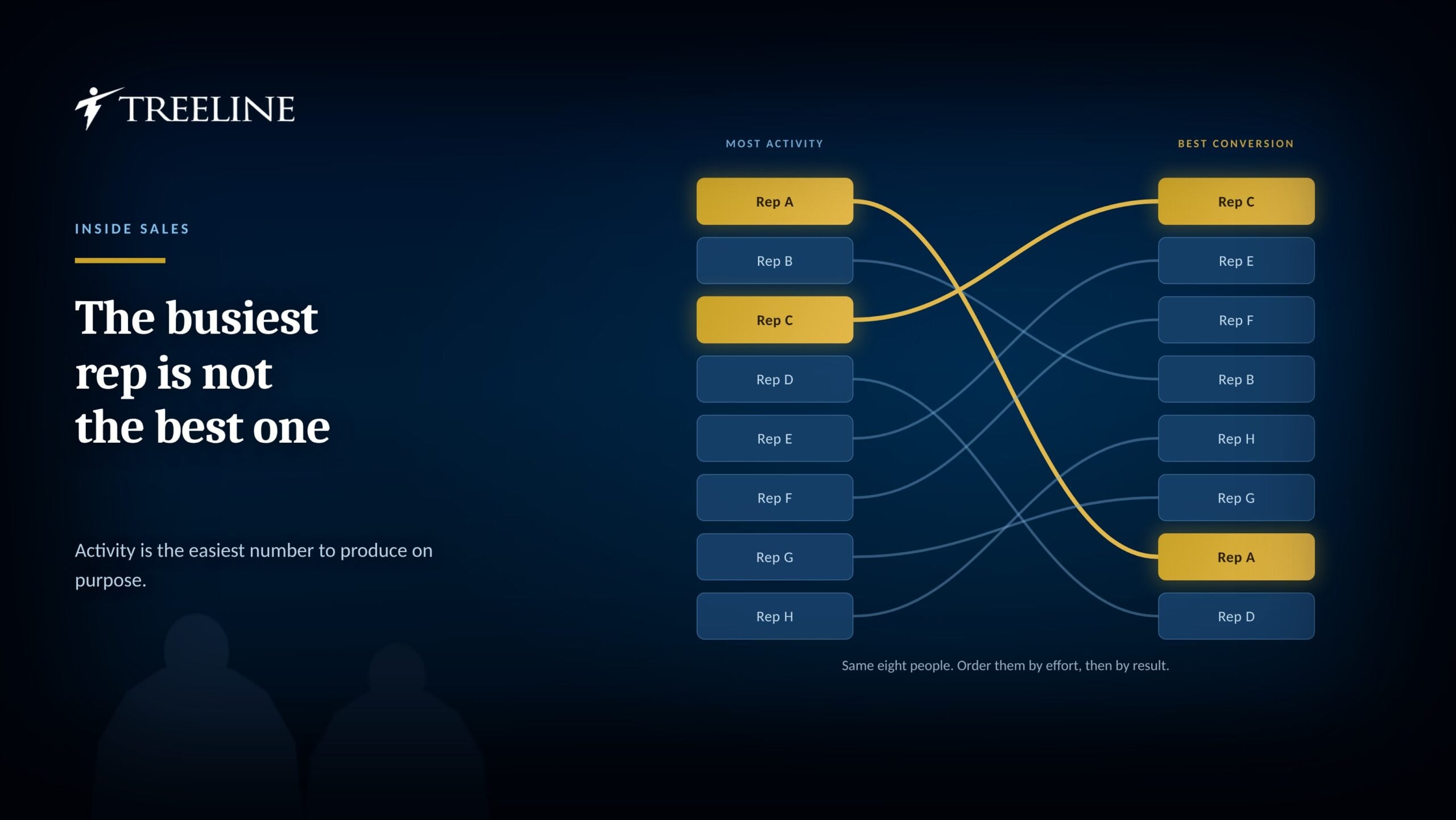
“We sell into financial services” describes two opposite jobs, and the people who are excellent at one are frequently poor at the other.
In one half of this market, a deal is originated through a relationship and closed by a small number of people who can simply decide. A managing director at a private equity firm or an investment bank does not run a vendor procurement process to engage a service; they decide, and the sale was effectively won months earlier in conversations that had no agenda. In the other half, nobody can decide alone. A core banking platform or an insurance system has to clear third-party risk, information security, compliance and procurement, and the person who wants it has influence but no authority.
Both are called financial services sales. A company that screens for one profile and needs the other has bought a year of polite underperformance, and will usually conclude that it hired badly rather than that it specified badly.
This article is about telling the two apart before the search opens. These roles commonly run under a contingency sales recruiting arrangement, with the comparison against an exclusive engagement set out in contingency hire vs retained search. The mechanics of screening for an institutional approval path, the committee half of this problem, in detail, are covered in healthcare IT sales recruiting, and the general assessment of a quota-carrying originator, independent of vertical, in business development recruiting.
Dan Fantasia, CEO of Treeline, Inc., makes the point that a vertical is not a specification. Naming the industry tells a recruiting partner almost nothing about who to look for. Naming how a deal actually gets agreed tells them nearly everything.
What Fintech Sales Recruiting Means in a Market With Two Motions
The split is not about deal size or seniority. It is about how many people have to agree, and what moves them.
The relationship-led motion. Found in private equity, investment banking, asset management and much of the advisory and capital-markets world. Deals are originated rather than worked: the seller is known, is trusted, and gets called when a need appears. Cycles can be fast once a need exists, and the relationship that made it possible may have taken two years to build. Few signers, little documentation, almost no procurement.
The committee-gated motion. Found in retail and commercial banking, insurance, payments infrastructure and core platform replacement. A purchase has to survive third-party risk review, information security assessment, compliance sign-off and procurement. Cycles run long for structural reasons, the champion cannot sign, and the seller spends more time on the buyer’s internal machinery than on the buyer.
Neither is harder. They reward different people, and the failure in each direction is specific and predictable.
Fantasia’s practical point about the split is that it is knowable in one question, asked of the hiring company rather than the candidate: who, by name, can agree to this without anyone else’s permission. A company that can answer has specified the search. A company that cannot has not yet decided what it is buying.
Why Fintech Sales Recruiting Fails When the Two Are Confused
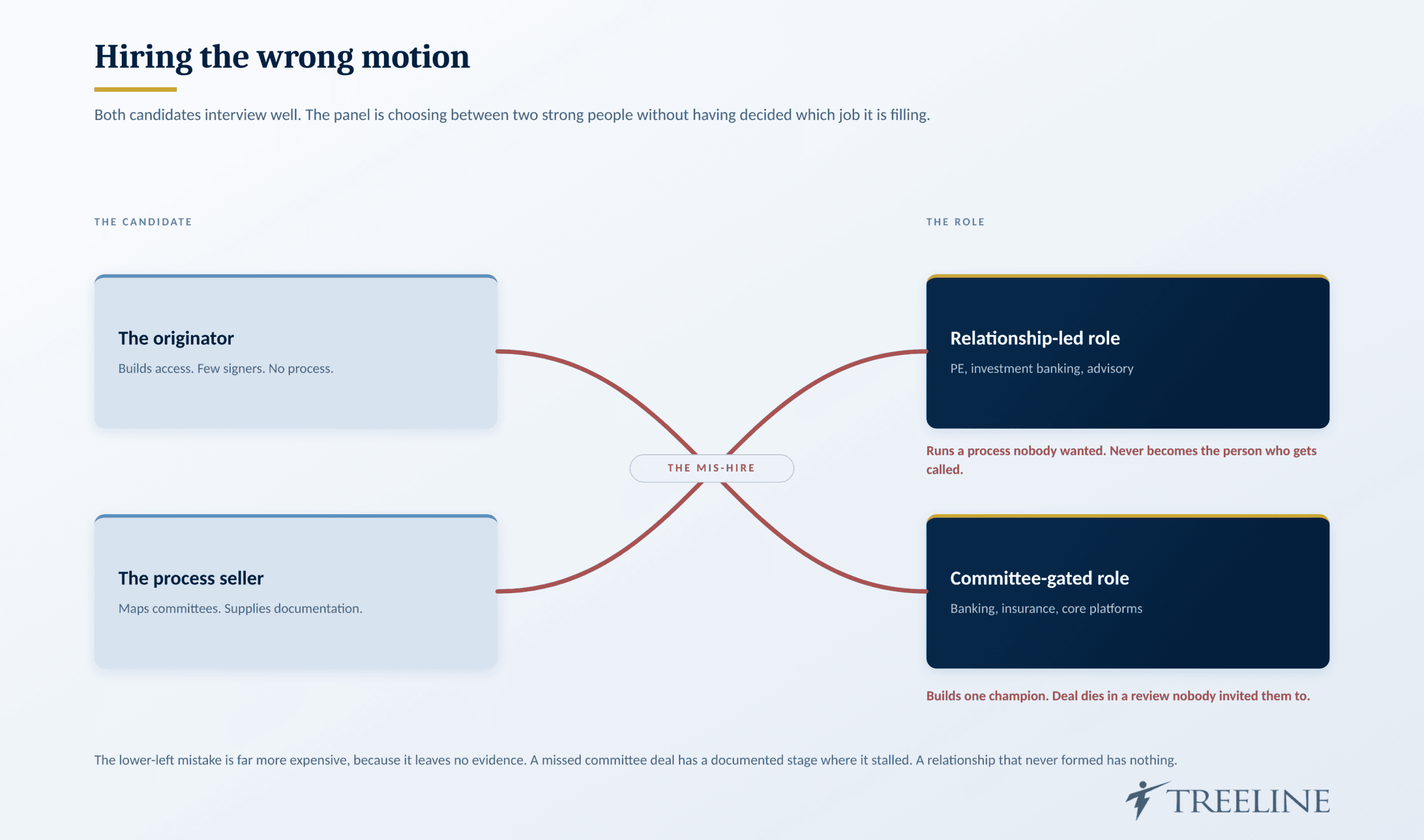
Put a relationship-led seller into a committee-gated role and they build one excellent champion relationship and stop. Everything they have ever done has worked that way. They are not being careless about the security questionnaire; they genuinely do not believe it decides anything, because in their experience it never has. The deal dies in a risk review they were not invited to, and the post-mortem concludes they lacked rigor.
Put a committee-gated seller into a relationship-led role and they run a process nobody asked for. They send the follow-up deck, propose the mutual action plan, and ask to map the decision-making unit at a firm where one person decides. The buyer finds this heavy and slightly odd. Nothing goes wrong dramatically; the seller simply never becomes the person who gets called, and after a year the pipeline is thin for reasons nobody can articulate.
The second failure is far more expensive because it is slower to detect. A missed committee deal leaves evidence, a documented stage where it stalled, a gate it did not clear. A relationship that never formed leaves nothing at all.
Fantasia’s observation from running searches across both halves is that the mis-assignment is almost never caught in interview, because both candidates interview well. The originator is warm and fluent. The process seller is organized and thorough. The panel is choosing between two strong people without having decided which job it is filling.
What Fintech Sales Recruiting Should Test for Each Motion
The interview differs because the available evidence differs.
For the relationship-led role, the question is how relationships began and what they produced without a transaction attached. Ask the candidate to describe someone they have known for five years who has sent them business more than once, and how that started. Ask what they did during the long stretches when that person needed nothing. Originators have specific answers, because the unpaid maintenance is the job. People describing someone else’s network give you a title and a firm and little else.
For the committee-gated role, walk one closed deal through every gate: who approved it, in what order, what each one wanted, and what the candidate supplied. People who have done this remember the security questionnaire and the third-party risk analyst, because those were the weeks that hurt. People who have not will describe the champion and stop.
For both, test domain vocabulary directly and early. Fifteen minutes with someone who knows the subsegment settles credibility faster than any structured interview, and it is the cheapest disqualifier available.
For both, separate built from inherited. For each major account, who made the first contact and what was already in place. Much of what reads as a seller’s relationship capital belongs to the employer, the reference customers, the security attestations, the regulatory history, and a candidate moving to a company without those starts with materially less than their record implies.
The stage to drop in both cases is the mock pitch. It tests preparation, which is not the constraint in either motion.
Where Fintech Sales Recruiting Finds Each Kind of Candidate
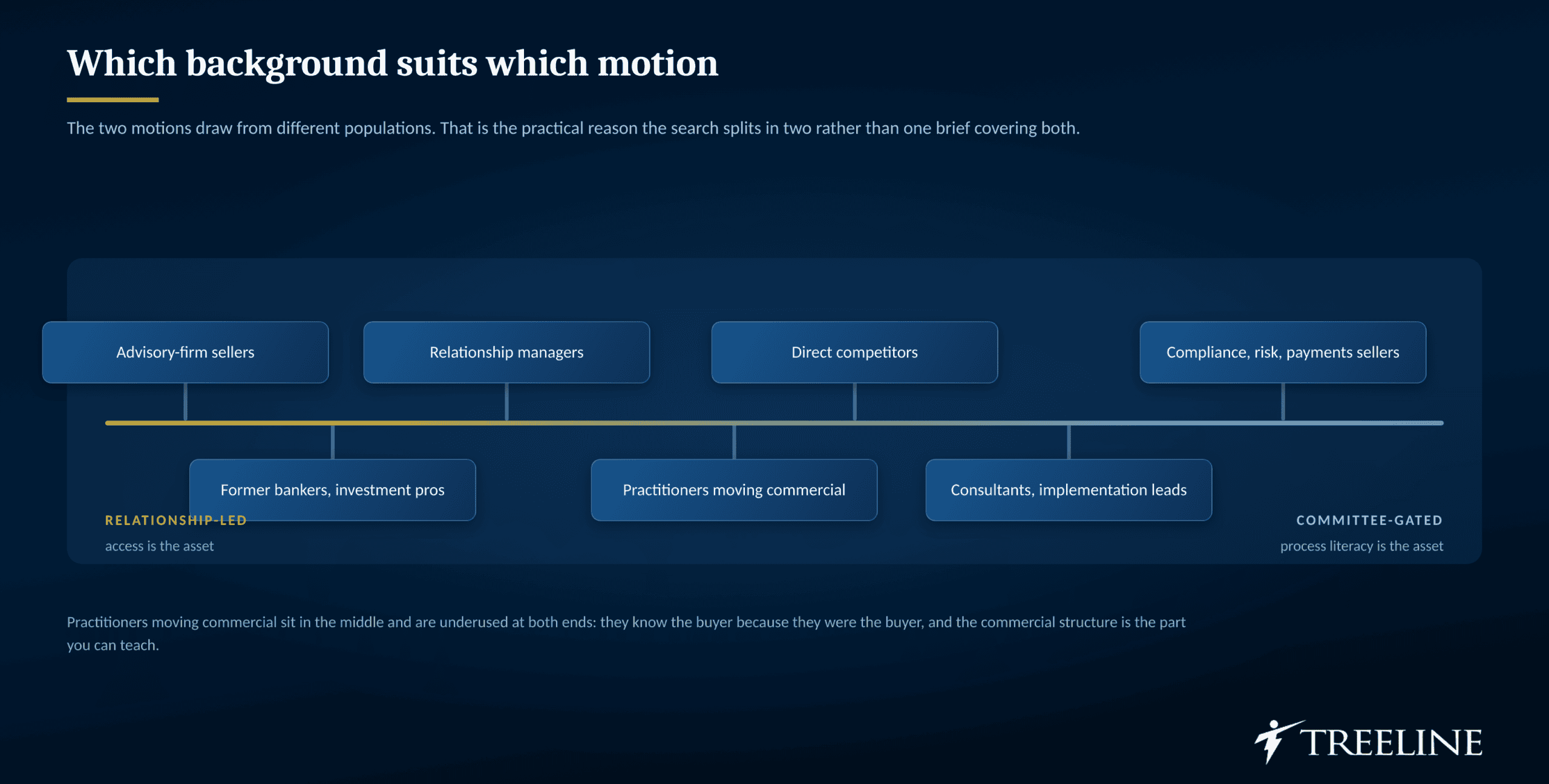
The two motions draw from substantially different populations, which is the practical reason the search splits in two.
For relationship-led roles, the strongest sources carry a network in the subsegment already: sellers at advisory firms, former bankers and investment professionals who moved commercial, and service-side relationship managers. Their asset is access, and access is the thing that cannot be taught quickly.
For committee-gated roles, the strongest sources are sellers from adjacent regulated categories, compliance technology, risk tooling, payments infrastructure, who bring process literacy and learn the product. Also consultants and implementation leads who have delivered these systems inside institutions and sat through the procurement, though many have never carried a number.
Useful to both, and underused in both: practitioners moving into sales. Former operations leaders and risk professionals know the buyer because they were the buyer. They need commercial structure and they arrive with credibility that no amount of onboarding produces.
Direct competitors serve either motion, with the caveat that this is where counteroffers concentrate and where the question of who actually owns the references matters most.
One consequence of the split is worth stating for anyone building a team rather than filling a seat. A company that genuinely sells into both halves needs both profiles, and should stop expecting either person to cover the other’s market. The usual compromise, hiring one versatile senior seller and asking them to do both, produces someone who does the motion they are good at and quietly neglects the other, which is indistinguishable from the territory simply not being worked.
Why the Contingency Model Suits Both Searches
Three characteristics hold across the split.
The population is identifiable but passive. Strong sellers in either motion are employed and not browsing postings, which makes this direct-approach work rather than volume work. A firm already operating in these buyer segments reaches them faster than an internal team starting cold, and a company paying on placement pays for that reach only when it produces a hire.
The roles are rarely confidential. Adding commercial capacity is not sensitive information, which removes the clearest argument for a retained engagement.
The brief sharpens during the search. Subsegment, seniority and domain requirements usually firm up once a company has met a few people and learned what the market contains, and a non-exclusive arrangement absorbs that without renegotiation.
The limit is worth naming. A head-of-sales appointment that will decide which motion the company pursues is a different search, with a smaller pool and a longer cycle, and the case for a retained engagement is stronger there. So is any search that must stay quiet because an incumbent is being replaced. Fantasia’s position has been consistent across market cycles: the arrangement follows the shape of the population and the sensitivity of the role, not the seniority printed on the business card.
What Fintech Sales Recruiting Asks of the Employer
Four decisions belong to the hiring company, and the first one is not optional.
Say which motion this is. Not the industry, the motion. If different stakeholders privately hold different answers, it surfaces at final-round debrief as disagreement about candidates, and resolving it then has already cost six weeks.
Name the subsegment. Capital markets, retail banking, insurance and private equity have different buyers and different reasons to decline. A company that cannot name one reads as a company that has not chosen.
Be honest about what the seller sells with. Security attestations, compliance documentation, named institutional references, regulatory history. In the committee half these are as much the product as the software is, and a candidate who finds out in month three that none of them exist has been mis-sold the role.
Set the ramp against the real cycle. A plan built on a six-month cycle in a market that runs twelve to eighteen produces a first year that reads as failure regardless of the hire. In the relationship-led half, the first year may produce no closed business at all while being entirely on track.
Reading the First Year
Judge each motion by its own early evidence, because the leading indicators are not the same.
In a committee-gated role: by week six, a mapped view of which gates exist at two or three target institutions and who owns them. By week twelve, one account through an early gate, a security questionnaire returned, a risk review scheduled. By the end of the second quarter, a pipeline with dates built from observed cycle length rather than from the plan.
In a relationship-led role: by week six, a named list of people worth knowing and a reason for each. By week twelve, conversations happening that have no transaction attached. By month six, at least one inbound, someone calling the seller rather than the reverse. That inbound is the clearest early signal this motion produces, and its absence at month nine is the one worth acting on.
The failure signatures differ too. In the committee half, deals stalling repeatedly at the same gate usually means the company lacks documentation rather than that the seller lacks skill. In the relationship half, a pipeline composed entirely of outbound-initiated conversations at month nine means the seller has not become someone the market calls.
In both halves the same mistake compounds: reading the absence of closed revenue as the absence of progress. The leading indicators above exist precisely because revenue is a lagging measure in markets where a cycle outlasts a probation period, and a company that has not agreed which indicators it will accept has set itself up to lose a working hire at month seven.
Frequently Asked Questions
Why does one vertical label cover two different sales jobs?
Because the label describes the buyer’s industry rather than how the buyer agrees to anything. In private equity, investment banking and advisory, a small number of people can decide and the sale was won in a relationship built long beforehand. In banking, insurance and core platform replacement, nobody can decide alone and the purchase has to clear risk, security, compliance and procurement.
How do we work out which motion our role is?
Ask who can say yes. If a deal can be agreed by one or two people who already know the seller, it is relationship-led. If it has to pass third-party risk review and procurement before anyone signs, it is committee-gated. The answer determines the profile, the quota, the ramp and the interview.
What happens if we hire the wrong one?
Each direction fails differently. A relationship-led seller in a committee role builds one champion and watches deals die in reviews they were not invited to. A committee-gated seller in a relationship role runs a process nobody wanted and never becomes the person who gets called. The second is far more expensive because it leaves no evidence until the year is over.
Why does the mis-assignment not show up in interview?
Because both candidates interview well. The originator is warm and fluent, the process seller is organized and thorough, and a panel that has not settled which job it is filling will simply prefer whichever style it finds more appealing that week.
What is the single best question for a relationship-led candidate?
Ask about someone they have known for five years who has sent them business more than once, how that began, and what they did during the long stretches when that person needed nothing. The unpaid maintenance is the job, so genuine originators answer in detail. People describing someone else’s network offer a title and a firm.
Does experience in one part of financial services transfer to another?
Less than it appears. Capital markets, retail banking, insurance and private equity have different buyers, cycles and objections. Someone fluent with trading operations is not automatically credible with a chief risk officer at a regional bank, and assuming they are puts a capable hire a year behind.
How should the ramp differ between the two motions?
In the committee half it has to carry the seller through a cycle that may exceed a year, and should recognize gates cleared rather than only revenue. In the relationship half the first year may produce nothing closed while being completely on track, because the asset being built is access rather than pipeline.
Nothing has closed by month six. Is that a problem?
Not necessarily, but what should exist by then differs. In a committee role, expect gates mapped and at least one account through an early one. In a relationship role, expect conversations with no transaction attached, and ideally one inbound, someone calling the seller. Absence of that inbound by month nine is the signal worth acting on.
Decide Which Motion You Are Hiring For, Then Open the Search
Most searches in this vertical are specified by industry and staffed by instinct. “Financial services” gets written into the brief, two stakeholders privately mean two different markets with two opposite buying processes, and the panel spends six weeks disagreeing about people when it is actually disagreeing about the job.
Ask who can say yes. Write down what a deal has to clear before anyone signs. Name the subsegment. Then run the search that matches the answer, because the two profiles overlap far less than the shared job title suggests.
Share This Story, Choose Your Platform!
Related Posts


What our happy clients are saying
Treeline Inc. provided us with the most candidates that aligned with our needs and were of the highest quality.

Dr. Jeffrey Klein Head of North America Sales, Satchel Pulse
Treeline Inc.’s collaborative, flexible, and communicative approach resulted in a smooth partnership. Beyond their recruitment expertise, their unique sourcing model was efficient and effective.

Sera Holt Director of Operations, LNS Research
Their professionalism was outstanding. Treeline Inc. was extremely thorough and ensured that we were on the same page before they started looking for candidates. They listened to us and did a great job working with the candidate to close out the process.

Cate Grant AVP Customer Success, Nasdaq
Thanks to Treeline Inc.’s intricate and thorough screening process, the company is able to hire six high-quality candidates that fit perfectly in the company’s culture. The team is highly receptive to concerns, and internal stakeholders are impressed with their unique recruitment abilities.

Anna McKean Sales Recruiter, Insider Intelligence
Treeline Inc. has been qualified individuals throughout a five-year-long engagement. They’ve made numerous placements of talented and qualified individuals for our business.

Michele St Laurent VP of HR, The Institute for Applied Network Security

Let Us Help You Source the Sales Talent You Need
Whether you’re building a team or replacing a key role, our Candidate Sourcing Platform provides a fast, flexible, and employer-focused solution.
Tell us more about your business and how we can help.
Treeline Inc.
Your Award-Winning Sales Recruitment Partner
15 Lincoln Street, Suite 314, Wakefield, MA 01880