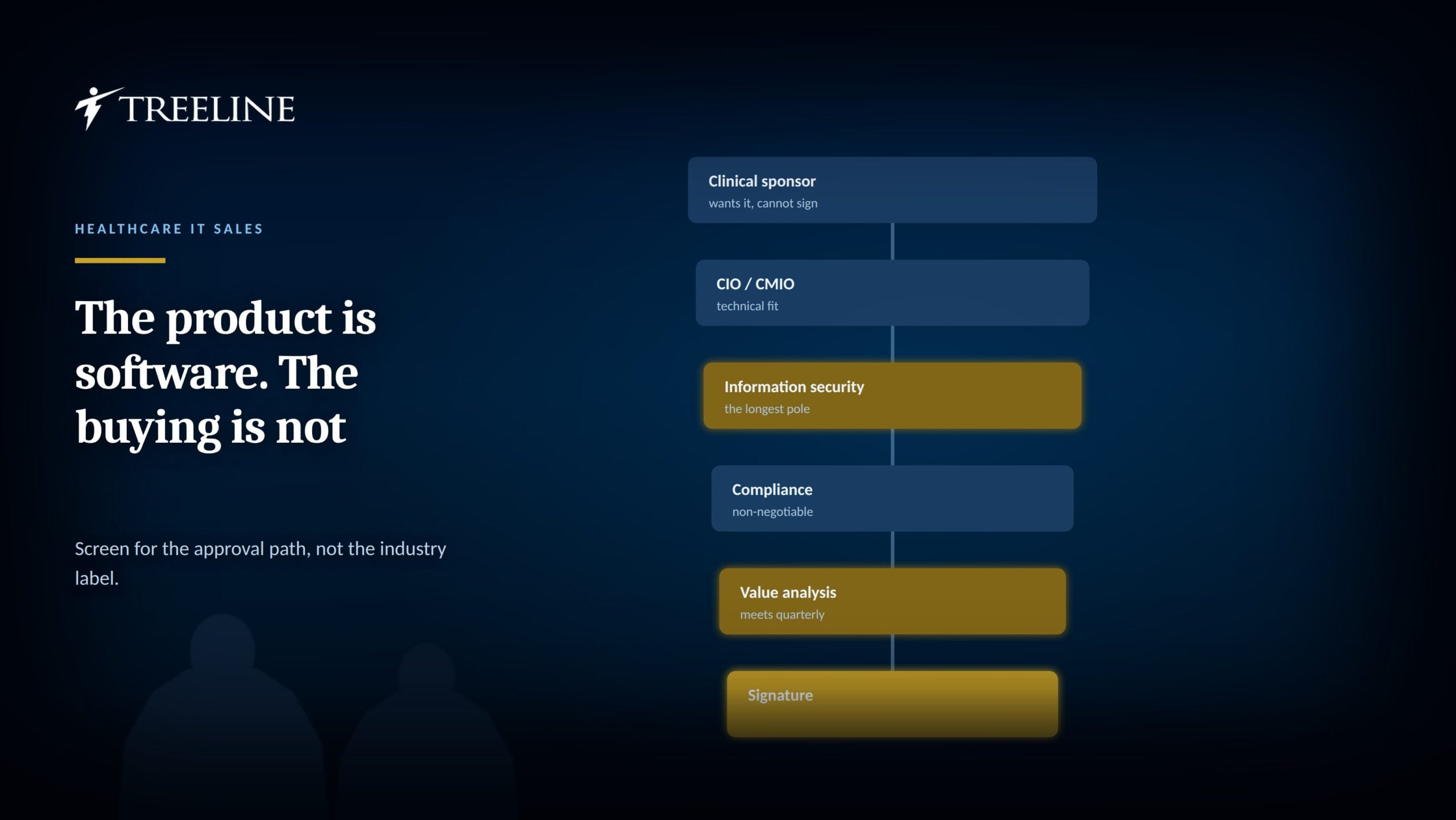
Selling software into a hospital system is not selling software. The product may be enterprise SaaS, but the buying process belongs to healthcare: a clinical sponsor who cannot sign, an IT department that can veto, a security review that runs months, a compliance requirement that is not negotiable, and a committee that meets quarterly.
A candidate who has run enterprise software deals elsewhere understands the first half of that and almost none of the second. Most companies run this search under a contingency sales recruiting arrangement, no fee unless you hire, which suits a requirement where the real question is whether a specific kind of experience exists in the market at your price, and where the firm’s willingness to say it does not is worth more than its database. Treeline sets out that standard in its own approach.
Dan Fantasia, CEO of Treeline, Inc., treats vertical sales hiring as a question about the buyer rather than about the product. From his perspective a candidate’s industry label matters far less than whether they have personally sat in front of the specific committee that will decide your deal.
What Healthcare IT Sales Recruiting Is Actually Screening For
The phrase covers several distinct buyers, and the distinction matters more than the shared label suggests.
Provider-side means hospitals and health systems. The buying unit includes clinical leadership, the chief information officer, information security, compliance, and often a value analysis committee. Cycles run nine to eighteen months and the clinical sponsor is an influencer rather than a signer.
Payer-side means insurers and managed care. The vocabulary is actuarial and regulatory rather than clinical, and the buyer behaves more like financial services than like a hospital.
Life sciences IT means systems sold to pharmaceutical and biotech organizations. Different again, and frequently confused with provider-side by people who have not sold into either.
A requirement that says healthcare without naming the side is describing three different candidate pools. That is the first thing to settle, and it is usually settled in the first ten minutes of an intake conversation that nobody scheduled.
Why Healthcare IT Sales Recruiting Cannot Rely on Enterprise Experience Alone
The gap is specific rather than general, and it shows up in four places.
The security review. Health systems run longer and more adversarial security assessments than almost any other buyer. A seller who has not managed one will under-forecast by a quarter and will be surprised by questions their product team cannot answer quickly.
The procurement vehicle. Group purchasing organizations, integrated delivery network contracts and state agreements shape what is possible before any seller is involved. Someone who does not know which vehicle applies will design a deal that cannot be bought.
The clinical sponsor problem. The person who wants the product usually cannot authorise it, and the person who can authorise it does not feel the problem. Managing that gap is the central skill, and it does not exist in most commercial software sales.
Implementation reality. A health system that has lived through a difficult electronic record implementation will interrogate your deployment plan harder than your feature set. Sellers who cannot speak credibly about implementation lose on risk rather than on product.
What does transfer is the enterprise motion itself, multi-stakeholder orchestration, long cycles, business cases, procurement negotiation. That is why a strong enterprise seller from another regulated industry often converts better than a healthcare seller from a transactional product.
Fantasia resists requirements that specify an industry without specifying a deal shape. His objection is that industry is the easiest thing to screen for and the least predictive, while deal shape is harder to screen for and explains most of the variance in who succeeds.
Where This Sits Against Medical Device and Life Sciences
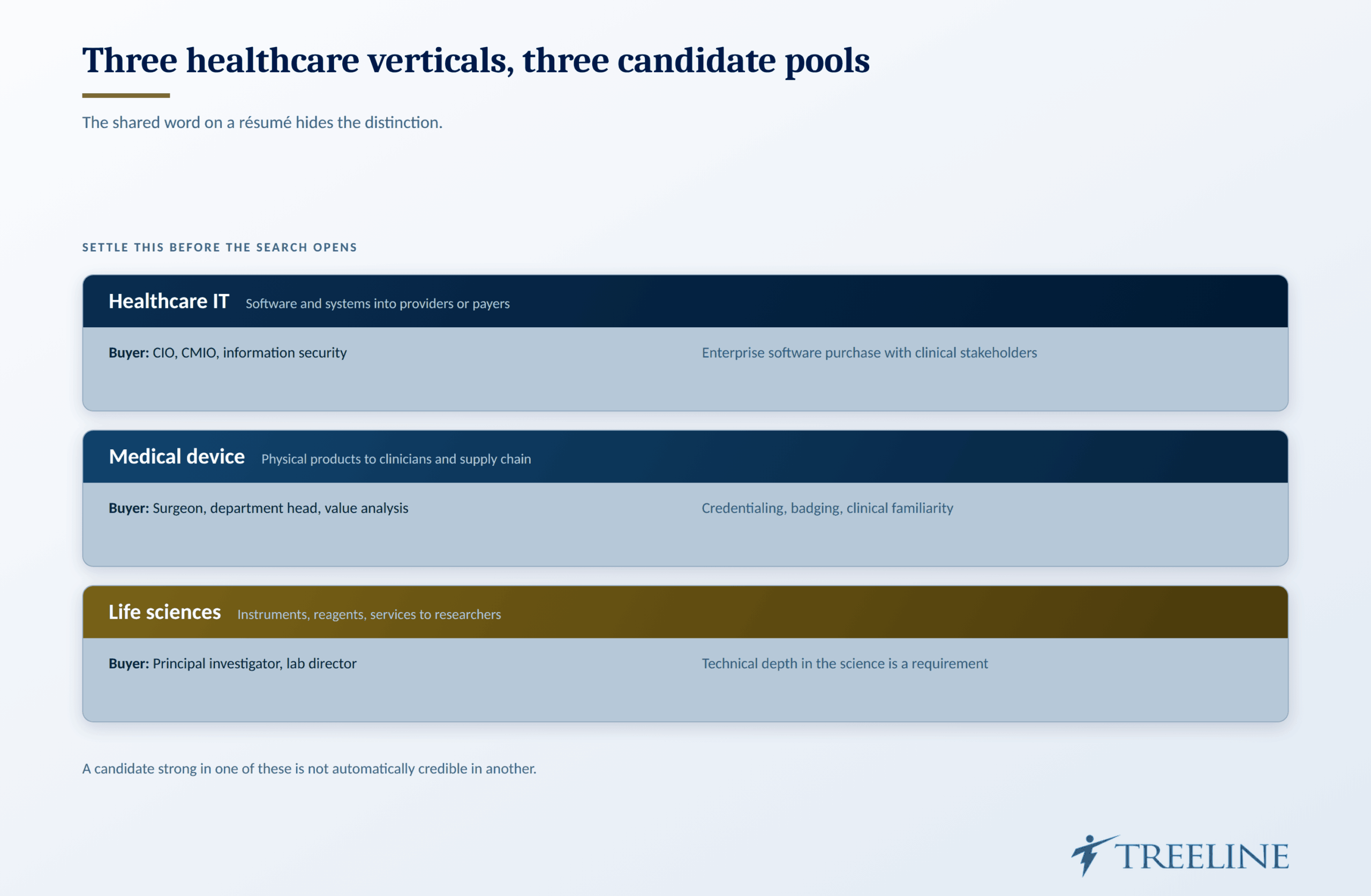
Three healthcare-adjacent sales roles get conflated during intake, and they are different hires with different candidate pools.
Healthcare IT sells software and systems into providers or payers. The buyer is the chief information officer, the chief medical information officer and information security, and the deal is an enterprise software purchase with clinical stakeholders attached.
Medical device sells physical products to clinicians and supply chain. The buyer is a surgeon or department head, the gate is a value analysis committee, and the seller is frequently in the room where the product is used. Credentialing, vendor badging and clinical familiarity matter in a way they do not for software.
Life sciences sells instruments, reagents or services to researchers in pharmaceutical and biotech organizations. The buyer is a principal investigator or lab director, and technical depth in the science is a hiring requirement rather than a preference.
A candidate strong in one of these is not automatically credible in another, and the shared word healthcare on a résumé hides the distinction. Establishing which of the three you are hiring for is the first scoping decision, and it changes the candidate pool entirely.
What to Test For in Healthcare IT Sales Recruiting
The résumé will say healthcare. The questions below establish what that actually meant.
Name the committee. Ask them to describe the approval path on their largest deal, by role. A candidate who has sold provider-side will name clinical leadership, information security, compliance, and the committee by its actual function. A candidate who has not will describe a champion and a budget holder.
The security review. What was asked, what delayed it, and what they did while it ran. This is the single most reliable separator, because it cannot be answered convincingly from the outside.
The deal they lost on risk. Everyone selling into health systems has lost one to implementation concern or incumbent inertia rather than to product. The ability to describe it specifically indicates real exposure.
Procurement vehicle literacy. Which contract vehicles their deals went through, and what that changed about pricing or timeline.
Reference pattern. In healthcare, peer reference between systems carries unusual weight. Ask how they used existing customers to open new accounts, because the sellers who do this well have a structural advantage that transfers to you.
Fantasia’s test on vertical candidates is whether they can describe the buyer’s own pressures without prompting, reimbursement, staffing, consolidation. He reads fluency there as evidence of genuine time in the market, and its absence as evidence that the industry on the résumé was a territory label rather than a specialism.
Where Healthcare IT Sales Recruiting Finds Candidates
The population is identifiable and smaller than the title count suggests.
Competing and adjacent healthcare IT vendors are the obvious pool, and the value is the approval-path knowledge rather than the relationships, which are less portable than in other industries.
Electronic record vendors and their implementation partners produce candidates who understand provider environments deeply. Some are looking to move from a dominant platform to something they can shape.
Health system employees occasionally convert, people who sat on the buying side and know the committee from inside. They need commercial support but they are credible immediately.
And strong enterprise sellers from other regulated industries convert more often than expected, particularly from financial services, where the security and compliance posture is comparable.
All four are employed and not applying, which is the practical case for contingency recruiters who work the vertical rather than advertising.
The Compliance Line a Seller Must Not Cross
One characteristic of this vertical has no equivalent in general enterprise software, and candidates should be assessed on their awareness of it.
Health systems operate under patient-privacy obligations that extend to vendors. A seller who treats a demo environment casually, who asks a clinical contact to share screens containing patient data, or who is loose about what gets stored in a customer relationship system, creates exposure for both sides. Experienced healthcare sellers know this instinctively and will mention it unprompted; sellers new to the vertical frequently do not know the boundary exists.
The practical interview question is simple: ask what they would do if a prospective customer offered to show them live data to illustrate a workflow problem. The right answer involves redirecting to a de-identified or demo environment. A candidate who sees no issue has told you something useful.
This is not an exotic risk. It is routine, it arises in discovery conversations rather than in contracting, and it is one of the few areas where a seller’s inexperience can create a problem the company cannot easily unwind.
Why Contingency Search Fits This Vertical
Three characteristics of the role make the structure appropriate.
The qualified population is genuinely small. A requirement combining provider-side experience, enterprise deal size, a specific geography and a realistic band may contain a few dozen people nationally. A firm that charges only on placement absorbs the risk that the intersection is empty, which is a real possibility worth discovering cheaply.
The requirement frequently needs correcting. Companies routinely open these searches asking for healthcare experience when what they need is enterprise discipline plus the willingness to learn the approval path, or the reverse. That discovery is worth more than most of what a search produces.
And the role is not confidential. There is no structural reason to pay for exclusivity.
What Makes the Population So Small
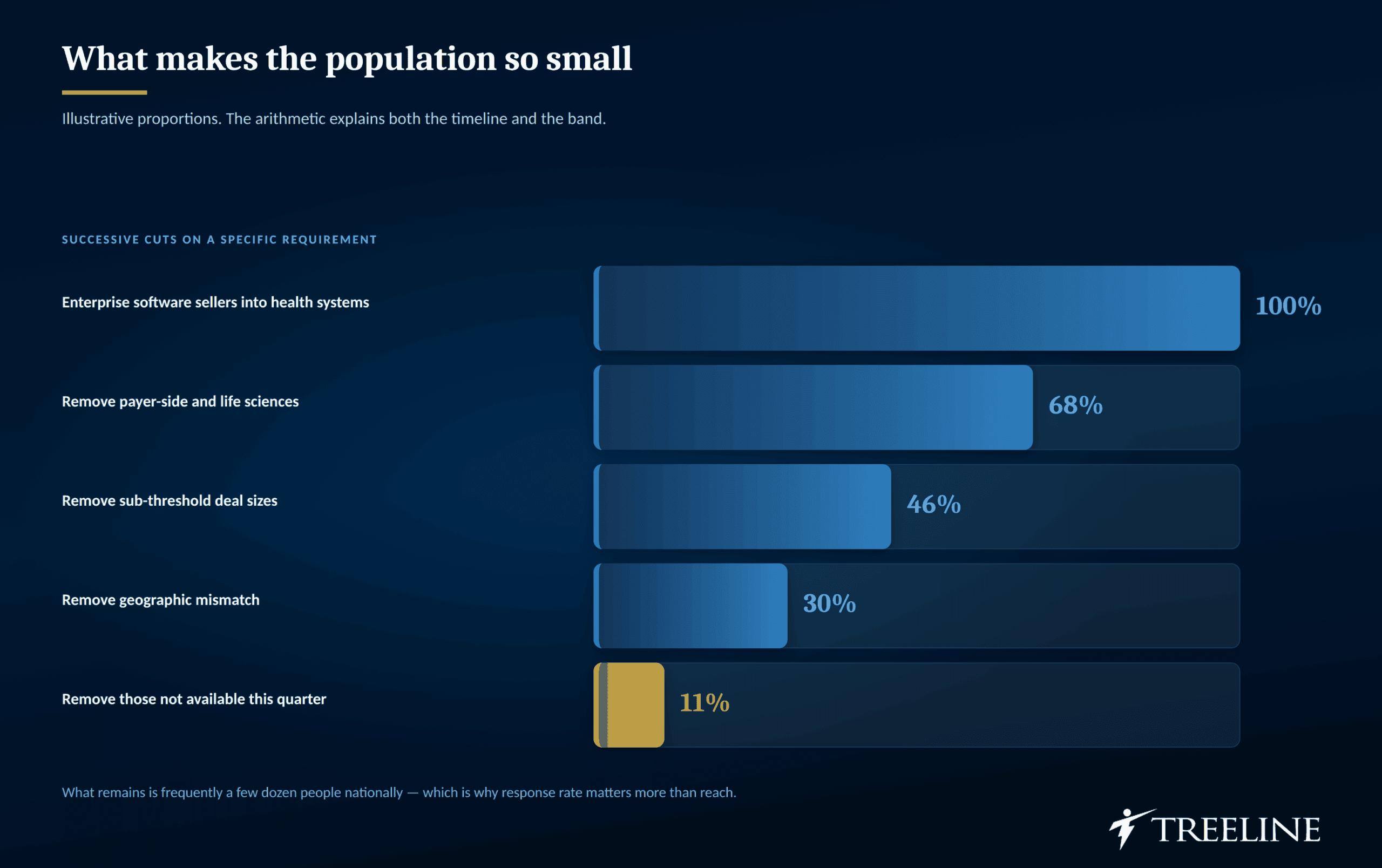
It is worth being explicit about the arithmetic, because it explains both the timeline and the compensation.
Start with people selling enterprise software into health systems. Remove those selling to payers or life sciences, which is a different buyer. Remove those whose deals were under the threshold where security review and committee approval apply, since they have not run the process that matters. Remove those whose geography does not match, which matters more here than in most verticals because health system relationships are regional. Then remove the majority who are performing and not available this quarter.
What remains for a specific requirement is frequently a few dozen people nationally rather than a few hundred. That is not a reason for pessimism; it is the reason response rate matters more than reach, and the reason a firm’s existing standing with those particular people determines the outcome more than any database.
It is also why the band deserves examining before the search rather than after three declines. A profile this narrow does not price against general enterprise software, and a company that discovers this in week six has spent the weeks when the best candidates were available.
What the Employer Controls
Three things sit inside the company and determine the outcome more than the search does.
A realistic band for a scarce profile. The intersection described above commands a premium. A band set against general enterprise software compensation will produce a search that cannot close, and the honest version of that conversation belongs at intake.
Reference customers the candidate can use. Healthcare buyers rely on peer validation. A seller joining a company with no named provider references is starting from a materially harder position, and strong candidates will ask.
An implementation story that survives scrutiny. If the deployment record is thin or troubled, the seller will meet it in every deal. Candidates should hear that during the process rather than discovering it in month three.
Reading the First Year After Healthcare IT Sales Recruiting
Cycles here run long enough that revenue is a poor first-year measure, and the useful signals arrive earlier.
By the end of the first quarter, the question is whether they have mapped an approval path at a real account, named roles, named committee, named security requirements. A seller who cannot produce that has not got far enough into an account.
By six months, the signal is whether security review has started anywhere. It is the longest pole and the one that proves a deal is real.
At twelve months, closed business becomes meaningful, and so does the shape of the pipeline: a seller with three well-qualified late-stage opportunities is in better condition than one with twelve early ones.
Fantasia’s caution on long-cycle verticals is that the first-year review arrives before the evidence does. He suggests agreeing the interim measures at offer stage, because a company that has not done so will fall back on revenue at month twelve and conclude the wrong thing about a seller who is two quarters from a good year.
Frequently Asked Questions
What does healthcare IT sales recruiting actually screen for?
Primarily the approval path. Provider-side deals involve clinical leadership, the chief information officer, information security, compliance and often a value analysis committee, with the clinical sponsor acting as influencer rather than signer. Screening should establish whether a candidate has personally navigated that, not whether their résumé says healthcare.
Can a strong enterprise software seller move into healthcare IT?
Often, and sometimes better than a healthcare seller from a transactional product. The enterprise motion transfers; what does not is security review experience, procurement vehicle literacy, and managing the gap between the clinical sponsor who wants it and the executive who can authorise it. Financial services backgrounds convert particularly well.
What single question separates candidates fastest?
Asking them to describe the security review on their largest deal, what was asked, what delayed it, what they did while it ran. It cannot be answered convincingly by someone who has only sold adjacent to healthcare.
Is provider-side experience the same as payer-side?
No, and conflating them is the most common scoping error. Provider means hospitals and health systems with clinical buyers. Payer means insurers, where the vocabulary is actuarial and regulatory and the buyer behaves more like financial services. Life sciences IT is a third pool again.
Why does contingency search suit this vertical?
Because the qualified population is genuinely small, a requirement combining provider-side experience, enterprise deal size, geography and a realistic band may contain a few dozen people nationally. A fee payable only on placement means the employer discovers cheaply whether that intersection exists.
What does the employer need to have in place?
A band set for a scarce profile rather than against general enterprise software, named provider reference customers the seller can use for peer validation, and an implementation story that survives scrutiny. Candidates should hear the honest version of the third during the process.
How long are the cycles?
Provider-side deals commonly run nine to eighteen months, with security review the longest single stage. This is why first-year reviews should look at approval-path mapping and whether security review has started, rather than at closed revenue.
How do we judge the hire before revenue arrives?
At one quarter, whether they can produce a mapped approval path at a real account with named roles and security requirements. At six months, whether a security review has begun anywhere. At twelve months, closed business plus pipeline shape, three well-qualified late-stage opportunities beats twelve early ones.
Settle Which Side of Healthcare You Are Hiring For
Treeline, Inc. is a sales-only executive search firm based in Wakefield, Massachusetts, working exclusively on building sales organizations. Our contingency sales recruiting service carries no upfront cost and no fee unless you hire, and we deliver your first candidate within three days of launching a search.
If you are opening a healthcare IT sales role, the useful first conversation is whether you are selling to providers, payers or life sciences organizations. Get in touch and we will work through the approval path before anyone looks at a candidate.
Share This Story, Choose Your Platform!
Related Posts
What our happy clients are saying
Treeline Inc. provided us with the most candidates that aligned with our needs and were of the highest quality.

Dr. Jeffrey Klein Head of North America Sales, Satchel Pulse
Treeline Inc.’s collaborative, flexible, and communicative approach resulted in a smooth partnership. Beyond their recruitment expertise, their unique sourcing model was efficient and effective.

Sera Holt Director of Operations, LNS Research
Their professionalism was outstanding. Treeline Inc. was extremely thorough and ensured that we were on the same page before they started looking for candidates. They listened to us and did a great job working with the candidate to close out the process.

Cate Grant AVP Customer Success, Nasdaq
Thanks to Treeline Inc.’s intricate and thorough screening process, the company is able to hire six high-quality candidates that fit perfectly in the company’s culture. The team is highly receptive to concerns, and internal stakeholders are impressed with their unique recruitment abilities.

Anna McKean Sales Recruiter, Insider Intelligence
Treeline Inc. has been qualified individuals throughout a five-year-long engagement. They’ve made numerous placements of talented and qualified individuals for our business.

Michele St Laurent VP of HR, The Institute for Applied Network Security

Let Us Help You Source the Sales Talent You Need
Whether you’re building a team or replacing a key role, our Candidate Sourcing Platform provides a fast, flexible, and employer-focused solution.
Tell us more about your business and how we can help.
Treeline Inc.
Your Award-Winning Sales Recruitment Partner
15 Lincoln Street, Suite 314, Wakefield, MA 01880