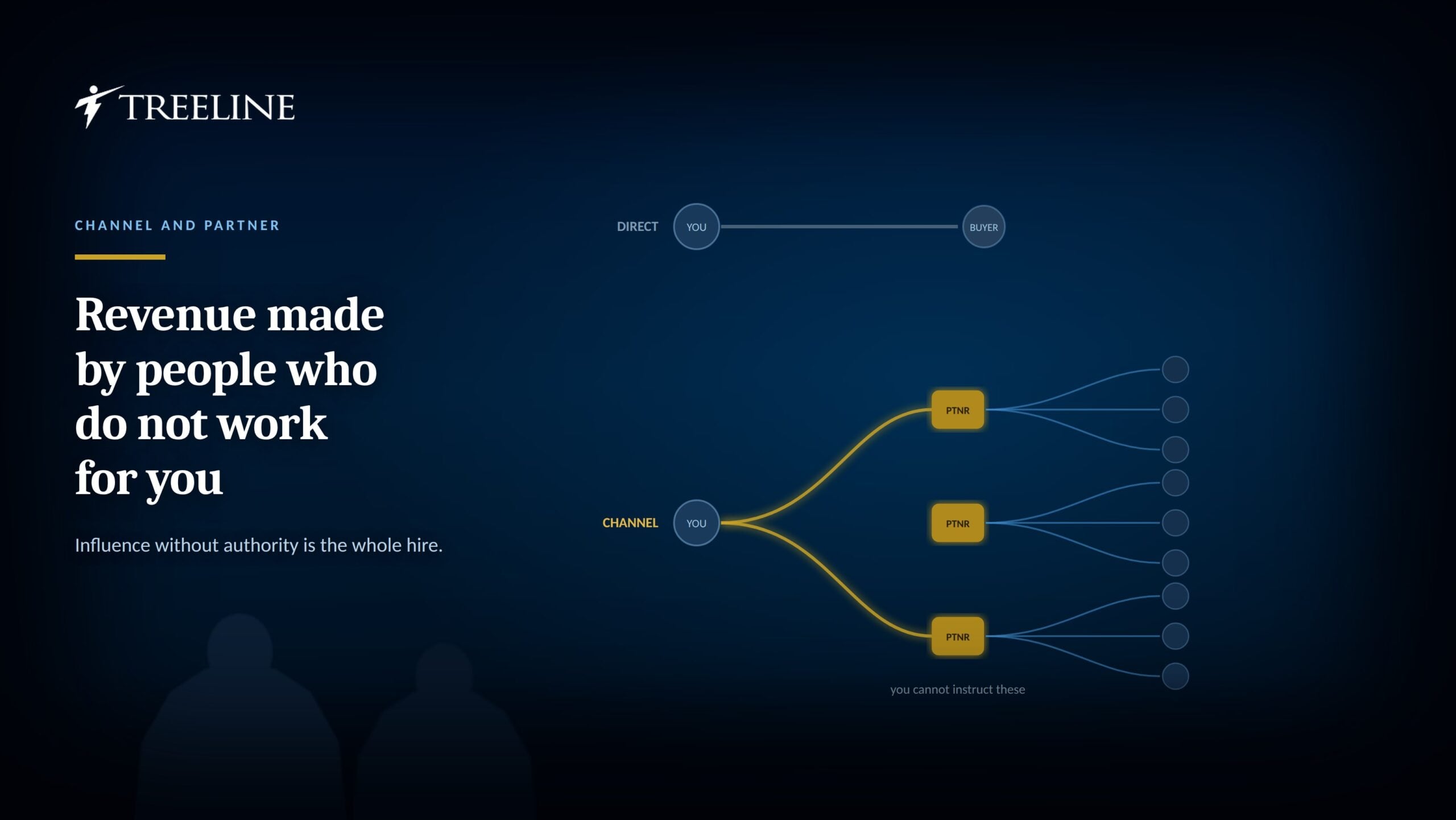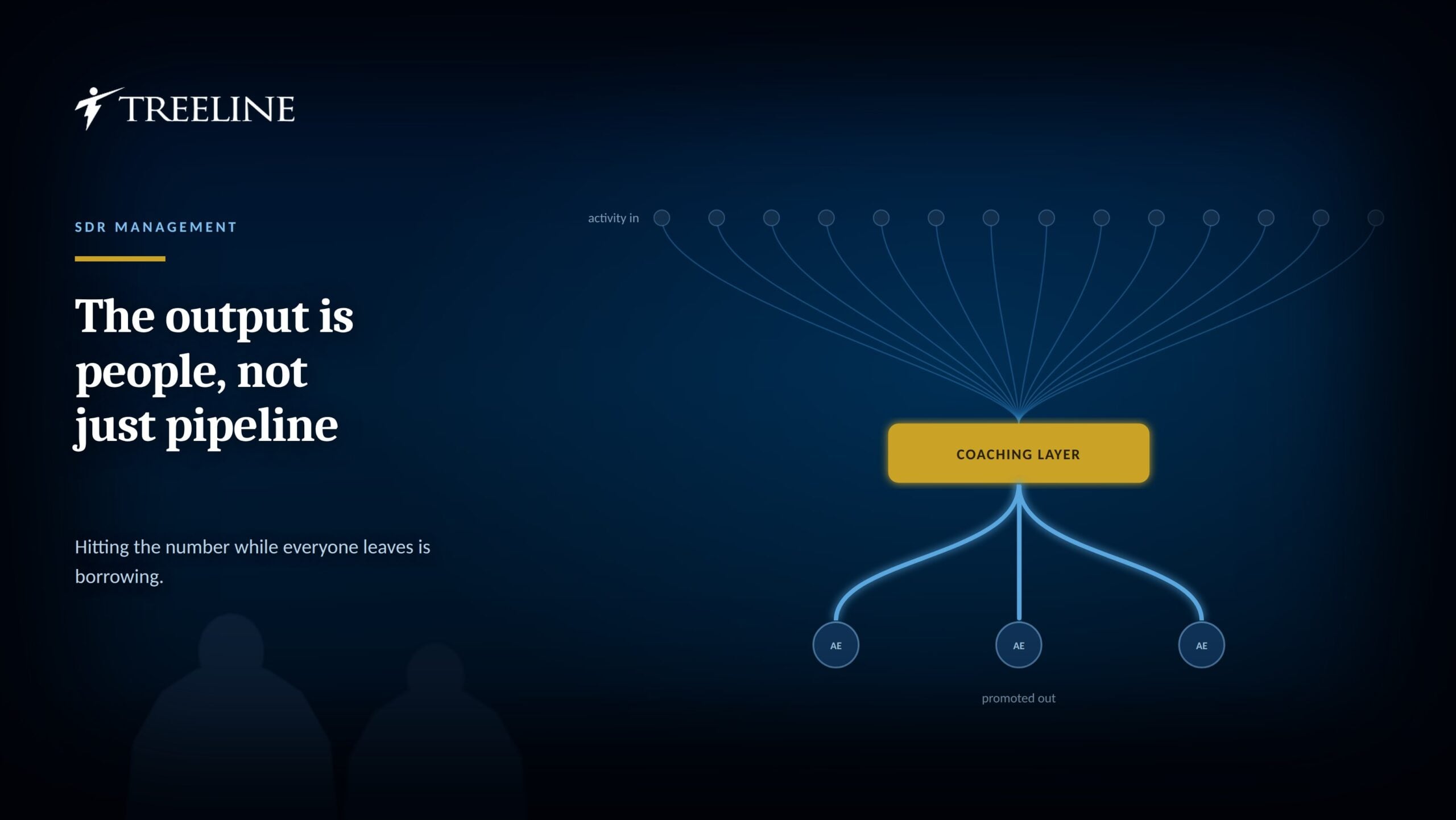
An SDR manager is not a junior version of a sales manager. The team is larger, newer, and turns over faster. The work is coaching volume rather than coaching complexity. And the real output is two things at once: qualified pipeline this quarter, and the next generation of account executives next year.
That second output is the one most companies forget to hire for, and it is the one that compounds. A manager who hits pipeline targets while every SDR leaves at month ten has produced a number and consumed a talent pipeline. Most companies run this search under a contingency sales recruiting arrangement, where the fee is payable only on a hire, a structure that fits a role many organizations are filling for the first time, and one that sits naturally within a growth-stage hiring strategy.
Dan Fantasia, CEO of Treeline, Inc., assesses this role on what happened to the people rather than on what happened to the number. From his perspective an SDR manager’s record is best read through how many of their team were promoted and how many left, because those two figures are harder to inherit than a pipeline target.
What SDR Manager Recruiting Is Actually Hiring For
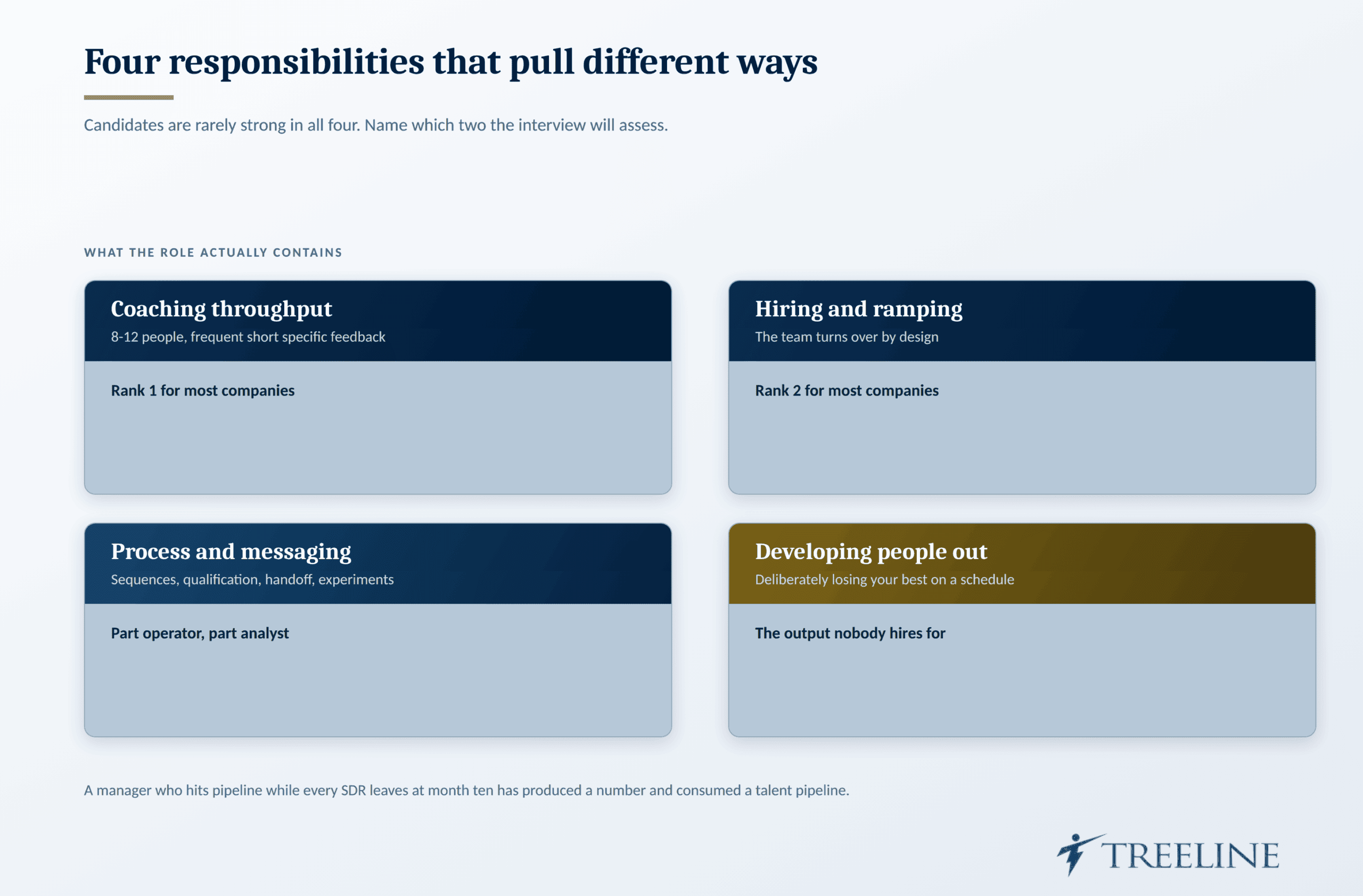
The job is divided into four responsibilities that pull in different directions, and candidates are rarely strong in all four.
Coaching throughput. Eight to twelve people, mostly early in their careers, each needing frequent, short, specific feedback on calls and messaging. This is high-frequency work and it does not resemble the deal-strategy coaching an AE manager does.
Process and messaging. Owning the sequences, the qualification criteria, the handoff definition to account executives, and the experiments that improve conversion. Part operator, part analyst.
Hiring and ramping. SDR teams turn over by design, people are promoted out or they leave, so the manager is almost permanently recruiting and onboarding. A manager who cannot hire well will spend their year understaffed.
Developing people out of the role. Preparing SDRs for promotion into closing roles, which means the manager is deliberately losing their best people on a schedule.
A requirement that lists all four without ranking them produces a shortlist strong in different pairs. Most companies need coaching throughput and hiring first.
Fantasia’s objection to the four-way requirement is that it describes an ideal rather than a job. His practical suggestion is to name which two will be assessed in the interview and tell candidates, since the ones who are strong in the other two will self-select out rather than discover the mismatch in month four.
The Metrics the Manager Actually Owns
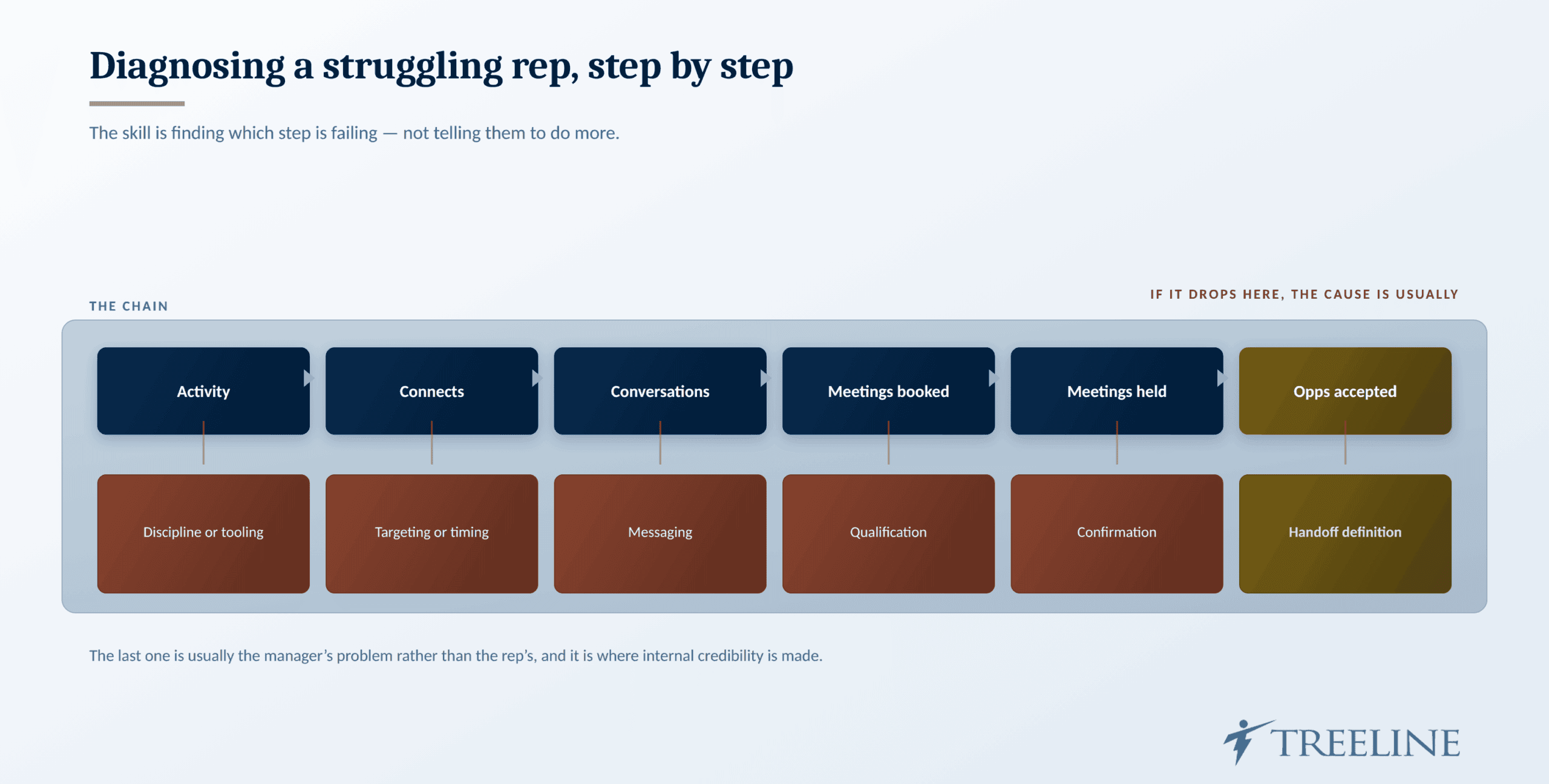
Being specific about the operating cadence helps, because it is the clearest practical difference from managing closers and the thing candidates are most readily tested on.
The chain runs: activity, connects, conversations, meetings booked, meetings held, opportunities accepted. Each step has a conversion rate, and an SDR manager’s real skill is diagnosing which step a struggling rep is failing at rather than telling them to do more.
A rep with low activity has a discipline or a tooling problem. A rep with high activity and low connects has a targeting or a timing problem. Good connect rates with poor conversation-to-meeting conversion is a messaging problem. Meetings booked that do not get held is a qualification or a confirmation problem. And meetings held that account executives reject is the handoff definition, which is usually the manager’s problem rather than the rep’s.
That diagnostic sequence is learnable and it is not what an account executive spends their time on. Asking a candidate to walk through it with a specific example is the fastest way to establish whether they have managed the function or merely sat above it.
Why SDR Manager Recruiting Rarely Succeeds With a Strong AE
The substitution is common and fails for structural reasons rather than for lack of effort.
An account executive succeeded by closing deals personally. SDR management succeeds through volume of small corrections across many people, almost none of which the manager performs themselves. The instinct to take over the call, which serves an AE well, produces an SDR team that never develops.
The metrics are also different in kind. AEs are measured on outcomes that arrive quarterly. SDR management runs on weekly leading indicators: connects, conversations, meetings booked, meetings held, conversion to opportunity. A manager who cannot work comfortably in that cadence will manage by month-end panic.
And the people are different. SDRs are frequently in their first or second professional role. They need management that is closer to teaching than to performance conversation, and a manager who has only led experienced sellers often finds the required patience unfamiliar.
The inverse case is worth naming: a strong SDR manager is not automatically ready to manage AEs. The skills overlap less than the org chart suggests.
What SDR Manager Recruiting Should Test For
The standard interview asks about quota attainment, which on this role is close to meaningless because team size and territory quality dominate it.
Promotion record. How many of their SDRs became account executives, and where are those people now? This is the single most predictive question and the hardest to fabricate.
Regretted attrition. Who left that they wanted to keep, and why. Every SDR manager has losses; the useful signal is whether they can diagnose them specifically.
Coaching mechanics. Ask exactly what they listen for on a call review and what they would say to a rep whose connect rate is fine but whose conversion is poor. Vague answers about activity indicate a manager who inspects rather than develops.
A messaging experiment they ran. What they changed, what happened, and whether they kept it. This separates people who executed a sequence somebody else wrote from people who improved one.
The handoff. How they defined a qualified meeting and how they resolved disagreement with account executives about quality. This is where most SDR functions break and where the manager’s internal credibility is made.
Fantasia reads the handoff answer as a test of political capability rather than process design. In his account the managers who last are the ones who can hold a quality standard against account executives who want more meetings, and that is a negotiation skill rather than an operational one.
Fantasia singles out regretted attrition as the question that most often changes his view of a candidate. His reasoning is that pipeline numbers can be inherited from a well-built team, while the ability to explain precisely why a good person left cannot.
Where SDR Manager Recruiting Finds Candidates
The population is identifiable and mostly not looking.
Senior SDRs and team leads at companies one stage ahead are the largest pool. Many are informally coaching already and are blocked because the manager above them is not moving.
Existing SDR managers at companies going through disruption, a pivot, an acquisition, a leadership change, are receptive for reasons unrelated to your opportunity, and timing rather than persuasion determines whether you reach them.
Account executives who genuinely want to manage form a third pool, and the qualifier matters. The ones who moved because they wanted to develop people work out; the ones who moved because closing was not going well do not.
Sales enablement and training people occasionally convert well, since the coaching instinct is already there, though they usually need support on the metrics side.
All four are employed and not applying, which is the practical argument for working through contingency recruiters who hold relationships in the function rather than advertising the role.
Why the Contingency Model Fits This Search
Three characteristics of the role make the structure appropriate.
The requirement is frequently first-of-kind, many companies are appointing a dedicated SDR manager for the first time, having run the team under a sales director or a founder. The specification changes during the search as the company works out whether it is buying coaching capacity or process ownership. Under an arrangement that charges only on placement, that discovery costs nothing.
The population is reachable and the search is not confidential, so exclusivity buys little.
And the role may correctly not be filled. Below about five SDRs, a dedicated manager is often premature, and the honest conclusion is to wait. A firm paid only on placement absorbs the cost of reaching it.
Compensation and Why It Is Awkward
Paying an SDR manager is harder than it looks, and the common structures produce predictable distortions.
Paying heavily on meetings booked produces volume and a quality argument with account executives within a quarter. Paying on opportunities accepted is better aligned but introduces a lag and a dependency on AE behaviour the manager only partly controls. Paying on closed revenue from SDR-sourced pipeline is the most aligned and the least motivating, because the feedback arrives two or three quarters later.
A workable structure weights opportunities accepted as the primary variable, with a smaller component on a retention or promotion measure. The second part is unusual and worth including, because it is the only way the deferred output, developing people into closing roles, appears in the compensation at all.
What does not work is paying the manager on the same plan as their reps. It makes them a senior SDR with a bigger number, and the coaching work loses to personal production for the same reason it does in any player-coach arrangement.
What Has to Exist Before the Hire
An SDR manager cannot create the conditions for their own success, and three preconditions matter most.
An agreed definition of a qualified meeting. Without it, the manager spends their year arbitrating disputes between their team and the account executives, and the SDRs learn that the standard depends on who complains.
A promotion path with real examples. SDRs join expecting to move into closing roles. If nobody has, the manager is recruiting against a promise the company has not kept, and candidates will discover this during their own interviews.
Enough team to manage. Three SDRs is not a management job. The manager will end up prospecting personally, which is the SDR equivalent of the player-coach problem and resolves the same way: the individual work wins.
When the Answer Is Not a Manager
Two situations produce the symptoms of needing an SDR manager and are solved differently.
The first is a team that is too small. Below roughly five reps there is not enough coaching work to fill a role, and the appointed manager will prospect personally to stay busy. The honest remedy is a senior SDR with a team-lead element and a defined point at which the role becomes a management job.
The second is a definitional problem wearing management clothing. If account executives are rejecting meetings and nobody has written down what qualified means, the function is generating conflict that no amount of coaching resolves. That is an afternoon of agreement between sales leadership and the SDR function, and hiring a manager to arbitrate it institutionalises the dispute instead of settling it.
Distinguishing them is straightforward: if the problem is that reps are not improving, the span is real. If the problem is that nobody agrees what good output looks like, a hire will mask it.
Reading the First Year After SDR Manager Recruiting
Because the outputs are partly deferred, the review needs both immediate and lagging measures.
In the first quarter, look at whether the leading indicators have become reliable rather than whether they improved. A manager who has established what the team actually does each week has done the first piece of work.
By six months, conversion from meeting booked to opportunity accepted is the honest measure, because it captures quality rather than activity and it is the number account executives care about.
At twelve months, the two questions that matter are how many SDRs were promoted and how many regretted departures occurred. A team that hit pipeline targets and lost everyone has borrowed from next year.
Frequently Asked Questions
How is SDR manager recruiting different from hiring a sales manager?
The team is larger, newer and turns over faster, and the work is coaching volume rather than deal complexity. An SDR manager also carries a second output most companies forget to hire for: developing people into closing roles. Assessment should test coaching mechanics and promotion record rather than quota attainment.
Should we promote a strong SDR or hire an experienced manager?
Promoting works when the process already exists and the gap is purely management skill. Hire externally when nobody internally has built a sequence, defined a handoff, or hired at volume. Do not promote purely on personal performance, look for evidence of informal coaching.
Can a strong account executive run an SDR team?
Sometimes, and the qualifier is why they want it. AEs who moved because they wanted to develop people tend to work out; those who moved because closing was going badly do not. The instinct to take over the call serves an AE well and produces an SDR team that never develops.
What does a strong SDR manager interview surface?
Promotion record, regretted attrition and whether they can diagnose it, specific coaching mechanics on a call review, a messaging experiment they ran and kept, and how they defined a qualified meeting and handled disagreement with account executives about quality.
What must be in place before an SDR manager starts?
An agreed definition of a qualified meeting, a promotion path with real examples of people who moved into closing roles, and enough team to constitute a management job. Below about five SDRs a dedicated manager is usually premature.
Why is a contingency arrangement a good fit for SDR management?
The requirement is often first-of-kind and changes during the search, the population is reachable and the role is not confidential, and a meaningful share of these searches should end with the company concluding the team is too small yet. A fee payable only on placement puts that uncertainty on the firm.
How do we judge the hire at twelve months?
By how many SDRs were promoted into closing roles and how many regretted departures occurred, alongside conversion from meeting booked to opportunity accepted. A team that hit pipeline targets while everyone left has produced a number and consumed a talent pipeline.
When is it too early to hire a dedicated SDR manager?
Below roughly five SDRs. The manager will end up prospecting personally to fill the time, and the individual work will win over the coaching work, the same dynamic that makes an under-scoped player-coach arrangement fail.
Decide Which Two Responsibilities Matter First
Treeline, Inc. is a sales-only executive search firm based in Wakefield, Massachusetts, working exclusively on building sales organizations. Our contingency sales recruiting service carries no upfront cost and no fee unless you hire, and we deliver your first candidate within three days of launching a search.
If you are opening an SDR management role, the useful first conversation is about how many of your SDRs have been promoted into closing roles. Get in touch and we will tell you plainly if the role is not ready yet.
Share This Story, Choose Your Platform!
Related Posts


What our happy clients are saying
Treeline Inc. provided us with the most candidates that aligned with our needs and were of the highest quality.

Dr. Jeffrey Klein Head of North America Sales, Satchel Pulse
Treeline Inc.’s collaborative, flexible, and communicative approach resulted in a smooth partnership. Beyond their recruitment expertise, their unique sourcing model was efficient and effective.

Sera Holt Director of Operations, LNS Research
Their professionalism was outstanding. Treeline Inc. was extremely thorough and ensured that we were on the same page before they started looking for candidates. They listened to us and did a great job working with the candidate to close out the process.

Cate Grant AVP Customer Success, Nasdaq
Thanks to Treeline Inc.’s intricate and thorough screening process, the company is able to hire six high-quality candidates that fit perfectly in the company’s culture. The team is highly receptive to concerns, and internal stakeholders are impressed with their unique recruitment abilities.

Anna McKean Sales Recruiter, Insider Intelligence
Treeline Inc. has been qualified individuals throughout a five-year-long engagement. They’ve made numerous placements of talented and qualified individuals for our business.

Michele St Laurent VP of HR, The Institute for Applied Network Security

Let Us Help You Source the Sales Talent You Need
Whether you’re building a team or replacing a key role, our Candidate Sourcing Platform provides a fast, flexible, and employer-focused solution.
Tell us more about your business and how we can help.
Treeline Inc.
Your Award-Winning Sales Recruitment Partner
15 Lincoln Street, Suite 314, Wakefield, MA 01880