The best sales executive recruiter to hire an Executive Vice President of Sales is a specialist who understands how senior sales strategy becomes consistent execution through regional leaders, frontline managers, account teams, sales operations, and enablement. An EVP of Sales typically operates between company-level commercial strategy and the daily management of the sales organization.
The executive may report to the CEO, President, Chief Revenue Officer, or Chief Sales Officer while leading several layers of sales management. That position makes the EVP of Sales search distinct from recruiting a frontline Vice President of Sales, an individual business-unit leader, or a C-suite revenue executive. The recruiting firm must determine whether candidates have built management systems, improved forecasting, allocated territories, developed senior sales leaders, enforced pipeline standards, and produced repeatable performance across multiple teams.
Employers should not begin the search by requesting executives from a list of well-known companies. They should begin by defining the operating problems the EVP must solve and the leadership system the business needs. Dan Fantasia, CEO of Treeline, Inc., consistently emphasizes that growing companies need a scalable revenue engine rather than additional sales headcount alone.
Applied to an EVP of Sales search, that means finding a leader who can convert strategy into management discipline, talent decisions, operating rhythms, and repeatable execution throughout the sales organization.
Why a Sales Executive Recruiter Matters for EVP of Sales Hiring
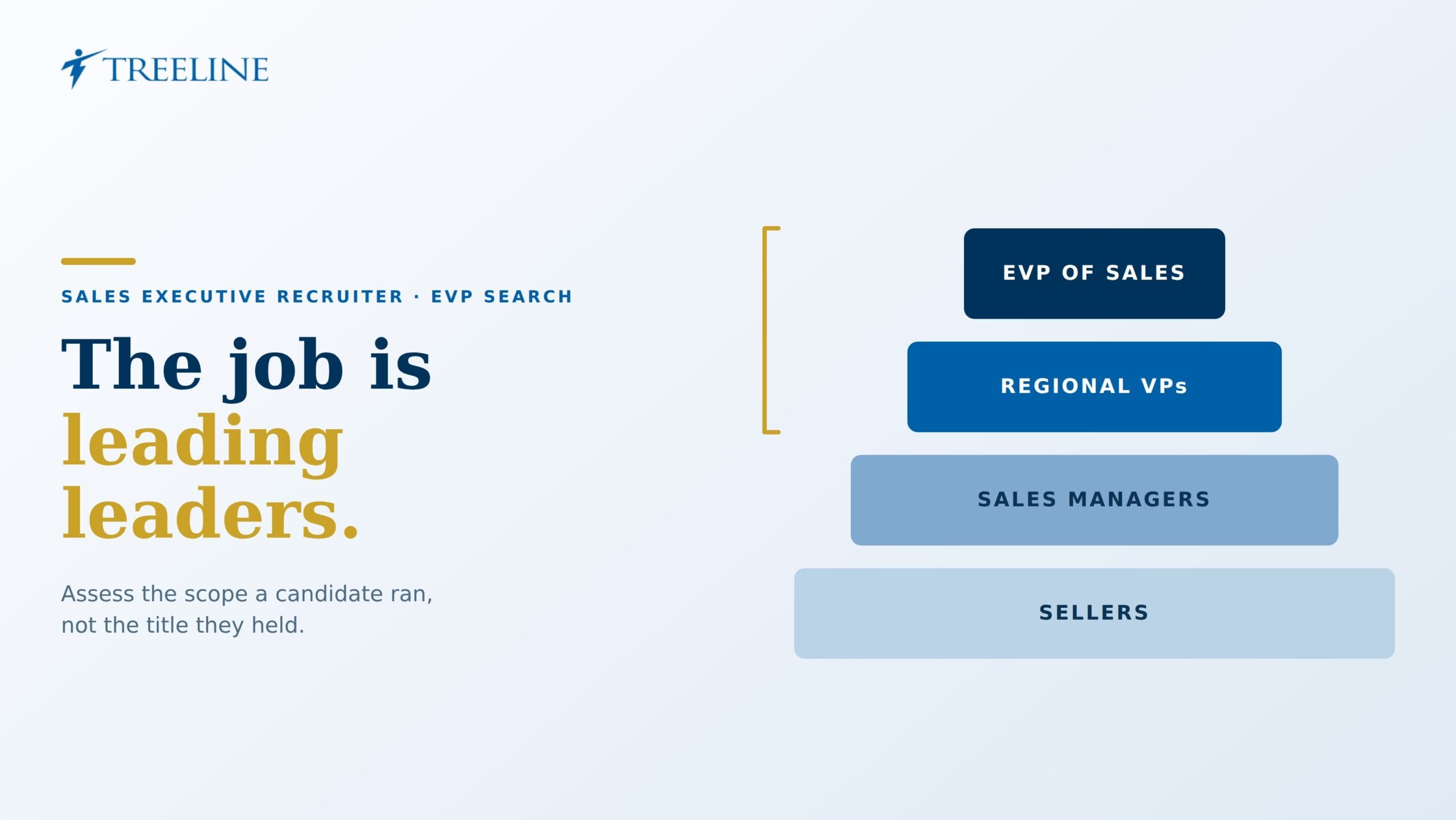
An EVP of Sales may oversee several geographic regions, customer segments, product lines, sales channels, or business units. The executive is often responsible for leading other senior sales leaders rather than managing individual sellers directly. This requires a different assessment process from the one used for a regional manager or Vice President of Sales.
The U.S. Bureau of Labor Statistics identifies sales-management responsibilities such as establishing goals, analyzing sales data, preparing budgets, monitoring customer preferences, resolving issues, and directing sales teams. An EVP of Sales performs these activities at greater organizational scale and may coordinate several sales-management layers simultaneously.
The recruiter should be able to evaluate whether a candidate can:
- Translate corporate growth goals into sales plans
- Lead regional and functional sales executives
- Establish a consistent sales-management system
- Improve forecasting across several teams
- Allocate headcount and resources
- Redesign territories and account coverage
- Strengthen enterprise pipeline execution
- Develop future sales executives
- Coordinate sales with marketing, finance, operations, and customer success
- Communicate risks and performance to the CEO or CRO
- Maintain consistency without eliminating local market judgment
A generalist recruiter may identify candidates with the correct title. A specialized recruiter should determine whether the executive has operated at the scale, complexity, and organizational level required by the employer.
Define the EVP of Sales Mandate Before Recruiting Candidates
The title Executive Vice President of Sales does not have one universal definition. In one company, the EVP may be the highest-ranking sales executive and report directly to the CEO. In another, the EVP may report to a CRO or CSO and lead several regional Vice Presidents. In a large enterprise, the EVP may own one major segment, geography, or product portfolio.
The hiring committee must clarify:
- Who the EVP reports to
- Which leaders report to the EVP
- Which regions, segments, products, or channels the role owns
- Whether the executive controls sales operations
- Whether enablement reports to the EVP
- Whether channel partnerships are included
- Whether customer expansion is included
- Whether the EVP owns strategic accounts
- How much authority the executive has over compensation and territories
- Which decisions require CRO, CEO, or board approval
- What must improve during the first 12 months
A vague mandate creates an inconsistent candidate market. For example, an executive who has led a global sales organization may be overqualified for a position that primarily manages one regional team. A successful regional VP may not be ready to lead several senior sales executives. A candidate who has worked under a powerful CRO may not have personally owned sales strategy.
The recruiter should convert the title into a clear operating assignment before beginning outreach.
Questions That Clarify the EVP of Sales Position
The search partner should ask:
- Why is the company creating or replacing this role?
- What sales responsibilities currently belong to the CEO, CRO, or CSO?
- Which responsibilities should move to the EVP?
- How many leadership layers will the executive manage?
- Which regions, segments, or channels require the most attention?
- Is the current strategy effective but inconsistently executed?
- Does the company need stronger sales managers?
- Is forecasting reliable across the organization?
- Are territories and quotas aligned with market opportunity?
- What decisions will the EVP be authorized to make?
- Which results must improve within the first year?
- What organizational changes will be necessary for the EVP to succeed?
The answers determine the appropriate candidate level and search strategy.
EVP of Sales Versus CSO, CRO, SVP, and VP of Sales
Employers should define how the EVP fits within the existing executive structure.
EVP of Sales Versus Chief Sales Officer
A Chief Sales Officer is generally the company’s highest-ranking sales executive and may participate directly in C-suite and board decisions. An EVP of Sales may hold comparable responsibilities in some companies, but in others the role reports to the CSO and translates the CSO’s strategy into operating execution across divisions or regions.
The practical difference is authority, scope, and reporting structure, not title prestige.
EVP of Sales Versus Chief Revenue Officer
A CRO may oversee the complete revenue lifecycle, including marketing, sales, customer success, renewals, expansion, revenue operations, and partnerships. An EVP of Sales normally focuses more directly on sales leadership, new-business execution, management systems, pipeline governance, territories, quotas, and talent.
A company should not recruit a broad revenue executive if the real need is stronger sales execution.
EVP of Sales Versus Senior Vice President of Sales
The EVP title often indicates broader enterprise authority or responsibility for several senior leaders. An SVP may still have an enterprise-wide role, particularly in organizations that do not use the EVP title. The recruiter must assess actual scope rather than relying on title hierarchy alone.
EVP of Sales Versus Vice President of Sales
A Vice President of Sales may manage a geography, product line, customer segment, or complete sales function in a smaller company. An EVP usually manages greater organizational complexity and may lead multiple VPs. The recruiting firm should determine whether candidates have already demonstrated the ability to lead leaders, allocate resources across competing priorities, and maintain consistency across several sales teams.
What a Sales Executive Recruiter Must Understand About the Sales Model
The sales executive recruiter should understand the company’s sales system before defining the candidate profile. That includes:
- Ideal customer profile
- Market segmentation
- Customer buying process
- Average contract value
- Sales-cycle duration
- Enterprise and mid-market coverage
- Transactional and consultative selling
- Geographic structure
- Product or solution complexity
- Direct and indirect channels
- New-business and expansion responsibilities
- Strategic-account coverage
- Sales development model
- Management layers
- Sales operations capacity
- Enablement resources
- Forecasting methodology
- Compensation structure
- Current productivity and ramp expectations
An EVP who succeeded in a centralized domestic sales organization may struggle with a global matrix structure. A candidate from an established brand may not know how to create demand in an emerging category. A leader accustomed to experienced regional VPs may not have demonstrated the ability to develop first-time managers.
The recruiter should compare operating environments rather than company reputations. Fantasia’s perspective is particularly relevant here: candidate evaluation should identify what the executive personally changed, not simply what happened while that person held the title. Employers need to know which managers were developed, which processes were redesigned, how accountability improved, and whether performance remained stable after the executive moved on.
Build an EVP of Sales Success Scorecard
A strong search begins with measurable first-year outcomes. Broad qualities such as “strategic,” “collaborative,” and “results-oriented” are insufficient unless they are translated into observable evidence. Potential outcomes include:
- Establish one consistent sales-management operating rhythm across all regions.
- Improve forecast reliability and executive visibility.
- Upgrade regional and frontline sales leadership.
- Clarify roles between the EVP, CRO, CSO, and regional executives.
- Redesign territories and account assignments.
- Improve enterprise pipeline inspection.
- Standardize qualification and deal-review practices.
- Align compensation with strategic priorities.
- Create a succession plan for sales leadership.
- Improve coordination between sales, marketing, finance, and customer success.
- Reduce dependence on the CEO or CRO in major deals.
- Build a repeatable plan for sales hiring and management development.
Each outcome should describe the current condition and expected improvement. For example, “improve sales management” is too broad. A more useful outcome would be: “Establish consistent weekly inspection, coaching, forecasting, and performance-management standards across four regional sales teams while preserving appropriate local market flexibility.” This formulation gives the recruiter specific evidence to test.
How Sales Leadership Recruiters Map EVP Candidates
Sales leadership recruiters should not limit the candidate market to sitting EVPs. Relevant candidates may include:
- Executive Vice Presidents of Sales
- Senior Vice Presidents of Sales
- Global Heads of Sales
- Presidents of major sales-led divisions
- Chief Sales Officers from smaller organizations
- Regional Presidents with substantial sales ownership
- Senior commercial leaders responsible for several sales functions
- Vice
Presidents who already manage multiple VPs or regions The recruiter must determine whether the candidate has already operated at the required level, even if the title differs. Candidate-market mapping should consider:
- Number of management layers
- Size of the sales organization
- Geographic reach
- Customer segments
- Deal complexity
- Sales-cycle length
- Product breadth
- Channel structure
- Company stage
- Ownership model
- Leadership quality inherited
- Growth or turnaround conditions
- Decision authority
Direct competitors may be relevant, but they should not define the complete search. Adjacent industries may produce candidates with stronger experience in global expansion, enterprise selling, channel development, sales transformation, or multi-region leadership. The recruiter should explain why each target company belongs in the search universe.
Assess Whether the Candidate Can Lead Sales Leaders
The most important transition into an EVP role is often the shift from managing sellers to managing senior leaders. The candidate should demonstrate how they have:
- Selected regional and divisional VPs
- Set expectations for senior sales leaders
- Inspected performance without micromanaging
- Resolved disagreements among executives
- Standardized critical processes
- Preserved regional market judgment
- Replaced leaders when necessary
- Developed internal successors
- Managed performance across different leadership styles
- Built trust while maintaining accountability
The recruiter should ask candidates to describe actual leadership situations. For example:
- A regional VP was achieving revenue targets but creating high turnover. What action did you take?
- Two divisions used different qualification standards. How did you establish consistency?
- A senior leader repeatedly missed forecasts but retained strong internal support. How did you respond?
- A newly promoted VP struggled to manage former peers. What coaching and accountability did you provide?
- A high-performing region resisted a company-wide process. How did you determine whether the process or the region needed to change?
Strong candidates explain their diagnosis, decision, communication, and result. Weak candidates rely on abstract leadership language.
Evaluate the EVP’s Sales Operating System
An EVP of Sales should establish an operating system that allows the organization to execute consistently. That system may include:
- Weekly forecast reviews
- Pipeline inspection
- Deal-risk reviews
- Manager coaching standards
- Monthly performance reviews
- Quarterly business reviews
- Talent reviews
- Territory and capacity reviews
- Compensation governance
- Hiring priorities
- Cross-functional planning
- Executive reporting
The recruiter should determine whether the candidate built these systems or merely participated in them. A strong candidate should explain:
- Which meetings were necessary
- Who attended
- What decisions were made
- Which information was required
- How accountability was documented
- What happened when leaders did not follow the process
- How the system changed as the company scaled
The goal is not to create more meetings. It is to establish decision-making rhythms that improve visibility, coordination, and execution.
Assess Forecasting and Pipeline Leadership
Forecasting at the EVP level requires consistency across several sales teams. The executive should understand how to establish:
- Shared sales stages
- Qualification standards
- Forecast categories
- Manager inspection
- Deal-risk definitions
- Close-date discipline
- Pipeline-coverage expectations
- Escalation procedures
- Executive communication
- Coordination with finance
The recruiter should ask candidates to provide examples of forecast problems they inherited. Useful questions include:
- How accurate was the forecast when you entered?
- Which behaviors caused the greatest distortion?
- How did different regional leaders interpret forecast categories?
- What changes did you make to manager inspection?
- How did finance use the new forecast?
- Which metrics improved?
- What resistance did you encounter?
- How did you prevent managers from simply lowering expectations?
Forecast improvement should reflect changes in behavior and decision quality, not only a new reporting tool.
Evaluate Regional and Global Sales Leadership
An EVP may need to balance enterprise standards with local market realities. The recruiter should assess experience involving:
- Regional sales models
- International expansion
- Local hiring conditions
- Market-specific pricing
- Partner ecosystems
- Language and cultural differences
- Regulatory constraints
- Geographic territories
- Centralized versus decentralized decision-making
- Regional leadership development
Candidates should explain how they determined which practices had to be standardized and which could vary. For example, qualification criteria may need consistency across the company, while channel strategy may differ materially by region. An executive who imposes one model without understanding local markets may damage performance.
An executive who permits every region to operate independently may eliminate visibility and accountability. The EVP must establish clear boundaries.
Assess Sales Talent Architecture and Succession
An EVP of Sales should build the leadership and talent structure required for future growth. That includes:
- Determining required management layers
- Defining leadership roles
- Hiring regional and functional VPs
- Developing frontline managers
- Identifying successors
- Establishing promotion criteria
- Reviewing performance and potential
- Coordinating with human resources
- Planning for expansion
- Addressing leadership gaps before they become urgent
Fantasia’s view is that recruiting should be connected to the complete sales system. Hiring additional sellers without capable managers, defined territories, effective onboarding, and clear performance expectations may increase cost without improving results. The search should therefore assess whether the EVP candidate can create a talent roadmap rather than react to isolated vacancies.
Assess Compensation, Territories, and Resource Allocation
The EVP may influence decisions involving:
- Sales compensation
- Quotas
- Accelerators
- Territory design
- Account ownership
- Headcount
- Management ratios
- Sales capacity
- Strategic-account coverage
- Enablement investment
- Sales operations support
The recruiter should test whether candidates understand the consequences of these decisions. A compensation plan focused only on bookings may encourage discounting or poor customer fit. Equal territories may still be inequitable when market potential differs. Adding headcount may not improve growth when management capacity or pipeline is insufficient.
Candidates should provide examples of tradeoffs they made. Questions can include:
- When did you decide not to add headcount?
- How did you evaluate territory potential?
- What behavior did the compensation plan unintentionally reward?
- How did you resolve account-ownership disputes?
- How did you allocate resources among regions?
- What information did you require before approving a new team?
Evaluate Cross-Functional Executive Leadership
The EVP must work with other executives without attempting to control every revenue-related function. Important relationships may include:
- CEO
- President
- CRO
- CSO
- CMO
- CFO
- CHRO
- Customer success leader
- Product leader
- Operations leader
- Revenue operations leader
The recruiter should assess how the candidate handles disagreement. Examples include:
- Marketing believes pipeline volume is sufficient, but sales questions lead quality.
- Finance challenges the sales hiring plan.
- Customer success reports that sales expectations are creating poor-fit customers.
- Product prioritizes features that sales does not consider commercially urgent.
- The CEO continues to intervene in large opportunities.
- Regional leaders resist centralized enablement or operations standards.
The EVP should be able to distinguish healthy executive debate from destructive functional conflict.
How Executive Recruiting Firms Differ in EVP of Sales Search
Executive recruiting firms vary in functional expertise, market access, partner involvement, assessment rigor, conflicts, and post-placement support. A general executive firm may have access to senior candidates but limited knowledge of sales leadership systems. An industry-focused recruiter may understand the market while lacking the functional ability to assess:
- Pipeline governance
- Forecasting
- Compensation
- Territory strategy
- Sales-management development
- Leadership succession
- Enterprise deal execution
- Multi-region accountability
A sales-specialized recruiting firm may provide stronger functional pattern recognition. Employers should still verify that the assigned consultant can assess enterprise leadership and organizational complexity. Treeline describes its focus as helping companies recruit and build sales organizations, supported by sales-specialized recruiting services and executive-search capabilities.
Treeline’s published employer content also positions specialized sales executive recruiting as valuable for pivotal revenue leadership roles, including Vice President and C-suite assignments.
How to Compare the Best Executive Search Firms
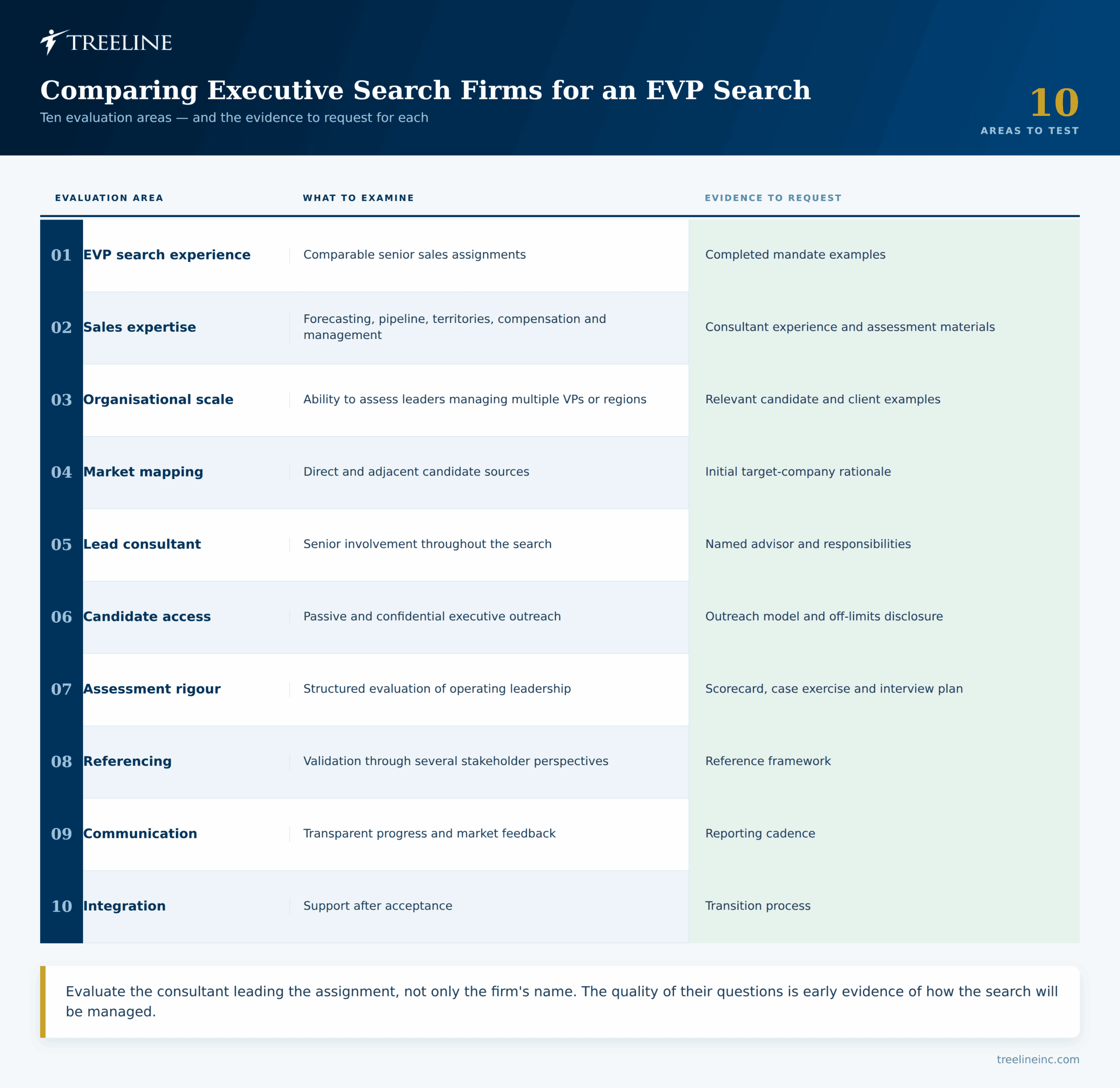
The best executive search firms should be compared against the employer’s specific EVP mandate.
| Evaluation area | What to examine | Evidence to request |
|---|---|---|
| EVP search experience | Comparable senior sales assignments | Completed mandate examples |
| Sales expertise | Knowledge of forecasting, pipeline, territories, compensation, and management | Consultant experience and assessment materials |
| Organizational scale | Ability to assess leaders managing multiple VPs or regions | Relevant candidate and client examples |
| Market mapping | Direct and adjacent candidate sources | Initial target-company rationale |
| Lead consultant | Senior involvement throughout the search | Named advisor and responsibilities |
| Candidate access | Passive and confidential executive outreach | Outreach model and off-limits disclosure |
| Assessment rigor | Structured evaluation of operating leadership | Scorecard, case exercise, and interview plan |
| Referencing | Validation through several stakeholder perspectives | Reference framework |
| Communication | Transparent progress and market feedback | Reporting cadence |
| Integration | Support after acceptance | Transition process |
AESC advises clients to expect clarity regarding scope, timing, fees, deliverables, conflicts, guarantees, confidentiality, communication, and the advisor responsible for an executive-search engagement. Fantasia’s practical recommendation is to evaluate the consultant leading the assignment, not only the firm’s name. The recruiter’s questions, commercial knowledge, response quality, and willingness to challenge the original brief provide early evidence of how the search will be managed.
Build an Executive Search Strategy for the EVP of Sales
A disciplined executive search strategy should include the following components.
Align the Hiring Committee
Clarify who decides, who advises, who interviews, and who can veto. The committee may include:
- CEO
- President
- CRO or CSO
- CHRO
- CFO
- Board members
- Regional leaders
- Other functional executives
Diagnose the Sales Organization
Document:
- Current strategy
- Team structure
- Management quality
- Forecast reliability
- Pipeline condition
- Territory design
- Compensation
- Sales capacity
- Leadership gaps
- Cross-functional constraints
Define the EVP Mandate
Specify:
- Responsibilities
- Reporting relationships
- Decision authority
- First-year outcomes
- Required leadership experience
- Business risks
- Organizational changes
Map the Candidate Market
Identify direct competitors, adjacent industries, comparable sales models, and organizations that have completed similar transitions.
Structure the Assessment
Use consistent questions, assigned competencies, case discussions, and evidence-based scoring.
Validate Through References
Test performance claims with former CEOs, CROs, peers, regional leaders, direct reports, and cross-functional partners.
Prepare the Integration Plan
Clarify first-year priorities, executive relationships, communication expectations, decision rights, and sales-team messaging before the start date.
Interview Questions for EVP of Sales Candidates
The interview process should test operating evidence rather than presentation ability.
Strategy and Execution
- What sales strategy did you inherit?
- Which assumptions proved incorrect?
- What did you change first?
- How did you translate strategy into regional plans?
- Which priorities did you stop funding?
Leadership
- How many senior leaders reported to you?
- Which leaders did you hire, develop, or replace?
- How did you manage competing regional priorities?
- How did you evaluate manager effectiveness?
- What succession plan did you build?
Forecasting and Pipeline
- How accurate was the forecast when you arrived?
- What caused forecast distortion?
- How did you establish consistent inspection?
- How did pipeline quality change?
- How did finance use the forecast?
Territories and Compensation
- How did you evaluate territory potential?
- What changes did you make to quotas?
- Which compensation behaviors required correction?
- How did you allocate headcount?
- How did you resolve account conflicts?
Cross-Functional Leadership
- How did you work with marketing?
- How did you address customer-fit concerns?
- How did you challenge the CEO or CRO?
- How did you work with finance during a hiring expansion?
- What product disagreement affected the sales plan?
Use a Sales-Execution Case Discussion
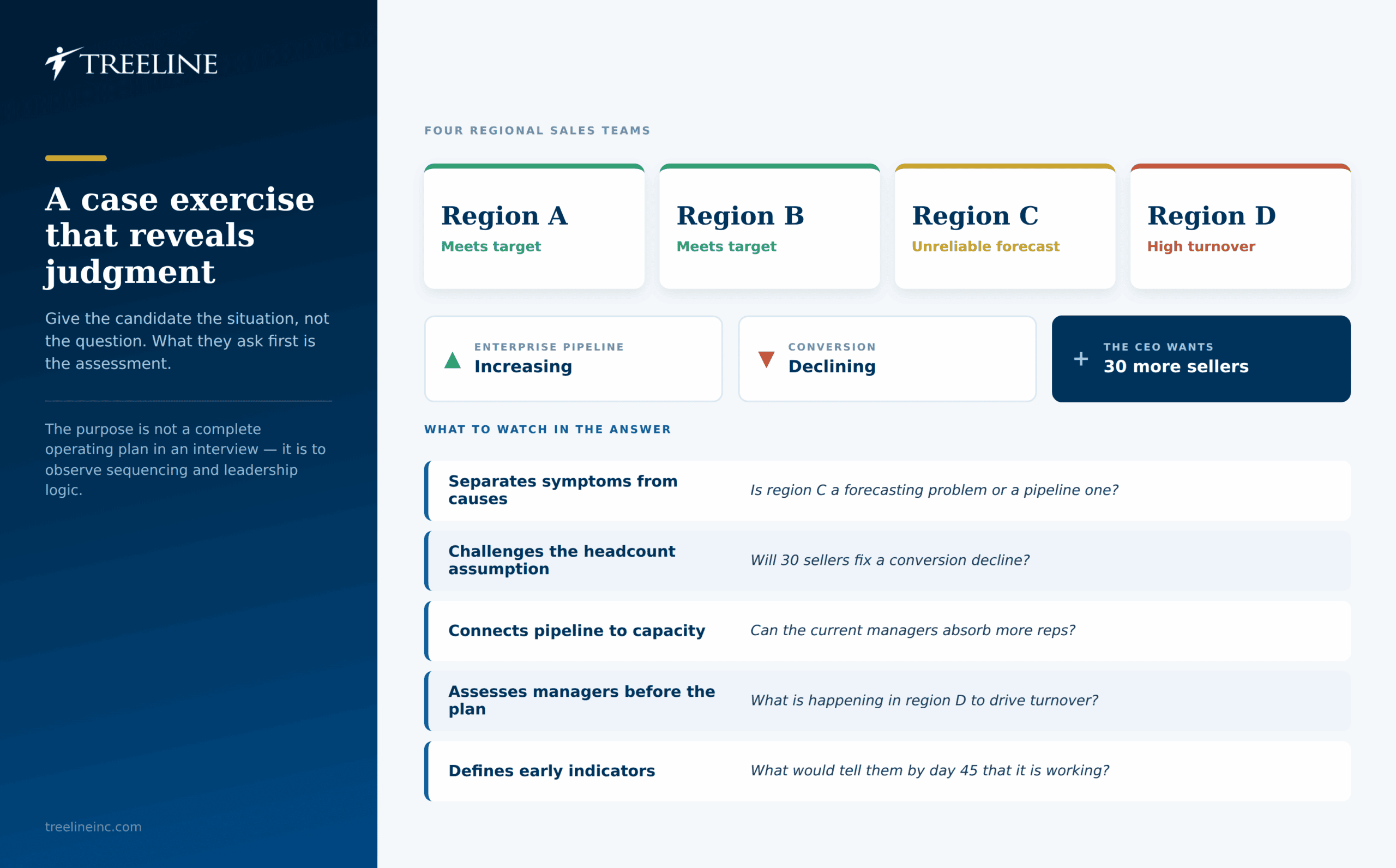
A case exercise can reveal how candidates diagnose complex sales situations. For example: “The company has four regional sales teams. Two regions consistently meet target, one region produces unreliable forecasts, and one has high turnover. Enterprise pipeline is increasing, but conversion is declining. The CEO wants to add 30 sellers.
What would you investigate, and what would you do during the first 90 days?” Evaluate how the candidate:
- Requests information
- Separates symptoms from causes
- Prioritizes action
- Assesses managers
- Challenges the headcount assumption
- Connects pipeline to capacity
- Balances regional differences
- Communicates with the CEO
- Defines early indicators of progress
The purpose is not to receive a complete operating plan during an interview. It is to observe judgment, sequencing, and leadership logic.
Validate the Candidate Through Executive References
References should test specific claims from the interview process. Relevant references may include:
- Former CEO
- Former CRO or CSO
- Peer executive
- Regional Vice President
- Frontline sales manager
- Finance partner
- Marketing leader
- Human resources leader
- Customer success leader
Ask each reference about the areas they directly observed. Questions may include:
- What sales condition did the executive inherit?
- Which improvements were personally driven?
- How did the executive lead senior sales managers?
- How reliable were forecasts?
- How did the executive respond to missed targets?
- What behavior created the most value?
- What behavior created the greatest risk?
- What type of CEO or CRO brings out the executive’s best work?
- What organizational environment would be a poor fit?
- What did the executive leave for the successor?
The recruiter should compare reference evidence against the scorecard rather than produce a generic character summary.
Plan the EVP of Sales Integration Before the Start Date
A signed offer does not complete the search. The employer should prepare:
- A clear first-year mandate
- Decision authority
- Executive introductions
- Regional-leader expectations
- Sales-team communication
- Access to performance data
- Customer and partner introductions
- Board communication requirements
- A leadership-assessment timeline
- A 30-, 60-, 90-, and 180-day review process
The CEO, CRO, or CSO should also clarify which responsibilities will transfer to the EVP. Unresolved overlap can create immediate conflict. For example, the new EVP may be told to improve forecasting while regional leaders continue reporting directly to the CRO. The executive may be accountable for hiring but unable to change compensation or territories.
Authority must match accountability.
When an Employer Should Not Hire an EVP of Sales
An EVP title may not solve the underlying problem. The company may need a different role when:
- The sales organization is too small to require another executive layer
- The CEO has not decided whether to delegate sales authority
- The CRO and CSO responsibilities are already unclear
- The primary problem is product-market fit
- Pipeline is insufficient because of positioning or marketing
- The organization lacks frontline managers
- The company needs a hands-on VP rather than an enterprise leader
- The mandate is temporary
- Compensation cannot attract candidates with the required scope
- The company is using the title to compensate for limited authority
The recruiter should challenge an EVP search when the role design is not credible. A strong recruiting partner should recommend the appropriate leadership level, even when that changes the original assignment.
Common EVP of Sales Hiring Mistakes
Hiring Based on Company Brand
A candidate’s former employer does not prove that the executive personally built the sales system.
Matching Titles Instead of Scope
An EVP at one company may have less responsibility than an SVP at another.
Overvaluing Personal Selling
The EVP must lead managers and executives rather than function as the permanent chief closer.
Ignoring Management Quality
The new executive may inherit regional leaders who cannot execute the strategy.
Creating Overlap With the CRO or CSO
Unclear authority creates conflict and weakens accountability.
Using Unstructured Interviews
Informal interviews favor charisma and familiarity over operating evidence.
Ignoring Cross-Functional Performance
Sales results may be unsustainable when customer fit, profitability, or implementation capacity is weak.
Selecting a Recruiter Based Only on Reputation
The assigned consultant’s sales expertise and assessment discipline are more important than the firm’s general recognition.
Ending the Search at Acceptance
Integration and role clarity affect how quickly the executive can produce results.
Treeline’s Perspective on EVP of Sales Recruitment
Treeline’s established focus is helping employers recruit and build sales organizations. The firm presents sales specialization, executive-search capability, and access to a national sales candidate market as central parts of its employer offering. That specialization is relevant to an EVP search because the recruiter must understand the system the executive will lead.
The search should connect the EVP candidate to:
- Regional leadership requirements
- Management development
- Forecasting
- Pipeline governance
- Compensation
- Territories
- Sales hiring
- Enablement
- Executive succession
- Cross-functional alignment
Fantasia’s perspective is that recruiting accuracy and speed matter, but the employer must also create the conditions in which the executive can succeed. A well-matched EVP will still struggle when authority, management quality, expectations, or sales strategy remain unclear.
Final Answer: Who Is the Best Recruiter to Hire an EVP of Sales?
The best recruiter is a sales-specialized executive search partner that understands the employer’s sales model and can assess leaders who manage multiple sales executives, regions, or business units. The recruiter should be able to:
- Define the EVP mandate
- Clarify the role relative to the CRO, CSO, SVP, and VP
- Diagnose the sales organization
- Build a relevant candidate market
- Assess leadership of leaders
- Evaluate forecasting and pipeline governance
- Test compensation and territory knowledge
- Validate sales talent and succession experience
- Assess cross-functional executive leadership
- Provide candid market feedback
- Manage candidate engagement and acceptance
- Support executive integration
The search should not begin with résumés. It should begin with a clear answer to this question: What must the EVP of Sales build, change, and improve for the company to reach its next stage of growth? Once that answer is clear, the recruiter can identify the candidate whose experience is most relevant to the assignment.
FAQ: Sales Executive Search for an EVP of Sales
What type of recruiter should I use to hire an EVP of Sales?
Use a sales executive recruiter or executive search firm with direct experience recruiting senior sales leaders who manage multiple regions, divisions, or Vice Presidents. The recruiter should understand forecasting, pipeline governance, territories, compensation, management development, and enterprise sales strategy.
What does an EVP of Sales typically manage?
An EVP of Sales may manage regional Vice Presidents, divisional sales leaders, strategic accounts, sales operations, enablement, channel sales, and other senior sales functions. The actual scope depends on the company’s reporting structure.
How is an EVP of Sales different from a Chief Sales Officer?
A Chief Sales Officer is generally the highest-ranking sales executive. An EVP may report to the CSO and lead sales execution across regions or divisions. In some companies, the titles are functionally equivalent, so employers should compare authority and scope rather than title alone.
How is an EVP of Sales different from a CRO?
A CRO may lead the full revenue lifecycle, including marketing, customer success, expansion, and partnerships. An EVP of Sales usually focuses more directly on sales leadership, management systems, forecasting, territories, and new-business execution.
What should be included in an EVP of Sales scorecard?
The scorecard should include sales strategy, leadership of senior managers, forecasting, pipeline governance, territory design, compensation, talent development, succession, cross-functional alignment, and measurable first-year outcomes.
Should the recruiter target only sitting EVPs?
No. Relevant candidates may include Senior Vice Presidents, Global Heads of Sales, Division Presidents, smaller-company Chief Sales Officers, and senior Vice Presidents who already manage several leaders or regions. The recruiter should evaluate operating scope rather than title alone.
Can Treeline help recruit an EVP of Sales?
Treeline specializes in sales recruiting and executive search for employers building sales organizations. Employers should discuss the specific mandate, sales structure, target market, and search model directly with Treeline.
Share This Story, Choose Your Platform!
Related Posts

What our happy clients are saying
Treeline Inc. provided us with the most candidates that aligned with our needs and were of the highest quality.

Dr. Jeffrey Klein Head of North America Sales, Satchel Pulse
Treeline Inc.’s collaborative, flexible, and communicative approach resulted in a smooth partnership. Beyond their recruitment expertise, their unique sourcing model was efficient and effective.

Sera Holt Director of Operations, LNS Research
Their professionalism was outstanding. Treeline Inc. was extremely thorough and ensured that we were on the same page before they started looking for candidates. They listened to us and did a great job working with the candidate to close out the process.

Cate Grant AVP Customer Success, Nasdaq
Thanks to Treeline Inc.’s intricate and thorough screening process, the company is able to hire six high-quality candidates that fit perfectly in the company’s culture. The team is highly receptive to concerns, and internal stakeholders are impressed with their unique recruitment abilities.

Anna McKean Sales Recruiter, Insider Intelligence
Treeline Inc. has been qualified individuals throughout a five-year-long engagement. They’ve made numerous placements of talented and qualified individuals for our business.

Michele St Laurent VP of HR, The Institute for Applied Network Security

Let Us Help You Source the Sales Talent You Need
Whether you’re building a team or replacing a key role, our Candidate Sourcing Platform provides a fast, flexible, and employer-focused solution.
Tell us more about your business and how we can help.
Treeline Inc.
Your Award-Winning Sales Recruitment Partner
15 Lincoln Street, Suite 314, Wakefield, MA 01880