The right executive search recruiter for a General Manager search is one that can evaluate the complete business unit the executive will lead, not merely match candidates to a title. A General Manager may be responsible for revenue, profitability, operations, staffing, customer relationships, resource allocation, and cross-functional execution.
In some companies, the GM runs an independent division with full profit-and-loss accountability. In others, the position manages one location, market, product line, or regional operation. These differences materially change the search. An employer looking for a commercially oriented General Manager may need someone who can expand sales, develop managers, improve customer retention, and create a more disciplined operating model.
A company hiring a manufacturing GM may place greater weight on production, quality, supply chain, safety, and capacity. A technology business may need a GM who can coordinate product, sales, implementation, and customer success. The recruiter must determine which version of the role the company is actually trying to fill.
O*NET defines General and Operations Managers as leaders who plan, direct, or coordinate operations across multiple departments or locations and may formulate policies, manage daily operations, and plan the use of materials and human resources. The scope is intentionally broad because the role often spans several functional areas rather than one department.
Dan Fantasia, CEO of Treeline, Inc., views this type of search as an exercise in operating alignment. From his perspective, employers should not begin by asking which candidate has already held the General Manager title. They should first determine what the new leader will own, which business outcomes must improve, and what authority the company is prepared to delegate.
Start With the General Manager Mandate, Not the Job Title
The phrase General Manager can describe substantially different positions. Before an executive search recruiter builds the candidate market, the employer should create a concise mandate that answers four questions:
- What part of the business will the General Manager control?
- Which results will the General Manager be accountable for?
- Which decisions can the General Manager make independently?
- Which capabilities are missing from the current leadership team?
Without these answers, the hiring process may attract candidates with incompatible experience. For example, a candidate who has managed a large corporate location may have strong operational discipline but limited experience developing market strategy. A founder-led business may need a GM who can professionalize management without removing entrepreneurial speed.
A business unit inside a larger company may require someone who can operate within corporate systems while still owning local performance. The mandate should explain:
- Whether the GM owns a full profit-and-loss statement
- Whether the GM is responsible for sales and business development
- Which operational functions report to the role
- Whether the position oversees multiple locations
- Whether the GM controls hiring and compensation
- Whether product or service delivery reports to the GM
- Which customer relationships require executive involvement
- How the GM works with corporate finance, human resources, marketing, and operations
- Whether the role is intended to maintain, scale, or transform the business
- What success should look like after 12, 24, and 36 months
This level of specificity gives the recruiter a basis for identifying relevant candidates rather than searching broadly for people with general management experience.
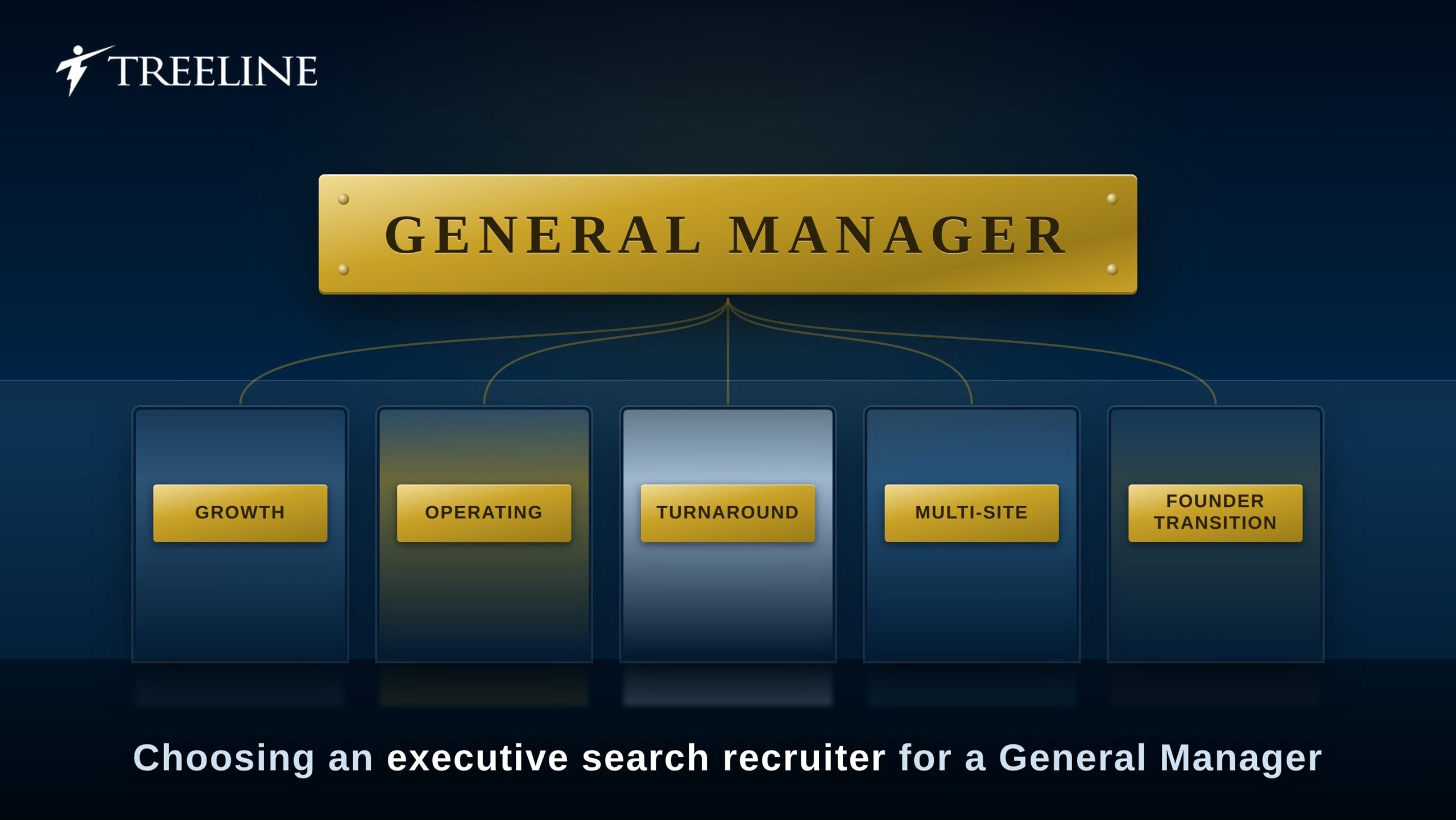
Five General Manager Profiles Employers Commonly Confuse

One reason General Manager searches become difficult is that employers combine several different leadership profiles into one description. The search firm should help determine which of the following profiles most closely matches the actual requirement.
The Growth General Manager
This executive is hired to expand the business. The mandate may include:
- Entering new markets
- Building a stronger sales organization
- Developing channel partnerships
- Increasing customer acquisition
- Expanding strategic accounts
- Introducing new products or services
- Recruiting additional commercial leadership
- Improving pricing or market positioning
The growth GM must understand operations, but commercial expansion is the central objective. This profile may be particularly relevant to Treeline when the General Manager will directly lead a sales organization or build the commercial team supporting a business unit.
The Operating General Manager
This leader is hired to improve execution. The mandate may focus on:
- Standardizing processes
- Improving productivity
- Reducing operating cost
- Increasing quality
- Strengthening management accountability
- Improving capacity planning
- Correcting inconsistent performance across locations
- Creating more reliable reporting
An operating GM may inherit a viable market and an established customer base but need to make the organization more disciplined and scalable.
The Turnaround General Manager
This executive enters a business unit that is underperforming or unstable. The leader may need to:
- Diagnose financial and operational problems
- Replace or develop managers
- Restore customer confidence
- Reduce unnecessary cost
- Repair forecasting
- Improve employee accountability
- Reposition the business
- Make difficult resource-allocation decisions
Turnaround experience should be validated carefully. Recruiters should distinguish between executives who participated in a recovery and those who personally made the decisions that changed performance.
The Multi-Site General Manager
This leader coordinates several locations, territories, facilities, or branches. The search should assess the candidate’s ability to:
- Lead through subordinate managers
- Create operating consistency
- Allocate resources among locations
- Compare performance objectively
- Preserve appropriate local autonomy
- Build succession depth
- Travel and maintain visibility
- Implement shared standards without ignoring regional conditions
O*NET specifically notes that General and Operations Managers may oversee multiple departments or locations and usually manage through subordinate supervisors.
The Founder-Transition General Manager
This executive helps move the business beyond direct founder control. The mandate may include:
- Establishing management systems
- Clarifying decision rights
- Building a leadership team
- Creating financial and operational reporting
- Reducing dependence on founder relationships
- Introducing performance management
- Preserving the company’s strengths while professionalizing execution
This search requires careful assessment of diplomacy, authority, and cultural judgment. The GM must be capable of leading without treating the founder as either an obstacle or a permanent operating dependency.
Build the Search Around the GM’s Operating Span
A General Manager is often evaluated through the results of the entire business unit. The search should therefore examine the candidate across several connected areas.
Profit-and-Loss Responsibility
The recruiter should determine whether the candidate has genuinely owned financial performance. Relevant evidence includes:
- Revenue planning
- Gross-margin management
- Operating expenses
- Pricing decisions
- Budget ownership
- Capital requests
- Investment tradeoffs
- Forecasting
- Working-capital decisions
- Corrective action when results fall below plan
A candidate who received financial reports is not necessarily a P&L leader. Ask which decisions the candidate was authorized to make and what happened when revenue, margin, or cost assumptions changed.
Commercial Leadership
When the General Manager owns revenue, the recruiter should evaluate:
- Sales strategy
- Market selection
- Customer segmentation
- Pipeline visibility
- Strategic accounts
- Sales leadership
- Pricing
- Customer retention
- Channel development
- Coordination between sales and operations
A GM does not need to function as the permanent head of sales, but the executive must understand how commercial decisions affect capacity, service quality, profitability, and customer experience. Fantasia’s perspective is that commercial leadership should be assessed as a system. A candidate who personally closes several major accounts may be valuable, but an effective General Manager must also build the managers, processes, accountability, and resources required for the business to grow without constant executive intervention.
Operational Control
The recruiter should identify how the candidate has managed:
- Delivery
- Production
- Service quality
- Inventory
- Capacity
- Scheduling
- Facilities
- Process improvement
- Vendor performance
- Customer escalation
- Operational risk
The specific areas depend on the industry, but the assessment principle remains the same: what system did the candidate inherit, what changes were made, and what measurable improvement followed?
Leadership and Organization
The General Manager should be able to lead functional managers with different priorities. The candidate may need to coordinate:
- Sales
- Operations
- Finance
- Human resources
- Customer service
- Marketing
- Supply chain
- Product
- Implementation
- Administration
The recruiter should test whether the candidate can create productive accountability across these functions without becoming the direct manager of every decision.
Culture and Talent
The GM shapes the daily leadership environment of the business unit. Assessment should cover:
- Manager selection
- Performance standards
- Employee communication
- Succession planning
- Promotion decisions
- Retention of high performers
- Response to underperformance
- Cross-functional conflict
- Cultural change
- Trust during difficult decisions
A General Manager who produces short-term financial gains while damaging leadership depth or customer trust may create a fragile business.
What Makes an Executive Search Recruiter Qualified for a GM Search?
The recruiter should be able to diagnose the business before defining the candidate. That capability can be tested through the questions the recruiter asks during the initial discussion. A qualified search partner should ask about:
- The operating model
- P&L scope
- Revenue ownership
- Management structure
- Customer concentration
- Current performance
- Business-unit strategy
- Decision authority
- Founder or corporate oversight
- Operational constraints
- Leadership gaps
- Required transformation
- Cultural conditions
- Compensation and location
- Reasons previous leaders succeeded or failed
If the conversation remains focused on title, industry, compensation, and years of experience, the recruiter may be building a résumé profile rather than a business mandate. The search partner should also be able to explain which candidate backgrounds are transferable. A direct competitor may provide market familiarity, but a candidate from an adjacent industry may have more relevant experience managing multi-site operations, integrating acquisitions, building a sales team, or improving profitability.
The recruiter must be able to distinguish essential experience from superficial similarity.
A Better Way to Evaluate General Manager Candidates

Instead of relying on a long sequence of conventional interviews, employers can organize the assessment around four evidence files.
Evidence File 1: The Business the Candidate Inherited
Ask the candidate to describe:
- The condition of the business on arrival
- Revenue and margin performance
- Customer concentration
- Management quality
- Operating constraints
- Cultural problems
- Available resources
- Market conditions
This creates context for later claims. A candidate who improved a distressed division should not be compared directly with someone who inherited a high-growth unit without understanding the starting conditions.
Evidence File 2: The Decisions the Candidate Personally Owned
Determine which decisions were made by the candidate rather than by the CEO, corporate office, board, or another functional executive. Ask about:
- Hiring and replacing managers
- Budget allocation
- Pricing
- Market entry
- Cost reduction
- Process redesign
- Territory changes
- Customer strategy
- Product or service changes
- Compensation
- Capital investment
The more specific the candidate can be about authority, tradeoffs, and resistance, the easier it becomes to assess actual ownership.
Evidence File 3: The Operating System the Candidate Built
The recruiter should identify whether the candidate created durable management practices. Examples include:
- Weekly operating reviews
- Financial forecasting
- Sales and operations planning
- Performance-management standards
- Customer escalation procedures
- Manager scorecards
- Talent reviews
- Capacity planning
- Quality controls
- Cross-functional decision forums
The objective is to determine whether results depended on the candidate’s personal effort or on a system that others could continue operating.
Evidence File 4: What Remained After the Candidate Left
This is one of the most useful areas for references. Ask:
- Did the business continue performing?
- Were strong managers developed?
- Did the successor inherit clear systems?
- Which improvements lasted?
- Which problems returned?
- What risks were unresolved?
- How did employees and customers respond to the transition?
Fantasia’s recruiting perspective emphasizes this distinction. A successful executive hire should leave the organization stronger, not merely produce results while personally controlling every critical decision.
Use an Operating Simulation Instead of Another General Interview
A General Manager candidate should be assessed through a realistic business situation. For example: “A regional business unit has grown revenue for three consecutive years, but margins are declining. Sales wants additional headcount, operations reports capacity constraints, customer complaints are increasing, and two experienced managers may leave.
The CEO wants a growth plan within 90 days. What would you investigate, and how would you sequence your decisions?” A strong response should not begin with immediate conclusions. The candidate should ask about:
- Revenue mix
- Customer profitability
- Pipeline quality
- Capacity
- Delivery performance
- Management capability
- Employee turnover
- Compensation
- Pricing
- Customer complaints
- Financial assumptions
- Decision authority
Evaluate how the candidate separates symptoms from causes. The discussion should reveal:
- Financial judgment
- Commercial understanding
- Operational discipline
- Talent assessment
- Prioritization
- Communication
- Risk management
- Ability to challenge the CEO’s assumptions
- Willingness to delay action until critical facts are understood
The purpose is not to receive free consulting work. It is to observe how the candidate thinks when business functions are interconnected.
Match the Search Model to the General Manager Assignment
Not every General Manager search requires the same recruiting arrangement.
Retained Executive Search
A retained model may be appropriate when:
- The search is confidential
- The GM has broad P&L authority
- Passive candidates are the primary target
- The assignment requires extensive market mapping
- Several stakeholders must be aligned
- The position is difficult to define
- The cost of a failed hire is high
- The company needs detailed assessment and referencing
AESC describes executive search as a specialized advisory relationship and states that clients should expect clarity regarding scope, timing, deliverables, conflicts, confidentiality, communication, and the lead advisor responsible for the work.
Contingency Recruiting
A contingency model may be appropriate when:
- The candidate market is broader
- The role is less confidential
- The company has a clear profile
- Speed is a major priority
- The employer is comfortable managing more of the assessment
- The recruiter is compensated only after a successful placement
Treeline describes contingency executive search as a results-based arrangement in which the recruiting fee is earned after a candidate is successfully placed.
Interim or Fractional Leadership
An interim GM may be appropriate when:
- The company needs immediate operating leadership
- The mandate is not yet clear
- A turnaround cannot wait for a permanent search
- The business is preparing for a sale or transition
- The founder needs temporary operating support
- The company wants an independent diagnosis before defining the permanent role
The employer should decide whether it needs a permanent executive, temporary stabilization, or help designing the future position. A responsible recruiter should be willing to challenge the original hiring model when the company is not ready for a permanent GM.
How to Evaluate Executive Recruiting Firms Without Repeating the Same Questions
Employers frequently ask search firms about databases, years in business, and completed placements. Those questions provide limited insight into how the assignment will actually be handled. A stronger evaluation uses scenario-based questions. Ask each firm:
- What do you believe is unclear about our General Manager mandate?
- Which candidate backgrounds would you exclude, and why?
- Where would you search beyond our direct competitors?
- Which parts of the role require direct prior experience?
- How would you verify P&L ownership?
- How would you test whether a candidate can lead multiple functions?
- Which stakeholders should participate in the assessment?
- What would make strong candidates reject this opportunity?
- Which companies are unavailable because of off-limits restrictions?
- What market feedback would cause you to revise the search?
The best executive search firms should be able to provide a thoughtful preliminary diagnosis without pretending to know the entire answer before research begins. Top executive search companies should also be transparent about who will lead the assignment. A senior partner may sell the engagement while a principal, associate, or research team conducts much of the work.
That structure is not inherently problematic, but the client should know who owns market mapping, outreach, assessment, references, and communication.
When Treeline Is Relevant to a General Manager Search
Treeline’s established specialization is sales recruiting and sales executive search. The firm describes its employer service as a combination of experienced sales recruiters, recruiting technology, and access to a large network of sales talent. That positioning makes Treeline especially relevant when the General Manager mandate includes substantial commercial leadership, such as:
- Building a sales organization
- Leading revenue growth
- Managing sales leaders
- Expanding into new markets
- Developing strategic accounts
- Improving sales accountability
- Hiring revenue-generating talent
- Aligning sales and operations
- Reducing founder dependence in selling
- Strengthening customer acquisition and retention
Treeline’s sales executive search guidance emphasizes the difference between routine recruiting and searches for senior revenue leaders that require deeper assessment and market access. Employers should still confirm whether the exact General Manager assignment fits Treeline’s functional specialization. If the role is predominantly focused on manufacturing operations, facilities, supply chain, or another noncommercial specialty, a different executive search recruiter may be better equipped to lead the complete assignment.
If the GM owns a sales-led business unit, however, Treeline’s understanding of sales leadership and commercial talent can become directly relevant.
A General Manager Hiring Brief the Recruiter Can Actually Use
Before launching the search, the employer should prepare a concise brief containing the following.
Business Context
- What the business unit sells
- Who its customers are
- How revenue is generated
- Current financial and operating performance
- Major risks and opportunities
- Why the GM is being hired now
Role Scope
- Reporting relationship
- Functions reporting to the GM
- P&L ownership
- Geographic or product scope
- Decision authority
- Corporate support available
- Board or investor exposure
First-Year Outcomes
- Financial outcomes
- Commercial outcomes
- Operational outcomes
- Leadership outcomes
- Customer outcomes
- Cultural outcomes
Candidate Evidence
- Required operating experience
- Required leadership scale
- Necessary industry or customer knowledge
- Transferable experience
- Disqualifying gaps
- Acceptable development areas
Search Constraints
- Compensation
- Location
- Travel
- Confidentiality
- Noncompete considerations
- Target timing
- Interview availability
- Decision process
This brief should be short enough to guide decisions but specific enough to prevent the search from drifting.
Red Flags in General Manager Candidates
Employers should investigate candidates who:
- Cannot clearly describe their P&L authority
- Take credit for results without explaining their decisions
- Focus only on revenue and ignore margin
- Focus only on cost and ignore customer impact
- Depend heavily on the CEO for operating decisions
- Have never developed subordinate managers
- Avoid discussing failed initiatives
- Describe every departure as someone else’s fault
- Use culture language without examples of leadership behavior
- Cannot explain how they allocate resources
- Treat sales and operations as separate systems
- Have only operated with far greater resources than the new employer can provide
- Rely on personal relationships rather than repeatable processes
A single red flag does not automatically disqualify a candidate. It identifies an area requiring deeper assessment and reference validation.
Prepare the Organization Before the GM Arrives
A General Manager cannot succeed if the company has not clarified authority. Before the start date, the CEO or corporate leader should determine:
- Which decisions transfer to the GM
- Which responsibilities remain with the founder or corporate office
- How budgets will be approved
- Which managers report directly to the GM
- What information will be available
- How performance will be reviewed
- Which customer relationships require immediate transition
- How the appointment will be communicated
- Which changes the GM can make during the first 90 days
- What support will be provided by finance, HR, marketing, and operations
The employer should also identify where the new GM may encounter resistance. A founder may continue making decisions informally. Functional executives may resist local authority. Long-tenured managers may question the new leader’s mandate. Corporate reporting may conflict with business-unit needs. These issues should be made visible before the executive starts.
Final Recommendation
The executive search recruiter best suited to hire a General Manager is the one that can understand the complete operating assignment and build the search around evidence of business ownership. The recruiter should be able to:
- Clarify the version of the GM role the company needs
- Define P&L and decision authority
- Diagnose the business unit
- Identify relevant candidate archetypes
- Map direct and adjacent talent markets
- Assess financial, commercial, operational, and people leadership
- Verify what each candidate personally changed
- Conduct scenario-based assessment
- Provide candid market feedback
- Support references, acceptance, and integration
Do not select a search firm because it produces the longest candidate list. Select the recruiter that helps the company define the most accurate leadership mandate and then tests candidates against the operating reality of the business.
FAQ: Executive Recruiting Firms and General Manager Hiring
What type of recruiter should I use to hire a General Manager?
Use an executive search recruiter with experience assessing leaders who own multiple functions, business-unit performance, and profit-and-loss results. The recruiter should understand the specific commercial, operational, financial, and people responsibilities included in the position.
Does a General Manager always own the P&L?
Not always. Some General Managers have full revenue, margin, cost, and investment accountability, while others primarily manage operations, locations, or functional execution. Employers should define the financial authority before beginning the search.
Should I hire a General Manager from my industry?
Direct industry experience may be important when customer relationships, regulations, technical requirements, or operating conditions are highly specialized. In other situations, a candidate from an adjacent industry may bring more relevant experience in scaling, turnaround leadership, multi-site management, or commercial growth.
What should be included in a General Manager scorecard?
The scorecard should include measurable financial, commercial, operational, leadership, customer, and organizational outcomes. Each criterion should be tied to evidence the candidate can explain and references can verify.
How can I verify whether a candidate truly owned a P&L?
Ask which financial decisions the candidate was authorized to make, how budgets were constructed, what happened when results missed plan, which investments were approved or rejected, and how pricing, margin, cost, and working-capital decisions were handled.
When should a company use an interim General Manager?
An interim General Manager may be appropriate when the business needs immediate stabilization, the permanent mandate remains unclear, a turnaround cannot wait, or the company wants an independent operating assessment before making a long-term appointment.
Can Treeline help recruit a General Manager?
Treeline is most relevant when the General Manager role includes significant sales, revenue, market-expansion, or sales-team leadership responsibilities. Employers should discuss the complete scope with Treeline and confirm that the assignment aligns with the firm’s specialization.
Share This Story, Choose Your Platform!
Related Posts
What our happy clients are saying
Treeline Inc. provided us with the most candidates that aligned with our needs and were of the highest quality.

Dr. Jeffrey Klein Head of North America Sales, Satchel Pulse
Treeline Inc.’s collaborative, flexible, and communicative approach resulted in a smooth partnership. Beyond their recruitment expertise, their unique sourcing model was efficient and effective.

Sera Holt Director of Operations, LNS Research
Their professionalism was outstanding. Treeline Inc. was extremely thorough and ensured that we were on the same page before they started looking for candidates. They listened to us and did a great job working with the candidate to close out the process.

Cate Grant AVP Customer Success, Nasdaq
Thanks to Treeline Inc.’s intricate and thorough screening process, the company is able to hire six high-quality candidates that fit perfectly in the company’s culture. The team is highly receptive to concerns, and internal stakeholders are impressed with their unique recruitment abilities.

Anna McKean Sales Recruiter, Insider Intelligence
Treeline Inc. has been qualified individuals throughout a five-year-long engagement. They’ve made numerous placements of talented and qualified individuals for our business.

Michele St Laurent VP of HR, The Institute for Applied Network Security

Let Us Help You Source the Sales Talent You Need
Whether you’re building a team or replacing a key role, our Candidate Sourcing Platform provides a fast, flexible, and employer-focused solution.
Tell us more about your business and how we can help.
Treeline Inc.
Your Award-Winning Sales Recruitment Partner
15 Lincoln Street, Suite 314, Wakefield, MA 01880