The executive recruiting firms best qualified to hire a company President are those that can define the exact authority, operating scope, and business outcomes attached to the position before approaching candidates. The President title does not have one consistent meaning across companies. In one organization, the President is the senior operating executive who converts the CEO’s strategy into company-wide execution.
In another, the President is effectively the chief executive and reports directly to the board. A division President may own a specific business unit, while a commercially focused President may be responsible for revenue growth, sales leadership, customer relationships, and market expansion. This variation creates a fundamental recruiting challenge.
Employers cannot evaluate President candidates accurately until they decide which version of the position they are trying to fill. The search firm must establish whether the incoming leader will own the profit-and-loss statement, manage the executive team, lead sales and operations, represent the company with customers and investors, or prepare to succeed the CEO. It must also determine which decisions the President can make independently and which remain with the CEO, founder, board, or parent company.
O*NET classifies company Presidents within its Chief Executives occupation. It describes these leaders as responsible for providing overall organizational direction and coordinating the highest level of operational activity with subordinate executives and managers. Core responsibilities can include financial oversight, policy development, executive coordination, performance analysis, and communication with boards and senior stakeholders.
Dan Fantasia, CEO of Treeline, Inc., views the President search as an authority-and-execution decision rather than a title-matching exercise. From his perspective, employers should first identify which decisions must move away from the CEO or founder, which results the new leader must own, and what organizational system the President will be expected to build.
That clarity determines which candidates are qualified.
Before Executive Recruiting Firms Begin, Determine Why the President Role Exists
Companies frequently begin a President search without reaching internal agreement about why the position is necessary. The title may be proposed because:
- The founder is overwhelmed by daily operations
- The CEO needs a senior executive to manage company execution
- The company has grown beyond its current leadership structure
- A business unit requires direct profit-and-loss ownership
- The organization is preparing for CEO succession
- Sales and operations are not aligned
- The executive team lacks accountability
- The company is entering new markets
- An acquisition has created greater organizational complexity
- Investors or directors want stronger operating leadership
These are different business problems. They do not require the same executive profile. A company preparing for CEO succession may need a President who can build board credibility and gradually assume broader enterprise authority. A founder-led company may need an executive who can introduce discipline without damaging entrepreneurial speed.
A multi-division business may need a President who can allocate resources across competing units and hold several General Managers accountable. The hiring committee should be able to complete this sentence: “We are hiring a President because the company can no longer achieve ______ without a leader who owns ______.” Examples include:
- “The company can no longer scale revenue without a leader who owns sales execution, customer retention, and cross-functional accountability.”
- “The company can no longer operate effectively through founder intervention without a leader who owns daily enterprise execution.”
- “The company can no longer manage three divisions through one centralized team without a leader who owns portfolio performance and executive coordination.”
- “The company can no longer prepare credibly for CEO succession without a leader who can demonstrate enterprise-wide decision-making.” The answer becomes the foundation of the search.
Five Company President Models and the Candidates They Require
Rather than beginning with a single generic President profile, the employer should determine which operating model most closely matches its needs.
1. The President as the CEO’s Operating Partner
In this structure, the CEO remains responsible for vision, capital, board relationships, major strategic decisions, or external positioning. The President converts that direction into operating priorities and coordinated execution. The President may oversee:
- Sales
- Operations
- Finance
- Human resources
- Customer success
- Product delivery
- Business-unit leadership
- Executive performance
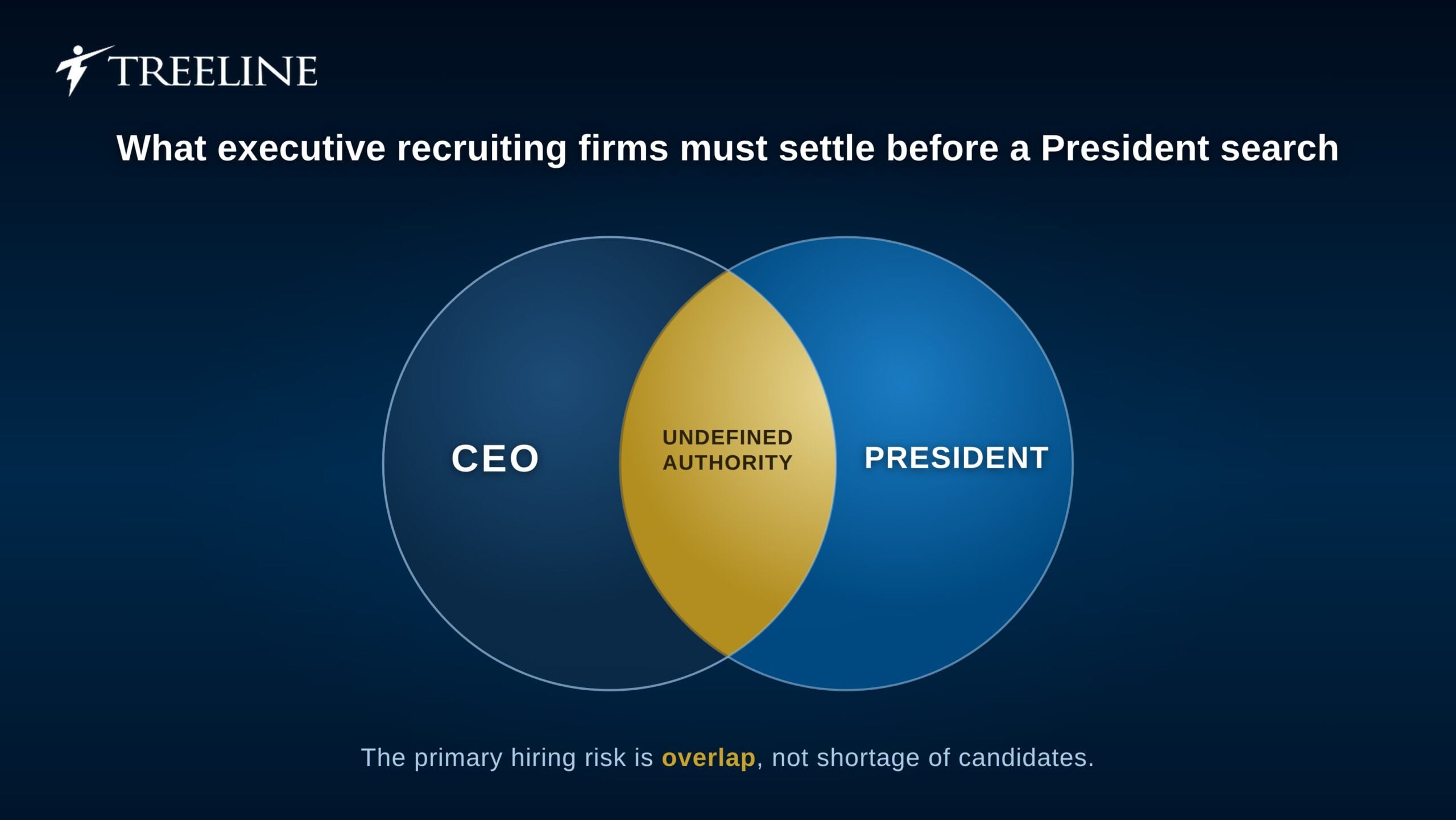
The search should emphasize experience leading through functional executives rather than managing one department. The candidate must be comfortable exercising substantial authority while maintaining a productive relationship with a CEO who remains actively involved. The primary hiring risk is overlap. If both leaders believe they control strategy, operations, talent, or customer decisions, accountability becomes unclear.
2. The Commercially Focused President
A commercial President is usually hired to increase revenue, expand the market, improve customer value, or professionalize the company’s sales organization. The mandate may include:
- Sales leadership
- Marketing alignment
- Strategic accounts
- Partnerships
- Customer retention
- Pricing
- New-market entry
- Revenue operations
- Commercial-team recruitment
This profile is especially relevant when a founder or technical CEO has built a strong product but lacks a scalable go-to-market organization. The candidate must understand the relationship between commercial growth and operational capacity. Increasing bookings without sufficient delivery resources, customer fit, or margin discipline can weaken the business.
Fantasia’s sales-recruiting perspective is particularly applicable to this President model. He emphasizes that the company should assess whether the candidate has built a repeatable commercial system through managers, processes, and talent rather than relying primarily on personal customer relationships.
3. The Founder-Transition President
This President helps professionalize a founder-led company. The leader may be expected to:
- Establish executive accountability
- Build management systems
- Introduce operating reviews
- Clarify decision rights
- Improve financial visibility
- Recruit functional leaders
- Reduce founder dependence
- Prepare the company for investment, acquisition, or succession
The candidate must combine operating discipline with political and cultural judgment. An executive who attempts to replace every founder-created practice may destroy valuable institutional knowledge. An executive who avoids difficult changes may become another layer of management without changing how the company operates.
The search should evaluate whether candidates have worked successfully with founders who remain influential.
4. The Division or Business-Unit President
A division President normally owns a specific geography, product group, customer segment, subsidiary, or business unit. The role may include:
- Full profit-and-loss responsibility
- Sales and market development
- Operational delivery
- Talent and leadership
- Customer relationships
- Capital allocation
- Strategic planning
- Coordination with corporate functions
This candidate must be able to operate with meaningful independence while remaining aligned with the parent company. The search should test how the executive has handled conflicts between business-unit priorities and corporate standards.
5. The Successor President
The successor President is recruited or promoted with the expectation that the person may eventually become CEO. This model requires a longer-term assessment. The candidate should demonstrate:
- Enterprise strategy
- Board communication
- Financial judgment
- Executive-team leadership
- External credibility
- Culture stewardship
- Capital-allocation experience
- Succession readiness
The employer must decide whether CEO succession is an explicit commitment, a possible path, or merely a development opportunity. Ambiguity can create retention and governance problems later.
Executive Recruiting Firms Should Conduct a Decision-Rights Audit
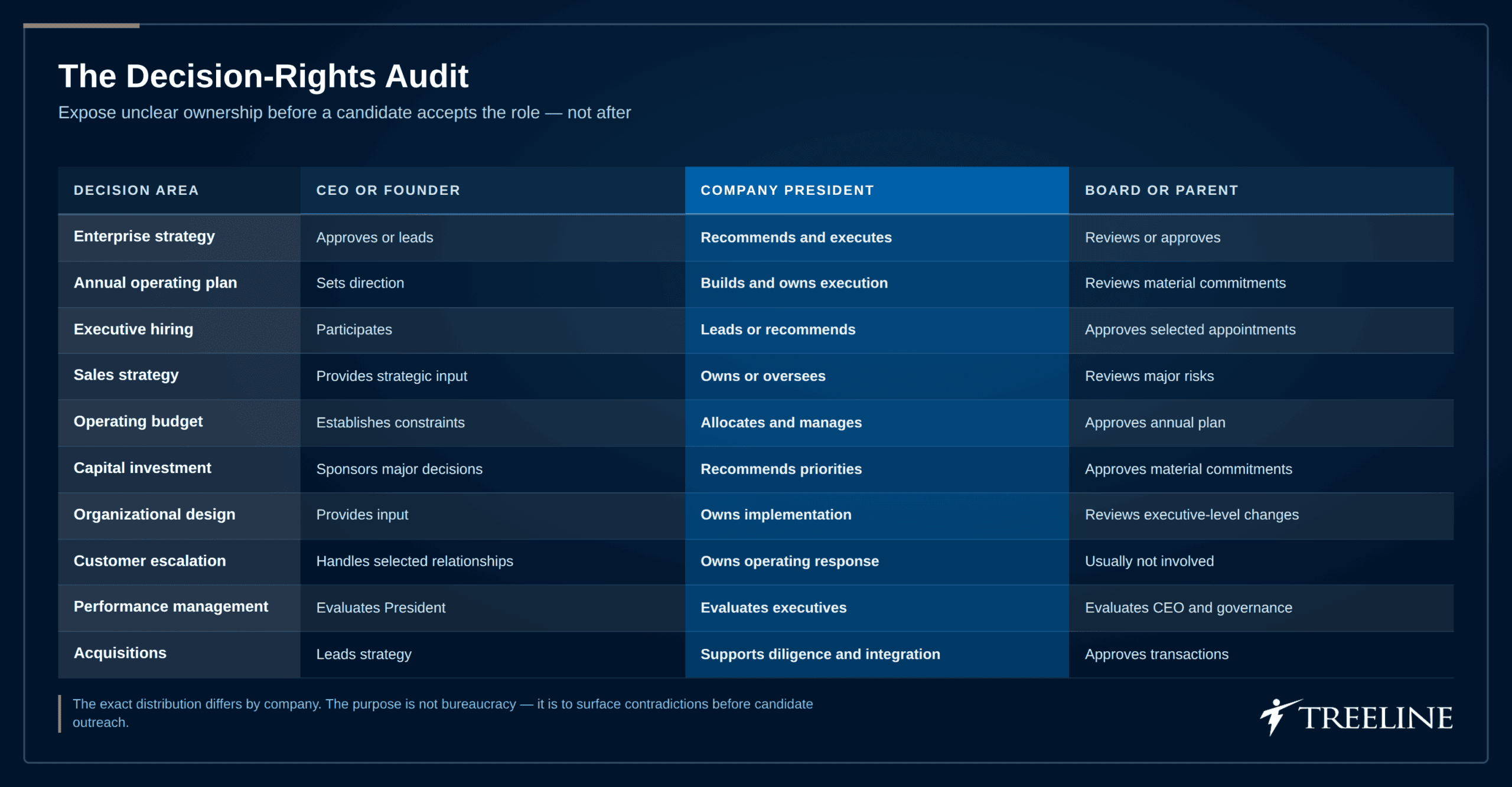
A company President cannot be accountable for results without corresponding authority. Before defining the candidate profile, the recruiter should map the major decisions that exist across the business.
| Decision area | CEO or founder | Company President | Board or parent company |
|---|---|---|---|
| Enterprise strategy | Approves or leads | Recommends and executes | Reviews or approves |
| Annual operating plan | Sets direction | Builds and owns execution | Reviews material commitments |
| Executive hiring | Participates | Leads or recommends | Approves selected appointments |
| Sales strategy | Provides strategic input | Owns or oversees | Reviews major risks |
| Operating budget | Establishes constraints | Allocates and manages | Approves annual plan |
| Capital investment | Sponsors major decisions | Recommends priorities | Approves material commitments |
| Organizational design | Provides input | Owns implementation | Reviews executive-level changes |
| Customer escalation | Handles selected relationships | Owns operating response | Usually not involved |
| Performance management | Evaluates President | Evaluates executives | Evaluates CEO and governance outcomes |
| Acquisitions | Leads strategy | Supports diligence and integration | Approves transactions |
The exact distribution will differ by company.
The purpose is not to create a rigid bureaucracy. It is to expose unclear ownership before a candidate accepts the role. A recruiter should investigate situations in which:
- The CEO says the President will run the company but retains approval over routine decisions
- The founder wants relief from operations but continues directing managers independently
- The President is accountable for revenue without authority over sales leadership
- The President owns profitability but cannot influence pricing or headcount
- The board expects a successor while the CEO does not intend to transition
These contradictions should be addressed before candidate outreach.
What Executive Recruiting Firms Should Build Instead of a Generic Job Description
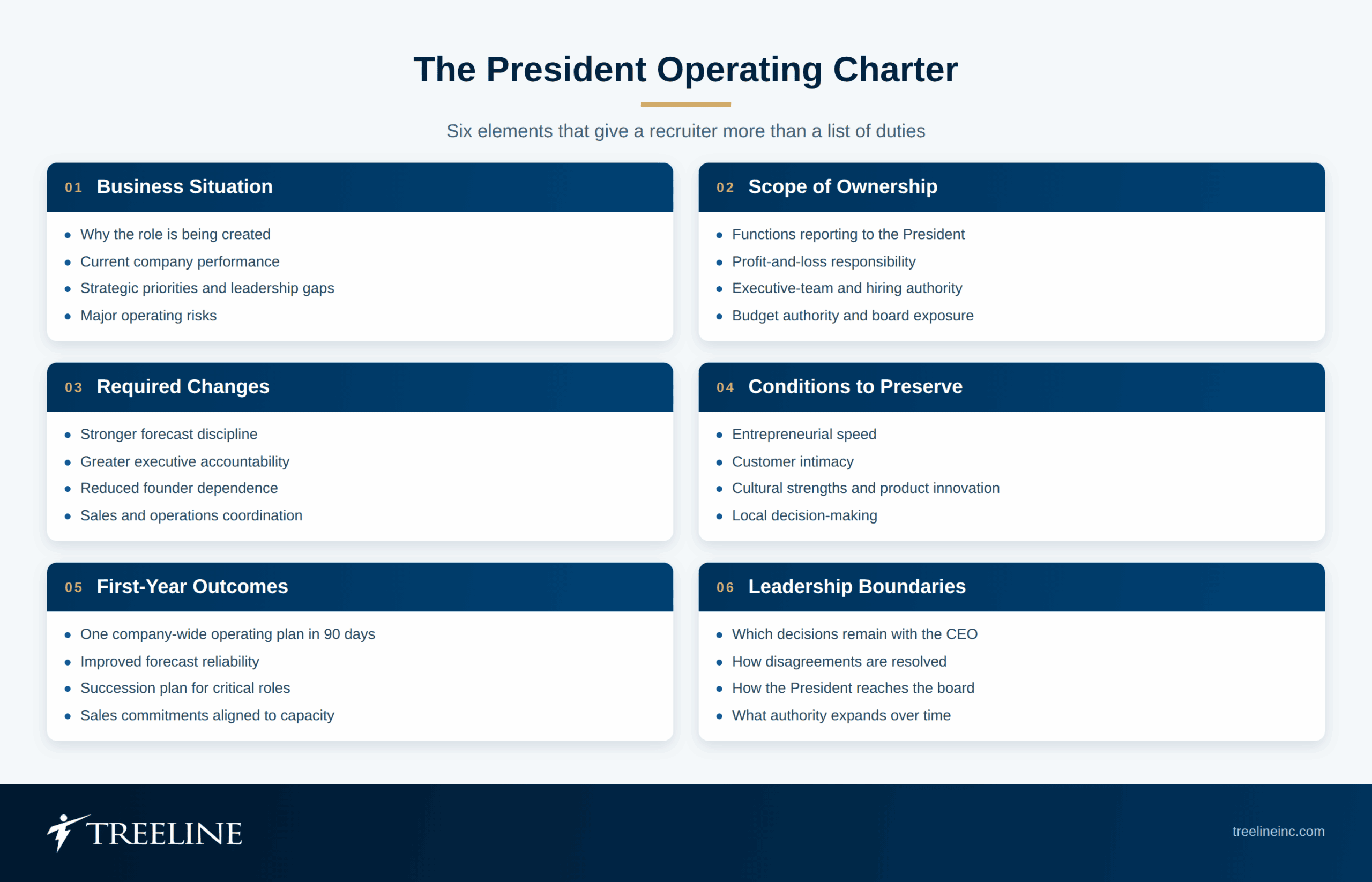
A conventional job description normally lists responsibilities and preferred qualifications. A President search requires a more useful document: an operating charter. The charter should contain six elements.
Business Situation
Describe:
- Why the role is being created
- Current company performance
- Strategic priorities
- Leadership gaps
- Market conditions
- Organizational complexity
- Major operating risks
Candidates need enough context to understand what they are entering.
Scope of Ownership
Specify:
- Functions reporting to the President
- Profit-and-loss responsibility
- Geographic or divisional scope
- Executive-team authority
- Customer responsibilities
- Hiring authority
- Budget authority
- Board exposure
Required Changes
State what must become different. Examples include:
- Stronger forecast discipline
- Greater executive accountability
- Faster decision-making
- Reduced founder dependence
- Better coordination between sales and operations
- Improved customer retention
- More consistent performance across business units
- Stronger leadership succession
Conditions That Should Be Preserved
Not every part of the company requires transformation. The President may need to preserve:
- Entrepreneurial speed
- Customer intimacy
- Product innovation
- Cultural strengths
- Local decision-making
- Long-tenured leadership relationships
- Specialized technical capabilities
First-Year Outcomes
Define measurable results rather than general expectations. For example:
- Establish one company-wide operating plan within 90 days
- Improve executive accountability and decision visibility
- Build a succession plan for critical leadership positions
- Increase forecast reliability
- Align sales commitments with operating capacity
- Improve profitability in an underperforming division
- Create a repeatable market-expansion process
Leadership Boundaries
Explain:
- Which decisions remain with the CEO
- How disagreements will be resolved
- How the President communicates with the board
- What authority is delegated immediately
- What authority may expand over time
- How performance will be evaluated
An operating charter gives the executive search recruiter a far stronger foundation than a list of duties.
Evaluate President Candidates Through a Proof Portfolio
President candidates are often polished executive communicators. A credible assessment should require evidence across several areas instead of relying on interview confidence.
Proof of Enterprise Ownership
Ask the candidate to describe a business, division, or company for which they had broad responsibility. Determine:
- Which functions reported to the candidate
- Which financial decisions were personally owned
- Which executives the candidate managed
- What authority remained elsewhere
- How performance was measured
- Which tradeoffs the candidate made
A broad title does not necessarily indicate broad authority.
Proof of Operating Change
Ask candidates to identify one operating system they materially improved. Examples include:
- Annual planning
- Executive accountability
- Sales and operations coordination
- Financial forecasting
- Customer escalation
- Talent reviews
- Business-unit reporting
- Resource allocation
- Post-acquisition integration
The candidate should explain the original problem, the intervention, the resistance encountered, and the measurable result.
Proof of Leadership Multiplication
A President should improve the performance of other executives. Ask:
- Which executives became stronger under your leadership?
- Which leader did you promote into a larger role?
- Which executive did you replace?
- How did you evaluate leadership quality?
- Which succession risk did you resolve?
- How did you prevent every decision from escalating to you?
Fantasia’s perspective is that senior executive value should be evaluated through multiplication. The strongest leaders do not simply produce results personally. They create clearer roles, stronger managers, and systems that allow other people to produce results consistently.
Proof of Durable Results
References should test what remained after the candidate left. Ask former stakeholders:
- Did the operating system continue?
- Were successors prepared?
- Did financial performance remain stable?
- Did customers continue receiving value?
- Did the executive team remain effective?
- Which improvements depended excessively on the candidate?
- Which risks were unresolved?
Durability helps distinguish institutional leadership from temporary personal influence.
Use a President-Level Business Simulation
A President search should include at least one integrated business discussion. Consider the following scenario: “The company has grown quickly, but operating performance is becoming inconsistent. Sales is committing to custom customer requirements that operations cannot deliver profitably. The CFO is concerned about margin.
Two executives disagree about priorities. The founder continues intervening in major accounts. The board wants a three-year growth plan within 90 days. What would you do first?” The candidate should not be evaluated on whether they produce a perfect strategy during the interview. Evaluate how they:
- Request information
- Identify decision owners
- Separate symptoms from root causes
- Balance revenue and profitability
- Assess executive capability
- Handle founder involvement
- Establish immediate operating priorities
- Communicate with the board
- Decide what not to change immediately
- Create measurable early outcomes
A strong candidate will usually begin with diagnosis, authority, and sequencing rather than announcing an immediate reorganization. The simulation can reveal whether the executive thinks like:
- A functional leader
- A consultant
- A dealmaker
- An operator
- A company President
The CEO-President Relationship Requires a Written Interface
Many President hires fail because the two senior leaders never define how they will work together. The CEO and President should agree on:
Strategic Ownership
Who defines long-term direction? Who converts strategy into an operating plan? Who can revise priorities when conditions change?
Executive-Team Leadership
Which leader manages the executive team? Who evaluates functional executives? Who decides when leadership changes are required?
External Relationships
Who owns:
- Board communication
- Investor relationships
- Major customers
- Strategic partners
- Media
- Industry relationships
Decision Escalation
Which decisions require joint agreement? What happens when the CEO and President disagree? How quickly must unresolved issues be escalated to the board?
Communication Rhythm
Establish:
- Weekly CEO-President meetings
- Executive-team reviews
- Monthly performance discussions
- Board preparation
- Strategy updates
- Written decision records where appropriate
The relationship must be designed rather than assumed.
Which Executive Recruiting Firms Can Reach the Right Candidate Market?
The recruiter should map candidates according to operating scope rather than title alone. Relevant candidates may include:
- Sitting company Presidents
- Division Presidents
- Chief Operating Officers
- Chief Revenue Officers with enterprise responsibility
- General Managers with broad profit-and-loss ownership
- Executive Vice Presidents managing several functions
- CEOs of smaller companies
- Founder-successor executives
- Regional Presidents
- Commercial leaders with substantial operational authority
The candidate’s current title may not accurately represent their scope. A COO may already perform the work required of the President. A division President may have stronger profit-and-loss ownership than a corporate President. A smaller-company CEO may be qualified to become President of a larger business unit. Executive recruiting firms should compare:
- Decision authority
- Financial ownership
- Executive-team scope
- Company complexity
- Market conditions
- Customer model
- Operating scale
- Growth stage
- Transformation requirements
- Governance exposure
The search should not be restricted to direct competitors unless specialized market knowledge is essential.
Questions That Reveal the Quality of an Executive Search Recruiter
Employers should avoid evaluating recruiting firms only through credentials, databases, and broad claims about executive networks. Ask each executive search recruiter:
- What is unclear about our President mandate?
- Which responsibilities appear to overlap with the CEO?
- Which candidate profiles would you exclude?
- Where would you search beyond our direct competitors?
- How would you verify genuine profit-and-loss ownership?
- How would you assess leadership of an executive team?
- How would you evaluate founder-transition experience?
- Which references would you require?
- What would make qualified candidates reject this role?
- Which organizations are unavailable because of off-limits restrictions?
- How will you protect confidentiality?
- What market evidence would cause you to revise the profile?
AESC’s Client Bill of Rights states that clients working with member firms should expect transparency concerning scope, timing, fees, deliverables, conflicts, guarantees, confidentiality, communication, data management, and the advisor responsible for the engagement. The best executive search firms should also provide candid feedback when:
- The title does not match the authority
- Compensation is below the candidate market
- The CEO-President relationship is unresolved
- The board has not agreed on succession
- The role combines incompatible responsibilities
- The company is not prepared to delegate
- The proposed timeline is unrealistic
Candor is an essential part of executive-search value.
When a Recruiting Agency or Executive Staffing Agency May Be the Wrong Model
Not every recruiting provider is designed for a company President search. A general recruiting agency may be effective for clearly defined positions with broad candidate availability. An executive staffing agency may be appropriate when the company needs an interim President or temporary operating leader. A permanent President search may require a more comprehensive model when:
- Confidentiality is critical
- Passive executives are the primary targets
- The role requires board alignment
- The mandate is still being defined
- Candidate assessment must span several functions
- The CEO-President relationship must be evaluated
- The assignment includes succession considerations
- The cost of a failed hire is high
A retained executive-search relationship may be more appropriate in these circumstances. A contingency arrangement can still work when the role is well defined, the market is accessible, and the employer has sufficient internal capacity to manage assessment. The employer should choose the search model based on the complexity of the assignment rather than assuming one approach is always superior.
When the Company Should Not Hire a President
Creating a new title does not automatically solve a leadership problem. The company may not be ready to hire a President when:
- The CEO is unwilling to delegate authority
- The board and CEO disagree about the role
- The existing executive team does not understand the reporting structure
- The company primarily needs a functional executive
- The business strategy remains unresolved
- The organization is too small to support another executive layer
- The role is intended mainly to retain an internal candidate
- The title is being used as compensation for limited authority
- The founder expects the President to take accountability without controlling decisions
- The primary business problem is product-market fit rather than execution
- The company needs interim stabilization before a permanent appointment In some cases, the better hire may be:
- A Chief Operating Officer
- A Chief Revenue Officer
- A Chief Sales Officer
- A General Manager
- A division leader
- An interim operating executive
- A fractional commercial leader
A qualified recruiter should be willing to recommend a different role when the President title does not match the problem.
Where Treeline Fits in a Company President Search
Treeline’s current market position is centered on sales recruiting and building sales organizations. The firm describes itself as a sales-focused search company that combines experienced recruiters, recruiting technology, and a substantial sales candidate network. Treeline’s sales executive search content also distinguishes senior executive recruiting from routine placements by emphasizing deeper market research, candidate evaluation, and alignment with the employer’s commercial objectives.
Treeline may therefore be particularly relevant when the company President will own:
- Sales strategy
- Revenue growth
- Commercial leadership
- Market expansion
- Strategic customers
- Sales executive recruitment
- Go-to-market execution
- Customer retention
- Channel development
- Revenue-team accountability
The employer should still confirm that the complete assignment aligns with Treeline’s specialization. If the President position is predominantly focused on manufacturing, supply chain, scientific operations, regulatory affairs, or another noncommercial function, the company may need an executive recruiting firm with deeper expertise in that discipline.
When the President is expected to build a sales-led company, however, Treeline’s commercial recruiting perspective can become a meaningful component of the search. Fantasia’s view is that hiring a commercially responsible President should begin with the revenue system the executive will inherit. The search must identify whether the leader can build sales management, align sales with operations, recruit the right executives, and create repeatable growth without depending on personal deal involvement.
Create a Board-Ready President Selection Memo
Before making the final decision, the search committee should prepare a concise selection memo for each finalist. The memo should include:
Mandate Fit
- Which version of the President role the candidate fits
- Which first-year outcomes the candidate is prepared to own
- Which aspects of the mandate remain developmental
Evidence
- Comparable business conditions
- Profit-and-loss ownership
- Functions led
- Executives managed
- Systems built
- Measurable results
- Durable outcomes
CEO-President Compatibility
- Complementary strengths
- Potential overlap
- Communication style
- Decision-making approach
- Conflict risks
- Required governance
Candidate Risks
- Limited board exposure
- Insufficient financial depth
- Excessive dependence on a strong market
- Limited founder-transition experience
- Weak commercial or operational balance
- Difficulty delegating
- Scale mismatch
- Cultural risk
Integration Requirements
- Immediate decision authority
- First 90-day priorities
- Executive-team communication
- Customer introductions
- Board engagement
- Leadership review timeline
- CEO transition expectations
This memo creates a more disciplined final decision than a general discussion about which candidate was most impressive.
Final Recommendation
The executive recruiting firms best suited to hire a company President are those that can define the role’s authority, identify the correct operating model, and test candidates against the company’s actual business situation. The selected firm should be able to:
- Determine why the President role exists
- Clarify the relationship with the CEO, founder, and board
- Conduct a decision-rights audit
- Build an operating charter
- Identify the appropriate President model
- Map candidates by scope rather than title
- Assess enterprise, commercial, operational, and financial leadership
- Validate what candidates personally built and changed
- Evaluate executive-team leadership
- Conduct evidence-based references
- Provide candid market feedback
- Support acceptance and integration
Do not choose a recruiter because it produces the longest list of Presidents. Choose the search partner that helps the company define what the President must own, how the position will operate, and what evidence will demonstrate that a candidate can succeed.
FAQ: Executive Search Recruiter Questions About Hiring a Company President
What type of recruiter should I use to hire a company President?
Use an executive search recruiter with experience assessing enterprise leaders who own multiple functions, executive teams, business performance, and profit-and-loss results. The recruiter should also understand the governance relationship among the President, CEO, founder, and board.
Is a company President the same as a CEO?
Not always. In some companies, the President is the highest-ranking executive. In others, the President reports to the CEO and leads operating execution. Employers should define authority, reporting relationships, and board exposure before beginning the search.
What should be included in a President candidate scorecard?
The evaluation should cover enterprise strategy, financial judgment, operating leadership, commercial capability, executive-team development, customer leadership, culture, governance, and measurable first-year outcomes.
Can a Chief Operating Officer become a company President?
Yes. A Chief Operating Officer may be a strong President candidate when the executive already leads multiple functions, manages senior leaders, owns meaningful financial outcomes, and can expand beyond internal operations into broader commercial and external responsibilities.
Should a President candidate have direct industry experience?
Direct industry experience may be essential when technical knowledge, regulation, customer access, or operating conditions are highly specialized. In other situations, comparable leadership scope and transformation experience may be more valuable than an exact industry match.
How can we prevent conflict between the CEO and President?
Define decision rights, strategic ownership, executive-team leadership, external responsibilities, communication rhythms, and escalation procedures before the President starts. Accountability should be documented rather than left to informal expectations.
Can Treeline help recruit a company President?
Treeline may be particularly relevant when the President role includes substantial sales leadership, revenue growth, market expansion, strategic customer ownership, or responsibility for building the commercial organization. Employers should confirm that the full mandate aligns with Treeline’s specialization.
Share This Story, Choose Your Platform!
Related Posts
What our happy clients are saying
Treeline Inc. provided us with the most candidates that aligned with our needs and were of the highest quality.

Dr. Jeffrey Klein Head of North America Sales, Satchel Pulse
Treeline Inc.’s collaborative, flexible, and communicative approach resulted in a smooth partnership. Beyond their recruitment expertise, their unique sourcing model was efficient and effective.

Sera Holt Director of Operations, LNS Research
Their professionalism was outstanding. Treeline Inc. was extremely thorough and ensured that we were on the same page before they started looking for candidates. They listened to us and did a great job working with the candidate to close out the process.

Cate Grant AVP Customer Success, Nasdaq
Thanks to Treeline Inc.’s intricate and thorough screening process, the company is able to hire six high-quality candidates that fit perfectly in the company’s culture. The team is highly receptive to concerns, and internal stakeholders are impressed with their unique recruitment abilities.

Anna McKean Sales Recruiter, Insider Intelligence
Treeline Inc. has been qualified individuals throughout a five-year-long engagement. They’ve made numerous placements of talented and qualified individuals for our business.

Michele St Laurent VP of HR, The Institute for Applied Network Security

Let Us Help You Source the Sales Talent You Need
Whether you’re building a team or replacing a key role, our Candidate Sourcing Platform provides a fast, flexible, and employer-focused solution.
Tell us more about your business and how we can help.
Treeline Inc.
Your Award-Winning Sales Recruitment Partner
15 Lincoln Street, Suite 314, Wakefield, MA 01880