What companies gain from working with top contingency sales recruiters is usually described in terms that cannot be checked, access, expertise, networks, market insight. Those things are real, but they are not what an employer should be buying. The gains worth paying for show up as changes in your own hiring numbers: fewer unqualified candidates reaching your hiring manager, a higher share of interviews that turn into offers, more offers accepted, shorter periods with an empty territory, and hires who are still producing a year later.
All five are measurable, most employers never measure them, and the difference between a top-tier firm and an average one shows up clearly in every one. Retention is the gain most often claimed and the one most often claimed badly, so it is worth setting a baseline first. The U.S. Bureau of Labor Statistics reports in its Employee Tenure release that 22 percent of wage and salary workers had a year or less of tenure with their current employer in January 2024, down from 24 percent two years earlier, and that median tenure for workers aged 25 to 34 was 2.7 years compared with 9.6 years for those aged 55 to 64.
Those are stock measures of the whole workforce rather than cohort retention rates for new hires, so they cannot be compared directly with a recruiter’s twelve-month retention claim, but they do establish that short tenure is ordinary, that it is far more ordinary among the age band most enterprise sellers occupy, and that any impressive-sounding retention figure means nothing until someone states what it is being measured against.
Dan Fantasia, CEO of Treeline, Inc., regards most recruiting proposals as unfalsifiable by design. His preference is to agree in advance which numbers the partnership will be judged on and what the company’s own baseline currently is, because a gain that was never defined before the engagement started cannot be demonstrated afterwards, and both sides end up arguing from impressions.
Where Top Contingency Sales Recruiters Actually Differ
Recruiting is sold in the language of capability rather than result, and the language has become close to interchangeable between firms. Every agency claims access to passive candidates. Every agency claims industry specialization. Every agency claims a rigorous process and a large network. An employer comparing three proposals is reading three versions of the same document, which is why the decision so often defaults to whoever responded fastest or charged least.
The problem is not that these claims are false. It is that they describe inputs. An employer cannot verify a network, cannot audit a database, and cannot assess a methodology from a slide. What an employer can do is measure what arrives: how many candidates, of what quality, at what pace, with what outcome. Shifting the conversation from capability to result changes what you can hold a partner to.
It also changes which firms want the work. A recruiting partner confident in their results will agree to be measured. One selling on capability alone tends to resist specifics, and that resistance is itself informative. There is a structural reason the market talks this way. Recruiting outcomes are noisy at low volumes: a firm can run a superb search that fails because the candidate’s spouse would not relocate, and a careless search that succeeds because the right person happened to be available that month.
With one or two searches a year, an employer genuinely cannot distinguish skill from luck on outcome alone. Capability language fills that gap, and it fills it in whichever direction the vendor prefers. The way through is not to demand certainty from small samples. It is to measure the things that are less noisy than the final outcome, the filtering ratio, the speed of first submission, the specificity of feedback, the willingness to challenge the requirement.
Those are visible within weeks and they vary far more between firms than placement rates do.
The Baseline Problem
Before any of the measurements below are useful, there is an awkward prior question: what are your current numbers? Most companies cannot answer it. They know roughly how long the last search took and they remember whether it felt painful, but they do not know how many candidates were submitted against how many were interviewed, what proportion of offers were accepted over the last two years, or how many of the sellers hired three years ago are still producing.
The data usually exists somewhere in an applicant tracking system, but nobody has assembled it because no decision depended on it. This has a specific consequence. Without a baseline, every recruiting engagement is judged on feeling, and feeling is dominated by the most recent event. A partner who closed a difficult search is remembered as excellent even if it took five months; a partner who produced three strong finalists that your team rejected is remembered as ineffective even though the failure was in the requirement.
Assembling the baseline is not a large project. For the last four searches in the same job family, you need the number of candidates submitted, the number interviewed, the number of offers extended, the number accepted, the calendar days between each stage, and the current status of everyone hired. A couple of hours of work produces a reference point that will outlast any individual vendor relationship.
It also changes the negotiation. An employer who can state their own acceptance rate and vacancy cost is a different customer from one who cannot, and specialist firms respond to that difference immediately.
The Metric That Misleads Almost Everyone
Time-to-fill is the number most companies track and the one least useful for judging a recruiting partner. The problem is that time-to-fill measures a process the recruiter only partly controls. A search can sit for three weeks because the hiring manager was travelling, because a panel could not be assembled, because finance had not approved the band, or because the company took eleven days to return feedback on a strong candidate.
All of that lands in time-to-fill, and none of it is the recruiter’s doing. It is also easy to improve dishonestly. A firm can reduce time-to-fill by submitting more candidates, lowering its internal bar, and letting your hiring manager do the filtering. The number improves; the burden simply moved to your team, and the quality of the eventual hire probably fell.
There is a better way to use it. Split the elapsed time into segments, search launch to first submission, submission to first interview, first interview to final, final to offer, offer to acceptance, and look at which segment is longest. In most stalled searches the longest segment belongs to the employer, and knowing that is more valuable than the total.
A partner who produces that segmented view without being asked is demonstrating something a claim about networks cannot.
Five Gains You Can Actually Measure
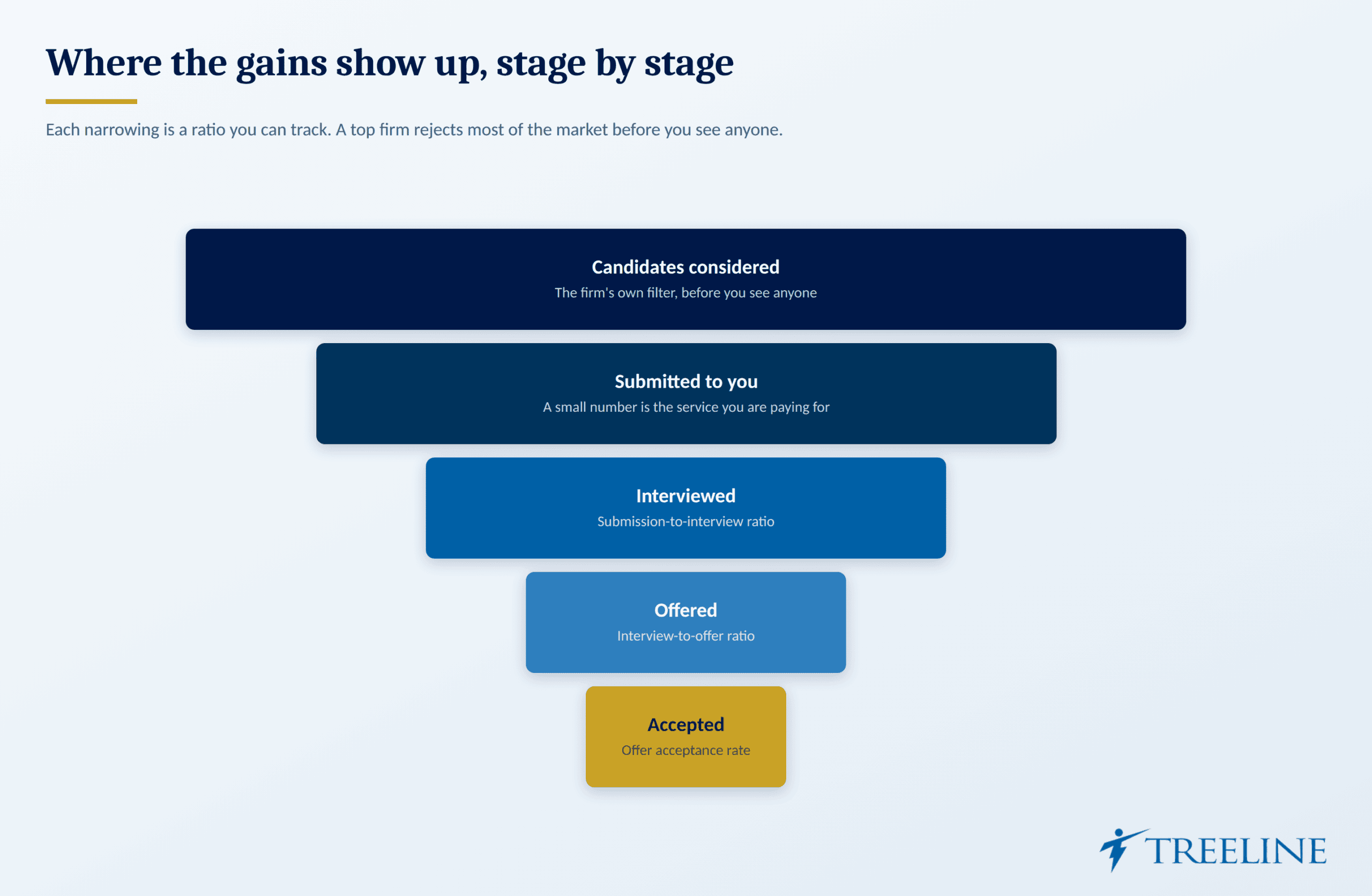
These are the numbers worth agreeing on before an engagement begins. None requires special software; all of them require someone to write down the current baseline honestly. The funnel below shows where each one sits.
Submission-to-Interview Ratio
This is the clearest single measure of whether a firm is filtering or forwarding. If a recruiter submits ten candidates and your team interviews two, the filtering is happening on your side and you are paying a placement fee for a sourcing service. If a recruiter submits four and you interview three, they are absorbing the screening burden, which is most of what a specialist is for.
Track it per search, and watch whether it improves as the partner learns your requirements, a flat ratio across three searches suggests they are not incorporating feedback. There is a caveat worth holding. A very high ratio is not automatically good; a firm submitting two candidates and getting two interviews may simply be submitting rarely, which solves your screening burden by transferring it into elapsed time.
Read the ratio alongside how long the first submission took. The combination you want is a small number of candidates arriving quickly, which is only achievable by a firm that already knows the market rather than one starting a search from scratch.
Interview-to-Offer Ratio
This measures whether the candidates reaching your final rounds are genuinely viable or merely presentable. A low ratio usually means one of two things: the recruiter is screening for the wrong attributes, or your requirement was never defined precisely enough to screen against. Both are fixable, but only if someone is watching the number.
Where this becomes revealing is in the reasons for rejection. If three consecutive finalists were rejected for the same underlying gap, the search definition is wrong, and that is a conversation to have in week three rather than month three.
Offer Acceptance Rate
For contested sales roles this is the number that most directly reflects the quality of the partnership, because it captures everything that happened before the offer. Acceptance is not primarily about compensation. It reflects whether expectations were set honestly early, whether the candidate’s actual motivation was understood, whether the process moved at a pace that sustained interest, and whether the counteroffer was anticipated.
A firm that closes a high proportion of the offers it reaches is doing work that is invisible in any other metric. It is also the metric that most clearly exposes an employer’s own contribution. If offers are being declined, the cause is usually discoverable and usually internal: a band that was never competitive, a loop that lost momentum, an interviewer who described the role differently from the hiring manager, or a reason-to-leave that was assumed rather than established.
Ask for the stated reason on every declined offer and write it down. Three declines with the same stated reason is not bad luck, and it is the cheapest diagnostic available to a hiring team. Treeline covers this specific dynamic in more depth in its discussion of contingency solutions for hard-to-fill sales roles.
Cost of the Open Seat
This is the number that reframes the fee conversation, and most companies have never calculated it. For an enterprise account executive, the cost of a vacant territory is not the salary you are saving. It is the pipeline not being built, the renewals not being protected, and the accounts a competitor is calling on while nobody answers.
A reasonable working figure is the quota the seat is expected to carry, divided across the year, multiplied by the months it stays empty, then discounted for whatever coverage colleagues are providing, which is usually less than assumed because they are protecting their own numbers first. Set against that, the arithmetic of a placement fee changes character.
This is not an argument that fees do not matter; it is an argument that a two-month reduction in vacancy is usually worth more than a few percentage points of negotiation on the fee, and employers routinely optimise the smaller number. The same calculation should be applied to the mis-hire, which is the more expensive failure.
A seller who leaves or is removed at month ten has consumed the vacancy cost twice, once before they arrived and again while they were underperforming, plus the ramp investment, the management attention, and the accounts that were handled poorly in between. This is the honest case for a firm that rejects most of the market before submitting anyone, and it is why submission volume is a cost rather than a service.
Twelve-Month Retention, With a Baseline
Retention is worth measuring and nearly worthless as a headline claim, for the reason set out at the start of this article. To make it meaningful, three things have to be defined. First, the denominator: retention of everyone placed, or only those who completed a probation period. Second, the comparison: your own historical twelve-month retention for the same role, which is the only baseline that matters.
Third, the treatment of terminations, a company that dismisses an underperformer at ten months has not experienced the same event as one whose hire resigned. Ask a prospective partner how they compute their own figure. A specific, slightly complicated answer is a good sign; a round number offered without qualification is not.
Fantasia’s position is that retention should be treated as a shared metric rather than a recruiter’s performance claim. He points out that a hire’s first year is shaped mostly by the territory, the manager, and the onboarding they receive, so a firm that accepts sole credit for retention is also implicitly accepting a level of control over those things that no external partner actually has.
Two Gains That Are Easy to Fake
Not every improvement in the numbers is real, and two of the five are straightforward to manufacture. Knowing how helps you read them honestly. Offer acceptance rate is the easier one to inflate. A firm that only lets an offer go out when acceptance is already agreed in principle will report a very high rate, which is partly genuine skill and partly definitional.
The way to read it is to ask how many candidates reached a final round and did not receive an offer, and why. A high acceptance rate sitting on top of a large pool of finalists who were quietly never offered is measuring caution rather than closing ability. Twelve-month retention is the other. A firm can improve it by favouring candidates who are risk-averse and unlikely to move again, which is not the same as favouring candidates who perform.
For an enterprise seller these can be opposing traits: the person who has changed companies twice in six years to take larger territories may be both the stronger performer and the higher retention risk. If retention is the only quality metric in the relationship, you are quietly instructing your partner to send you safer, less ambitious people.
The defence against both is to pair each metric with a counter-metric. Read acceptance alongside finalist volume. Read retention alongside quota attainment at twelve months, which your sales operations team already has. Any single number optimised in isolation will be optimised at the expense of something you care about more.
What You Gain That Never Shows Up in a Metric
Some of the most valuable things a specialist provides resist measurement entirely, and it would be dishonest to pretend otherwise. The first is calibration. A firm running similar searches across many companies knows what your requirement actually costs in the current market, whether your interview loop is unusually slow, and whether the profile you have described exists in the quantity you are assuming.
An employer running one search a year has no comparison set and tends to interpret the market’s response as luck. The second is early bad news. Being told in week one that the compensation band is short, or that the role as written describes two different jobs, is worth more than a polished shortlist delivered in week six.
It is also the thing an internal recruiter is least positioned to say to a hiring executive. The third is the conversations that do not produce a hire. A specialist talks to strong sellers who decline, and those declines tell you how your company is perceived, what your competitors are paying, and which parts of your pitch are not landing.
That intelligence exists whether or not you ask for it, and most employers never do. The fourth is optionality later. Recruiters maintain relationships across years, and the candidate who declines this quarter because their vesting date is six months away is frequently the candidate who joins next year. That only happens if someone kept the relationship warm.
The fifth is protection of your employer brand. Every candidate a firm approaches on your behalf forms an impression of your company, including the ones you never hear about. A firm that handles declines and rejections carefully is maintaining an asset that never appears on any report. This matters more in narrow markets than most employers appreciate.
If the qualified population for your enterprise role is a few hundred people who largely know each other, then how you treated the candidate you rejected in the final round is information that circulates. A rejection delivered late, vaguely, or not at all becomes a small permanent cost on every future search in that market, and it is paid by whoever runs the next one.
The sixth is a defensible record. When a hire does not work out, the question of what went wrong is usually contested and rarely resolved. A partnership that documented the requirement, the candidates considered and rejected, the reasons, and the feedback at each stage produces an account of the decision that can actually be examined.
That is worth having before you need it.
What Changes in the Second Year
The gains from a recruiting relationship are not evenly distributed across time, and the first search is usually the worst one to judge by. A first search carries the cost of learning. The firm is working out what your hiring manager actually rejects as opposed to what the job description says, how your interview loop behaves, which parts of your pitch land with candidates, and where your compensation sits against the market.
Some of that learning is paid for in candidates that miss. By the third or fourth search, several things should have changed. Intake should be shorter because the context is established. The first submission should arrive faster because the firm has been maintaining relationships in your market continuously rather than starting cold.
Submissions should miss less often on the same recurring criteria. And the firm should be bringing you people speculatively, candidates who are strong and available now, for roles you have not opened yet. That last behaviour is the clearest signal of a working partnership, and it only occurs when a firm expects the relationship to continue.
It is also the argument against rotating vendors on every requisition to extract a marginally better fee: the discount is visible and the accumulated context is not, so the trade looks better than it is. The corollary is that a partnership which has not improved by the fourth search is not going to. If the same defects keep appearing in submissions and intake still takes as long as it did the first time, the learning is not happening, and the relationship is worth ending rather than persevering with.
How to Run a Ninety-Day Test of a New Partner

Rather than committing to a broad relationship on the strength of a proposal, most employers are better served by a bounded test with agreed measurements. Give the firm one real search, a genuinely difficult one, not the easiest requisition on the list, because an easy role tells you nothing. Write down your own current baseline for the five numbers above before anything starts.
Agree what the firm will produce in the first two weeks and what you will produce in return, including feedback turnaround, because a test in which the employer is the bottleneck measures nothing useful. Then watch four things over the ninety days, alongside the questions summarised below.
- Did they push back during intake? A partner who accepted your job description without challenge either knows your market extremely well or has not engaged with it.
- Did submission quality converge? Each round of feedback should visibly narrow the next submission. If candidate six shares candidate one’s defect, either your feedback lacks specificity or they are not incorporating it.
- Did they tell you something you did not want to hear? On compensation, on timeline, on the realism of the profile. Silence here is the strongest negative signal available.
- Did they participate in the debrief?
Including on the searches that did not close. At ninety days you will have evidence rather than impressions, and the evidence transfers, the baseline you established is the one you will use to judge every subsequent partner.
Who Should Own the Relationship Internally
A recurring cause of wasted spend is that nobody inside the company actually owns the recruiting relationship, and the resulting gaps are invisible until a search fails. The failure mode is familiar. Talent acquisition manages the vendor contract, the hiring manager runs the interviews, finance approves the offer, and no single person holds the whole picture.
The recruiter ends up receiving different instructions from different people, feedback arrives in fragments, and the requirement drifts without anyone deciding that it should. For an enterprise sales role the practical answer is usually that the hiring manager owns the substance and talent acquisition owns the process, with one of them explicitly designated as the person the recruiter calls when something needs a decision.
That person needs enough authority to say the band is moving or the loop is being compressed, or the designation is decorative. It also matters that the same person handles the debrief. Recruiting knowledge decays quickly across a company; the reason a candidate declined in March is rarely available to the person running the search in September unless somebody wrote it down and owned it.
How to Tell a Real Gain From a Recycled Claim
The market is saturated with claims that sound specific and are not. A few questions separate them quickly.
- Ask what the number is measured against. A retention or fill rate without a stated denominator and comparison group is decoration.
- Ask for the definition, not the figure. How is a placement counted? Does a candidate who leaves at eleven months count against retention if they were dismissed?
- Ask about a search that failed. Every firm has them. One that cannot describe a recent failure and what it learned is either new or not being straight with you.
- Ask what they would decline. A firm that has never turned down a search is telling you how it prioritises.
- Ask how many candidates were rejected before the first submission. Volume of submissions is a measure of low filtering, not of a strong network.
- Ask who actually does the work.
The person in the meeting is not always the person running the search, and the difference matters more than the logo on the proposal. Fantasia’s view is that the willingness to be measured is the most reliable single indicator when choosing between contingency recruiting firms, more reliable than tenure in the market or the size of a client list.
He suggests treating any reluctance to agree on definitions before an engagement as the answer to the question you were asking.
What You Give Up in Exchange
Presenting the model as costless would be inaccurate, and the tradeoffs are worth stating plainly. You give up exclusivity of attention. Because payment depends on placement, a contingency recruiter allocates effort toward searches they believe will close. A vague requirement, an uncompetitive package, or a slow decision process will quietly lose priority to another client’s work, and you will rarely be told that directly.
You give up some control of the candidate relationship. The recruiter holds the relationship, manages expectations, and often knows more about the candidate’s true motivation than you do. That is most of the value, and it also means the quality of that relationship is not something you can inspect. You accept a fee that is a real number.
Fees are typically a percentage of first-year compensation, with 25 percent a common standard for professional sales roles, payable only on a hire. Whether that is worth it depends almost entirely on the cost-of-vacancy calculation above, which is why doing that arithmetic first changes the conversation. And you accept that the model does not fit every situation.
Confidential replacements and searches requiring a complete map of the market are better served by a different structure; Treeline’s comparison of retained search versus contingency search sets out the distinction, and its overview of contingency executive recruiters for sales leadership hiring covers the more senior end.
What This Looks Like on an Enterprise Account Executive Search
It is worth making the abstraction concrete, because the numbers behave differently by role. For an enterprise account executive the qualified population is small, mostly employed, and concentrated in a handful of competitors. That shapes every metric discussed here. Submission volume should be low by design, a firm sending you fifteen candidates for a narrow enterprise role is describing the size of its database rather than the size of the qualified market.
First submission will usually take longer than for a mid-market role, because the first conversations are persuasion rather than screening. Acceptance rate carries more weight than elsewhere, because losing a finalist means restarting against a pool that may contain only a few more genuine fits. Vacancy cost is higher for the same reason and because enterprise territories decay: pipeline built over quarters degrades when nobody is tending it, and the recovery is slower than the vacancy itself.
Retention needs the longest view of all. An enterprise seller with a nine-month cycle may produce very little in their first two quarters while doing exactly the right work, so a twelve-month judgment is genuinely difficult and an eight-month judgment is close to meaningless. If your compensation plan does not acknowledge that with a ramp, early attrition will show up in your retention number and will be recorded as a hiring failure when it was a plan design failure.
The practical adjustment is to set different expectations for this role family than for the rest of the sales organisation, and to say so explicitly when agreeing measurements with a partner. Applying mid-market benchmarks to an enterprise search produces a partnership that looks like it is underperforming while doing the right thing.
When the Gains Do Not Materialise
It is worth being direct about the conditions under which none of this works, because they are common and they are usually visible in advance. The gains do not appear when the compensation on offer is below market for the profile described and the employer will not move. No search partner solves that, and a firm that takes the assignment anyway is either optimistic or not being straight.
They do not appear when internal feedback takes a week. The speed advantage evaporates entirely, and the strongest candidates are gone before the second round. They do not appear when the requirement keeps changing. A definition revised three times in six weeks means every prior submission was judged against a standard that no longer applies, and the partner is effectively starting over each time.
They do not appear when nobody owns the decision. If the approving executive is unavailable or the internal candidate question is unresolved, the process will stall regardless of how good the shortlist is. And they do not appear when the employer engages four firms simultaneously on a narrow role. The same small candidate pool receives four different descriptions of the same opportunity, candidate ownership becomes contested, and every firm reduces its effort because the odds of being paid have quartered.
Fantasia’s observation is that most disappointing recruiting engagements were predictable at the outset from the state of the requirement rather than the choice of firm. He recommends spending the first week fixing the definition, the band, and the decision path, because a partnership entered before those are settled tends to spend its energy on the wrong problem.
Frequently Asked Questions
What do companies actually gain from top contingency sales recruiters?
Measurable improvements in five places: fewer unqualified candidates reaching hiring managers, a higher proportion of interviews producing offers, more offers accepted, shorter vacancy periods, and hires still performing after a year. Alongside those, they gain calibration on what the market will bear, early warning when a requirement is unrealistic, and intelligence from the candidates who decline.
How is a top firm different from an average one?
Mainly in filtering and in honesty. An average firm forwards candidates and lets your team screen; a strong one rejects most of the market before you see anyone. An average firm relays good news; a strong one tells you in week one that your band is short or your loop is too slow. Both differences show up in the numbers above.
What does contingency executive search cost?
Fees are a percentage of the hire’s first-year compensation and are invoiced only after a hire is made, with 25 percent a common standard for professional sales roles. There is no retainer. Confirm which earnings the percentage applies to and what voids the replacement guarantee, since definitions vary between firms.
Should we measure our recruiting partner on time-to-fill?
Not on its own. Time-to-fill includes delays the recruiter does not control and can be improved by submitting more candidates and lowering the internal bar. Break the elapsed time into segments instead and look at which segment is longest, it is often an internal one.
How long before we can judge whether a partnership is working?
About ninety days on one genuinely difficult search, provided you recorded your baseline first and agreed what each side would deliver. Judge convergence of candidate quality, willingness to challenge the requirement, and participation in debriefs, rather than whether a hire happened to close inside the window.
Is a contingency placement firm suitable for senior sales roles?
Often, yes, the fee model is separate from the seniority question. What matters is whether the firm works your specific market and can screen for the sales motion the role requires. Confidentiality is the real dividing line: if the current occupant does not know they are being replaced, a retained structure fits better.
Can we use several contingency recruiting firms at once?
You can, since these engagements are usually non-exclusive, but on a narrow role it tends to backfire. Multiple firms reach the same small pool with inconsistent messaging, candidate ownership becomes disputed, and each firm reduces effort as its odds of payment fall.
What should we prepare before engaging a sales recruiting contingency partner?
Your current baseline for the five metrics, an honest description of the territory as it will exist on day one, the real compensation band, the interview loop with named participants and committed availability, and a clear answer on whether an internal candidate is in play.
Measure the Gains With Treeline
Treeline, Inc. is a sales-only executive search firm based in Wakefield, Massachusetts, focused exclusively on building sales organizations. Our contingency sales recruiting service carries no upfront cost and no fee unless you hire, and we deliver your first candidate within three days of launching a search. If you are considering a new recruiting partner, start by writing down where your five numbers stand today.
Then get in touch, and we will tell you which of them we think we can move on your next enterprise sales search, and which ones depend on you.
Share This Story, Choose Your Platform!
Related Posts


What our happy clients are saying
Treeline Inc. provided us with the most candidates that aligned with our needs and were of the highest quality.

Dr. Jeffrey Klein Head of North America Sales, Satchel Pulse
Treeline Inc.’s collaborative, flexible, and communicative approach resulted in a smooth partnership. Beyond their recruitment expertise, their unique sourcing model was efficient and effective.

Sera Holt Director of Operations, LNS Research
Their professionalism was outstanding. Treeline Inc. was extremely thorough and ensured that we were on the same page before they started looking for candidates. They listened to us and did a great job working with the candidate to close out the process.

Cate Grant AVP Customer Success, Nasdaq
Thanks to Treeline Inc.’s intricate and thorough screening process, the company is able to hire six high-quality candidates that fit perfectly in the company’s culture. The team is highly receptive to concerns, and internal stakeholders are impressed with their unique recruitment abilities.

Anna McKean Sales Recruiter, Insider Intelligence
Treeline Inc. has been qualified individuals throughout a five-year-long engagement. They’ve made numerous placements of talented and qualified individuals for our business.

Michele St Laurent VP of HR, The Institute for Applied Network Security

Let Us Help You Source the Sales Talent You Need
Whether you’re building a team or replacing a key role, our Candidate Sourcing Platform provides a fast, flexible, and employer-focused solution.
Tell us more about your business and how we can help.
Treeline Inc.
Your Award-Winning Sales Recruitment Partner
15 Lincoln Street, Suite 314, Wakefield, MA 01880