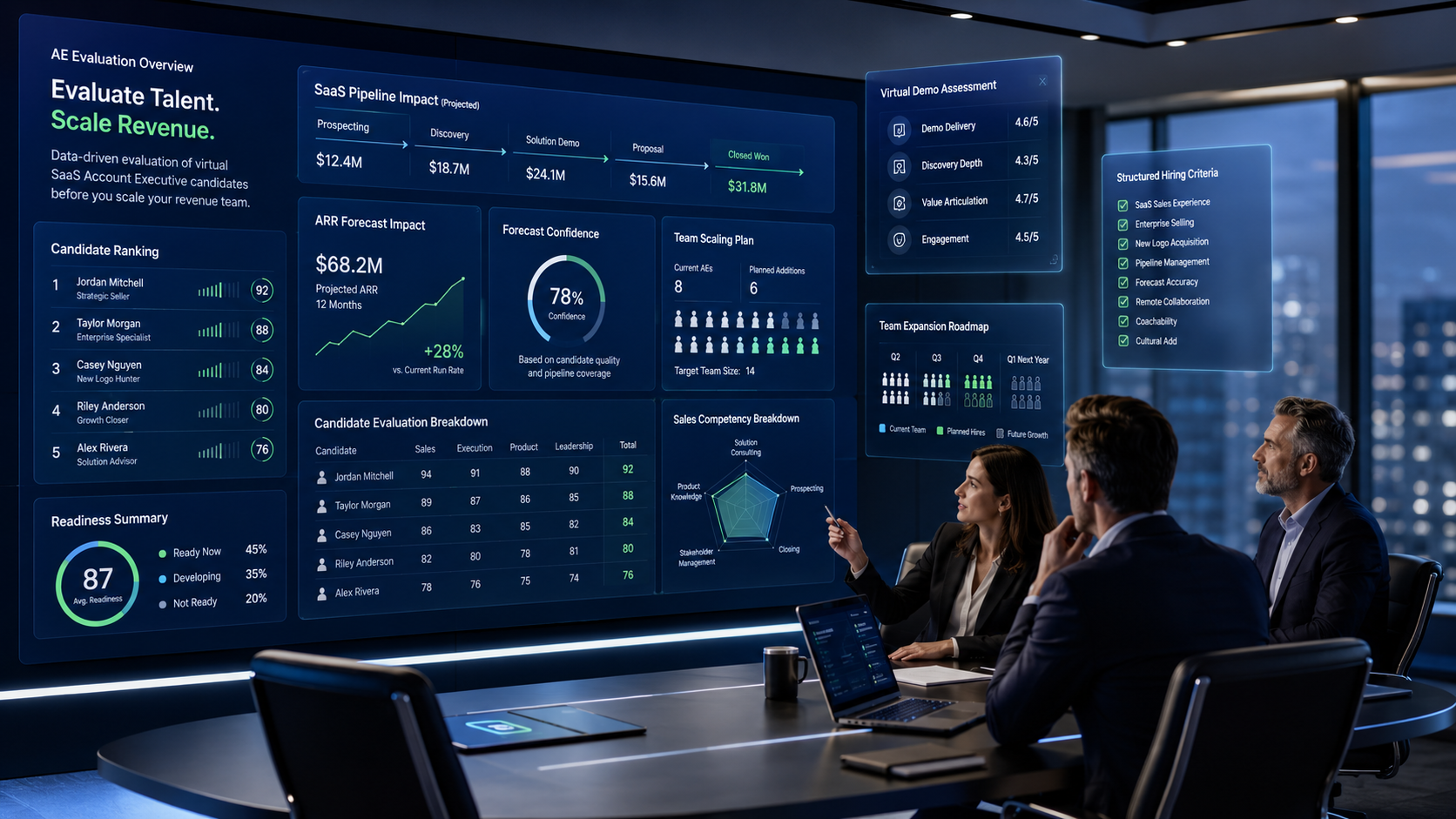
Virtual SaaS Account Executive Sales Recruiting should help SaaS companies evaluate whether Account Executives are ready to support a larger revenue team before the company adds more headcount, territories, quotas, and management complexity. For employers and sales recruiters, the goal is not simply to hire virtual sellers. The goal is to identify AEs who can operate inside a scalable SaaS revenue model, sell through digital channels, manage subscription-based buying decisions, and create repeatable pipeline quality before the business expands the sales organization.
That distinction matters because scaling a SaaS revenue team exposes every weakness in the hiring process. If the first few Account Executives cannot qualify properly, forecast accurately, document buyer signals, manage digital sales conversations, or explain subscription value clearly, adding more AEs will not solve the problem. It will multiply the problem. SaaS companies may end up with more activity, more pipeline noise, more missed forecasts, and more pressure on sales leadership.
Virtual SaaS Account Executive Sales Recruiting should help employers answer a sharper question: Are we hiring AEs who can support a scalable revenue system, or are we hiring individual sellers who only look strong in isolation? That is the difference between hiring for headcount and hiring for revenue architecture.
Why Virtual SaaS Account Executive Sales Recruiting Should Happen Before Team Expansion
Virtual SaaS Account Executive Sales Recruiting should happen before SaaS companies scale the revenue team because sales headcount growth can create false confidence. More AEs do not automatically create more revenue. More AEs create more interviews, more onboarding, more territories, more compensation planning, more pipeline reviews, more sales enablement pressure, and more management load. If the hiring profile is not clear, every additional AE increases the risk of inconsistent performance. Before scaling, employers should evaluate whether the current AE hiring profile is strong enough to repeat. The company should ask:
- Do our best AEs share clear traits?
- Do we know which AE backgrounds fail in our sales motion?
- Can we explain what makes an opportunity qualified?
- Do candidates understand our buyer personas?
- Do we know whether the role requires self-sourced pipeline?
- Can our virtual selling process be taught consistently?
- Are managers aligned on what good AE performance looks like?
- Do we have a scorecard that separates strong candidates from polished interviewers?
- Can we identify candidates who will fit our revenue model before offer stage?
Scaling without these answers creates hiring drag. Employers may add sales headcount without improving pipeline quality, conversion rates, or forecast accuracy. A virtual SaaS AE must be evaluated not only as an individual contributor, but as part of a larger revenue system. The candidate must fit the sales process, buyer journey, technology stack, compensation structure, and management model the company plans to scale.
The Pre-Scale AE Evaluation Problem
Many SaaS companies begin scaling sales teams too early. They may have strong founder-led sales, a few successful early AEs, or enough investor pressure to expand quickly. But early sales success does not always mean the company has a repeatable AE hiring model. Before adding more virtual Account Executives, employers should identify whether the sales motion is mature enough to support them. Common warning signs include:
- The company cannot clearly define its ideal customer profile
- Top performers use different qualification standards
- Sales stages are inconsistent across reps
- Forecast calls depend on opinion instead of evidence
- The CRM does not show real deal health
- AEs rely too heavily on founder credibility
- The buyer journey changes from deal to deal
- Demo quality varies widely
- Follow-up is inconsistent
- Managers cannot explain why some AEs succeed and others fail
If these issues exist, hiring more AEs may make the revenue function harder to manage. Virtual SaaS Account Executive Sales Recruiting should bring discipline to this stage. The search should be tied to the company’s scaling readiness, not only to its open requisitions.
What SaaS Companies Should Prove Before Adding More AEs
Before scaling a virtual revenue team, SaaS companies should prove that the AE role is repeatable. This does not mean every detail must be perfect. It means the company should understand what success requires and how to evaluate candidates against that standard.
1. The Sales Motion Is Clear
The employer should know whether the AE is selling to SMB, mid-market, enterprise, or strategic accounts. The company should also know whether the role is transactional, consultative, technical, product-led, founder-assisted, partner-driven, or fully outbound. A candidate who fits one motion may struggle in another.
2. Pipeline Ownership Is Defined
The company must decide whether the AE owns outbound pipeline, closes inbound demand, manages product-qualified leads, works partner-sourced opportunities, or handles a blended pipeline model. An AE who succeeds with high-intent inbound leads may not be right for a role requiring cold outbound prospecting.
3. Buyer Complexity Is Understood
SaaS employers must identify how many stakeholders are usually involved and what each stakeholder cares about. A simple buyer journey requires one type of AE. A buying committee involving finance, procurement, operations, security, and executive approval requires another.
4. Forecast Rules Are Documented
A virtual AE must know when a deal is real enough to forecast. The employer should define what evidence is required at each stage. Without clear forecast rules, scaling the team will create inconsistent pipeline reporting.
5. Ramp Expectations Are Realistic
The company should know how long it takes for a new AE to understand the product, buyer, market, messaging, CRM process, and sales cycle. If ramp expectations are unrealistic, the company may misjudge candidate quality.
6. The Manager Can Coach the Role
Scaling a virtual AE team requires managers who can coach remotely. If sales leadership does not have time or structure to coach new AEs, hiring more people may reduce performance quality instead of improving revenue.
How Virtual Account Executive Sales Recruiting Changes in SaaS
Virtual Account Executive Sales Recruiting becomes more demanding in SaaS because the AE must sell value, not just availability, pricing, or features. In SaaS, the buyer is usually evaluating a recurring decision. They are asking whether the product will solve a business problem, whether users will adopt it, whether implementation will work, whether security or integration concerns are manageable, and whether the subscription will continue to justify itself over time. A virtual AE must manage that conversation through digital channels. This requires:
- Strong discovery discipline
- Clean video-call presence
- Ability to run virtual demos
- Written follow-up that advances the deal
- CRM documentation that gives managers visibility
- Stakeholder mapping across business and technical buyers
- Ability to create urgency without in-person pressure
- Comfort coordinating internal resources remotely
- Forecast updates based on buyer evidence
Employers should not assume that every Account Executive can sell virtually just because they have worked remotely. Virtual selling is a revenue competency. It should be evaluated directly.
Where Remote SaaS Account Executive Sales Recruiting Still Matters
Remote SaaS Account Executive Sales Recruiting remains important because virtual selling performance depends on remote work discipline. A virtual SaaS AE must sell digitally, but they must also manage their work without daily in-office supervision. Remote-readiness includes time management, pipeline organization, prospecting discipline, CRM hygiene, self-directed follow-up, written communication, manager update cadence, forecast preparation, and accountability without constant prompting. A candidate can be persuasive on video and still struggle as a remote seller. Remote SaaS Account Executive Sales Recruiting helps employers evaluate whether the candidate can operate independently inside a distributed sales team. For SaaS companies preparing to scale, this matters because one remote AE with weak operating habits can be coached, but ten remote AEs with inconsistent operating habits can overwhelm the management system.
The Revenue Team Scaling Readiness Matrix
SaaS employers should evaluate virtual AE candidates against the scaling stage of the company. A company hiring its first two AEs needs a different profile than a company expanding from 20 to 50 AEs.
Early-Stage SaaS: The Builder AE
Early-stage SaaS companies often need AEs who can tolerate ambiguity. These candidates may need to test messaging, build pipeline from scratch, help refine the sales process, and communicate market feedback to leadership. Strong signals include startup sales experience, ability to sell without a fully mature brand, comfort with changing messaging, self-sourced pipeline history, strong discovery instincts, and a willingness to document what works.
Growth-Stage SaaS: The Process AE
Growth-stage SaaS companies often need AEs who can follow a defined process while still exercising judgment. The company may have clearer ICP, messaging, sales stages, and handoff processes. Strong signals include SaaS sales motion fit, CRM discipline, consistent quota performance, ability to manage multiple active opportunities, strong virtual demo and follow-up habits, and evidence-based forecasting.
Scale-Up SaaS: The Specialist AE
Scale-up SaaS companies may need AEs by vertical, segment, territory, product line, or strategic account type. The hiring process must become more precise. Strong signals include segment-specific experience, enterprise or mid-market specialization, industry familiarity, multi-stakeholder sales history, ability to work with sales engineers or customer success, and strong internal coordination. The right AE profile depends on the company’s scaling stage.
How Virtual SaaS Sales Recruiters Should Calibrate the Search
Virtual SaaS Sales Recruiters should calibrate the search before sourcing begins. The recruiter should not simply ask for a job description and begin screening resumes. A strong calibration process should clarify:
- Why the company is adding this AE role now
- Whether the team is replacing a poor fit or expanding
- What the best current AEs do differently
- Which prior AE hires failed and why
- What buyer segment the role will cover
- What pipeline source the AE must own
- What contract value and sales cycle the AE must manage
- What technical or product knowledge is required
- What manager support will be available
- What remote or virtual sales habits matter most
- What compensation range is realistic
- What deal-breakers should eliminate candidates early
This calibration prevents the recruiter from sending candidates who are qualified in general but wrong for the company’s scale stage. A candidate can be a strong AE and still be the wrong hire.
The Candidate Evidence SaaS Employers Should Demand
Before scaling revenue teams, employers should require stronger evidence from AE candidates. A resume can show job titles and companies. It cannot prove that the candidate can perform in the employer’s specific virtual SaaS environment. Employers should look for candidate evidence in six areas: sales motion evidence (segment, buyer personas, contract size, sales cycle length, pipeline source, quota structure, win-rate context, demo ownership); digital selling evidence (discovery structure, demo flow, follow-up examples, stakeholder communication, meeting preparation, buyer engagement tactics); pipeline quality evidence (qualification criteria, disqualification discipline, pipeline coverage, conversion rates, prospecting process, opportunity prioritization); forecast evidence (decision criteria, economic buyer access, timeline confirmation, budget visibility, legal or procurement status, risk notes, mutual action plan); subscription value evidence (customer fit judgment, adoption concerns, renewal awareness, expansion potential, customer success handoff, churn risk awareness); and remote accountability evidence (weekly operating rhythm, CRM discipline, manager communication, prospecting schedule, follow-up system, prior remote performance). These categories make the interview more practical and less dependent on personality.
Why Scaling Fails When AE Hiring Is Too Generic
SaaS companies often run into problems when they hire AEs based on broad experience rather than precise fit. Generic hiring may look efficient at first. But once those candidates enter the business, performance gaps appear. Common problems include:
- AEs cannot create enough pipeline
- AEs depend too heavily on inbound demand
- AEs over-forecast deals that are not ready
- AEs struggle to sell to technical stakeholders
- AEs cannot run strong virtual discovery
- AEs do not document next steps clearly
- AEs lack urgency in follow-up
- AEs are not aligned with the company’s sales cycle
- AEs need more manager support than expected
- AEs create activity but not qualified opportunities
These issues are expensive because they show up after the company has already invested in recruiting, onboarding, compensation, tooling, enablement, and management time. Virtual SaaS Account Executive Sales Recruiting should reduce that risk by making the hiring profile more specific before the team scales.
The Pre-Scale Interview Framework
SaaS employers should build interviews around the question: Can this candidate help us scale revenue predictably?
Interview 1: Sales Motion Fit
The first interview should confirm whether the candidate has sold in a comparable SaaS environment. Topics to test: segment experience, sales cycle length, deal size, buyer personas, pipeline source, quota attainment, and product complexity.
Interview 2: Virtual Selling Execution
The second interview should test how the candidate sells through digital channels. Topics to test: video discovery, virtual demo preparation, digital follow-up, stakeholder communication, CRM usage, and remote work discipline.
Interview 3: Revenue Judgment
The third interview should test how the candidate thinks about SaaS revenue quality. Topics to test: customer fit, adoption risk, expansion potential, renewal implications, forecast judgment, and deal risk communication.
Interview 4: Practical Evaluation
The final interview should include a realistic scenario, such as a mock discovery call, written follow-up exercise, deal review, pipeline prioritization exercise, or forecast defense. This structure helps employers make better decisions because each interview has a purpose.
The SaaS AE Scenario Test
A scenario test is especially useful before scaling a virtual AE team. Give the candidate a realistic SaaS sales scenario: a mid-market company is evaluating the platform; the VP of Sales is interested, but RevOps needs integration details; finance wants a business case; procurement wants price concessions; end users are concerned about adoption; the timeline is unclear; and the current champion is not the final decision-maker. Ask the candidate:
- How would you qualify this opportunity?
- Who would you need to speak with next?
- What questions would you ask the VP of Sales?
- How would you involve RevOps?
- What would you need to build a business case for finance?
- How would you prevent procurement from controlling the conversation too early?
- What would make this deal forecastable?
- What would you document in CRM?
- What would your follow-up email say?
- What would make you disqualify the opportunity?
This exercise reveals sales judgment more clearly than a generic pitch. Strong candidates will think in terms of buying process, stakeholder roles, business pain, risk, and next steps. Weak candidates will focus too quickly on the demo or price.
How to Evaluate AEs for Repeatability, Not Just Performance
Before scaling revenue teams, SaaS companies need repeatable sales performance. A candidate’s past quota attainment matters, but employers should also understand whether that performance can transfer into the new environment. Ask whether the candidate was successful because of their own outbound effort or because of strong inbound demand, whether the prior company had a mature brand that made selling easier, whether the product category was already well understood by buyers, whether the candidate owned full-cycle sales or only one part of the process, whether a solution engineer or founder carried the technical portion of the sale, whether the candidate managed multiple stakeholders or mostly one buyer, and whether the sales process was similar to the employer’s process. Repeatability matters because scaling depends on pattern recognition. A strong candidate can explain what they did personally to create results and can separate company advantage from individual execution.
Compensation Alignment Before Scaling
Compensation alignment is often overlooked in virtual SaaS AE hiring. Before scaling revenue teams, employers need to understand whether the compensation plan matches the role’s expectations. If the plan is too low, qualified candidates may not engage. If the plan is too high for the revenue model, the company may create unsustainable cost structures. Employers should align base salary, variable compensation, quota, ramp period, territory potential, expected pipeline source, average contract value, sales cycle length, commission timing, accelerator structure, and renewal or expansion credit, if applicable. Virtual SaaS Sales Recruiters should surface this issue early, because compensation is part of candidate-market fit.
How Treeline Helps Employers Build a Better Virtual SaaS AE Search
Treeline’s value for employers is tied to sales specialization, speed, role alignment, and candidate quality. Treeline is focused on sales recruiting rather than broad staffing, with a proprietary Treeline Resume® platform, more than 200,000 qualified sales professionals, and employer-focused recruiting support for companies building high-performing sales teams. For SaaS companies preparing to scale revenue teams, that matters because AE hiring is not only a talent acquisition task. It is a revenue design decision. Treeline can help employers clarify which AE profile fits the company’s SaaS sales motion, whether the role requires remote, virtual, or hybrid selling strengths, which candidate backgrounds are likely to transfer, which interview questions reveal sales judgment, what scorecard should be used before final selection, how to evaluate candidate quality without slowing the process, and how to reduce hiring risk before adding more revenue headcount.
What a Strong Virtual SaaS AE Hiring Scorecard Should Include
A practical scorecard helps employers compare candidates without relying on interview chemistry alone. For Virtual SaaS Account Executive Sales Recruiting, the scorecard should reflect the company’s scaling goals.
| Evaluation Area | What Employers Should Measure |
|---|---|
| SaaS sales motion fit | Segment, ACV, sales cycle, buyer type, product complexity |
| Virtual selling execution | Discovery, demo control, video presence, written follow-up |
| Pipeline creation | Self-sourcing, qualification, conversion, pipeline discipline |
| Forecast judgment | Evidence-based close dates, risk visibility, CRM accuracy |
| Subscription revenue thinking | Customer fit, adoption risk, renewal impact, expansion awareness |
| Scaling fit | Ability to follow process, document learning, work within a growing team |
| Remote accountability | Independent work rhythm, manager communication, activity discipline |
This scorecard keeps the hiring process tied to revenue outcomes. It also helps sales recruiters provide better candidate feedback. Instead of saying a candidate is “strong” or “not strong,” recruiters can explain exactly where the candidate fits or falls short.
When Employers Should Pause Before Hiring More Virtual AEs
Sometimes the best hiring decision is to pause and refine the role before adding more headcount. Employers should pause if the sales process is unclear, existing AEs are not using CRM consistently, managers disagree on what good looks like, quota expectations are not tied to market reality, the candidate profile changes after every interview, compensation is not competitive, the company cannot explain why prior AEs failed, pipeline quality is poor across the existing team, the onboarding process is not ready, or leadership expects new hires to solve a positioning problem. A recruiting partner can help identify these gaps, but employers must be willing to address them. Hiring more virtual AEs will not fix unclear positioning, weak qualification standards, poor enablement, or unrealistic quota design.
The Hiring Standard SaaS Companies Should Use
SaaS companies should evaluate virtual AEs based on whether they can support the next stage of revenue growth. The standard should be specific:
- Can this candidate sell the company’s SaaS product through a virtual process?
- Can this candidate manage the company’s buyer complexity?
- Can this candidate create or convert pipeline based on the role design?
- Can this candidate forecast with evidence?
- Can this candidate document deal movement clearly?
- Can this candidate understand subscription revenue quality?
- Can this candidate operate independently without becoming disconnected?
- Can this candidate fit into a revenue team that is about to scale?
Virtual SaaS Account Executive Sales Recruiting works best when employers treat hiring as a scaling decision, not only a staffing need. Before adding more AEs, SaaS companies need to know whether the candidates they are hiring can strengthen the system they are building. That is the real value of a focused virtual SaaS AE recruiting strategy.
FAQ
What is Virtual SaaS Account Executive Sales Recruiting?
Virtual SaaS Account Executive Sales Recruiting is the process of identifying, evaluating, and hiring SaaS Account Executives who can sell subscription products through digital channels, manage pipeline, engage buyers virtually, and support scalable revenue growth.
How is Remote SaaS Account Executive Sales Recruiting different from Virtual SaaS Account Executive Sales Recruiting?
Remote SaaS Account Executive Sales Recruiting focuses on hiring SaaS AEs who can work outside a traditional office. Virtual SaaS Account Executive Sales Recruiting focuses more specifically on digital selling execution, including video discovery, virtual demos, CRM workflows, and online stakeholder communication.
What should SaaS companies evaluate before scaling virtual AE teams?
SaaS companies should evaluate sales motion clarity, pipeline ownership, buyer complexity, forecast standards, compensation alignment, remote accountability, virtual selling ability, and whether the AE profile can be repeated across a larger revenue team.
How should Virtual SaaS Sales Recruiters screen Account Executive candidates?
Virtual SaaS Sales Recruiters should screen for SaaS sales motion fit, digital selling execution, pipeline creation, CRM discipline, forecast judgment, subscription revenue awareness, compensation alignment, and evidence that the candidate can perform in a scaling revenue team.
How does Virtual Account Executive Sales Recruiting help employers avoid hiring risk?
Virtual Account Executive Sales Recruiting helps employers avoid hiring risk by testing whether candidates can sell through digital channels, manage buyer complexity, maintain forecast visibility, and operate independently before the company adds more sales headcount.
Share This Story, Choose Your Platform!
Related Posts
What our happy clients are saying
Treeline Inc. provided us with the most candidates that aligned with our needs and were of the highest quality.

Dr. Jeffrey Klein Head of North America Sales, Satchel Pulse
Treeline Inc.’s collaborative, flexible, and communicative approach resulted in a smooth partnership. Beyond their recruitment expertise, their unique sourcing model was efficient and effective.

Sera Holt Director of Operations, LNS Research
Their professionalism was outstanding. Treeline Inc. was extremely thorough and ensured that we were on the same page before they started looking for candidates. They listened to us and did a great job working with the candidate to close out the process.

Cate Grant AVP Customer Success, Nasdaq
Thanks to Treeline Inc.’s intricate and thorough screening process, the company is able to hire six high-quality candidates that fit perfectly in the company’s culture. The team is highly receptive to concerns, and internal stakeholders are impressed with their unique recruitment abilities.

Anna McKean Sales Recruiter, Insider Intelligence
Treeline Inc. has been qualified individuals throughout a five-year-long engagement. They’ve made numerous placements of talented and qualified individuals for our business.

Michele St Laurent VP of HR, The Institute for Applied Network Security

Let Us Help You Source the Sales Talent You Need
Whether you’re building a team or replacing a key role, our Candidate Sourcing Platform provides a fast, flexible, and employer-focused solution.
Tell us more about your business and how we can help.
Treeline Inc.
Your Award-Winning Sales Recruitment Partner
15 Lincoln Street, Suite 314, Wakefield, MA 01880