A company runs a careful search, assesses well, hires a strong field seller, and watches them miss for three quarters. The debrief concludes the hire was wrong. Sometimes it was. More often the patch was drawn before anyone thought about who would carry it, and no seller available at any price was going to make that geography produce the number attached to it.
Territory design is the part of field sales hiring that happens before the search and gets reviewed after the failure. It sets the ceiling on what the hire can do, it decides which kind of person can do it, and it is almost never on the agenda when a requisition opens.
This article is about the patch rather than the person. The complementary question, how to assess the seller who will carry it, is covered in outside sales recruiting. Searches of this kind are commonly run under a contingency sales recruiting arrangement, and the wider case for that model inside a growth plan is set out in how contingency recruiting transforms sales hiring for growth-driven employers. A separate and genuinely different question is what an unfilled territory costs while it sits empty, which Treeline has written about in the true cost of vacant territories.
Dan Fantasia, CEO of Treeline, Inc., makes a point that reframes most of these conversations: a territory is a hiring decision made in advance. By the time a company is interviewing, the most consequential choice about that role has already been made by whoever drew the lines, and usually without anyone treating it as a hiring choice at all.
What Territory Design Actually Decides
Four things are settled the moment the map is drawn, and all four constrain the hire.
The ceiling on reachable revenue. A patch contains a finite number of companies that could plausibly buy. No amount of effort changes that number in year one. If the quota assumes more, the seller is being measured against a target the geography cannot contain.
The shape of the working week. Density decides how many face-to-face meetings are possible. One metro supports several meetings a day; four states support a planned swing and a lot of driving. These are different jobs with the same title, and they suit different people.
How long before anything closes. A patch with existing customers produces referenceable conversations in month two. A patch with none produces them in month six. Both can be good territories; only one of them is survivable on a standard commission plan.
Who will accept the job. Strong field sellers read a territory in the first interview, because they have been burned before. A vague or obviously thin patch is a risk signal that costs a company its best candidates before any offer is discussed.
The Four Territory Design Mistakes That Outlive the Hire
The same four errors recur, and each one survives several hiring cycles because the symptom always looks like a people problem.
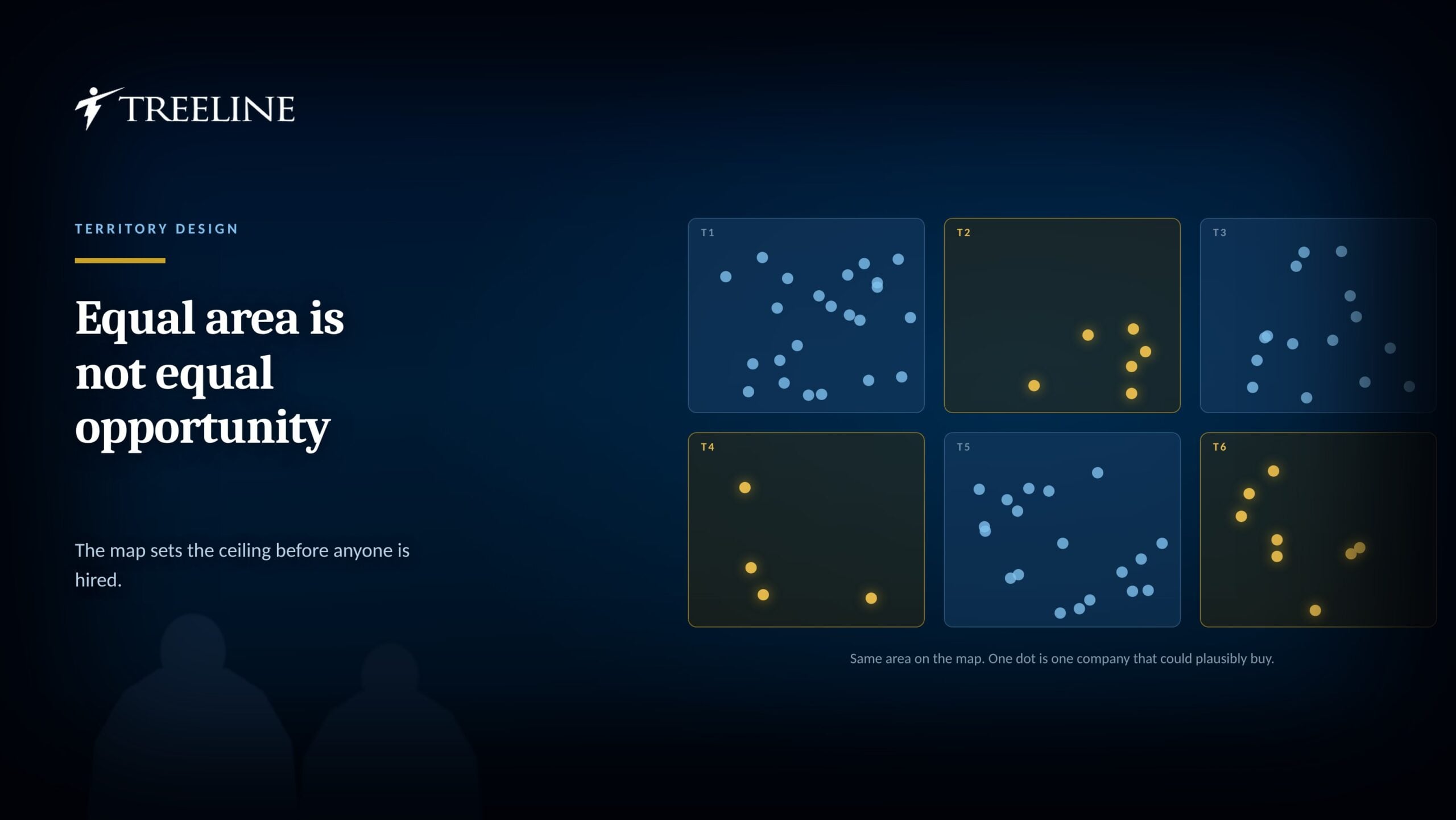
Drawing by geography when the buyers are not evenly spread. Equal square miles is the easiest line to draw and almost never the right one. Opportunity clusters around industry, population and existing relationships, so six territories of similar size routinely contain wildly different numbers of real prospects. The seller in the thin one is not underperforming; they are working a smaller market against the same number.
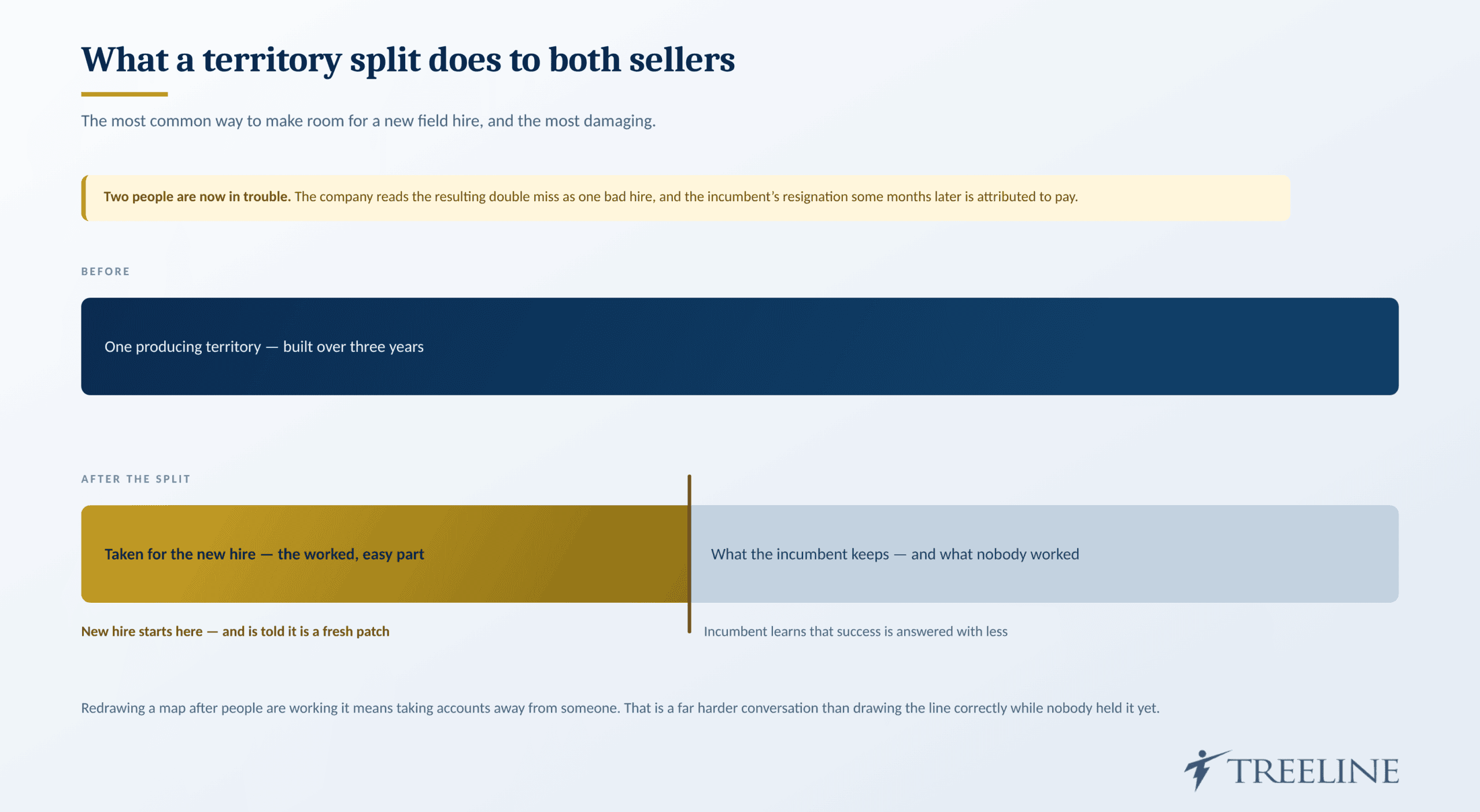
Splitting a producing territory to make room for a new hire. This is the most common and the most damaging. The incumbent loses accounts they built, usually the easy ones, and learns that success is punished with a smaller patch. The new hire inherits whatever was left over, which is the part nobody worked because it was hard. Two people are now in trouble, and the company reads it as one bad hire.
Overlap with no rule for it. Where two patches touch, somebody will eventually work the same account. Without a written rule, who owns what, decided how, and by whom, the resolution becomes political, and the seller who loses the argument learns to avoid the boundary entirely. That quiet withdrawal leaves a strip of market nobody covers.
Never redrawing. A map drawn three years ago reflects a product, a price point and a market that have all moved. Territories are treated as permanent because redrawing them is unpleasant, and the cost of leaving them wrong is invisible until it is expressed as turnover.
What these four share is that each one is cheap to prevent and expensive to reverse. Redrawing a map after people are working it means taking accounts away from someone, which is a far harder conversation than drawing the line correctly when nobody held it yet.
Fantasia’s framing of the split in particular is that a company doing it has quietly decided the incumbent matters less than the plan, and that the incumbent will work this out faster than anyone expects. The resignation that follows some months later is usually attributed to compensation.
Why Territory Design Problems Look Like People Problems
The failure signature of a badly drawn patch is almost identical to the failure signature of a weak hire, which is why companies so often reach the wrong conclusion.
A seller in a thin territory misses the number, becomes defensive about pipeline reviews, and starts spending time on the few accounts that respond. From the outside this reads as poor prospecting discipline and a bad attitude. From inside the patch it is a rational response to a market that does not contain enough buyers.
Three patterns distinguish a territory problem from a person problem, and all three are visible in data a company already has.
Sequential failure in the same seat. Two or three different people miss in the same patch while others hit. The common factor is the territory, and the only reason this is ever read as coincidence is that each departure is reviewed separately.
Pipeline that is healthy at the top and thin at the bottom. The seller is finding conversations and the conversations are not qualifying. That points at fit between what is being sold and who is in the patch, rather than at the seller’s ability.
A number that was never built from the territory. Where quota was set by dividing a company target by headcount rather than by assessing each patch, a miss carries no information about the person at all.
Fantasia’s observation from the recruiting side is that companies with recurring failures in one seat almost always present it as a hiring problem, and the useful first question is not about the candidates. It is whether anyone has looked at what that patch actually contains.
What to Fix in Territory Design Before the Search Opens
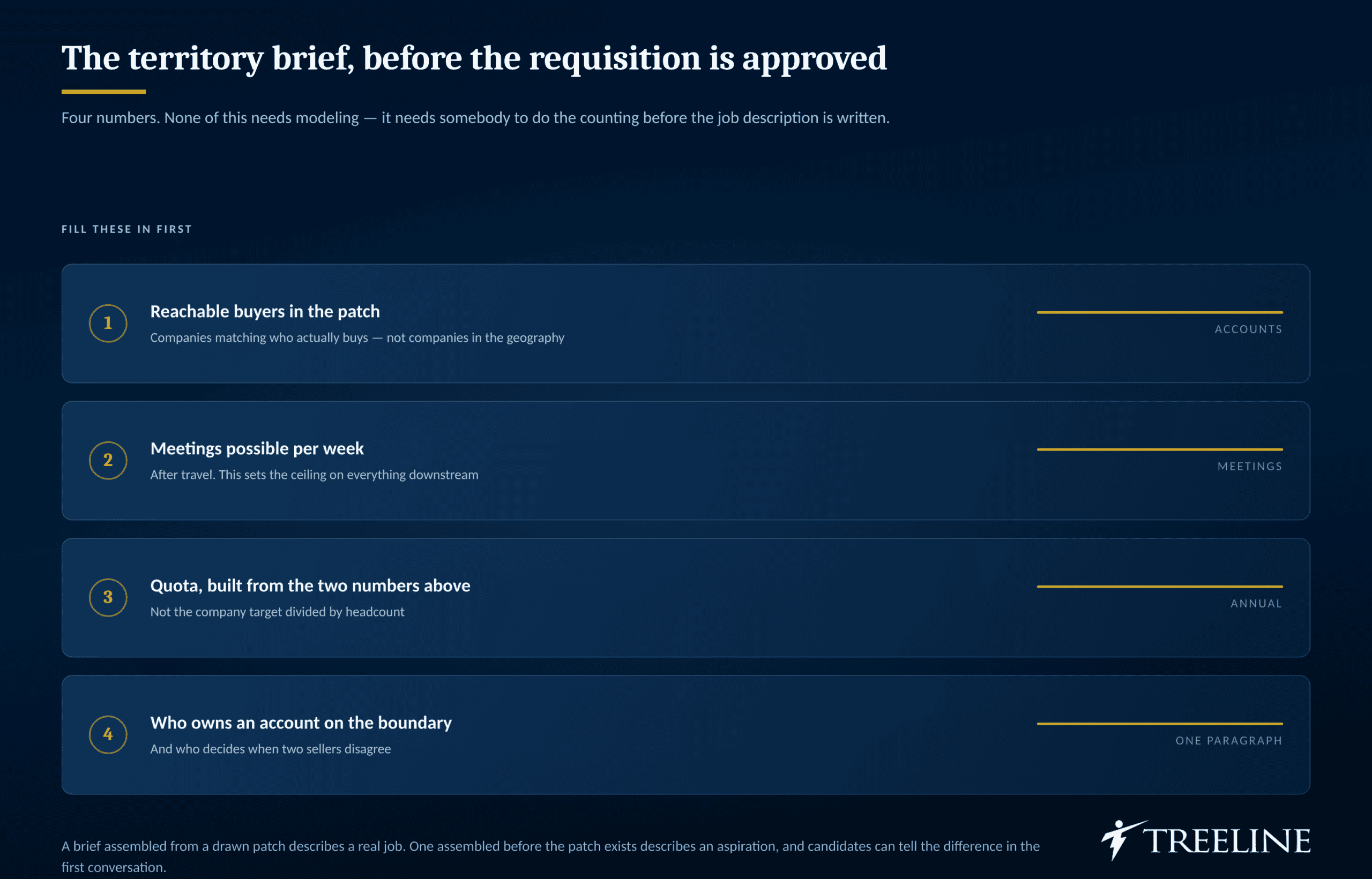
None of this requires sophisticated modeling. It requires somebody to do the counting before the requisition is approved.
Count the reachable buyers. Not companies in the geography, companies in the geography that match the profile of who actually buys. The number is usually smaller than expected and it is the single most useful figure in the whole exercise.
Convert density into meetings. How many of those accounts can realistically be seen in a week, accounting for travel. That number sets the ceiling on everything downstream and determines which seller profile fits.
Set quota from the patch, not from the plan. The company target divided by headcount is a budget, not a quota. A quota that bears no relation to what a territory contains cannot be hit by anyone, and setting one guarantees a sequence of apparent hiring failures.
Write the boundary rule down. Who owns an account that straddles two patches, how a conflict is settled, and who decides. One paragraph, agreed before anyone joins, prevents the most predictable source of friction in a field organization.
How Territory Design Changes Who You Should Hire
Once the patch is drawn honestly, it tells you which candidate to look for, which is why doing this first makes the search faster rather than slower.
A dense patch with existing customers calls for volume tolerance, fast context-switching and discipline about short meetings. Relationship depth matters less than throughput.
A sparse, multi-state patch calls for trip planning, comfort with long stretches alone, and the judgment to build a swing around one ready account. Hiring the dense-patch profile into this one produces someone who is frustrated by month two and gone by month seven, having correctly concluded that the job they accepted does not exist where they live.
A greenfield patch with no customers calls for someone who has started from nothing before, on purpose, more than once, and a compensation plan that acknowledges there is nothing to close for several months.
A patch being split off an incumbent calls for a different kind of conversation entirely. The candidate should be told plainly what they are inheriting and what was kept, because they will discover it in week three regardless, and the ones who accept on honest terms stay. It is also worth deciding in advance what the incumbent is told and when, because the new hire’s first weeks are considerably harder if they arrive into a team that learned about the split from them.
The practical consequence of all four is that the territory should be settled before the job description is written, not after the first round of interviews. A brief assembled from a drawn patch describes a real job. A brief assembled before the patch exists describes an aspiration, and candidates can tell the difference in the first conversation.
What a Recruiting Partner Can and Cannot Fix
A search firm can tell a company that its patch is unsellable to the candidates worth having. It cannot make the patch produce more than it contains.
What a good partner does contribute is market feedback, which is the fastest diagnostic available. When strong candidates decline at the territory conversation rather than at compensation, that is information about the map, and it arrives weeks before any internal analysis would. A firm working several field searches in the same vertical knows what a credible patch looks like in that market and can say when one is not.
This is also where a contingency arrangement sits comfortably. The role is not confidential, the population is reachable, and a firm paid on placement has a direct interest in telling a company early that the territory will not attract the person they want, because the alternative is working a search that cannot close. Fantasia’s consistent position is that the arrangement should follow the shape of the population and the sensitivity of the role, and a field seat with a defined patch sits close to the center of what contingency does well.
The limit is real and worth stating. If a company insists on a quota the territory cannot support, no recruiting partner can solve that, and the honest answer is to say so rather than to fill the seat twice.
Reading the First Year Against the Patch
Judge the hire against what the territory could produce, not against the plan number, and the first year becomes readable much earlier.
By week six there should be a reasoned account list, a ranking with a why, not a list of logos. By week ten, first meetings in the parts of the patch that were not already warm. By the end of the second quarter, a view of the territory the company did not have before: which segments respond, what they currently use, where the real objection sits. By month nine, pipeline distributed across the patch rather than concentrated in its easiest corner.
If those appear and the revenue does not, the territory is the more likely explanation than the person, and the next move is to recount the reachable buyers rather than to reopen the search. If they do not appear, the problem is in the seat.
The distinction is worth drawing deliberately, because the two conclusions lead to opposite actions. One ends in a redrawn map and a revised number. The other ends in a second search. Running the second when the first was needed is how a company arrives at three consecutive failures in one territory and still believes it has a recruiting problem.
Frequently Asked Questions
What does territory design decide that hiring cannot change?
The ceiling on reachable revenue, the shape of the working week, and how long before anything can close. A patch contains a finite number of plausible buyers, and no level of candidate quality changes that number in year one. If the quota assumes more than the geography holds, the seller is being measured against something unreachable.
How can you tell a territory problem from a hiring problem?
Three signals, all visible in data a company already holds: two or three different people missing in the same seat while others hit; pipeline that is healthy at the top and thin at the bottom; and a quota that was set by dividing a company target by headcount rather than by assessing the patch. Any of those points at the map.
Why is splitting a producing territory so damaging?
It harms two people at once. The incumbent loses accounts they built and learns that success is answered with a smaller patch, and the new hire inherits the part that was left unworked because it was hard. The company then reads the resulting double miss as one bad hire.
Should overlap between territories be eliminated?
Not necessarily, but it has to be governed. Where patches touch, somebody will eventually work the same account, and without a written rule for who owns it and who decides, the matter becomes political. Sellers who lose that argument quietly stop working the boundary, which leaves a strip of market uncovered.
How often should territories be redrawn?
Often enough that the map still reflects the product, the price point and the market. Territories tend to be treated as permanent because redrawing them is unpleasant, so the cost of a stale map stays invisible until it shows up as turnover in a particular seat.
Does a thin territory mean we should not hire?
No, it means the brief has to be honest and the terms have to match. A sparse or greenfield patch can be a good territory for the right person on the right plan. It is a poor one for a seller hired on dense-patch assumptions and a standard commission structure.
What should candidates be told about a patch split off an incumbent?
Exactly what they are inheriting and exactly what was retained. They will discover it in week three in any case, and the candidates who accept on honest terms are the ones who stay. Discovering it afterwards converts a good hire into a short tenure.
Can a recruiting partner tell us our territory is a problem?
A good one will, and the signal arrives early. When strong candidates decline at the territory conversation rather than over compensation, that is direct market feedback about the map, and it surfaces weeks before any internal review would reach the same conclusion.
Draw the Map Before You Approve the Requisition
The most consequential decision about a field sales role is usually made by whoever drew the lines, months before anyone writes a job description, and it is almost never treated as a hiring decision.
Count the buyers the patch actually contains. Work out how many meetings a week that supports. Set the quota from those two numbers rather than from the company target divided by headcount. Write down who owns the boundary. Then open the search, and expect it to run faster, because a territory a candidate can evaluate is one a candidate will accept.
Share This Story, Choose Your Platform!
Related Posts
What our happy clients are saying
Treeline Inc. provided us with the most candidates that aligned with our needs and were of the highest quality.

Dr. Jeffrey Klein Head of North America Sales, Satchel Pulse
Treeline Inc.’s collaborative, flexible, and communicative approach resulted in a smooth partnership. Beyond their recruitment expertise, their unique sourcing model was efficient and effective.

Sera Holt Director of Operations, LNS Research
Their professionalism was outstanding. Treeline Inc. was extremely thorough and ensured that we were on the same page before they started looking for candidates. They listened to us and did a great job working with the candidate to close out the process.

Cate Grant AVP Customer Success, Nasdaq
Thanks to Treeline Inc.’s intricate and thorough screening process, the company is able to hire six high-quality candidates that fit perfectly in the company’s culture. The team is highly receptive to concerns, and internal stakeholders are impressed with their unique recruitment abilities.

Anna McKean Sales Recruiter, Insider Intelligence
Treeline Inc. has been qualified individuals throughout a five-year-long engagement. They’ve made numerous placements of talented and qualified individuals for our business.

Michele St Laurent VP of HR, The Institute for Applied Network Security

Let Us Help You Source the Sales Talent You Need
Whether you’re building a team or replacing a key role, our Candidate Sourcing Platform provides a fast, flexible, and employer-focused solution.
Tell us more about your business and how we can help.
Treeline Inc.
Your Award-Winning Sales Recruitment Partner
15 Lincoln Street, Suite 314, Wakefield, MA 01880