The first time a company hires someone to manage managers, it usually promotes the best manager it has. That instinct is reasonable and it fails more often than any other leadership appointment in a sales organization.
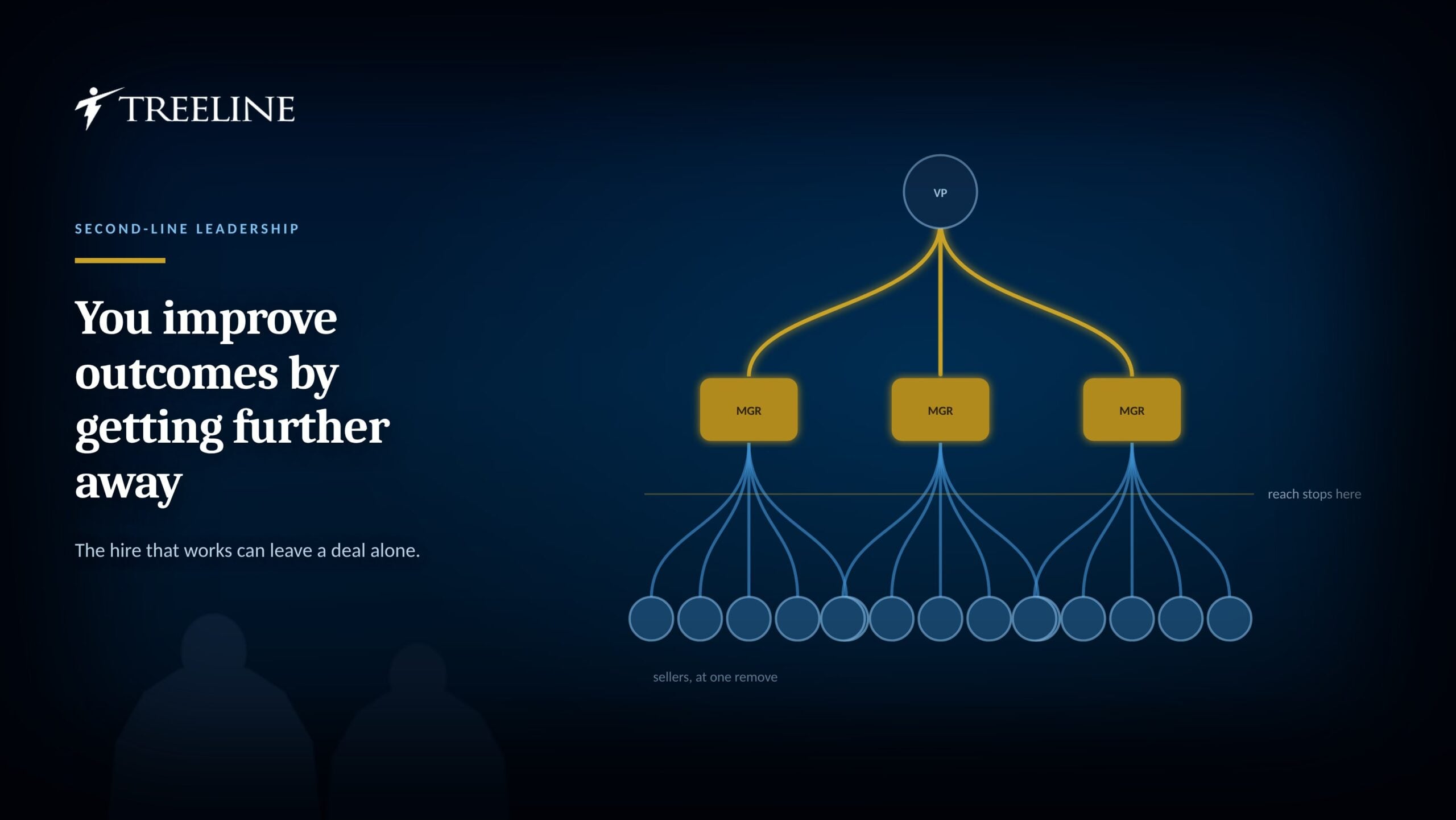
Managing sellers and managing managers are different jobs. A front-line manager improves outcomes by getting closer, joining calls, coaching the deal, intervening where it matters. A second-line leader improves outcomes by getting further away, and by changing what their managers do rather than what the sellers do. The behavior that made someone excellent at the first job is precisely the behavior that undermines them in the second.
This article covers the assessment and the search. The separate question of when a company needs this layer, the span arithmetic that triggers it, is covered in how to know when to hire another sales manager. Companies commonly run this search under a contingency sales recruiting arrangement, where no fee is payable unless a hire is made.
Dan Fantasia, CEO of Treeline, Inc., describes the second-line appointment as the point where a sales organization stops being a team and becomes a structure. From his perspective the hire that works is the one who can leave a deal alone, and that is a disposition rather than a skill.
What Second-Line Sales Leadership Recruiting Is Assessing
Four capabilities define the job, and none of them is visible in a front-line manager’s results.
Diagnosing through a layer. When a team misses, the second-line leader cannot inspect every deal. They have to work out whether the problem is the market, the territory, the manager, or a specific seller, using their manager’s account of it, which is itself evidence about the manager.
Developing managers. Coaching someone on how to coach is a different act from coaching directly. It requires watching a manager run a pipeline review and giving feedback on the review rather than on the deals in it.
Holding a forecast they did not build. The number now arrives through two layers of judgment. A second-line leader who simply adds a discount to what their managers submit has not solved the problem; one who can tell which manager is systematically optimistic has.
Running a cadence they do not attend. Pipeline reviews, forecast calls and one-to-ones now happen without them in the room. The second-line leader designs those meetings, sets what good looks like in them, and audits them occasionally, which is a different skill from running them well personally.
**Making structural decisions. Territory design, segmentation, how many managers and where, which teams merge. These are the levers at this level, and they are not levers a front-line manager has ever pulled.
A requirement that describes a bigger version of the front-line role has specified none of this, which is why so many of these searches produce a shortlist of strong managers and a disappointing year.
Why Second-Line Sales Leadership Recruiting Should Not Default to Promotion
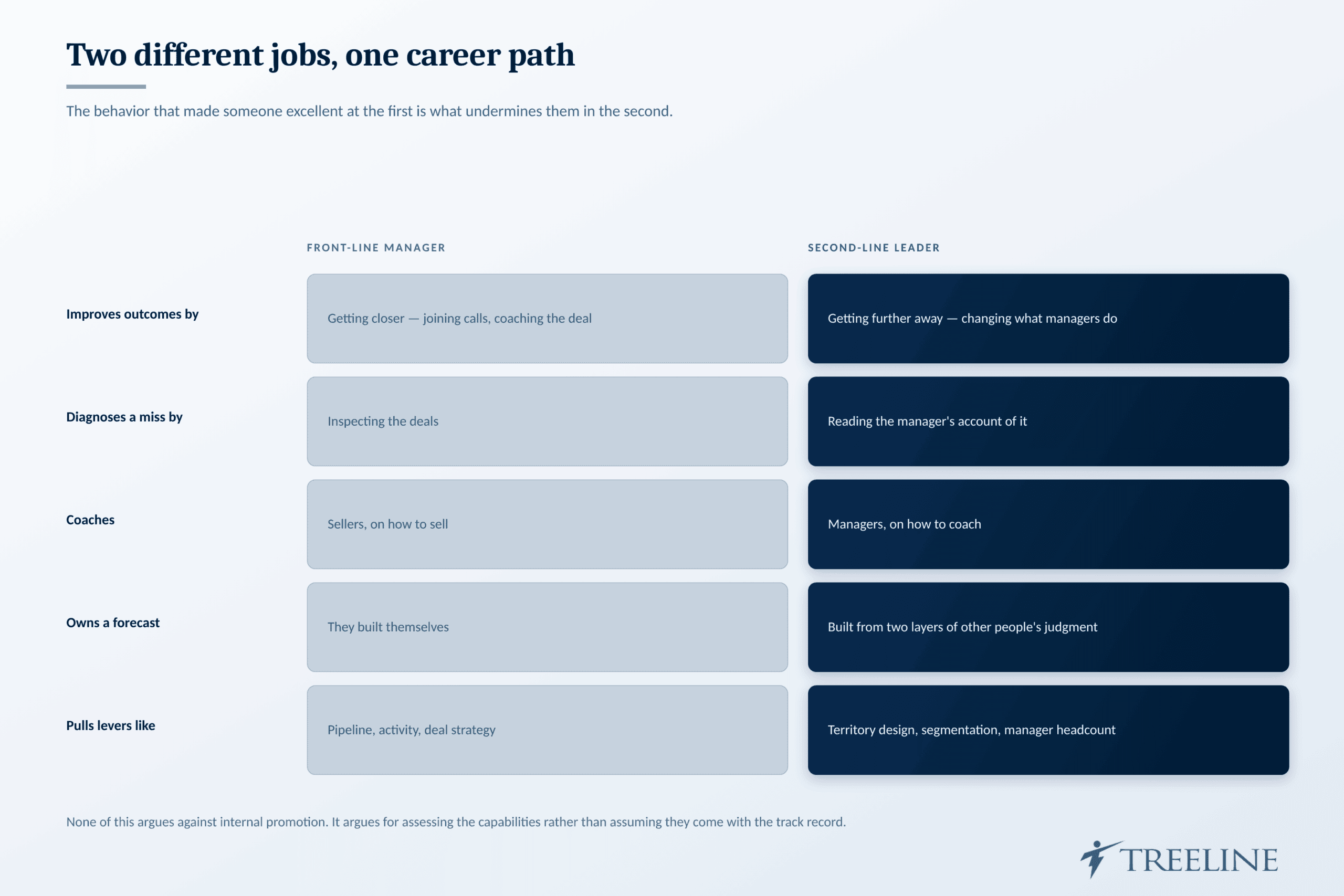
The promotion looks obvious and fails for reasons that are structural rather than about capability.
A strong front-line manager is usually strong because they intervene well. Promote them and the intervention continues one level down, which means they are now doing their managers’ jobs. The managers disengage, because someone more senior keeps resolving the things they were accountable for, and within two quarters the layer exists on the chart and not in practice.
The second failure is the comparison problem. A newly promoted second-line leader who was recently a peer now evaluates people who were colleagues last quarter. The ones who were passed over are watching, and the appointment’s credibility rests on decisions made in the first ninety days rather than on the promotion itself.
The third is that the feedback loop lengthens. A front-line manager sees the effect of coaching within a cycle. A second-line leader changes how a manager operates and sees the result two quarters later, through someone else’s team. People who need faster signal find the job unsatisfying and tend to fill the gap by reaching back down into deals.
None of this argues against internal promotion. It argues for assessing the specific capabilities rather than assuming they come with the track record.
What Second-Line Sales Leadership Recruiting Should Test
The standard leadership interview asks about results, strategy and team-building. Those produce rehearsed answers. Four questions produce unrehearsed ones.
Ask about a manager they removed. Every experienced second-line leader has had to act on an underperforming manager, which is harder than acting on a seller because the manager’s team is watching and the decision is less legible. The quality of the answer is in the specifics and the timeline.
Ask how they found out a forecast was wrong. Not that it was wrong, how they found out. A leader who discovered it at quarter end has not built the mechanism; one who can describe the signal they watch has.
Ask what they changed that their managers resisted. Second-line leaders who have never met resistance have either never changed anything structural or do not notice resistance, and both are problems.
Ask them to describe one of their managers in detail. A leader who can characterize each manager’s particular strengths and blind spots is doing the job. A leader who describes their managers by their numbers is still managing a team rather than a layer.
Fantasia’s view on the removal question is that the timeline matters more than the decision. He notes that nearly every leader eventually acts, and the ones worth hiring can say how long they waited and why, which separates considered judgment from avoidance dressed up as patience.
Where Second-Line Sales Leadership Recruiting Finds Candidates
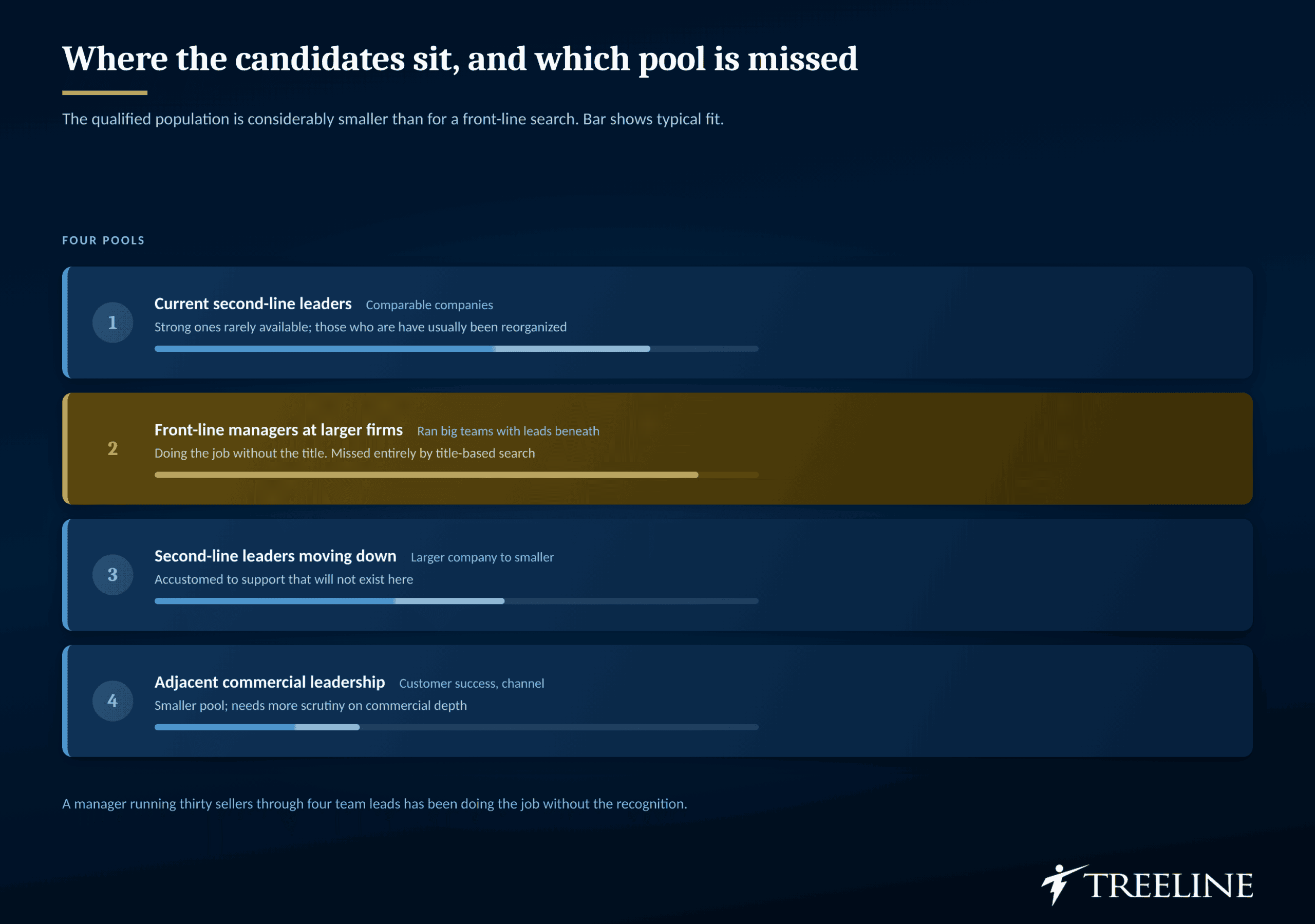
The qualified population is considerably smaller than for a front-line search, and sits in four places.
Current second-line leaders at comparable companies are the obvious pool. The constraint is that strong ones are rarely available, and the ones who are available at any given moment have usually been affected by a reorganization, which is worth understanding rather than treating as disqualifying.
Front-line managers at larger companies who have run a large team with team leads beneath them have effectively done the job without the title. This pool is underused because a title-based search misses it entirely.
Second-line leaders moving down in company size bring structure and process from an environment that had both. The risk is the familiar one: accustomed to enablement, operations and recruiting support that will not exist, and the breadth of a smaller role catches them out.
Functional leaders from adjacent commercial functions, customer success leadership, channel leadership, occasionally convert where the motion is similar. This is a smaller pool and needs more scrutiny on commercial depth.
Fantasia’s caution on the second pool is that the title understates the work. He points out that a manager running thirty sellers through four team leads has been doing second-line management without the recognition, and that they are frequently cheaper to hire and more motivated than someone already carrying the title.
All four are employed and not applying. Reaching them is a relationships problem, which is the practical argument for working through contingency recruiters who hold standing in the function.
Why the Contingency Model Suits This Search
Three characteristics make the structure appropriate, with one important exception.
The requirement frequently needs correcting. Companies open this search describing a second-line role that is really a senior front-line role with a bigger team, or a vice president role with commercial ownership well beyond what was written. That discovery happens before candidates appear and is worth more than most of what a search produces.
The population is small enough that an honest conversation about whether the intersection exists at your band is worth having early, and a firm paid only on placement carries that risk rather than billing for the discovery.
And the plan may change. Second-line layers are frequently added in anticipation of growth that has not yet arrived, and a search that is withdrawn costs nothing under a fee-on-placement structure.
The exception matters. If the role is confidential, because an incumbent is being replaced and does not know, a non-exclusive arrangement is structurally unsuited to it. The qualified population is small enough that several firms working it will reach the incumbent’s network, and in sales leadership that network is tight. That situation calls for a retained or exclusive structure, and a firm that does not raise it is not paying attention.
What the Employer Controls
Three things sit inside the company and determine the outcome more than the search does.
Whether the authority is real. A second-line leader accountable for a number without influence over territory design, comp structure or manager headcount is accountable for outcomes they cannot move. Candidates with experience will ask about all three.
Whether the existing managers are told properly. The people who will report to this hire need to hear it from their current leader, with the reasoning, before it is announced. Managers who learn about a new layer above them from an announcement will read it as a judgment on their performance.
Whether an internal candidate was considered honestly. If one was passed over, that conversation happens before the external hire is announced, not after. This is the most common way a company loses a strong manager during a second-line search.
Fantasia presses employers on the authority question first because it is the one that cannot be fixed later. His position is that a company unwilling to hand over territory and comp decisions is describing a reporting convenience rather than a leadership role, and strong candidates detect the difference in the first conversation.
Compensation and the Band Problem
Second-line compensation is frequently set by looking up from the front-line band, which produces a number the market does not recognize.
The role sits between front-line management and executive leadership, and the gap between those two is wide. Benchmarking a percentage above the best-paid front-line manager tends to land below where the candidates you want are currently paid, and the search stalls at offer with no obvious explanation.
The variable structure also changes. At this level the number is aggregated across teams, so a plan weighted heavily toward quarterly attainment rewards short-term intervention, exactly the behavior that makes second-line leaders reach back into deals. A longer measurement period, with some weight on manager retention and development, aligns better with what the job actually is.
One further consideration: equity and scope matter more at this level than at front-line. A candidate weighing two offers at similar cash will usually choose the one with the larger structural remit, and remit is something you can expand without spending anything.
Reading the First Year After Second-Line Sales Leadership Recruiting
Because this hire works through other people, the measures that matter are not the team’s number.
In the first quarter, the question is whether the managers are still making decisions. A second-line leader whose arrival caused decision-making to move upward has started badly, and it is visible early if anyone asks the managers directly.
By six months, the signal is whether forecast accuracy has improved at the roll-up level. That is the clearest evidence that the leader has built a mechanism rather than applying a personal discount.
At twelve months, two questions matter. Did any manager visibly improve, with something specific to point to? And did the organization retain the managers worth keeping? A second-line year that produced revenue and lost two good managers has borrowed from the next one.
There is a quieter signal worth watching alongside it. If the managers have stopped bringing problems upward and now bring only solutions, that can look like maturity and often means they have learned that raising a problem results in it being taken off them. A layer that only receives good news is a layer that has stopped functioning as one.
The signal that something is wrong is a second-line leader who is personally present in deals. It usually means either the layer below is not trusted, or the leader has not adjusted to working at one remove, and the two have different remedies.
Frequently Asked Questions
What does second-line sales leadership recruiting actually assess?
Four capabilities that are invisible in a front-line manager’s results: diagnosing a problem through a layer rather than by inspecting deals, developing managers rather than sellers, holding a forecast built from other people’s judgment, and making structural decisions about territory, segmentation and manager headcount.
Why does promoting the strongest front-line manager often fail?
Because strong front-line managers are usually strong because they intervene well, and the intervention continues one level down after promotion. They end up doing their managers’ jobs, the managers disengage, and within two quarters the layer exists on the chart and not in practice.
What should we ask in interview?
Ask about a manager they removed and how long they waited. Ask how they found out a forecast was wrong, not that it was. Ask what they changed that their managers resisted. And ask them to describe one of their managers in detail, a leader who describes managers by their numbers is still managing a team rather than a layer.
Where do the candidates come from?
Current second-line leaders at comparable companies, front-line managers at larger companies who ran big teams with leads beneath them, second-line leaders moving down in company size, and occasionally leaders from adjacent commercial functions. The second pool is underused because title-based searching misses it.
Is a contingency arrangement right for this role?
Usually, because the requirement often needs correcting, the population is small enough that the band question is worth testing early, and plans change. The exception is a confidential replacement of an incumbent, the leadership network is tight enough that a non-exclusive search will reach them, and that calls for a retained structure.
What does the employer need to get right?
Real authority over territory, comp and manager headcount; telling the existing managers properly and in advance; and resolving any internal candidate honestly before the external hire is announced. The authority question is the one that cannot be fixed later.
How should a second-line leader be compensated?
Not by benchmarking a percentage above the best-paid front-line manager, which usually lands below the market and stalls the search at offer. Use a longer variable measurement period than front-line, with some weight on manager retention and development, since quarterly weighting rewards exactly the short-term intervention the job should avoid.
How do we judge a second-line hire at twelve months?
Whether any manager visibly improved with something specific to point to, and whether the managers worth keeping stayed. Earlier: at one quarter, whether managers are still making decisions; at six months, whether roll-up forecast accuracy improved. A leader personally present in deals is the clearest warning sign.
Settle the Authority Question Before You Open the Search
Treeline, Inc. is a sales-only executive search firm based in Wakefield, Massachusetts, working exclusively on building sales organizations. Our contingency sales recruiting service carries no upfront cost and no fee unless you hire, and we deliver your first candidate within three days of launching a search.
If you are adding a second-line sales leadership role, the useful first conversation is about what this person will decide that nobody currently decides. Get in touch and we will work through the remit before anyone looks at a resume.
Share This Story, Choose Your Platform!
Related Posts

What our happy clients are saying
Treeline Inc. provided us with the most candidates that aligned with our needs and were of the highest quality.

Dr. Jeffrey Klein Head of North America Sales, Satchel Pulse
Treeline Inc.’s collaborative, flexible, and communicative approach resulted in a smooth partnership. Beyond their recruitment expertise, their unique sourcing model was efficient and effective.

Sera Holt Director of Operations, LNS Research
Their professionalism was outstanding. Treeline Inc. was extremely thorough and ensured that we were on the same page before they started looking for candidates. They listened to us and did a great job working with the candidate to close out the process.

Cate Grant AVP Customer Success, Nasdaq
Thanks to Treeline Inc.’s intricate and thorough screening process, the company is able to hire six high-quality candidates that fit perfectly in the company’s culture. The team is highly receptive to concerns, and internal stakeholders are impressed with their unique recruitment abilities.

Anna McKean Sales Recruiter, Insider Intelligence
Treeline Inc. has been qualified individuals throughout a five-year-long engagement. They’ve made numerous placements of talented and qualified individuals for our business.

Michele St Laurent VP of HR, The Institute for Applied Network Security

Let Us Help You Source the Sales Talent You Need
Whether you’re building a team or replacing a key role, our Candidate Sourcing Platform provides a fast, flexible, and employer-focused solution.
Tell us more about your business and how we can help.
Treeline Inc.
Your Award-Winning Sales Recruitment Partner
15 Lincoln Street, Suite 314, Wakefield, MA 01880