A contingency sales recruiting agency supports specialized sales hiring by doing the work a generic recruiting process cannot do: defining a narrow requirement precisely, reaching people who are already employed and not applying anywhere, testing candidates against the shape of the deals they will actually run, and keeping the process moving fast enough that the strongest person does not disappear.
For a role like an enterprise account executive, where the addressable talent pool may be a few hundred people who fit and almost none of them are on a job board, that combination is usually the difference between a hire and a six-month vacancy. That scarcity is not a market mood. It is structural. The U.S. Bureau of Labor Statistics reports in its Occupational Outlook Handbook that sales representatives selling technical and scientific products held roughly 303,200 jobs in 2024, with employment projected to grow only about 2 percent through 2034.
Across the wider wholesale and manufacturing sales category, the Handbook projects about 142,100 openings each year on average, and attributes most of them to the need to replace people who move into different occupations or leave the workforce, rather than to newly created positions. In a market where most openings are backfills, every serious enterprise sales hire is a recruit away from another employer.
Dan Fantasia, CEO of Treeline, Inc., treats specialized as a claim that has to be earned rather than a label a hiring manager applies to a role that has been open too long. From his perspective, the useful question is not whether a search feels hard but which specific constraints are narrowing the candidate population: the buyer, the shape of the deal, the domain knowledge, or the procurement process.
Employers who can name those constraints get a search that can actually be run. Employers who cannot tend to widen the net and receive the same disappointing shortlist a second time.
What “Specialized” Actually Means in a Sales Search
Employers use the word specialized loosely, and it costs them time. Sometimes it means senior. Sometimes it means technical. Sometimes it just means the last two searches were painful. None of those are useful definitions for a search partner, because none of them narrows the population you are searching. A sales role is genuinely specialized when at least two of the following constraints are simultaneously true:
- The buyer is unusual. The candidate must sell to a specific title in a specific function, and credibility with that buyer is not transferable from adjacent markets.
- The deal has a distinctive shape. Cycle length, contract value, procurement path, or the number of stakeholders puts the role outside common sales experience.
- Domain fluency is a gate, not a bonus. The candidate cannot learn the subject matter after the fact fast enough to hit a quota inside the first year.
- The motion is different from the résumé. Two people from the same well-known company may have run completely different sales motions inside it.
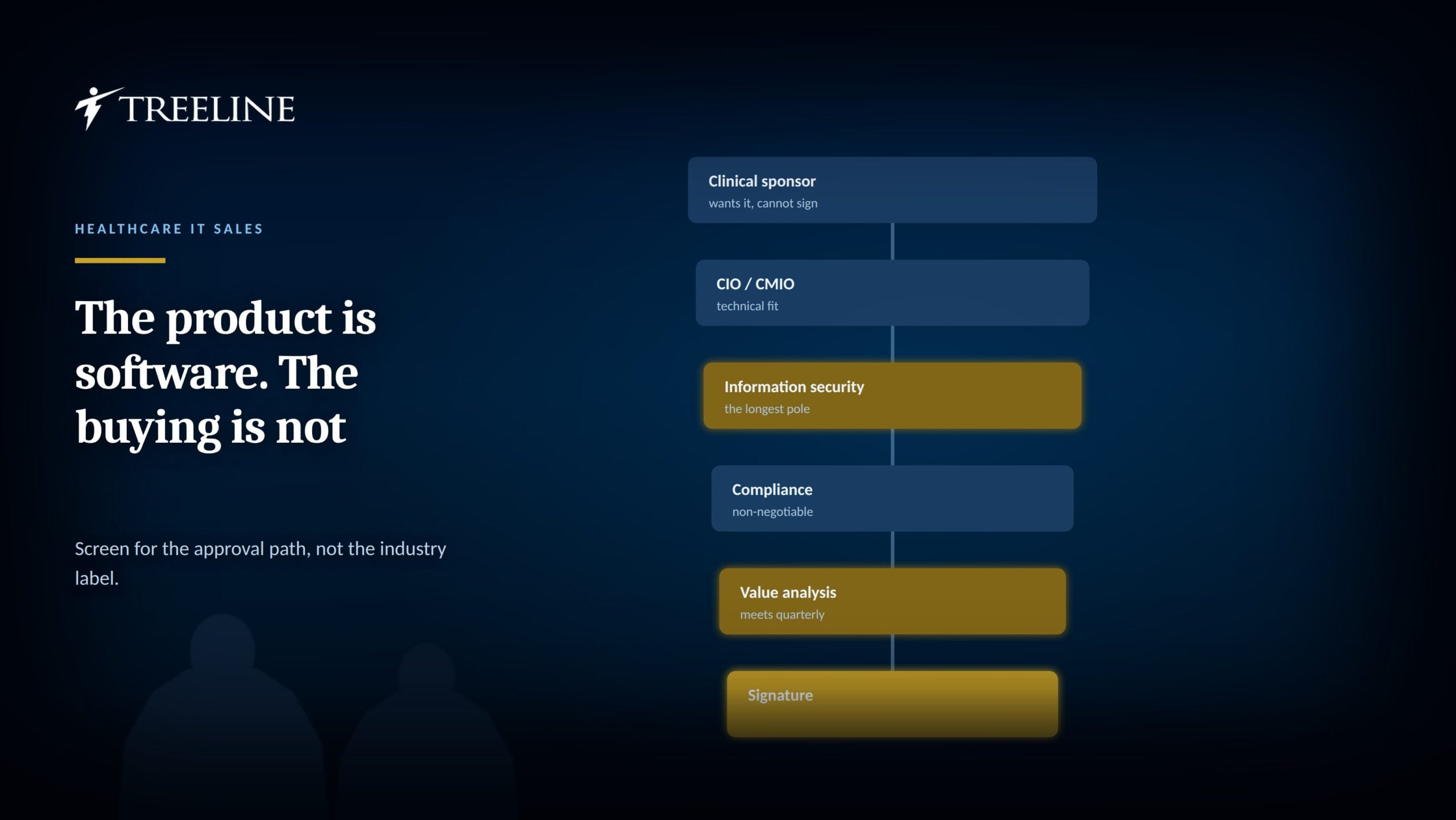
- The regulatory or procurement environment constrains the sale.
Public sector, clinical, or financial-services buying processes impose steps that most sellers have never run. When only one of these is true, most competent recruiting can work. When two or more are true at once, the candidate population collapses fast, and the ordinary tools, job postings, inbound applications, a general staffing vendor, stop producing anything usable.
Why the Enterprise Account Executive Is the Clearest Test Case
The enterprise account executive sits at the intersection of nearly all of those constraints, which is why it is a useful role to reason through. An enterprise AE is typically running multi-stakeholder deals with long cycles, a formal procurement stage, a security or legal review, and a business case that has to survive a budget committee.
The person is expected to build consensus across functions that do not report to each other, sustain momentum across quarters, and forecast honestly enough that a revenue leader can plan around them. In technical categories they are also expected to hold their own in a room where the buyer knows the product space well.
That last point is where employers most often underestimate the search. The Bureau of Labor Statistics notes in the same Handbook entry that representatives selling scientific and technical products typically need at least a bachelor’s degree in a field related to what they sell, and that when a representative lacks deep product expertise the sale is often run jointly with a technical specialist such as a sales engineer.
In other words, the government’s own occupational description treats complex selling as a team activity with a real knowledge threshold. A hiring process that screens only for quota attainment is measuring one variable in a role that has several. The most common mistake at this stage is treating seniority as the specialization.
An employer decides the last hire was too junior and raises the experience requirement, when the actual mismatch was that the previous person had never sold through a formal procurement process. More years of the wrong motion does not fix that. The requirement that needs tightening is almost always about the shape of the work rather than the length of the résumé, and an agency that has run this search before will say so in the intake call.
Treeline covers the adjacent version of this problem in its guidance on contingency solutions for hard-to-fill sales roles. The compensation profile follows the difficulty. The Handbook puts the median annual wage for sales representatives in technical and scientific products at $100,070 as of May 2024, with the top 10 percent above $194,890.
That range covers the entire occupation rather than enterprise-level sellers specifically, so it is better read as a floor for the kind of role discussed here than as a benchmark for it. Either way, these are expensive hires to get wrong and expensive hires to leave open.
The Replacement Market Problem Behind Most Enterprise AE Searches
Here is the thing most employers do not price in when they open an enterprise AE requisition: they are not competing for candidates in a pool. They are competing for candidates inside other companies’ sales teams. The Bureau of Labor Statistics figures above make the point at the occupational level, most openings come from replacement rather than growth.
The broader hiring picture is consistent with it. In the Job Openings and Labor Turnover Survey, the national quits rate was 2.0 percent in June 2026 on a preliminary basis. That figure covers the whole economy and says nothing specific about enterprise sales, but the direction it points is worth sitting with: voluntary movement is comparatively subdued, which means fewer strong performers are circulating on their own initiative.
For a specialized search, subdued voluntary movement changes the entire job:
- The best-fit candidates are employed, on plan, and mid-cycle on deals they want to close before they leave.
- They are not reading job postings, so an inbound-first process reaches a systematically different population than the one you want.
- The first conversation is not an interview. It is a persuasion problem, and it happens before the candidate ever sees a job description.
- Timing matters enormously. Someone three weeks from a commission payout behaves differently than the same person five weeks later.
- Any candidate worth hiring will get a counteroffer, and that has to be anticipated in week one, not week nine.
There is a second structural force worth naming, because it cuts in the opposite direction from what most people assume. In explaining why growth in this occupation is projected to be slow, the Bureau of Labor Statistics points to advances in artificial intelligence and integration with automation technologies such as chat bots as factors that may limit employment growth for sales representatives, while noting that online wholesale selling is mostly expected to complement face-to-face selling rather than replace it.
Read carefully, that is a statement about which sales work is exposed. Automation absorbs transactional, high-volume, low-complexity selling first. It does not absorb a nine-month deal with seven stakeholders, a security review, a procurement negotiation, and a business case that has to survive a budget committee. The practical consequence for employers is that the pool of sellers who can genuinely run complex enterprise deals is not being replenished as quickly as the demand for them, even while headline growth in the wider occupation looks flat.
Slow projected growth in an occupation and difficulty hiring within a specialized slice of it are entirely compatible, and employers who read only the headline number tend to underestimate their own search.
Where Specialized Sales Searches Actually Break Down
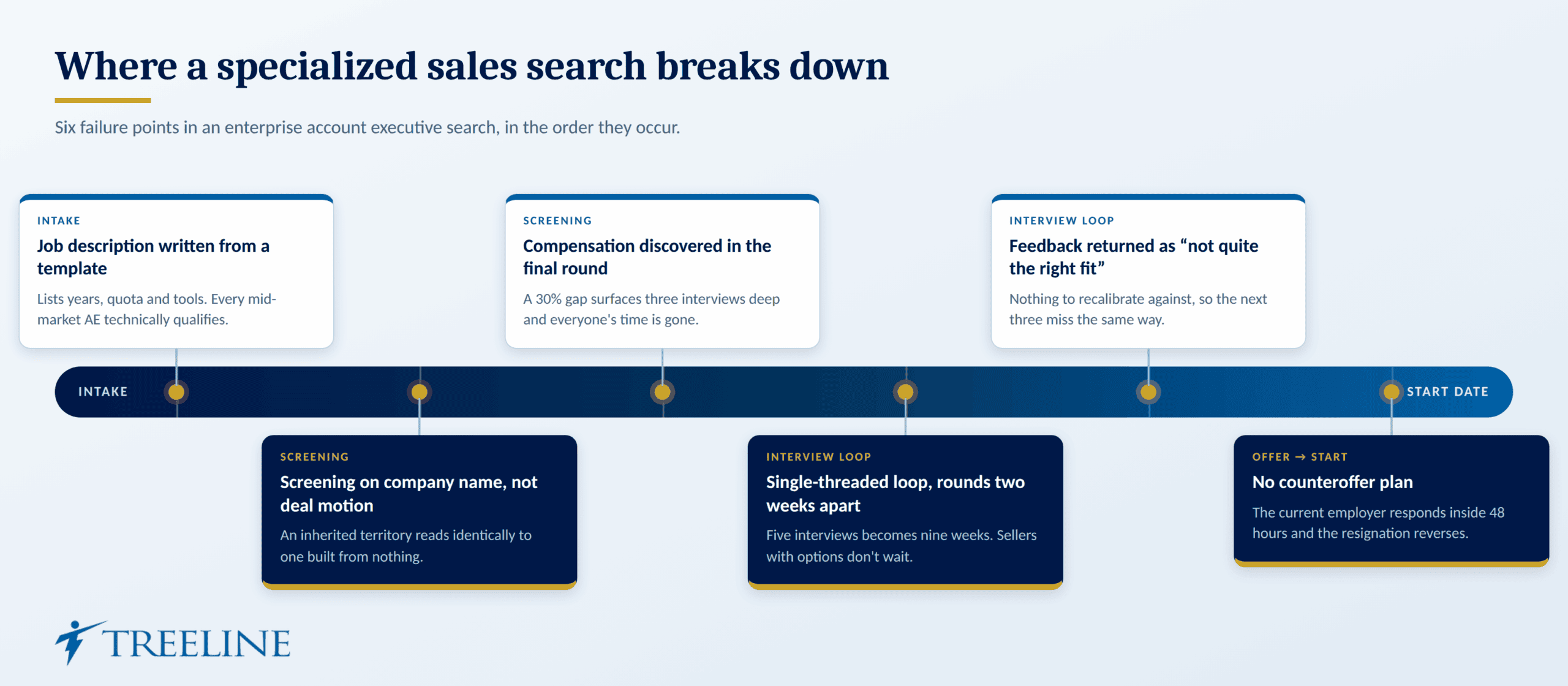
Most failed enterprise AE searches do not fail at sourcing. They fail at a small number of specific, repeatable points, and knowing which ones tells you what you actually need from an agency. The diagram below maps all six to the stage of the search where each one surfaces. The job description is written from a template.
It lists years of experience, a quota number, and a list of tools. It does not describe the deal, the buyer, the sales cycle, or what the first twelve months look like. A description like that cannot be used to screen anyone, because every mid-market AE in the country technically qualifies. Screening runs on company names rather than motion.
A candidate from a famous enterprise software company may have inherited a mature territory, sold through channel partners, or worked a named-account list handed to them. Another candidate from a company nobody has heard of may have built a territory from nothing and closed six-figure deals against incumbents. The logo tells you almost nothing about which one happened.
Compensation is discovered too late. The employer discusses base and on-target earnings in the final round, discovers a gap of thirty percent, and loses a candidate who was already three interviews deep. Everyone’s time is gone. The interview loop is single-threaded and slow. Five interviews scheduled two weeks apart is a nine-week process.
Enterprise sellers with options do not sit through nine weeks unless someone is actively keeping them engaged. Feedback is vague or delayed. “Not quite the right fit” gives a recruiting partner nothing to recalibrate against, so the next three candidates miss for the same unstated reason. Nobody plans for the counteroffer.
The candidate resigns, their current employer responds within forty-eight hours, and the hiring company finds out it never established a reason to leave that was stronger than money. Fantasia’s perspective is that most of these are not recruiting failures at all but decision-making failures that recruiting exposes. He recommends a straightforward test before launching: if the hiring manager cannot describe in two sentences what the new hire will do differently from the person who last held the seat, the search is not ready to launch.
What a Contingency Sales Recruiting Agency Actually Does Differently
The value of a specialist agency is not access to a database. Databases are commodities. The value is in the specific work performed at each of the breakdown points above.
Translating the Requirement Into a Search Definition
The first substantive thing a good contingency search firm does is refuse to accept the job description as written. That intake conversation should produce answers to questions the internal description usually skips. What is the average contract value, and what is the distribution around it? How many stakeholders sign off, and which one can kill the deal?
Is the seller expected to generate their own pipeline, or will marketing supply it, and what is the honest ratio today? What does the territory look like on day one, named accounts, open geography, or a book inherited from someone who left? Which competitor shows up most often in deals, and what does losing to them usually look like?
The output of that conversation is not a longer job description. It is a search definition: a short, specific statement of the population being searched and the evidence that would prove someone belongs in it. That definition is what makes it possible to say no to plausible-looking candidates quickly, which is the actual bottleneck in most specialized searches.
Reaching People Who Are Not Applying
Once the definition exists, the sourcing problem becomes tractable, because you are looking for a describable person rather than a good résumé. Specialist contingency recruiters work this population through relationships built over years of placing into the same market, people they have previously placed, people they interviewed and did not place, referrals from sales leaders they have worked with, and candidates who took a different role two years ago and are now approaching the point where they would listen.
This is why market focus matters more than firm size. A recruiter who has spent a decade placing enterprise sellers into technology companies has a fundamentally different network from a generalist agency that filled a warehouse role last week. The mechanics of that outreach also differ. A specialist is not sending a job description to a passive candidate.
They are opening a conversation about the market, the company’s trajectory, the territory, and the earning potential relative to where that person is now, and much of the time the answer is no, which is itself useful information about how the opportunity is landing.
Screening for Deal Shape, Not Company Name
This is where a sales-focused agency earns its fee, and it is the hardest part to replicate internally. Screening an enterprise AE properly means reconstructing actual deals. A capable recruiter will walk a candidate through a specific closed deal in detail: how the opportunity originated, who the economic buyer was, what the competing options were, where it stalled, what the candidate personally did to restart it, how the pricing conversation went, what procurement demanded, and how long the whole thing took from first meeting to signature.
Then they will do it again with a deal the candidate lost. The value of that exercise is that it is very hard to fake and very hard to inherit. Someone who was carried by a strong territory tells a thin version of that story. Someone who genuinely ran the deal tells a version full of specific friction. Fantasia recommends treating a candidate’s largest closed deal as less informative than their most difficult one.
His view is that the hardest deal reveals how the person behaves when the process breaks, which is the condition an enterprise seller operates in most of the time. This is also where a structured approach pays off. The U.S. Office of Personnel Management, in its guidance on structured interviews, describes the method as asking every candidate the same predetermined questions in the same order, with the questions tied to competencies identified through job analysis, and states that this consistency helps ensure candidates are assessed accurately and consistently.
That guidance was written for federal hiring, not for sales, but the underlying logic transfers directly: if every enterprise AE candidate is asked to reconstruct a difficult deal against the same criteria, the comparisons between them mean something. If each interviewer improvises, they do not.
Managing Compensation Reality Early
A specialist agency should be raising compensation in the first conversation with the employer, not the last conversation with the candidate. For an enterprise AE that means establishing the base-to-variable split, the on-target earnings figure, whether variable pay is capped, how accelerators work above quota, what the ramp looks like in the first two quarters, whether any portion is guaranteed during ramp, and how equity is structured if it exists.
It also means being honest with the employer when the package is not competitive for the profile they described, which is a conversation an internal recruiter is often not positioned to have with a hiring executive. Because a contingency recruiter is paid only on placement, they have a direct interest in surfacing a compensation mismatch in week one rather than week nine.
A search that cannot close on money is a search they will not get paid for.
Holding the Process Together Between Interviews
The unglamorous work is often the decisive work. Between rounds, a specialist agency is preparing candidates on what each interviewer will focus on, debriefing them immediately afterward while the detail is fresh, relaying honest signal back to the hiring team, pushing for scheduling that compresses rather than stretches the loop, testing motivation repeatedly, and preparing the candidate for the counteroffer conversation before the resignation happens rather than after.
A candidate who has already thought through what they will say when their VP offers them twenty thousand dollars to stay behaves very differently from one who has not.
The Economics: Why the Contingency Model Fits a Specialized Role
The contingency model is simple. The agency is paid a fee only when the employer hires a candidate the agency introduced. There is no upfront cost, no retainer, and no obligation if nobody is hired. Industry fees are typically calculated as a percentage of the hire’s first-year compensation, with 25 percent a common standard for professional sales roles, and most reputable firms attach a replacement guarantee for a defined period after the start date.
For a specialized search, that structure has three practical consequences. The first is risk placement. The employer is not paying to find out whether the search is viable. If the market cannot produce someone who fits the definition at the compensation offered, the employer has spent internal time but no fee. For a role the company has never hired before, that matters.
The second is incentive alignment on speed and closure. A contingency recruiter earns nothing for a beautifully run search that ends without a hire. That produces genuine urgency, and it is the reason contingency partners tend to push hard on scheduling, feedback, and offer decisions. The third is a real tradeoff worth stating plainly: because payment depends on placement, contingency recruiters allocate effort toward searches they believe will close.
A vague requirement, an uncompetitive package, or a slow decision process will quietly lose priority against another client’s search. The employer’s own responsiveness is part of what determines the result. Retained search inverts that. The employer pays in installments regardless of outcome, and buys exclusivity, a documented market map, and a firm that is contractually committed to the search whether or not it is easy.
That model fits confidential replacements, board-level searches, and roles where the employer needs a complete picture of the market rather than a strong shortlist. Treeline’s comparison of retained search versus contingency search sets out where each one applies. Fantasia emphasizes that the choice between models should follow the confidentiality and completeness requirements of the search rather than the seniority of the title.
His practical test is whether the employer needs to know every qualified person in the market or simply needs to hire one of them.
What to Give the Agency in the First Conversation
The quality of a specialized search is largely determined in the intake meeting. Employers who arrive with the following material get usable candidates materially faster, because the recruiter can start disqualifying people on day one instead of day twenty.
- A real deal profile. Average contract value, typical cycle length, number of stakeholders, and who signs. If those numbers vary widely by segment, say so and give the range.
- The pipeline truth. What percentage of pipeline the seller is expected to self-generate versus receive, based on what actually happened last year rather than the plan.
- The territory as it will exist on day one. Named accounts, open geography, inherited book, or greenfield, and whether anything is being carved away from an existing rep.
- The two or three competitors that show up most. Plus an honest account of why deals are lost to them.
- The full compensation structure. Base, on-target earnings, split, cap or no cap, accelerators, ramp guarantee, equity.
- The interview loop, mapped. Who is involved, what each person is assessing, and the maximum number of calendar days from first conversation to offer.
- The decision maker’s actual availability. Not the theoretical availability.
- Why the seat is open.
Growth, backfill, or a termination, and if it is a backfill, what did not work last time. Fantasia’s operating perspective is that the last item is the one employers most often soften and the one that predicts the search most reliably. He suggests stating the previous holder’s failure in plain operational terms, because a recruiter who knows exactly what went wrong can screen for it directly rather than guessing at it.
How to Tell a Specialist Agency From a Generalist One
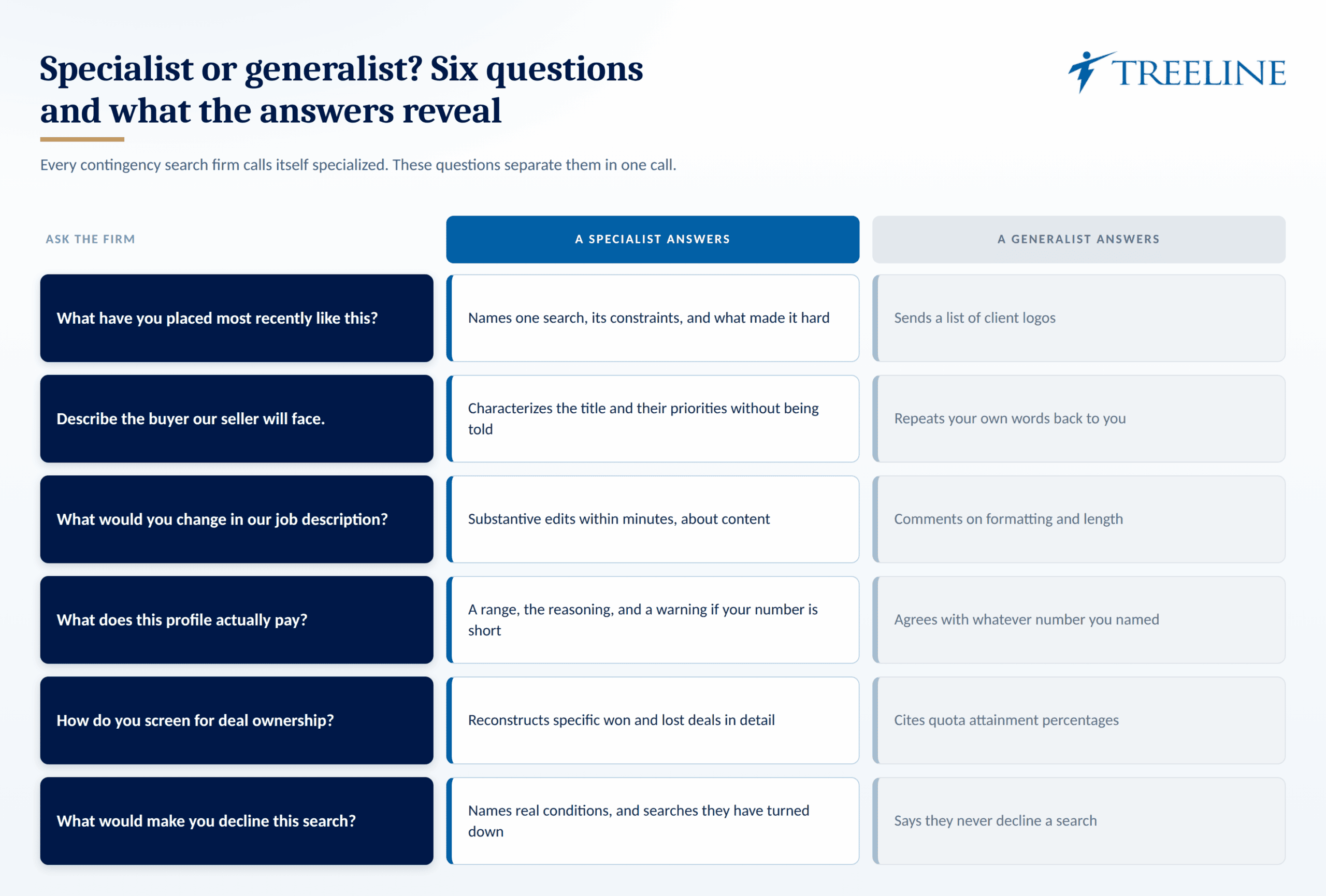
Every contingency search firm will describe itself as specialized. The claim is easy to make and easy to test. These questions separate them quickly, because a genuine specialist answers them from memory and a generalist answers them in generalities. The table below pairs six of them with what each kind of answer actually sounds like.
- Ask what they placed most recently into a comparable role. Not a client list, a specific search, its constraints, and what made it difficult.
- Ask them to describe your buyer. A recruiter who works your market can characterize the person your seller sells to without being told.
- Ask what they would change about your job description. A specialist will have opinions within minutes. Note whether the opinions are about substance or formatting.
- Ask what compensation the profile you described actually commands. They should answer with a range and the reasoning behind it, and be willing to tell you if your number is short.
- Ask how they screen for deal ownership. Listen for whether they interrogate specific deals or rely on quota-attainment percentages.
- Ask what their submitted-to-interview ratio looks like on searches like yours. High submission volume is a signal of a low filter, not of a strong network.
- Ask what would make them decline the search. A firm that has never declined one is telling you something about how it prioritizes.
- Ask about the guarantee and what voids it.
The exclusions matter more than the headline period. If you want a fuller framework for this evaluation, Treeline has written separately on how employers evaluate contingency search firms for specialized sales roles and on what distinguishes specialist contingency sales recruiters from traditional recruiters.
Measuring Whether the Partnership Is Working
Specialized searches take longer than routine ones, which makes it easy to confuse a slow search with a broken one. Time-to-fill alone will not tell you the difference. These signals will. In the first week, the useful question is whether the recruiter pushed back on anything. A partner who accepted your job description without challenge either already knows the market extremely well or has not engaged with it.
The first submission is a calibration instrument more than a hire, its purpose is to make your criteria concrete by giving you something specific to react to. By roughly the third or fourth week, look at whether candidate quality is converging. Each round of feedback should visibly narrow the next submission. If candidate five has the same defect as candidate one, either your feedback is not specific enough or the recruiter is not incorporating it, and that conversation should happen immediately rather than at week eight.
Watch the disqualification rate, not just the submission rate. A recruiter who tells you they reviewed forty people and are sending you two is doing the filtering you are paying for. A recruiter who forwards everything is transferring the work back to your hiring manager. Also watch what the market is telling you through the recruiter.
If experienced enterprise sellers are consistently declining the first conversation, that is data about your compensation, your company’s reputation, or the way the opportunity is being positioned. It is not a sourcing failure, and treating it as one wastes the most valuable feedback the process generates.
What Happens Between Offer and Start Date
The search is not finished when the candidate says yes. For a specialized hire it is arguably at its most fragile in the two to four weeks that follow, and employers routinely treat that window as administrative. Two things happen in it. The first is the counteroffer. A strong enterprise seller resigning mid-quarter creates an immediate problem for their current employer, and the response is usually fast and generous.
If the only reason the candidate was leaving was compensation, the counteroffer solves it, and the search restarts. This is why the reason for leaving has to be established and reinforced throughout the process rather than discovered at the end. The second is quieter and more common: nothing happens at all. The candidate has resigned, the new employer has gone silent while onboarding paperwork moves through HR, and three weeks of dead air gives a person ample room to reconsider a decision they made with incomplete information.
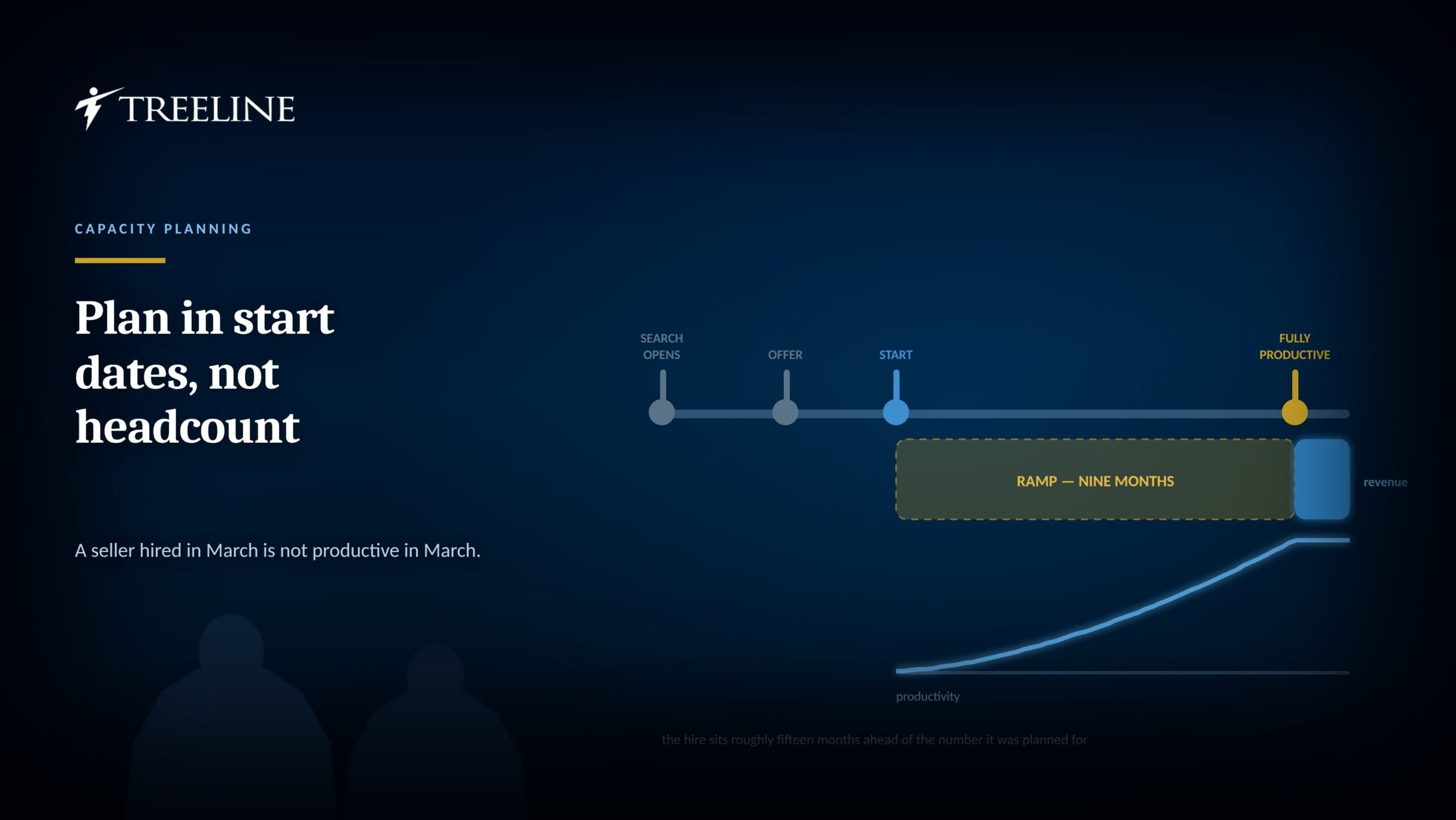
Specialist firms treat that silence as a risk to be managed, staying in contact, arranging informal conversations with the future manager or a peer, and making sure the first week is scheduled before the candidate arrives rather than improvised on the morning they start. There is a ramp question underneath this too. An enterprise seller with a nine-month cycle will not close anything in their first quarter, and if the compensation plan does not acknowledge that with a guarantee or a ramped quota, the new hire spends their first months earning base salary while watching a pipeline that has not matured.
That is a predictable and preventable cause of early attrition, and it belongs in the compensation conversation at intake rather than in an exit interview eleven months later.
When Contingency Is Not the Right Tool
Recommending the model in every situation would be dishonest, and the exceptions are reasonably clear. Contingency is a poor fit when the search must be confidential because the current occupant of the seat does not know they are being replaced. It is a poor fit when the employer genuinely needs a complete map of every qualified person in the market rather than a viable shortlist, which is sometimes the case for a first executive hire into a new category.
It is a poor fit when the compensation on offer is below market for the profile and the employer is unwilling to move, because no model solves that. And it is a poor fit when the internal decision process cannot produce feedback within a few days, since the speed advantage disappears entirely and the strongest candidates will be gone before the second round.
There is also a category question. A senior enterprise AE search and a Chief Revenue Officer search are different exercises, and Treeline covers the leadership end of that range in its guidance on contingency executive recruiters and sales leadership hiring. For context on the surrounding leadership market, the Bureau of Labor Statistics reports a median annual wage of $138,060 for sales managers as of May 2024, which is a useful anchor when an employer is weighing a senior individual contributor against a first-line leadership hire.
Frequently Asked Questions
What is a contingency sales recruiting agency?
A contingency sales recruiting agency is a recruiting firm that specializes in sales roles and is paid only when an employer hires a candidate the firm introduced. There is no upfront fee and no retainer. Fees are typically a percentage of the hire’s first-year compensation, with 25 percent a common standard for professional sales roles, and most firms include a replacement guarantee for a defined period after the start date.
Can contingency recruiters handle specialized roles like an enterprise account executive?
Yes, provided the firm actually specializes in sales rather than recruiting broadly. The relevant question is not the fee model but whether the recruiter can define the requirement precisely, reach candidates who are not applying, and screen for the specific deal motion the role requires. A generalist agency working on a contingency basis will struggle with an enterprise account executive search for reasons that have nothing to do with how it is paid.
How long does a specialized sales search usually take?
It varies too widely to promise a number responsibly, because it depends on the size of the qualified population, how competitive the compensation is, and how quickly the employer can move through interviews. What is more predictable is the relationship between employer responsiveness and outcome: loops that compress into two or three weeks close candidates that nine-week loops lose.
What does a contingency recruiting agency charge?
Fees are calculated as a percentage of the hire’s first-year compensation and are invoiced only after a hire is made. Twenty-five percent is a common standard for professional sales roles, though the figure varies by firm, role, and market. Employers should confirm what compensation the percentage is applied to, since definitions of first-year earnings differ between firms.
Should we use one contingency recruiter or several?
Contingency engagements are usually non-exclusive, so employers can run more than one. The tradeoff is real: multiple firms increase coverage but can produce duplicate submissions, confusion over candidate ownership, and a diluted market message if two recruiters describe the same opportunity differently to the same candidate. For a narrow specialized role, one firm with genuine depth in that market often outperforms three firms working the periphery.
When is retained search the better choice?
Retained search fits when confidentiality is essential, when the employer needs a documented map of the entire qualified market rather than a shortlist, or when the role is senior enough that the search requires a firm contractually committed to completing it. The distinction is about the completeness and discretion the search requires, not simply the seniority of the title.
Does a contingency recruiter still help after the offer is accepted?
A capable one does. The period between acceptance and start date is when counteroffers land and candidates reconsider, and specialist firms typically stay in contact through that window and into the early weeks of onboarding. Ask directly what post-offer support looks like, because practice varies considerably between firms.
How should we evaluate candidates for an enterprise account executive role?
Ask every candidate to reconstruct the same kinds of deals in detail, one they won and one they lost, covering how the opportunity started, who the economic buyer was, what competition was present, where it stalled, and what they personally did. Asking the same questions in the same order across candidates makes the comparisons meaningful, which is the core principle behind structured interviewing.
Start a Specialized Sales Search With Treeline
Treeline, Inc. is a sales-only executive search firm based in Wakefield, Massachusetts, focused exclusively on building sales organizations. Our contingency sales recruiting service carries no upfront cost and no fee unless you hire, and we deliver your first candidate within three days of launching a search. If you are working on an enterprise account executive requirement, or any specialized sales role where the qualified population is small and mostly employed elsewhere, reach out to talk through the requirement before you post it.
Getting the search definition right is the part that determines everything after it.
Share This Story, Choose Your Platform!
Related Posts

What our happy clients are saying
Treeline Inc. provided us with the most candidates that aligned with our needs and were of the highest quality.

Dr. Jeffrey Klein Head of North America Sales, Satchel Pulse
Treeline Inc.’s collaborative, flexible, and communicative approach resulted in a smooth partnership. Beyond their recruitment expertise, their unique sourcing model was efficient and effective.

Sera Holt Director of Operations, LNS Research
Their professionalism was outstanding. Treeline Inc. was extremely thorough and ensured that we were on the same page before they started looking for candidates. They listened to us and did a great job working with the candidate to close out the process.

Cate Grant AVP Customer Success, Nasdaq
Thanks to Treeline Inc.’s intricate and thorough screening process, the company is able to hire six high-quality candidates that fit perfectly in the company’s culture. The team is highly receptive to concerns, and internal stakeholders are impressed with their unique recruitment abilities.

Anna McKean Sales Recruiter, Insider Intelligence
Treeline Inc. has been qualified individuals throughout a five-year-long engagement. They’ve made numerous placements of talented and qualified individuals for our business.

Michele St Laurent VP of HR, The Institute for Applied Network Security

Let Us Help You Source the Sales Talent You Need
Whether you’re building a team or replacing a key role, our Candidate Sourcing Platform provides a fast, flexible, and employer-focused solution.
Tell us more about your business and how we can help.
Treeline Inc.
Your Award-Winning Sales Recruitment Partner
15 Lincoln Street, Suite 314, Wakefield, MA 01880