A sales engineer carries no quota, closes no deals personally, and is the reason a meaningful share of enterprise deals close at all. They answer the question the account executive cannot, they tell the customer when the product will not do what was asked, and they are the only person in the room both sides believe.
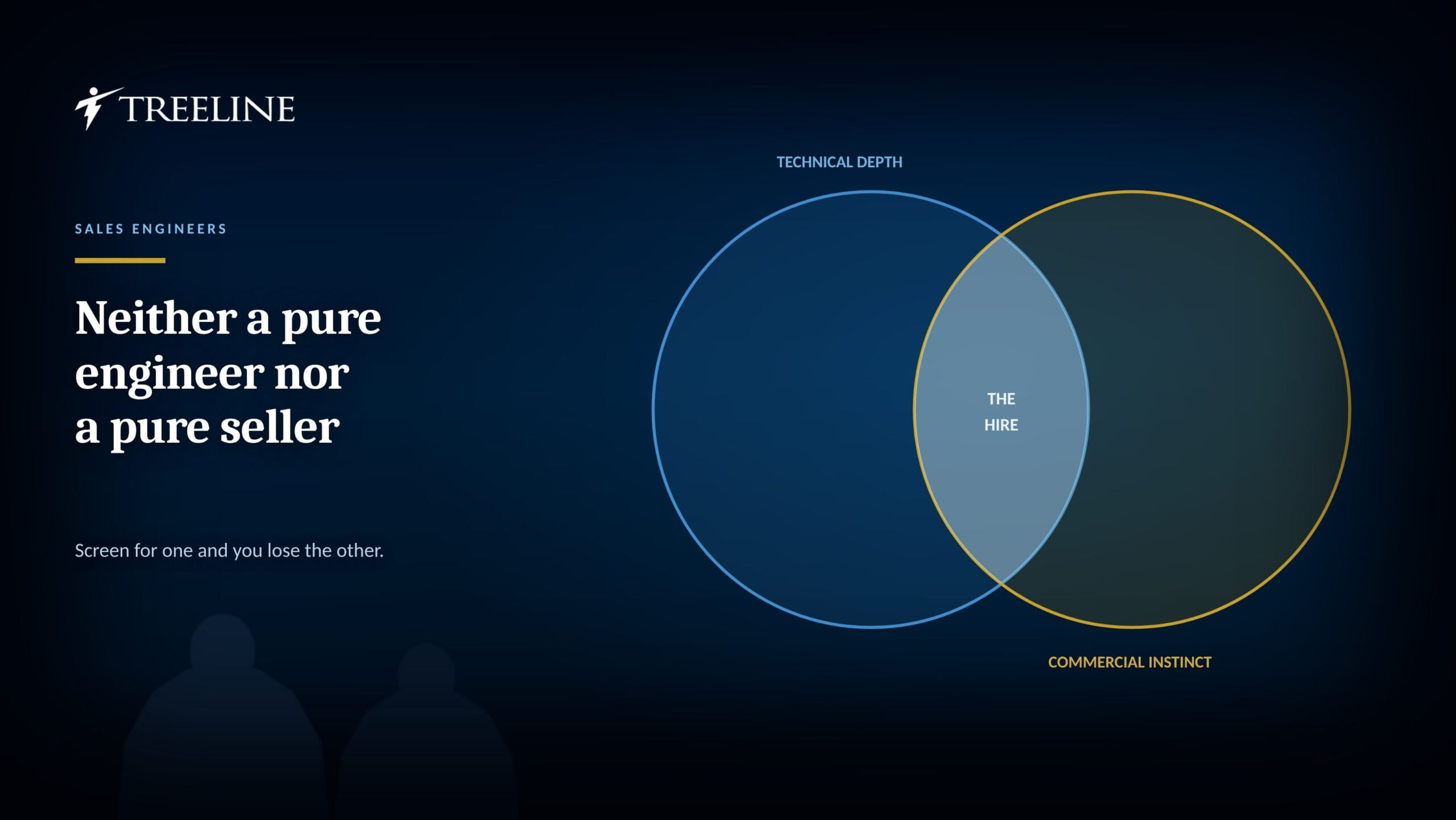
That makes the assessment unusually difficult. Screen for engineering and you get someone who is accurate and loses the room. Screen for selling and you get someone agreeable whose technical answers do not survive the customer’s own engineers. Most companies run this search under a contingency sales recruiting arrangement, where no fee is payable unless you hire, which suits a profile this narrow, and puts more weight on whether the firm can actually test for it, a standard Treeline sets out in its own approach.
Dan Fantasia, CEO of Treeline, Inc., treats the sales engineer as the hardest commercial profile to screen without a technical interviewer in the loop. From his perspective a recruiter who cannot tell depth from fluency will forward the candidate who presents best, which on this role is frequently the wrong one.
What Sales Engineer Recruiting Is Actually Looking For
The title covers a role that sits between two functions and belongs fully to neither, and four capabilities define it.
Technical credibility under scrutiny. The customer’s own engineers will test them. Credibility here is not knowing the product; it is being right in front of people who can check, and being visibly willing to say when something is outside the product’s scope.
Translation. Converting a business problem into an architecture, and an architecture back into a business consequence the economic buyer understands. This is the skill most often missing and least often tested.
Commercial instinct without commercial responsibility. Knowing which questions signal a real evaluation and which signal a procurement exercise. Knowing when a technical objection is actually a budget objection wearing a technical disguise.
Discipline about scope. The sales engineer is where deals get promised into existence. One who agrees to everything produces signed contracts that implementation cannot deliver, and the cost of that lands two quarters later on a different team.
A requirement that lists product knowledge and communication skills has described none of this, which is why so many of these searches produce shortlists that look fine and interview badly.
Why the Usual Screens Fail Sales Engineer Recruiting
Three screening habits transfer from other sales roles and mislead on this one.
Screening on quota attainment. Most sales engineers are measured on the team’s number or on a loose attainment figure they only partly influence. The figure tells you about the account executive they supported and the territory they sat in. It is close to noise.
Screening on product familiarity. Knowing a specific platform is the most replaceable thing a candidate brings. A strong sales engineer learns a new product in weeks. What they cannot learn quickly is how to be convincing while disagreeing with a customer.
Screening on presentation polish. Demo fluency is visible in ten minutes and is the easiest quality to acquire. It correlates with being impressive in an interview and only loosely with winning technical evaluations.
The common thread is that all three measure what is easy to observe. The capabilities that predict performance are harder to see and have to be tested deliberately.
What Sales Engineer Recruiting Should Test, and How
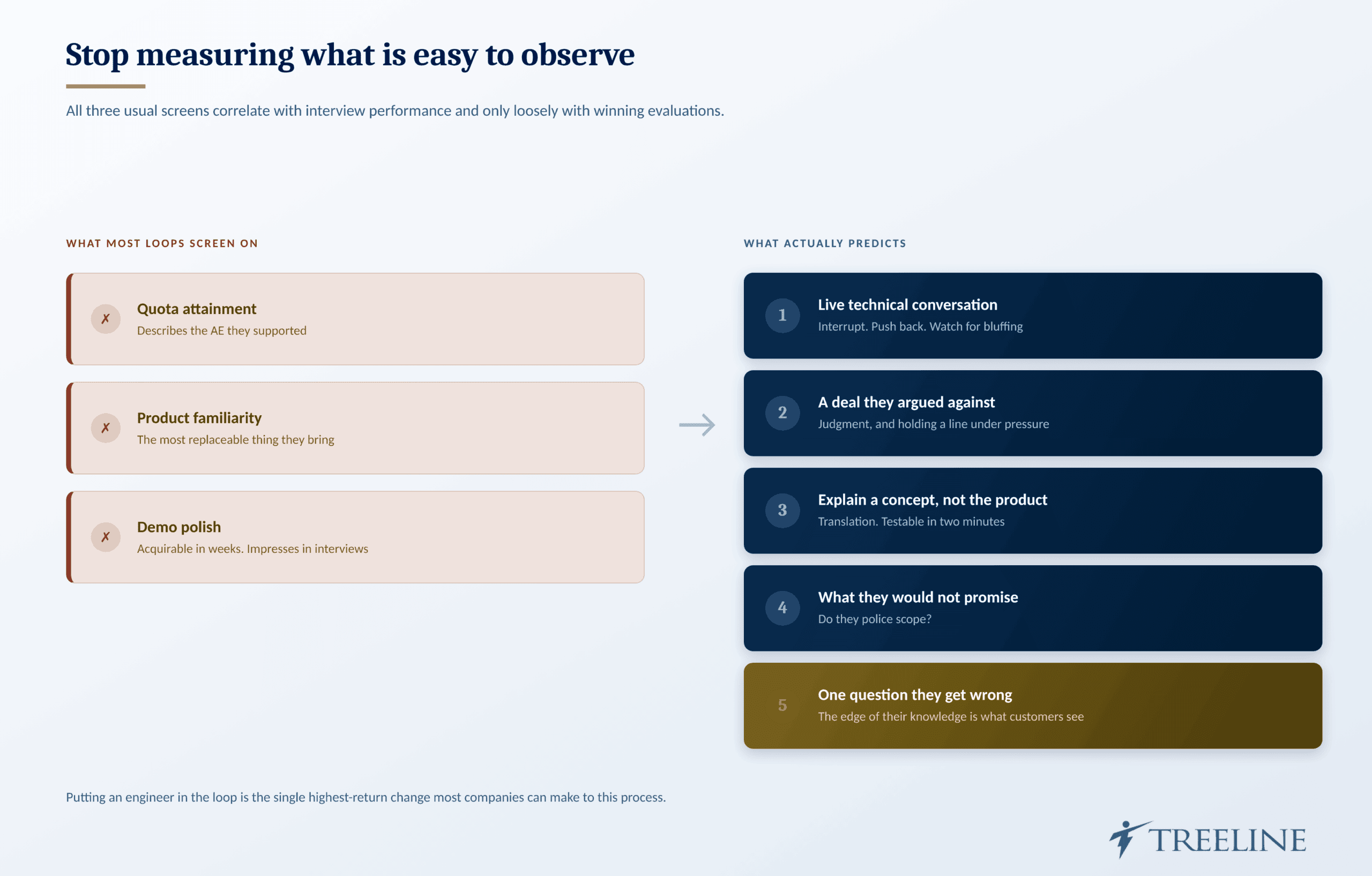
Five tests separate candidates reliably, and the format matters as much as the question.
A live technical conversation, not a presentation. Give them a plausible architecture problem and interrupt. The assessment is how they handle being pushed, corrected, or asked something they do not know. A candidate who bluffs once in an interview will bluff in front of a customer.
Ask about a deal they argued against. Every experienced sales engineer has told an account executive that a deal should not be pursued, or that a commitment could not be met. The specific answer reveals both technical judgment and whether they will hold a line under commercial pressure.
Ask them to explain something to a non-technical listener. Not the product, a concept. Translation is testable in two minutes and most interview loops never test it.
Ask what they would not promise. A candidate who cannot name a limit has either not worked on complex deals or does not police scope, and both produce the same downstream problem.
Involve an engineer in the loop. The single highest-return change most companies can make. A commercial interviewer cannot distinguish genuine depth from confident vocabulary, and on this role that distinction is the assessment.
Fantasia’s practical rule is that the interview should include at least one question the candidate is expected to get wrong. His reasoning is that how a sales engineer handles the edge of their knowledge is the behavior the customer will see, and it cannot be observed in a conversation engineered for them to succeed.
Where Sales Engineer Recruiting Finds Candidates
The population is identifiable and sits in four places, each with a characteristic strength and risk.
Competing and adjacent vendors supply people who already know the buyer’s environment and the objections. The risk is a candidate who has only ever sold one architecture and treats it as the only one.
Implementation and professional services produce strong candidates who have lived with the consequences of what was promised, which makes them unusually disciplined about scope. The risk is comfort with the commercial half; some genuinely dislike it, and that is worth asking directly.
Customer-side engineers, people who evaluated and ran the product at a buyer, bring credibility that cannot be manufactured. They need commercial coaching and are frequently receptive, because they have already done the technical work without the commercial upside.
Support and technical account management supply people who know where the product actually breaks. The risk is a reflex toward caution that can read to customers as a lack of confidence.
Fantasia’s observation about the customer-side pool is that its candidates convert at a higher rate than their numbers suggest. His reading is that an engineer who has already sat through vendor evaluations knows exactly what the job involves, so the ones who express interest have usually self-selected more carefully than candidates arriving from a competitor.
All four are employed and not applying, which is the practical argument for working through contingency recruiters who hold relationships in the function rather than advertising.
The Three Roles This Gets Confused With
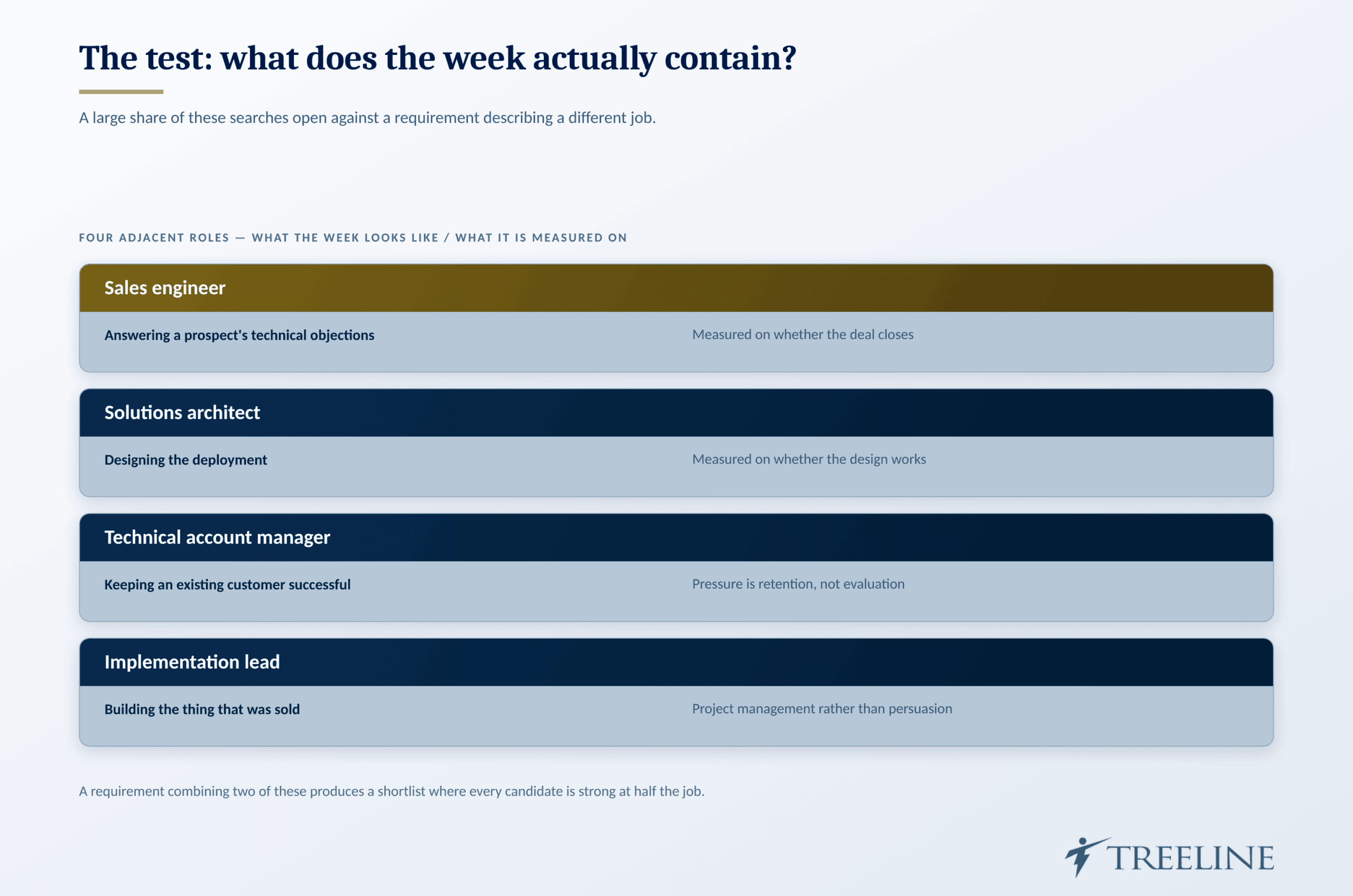
A large share of these searches open against a requirement that describes a different job, and naming the alternatives early prevents a wasted quarter.
Solutions architect. Designs the implementation, usually post-sale or late in the cycle, and is measured on whether the design works rather than on whether the deal closes. Deeper technically, less commercially exposed. A company that wants an architect and hires a sales engineer gets someone who presents well and lacks the implementation depth the work needs.
Technical account manager. Owns the relationship after the sale, adoption, escalation, renewal support. Overlaps on product knowledge and almost nowhere else, because the pressure is retention rather than evaluation.
Implementation lead. Delivers what was sold. Knows the product’s real limits better than anyone, which makes them a strong source of sales engineer candidates and a poor substitute, since the day-to-day is project management rather than persuasion.
The test for which one you need is simple: what does the person spend most of their week doing? Answering a prospect’s technical objections is a sales engineer. Designing a deployment is an architect. Keeping an existing customer successful is an account manager. Building the thing is implementation.
Companies that cannot answer that cleanly have usually written a requirement combining two of them, which produces a shortlist where every candidate is strong at half the job.
Why the Contingency Model Fits This Search
Three characteristics of the role make the structure appropriate.
The qualified intersection is genuinely small. Requiring real technical depth, commercial composure, a specific domain and a realistic band narrows the field quickly, and a firm paid only on placement absorbs the risk that the intersection is empty at your number.
The requirement frequently needs correcting. Companies routinely open this search describing a role that is really a solutions architect, a technical account manager, or an implementation lead. That discovery is worth more than most of what a search produces, and it happens before any candidate appears.
And the role is not confidential, so exclusivity buys little.
What the arrangement does not do is solve the assessment problem. A firm that forwards candidates without technical screening has moved the problem to your calendar, which is the main thing to probe when choosing who runs the search.
What the Employer Controls
Three conditions determine the outcome more than search quality does.
Whether an engineer is in the interview loop. Covered above, and worth repeating because it is the most common gap and the cheapest to close.
Whether the band reflects a hybrid. Sales engineers are frequently benchmarked against engineers, which underprices the commercial half, or against account executives, which misprices the structure. Both produce searches that stall at offer.
Whether the ratio is realistic. A sales engineer supporting three account executives in a complex product is in a different job from one supporting eight. Candidates with experience will ask, and a ratio that implies they cannot do the work properly will cost you the strongest people.
Fantasia pushes back on requirements that specify years of experience with a named platform. His objection is that platform familiarity is the fastest thing to acquire and the easiest to screen for, so leaning on it filters out stronger candidates while feeling rigorous.
What the Role Looks Like at Different Stages
The same title describes materially different jobs depending on company size, and candidates calibrate on this quickly.
At an early-stage company the sales engineer is frequently the only technical voice in the commercial organization. They build the demo environment, write the security questionnaire responses, train the account executives, and sometimes handle the first implementations. Breadth is the requirement and the risk is burnout.
At a mid-size company the role narrows toward what it is nominally for: supporting evaluations, running technical discovery, handling competitive bake-offs. A support function usually exists, and the ratio of sales engineers to account executives becomes a real number rather than an aspiration.
At a large company the role specializes further, by product line, by segment, sometimes by stage of the cycle, and a dedicated enablement and demo-engineering function exists behind it. Depth in one area is the requirement.
The mismatch that recurs is hiring from a large company into an early-stage role. The candidate is accustomed to a support structure that does not exist, and the breadth expected of them is wider than anything they have done. It is the same failure pattern that affects operations and channel hires, and it is detectable by asking what they personally built rather than what their team provided.
Compensation and Why It Is Structured Differently
Paying a sales engineer is not a smaller version of paying a seller, and the structure signals what you expect.
The variable component is usually smaller as a share of the package, commonly a quarter to a third rather than half, because the person influences outcomes they do not control. Weighting it like a seller’s plan produces a sales engineer who behaves like a seller, which removes the independence that made them credible to customers in the first place.
What the variable attaches to matters more than its size. Tying it to the supported team’s bookings is standard and reasonable. Tying some portion to technical win rate in competitive evaluations is better where it can be measured, because it rewards the part of the job they actually own.
One consideration specific to this profile: many strong candidates weigh the product and the problem more heavily than cash. A technically interesting product with a difficult buyer is a genuine draw, and it is the main non-financial lever available on this search.
Reading the First Six Months After Sales Engineer Recruiting
Because the contribution is indirect, the review needs measures that are not revenue.
In the first quarter the question is whether account executives are requesting them specifically. Sales engineers get pulled into deals by reputation, and internal demand is the earliest honest signal.
By six months, technical win rate in competitive evaluations becomes meaningful where it is tracked, and so does a quieter measure: whether deals they supported are being implemented without surprises. A sales engineer whose deals arrive at implementation matching what was sold is doing the scope half of the job.
The signal that something is wrong is a sales engineer who has become a demo resource, scheduled, present, and not consulted. That usually indicates the role was scoped as presentation support rather than as technical sales, and no amount of recruiting quality corrects it afterward.
Frequently Asked Questions
What makes sales engineer recruiting harder than hiring a seller?
The role sits between two functions. Screening for engineering produces someone accurate who loses the room; screening for selling produces someone agreeable whose technical answers do not survive the customer’s engineers. The capabilities that predict performance, translation, composure under technical scrutiny, discipline about scope, are harder to observe than demo polish.
Should we screen on quota attainment?
No. Most sales engineers are measured on a team number they only partly influence, so the figure describes the account executive they supported and the territory they worked. It is close to noise on this role.
What is the single highest-return change to our process?
Put an engineer in the interview loop. A commercial interviewer cannot reliably distinguish genuine technical depth from confident vocabulary, and on this role that distinction is the assessment.
What should we actually test?
A live technical conversation with interruptions rather than a prepared presentation; a deal they argued against; explaining a concept to a non-technical listener; what they would refuse to promise; and at least one question they are expected to get wrong, to see how they handle the edge of their knowledge.
Where do the best candidates come from?
Competing and adjacent vendors, implementation and professional services, customer-side engineers who evaluated and ran the product, and technical support or account management. Each brings a characteristic strength and a characteristic risk worth probing.
How should the role be compensated?
With a smaller variable share than a seller’s, commonly a quarter to a third, because the person influences outcomes they do not control. What it attaches to matters more than its size; technical win rate in competitive evaluations rewards the part of the job they own.
Why does a contingency arrangement suit this search?
The qualified intersection of technical depth, commercial composure, domain and band is genuinely small, and a fee payable only on placement puts the risk of an empty intersection on the firm. The requirement also frequently needs correcting before candidates appear.
How do we judge the hire early?
In the first quarter, whether account executives request them by name, internal demand is the earliest honest signal. By six months, technical win rates were tracked, and whether their deals reach implementation matching what was sold. A sales engineer who has become a scheduled demo resource indicates the role was scoped wrongly.
Put an Engineer in the Loop Before You Open the Search
Treeline, Inc. is a sales-only executive search firm based in Wakefield, Massachusetts, working exclusively on building sales organizations. Our contingency sales recruiting service carries no upfront cost and no fee unless you hire, and we deliver your first candidate within three days of launching a search.
If you are opening a sales engineer role, the useful first conversation is about who will test the technical half and what the support ratio actually is. Get in touch and we will work through the assessment before anyone looks at a resume.
Share This Story, Choose Your Platform!
Related Posts

What our happy clients are saying
Treeline Inc. provided us with the most candidates that aligned with our needs and were of the highest quality.

Dr. Jeffrey Klein Head of North America Sales, Satchel Pulse
Treeline Inc.’s collaborative, flexible, and communicative approach resulted in a smooth partnership. Beyond their recruitment expertise, their unique sourcing model was efficient and effective.

Sera Holt Director of Operations, LNS Research
Their professionalism was outstanding. Treeline Inc. was extremely thorough and ensured that we were on the same page before they started looking for candidates. They listened to us and did a great job working with the candidate to close out the process.

Cate Grant AVP Customer Success, Nasdaq
Thanks to Treeline Inc.’s intricate and thorough screening process, the company is able to hire six high-quality candidates that fit perfectly in the company’s culture. The team is highly receptive to concerns, and internal stakeholders are impressed with their unique recruitment abilities.

Anna McKean Sales Recruiter, Insider Intelligence
Treeline Inc. has been qualified individuals throughout a five-year-long engagement. They’ve made numerous placements of talented and qualified individuals for our business.

Michele St Laurent VP of HR, The Institute for Applied Network Security

Let Us Help You Source the Sales Talent You Need
Whether you’re building a team or replacing a key role, our Candidate Sourcing Platform provides a fast, flexible, and employer-focused solution.
Tell us more about your business and how we can help.
Treeline Inc.
Your Award-Winning Sales Recruitment Partner
15 Lincoln Street, Suite 314, Wakefield, MA 01880