The value of a contingency sales executive search firm in executive hiring is real, substantial, and bounded, and the boundary is the part most articles on this subject leave out. For sales leadership roles from front-line manager up through vice president, the contingency model usually delivers better speed, better market coverage and better economics than the alternatives.
At the top of the ladder, where the qualified population is measured in hundreds nationally and the search is genuinely confidential, it is frequently the wrong instrument. Knowing which situation you are in is worth more than any argument about fee structures. The population arithmetic explains most of the boundary. The U.S. Bureau of Labor Statistics reports in its Top Executives profile that overall employment of top executives is projected to grow 4 percent from 2024 to 2034, with about 331,000 openings each year on average, and that many of those openings come from the need to replace people who transfer to other occupations or leave the workforce.
Within that group, chief executives are a much smaller population: the BLS employment projections tables put chief executives at 309,400 jobs in 2024, rising to 322,700 by 2034, with roughly 22,200 openings a year across the entire United States and a median annual wage of $206,420 in May 2024. Those figures cover every industry, so the slice relevant to any one company’s sales leadership search is a fraction of a fraction.
Dan Fantasia, CEO of Treeline, Inc., treats the choice of search model as a question about the shape of the market rather than the prestige of the title. In his framing, the decision turns on whether you need to meet the few people who could do the job or simply need to hire one of the many who could, and most companies discover they are in the second situation more often than the language of executive search suggests.
The Four Jobs the Word Executive Covers
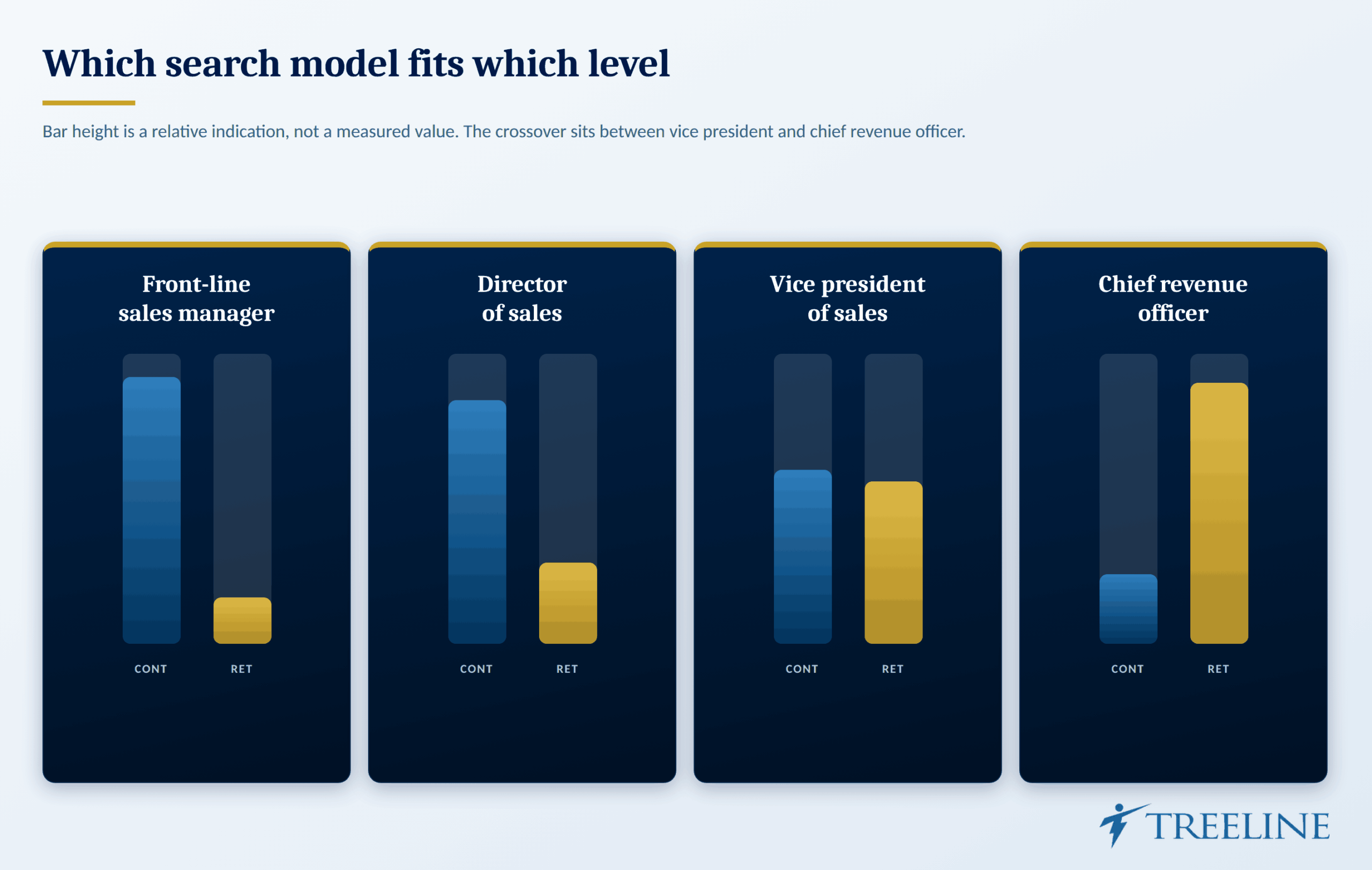
The word covers at least four distinct jobs, and the right search model is different for each. Collapsing them is the most common cause of a badly structured engagement, and the four levels sit differently against the two models. A front-line sales manager carries a team number, coaches on live deals, and is usually promoted from within the seller population.
The candidate pool is large, the profile is well understood, and the search is closer to a specialist individual-contributor search than to executive hiring. A director of sales owns a segment or region, manages managers or a large team, and starts to carry responsibility for how the sales motion is designed rather than only how it is executed.
The population narrows, but it remains large enough that a well-networked firm can reach dozens of genuine candidates. A vice president of sales owns the number for the whole organisation or a major division, builds the operating rhythm, hires the leadership layer beneath them, and answers to the chief executive or the board on forecast accuracy.
This is where the population thins noticeably and where the cost of a wrong hire becomes severe. A chief revenue officer or chief sales officer owns sales, and typically marketing, customer success or partnerships alongside it. The role is as much about organisational design and cross-functional politics as about selling, and the qualified population for any specific company is genuinely small.
The practical consequence is that contingency search covers the first three well and the fourth poorly, and the transition is gradual rather than sharp. An employer treating a director search with the ceremony of a chief executive search wastes months; an employer treating a chief revenue officer search as a contingency requisition usually ends up with an incomplete view of the market and no reliable way to know what it missed.
The Population Problem at the Top of the Ladder
At the senior end, the difficulty is not that good candidates are hard to persuade. It is that there are not many of them, and you cannot tell whether you have seen them. Consider what the numbers above imply. If chief executives across every industry in the United States number a little over three hundred thousand, then the population of people who have run a revenue organisation of your size, in your category, selling to your buyer, at your stage of company, is not a large market, it is a list.
Lists can be enumerated, and enumerating them is a different activity from recruiting. That difference is what the retained model is actually for. A retained engagement buys a documented map: every company in the relevant space, every person in the relevant seat, who was approached, who declined, and why. The employer ends up knowing what exists rather than knowing who applied.
For a board approving a chief revenue officer hire, that completeness is often the point of the exercise, and no contingency arrangement reliably produces it, because a firm paid only on placement has no economic reason to document the people it could not convert. Lower down, the calculus inverts. For a director or vice president search the qualified population is large enough that a complete map is neither achievable nor useful.
What matters is reaching a strong subset quickly and converting one of them, which is precisely what a contingency structure rewards. There is a further wrinkle worth naming, because it affects both models. At senior level the people you most want are frequently not available in the sense a job market implies. They are two years into building something, or holding unvested equity, or waiting for an acquisition to close.
A search conducted in any given quarter is therefore sampling a rotating subset of the qualified population rather than the population itself, and the same search run six months later would surface materially different people. Employers who conclude from one search that the market is thin are often observing timing rather than scarcity.
This is the strongest practical argument for maintaining relationships with a search partner between searches rather than engaging transactionally. The candidate who was unavailable in March is frequently available in November, and somebody has to have kept track. Fantasia’s view is that employers rarely need a full market map as often as they believe, and that the instinct to commission one is usually a response to anxiety about the decision rather than a genuine information requirement.
He suggests asking what you would do differently if you saw ten more candidates, because an employer who cannot answer that question is buying reassurance rather than intelligence.
Where a Contingency Sales Executive Search Firm Adds the Most Value
Between the front-line manager and the vice president, the contingency model is not a compromise. It is usually the better structure, for four specific reasons.
- Speed, because the model punishes delay. A firm paid on placement has a direct interest in compressing the process, chasing feedback, and pushing candidates through before rival processes mature. In leadership searches where the seat is producing nothing while it stays open, this matters more than it does for junior roles.
- Coverage without exclusivity. Contingency engagements are typically non-exclusive, which lets an employer keep an internal pipeline running alongside. For a director-level role where a strong internal candidate might emerge, that flexibility has real value, and it is expensive to preserve under a retained agreement.
- Risk placement. If the market cannot produce someone at the compensation on offer, the employer has spent time but no fee. For a first-time hire into a role the company has never had, a first VP of Sales, a first enterprise segment leader, that matters, because the requirement itself is often unproven.
- Market calibration as a by-product.
A firm running similar leadership searches across several companies knows what your VP band actually buys in the current market, whether your equity offer reads as competitive, and whether the scope you have described is one job or two. Employers running one leadership search every few years have no way to know any of that.
Treeline covers the neighbouring question of pace in its discussion of how contingency executive recruiters help companies hire sales leaders faster, and the broader model comparison in retained search versus contingency search.
Four Conditions That Override Seniority
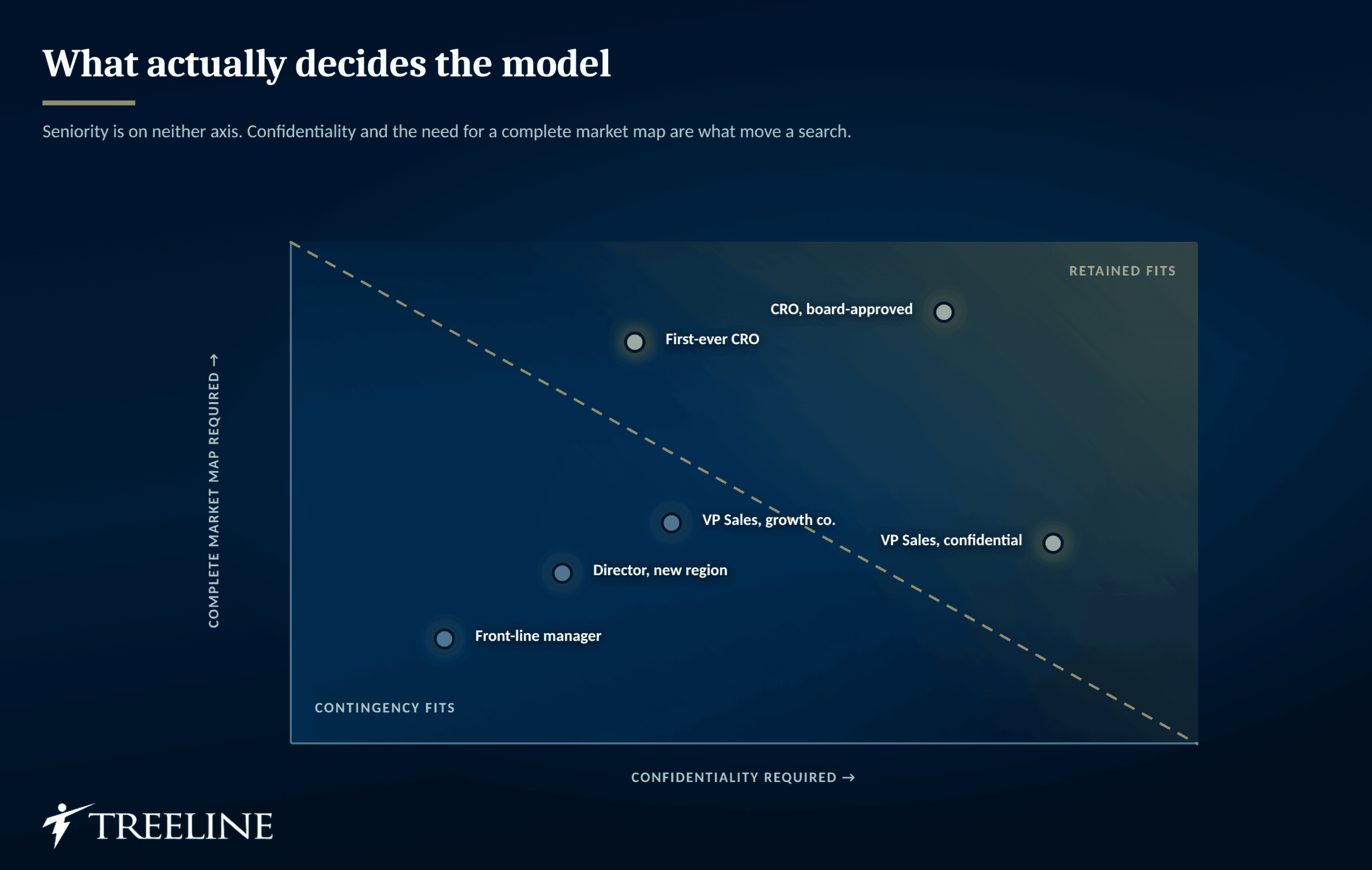
Title is a weak predictor on its own. These four conditions matter more, and any one of them can push a director-level search toward a retained structure or pull a chief revenue officer search back toward contingency. Plotted against the two that dominate, the pattern is clearer than a seniority ladder.
- Confidentiality. If the current occupant does not know they are being replaced, a non-exclusive search that touches dozens of people in a small market will leak. This is the single strongest argument for a retained structure, and it applies at any level.
- Completeness. If the board or the chief executive needs to see that the whole market was covered before approving a hire, you are buying documentation, and only a retained engagement reliably produces it.
- Novelty of the role. A position the company has never had is usually defined badly on the first attempt. Contingency handles that better, because the definition can be revised without renegotiating a contract.
- Internal candidacy.
If someone inside is a genuine contender, an exclusive retained mandate creates an awkward obligation. A non-exclusive arrangement leaves the internal route open honestly. Read together, these explain most engagements that go wrong. A confidential VP replacement run through three contingency firms leaks within weeks. A first-ever director role run as a retained mandate locks the company into a definition it outgrows by month two.
What Changes in an Executive Search That Does Not Change Lower Down
Even where contingency is the right model, executive hiring is a materially different exercise, and firms that treat it as a bigger version of a seller search produce weak shortlists.
The Scorecard Is About a Plan, Not a Quota
An individual contributor is assessed on whether they can produce a number. A sales leader is assessed on whether they can design the system that produces it. That means the useful evidence is different. What did they inherit, and what did they change? Did they build a segmentation, a comp plan, an enablement function, a forecast discipline, and did the improvement survive their departure?
A candidate who beat a number inside a system somebody else built is a different proposition from one who built the system, and both look identical on a résumé.
References Carry More Weight and Need Different Questions
At executive level, backchannel references are frequently more informative than the interview, and they are usually collected badly. The questions that produce signal are specific: who did this person promote, and where are those people now? What did their peers in marketing or finance say about working with them? What did they do when the quarter was clearly going to miss?
A firm that runs references as a formality after the offer is skipping the most predictive part of the process.
The Panel Includes People Who Will Not Manage Them
A vice president of sales will work as closely with the chief financial officer and the head of marketing as with the chief executive, and those relationships determine whether the hire succeeds. Involving those functions in the interview loop is not a courtesy. It surfaces the friction early, and it gives the candidate an accurate picture of the organisation they are joining, which reduces the chance of an eighteen-month departure that everyone saw coming.
Compensation Becomes a Structure Rather Than a Number
Base and variable are the smallest part of the conversation at this level. Equity type and vesting, acceleration on a change of control, severance terms, the definition of the number that triggers variable pay, and whether the plan is measured on bookings or recognised revenue all matter more than the headline figure. For context on the surrounding market, the Bureau of Labor Statistics reports a median annual wage of $138,060 for sales managers as of May 2024 and $102,950 for general and operations managers, though both cover every industry and every company size and should be treated as a floor for revenue leadership in competitive categories rather than a benchmark.
Fantasia recommends that the compensation structure be settled in principle before the final interview rather than after it. His reasoning is that an executive candidate who reaches an offer and then discovers the equity terms are not what they assumed will renegotiate from a position of strength, and the resulting process usually damages the relationship the company is about to depend on.
The Cost of Getting a Leadership Hire Wrong
The reason model choice deserves this much attention is that the downside is asymmetric, and it compounds in ways an individual contributor mis-hire does not. A seller who does not work out costs you a territory for a year. A sales leader who does not work out costs you the decisions they made while they were there. They hired people, and those people are now yours.
They set a comp plan, and the team has organised around it. They changed the segmentation, dropped a channel, restructured territories, or committed to a forecast the board planned against. Undoing that takes longer than the tenure did. There is a second-order effect that is easy to miss. Strong performers watch how a leadership change goes.
A leader who arrives, disrupts, and departs inside eighteen months usually takes some of the existing team with them on the way out, either because the leader recruits them, or because the disruption gave good people a reason to look. The attrition typically shows up a quarter or two after the departure, by which point it is attributed to something else.
Then there is the time cost of the second search. The company that has just removed a vice president is not in a strong position to recruit the next one: the market notices, candidates ask what happened, and the honest answer is uncomfortable. That is the moment when a firm’s willingness to tell you the truth about your reputation stops being a nicety.
None of this argues for slower hiring. It argues for spending the first week on the definition and the decision path rather than on sourcing, because the failures described here almost all originate before the first candidate is contacted.
How to Structure a Hybrid Engagement
The choice is not always binary, and for the awkward middle, a vice president search that is semi-confidential, or a director role with an internal contender, a hybrid structure often fits better than either pure model. Several arrangements are common. An engaged search takes a modest upfront fee that buys prioritisation and a documented market map, with the balance payable on placement; the employer gets some of the completeness of a retained engagement without paying the full cost of one.
An exclusive contingency arrangement keeps the pay-on-placement structure but grants one firm sole access for a defined period, typically thirty to sixty days, which materially raises the effort a firm will invest. A staged mandate starts as contingency and converts to retained if the search passes an agreed date without a hire, which acknowledges honestly that the requirement may be harder than either side assumed.
Each of these has a condition attached that employers should insist on. If you are paying anything upfront, you should receive the market map as a deliverable, in writing, whether or not a hire results. If you are granting exclusivity, it should carry a defined end date and a stated expectation of what arrives in the first two weeks.
If you are staging, the conversion trigger should be a date and a named condition rather than a mutual feeling that things are going slowly. The important point is that these structures should be chosen for the shape of the search rather than negotiated as a way of splitting the difference on fee. A hybrid entered purely to reduce cost tends to deliver the weaknesses of both models.
What the Firm Should Be Able to Tell You About Your Own Market
Before signing anything, a useful test is to ask a prospective partner what they already know. A firm genuinely working your market answers these from memory; one that is not will offer to research and return.
- Which companies in your category have recently changed sales leadership, and what happened afterwards.
- What your vice president band actually buys in your geography and stage, expressed as a range with reasoning.
- Which two or three people they would approach first, described by situation rather than by name.
- What the common reason is that leaders leave companies like yours.
- Whether the scope you have described is one job, and if not, where they would split it.
- What your company’s reputation is among sales leaders in your market, delivered plainly rather than diplomatically.
That last question is uncomfortable and it is the most valuable. Employers are frequently the last to learn that their reputation among candidates is worse than they assume, and a firm willing to say so in a first meeting is demonstrating the behaviour you actually want from the engagement. It is worth being specific about what a poor reputation among sales leaders actually consists of, because it is rarely what companies expect.
It is seldom about the product. More often it is a pattern that circulates: leaders who left after a year, a founder with a reputation for overruling the sales organisation, a forecast culture that punishes honesty, or a comp plan that changed mid-year. Those stories travel quickly in a small market and they reach exactly the candidates you most want.
The useful response is not to dispute the story but to establish whether it is still true and, if it is not, to be able to say what changed and when. A credible account of a fixed problem is persuasive. A denial is not, and candidates who hear one usually stop returning calls without explaining why. Fantasia argues that the willingness to answer the reputation question honestly separates contingency executive search firms more reliably than any credential does.
His point is that a partner who softens the market’s view of you in the first conversation will also soften it later, at precisely the moment when an accurate reading would have changed a decision.
Where the Board and Investors Fit
Sales leadership hires are frequently the first search in a company’s history where people outside the management team have a view, and the process usually handles that badly. Board involvement is legitimate. A vice president of sales or chief revenue officer determines whether the revenue plan the board approved is achievable, so wanting a say is reasonable.
The problem is that involvement is rarely defined, so it arrives late and unpredictably, a director who wants to meet the finalist after the offer has been discussed, or an investor who forwards a candidate from their own portfolio in week six. Three decisions make this manageable, and all of them belong at the start.
- Who has a vote and who has a voice. These are different, and conflating them is what produces the late reversal. A board member consulted for perspective is not the same as a board member whose approval is required.
- At what stage they enter. A single conversation with a finalist is useful. An introduction at first-round stage tends to distort the process, because candidates behave differently and internal interviewers defer.
- What happens to introduced candidates.
Investors and directors will suggest people. Those candidates should go through the same assessment as everyone else, and someone should say so out loud before the first one arrives. There is a related point about pace. Board schedules are the single most common cause of extended executive searches, and the extension is usually invisible until it has already happened.
If final approval depends on a monthly meeting, the search has a built-in delay of up to four weeks that has nothing to do with candidate availability, and a strong candidate with another offer will not wait for it. Agreeing an out-of-cycle approval mechanism before launching removes more elapsed time than any sourcing improvement will.
The Failure Modes Specific to Executive Sales Hiring
These are the ways leadership searches go wrong that do not occur further down the organisation.
- Hiring the profile of the last leader. After a departure, companies tend to specify the inverse of whatever frustrated them most. A process-heavy predecessor produces a search for someone entrepreneurial; a chaotic one produces a search for someone systematic. The correction usually overshoots, and the replacement fails for the opposite reason two years later.
- Buying a résumé from a company you admire. A leader who succeeded at a business with strong inbound demand, an established brand and a mature enablement function may have very little transferable experience for a company with none of those. The logo is not the evidence.
- Scope that is really two jobs. A single requisition asking for someone to build the enterprise motion, manage the existing mid-market team, own partnerships and fix forecasting is not a hard search, it is an impossible one. A good firm says this at intake.
- No agreement on what the first year means. If the chief executive expects a rebuilt team and the board expects an immediate revenue improvement, the new leader will fail one of them regardless of ability. This is worth resolving internally before the search, not during onboarding.
- Interviewing without anyone who has done the job.
If nobody on the panel has run a revenue organisation, the assessment defaults to presentation quality, which is exactly the trait a career interviewer optimises for. Bringing in an advisor or board member for one conversation is a cheap correction.
Onboarding Is Part of the Search
The handover between accepting an offer and running the organisation is where a surprising share of executive hires quietly fail, and it is rarely treated as part of the engagement. A sales leader arriving from outside faces a specific problem: they are expected to make consequential decisions before they understand the business, and the pressure to demonstrate impact early pushes them toward visible changes rather than correct ones.
A comp plan rewritten in month two by someone who has not yet seen a full quarter is a common example, and it is usually reversed by month eight. Several things reduce that risk, and none of them is expensive. Agreeing explicitly what the first ninety days are for, learning rather than restructuring, removes the pressure to act prematurely.
Giving the new leader access to the last four quarters of pipeline data, win-loss records and forecast accuracy before their start date lets the learning begin earlier. Scheduling their first conversations with the people who will disagree with them, rather than only with allies, surfaces the real constraints faster. There is also a candid conversation worth having about what the predecessor got right.
Companies tend to brief a new leader on the problems, which produces a leader who assumes nothing was working. Some things were, and dismantling them is an avoidable cost. A search firm that stays involved through this window is providing real value, and it costs them nothing except attention. Ask a prospective partner what their involvement looks like between acceptance and month three.
Vague answers here are common and worth noting.
What Value Looks Like Twelve Months Later
The honest test of any executive search is not whether the hire is still in the seat. It is whether the things a leader was hired to change have changed. Twelve months in, the useful questions are specific. Has the forecast become more accurate, and can the leader explain the variance? Has the leadership layer beneath them improved, either through hiring or through people growing into larger roles?
Is the sales motion documented in a way that survives an individual departure? Have they made at least one difficult personnel decision, and did they make it earlier than their predecessor would have? A hire who is well-liked, still in post, and has changed nothing structural is usually a failed search that has not been recognised yet.
Conversely, a leader who has removed underperformers, reset a comp plan and made themselves unpopular in the first year may be exactly what the company needed, and judging them on team sentiment at month twelve will produce the wrong conclusion. The relevance to search model choice is direct. If the firm you engaged understood the operating problem rather than the job description, the shortlist will have been built around it, and this review will be easy.
If they matched a title, the review at twelve months tends to be the first time anyone notices that the wrong problem was solved.
What to Agree Before the First Candidate Is Contacted
Almost everything above reduces to a short list of things that should be settled in the first week. Searches that stall usually skipped one of them.
- The operating problem, in two sentences. Not the job description. What will this person change that is not changing now?
- Which of the four conditions apply. Confidentiality, completeness, novelty, internal candidacy, and therefore which model the search needs.
- The compensation structure in full. Base, variable, the metric that triggers variable pay, equity type and vesting, acceleration, severance.
- The decision path with names and dates. Who interviews, who approves, and what happens if the approver is unavailable.
- The board’s role. Vote or voice, entry stage, and treatment of introduced candidates.
- The internal candidate position. Resolved and communicated, either way.
- What the first year is supposed to produce, agreed between the chief executive and the board rather than assumed separately.
An employer who can hand a search partner that list is a materially different client from one who cannot, and the difference shows up in the quality of what comes back within about three weeks.
When to Stop the Search Entirely
Sometimes the correct outcome is not a different firm or a different model. It is not hiring. If the market has consistently declined the opportunity for the same reason, and that reason is something the company will not change, continuing the search is a way of avoiding a decision. If the scope is genuinely two jobs and the budget covers one, no partner solves that.
If the compensation band is materially below what the profile commands and finance will not move, the only outcomes available are a long vacancy or a compromise hire, and the compromise hire is the more expensive of the two. There is also the internal option, which companies undervalue because it feels like a failure of ambition.
A strong director promoted into a vice president role with an experienced advisor alongside them frequently outperforms an external hire who needs six months to learn the product, the market and the people. The external search is worth running to test that hypothesis, but it should be genuinely open to the answer.
Frequently Asked Questions
Is a contingency sales executive search firm suitable for senior sales roles?
For most sales leadership roles up to vice president, yes, the model usually delivers better speed and better economics, and the qualified population is large enough that a complete market map is neither achievable nor necessary. At chief revenue officer level, or wherever the search must be confidential, a retained structure generally fits better.
What is the real difference between contingency and retained executive search?
Contingency firms are paid only on placement and produce a strong shortlist. Retained firms are paid in instalments regardless of outcome and produce a documented map of the whole market, plus exclusivity and a contractual commitment to complete the search. You are choosing between a shortlist and a census, not between cheap and expensive.
When does confidentiality force a retained search?
Whenever the current occupant of the seat does not know they are being replaced. A non-exclusive search reaching many people in a small market will leak, and the damage from that is usually worse than the cost difference between the two models.
What do contingency executive recruiters charge for leadership roles?
Fees are a percentage of first-year compensation and are payable only on a hire, with 25 percent a common standard for professional sales roles and senior positions sometimes carrying a higher percentage. Confirm which components of executive compensation the percentage applies to, since equity and signing bonuses are treated differently between firms.
Can we run an internal candidate alongside an external search?
Yes, and a non-exclusive contingency arrangement makes that easier than a retained mandate does. What matters is telling the internal person honestly that an external search is running, and deciding in advance what would make them the choice. Leaving it ambiguous slows the external process and damages the internal relationship.
How long should an executive sales search take?
Longer than an individual contributor search and shorter than most companies allow. The stage that reliably extends is not sourcing but internal decision-making, particularly where a board or multiple executives are involved. Agreeing the decision path before launching removes more elapsed time than any sourcing improvement.
Should we use several contingency search firms for a leadership role?
Rarely. At leadership level the qualified pool is small enough that multiple firms will contact the same people with inconsistent descriptions of the opportunity, which damages your positioning in exactly the market you need to recruit from. One firm with genuine depth is usually better.
What should we prepare before engaging a contingency recruiting agency for an executive hire?
An honest description of the operating problem rather than a job description, the compensation structure including equity and severance terms, the named decision path with committed availability, a resolved position on any internal candidate, and agreement between the chief executive and the board about what the first year is supposed to produce.
Talk Through Your Sales Leadership Search
Treeline, Inc. is a sales-only executive search firm based in Wakefield, Massachusetts, working exclusively on building sales organizations. Our contingency sales recruiting service carries no upfront cost and no fee unless you hire, and we deliver your first candidate within three days of launching a search. If you are weighing a sales leadership hire, the most useful first conversation is about which model the search actually needs.
Get in touch and we will tell you plainly whether contingency is the right structure for it, including when we think it is not.
Share This Story, Choose Your Platform!
Related Posts


What our happy clients are saying
Treeline Inc. provided us with the most candidates that aligned with our needs and were of the highest quality.

Dr. Jeffrey Klein Head of North America Sales, Satchel Pulse
Treeline Inc.’s collaborative, flexible, and communicative approach resulted in a smooth partnership. Beyond their recruitment expertise, their unique sourcing model was efficient and effective.

Sera Holt Director of Operations, LNS Research
Their professionalism was outstanding. Treeline Inc. was extremely thorough and ensured that we were on the same page before they started looking for candidates. They listened to us and did a great job working with the candidate to close out the process.

Cate Grant AVP Customer Success, Nasdaq
Thanks to Treeline Inc.’s intricate and thorough screening process, the company is able to hire six high-quality candidates that fit perfectly in the company’s culture. The team is highly receptive to concerns, and internal stakeholders are impressed with their unique recruitment abilities.

Anna McKean Sales Recruiter, Insider Intelligence
Treeline Inc. has been qualified individuals throughout a five-year-long engagement. They’ve made numerous placements of talented and qualified individuals for our business.

Michele St Laurent VP of HR, The Institute for Applied Network Security

Let Us Help You Source the Sales Talent You Need
Whether you’re building a team or replacing a key role, our Candidate Sourcing Platform provides a fast, flexible, and employer-focused solution.
Tell us more about your business and how we can help.
Treeline Inc.
Your Award-Winning Sales Recruitment Partner
15 Lincoln Street, Suite 314, Wakefield, MA 01880