Most hiring plans are built forwards: here is the headcount budget, let us fill it. Capacity planning runs the other way. It starts with the number the company has committed to, works out how much selling capacity produces that number, subtracts what already exists, and converts the gap into hire dates.
Done properly it produces an uncomfortable answer. The people who will carry next year’s number mostly need to start this year, because a seller hired in March is not productive in March. That lag is the whole of the discipline, and it is why a contingency sales recruiting arrangement, fee payable only on a hire, fits a plan that will be revised at least once, in the way described in Treeline’s account of contingency hiring for growth-driven employers.
Dan Fantasia, CEO of Treeline, Inc., observes that most hiring plans are written in headcount and should be written in start dates. From his perspective a plan that names a number of hires without naming when each must be productive has deferred the only decision that matters.
What Sales Capacity Planning Actually Calculates
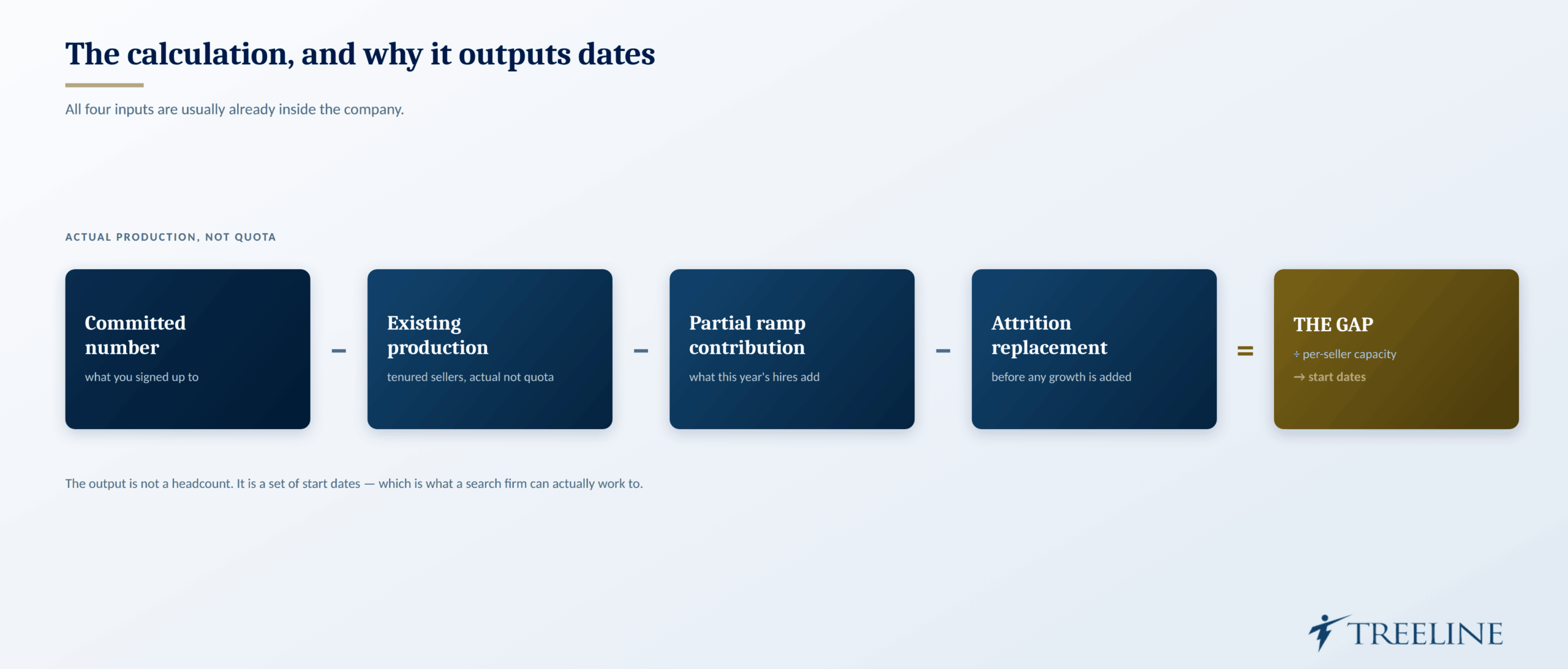
Four inputs produce the answer, and all four are usually available inside the company.
Productive capacity per seller. Not quota, what a tenured seller in that segment actually produces, taken from history rather than from the plan. If eight sellers carried a million each and delivered seven hundred thousand each, the planning figure is seven hundred thousand.
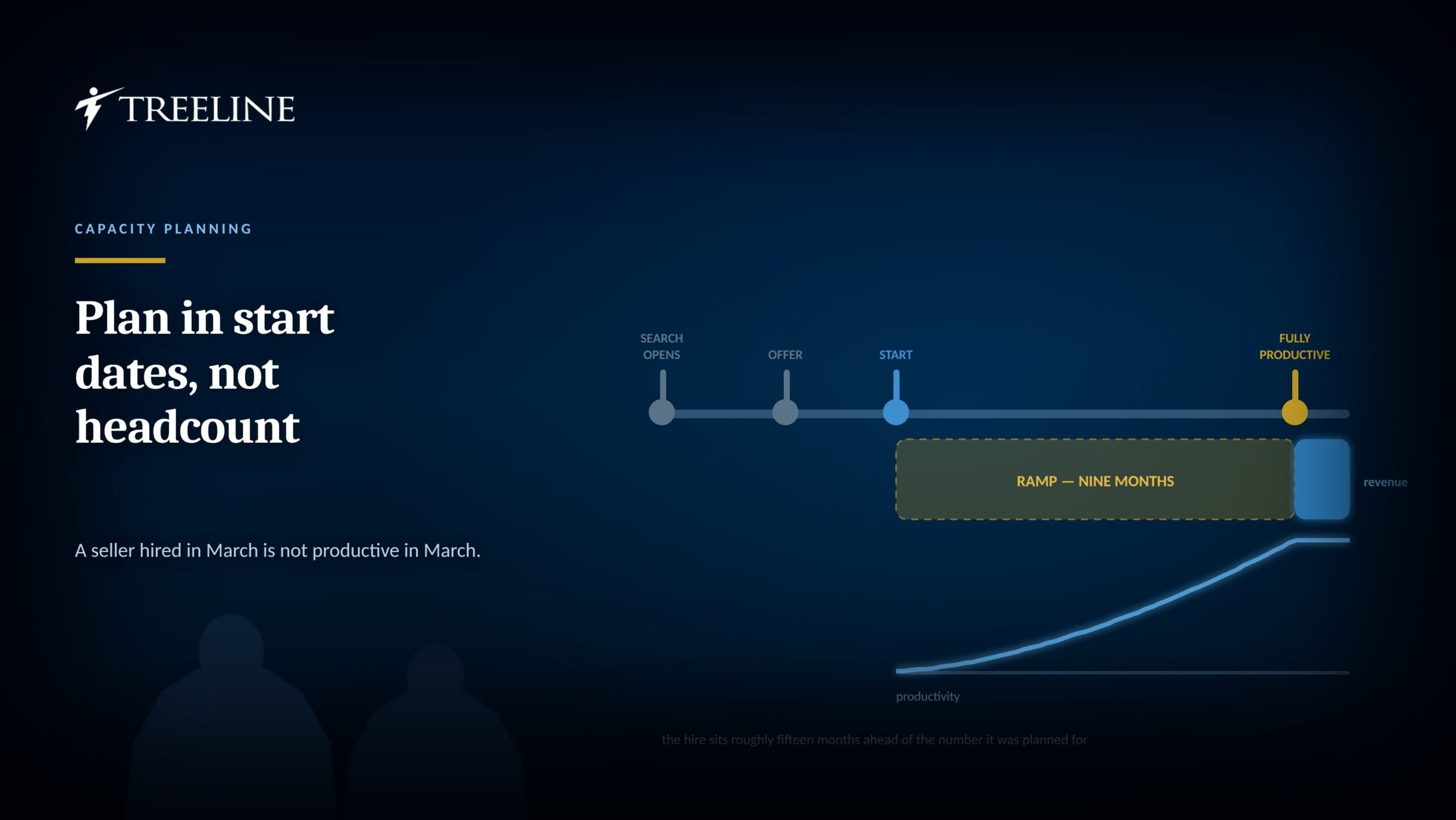
Ramp curve. How long until a new hire reaches that figure, and what they produce along the way. A nine-month ramp in enterprise is normal and means a hire contributes perhaps a third of full capacity in their first year.
Attrition. What proportion of the team leaves annually, and when. A team of twelve with twenty percent attrition loses between two and three sellers a year, which has to be replaced before any growth is added.
The gap. The committed number, minus what existing tenured sellers will produce, minus what partially ramped hires will contribute, divided by per-seller capacity.
The output is not a headcount. It is a set of start dates, and start dates are what a search firm can actually work to.
Fantasia’s test of whether a company has done this work is whether it can say which single hire matters most. He finds that a company able to name it has sequenced the plan, while one that treats all open roles as equally urgent has produced a budget rather than a plan.
Why Sales Capacity Planning Is Decided by Ramp Lag
The arithmetic that catches companies out is simple and consistently underestimated.
A seller who starts in January, on a nine-month ramp, reaches full productivity in October. They contribute a fraction of a full year in the year they are hired. To have a seller fully productive from the start of next year, they must start around the first quarter of this one, and to start then, the search must open the quarter before that.
Working backwards from a January full-productivity date: search opens in the autumn of the prior year, offer lands around November, notice runs to January, ramp completes the following October. The hire is nearly fifteen months ahead of the revenue it was planned for.
This is why hiring plans built on the current year’s budget cycle are structurally late. By the time the budget is approved and the requisition opens, the capacity it buys lands a year after it was needed.
The practical consequence for a contingency arrangement is that the engagement should start earlier than feels necessary, and that a firm which can produce candidates quickly is worth more than the fee difference, because every week of delay moves the productivity date.
A Worked Example
The arithmetic is easier to see on a specific case. This is constructed rather than drawn from a particular company.
A company has ten enterprise sellers and commits to twelve million next year. History says a tenured seller delivers eight hundred thousand against a one million quota. Attrition has run at twenty percent. Ramp to full productivity is nine months, with a new hire contributing roughly thirty percent of full capacity across their first twelve months.
Start with existing capacity. Ten sellers at eight hundred thousand is eight million, but attrition will remove two during the year, and their territories produce partially. Call it seven million from the existing team.
The gap is five million. At eight hundred thousand per fully productive seller that is just over six sellers, except none of them will be fully productive next year. A hire starting in January contributes about two hundred and forty thousand in their first year, not eight hundred.
To close five million with first-year hires alone would require more than twenty people, which is absurd. The real answer is that most of the gap has to be closed by people hired this year, so they are tenured next year, and the remainder by raising per-seller production, extending the timeline, or revising the number.
That conclusion is available in an afternoon and it changes the conversation entirely. The company that does not run it opens six requisitions in January and discovers the shortfall in September.
Where Sales Capacity Planning Usually Breaks

Four errors recur, and each produces the same symptom: a team that is apparently fully staffed and still missing.
Planning on quota rather than on actual production. If the team historically delivers seventy percent of quota, planning capacity at a hundred percent means the plan is short by nearly a third before anyone is hired.
Ignoring attrition. A plan that adds four sellers to a team of twelve, in a company losing two or three a year, is a plan that adds one or two net. Companies routinely report hiring four and growing by one, and attribute it to recruiting quality rather than to arithmetic.
Treating ramp as binary. New hires are not unproductive and then productive. Modelling them as either produces a plan that is wrong in both directions, too pessimistic early, too optimistic at the transition.
Assuming the ramp curve is fixed. Ramp length is partly a property of the company rather than of the hire. A business with documented territory data, working enablement and a defined qualification standard ramps people faster than one where a new seller spends six weeks working out who the buyer is. Treating ramp as an immovable constant hides a lever that is usually cheaper to pull than additional headcount.
Hiring in a single batch. Four sellers starting the same month overwhelm onboarding, ramp more slowly than they would staggered, and arrive at full productivity together rather than sequentially. Staggered starts produce capacity earlier even though the last hire lands later.
Fantasia’s objection to batch hiring is that it optimises the requisition rather than the revenue. He notes that four people starting across four months reach aggregate productivity sooner than four starting together, because onboarding attention is the constraint rather than seat availability.
Turning Sales Capacity Planning Into a Search Brief
Capacity planning changes what a search firm should be asked for, in three specific ways.
Dates rather than counts. “Three enterprise sellers” is a requisition. “One productive by Q1, two by Q3” is a brief, and it tells the firm which search to prioritise.
A stated tolerance for partial fill. If the plan needs three and the market yields two strong candidates, is two acceptable or does the plan fail? Firms behave differently depending on the answer, and most are never told.
Which hire matters most. If the plan contains four roles and one of them carries materially more of the gap than the others, say so. Firms allocate effort across their caseload, and a client who has identified the critical search gets it worked first. A client who presents four equal-priority roles gets whichever is easiest to fill.
The revision trigger. Plans change. Saying in advance what would cause this one to change, a funding event, a product delay, a segment exit, lets a firm calibrate how hard to push on a search that may be withdrawn.
A contingency arrangement handles revision better than most, because a search that is cancelled costs the employer nothing. That is the structural argument for using it on a plan with genuine uncertainty, and the reason to be honest with the firm about where the uncertainty sits.
Territory Capacity Is a Separate Constraint
Headcount arithmetic assumes there is somewhere for each new seller to sell, and that assumption fails more often than companies expect.
A territory that already supports a tenured seller at full production cannot absorb a second one without being divided, and dividing it reduces the incumbent’s capacity in the year of the split. Adding a seller to a covered patch produces less incremental revenue than the model predicts, and it produces a comp conversation with the incumbent.
Genuinely uncovered territory is different and is where added headcount produces close to the modelled return. Most companies have less of it than their plan assumes, because the obvious uncovered ground was taken first.
The practical step is to map the plan against coverage before converting it into requisitions. If six hires are planned and only three have genuinely uncovered ground, the other three are splits, and splits should be planned as splits, with the incumbent’s number adjusted and the conversation had in advance rather than discovered.
This is also where capacity planning connects to the search brief. A seller being hired into a split territory is a different pitch from one being hired into open ground, and candidates can tell the difference quickly.
What to Do When the Arithmetic Says the Plan Is Impossible
Sometimes the honest output is that the number cannot be reached with the hiring the calendar permits, and that conclusion is worth having early.
If the gap requires eight hires productive by mid-year and the ramp is nine months, the capacity does not exist regardless of recruiting quality. The options are then real choices rather than effort: raise per-seller productivity, extend the timeline, reduce the number, or buy capacity differently through channel or partner routes.
Companies that do not run this calculation discover the same conclusion in the third quarter, having spent two quarters recruiting against a plan that was never achievable, and frequently conclude that the recruiting failed.
Fantasia’s position is that a firm should tell a client when the plan is arithmetically out of reach, even though saying so reduces the number of searches. His reasoning is that the alternative is a client who spends six months hiring and still misses, and who attributes the miss to the firm.
Checking Sales Capacity Planning Through the Year
Two checkpoints are worth scheduling, and both are early enough to act on.
At the end of the first quarter, compare actual start dates against planned ones. A month of slippage per hire compounds into a materially different year, and it is recoverable in March in a way it is not in September.
At mid-year, compare actual ramp against the assumed curve. If hires are reaching productivity more slowly than modelled, the problem is onboarding or role definition rather than selection, and adding more hires will not fix it. The distinction matters commercially: a company that misreads a ramp problem as a selection problem will change search firms, which costs a quarter and resolves nothing.
The signal that the plan is working is unglamorous: capacity arriving on the dates it was planned to arrive, with ramp tracking the curve. Revenue follows from that or it does not, but at least the hiring half has been established as sound.
There is a reporting benefit worth noting. A sales leader who can show the board that capacity arrived on plan, with ramp tracking the modelled curve, has separated the hiring question from the revenue question. Without that separation, a revenue miss gets attributed to recruiting by default, and the following year’s plan gets built on the assumption that hiring was the problem.
Frequently Asked Questions
What does sales capacity planning actually calculate?
It works backwards from the committed number to a set of start dates. Four inputs: actual production per tenured seller taken from history rather than quota, the ramp curve for new hires, annual attrition, and the resulting gap. The output is dates, not headcount.
Why do hiring plans built on the budget cycle run late?
Because ramp lag puts the hire roughly fifteen months ahead of the revenue it was planned for. A seller fully productive from January needs to start around the first quarter of the prior year, which means the search opens the autumn before that. Budget-cycle timing delivers capacity about a year after it was needed.
What is the most common planning error?
Planning on quota rather than on actual production. If a team historically delivers seventy percent of quota, planning capacity at full quota leaves the plan short by nearly a third before anyone is hired. Ignoring attrition is a close second.
Should we hire several sellers at once?
Staggered starts usually produce aggregate capacity sooner, because onboarding attention is the constraint rather than seat availability. Four people starting in the same month ramp more slowly than four starting across four months, and they all reach productivity simultaneously rather than in sequence.
How does capacity planning change what we ask a search firm?
Give them dates rather than counts, state your tolerance for partial fill, and name what would cause the plan to be revised. “One productive by Q1, two by Q3” tells a firm which search to prioritise; “three enterprise sellers” does not.
Why does a contingency arrangement suit a capacity-driven plan?
Because plans get revised, and a search that is cancelled costs the employer nothing under a fee-on-placement structure. That makes it the appropriate instrument where the uncertainty is real, provided you tell the firm honestly where that uncertainty sits.
What if the arithmetic says the number is unreachable?
That is a useful output and worth having early. If the gap needs eight hires productive by mid-year against a nine-month ramp, no amount of recruiting quality produces it. The real options are raising per-seller productivity, extending the timeline, reducing the number, or buying capacity through channel routes.
How do we check the plan during the year?
At the end of the first quarter compare actual start dates against planned ones, since a month of slippage per hire compounds and is recoverable in March but not September. At mid-year compare actual ramp against the assumed curve, slower ramp points at onboarding or role definition rather than selection.
Work Backwards From the Number
Treeline, Inc. is a sales-only executive search firm based in Wakefield, Massachusetts, working exclusively on building sales organizations. Our contingency sales recruiting service carries no upfront cost and no fee unless you hire, and we deliver your first candidate within three days of launching a search.
If you are building next year’s hiring plan, the useful first conversation is about start dates rather than headcount. Get in touch and we will work the arithmetic backwards with you.
Share This Story, Choose Your Platform!
Related Posts
What our happy clients are saying
Treeline Inc. provided us with the most candidates that aligned with our needs and were of the highest quality.

Dr. Jeffrey Klein Head of North America Sales, Satchel Pulse
Treeline Inc.’s collaborative, flexible, and communicative approach resulted in a smooth partnership. Beyond their recruitment expertise, their unique sourcing model was efficient and effective.

Sera Holt Director of Operations, LNS Research
Their professionalism was outstanding. Treeline Inc. was extremely thorough and ensured that we were on the same page before they started looking for candidates. They listened to us and did a great job working with the candidate to close out the process.

Cate Grant AVP Customer Success, Nasdaq
Thanks to Treeline Inc.’s intricate and thorough screening process, the company is able to hire six high-quality candidates that fit perfectly in the company’s culture. The team is highly receptive to concerns, and internal stakeholders are impressed with their unique recruitment abilities.

Anna McKean Sales Recruiter, Insider Intelligence
Treeline Inc. has been qualified individuals throughout a five-year-long engagement. They’ve made numerous placements of talented and qualified individuals for our business.

Michele St Laurent VP of HR, The Institute for Applied Network Security

Let Us Help You Source the Sales Talent You Need
Whether you’re building a team or replacing a key role, our Candidate Sourcing Platform provides a fast, flexible, and employer-focused solution.
Tell us more about your business and how we can help.
Treeline Inc.
Your Award-Winning Sales Recruitment Partner
15 Lincoln Street, Suite 314, Wakefield, MA 01880