Hiring sellers six months after you let sellers go is a different exercise from ordinary hiring, and the difference is not sourcing. The roles are the same, the market is the same, the compensation may even be the same. What has changed is that every candidate will ask what happened, every reference check will surface it, and the people who stayed are watching how the rebuild is handled.
That makes it a credibility problem first. Most companies in this position run the search under a contingency sales recruiting arrangement, no fee unless you hire, which suits a rebuild where the headcount plan may change again, and the choice between that and a retained structure turns on how settled the plan actually is.
Dan Fantasia, CEO of Treeline, Inc., treats the first post-reduction hire as a signal rather than a transaction. From his perspective the market reads who a company hires after a contraction as a statement about where it thinks it is going, and candidates calibrate on it quickly.
What a Sales Team Rebuild After Layoffs Actually Has to Overcome
Four obstacles sit between the requisition and the hire, and only one of them is about finding people.
The candidate’s risk assessment. An experienced seller leaving a stable role to join a company that recently reduced its sales force is accepting a visible risk. They will want to know whether the reduction was performance-driven, funding-driven or strategic, and whether it is finished.
What the market already knows. Departures are public. Former employees talk, and a candidate will hear a version of events before they hear yours. The version they hear is rarely balanced and is sometimes accurate.
The remaining team. Survivors watch the rebuild closely. If new hires arrive on better terms, with better territories, or in larger numbers than the people who left, the message is legible and the second wave of departures is voluntary.
Your own uncertainty. Companies rebuilding frequently do not know whether the plan is final. That uncertainty transmits, candidates detect a hiring manager who cannot commit to what the role will look like in a year.
Why the Reason Matters More Than the Event
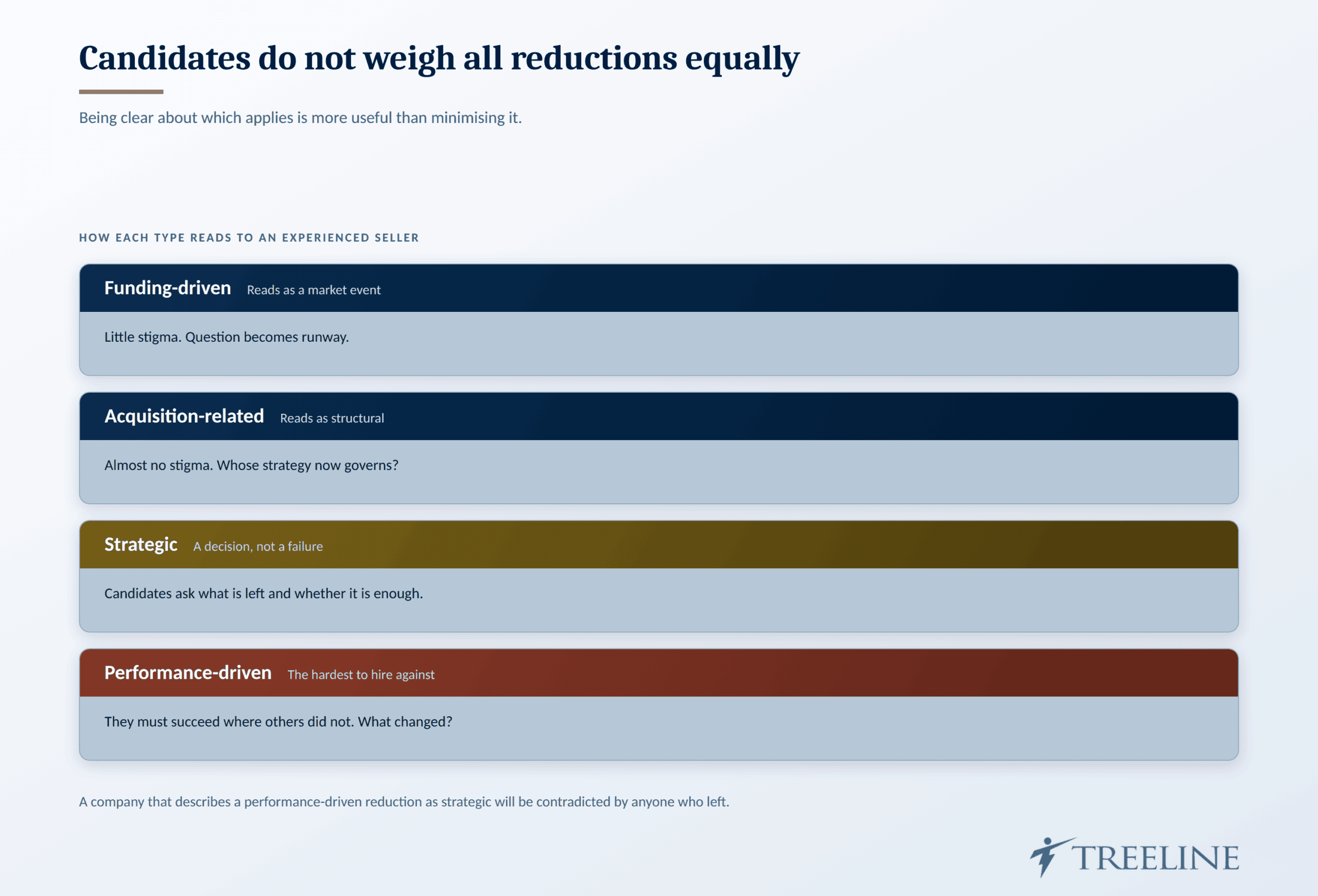
Candidates do not weigh reductions equally, and understanding the hierarchy helps a company position its own situation honestly.
A funding-driven reduction at a venture-backed company reads as a market event. Sellers understand it, it carries little stigma, and the question becomes whether the runway is now sufficient. This is the easiest version to hire against.
A strategic reduction, exiting a segment, discontinuing a product, closing a geography, reads as a decision rather than a failure, provided the remaining strategy is coherent. Candidates will ask what is left and whether it is enough.
A performance-driven reduction, where the sales organization missed and was cut, is the hardest. The candidate is being asked to succeed where others did not, and they will want to know what changed about the conditions rather than about the people.
An acquisition-related reduction is read as structural and carries almost no stigma, though it raises a different question about whose strategy now governs.
Being clear about which one applies is more useful than minimising it. A company that describes a performance-driven reduction as strategic will be contradicted by anyone who left, and the contradiction costs more than the original fact.
What Candidates Will Ask During a Sales Team Rebuild After Layoffs
The questions are predictable, and the quality of the answers determines the outcome more than the package does.
Why did it happen? The answer that works is specific and unflattering where necessary. “We hired against a plan that assumed a market that did not arrive” is credible. “We made some strategic adjustments” is not, and experienced sellers hear it as evasion.
Is it finished? If you know, say so and say what would change it. If you do not know, say that instead, a candidate who accepts on a false assurance and then sees a second reduction becomes a detractor with a specific grievance.
What happened to the people who left? Whether they were supported, and whether anyone has been rehired. This is a character question and candidates weigh it.
What is different now? The useful answer names a change in the model, not a change in sentiment. A revised plan, a narrowed segment, a different motion, something that explains why this time is not the last time.
Why is this territory open? If it belonged to someone who was let go, say so. The candidate will find out, and finding out later costs more than hearing it now.
Fantasia’s position on disclosure is that the uncomfortable version travels better than the polished one. His reasoning is that a candidate who hears the hard facts from the company and then hears the same facts from a former employee concludes the company is honest, while a candidate who hears two different versions concludes the opposite.
Sequencing a Sales Team Rebuild After Layoffs
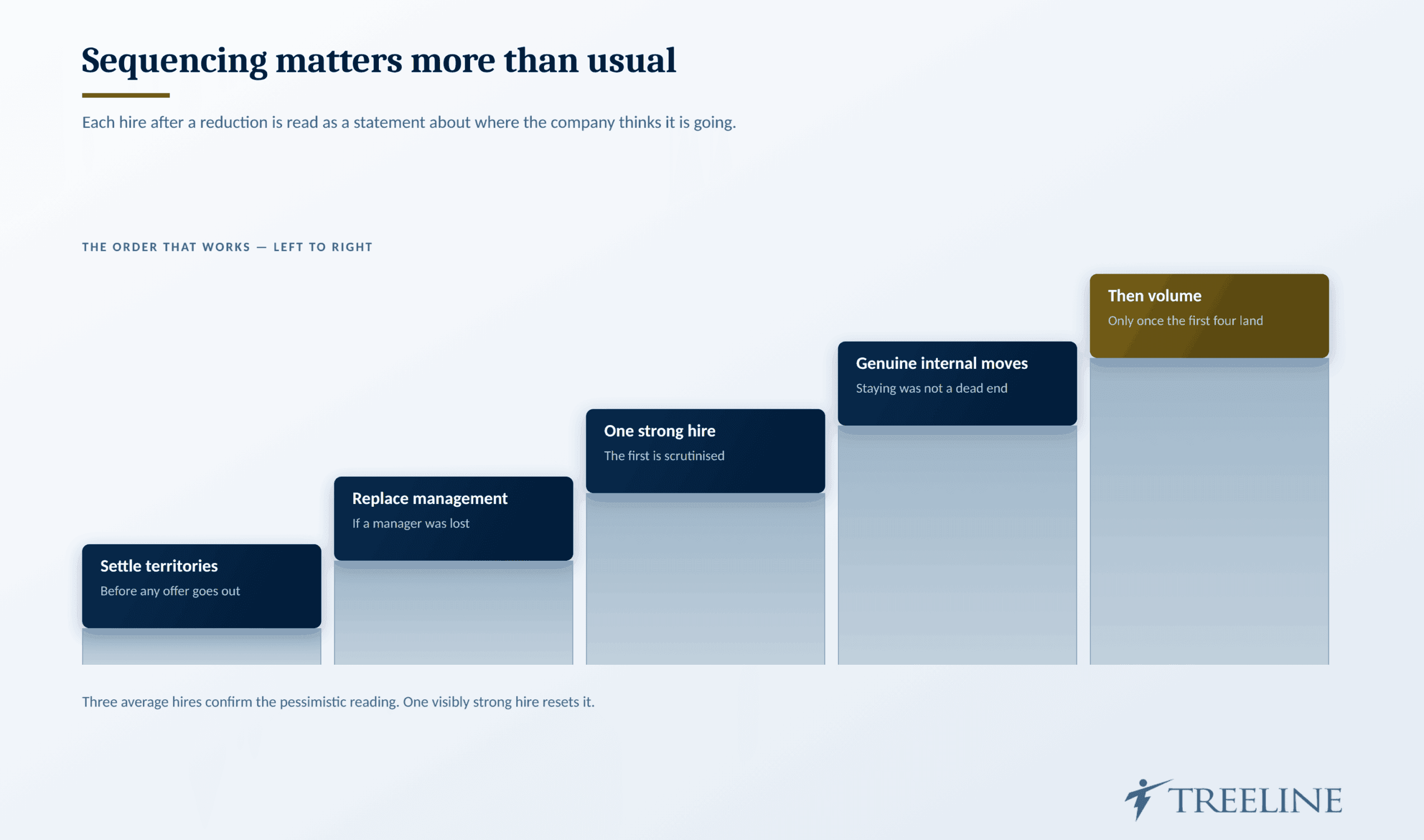
The order of hires matters more here than in ordinary growth hiring, because each one is read as a statement.
Management before volume. If a manager was lost in the reduction, replacing them before adding sellers gives the new arrivals someone to onboard them and signals that the function is being rebuilt properly rather than backfilled cheaply.
One strong hire before several adequate ones. The first hire after a reduction is scrutinised internally. Someone visibly strong resets the narrative; three average hires confirm the pessimistic reading.
Internal moves before external ones where they are genuine. Promoting or expanding a survivor’s scope, when deserved, tells the remaining team that staying was not a dead end. Doing it cosmetically achieves the opposite.
Territories settled before offers go out. Rebuilding usually means redrawing coverage. Doing that after new people arrive means two disruptions instead of one, and the second lands on people who have no history with the company to cushion it.
Where Contingency Recruiters Help a Sales Team Rebuild After Layoffs
The contribution is concentrated in places the employer cannot reach.
The first is intelligence about what the market is saying. A firm working the segment hears the version of your story that candidates are circulating, and can tell you what it is. Most companies in this position are operating without that information.
The second is conveying the difficult context credibly. A recruiter who gives a candidate the honest account before the first interview removes the discovery risk, and candidates who proceed past that point have already priced it in.
The third is reaching people who would not respond to the company directly. A seller who has seen the news is unlikely to answer an approach from the company itself, and considerably more likely to take a call from a recruiter they know.
The fourth is risk transfer on a plan that may change. If the headcount is revised down again mid-search, a structure that charges only on placement means the employer has not paid for work that is now surplus.
What the Firm Cannot Resolve
Three things sit inside the company and determine the outcome more than any search quality.
Whether the plan is actually settled. A rebuild launched against a number that leadership privately doubts will produce offers that get withdrawn, and the market will know within a fortnight.
Whether the remaining team is stable. Hiring into an organization where the survivors are themselves looking produces a revolving door and burns the firm’s relationships alongside the company’s reputation.
Whether leadership is aligned on the story. If the chief executive, the sales leader and the hiring manager each describe the reduction differently, candidates will hear all three versions across an interview loop and draw the obvious conclusion. Agreeing the account, including which parts are not for discussion, takes one conversation and is routinely skipped.
Whether the compensation is honest. A company that reduced headcount for cost reasons and is now hiring at the same band is making a claim about the economics that candidates will test against what they know.
What a Sales Team Rebuild After Layoffs Owes the Remaining Team
The rebuild is as much an internal exercise as an external one, and the internal half is usually underdone.
They need to know the plan. Not the full financial picture, but how many people are being added, into what, and over what period. Silence produces worse speculation than any announcement.
They need to not discover new colleagues by seeing them on a call. Announce arrivals properly, with the reasoning.
They need territory changes explained individually. A survivor who loses accounts to a new hire without a conversation will read it as a judgement on their performance, which after a reduction is a particularly damaging interpretation.
They also need to know whether their own role is safe, and the honest answer may be that it depends. A manager who says everyone is secure and is contradicted within two quarters has spent the credibility the rebuild depends on. A manager who says the current plan does not involve further reductions, and names what would change that, is believed.
And they need someone to acknowledge what happened. Teams that are asked to move on without acknowledgement tend to move on somewhere else.
Fantasia observes that the second wave of departures after a reduction is usually voluntary and usually preventable. His point is that it follows the handling of the rebuild rather than the reduction itself, which means the window to prevent it is still open when most companies have stopped paying attention.
Compensation and Equity Questions You Will Be Asked
Two questions arise in these conversations that do not arise in ordinary hiring, and both need answers prepared in advance.
The first is about the band. If the reduction was cost-driven, a candidate will reasonably ask how the company can afford them now. The credible answer is specific: a smaller team at a higher quality bar, a narrowed segment that needs fewer but stronger sellers, or a genuinely improved funding position. The answer that fails is a general assurance that the economics are fine.
The second is about equity. Candidates joining after a down round or a difficult period will scrutinise the equity story more carefully than they would at a company with momentum, and some will discount it to zero. That is a reasonable position and arguing against it wastes credibility. The better approach is to be straightforward about what the equity is worth on current evidence and to let the cash component carry the offer.
There is also a quota question worth anticipating. A seller joining a rebuilt team will ask what the previous occupant of the territory achieved, and whether the number has been adjusted. If the quota is unchanged from a plan that produced a reduction, that is difficult to defend, and candidates who accept without asking tend to be the ones with fewer options.
Reading the First Six Months
The measures that matter early are about retention and credibility rather than production.
In the first quarter, the question is whether the survivors stayed. Regretted attrition among the remaining team is the clearest signal that the rebuild is being handled badly, and it is visible long before any new hire produces revenue.
By six months, the question is whether offers are being accepted at the rate you expected. A high decline rate at offer stage usually means the story is not landing, and that is diagnosable through the firm if you ask for stated reasons.
Fantasia reads the referral signal as the one that cannot be manufactured. In his account a company can control its messaging to candidates and cannot control whether its own staff are willing to put friends forward, which makes it the most honest indicator available.
And throughout, the signal worth watching is whether candidates are arriving through referral from people already there. Employees referring friends into a company that recently cut staff is the strongest available evidence that the internal half of the rebuild is working.
Frequently Asked Questions
How soon after layoffs can we start hiring sellers again?
Sooner than most companies expect, provided the story is coherent. The constraint is not elapsed time but whether you can explain what changed in the model and whether the plan is settled. Hiring two months after a reduction with a credible explanation works better than waiting six months with a vague one.
What do candidates ask about the layoffs?
Why it happened, whether it is finished, what happened to the people who left, what is different now, and whether the specific territory belonged to someone who was let go. The answer that works is specific and unflattering where necessary; sellers hear “strategic adjustments” as evasion.
Should we tell candidates the territory belonged to someone who was let go?
Yes. They will find out, and finding out after they join costs considerably more than hearing it during the process. Volunteering it also reads as confidence, which is the opposite of how companies usually fear it will read.
Who should we hire first?
Management before volume if a manager was lost, and one visibly strong hire before several adequate ones. The first hire after a reduction is scrutinised internally and resets or confirms the narrative. Settle territories before offers go out rather than redrawing them after people arrive.
What can a recruiting firm do that we cannot?
Tell you what version of your story the market is circulating, convey the difficult context credibly before a first interview, reach candidates who would not respond to the company directly, and carry the risk of a search that becomes surplus if the plan is revised again.
What usually goes wrong?
The second wave of departures, voluntary, from the remaining team, and largely preventable. It follows the handling of the rebuild rather than the reduction itself: new hires arriving on visibly better terms, territory changes made without individual conversations, and nobody acknowledging what happened.
How do we judge the rebuild at six months?
By retention among the survivors, by the offer acceptance rate, and by whether existing employees are referring candidates. The last one is the strongest available evidence that the internal half is working, because people do not refer friends into a company they are leaving.
Does a contingency arrangement suit a rebuild?
Usually, because the headcount plan may change again and a fee payable only on placement means the employer has not paid for work that becomes surplus. The exception is where the rebuild involves a confidential leadership replacement, which needs a different structure.
Settle the Story Before the First Interview
Treeline, Inc. is a sales-only executive search firm based in Wakefield, Massachusetts, working exclusively on building sales organizations. Our contingency sales recruiting service carries no upfront cost and no fee unless you hire, and we deliver your first candidate within three days of launching a search.
If you are rebuilding a sales team, the useful first conversation is about what you will tell candidates happened, and whether the plan is settled. Get in touch and we will tell you how that story is likely to land.
Share This Story, Choose Your Platform!
Related Posts
What our happy clients are saying
Treeline Inc. provided us with the most candidates that aligned with our needs and were of the highest quality.

Dr. Jeffrey Klein Head of North America Sales, Satchel Pulse
Treeline Inc.’s collaborative, flexible, and communicative approach resulted in a smooth partnership. Beyond their recruitment expertise, their unique sourcing model was efficient and effective.

Sera Holt Director of Operations, LNS Research
Their professionalism was outstanding. Treeline Inc. was extremely thorough and ensured that we were on the same page before they started looking for candidates. They listened to us and did a great job working with the candidate to close out the process.

Cate Grant AVP Customer Success, Nasdaq
Thanks to Treeline Inc.’s intricate and thorough screening process, the company is able to hire six high-quality candidates that fit perfectly in the company’s culture. The team is highly receptive to concerns, and internal stakeholders are impressed with their unique recruitment abilities.

Anna McKean Sales Recruiter, Insider Intelligence
Treeline Inc. has been qualified individuals throughout a five-year-long engagement. They’ve made numerous placements of talented and qualified individuals for our business.

Michele St Laurent VP of HR, The Institute for Applied Network Security

Let Us Help You Source the Sales Talent You Need
Whether you’re building a team or replacing a key role, our Candidate Sourcing Platform provides a fast, flexible, and employer-focused solution.
Tell us more about your business and how we can help.
Treeline Inc.
Your Award-Winning Sales Recruitment Partner
15 Lincoln Street, Suite 314, Wakefield, MA 01880