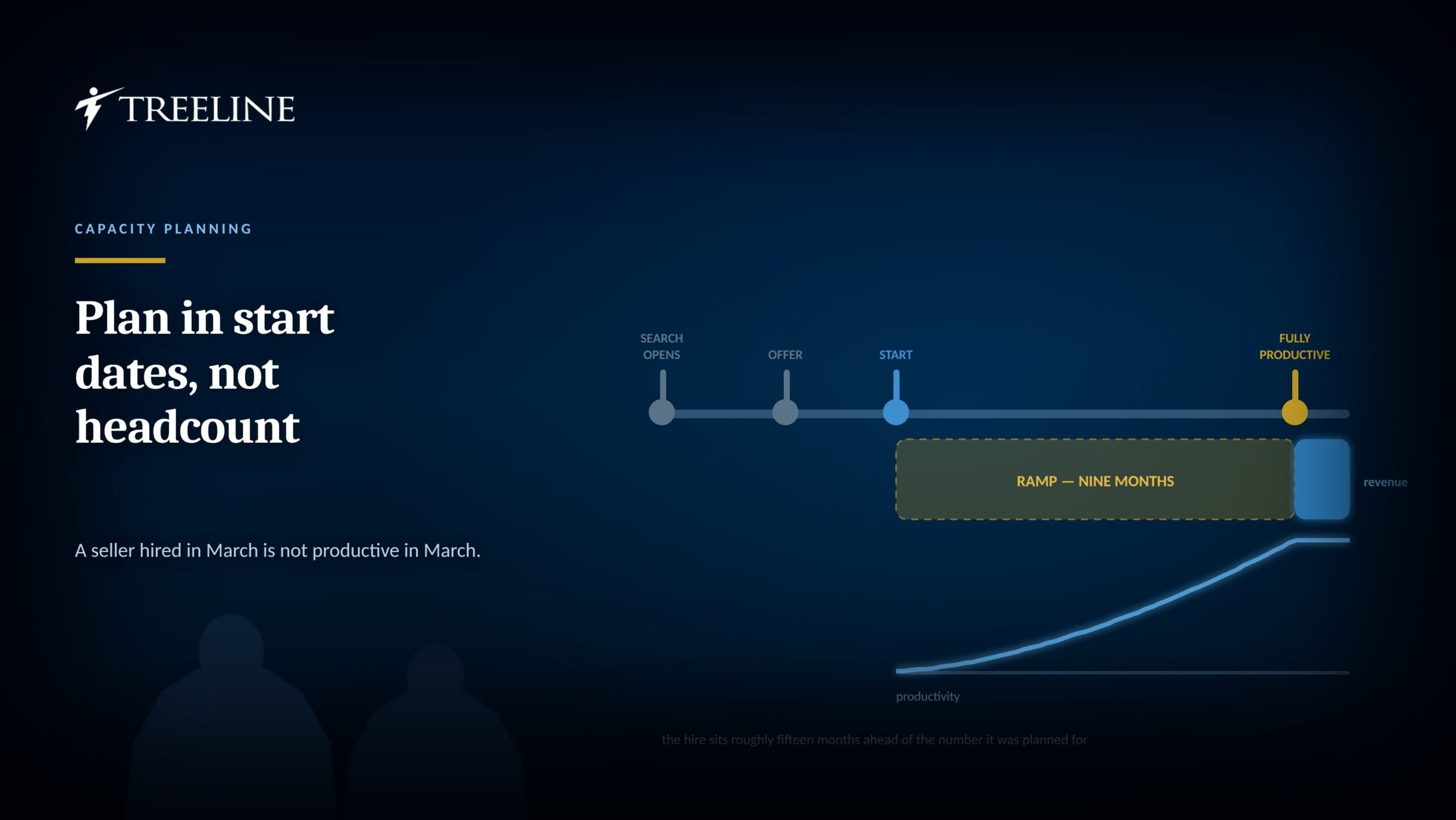
Your sales team has a vacancy. You need to fill it fast. With traditional recruiting, you’re looking at 3-6 months. Post the job, screen applications, conduct interviews, negotiate offer. By month four, your best candidates have accepted offers elsewhere. By month six, you’ve finally hired someone, and your territory has been vacant for half a year.
The cost is real. Every month a sales territory sits vacant costs $15,000-$50,000+ in lost revenue depending on role level. A six-month vacancy costs $90,000-$300,000 in lost revenue alone. That’s before you calculate team disruption, morale impact, and the fact that your remaining salespeople are burned out covering the gap.
There’s a faster way. When you work with a contingency search firm, the recruiting timeline collapses. Instead of 3-6 months, you’re looking at 2-4 weeks from engagement to qualified candidate presentation. Instead of months of waiting and hoping, you’re moving at the speed of business. But the time-to-hire advantage isn’t just about speed.
It’s about how contingency search firms are structurally designed to move fast without sacrificing quality. They’re built for rapid candidate identification. They have relationships already in place. They understand how to assess quickly. They move with urgency because their payment depends on placement.
This guide explores how contingency search firms actually reduce time-to-hire in sales—the specific mechanisms that make them faster, what it means for your business, and how to maximize the speed advantage.
Why Time-to-Hire Matters in Sales Recruiting
Before diving into how contingency search firms reduce time-to-hire, it’s important to understand why speed matters so much in sales recruiting. Every month of vacancy has a direct business cost. A VP of Sales vacancy costs approximately $40,000-$50,000 monthly in lost revenue. Sales leadership impacts the whole organization.
Without them, your sales execution suffers. Deals slip. Pipeline moves slower. Your best salespeople start looking for other opportunities because they feel unsupported. An account executive vacancy costs approximately $15,000-$25,000 monthly in lost territory revenue depending on average deal size and sales cycle.
That territory isn’t generating revenue. That opportunity cost compounds with every month that passes. A sales development representative vacancy costs approximately $8,000-$12,000 monthly in pipeline impact. SDRs generate pipeline. Without them, your salespeople have less pipeline. Deals flow slower.
The key insight: every month of vacancy has direct, measurable business cost. Hire three months faster and you’ve saved $45,000-$150,000+ in direct vacancy costs depending on roles. That savings alone can pay for expensive recruiting approaches. Talent competition means the best candidates don’t wait.
In competitive talent markets, the best candidates have multiple options. They don’t wait for slow-moving recruiting processes. They accept the first compelling offer that comes. When you take 3-6 months to hire, you lose the talent race. The candidate who would have been perfect has already accepted another offer.
You’re left hiring from your second or third choice candidates. When you hire in 2-4 weeks through a contingency search firm, you can present an offer while the candidate is still seriously considering moves. You can win the talent competition because you’re fastest. For organizations building strong sales teams, speed directly impacts talent quality.
You’re not choosing between speed and quality—you’re choosing to get better quality faster by moving faster. Organizational momentum matters. When you have an open role, it creates a hole in your organization. Your team feels it. Your remaining salespeople are covering the gap. Your management team is focused on the vacancy instead of growth.
Your organization feels incomplete. Fill the vacancy quickly and momentum returns. Your team is whole again. Your management can focus on growth instead of recruitment. Your organization feels forward-moving. The longer a vacancy lasts, the more it drains organizational energy. Speed fills that gap and restores momentum.
How Contingency Search Firms Reduce Time-to-Hire: The Mechanisms
Understanding how contingency search firms actually achieve faster time-to-hire requires understanding the specific mechanisms that make them faster.
Mechanism 1: Relationship-Based Sourcing (Not Job-Posting-Based)
Traditional recruiting starts with a blank slate. You post a job. You wait for applications. You screen. Time passes. Contingency search firms don’t start from zero. They start with relationships. When you engage a contingency search firm for a sales role, they immediately activate their existing network of relationships with sales professionals.
They’re not starting to search. They’re starting to contact people they know. This is fundamentally faster because:
- No job posting to write and post
- No application screening process
- No broad sourcing that requires weeks to identify candidates
- Immediate outreach to people they already know
A contingency search firm can have preliminary conversations with 10-15 potential candidates within days, not weeks. They’re not waiting for applications. They’re calling people. This relationship activation approach compresses the first 4-6 weeks of traditional recruiting into the first 2-3 days of engagement.
Mechanism 2: Parallel Assessment (Not Sequential Screening)
Traditional recruiting is sequential. Screen resumes. Phone interview. First interview. Second interview. Reference checks. Offer. Each stage adds time. Each stage is sequential—you can’t move to the next stage until the previous one is complete. Contingency search firms compress this by conducting parallel assessment.
While initial conversations are happening with multiple candidates, they’re simultaneously conducting reference checks. While one candidate is interviewing with you, they’re assessing others. Instead of a linear timeline where each stage adds weeks, contingency search firms run multiple processes in parallel.
A candidate can move through initial conversation, reference check, and assessment in days rather than weeks because these are happening in parallel, not sequentially.
Mechanism 3: Pre-Vetting Before Presentation
By the time contingency search firms present you with candidates, those candidates have already been assessed and vetted. This means when you interview, you’re not screening for capability. You’re not evaluating whether someone can do the job. They can. You’re evaluating fit and whether you want to make an offer.
This vetting speeds up your internal process. You don’t need multiple rounds of interviews to determine capability. You can focus on fit, culture, and closing. Your interview process can be faster because you’re not screening—you’re selecting from pre-vetted candidates.
Mechanism 4: Contingency-Based Urgency
Contingency search firms only get paid when you hire. This creates urgent, focused effort that’s different from other recruiting approaches. When you post on a job board, the site gets paid whether you hire or not. There’s no urgency. Your job posting is one of thousands. When you hire an in-house recruiter, they’re paid salary whether you hire or not.
There might be urgency but there’s no direct payment consequence for speed. Contingency search firms are directly incentivized to move fast. They only get paid if you hire. Speed directly impacts their revenue. This creates genuine urgency and focused effort that other approaches don’t have. This urgency translates to action.
Candidates get contacted immediately. Reference checks happen quickly. Follow-up is fast. Everything is focused on reducing time-to-hire because time-to-hire impacts the firm’s ability to get paid.
Mechanism 5: Specialized Knowledge (They Know How to Move Fast in Sales)
Contingency search firms specializing in sales know how to move fast in sales recruiting specifically. They understand:
- What questions matter most (so they can assess quickly)
- What factors predict success (so they can identify candidates fast)
- How to close salespeople (so they can move candidates toward decisions)
- What compensation is competitive (so offers don’t stall on money)
This specialized knowledge enables faster assessment, faster candidate movement, and faster closing. A generalist recruiter might need multiple conversations to assess a sales candidate. A specialized contingency recruiter can assess in a single conversation because they know what matters.
The Time-to-Hire Comparison: Numbers That Matter
Understanding the actual time differences between recruiting approaches helps illustrate the advantage.
Traditional Job Board Recruiting Timeline:
- Week 1-2: Post job, applications arrive
- Week 3-6: Screen resumes, preliminary phone calls
- Week 7-10: Conduct first interviews, select finalists
- Week 11-12: Reference checks, final interviews
- Week 13: Offer, negotiation
- Week 14+: Start date
- Total: 14-20+ weeks (3-5 months)
In-House Recruiting Timeline:
- Week 1: Post job internally, network activates
- Week 2-4: Screen candidates, schedule interviews
- Week 5-8: Conduct interviews, select finalist
- Week 9: Reference checks
- Week 10: Offer
- Week 11+: Start date
- Total: 11-15 weeks (2.5-4 months)
Contingency Search Firm Timeline:
- Day 1-3: Engagement, requirement definition, network activation
- Day 4-7: Initial conversations with candidates, preliminary assessment
- Day 8-14: Reference checks, deeper assessment, candidate interviews with you
- Week 3-4: Final candidates, offer, closing
- Week 4-6: Start date
- Total: 4-6 weeks (1-1.5 months)
The time difference is substantial. Contingency search firms are typically 2-3x faster than traditional recruiting. For a sales organization, this translates to 10-12 weeks faster hiring, which means 10-12 weeks less vacancy, which means $150,000-$400,000+ less in vacancy costs depending on role.
Why Speed Matters for Sales Talent Quality
An important counterintuitive insight: faster hiring through contingency search firms typically results in better talent quality, not lower quality. This happens because of several factors: Speed enables you to win the talent competition. The best salespeople have options. They’re not desperately waiting for a job offer.
They’re evaluating multiple opportunities. The organization that moves fastest typically wins. Traditional recruiting takes months. By the time you’re ready to offer, the best candidate has accepted another offer. Contingency search firms move so fast that you can present an offer while the candidate is still actively considering.
You win the talent race. Vetting happens before presentation. Because contingency search firms have already vetted candidates, the candidates you interview are genuinely qualified. You’re not screening for capability—you’re selecting from qualified candidates. This reduces the pressure to hire quickly from desperation.
You can afford to be selective because you have multiple vetted candidates. Time pressure doesn’t compromise judgment. In slow recruiting, you can have comprehensive interview processes. In fast recruiting, you can still have thorough evaluation because the contingency search firm has already done significant assessment.
Your interviews can be focused on fit and confirmation rather than rushed capability screening.
What Reduces Time-to-Hire and What Doesn’t
Not all approaches to faster hiring are equally effective. Understanding what actually reduces time-to-hire is important.
What Reduces Time-to-Hire:
- Relationship-based sourcing (contingency search firms have existing relationships)
- Parallel assessment (simultaneous evaluation of multiple candidates)
- Pre-vetting (candidates are assessed before reaching you)
- Clear requirements (knowing exactly what you need enables faster assessment)
- Responsive hiring team (quick internal interviews and decisions)
- Speed-focused processes (removing unnecessary steps and delays)
What Doesn’t Reduce Time-to-Hire (Or Makes It Worse):
- Job board posting (starts from zero, requires application screening)
- Broader sourcing (cast wider nets, take longer to find candidates)
- Multiple interview rounds (more people to schedule, more delays)
- Unclear requirements (takes longer to assess fit)
- Unresponsive hiring team (candidates wait for feedback)
- Comprehensive but slow processes (can’t move candidates forward quickly)
The key insight: time-to-hire isn’t just about having recruiting support. It’s about having the right recruiting approach. Contingency search firms are specifically designed to optimize for speed while maintaining quality.
The Business Impact of Reduced Time-to-Hire
What does 2-3x faster hiring actually mean for your business?
Direct Revenue Impact
A sales role vacant for 6 months costs approximately $90,000-$300,000 in lost revenue. The same role hired in 2 months saves $60,000-$200,000 in vacancy costs. Across multiple hires annually, this compounds. If you’re hiring 10 salespeople per year, accelerating each hire by 2-3 months saves $600,000-$2,000,000+ annually in reduced vacancy costs.
That’s not hypothetical. That’s real business impact that directly improves profitability.
Competitive Advantage
In fast-growing markets, the organization that can scale sales team capacity fastest wins. Contingency search firms enable faster team growth. You can respond to market opportunities faster than competitors using slower recruiting approaches. This speed becomes competitive advantage. You can expand into new markets faster.
You can pursue opportunities faster. You can build sales capacity faster.
Talent Quality
As discussed, faster hiring through the right approach (contingency search firms) typically results in better talent quality. You’re not racing to hire anyone fast. You’re racing to hire great people fast. This talent quality compounds. Great salespeople attract other great salespeople. Great hires stay longer.
Great hires perform better. The quality multiplier compounds across time.
Organizational Momentum
Vacancies drain organizational energy. Filling vacancies quickly restores momentum. Your organization feels complete. Your team feels supported. Your management can focus on growth rather than recruiting. This momentum isn’t just morale. It’s measurable in organizational effectiveness. Teams with consistent membership execute better than teams constantly managing vacancies.
How to Maximize Time-to-Hire Advantage With Contingency Search Firms
Understanding how contingency search firms reduce time-to-hire is valuable. Knowing how to work with them to maximize that advantage is more valuable.
Be Clear on Requirements Upfront
The faster you can communicate requirements, the faster contingency search firms can move. Don’t be vague. Provide clarity on:
- Role responsibilities and scope
- Required experience and skills
- Compensation range
- Culture fit indicators
- Deal size and sales cycle specifics
Clear requirements enable faster candidate identification. Vague requirements slow everything down.
Move Fast Internally
Contingency search firms can present candidates quickly. You need to move quickly on your end too. Interview candidates within days of presentation, not weeks. Provide feedback immediately. Make offers quickly when you’ve decided. The speed advantage only works if both sides are moving fast. Organizations that slow down the internal process lose the time-to-hire advantage.
You need responsive hiring managers and clear decision-making processes.
Maintain Clear Communication
Keep contingency search firms updated on feedback, decisions, and any changes. Communication delays slow down the process. If you decide to pass on a candidate, communicate that immediately so they can move forward with the next candidate. If you need to pause the search, communicate that. Clear, constant communication keeps momentum.
Offer Competitive Compensation
Surprises during offer negotiation slow everything down. Be clear upfront on compensation, benefits, and structure so there are no surprises when you make an offer. If your compensation is below market, contingency search firms will tell you. Address this before they start sourcing so you don’t get to offer stage and have the candidate reject because compensation is too low.
Trust the Vetting
The contingency search firm has already vetted candidates. You don’t need to screen for basics. You can focus your interview on fit, culture, and confirmation. If you treat the interview as a screening process, you’re negating the speed advantage. Trust that they’ve vetted, and focus your interview where you add value—determining fit.
Contingency Search Firms vs. Other Fast-Track Approaches
Are there other approaches to faster hiring? Sure. But they come with trade-offs.
Recruiting Agencies vs. Contingency Search Firms
Staffing agencies can move fast. But they often place on temporary or contract basis. If you need permanent sales leadership, staffing agencies might not be the solution. Some recruiting agencies do permanent placement but operate on hybrid fee structures. Contingency search firms specialize in permanent sales placement and are structured purely for speed.
Internal Recruiting at Scale
You could hire additional internal recruiting staff to move faster. But this creates fixed cost. If hiring volume decreases, you have recruiting overhead with no work to justify it. Contingency search firms scale with your hiring needs. High-volume years you use them heavily. Lower-volume years you use them less.
Variable cost instead of fixed cost.
Technology-Enabled Recruiting
Some organizations invest in recruiting technology thinking it will accelerate hiring. Technology can help, but it doesn’t replace relationships and specialized knowledge. An applicant tracking system won’t make your sourcing faster. A relationship-based contingency search firm will.
Contingency Search Firms Are Purpose-Built for Speed
Contingency search firms are specifically designed for fast, permanent sales placement. Their business model, their incentives, their expertise, their processes are all aligned around speed. Other approaches can be fast. But contingency search firms are purpose-built for the speed that sales organizations need.
Conclusion: Why Contingency Search Firms Have Become Standard for Sales Hiring
Sales organizations serious about reducing time-to-hire have largely standardized on contingency search firms because they deliver what other approaches can’t: fast, quality hiring without organizational burden. The mechanisms are clear: relationship-based sourcing, parallel assessment, pre-vetting, contingency-based urgency, and specialized sales knowledge all combine to reduce time-to-hire by 60-70% compared to traditional recruiting.
The business impact is measurable: 2-3 months faster hiring saves $150,000-$400,000+ in vacancy costs per year for a growing sales organization. The quality outcome is counterintuitive: faster hiring through the right approach results in better talent quality, not worse. For sales organizations building teams and executing against growth targets, working with contingency search firms has become the standard approach to recruiting.
Not because they’re perfect, but because they solve the time-to-hire problem that other approaches create or exacerbate. The question for most sales organizations isn’t whether to use contingency search firms. It’s how to integrate them strategically to accelerate team growth.
Discover how Treeline’s contingency search expertise reduces your time-to-hire for sales roles
Questions People Actually Ask About Reducing Time-to-Hire in Sales
Can we really hire in 4-6 weeks through a contingency search firm, or is that optimistic?
That timeline is realistic for contingency search firms specializing in sales. First 2-3 days are engagement and network activation. Days 4-14 involve candidate conversations, assessment, and reference checks. Weeks 3-4 involve your interviews and offer. Timeline assumes responsive internal hiring and decisions, but yes, 4-6 weeks is realistic when both parties are moving fast.
If contingency search firms are so fast, why do some take months?
Poor contingency search firms might be slow for several reasons: weak network requiring broader sourcing, unclear requirements requiring longer assessment, unresponsive internal hiring teams, or lack of urgency. Quality contingency search firms with specialized expertise and strong networks move much faster. The firm matters. Specialized firms in your market move faster than generalists.
Does faster hiring mean lower quality candidates?
Not with contingency search firms. Pre-vetting and relationship-based sourcing enable better quality. Candidates presented are faster, but they’ve already been assessed. It’s not rushing quality. It’s moving quality candidates through process faster.
How do we move faster on our internal side to match the contingency search firm’s speed?
Schedule interviews within 3 days of presentation. Provide feedback within 24 hours of interviews. Make offer decisions within 48 hours of final interviews. Have clear decision-making authority so you’re not waiting for approvals. Internal side needs to move at same speed as contingency search firm.
Should we always go with the fastest contingency search firm, or is there a trade-off between speed and quality?
Quality contingency search firms move fast. Speed and quality aren’t inherently in conflict. Firms that move fastest typically have strongest networks and most specialized expertise. Don’t choose between speed and quality. Choose contingency search firms that provide both. If getting slow timelines, issue might be the firm, not the approach.
“@context”: “https://schema.org”,
“@type”: “FAQPage”,
“mainEntity”: [
{
“@type”: “Question”,
“name”: “Can we really hire in 4-6 weeks through a contingency search firm, or is that optimistic?”,
“acceptedAnswer”: {
“@type”: “Answer”,
“text”: “That timeline is realistic for contingency search firms specializing in sales. First 2-3 days are engagement and network activation. Days 4-14 involve candidate conversations, assessment, and reference checks. Weeks 3-4 involve your interviews and offer. Timeline assumes responsive internal hiring and decisions, but yes, 4-6 weeks is realistic when both parties are moving fast.”
}
},
{
“@type”: “Question”,
“name”: “If contingency search firms are so fast, why do some take months?”,
“acceptedAnswer”: {
“@type”: “Answer”,
“text”: “Poor contingency search firms might be slow for several reasons: weak network requiring broader sourcing, unclear requirements requiring longer assessment, unresponsive internal hiring teams, or lack of urgency. Quality contingency search firms with specialized expertise and strong networks move much faster. The firm matters. Specialized firms in your market move faster than generalists.”
}
},
{
“@type”: “Question”,
“name”: “Does faster hiring mean lower quality candidates?”,
“acceptedAnswer”: {
“@type”: “Answer”,
“text”: “Not with contingency search firms. Pre-vetting and relationship-based sourcing enable better quality. Candidates presented are faster, but they’ve already been assessed. It’s not rushing quality. It’s moving quality candidates through process faster.”
}
},
{
“@type”: “Question”,
“name”: “How do we move faster on our internal side to match the contingency search firm’s speed?”,
“acceptedAnswer”: {
“@type”: “Answer”,
“text”: “Schedule interviews within 3 days of presentation. Provide feedback within 24 hours of interviews. Make offer decisions within 48 hours of final interviews. Have clear decision-making authority so you’re not waiting for approvals. Internal side needs to move at same speed as contingency search firm.”
}
},
{
“@type”: “Question”,
“name”: “Should we always go with the fastest contingency search firm, or is there a trade-off between speed and quality?”,
“acceptedAnswer”: {
“@type”: “Answer”,
“text”: “Quality contingency search firms move fast. Speed and quality aren’t inherently in conflict. Firms that move fastest typically have strongest networks and most specialized expertise. Don’t choose between speed and quality. Choose contingency search firms that provide both. If getting slow timelines, issue might be the firm, not the approach.”
}
}
] }
Share This Story, Choose Your Platform!
Related Posts

What our happy clients are saying
Treeline Inc. provided us with the most candidates that aligned with our needs and were of the highest quality.

Dr. Jeffrey Klein Head of North America Sales, Satchel Pulse
Treeline Inc.’s collaborative, flexible, and communicative approach resulted in a smooth partnership. Beyond their recruitment expertise, their unique sourcing model was efficient and effective.

Sera Holt Director of Operations, LNS Research
Their professionalism was outstanding. Treeline Inc. was extremely thorough and ensured that we were on the same page before they started looking for candidates. They listened to us and did a great job working with the candidate to close out the process.

Cate Grant AVP Customer Success, Nasdaq
Thanks to Treeline Inc.’s intricate and thorough screening process, the company is able to hire six high-quality candidates that fit perfectly in the company’s culture. The team is highly receptive to concerns, and internal stakeholders are impressed with their unique recruitment abilities.

Anna McKean Sales Recruiter, Insider Intelligence
Treeline Inc. has been qualified individuals throughout a five-year-long engagement. They’ve made numerous placements of talented and qualified individuals for our business.

Michele St Laurent VP of HR, The Institute for Applied Network Security

Let Us Help You Source the Sales Talent You Need
Whether you’re building a team or replacing a key role, our Candidate Sourcing Platform provides a fast, flexible, and employer-focused solution.
Tell us more about your business and how we can help.
Treeline Inc.
Your Award-Winning Sales Recruitment Partner
15 Lincoln Street, Suite 314, Wakefield, MA 01880