Contingency sales recruiters help companies compete for top talent by changing the terms of a contest most employers do not realize they have entered. When a strong enterprise account executive becomes available, the employer is not choosing from a pool of applicants. It is bidding against the candidate’s current employer, against two or three other companies running their own processes, and against the candidate’s entirely rational option to stay where they are.
Recruiters who work a single market every day know how that contest is usually decided, and most of the deciding factors are not money. Compensation is the first thing employers reach for, and the data suggests it is a weaker lever than it looks. The U.S. Bureau of Labor Statistics reports in its Employment Cost Index that compensation costs for private industry workers rose 3.3 percent over the twelve months ending June 2026, with wages and salaries up 3.1 percent, while inflation-adjusted wages and salaries fell 0.4 percent over the same period.
Nominal raises are happening almost everywhere and buying slightly less than they did a year ago. An employer that expects a modest premium over current pay to win a contested candidate is offering something that candidate’s own company can match in an afternoon. Dan Fantasia, CEO of Treeline, Inc., sees the competitive hire as a problem of sequencing rather than generosity.
For him, the companies that win contested sales candidates are rarely the ones that pay the most; they are the ones that reach the person earliest, decide fastest, and give a clearer account of what the first year will actually look like. Money settles a negotiation that has already gone well. It very rarely rescues one that has gone slowly.
Who You Are Actually Competing With
Naming the competition precisely is the first practical step, because each competitor is beaten differently.
The Candidate’s Current Employer
This is the strongest competitor in almost every contested sales search, and the one employers most consistently underrate. The incumbent employer has advantages no outside company can match on day one. They have an existing relationship with the person, knowledge of their pipeline, and the ability to act instantly. They also have asymmetric information: they know exactly what the candidate is frustrated about, and they can address it selectively.
When a resignation lands, they are not competing for a stranger. They are protecting revenue they can forecast.
The Two or Three Other Companies in the Process
A strong enterprise seller who agrees to explore the market is almost never exploring one option. These competitors are the ones employers imagine they are fighting, and they are real, but they are also the most beatable. Rival processes suffer from the same delays, vague feedback, and scheduling problems as your own. The company that runs a tighter loop usually wins, and tightness is a decision rather than a budget.
The Decision to Do Nothing
The quietest competitor is inertia, and it wins more often than any rival employer. Changing companies as an enterprise seller means abandoning a pipeline that took quarters to build, restarting relationships with new internal partners, and accepting a ramp during which earnings drop. A candidate weighing that against a role they are merely curious about will usually stay.
Beating inertia requires a reason to move that is specific to that person’s situation, which is exactly what a generic job description cannot supply.
The Internal Candidate
Occasionally there is a fourth competitor sitting inside your own building, and failing to name them causes avoidable damage. If a current employee believes they are in line for the role, an external search runs against an internal expectation that nobody has addressed. The visible cost is a difficult conversation later.
The hidden cost is a slower, more hesitant process, because the hiring manager is quietly managing two outcomes at once and cannot commit fully to either. External candidates read that hesitation accurately and discount the opportunity accordingly. The resolution is not complicated, but it has to happen before the search launches rather than during it: decide whether the internal person is genuinely a candidate, tell them either way, and then run the external process at full speed.
Why Money Alone Stopped Being Decisive
There is a structural reason compensation has become a less reliable differentiator, and it is worth understanding before building an offer around it. Wage growth is broad but modest. Alongside the figures above, the Bureau of Labor Statistics notes in The Economics Daily that a year earlier wages and salaries had been rising 3.5 percent while benefit costs rose 3.4 percent, meaning wage growth has cooled slightly while benefit costs have accelerated to 3.8 percent.
For a candidate, that combination means their current employer is probably not delivering a real increase, which is what makes them willing to take a call in the first place. But it also means the gap you can open with money is narrow and easily closed. Three things follow:
- A pay-led pitch invites a pay-led counter. If money is the stated reason to move, the incumbent employer only has to match money, which is the one thing they can do fastest.
- Total compensation is harder to compare than it looks. Base, variable split, cap or no cap, accelerator structure, ramp guarantee, and equity are not reducible to one number, and candidates routinely misjudge their own current figure.
- Real earnings depend on the territory, not the plan.
On-target earnings assume the quota is attainable. An experienced seller discounts your number by whatever they believe about your pipeline. The practical implication is not that compensation is unimportant. It is that compensation must be competitive enough to remove itself as an objection, after which the contest is decided somewhere else.
The Four Levers That Decide a Contested Sales Hire
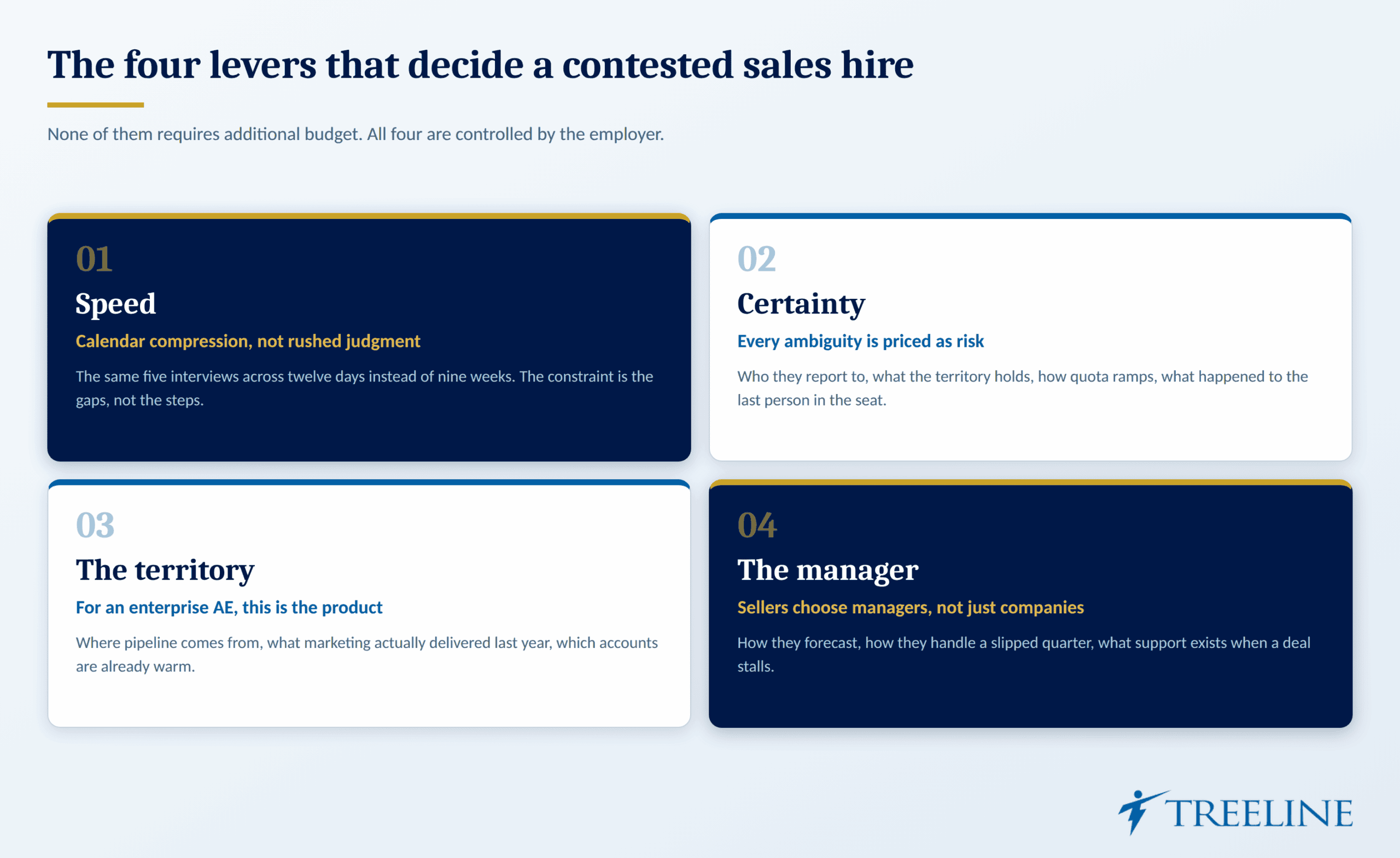
Across contested searches, four factors do most of the work. All four are controlled by the employer, and none of them requires additional budget. They are summarised below.
Speed
Speed is the single most reliable predictor of who wins a contested sales candidate, and it is almost entirely a function of internal decisions. A loop that runs first conversation to offer in two or three weeks does something a longer loop cannot: it reaches a decision while the candidate’s interest is at its peak and before competing processes mature.
A nine-week loop does the opposite. It gives every rival time to catch up, gives the incumbent employer time to notice something is happening, and signals that the hiring company is either uncertain or disorganized. Speed here means calendar compression, not rushed judgment. The same five interviews conducted across twelve days produce the same information as five interviews across nine weeks, and one of those versions wins the candidate.
Compression is mostly a scheduling and authority problem. Interviewers who hold open slots for a live search, panels that meet rather than interview sequentially, a decision-maker who has committed availability in advance, and a standing rule that feedback is returned within twenty-four hours will together halve most timelines without removing a single step.
The constraint is rarely the number of interviews; it is the gaps between them.
Certainty
Contested candidates are weighing a known situation against an unknown one, and every ambiguity in your process is priced as risk. Certainty comes from specifics: exactly who the seller reports to, exactly what the territory contains, exactly how quota ramps in the first two quarters, exactly what happened to the person who held the seat before.
Vagueness on any of these is read, correctly, as a signal that the company has not decided. Sellers are professionally trained to notice when the other side of the table is not aligned. Inconsistency between interviewers is the sharpest version of this problem. When the hiring manager describes a role focused on new logos and a second interviewer describes managing existing accounts, the candidate does not conclude that one of them misspoke.
They conclude the company has not agreed what the job is, and they price the risk of joining accordingly. Aligning interviewers on a single description of the role before the loop begins costs an hour and prevents a category of loss that is invisible from the inside.
The Story of the Territory
For an enterprise account executive, the territory is the product being sold to them, and most employers describe it badly. A strong territory story explains where the pipeline will come from, what marketing actually delivered last year rather than what it planned to, which accounts are already warm, which competitor holds them, and what a realistic first-year number looks like given all of that.
It is more persuasive than an inflated quota with an impressive accelerator, because an experienced seller can tell the difference immediately. Employers often resist this level of disclosure, worrying that an honest account of a thin pipeline will scare candidates away. In practice the opposite happens. A candidate told plainly that inbound is weak and the role is expected to be seventy percent self-generated can decide whether that suits them; some of the strongest enterprise sellers actively prefer it.
The candidates lost by honesty were going to leave in the first year anyway, and the ones who stay arrive with accurate expectations.
The Manager
Enterprise sellers choose managers at least as often as they choose companies. The hiring manager’s credibility in the interview loop is a competitive asset, and it is frequently squandered by scheduling them late, giving them thirty minutes, or having them recite the job description. A candidate who leaves that conversation understanding how the manager forecasts, how they handle a slipped quarter, and what support exists for a stalled deal has been given something no counteroffer addresses.
The practical fix is to give the hiring manager a real slot rather than a screening slot, ideally late enough in the process that the candidate is serious and early enough that the impression can still shape the outcome. It also helps to let the manager talk about their own record, what they have built, who they have promoted, how long people tend to stay on their team.
Enterprise sellers are evaluating whether this person will make them successful, and that is a question about the manager’s history rather than the company’s marketing. Fantasia frames the four levers as a sequence rather than a menu. In his view, speed and certainty are what keep a strong candidate in the process at all, while the territory and the manager are what make them choose you at the end, and employers who invest heavily in the second pair while neglecting the first pair tend to lose candidates before the pitch ever lands.
What Actually Persuades an Employed Enterprise Seller
The first conversation with a passive candidate is not an interview and should not be run like one. It is the moment the entire contest is either opened or closed, and most outreach fails inside the first two sentences. A seller who is performing well and being paid accordingly has no reason to engage with a message about an exciting opportunity at a fast-growing company.
They receive several of those a week and have learned to ignore all of them. What earns a reply is specificity that could only come from someone who understands their world: a reference to the segment they sell into, the buyer they call on, the competitor they lose to, or the structural problem their current employer has that they think about privately.
From there, the conversation that works tends to move in a particular order. It starts with their situation rather than your role, what their territory looks like now, whether pipeline is arriving, how the last two quarters actually went. It moves to what would have to be true for them to consider a change at all, which is a question most people have never been asked directly and often have not resolved themselves.
Only then does it introduce the opportunity, and by that point it can be framed against something concrete. Two things are worth protecting in that first conversation. The first is honesty about the parts of the role that are hard, because an experienced seller who hears only positives assumes something is being concealed and disengages.
The second is not pushing for a decision. The purpose of the first conversation is to establish whether a reason to move exists, not to secure a commitment; pressure at this stage reliably ends the relationship with someone who might have been ready in six months.
Timing: When to Approach a Seller You Want
Timing is the least discussed variable in competitive sales hiring and one of the most consequential, because an enterprise seller’s willingness to move fluctuates predictably across the year. Several forces are at work. Commission on a large closed deal often pays out on a defined schedule, and few sellers will walk away from money they have already earned.
Annual bonus and equity vesting dates create similar anchors. Quota periods matter too: a seller three weeks from closing a deal that makes their year behaves differently from the same person the week after their number is booked. Territory reassignments and comp plan changes, which typically land at the start of a fiscal year, generate more genuine movement than almost anything else.
The practical consequence is that the right person is often reachable only during particular windows, and an employer who approaches them outside one of those windows concludes wrongly that they are not interested. This is one of the quieter advantages of a recruiter who works the same market continuously: they know roughly when a given company pays out, when plans reset, and who has recently had a territory carved.
They can also maintain a relationship across months so that the conversation happens at the right moment rather than the convenient one. None of this helps if the requisition is open now and must be filled this quarter, which is the usual situation. But it does explain why a search that starts cold takes longer than a search that starts from an existing relationship, and why the most competitive employers keep talking to people they cannot hire yet.
Where Internal Hiring Teams Lose These Contests
None of this reflects a lack of skill inside talent acquisition teams. It reflects structural constraints that outside recruiters do not share.
- Internal teams recruit across many functions. An in-house recruiter carrying engineering, finance, and sales requisitions cannot maintain a live map of who is performing well in a narrow sales market.
- They see a fraction of the market. Internal pipelines are built from applicants, referrals, and outbound to people who are visible. Contingency search firms working one vertical see the people who never appear in any of those channels.
- They cannot easily challenge the hiring executive. Telling a VP that the compensation band is uncompetitive or the loop is too slow is a difficult internal conversation and an easy external one.
- They have no comparative benchmark. A recruiter running similar searches across many companies knows what a competitive package and a normal loop actually look like right now.
- Their incentives are not tied to closure.
This is not a criticism, but a contingency recruiter is paid only if the hire happens, which produces relentless attention to whatever is blocking it. Fantasia’s view is that the most valuable thing an outside recruiter provides in a competitive search is uncomfortable information delivered early. He suggests judging a search partner by whether they were willing to tell you something you did not want to hear in the first week, because a partner who only relays good news is not giving you the market’s actual response to your opportunity.
What Contingency Sales Recruiters Do Inside a Contested Search
The work that decides a competitive hire happens between the visible steps, and most of it is unglamorous. The first thing a specialist does is reach the candidate before the market does. In a replacement-driven market, the strongest enterprise sellers are employed and not looking, and the recruiter who has an existing relationship with that person gets the first conversation, often weeks before the role is posted anywhere.
That head start is worth more than any subsequent advantage in the process. The second is positioning the opportunity against the candidate’s actual situation rather than in the abstract. A recruiter who knows the market knows what that person’s current territory looks like, roughly what they are earning, what their company’s pipeline problem is, and what would genuinely represent an improvement.
The pitch is built from that, not from the job description. The third is running interference on timing. Contested searches are lost in scheduling gaps, and an external recruiter spends a surprising amount of energy compressing calendars, chasing feedback, and preventing the four-day silences that let a rival process overtake yours.
The fourth is honest signal in both directions. The recruiter tells the employer when the package is short, when the loop is too slow, and when a candidate is cooling. They tell the candidate when an expectation is unrealistic. Neither conversation is comfortable, and both prevent late-stage collapses. The fifth is managing the candidate’s own decision process.
Enterprise sellers are analytical about their careers and frequently need help thinking through a decision they make only every few years, how to weigh equity against guaranteed ramp, how to evaluate a territory they cannot see from outside, how to compare two offers with different risk profiles. A recruiter who has walked dozens of people through that comparison is materially more useful than a job description.
The sixth is preparing for the counteroffer from the first conversation, which is important enough to treat separately.
Reading the Market’s Answer When Candidates Say No
Most employers treat declines as failures to be moved past. They are usually the most valuable information the search produces, and they arrive early enough to act on. When a search partner reaches thirty qualified enterprise sellers and most decline the first conversation, that is not a sourcing problem. It is the market pricing your opportunity, and the pattern in the reasons tells you what to change:
- Declines citing compensation mean your band is genuinely below market for the profile, not that candidates are greedy. Two or three consistent data points here are worth more than a salary survey.
- Declines citing company trajectory point at a positioning problem, how the business is understood externally, which is fixable with a better narrative but not with money.
- Interest that cools after the first interview usually indicates a gap between how the role was described and how it was presented internally.
- Candidates who engage but will not resign point to a reason-to-leave that was never strong enough, which sends you back to the territory story.
- Silence rather than declines typically means the outreach itself is generic and is being read as a mass approach.
This is one of the practical advantages of working with contingency executive search firms that specialize narrowly: they are having these conversations across many companies in the same market, so they can tell you whether the response you are getting is normal or specific to you. A single employer running one search has no comparison set and tends to interpret rejection as bad luck.
Acting on this feedback within the search, rather than after it, is what separates a search that corrects and closes from one that runs for five months and quietly stops.
The Counteroffer, and Why It Usually Works
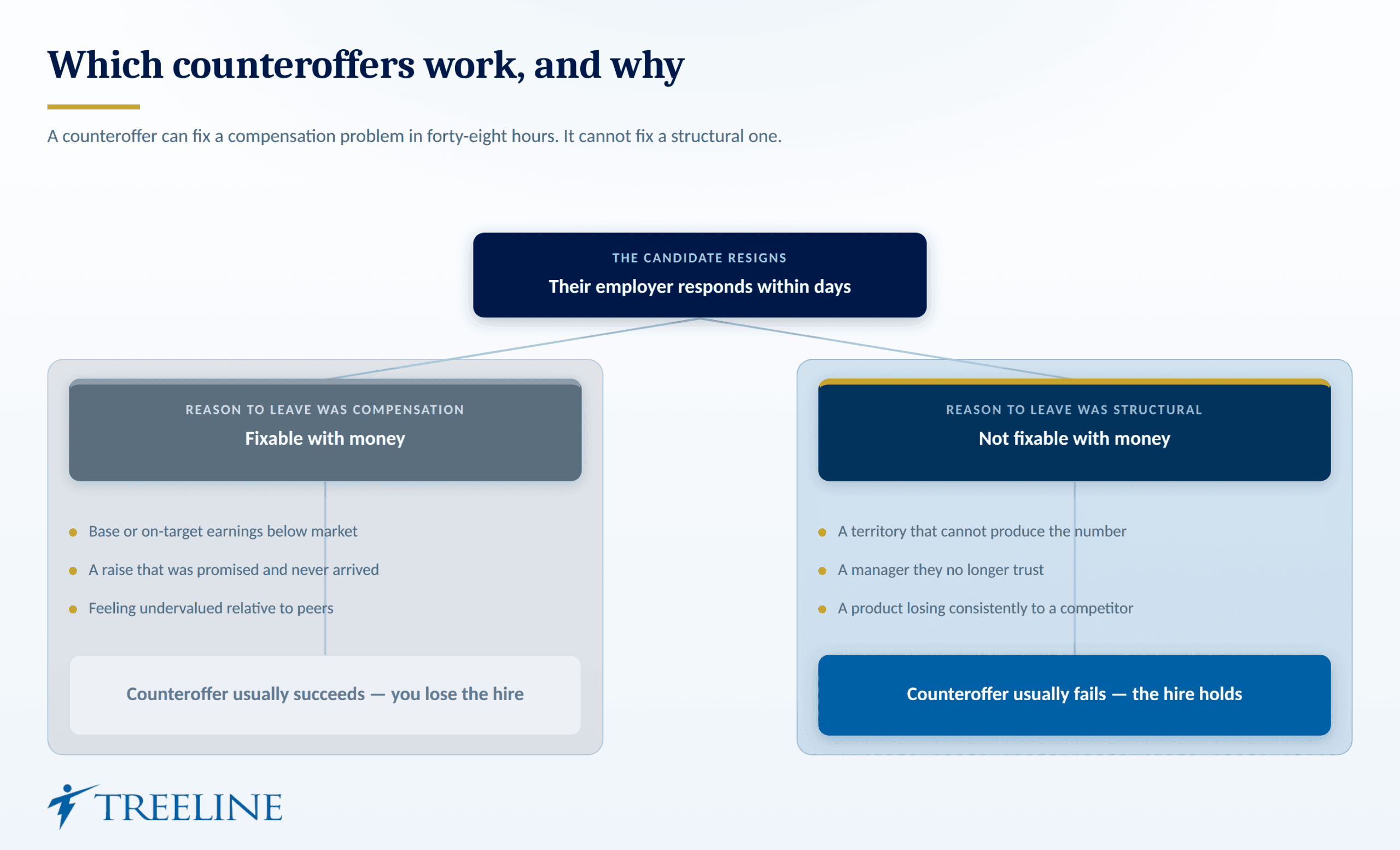
Employers tend to treat the counteroffer as bad luck. It is closer to a predictable event with a known cause, and whether it succeeds is largely determined by one thing. When a productive enterprise seller resigns, their employer faces an immediate revenue problem: an open territory, a pipeline in mid-flight, and a replacement search that will take months.
Against that, a substantial raise is cheap. The counteroffer is not sentimental; it is arithmetic, and it arrives fast. It works when the candidate’s stated reason for leaving was something the incumbent can fix in forty-eight hours. It fails when the reason was structural, a territory that cannot produce, a manager they do not trust, a product losing to a competitor, a company whose direction they no longer believe in.
Those cannot be repaired with a compensation adjustment, and the candidate knows it. This is why the reason for leaving has to be identified early and reinforced throughout, rather than discovered at resignation. A recruiter who has asked the question properly in week one knows whether the eventual counteroffer is survivable.
Treeline’s discussion of what distinguishes specialist contingency sales recruiters from traditional recruiters covers more of this ground. Fantasia’s approach is to treat the acceptance as the midpoint of the process rather than the end of it. He recommends that the hiring manager and the future new hire have at least one substantive conversation between acceptance and start date, because the weeks of administrative silence after an offer is signed are when most reversals actually happen.
Building an Offer That Survives the Counteroffer
An offer is a document, but it is also an argument, and the two are usually built with unequal care. The financial structure matters, and it should be explained rather than presented. An enterprise seller evaluating a contingency hire opportunity is trying to work out what they will realistically earn, not what the plan says at target.
That means being explicit about the base and variable split, whether variable pay is capped, how accelerators behave above quota, what the ramp looks like across the first two quarters, and whether any portion of variable pay is guaranteed during that ramp. An offer that quietly omits the ramp is read as an offer that has something to hide.
The non-financial terms often decide it. Start date flexibility that lets someone close a deal in flight, a written account of the territory as it will exist on day one, clarity on who they report to and whether that person is themselves new, and an honest statement of what the first ninety days are meant to produce, these are the parts a counteroffer cannot match, because the incumbent employer cannot offer a different company.
Then there is the argument itself, which is simply the reason this move is better for that specific person. It should be something they can repeat to their manager during the resignation conversation and to their partner at home. If the only sentence available is that the money is better, the offer will not survive contact with a determined counteroffer.
The sequencing matters as much as the content. An offer that arrives as a surprise invites deliberation. An offer that arrives after the number has already been discussed and broadly agreed is a confirmation, and confirmations are accepted faster.
A Competitiveness Self-Audit Before You Open the Role
Before engaging anyone, it is worth establishing honestly whether you are competitive for the profile you have in mind. These questions are the ones a good recruiter will ask anyway.
- How many calendar days from first conversation to offer, realistically? Not the target. The last three hires.
- Who has authority to approve an offer, and are they available next week?
- Is the compensation band based on current market data or on what the last person was paid?
- What does the territory contain on day one, in specifics?
- What percentage of pipeline did sellers self-generate last year, in reality?
- Why is this seat open, and what happened to the previous holder?
- Can the hiring manager describe the role’s first year in two minutes without notes?
- What is the honest reason a strong seller at a competitor would leave to join you?
If several of these have no clear answer, the search is not yet competitive, and no recruiting partner, internal or external, can compensate for that. Getting the answers is a week of work that saves a quarter. Fantasia’s position is that the last question is the one worth resolving before anything else. In his experience, employers who cannot articulate a specific reason a strong performer would leave a working situation for theirs usually discover that reason does not exist yet, and the honest response is to build it rather than to keep interviewing.
After the Search: A Review Worth Running
Competitive hiring improves through review, and almost nobody does it because the search is over and attention moves on. A short debrief after each search, thirty minutes, with the recruiter in the room, should establish how many qualified people were approached, how many engaged, where candidates dropped out and for what stated reason, how many calendar days elapsed at each stage, and what the eventual hire said was the deciding factor.
That last question is the most useful one asked in the entire process, and it is almost always skipped. Run across three or four searches, this produces something no individual hire can: a pattern. It might show that candidates consistently cool after a particular interview stage, or that your median time from final interview to offer is nine days when the market closes in three, or that the reason people join keeps turning out to be the manager rather than anything in the job description.
Each of those changes what you do next time. It is also the honest basis for judging a search partner. Good contingency search firms will participate in this review willingly and will have their own view of where the process cost you candidates. A partner unwilling to be measured on anything except placements made is not the kind of partner that improves your hiring.
When You Should Not Compete
Competing for every strong candidate is not a strategy, and walking away is sometimes the correct call. If the candidate’s motivation is entirely compensation and your band is genuinely at its ceiling, you are unlikely to win and unlikely to keep them if you do. If the person requires a territory or a support structure you cannot provide, the hire fails later rather than sooner.
If your interview process cannot move at the speed the contest requires because of constraints you cannot change this quarter, it is more productive to fix the process than to enter contests you will lose. There are also searches where the contingency model is the wrong instrument entirely, confidential replacements, or roles where you need a complete map of the market rather than a viable shortlist.
Treeline’s comparison of retained search versus contingency search sets out where each applies, and its overview of contingency executive recruiters for sales leadership hiring covers the more senior end of the range.
What Competing Well Costs You
None of this is free, and it is worth being clear about what a genuinely competitive process demands, because employers who underestimate it start strong and drift. It costs calendar time from senior people, concentrated rather than spread. It costs the discomfort of stating a compensation number early instead of discovering a gap late.
It costs the willingness to describe the territory accurately, including the parts that are not attractive. It costs a decision about the internal candidate before the external search begins. And it costs the discipline to return feedback in a day when the natural rhythm of a busy quarter is a week. Set against that, the cost of losing is larger and less visible: a seat that stays open for two or three quarters, a territory generating nothing, a hiring manager carrying accounts they should not be carrying, and eventually a compromise hire made out of fatigue.
The compromise hire is the expensive one, because it usually surfaces as a performance conversation eleven months later and returns the company to the same search with less time and less credibility.
Frequently Asked Questions
What do contingency sales recruiters actually do differently in a competitive hire?
They reach candidates before the role is public, position the opportunity against the person’s real situation rather than in the abstract, compress the interview calendar, deliver honest signal to both sides, and prepare for the counteroffer from the first conversation. In a contested search the decisive work is timing and information, not access to a database.
How much do contingency recruiters cost?
Fees are a percentage of the hire’s first-year compensation and are payable only when a hire is made, with 25 percent a common standard for professional sales roles. There is no retainer and no cost if nobody is hired. Confirm what earnings the percentage applies to and what the replacement guarantee covers, since both vary between firms.
Can we just pay more instead of using a recruiter?
Sometimes, but it is the least durable lever. A pay-led pitch invites a pay-led counteroffer from the candidate’s current employer, who can usually respond within a day or two. Compensation needs to be competitive enough to remove itself as an objection; the contest is then decided by speed, certainty, the territory, and the manager.
How fast does our interview process need to be?
Fast enough that a candidate does not have time to accumulate competing offers or be talked out of moving. Compressing the same interviews into two or three weeks rather than spreading them across two months changes outcomes without changing the rigour of the assessment.
Should we work with more than one contingency recruiting agency?
You can, since these engagements are usually non-exclusive. The tradeoff is duplicate submissions, disputes over candidate ownership, and inconsistent messaging reaching the same small candidate pool. For a narrow enterprise role, one firm with real depth in that market often beats several firms working its edges.
What is the most common reason companies lose candidates they wanted?
Delay, followed closely by vagueness. Most losses trace back to gaps between interview rounds, slow feedback, or an inability to describe the territory and the first year in concrete terms. Both are within the employer’s control.
Does a counteroffer mean we did something wrong?
No, counteroffers are close to inevitable for strong performers, because replacing them is expensive and slow for their current employer. What matters is whether the candidate’s reason for leaving is something a raise can fix. Structural reasons survive counteroffers; compensation-only reasons usually do not.
When is contingency search the wrong choice?
When the search must be confidential, when you need a documented map of the entire qualified market rather than a shortlist, or when your internal decision process cannot produce feedback quickly enough for the speed advantage to matter.
Compete for Sales Talent With Treeline
Treeline, Inc. is a sales-only executive search firm based in Wakefield, Massachusetts, working exclusively on building sales organizations. Our contingency sales recruiting service carries no upfront cost and no fee unless you hire, and we deliver your first candidate within three days of launching a search. If you are about to compete for an enterprise account executive, or any sales professional who is currently employed, performing well, and being approached by other companies, the useful conversation happens before the role goes live.
Get in touch and we will tell you honestly whether the opportunity as it stands today is competitive.
Share This Story, Choose Your Platform!
Related Posts


What our happy clients are saying
Treeline Inc. provided us with the most candidates that aligned with our needs and were of the highest quality.

Dr. Jeffrey Klein Head of North America Sales, Satchel Pulse
Treeline Inc.’s collaborative, flexible, and communicative approach resulted in a smooth partnership. Beyond their recruitment expertise, their unique sourcing model was efficient and effective.

Sera Holt Director of Operations, LNS Research
Their professionalism was outstanding. Treeline Inc. was extremely thorough and ensured that we were on the same page before they started looking for candidates. They listened to us and did a great job working with the candidate to close out the process.

Cate Grant AVP Customer Success, Nasdaq
Thanks to Treeline Inc.’s intricate and thorough screening process, the company is able to hire six high-quality candidates that fit perfectly in the company’s culture. The team is highly receptive to concerns, and internal stakeholders are impressed with their unique recruitment abilities.

Anna McKean Sales Recruiter, Insider Intelligence
Treeline Inc. has been qualified individuals throughout a five-year-long engagement. They’ve made numerous placements of talented and qualified individuals for our business.

Michele St Laurent VP of HR, The Institute for Applied Network Security

Let Us Help You Source the Sales Talent You Need
Whether you’re building a team or replacing a key role, our Candidate Sourcing Platform provides a fast, flexible, and employer-focused solution.
Tell us more about your business and how we can help.
Treeline Inc.
Your Award-Winning Sales Recruitment Partner
15 Lincoln Street, Suite 314, Wakefield, MA 01880