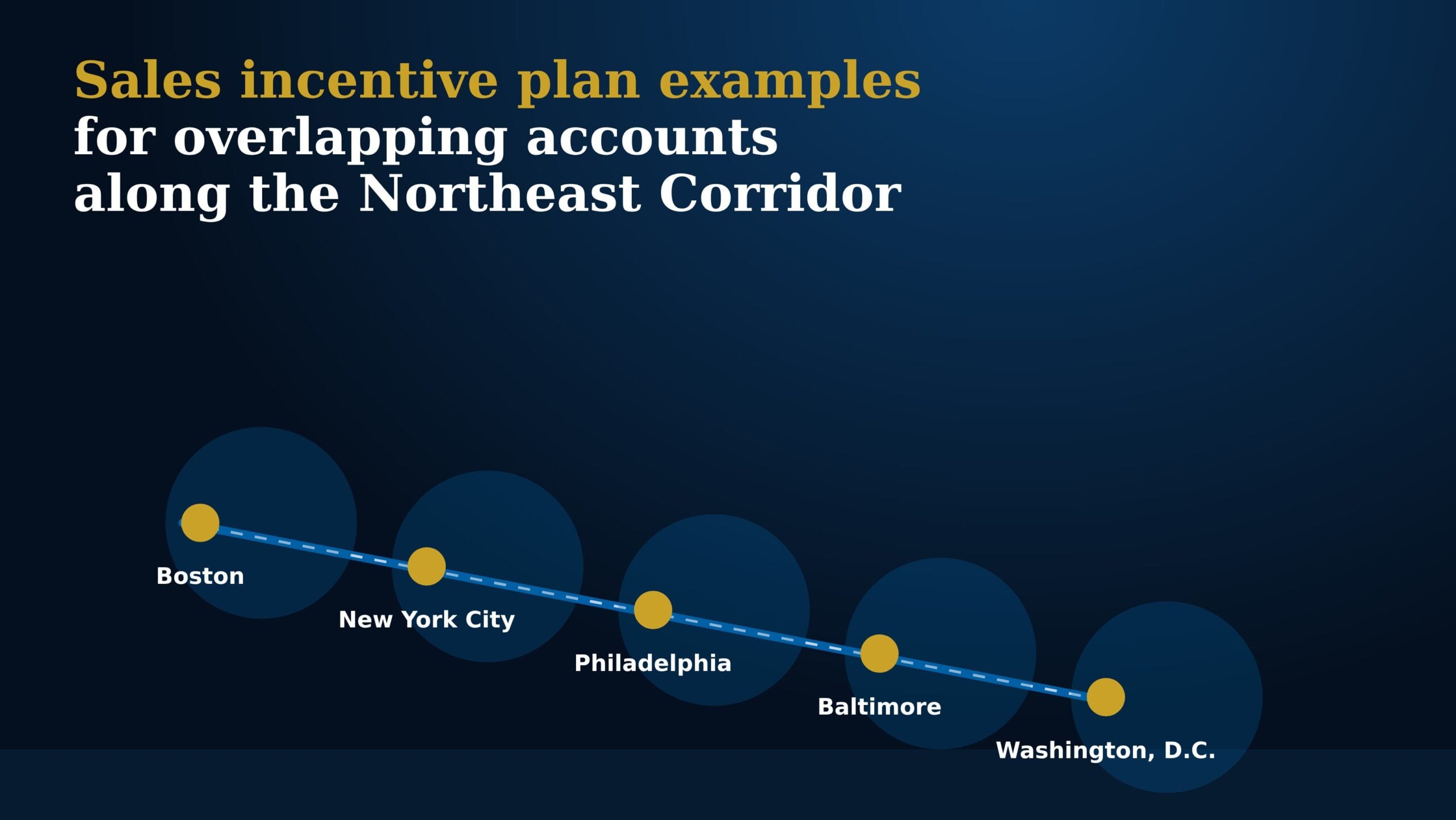
Northeast Corridor rail line connecting five city markers with overlapping account circles, headline Sales incentive plan examples for overlapping accounts along the Northeast Corridor
Sales incentive plan examples for overlapping accounts share one purpose: they decide, in advance and in writing, who gets paid when more than one salesperson has a claim on the same customer. Along the Northeast Corridor, the dense belt that runs from Boston to Washington, D.C., that question comes up often, because companies, offices and buyers sit close together and a single customer may be reachable from several metros. This guide walks through the ways plans handle overlap, with illustrative examples, and explains how to choose among them.
It is written for sales leaders and owners who run reps in more than one corridor metro, or who sell to customers with several offices in the region. The examples use made-up round numbers and are not benchmarks. This is general information, not legal advice, and pay terms should be reviewed by employment counsel.
Treeline, Inc. is a sales recruiting firm in Wakefield, Massachusetts that places salespeople permanently. Its Sales Compensation Assessment page describes a seven-step review of a compensation plan, and its locations page lists a page for each corridor state it serves.
Dan Fantasia, CEO of Treeline, Inc., would describe overlap as the point where a sales plan meets reality. From his perspective, a company can have a clean territory map and still face constant friction, because customers do not respect the map. The plan has to say what happens when they do not, or the reps will settle it with each other, and not always kindly.
What the Northeast Corridor Is, and Why Overlap Happens There
The Wikipedia article on the Northeast megalopolis describes the region as extending from the northern suburbs of Boston to Washington, D.C., running along U.S. Route 1, Interstate 95 and the Northeast Corridor rail line, and names Boston, New York City, Philadelphia, Baltimore and Washington, D.C. as its major cities. The page says it covers all or part of 12 states plus the District of Columbia and notes that some definitions are broader. Wikipedia is a general reference, so the definition should be treated as a common description and not an official boundary.
That geography matters to a sales plan for a simple reason. Several large markets sit within a short distance of one another, so one customer is often reachable from more than one metro.
- Multi-site customers. A company with offices in two corridor cities may be served by reps in both.
- Parent and subsidiary accounts. A parent in one city may own subsidiaries in others, each with its own buyer.
- Remote and hybrid buyers. The person who decides may not sit where the company’s address says.
- Adjacent territories. Reps in neighboring metros can both reasonably claim a customer between them.
- Inside and field overlap. An inside team and a field rep may both work the same account.
None of these problems is unique to the corridor. The corridor simply has more of them in a small area.
Treeline’s corridor state pages
Treeline has pages for Massachusetts, Connecticut, Rhode Island, New York, New Jersey, Pennsylvania, Delaware, Maryland and Washington, D.C., which together cover the main states along the corridor.
Why Sales Incentive Plan Examples Must Address Overlap Directly
A plan that is silent about overlap does not avoid the problem. It leaves the answer to whoever argues most persuasively, usually after a large deal has closed. The costs are real.
- Trust erodes. Reps who think credit is decided by politics stop cooperating.
- Cost rises silently. If two reps are each paid in full on one deal, the company pays twice and may not notice.
- Customers feel it. A customer contacted by two reps from the same company sees a disorganized seller.
- Managers lose time. Every dispute is a conversation that a written rule would have prevented.
Treeline’s guidance on determining sales compensation describes setting a total compensation budget as a share of margin. Double credit changes that share without anyone deciding to change it, which is the main reason an overlap rule has to be explicit.
Five Sales Incentive Plan Examples for Overlapping Accounts
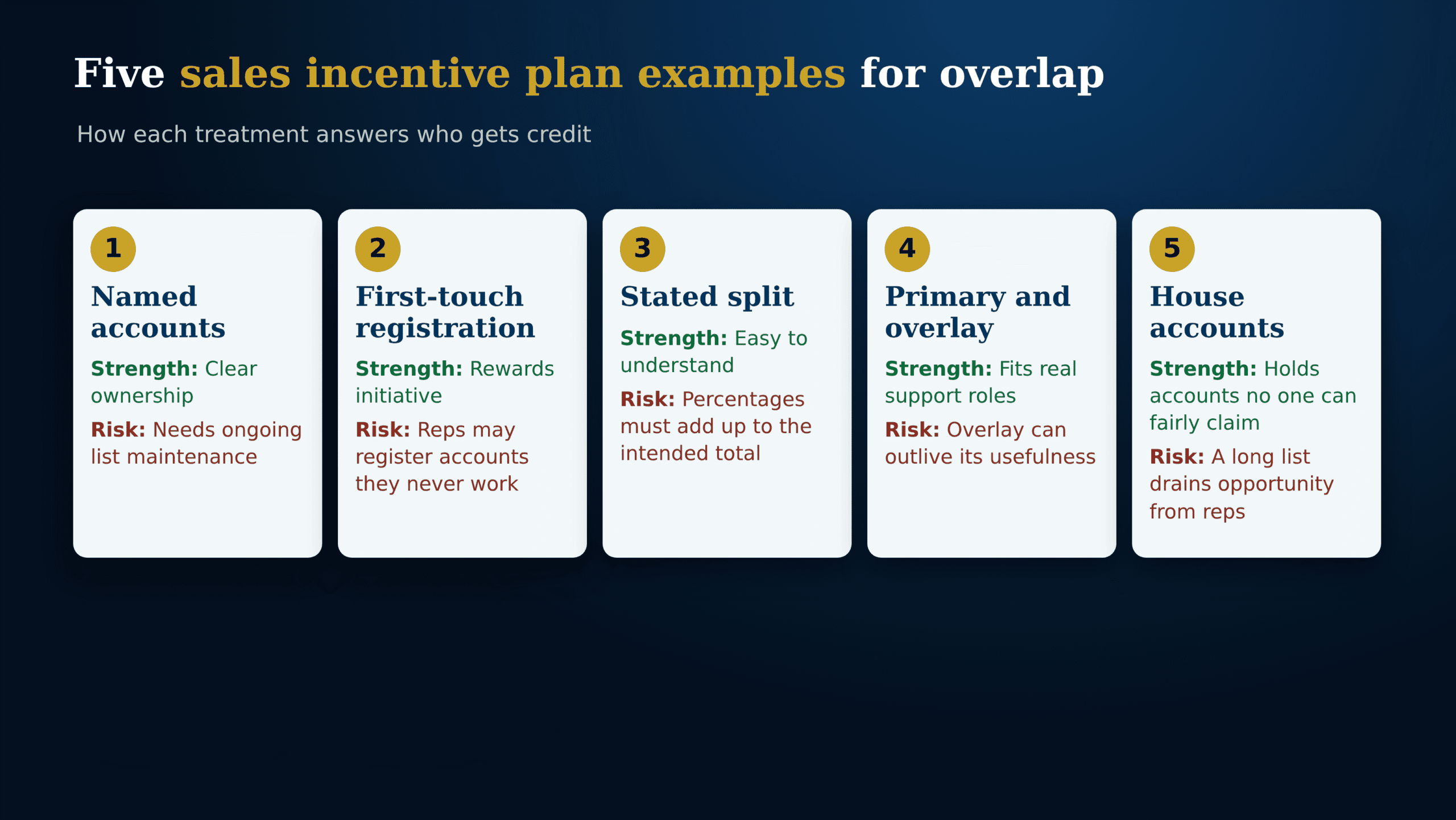
Plans usually combine several of the treatments below. Each is shown with a short illustration. The numbers are invented.
Five sales incentive plan examples for overlapping accounts: named accounts, first-touch registration, stated split, primary and overlay, and house accounts
As the graphic shows, each treatment answers the overlap question differently and carries a different risk.
Example 1: Named accounts
The plan lists the accounts each rep owns, and those accounts belong to that rep whatever the geography. A customer with offices in Boston and New York is on one rep’s list, so there is no argument about which city counts. The strength is clarity. The weakness is maintenance, because the list must be updated as accounts change, merge or are acquired.
Example 2: First-touch registration
The first rep to register an opportunity, under a defined process, owns it for a stated period. The rule rewards initiative, and it prevents two reps from working the same lead. Its risk is that reps register accounts they never intend to work, so the plan should say that a registration expires if there is no real activity.
Example 3: Stated split
Credit is divided by percentages. A deal that involves two reps might pay 60 percent to the rep who owns the relationship and 40 percent to the rep who supports it. The split is easy to understand. The plan must make sure the percentages add up to the intended total, since totals above 100 percent change the cost of the plan.
Example 4: Primary and overlay
One rep carries the quota and receives the main credit. A specialist, inside rep or partner manager receives a smaller overlay, often at a lower rate, for supporting the sale. It fits teams in which the support role is real and recurring.
Example 5: House accounts
Some accounts are assigned to no one, and they are handled by the company or an inside team, sometimes at a lower or no commission rate. House accounts are useful for customers no one can fairly claim, but they should be limited and reviewed, because a long list of house accounts can drain opportunity from the reps.
Dan Fantasia, CEO of Treeline, Inc., advises companies to pick the simplest rule that handles most cases and to write an exception process for the rest. From his perspective, a plan that tries to settle every possible overlap in advance becomes too complicated to follow, while a plan with one clear default and a defined path for disputes gets used.
How Sales Incentive Plan Examples Handle Parent and Subsidiary Accounts
Parent and subsidiary relationships create some of the hardest cases, and a plan should address them directly.
- Define the account. Say whether credit follows the legal entity, the buying group or the site that signs.
- Decide the roll-up. If a subsidiary buys under the parent’s contract, say whether the sale counts for the parent’s rep, the subsidiary’s rep or both.
- Handle acquisitions. If a customer acquires another customer, say which rep keeps the combined account and what happens to open deals.
- Set a review point. Accounts change, and the plan should say when assignments are reviewed.
An illustrative example
A company sells to a parent headquartered in one corridor city. A subsidiary in another city places its own order. If the plan credits by the signing entity, the subsidiary’s rep is credited. If it credits by the parent, the parent’s rep is credited. Neither is wrong. The plan has to choose, and it has to apply the choice the same way each time.
A Dispute Path for Sales Incentive Plan Examples
Even a good rule meets cases it did not foresee. The plan should say what happens then.
- Report the overlap early. The rep raises it before the deal closes, not after.
- Apply the written rule. The manager checks the plan’s default.
- Escalate if the rule does not fit. A named person, such as the head of sales, decides within a stated time.
- Record the decision. The outcome is written down so the same case is handled the same way next time.
- Review the rule. If the same kind of dispute recurs, the plan should change.
A defined path serves two purposes. It tells reps that disputes will be settled consistently, and it gives the company a record of how the plan is working.
Choosing Among Sales Incentive Plan Examples for Overlap
No single treatment fits every company. The choice depends on the sales model, the number of reps and how often accounts overlap.
- A few large accounts, long cycles. Named accounts usually work best, because the number of accounts is small enough to list and each one matters.
- Many mid-sized accounts, shared markets. First-touch registration with an expiry date can keep reps from working the same accounts.
- Complex sales with specialists. Primary and overlay fits when a support role is a regular part of the sale.
- Few reps, close collaboration. A stated split may be enough, provided the percentages are written down.
- Orphaned or strategic accounts. House accounts can hold them, as long as the list is short and reviewed.
Questions to ask before choosing
- How often does overlap actually happen in our deals today?
- Which dispute has cost us the most time or trust?
- Can a rep read the rule and predict the answer?
- What does the rule cost if it is applied to our largest account?
If a rule fails the third question, it is probably too complicated. A rep who cannot predict the answer will not trust it, and a rule nobody trusts is a rule people argue around.
Dan Fantasia, CEO of Treeline, Inc., suggests testing a draft rule on three real accounts before adopting it. From his perspective, if the rule produces an answer the sales leader finds fair on all three, it is probably workable, and if it produces a surprise on any of them, the surprise is the part of the plan that still needs work.
Pay Terms for Sales Incentive Plan Examples With Shared Credit
Shared credit raises pay-timing questions that the plan should answer.
- When is the credit final? A split that is decided after the deal closes delays payment.
- What if a deal is cancelled? Say how clawbacks are shared between reps.
- What if a rep leaves? Say what happens to a shared deal that has closed but not been paid.
- How are changes handled? Say how and when the company may change the plan, and how reps are told.
Earned commissions may be treated as wages in some states, which makes the written pay terms important. A Foley & Lardner analysis published in November 2025 describes how the Massachusetts Wage Act can reach employees outside Massachusetts in some circumstances, which is one reason a company with reps in several corridor states should have counsel review its plan. The analysis describes one trial-court decision and does not settle the question for every employer.
A Worked Example of Sales Incentive Plan Examples Along the Corridor
This example is hypothetical, with invented numbers.
A company has reps in Boston, New York and Philadelphia. A customer based in New York has a Philadelphia office that buys separately. The plan’s default is to credit by the signing entity, with named accounts overriding the default. The customer is on the New York rep’s named list, so the New York rep owns it. The Philadelphia rep, who has a strong relationship with the local buyer, receives a 25 percent overlay on sales to that office for as long as the arrangement is in place. The percentages are written into the plan, and the company’s cost per deal is known.
When the customer opens a Boston office, the rep in New York raises it early. The manager applies the named-account rule, and the Boston rep receives no credit unless the plan assigns a split. The decision is recorded. After two quarters, the sales leader reviews whether the overlay is still earning its cost.
The example works because the rule was written before the deal, the exception was raised early and the decision was recorded.
Dan Fantasia, CEO of Treeline, Inc., would point to the review at the end as the habit that keeps a plan honest. From his perspective, a company that checks whether each overlay is still worth its cost, and removes the ones that are not, protects both its margin and the reps’ trust.
Hiring Reps Who Will Work Overlapping Accounts
Overlap affects hiring as well as pay.
- Candidates should hear the rule. A seller deciding to join wants to know how shared accounts are handled.
- Cooperation is a skill. Reps who work overlapping accounts must share information, and a candidate’s past behavior is a guide.
- Territory clarity attracts candidates. A company that can describe where a rep’s credit begins and ends looks organized.
For companies that need help with the search, Treeline’s contingency recruiting service is the model under which it typically takes on a search, and its fractional CRO service page describes an ongoing engagement that covers pipeline reviews, coaching and reporting.
Common Mistakes in Sales Incentive Plan Examples for Overlapping Accounts
- Silence on overlap. The first large dispute writes the rule, usually badly.
- Double credit by accident. Cost rises without a decision.
- An outdated named-account list. Reps argue over accounts that have changed.
- Unlimited registration. Reps claim accounts they do not work.
- Too many house accounts. Opportunity drains from the team.
- No dispute path. Each case becomes a negotiation.
- No review. Overlays outlive their usefulness.
A Checklist for Overlapping Accounts
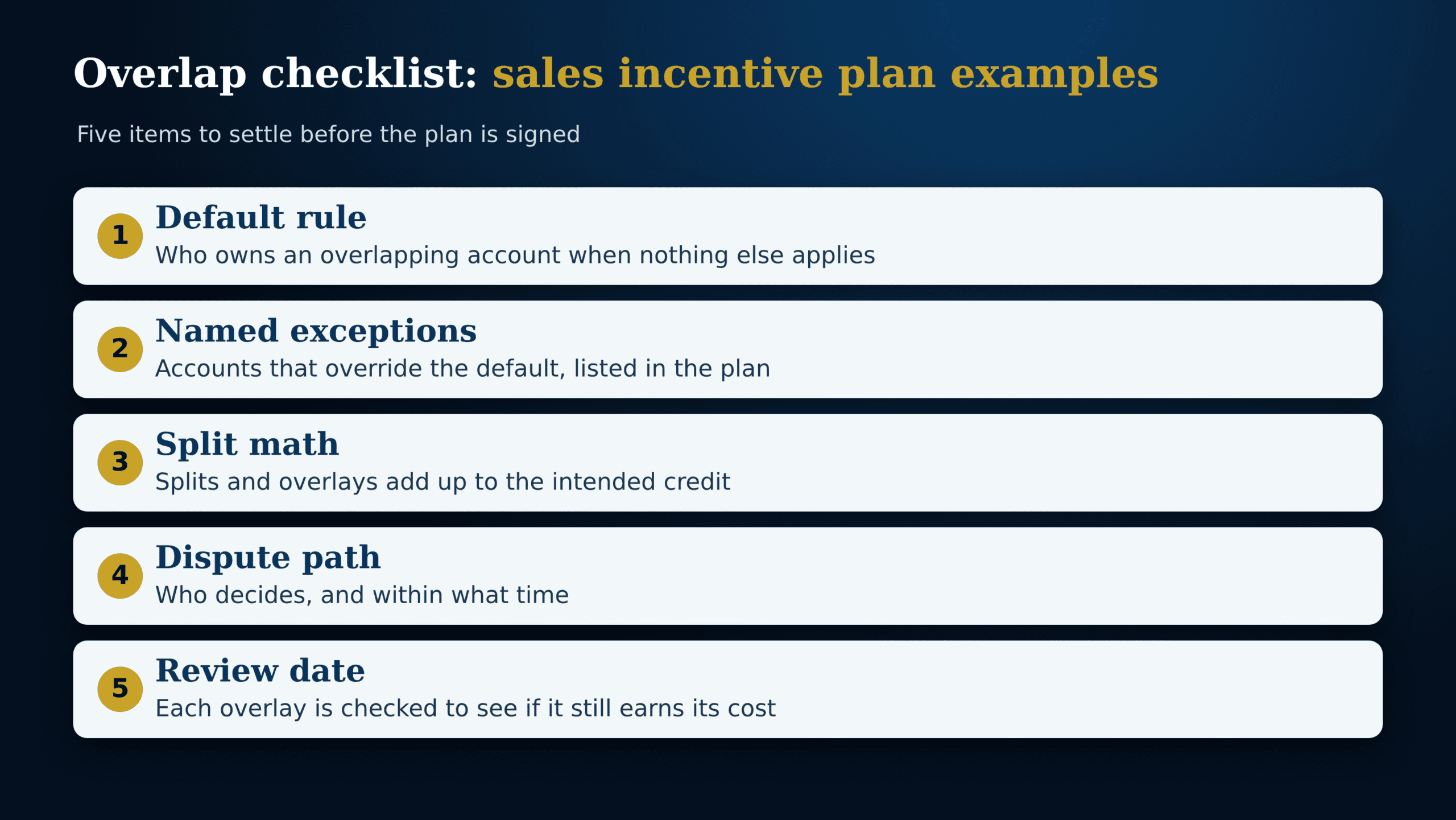
Checklist for overlapping-account rules in sales incentive plan examples: default rule, named exceptions, split math, dispute path and review date
The checklist above lists the items to settle before the plan is signed.
- Choose a default rule for who owns an overlapping account.
- List the named accounts that override the default.
- Check that split and overlay percentages add up to the intended total.
- Define how parent, subsidiary and acquired accounts are treated.
- State the dispute path and who decides.
- State how clawbacks and departures affect shared deals.
- Have counsel review the pay terms.
- Set a date to review each overlay.
Frequently Asked Questions About Sales Incentive Plan Examples
What do sales incentive plan examples say about overlapping accounts?
They set a written rule for who gets credit when more than one rep has a claim on the same customer. Common treatments are named accounts, first-touch registration, stated splits, primary-and-overlay credit and house accounts.
Why does overlap happen so often along the Northeast Corridor?
Several large markets, from Boston to Washington, D.C., sit close together, so one customer is often reachable from more than one metro. The region is described this way in a general reference, and the boundary is not official.
How can a plan avoid paying twice on one deal?
By making sure split and overlay percentages add up to the credit the company intends to pay. A plan should also state the default rule so that two reps are not each credited in full.
What is a primary-and-overlay arrangement?
One rep carries the quota and receives the main credit, and a specialist or support rep receives a smaller overlay for helping with the sale. The overlay rate and the conditions should be written down.
Should a company use house accounts?
They can be useful for customers no one can fairly claim, but they should be limited and reviewed. A long list of house accounts can drain opportunity from the reps.
How should a plan handle a customer that acquires another customer?
It should say which rep keeps the combined account, what happens to open deals and when assignments are reviewed. Writing the rule before an acquisition happens avoids a dispute afterward.
When should an overlapping-account rule be reviewed?
Treeline’s assessment page suggests reassessing a new plan at 90 days, and each overlay should have its own review date so that it does not outlive its purpose.
Share This Story, Choose Your Platform!
Related Posts
What our happy clients are saying
Treeline Inc. provided us with the most candidates that aligned with our needs and were of the highest quality.

Dr. Jeffrey Klein Head of North America Sales, Satchel Pulse
Treeline Inc.’s collaborative, flexible, and communicative approach resulted in a smooth partnership. Beyond their recruitment expertise, their unique sourcing model was efficient and effective.

Sera Holt Director of Operations, LNS Research
Their professionalism was outstanding. Treeline Inc. was extremely thorough and ensured that we were on the same page before they started looking for candidates. They listened to us and did a great job working with the candidate to close out the process.

Cate Grant AVP Customer Success, Nasdaq
Thanks to Treeline Inc.’s intricate and thorough screening process, the company is able to hire six high-quality candidates that fit perfectly in the company’s culture. The team is highly receptive to concerns, and internal stakeholders are impressed with their unique recruitment abilities.

Anna McKean Sales Recruiter, Insider Intelligence
Treeline Inc. has been qualified individuals throughout a five-year-long engagement. They’ve made numerous placements of talented and qualified individuals for our business.

Michele St Laurent VP of HR, The Institute for Applied Network Security

Let Us Help You Source the Sales Talent You Need
Whether you’re building a team or replacing a key role, our Candidate Sourcing Platform provides a fast, flexible, and employer-focused solution.
Tell us more about your business and how we can help.
Treeline Inc.
Your Award-Winning Sales Recruitment Partner
15 Lincoln Street, Suite 314, Wakefield, MA 01880