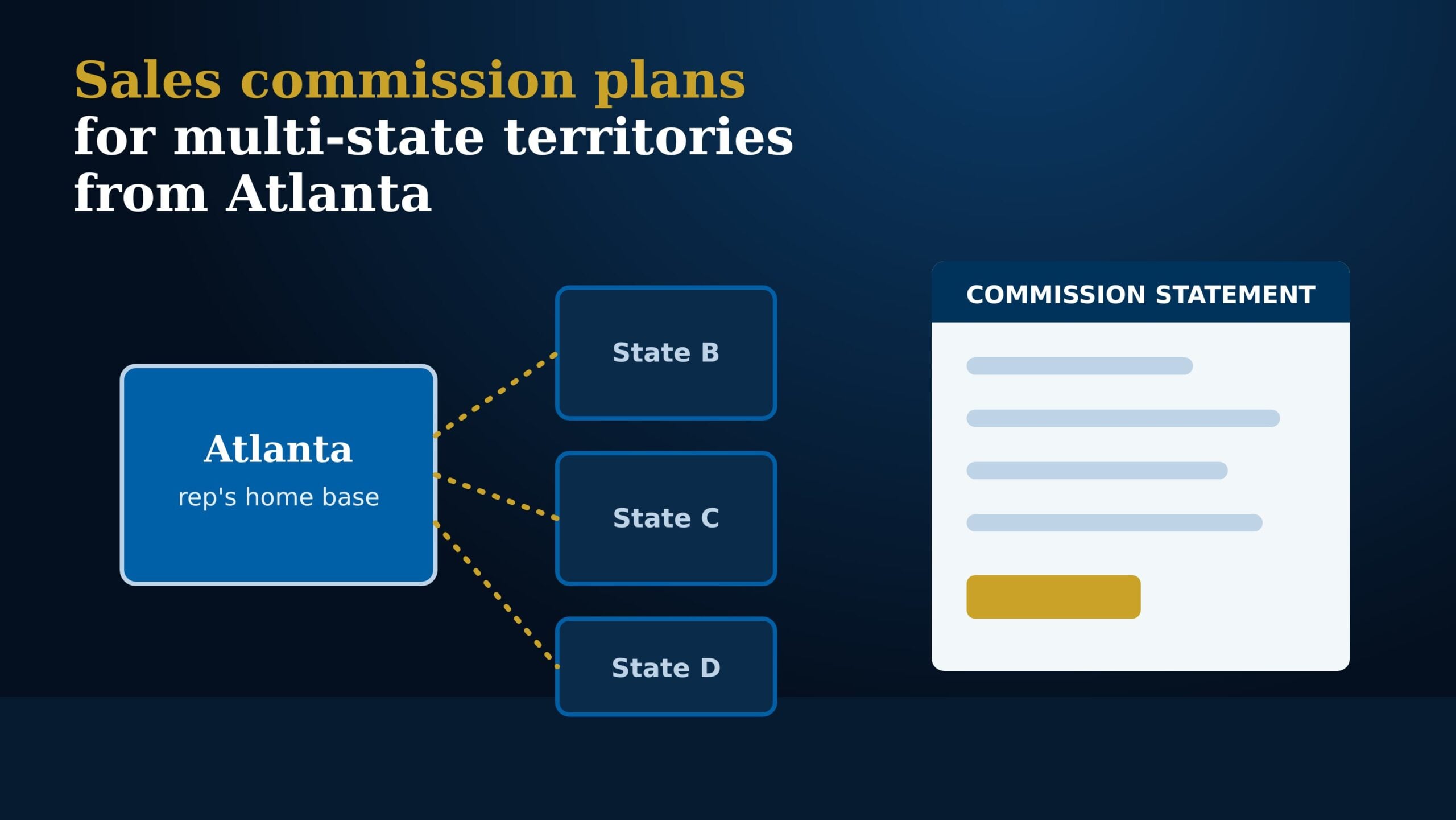
Atlanta-based sales rep desk with a map of several connected Southeast states and a commission statement, headline Sales commission plans for multi-state territories from Atlanta
Sales commission plans for a rep who lives in Atlanta and sells across several states reward the behavior a company wants by tying pay to results the rep can actually influence. For a multi-state territory, that means choosing a commission structure that fits the sales cycle, deciding what counts as a credited sale when a customer touches more than one state, and writing down when earned commission is paid. A plan that does those three things clearly lets a rep who works alone, far from the office, see how effort turns into pay.
This guide focuses on the commission mechanics: the rate structures companies use, how accelerators and thresholds work, how credit and ramp are handled, and what Georgia’s pay rules mean for the written plan. It is written for sales leaders and owners who are building or reviewing commission plans for a remote or Atlanta-based rep. The examples use made-up round numbers and are not benchmarks. This is general information and not legal advice.
Treeline, Inc. is a sales recruiting firm in Wakefield, Massachusetts that places salespeople permanently. Its Georgia page names Atlanta as a hub for logistics, fintech and media, and its Sales Compensation Assessment page describes a seven-step review of a compensation plan.
Dan Fantasia, CEO of Treeline, Inc., views the commission plan as the clearest statement a company makes about what it values. From his perspective, a rep who covers several states from Atlanta cannot lean on hallway conversations to learn what the company wants, so the plan has to say it, and a plan that rewards the wrong behavior will produce that behavior reliably.
What Sales Commission Plans Are Meant to Do
A commission plan is the variable portion of a seller’s pay. It rewards results, usually a share of revenue or margin from sales the rep closes. A good plan does four things.
- It motivates the right activity. A plan that pays on closed revenue will push a rep toward closing, and a plan that also pays on new customers will push toward prospecting.
- It is affordable. Treeline’s guidance on determining sales compensation describes setting a total compensation budget as a share of margin, which gives the company a way to test whether commission rates are sustainable.
- It is understandable. A rep should be able to estimate a commission on a deal in a minute.
- It is fair across territories. Two reps with different territories should have a reasonable chance at similar earnings for similar effort.
A multi-state territory puts pressure on each point, because the rep works alone, travels, and sells into markets of different sizes.
Sales commission plans and compensation are not the same thing
Total compensation includes base pay, commission, any bonus and benefits. Sales commission plans cover the variable part. The two should be designed together, since a high base lowers the need for a high commission rate and the reverse.
Common Structures in Sales Commission Plans
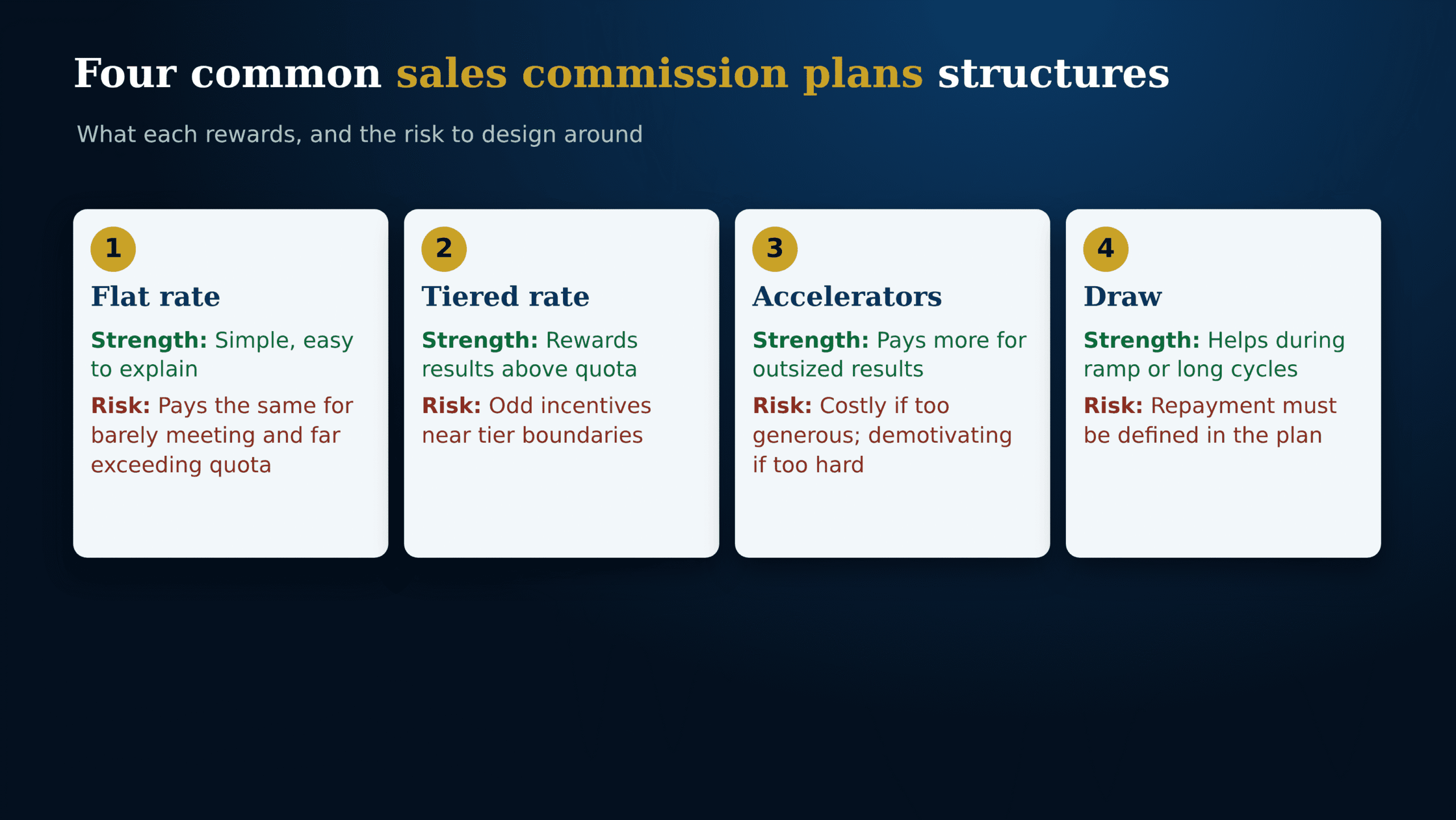
Companies use several commission structures, often in combination.
Four common sales commission plans for a multi-state rep: flat rate, tiered rate, accelerators and commission with a draw, each with a strength and a risk
As the diagram shows, each structure rewards something different and carries its own risk.
Flat rate. The rep earns the same percentage on every sale. It is simple and easy to explain. Its weakness is that it does not distinguish between a rep who barely meets quota and one who far exceeds it.
Tiered rate. The percentage changes at set levels of attainment. A rep might earn one rate up to quota and a higher rate beyond it. It rewards performance above quota, but the tiers need to be set with care so that they do not produce odd incentives near the boundaries.
Accelerators. A multiplier applies once the rep passes a threshold. It is a common way to pay more for outsized results. If it is too generous it becomes costly, and if it is too hard to reach it stops motivating.
Commission with a draw. The rep receives an advance against future commission. It can help during ramp or a long sales cycle, but the plan must say how the draw is repaid if commissions fall short.
Choose the structure to fit the sales cycle
- Short cycles with many small deals usually work with a flat or simple tiered rate.
- Long cycles with few large deals may need a draw or milestone payments, because the rep may go months without a closed sale.
- Recurring revenue may call for commission tied to initial contract value, renewal or both, and the plan should say which.
None of these is the right answer in every case. The right one is the structure that makes the desired behavior the easy path for a rep working alone.
How Sales Commission Plans Handle Credit Across States
A multi-state territory raises credit questions that a one-city territory does not. A customer may be headquartered in one state, buy for a site in another and have its contract signed in a third. The plan should say which event decides credit.
- Customer headquarters. Simple, and it matches how many companies track accounts.
- Ship-to or service location. It tracks where the work happens, and it fits product sales.
- Relationship ownership. The rep who owns the buyer relationship gets the credit.
- Stated split. The credit is divided by percentages, such as 70 percent and 30 percent.
- Primary and overlay. One rep gets the main credit, and a specialist or inside seller gets a smaller overlay.
An illustrative example
Suppose an Atlanta-based rep covers four states, and a customer headquartered in one state places an order for two sites in another. If the plan credits by headquarters, the rep for the headquarters state gets the full credit. If it credits by ship-to, the credit is divided by site. The numbers are invented. What matters is that the rule is written and applied consistently, because an unwritten rule invites disputes at exactly the moment a large deal closes.
Dan Fantasia, CEO of Treeline, Inc., would ask companies to test every credit rule against the hardest deal they can imagine. From his perspective, if the plan cannot say who gets paid on a customer with three sites and two buyers, it is not finished, and the dispute will arrive with the first large order.
Thresholds, Accelerators and Ramp in Sales Commission Plans
Three features shape how a plan feels to a new rep.
- Thresholds. Some plans pay commission only after the rep reaches a minimum level of attainment. A threshold protects the company but can discourage a new rep who has not yet built a pipeline.
- Accelerators. They reward results above quota. The plan should state the point at which they begin and whether they apply to all sales or only to those above the line.
- Ramp. A new rep in a new territory needs time. A ramp can reduce quota, guarantee part of the commission, or both for a stated period.
For a rep who works from Atlanta and covers several states, ramp is especially important. The rep must learn several markets, build trust with customers who may never visit an office, and travel to reach them. A plan that expects full-quota performance in the first month is likely to lose the rep.
Quota and capacity
Quota should reflect the opportunity in the territory and the rep’s capacity. Time spent traveling is time not spent selling. A quota that ignores that will feel arbitrary, and a rep who feels the plan is arbitrary may stop trusting it.
Georgia Pay Terms in Sales Commission Plans
Pay timing is part of any commission plan. For a rep who lives in Georgia, two sources reviewed for this guide describe the state’s approach, and both are secondary sources and not statutes read directly.
- An Everstage guide to sales commission laws in Georgia, last updated October 6, 2026, says Georgia “does not impose a general statutory final-pay schedule for private employers,” that it relies heavily on the written commission agreement, and that covered independent sales representatives have protections under the Georgia Sales Representative’s Commission Act. Everstage is a sales-compensation software company, so this is a vendor source.
- A Teambridge page, last updated May 27, 2026, says Georgia sets no specific deadline for final pay and that final wages are due on the next regularly scheduled payday. It cites O.C.G.A. § 34-7-2 and says earned commissions and bonuses that are due and calculable as of the last day should be included in the final paycheck, depending on the employer’s policy or agreement.
The two sources agree on the main point, which is that the written plan carries a great deal of weight. They describe it in different terms, and the Everstage page contains a citation that appears to be an error, so the details should be confirmed with employment counsel.
What to write into the plan
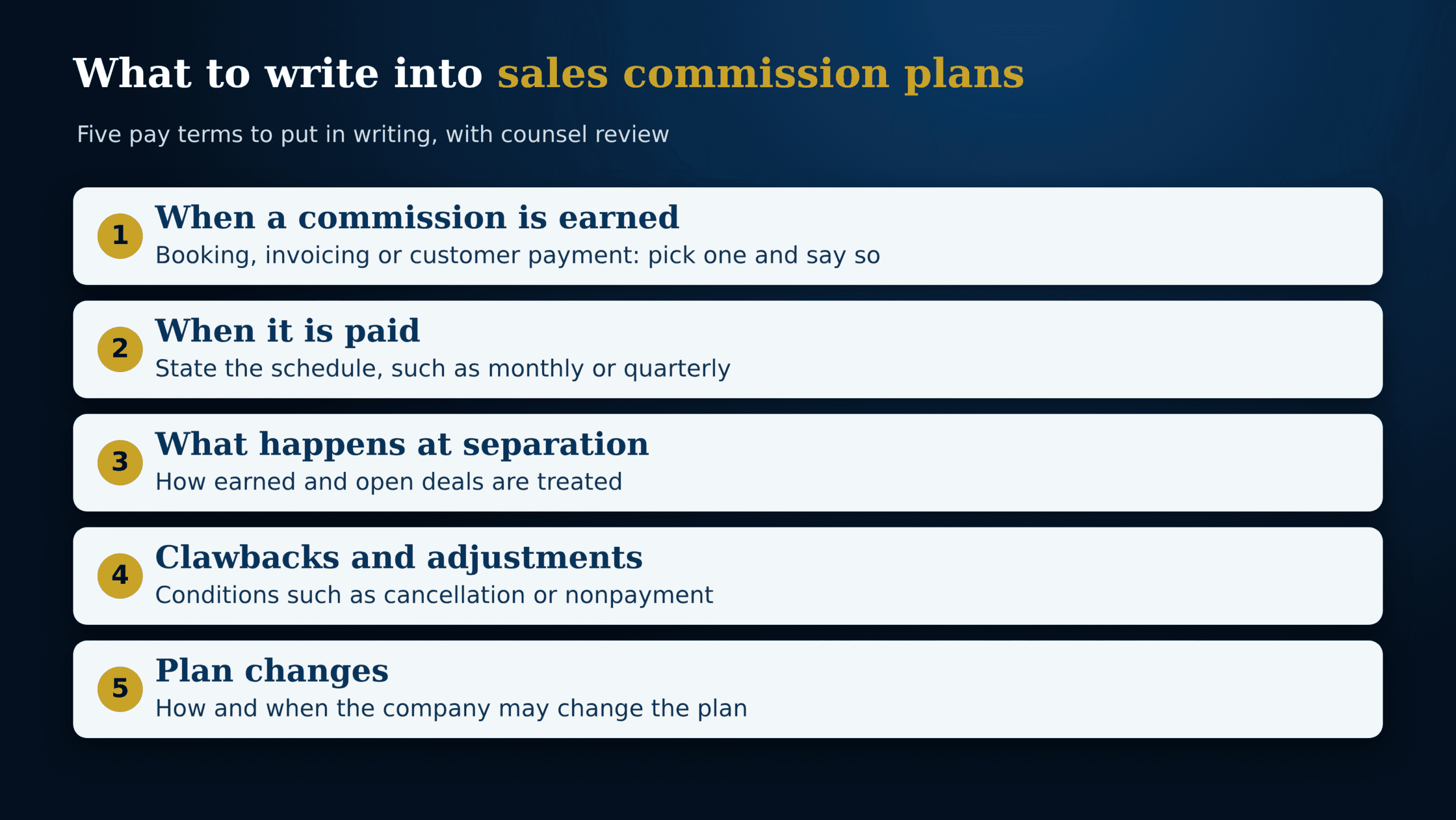
The graphic below lists the five terms.
Five pay terms to write into sales commission plans: when earned, when paid, separation, clawbacks and plan changes
- When a commission is earned. Booking, invoicing and customer payment are all used.
- When it is paid. State the schedule, such as monthly or quarterly.
- What happens at separation. Say how earned and open deals are treated.
- Clawbacks and adjustments. State the conditions, such as customer cancellation or nonpayment.
- Plan changes. Say how and when the company may change the plan, and how the rep is told.
A multi-state rep may raise more than Georgia questions
A rep who lives in Georgia but sells in other states may have other states’ rules in play, and the answer depends on the facts. That is a question for counsel. The plan should state the pay terms and leave withholding questions to the company’s payroll provider or tax adviser.
A Worked Example of Sales Commission Plans for an Atlanta-Based Rep
This example is hypothetical, with invented round numbers.
A company hires a rep in Atlanta to cover four states. It sets a target total compensation, splits it between base and commission, and sets one territory quota. It chooses a tiered rate with a modest accelerator above quota, and a draw for the first three months during ramp. Credit is assigned by customer headquarters, with a written rule for customers that have sites in several states.
The plan says a commission is earned when the customer pays, and it states the payment schedule. It says that open deals at separation are handled according to a stated clause. It describes how clawbacks apply if a customer cancels within a set window. Before the plan is signed, counsel reads the pay terms against the rules that apply.
At about 90 days, the company reviews the plan, as Treeline’s assessment page suggests for new plans. It checks whether the draw is working, whether travel is eating too many selling days and whether the credit rule has caused disputes. It adjusts only what the data justify.
Dan Fantasia, CEO of Treeline, Inc., would say that the 90-day review is where a commission plan proves itself. From his perspective, a company that looks at real results, asks the rep what is confusing and changes the plan deliberately earns trust that a plan left alone for a year never will.
How Sales Commission Plans Affect Hiring in the Atlanta Market
The plan shapes who accepts the job.
- Candidates compare plans. A clear plan with a fair ramp signals a company that has thought about the job.
- Territory and travel should be explicit. A candidate who learns about the driving after the offer may leave.
- Support should be named. The candidate should know who handles inside sales, engineering and service.
- Pay terms should be in writing. A candidate deciding to leave a current job wants certainty about when earned commission is paid.
Dan Fantasia, CEO of Treeline, Inc., notes that candidates for these roles often ask about the commission plan before they ask about the product. From his perspective, a company that can hand a candidate a clear one-page plan, with the earning event and payment dates stated plainly, is already showing the candidate how it will treat them after they start.
For companies that need help finding the rep, Treeline’s contingency recruiting service is the model under which it typically takes on a search, and its Georgia page says the firm does not charge upfront fees and collects a fee only once a suitable candidate is hired. That is the firm’s own statement and should be confirmed in a written agreement.
Common Mistakes in Sales Commission Plans for Multi-State Reps
- Paying for the wrong behavior. A plan that pays only on closed revenue may discourage prospecting in a territory that needs it.
- Unwritten credit rules. Disputes arise on the largest deals.
- A quota that ignores travel. The rep cannot hit a number built for one city.
- No ramp. A new rep in a new territory needs time.
- A draw with no repayment rule. The rep and the company disagree about what is owed.
- Vague separation terms. Earned and open commissions are disputed.
- Never reviewing the plan. A new plan should be checked against real results.
For a company that needs sales leadership while it designs or reviews commission plans, Treeline’s fractional CRO service page describes an ongoing engagement that covers pipeline reviews, coaching and reporting.
A Checklist for Sales Commission Plans in a Multi-State Territory
- Choose a structure that fits the sales cycle.
- State what counts as a credited sale and how multi-state deals are credited.
- Set quota with capacity and travel in mind.
- Define thresholds, accelerators and ramp.
- State when commission is earned and paid.
- State how open deals, clawbacks and plan changes are handled.
- Have counsel review the pay terms.
- Review the plan at about 90 days.
Frequently Asked Questions About Sales Commission Plans
What are sales commission plans?
Sales commission plans are the variable-pay part of a seller’s compensation. They pay a share of results, usually revenue or margin, and they should be designed together with base pay and quota.
What are the most common sales commission structures?
Flat rate, tiered rate, accelerators and commission with a draw. Many plans combine them, and the best fit depends on the sales cycle.
How should sales commission plans credit deals across states?
By customer headquarters, ship-to location, relationship ownership, a stated split or a primary-and-overlay arrangement. The plan should state the rule in advance and make the percentages add up to the intended total.
Does Georgia set a final pay deadline for commissions?
A vendor guide and a compliance site reviewed for this guide both say Georgia has no general statutory final-pay schedule, and one says final wages are due on the next regular payday. They describe the written plan as central. Counsel should confirm the position.
What should a commission plan say about ramp?
It should say how long the ramp lasts and whether it reduces quota, guarantees part of the commission or both. A rep covering several new states needs time to build a pipeline.
How should a draw work in a commission plan?
A draw is an advance against future commission. The plan should state its length, its amount and how any shortfall is repaid or forgiven, so that neither side is surprised.
When should a new commission plan be reviewed?
Treeline’s assessment page suggests reassessing a new plan at 90 days. That gives time to see how the territory, credit rules and quota work in practice.
Share This Story, Choose Your Platform!
Related Posts
What our happy clients are saying
Treeline Inc. provided us with the most candidates that aligned with our needs and were of the highest quality.

Dr. Jeffrey Klein Head of North America Sales, Satchel Pulse
Treeline Inc.’s collaborative, flexible, and communicative approach resulted in a smooth partnership. Beyond their recruitment expertise, their unique sourcing model was efficient and effective.

Sera Holt Director of Operations, LNS Research
Their professionalism was outstanding. Treeline Inc. was extremely thorough and ensured that we were on the same page before they started looking for candidates. They listened to us and did a great job working with the candidate to close out the process.

Cate Grant AVP Customer Success, Nasdaq
Thanks to Treeline Inc.’s intricate and thorough screening process, the company is able to hire six high-quality candidates that fit perfectly in the company’s culture. The team is highly receptive to concerns, and internal stakeholders are impressed with their unique recruitment abilities.

Anna McKean Sales Recruiter, Insider Intelligence
Treeline Inc. has been qualified individuals throughout a five-year-long engagement. They’ve made numerous placements of talented and qualified individuals for our business.

Michele St Laurent VP of HR, The Institute for Applied Network Security

Let Us Help You Source the Sales Talent You Need
Whether you’re building a team or replacing a key role, our Candidate Sourcing Platform provides a fast, flexible, and employer-focused solution.
Tell us more about your business and how we can help.
Treeline Inc.
Your Award-Winning Sales Recruitment Partner
15 Lincoln Street, Suite 314, Wakefield, MA 01880