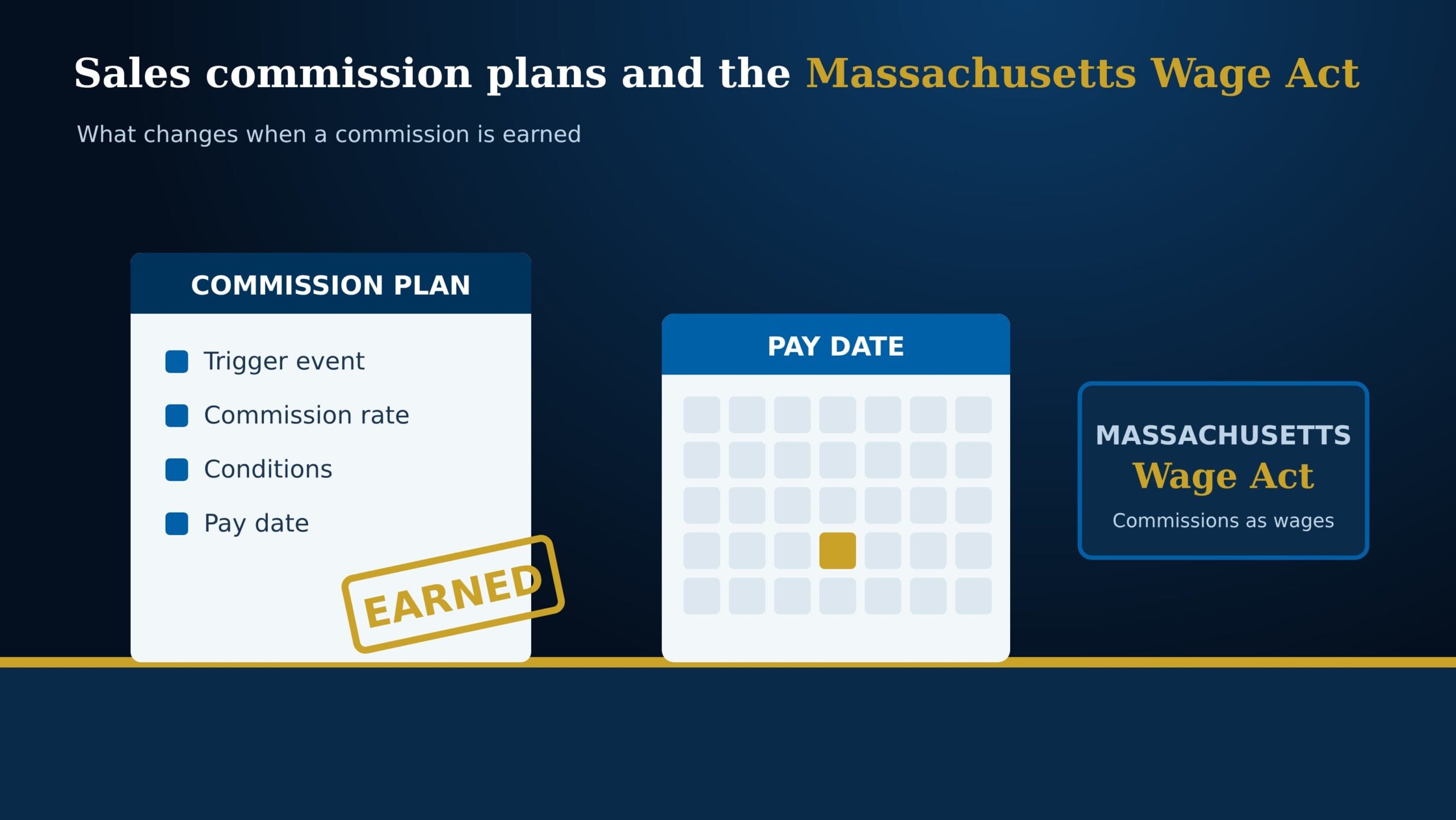
Sales commission plans meet the Massachusetts Wage Act at one moment: when a commission stops being a possible future payment and becomes money the employee has earned. According to a Massachusetts Bar Association summary of a 2020 Supreme Judicial Court decision, commissions are contingent and generally count as wages under the Wage Act only once they are “definitely determined and due and payable.” Everything a Massachusetts employer writes into a commission plan either clarifies when that moment arrives or leaves it to be argued later.
This guide explains that moment, what a commission plan should say about it and the lessons employers draw from the 2020 decision. It is a general explanation of how one summary describes the law. It is not legal advice, the law may have changed since the sources were written, and a company with Massachusetts salespeople should have employment counsel review its plan.
Treeline, Inc. is a sales recruiting firm based in Wakefield, Massachusetts that places salespeople permanently; its Massachusetts page describes its work in the state. Treeline’s Sales Compensation Assessment page describes a seven-step review of a compensation plan, and its contingency recruiting service is how it typically takes on a sales search. The firm does not give legal advice, and this article is not a substitute for it.
Dan Fantasia, CEO of Treeline, Inc., views a commission plan as a promise that the company has to be able to keep in writing. From his perspective, the plans that cause the most trouble are not the generous or the stingy ones but the ones that leave the trigger for payment unclear, because a rep and a company can each believe they are right.
What Sales Commission Plans Mean by “Earned”
A commission plan describes how a seller’s results become pay. The word “earned” has a practical meaning inside the plan and a legal meaning under the Wage Act, and the two do not always match.
Inside the plan, a commission is usually earned when a defined event occurs. Common triggers include:
- Booking: the customer signs the contract.
- Invoicing: the company bills the customer.
- Collection: the customer pays.
- Delivery or go-live: the product is delivered or implemented.
- A later milestone: for example, the end of a trial or the first renewal.
The plan’s trigger matters because it decides when the commission can be calculated. A commission that depends on collection is not final until the customer pays. A commission that depends on booking can be calculated as soon as the contract is signed.
Under the Wage Act, the Massachusetts Bar Association summary describes the rule differently. A commission counts as a wage once it is definitely determined and due and payable. In other words, the question is whether the amount is fixed and the payment is owed. A plan can describe a commission as “not earned” until a particular date, and the 2020 decision discussed below shows that a court may also look at what the company actually did.
Why the distinction matters
Once a commission is a wage, the Wage Act’s protections apply to it. The summary describes the practical consequence: unpaid wages can lead to claims, and in some circumstances the amounts can be trebled, meaning multiplied by three. A company that treats a commission as optional when it has in fact become a wage can face much larger exposure than the commission itself.
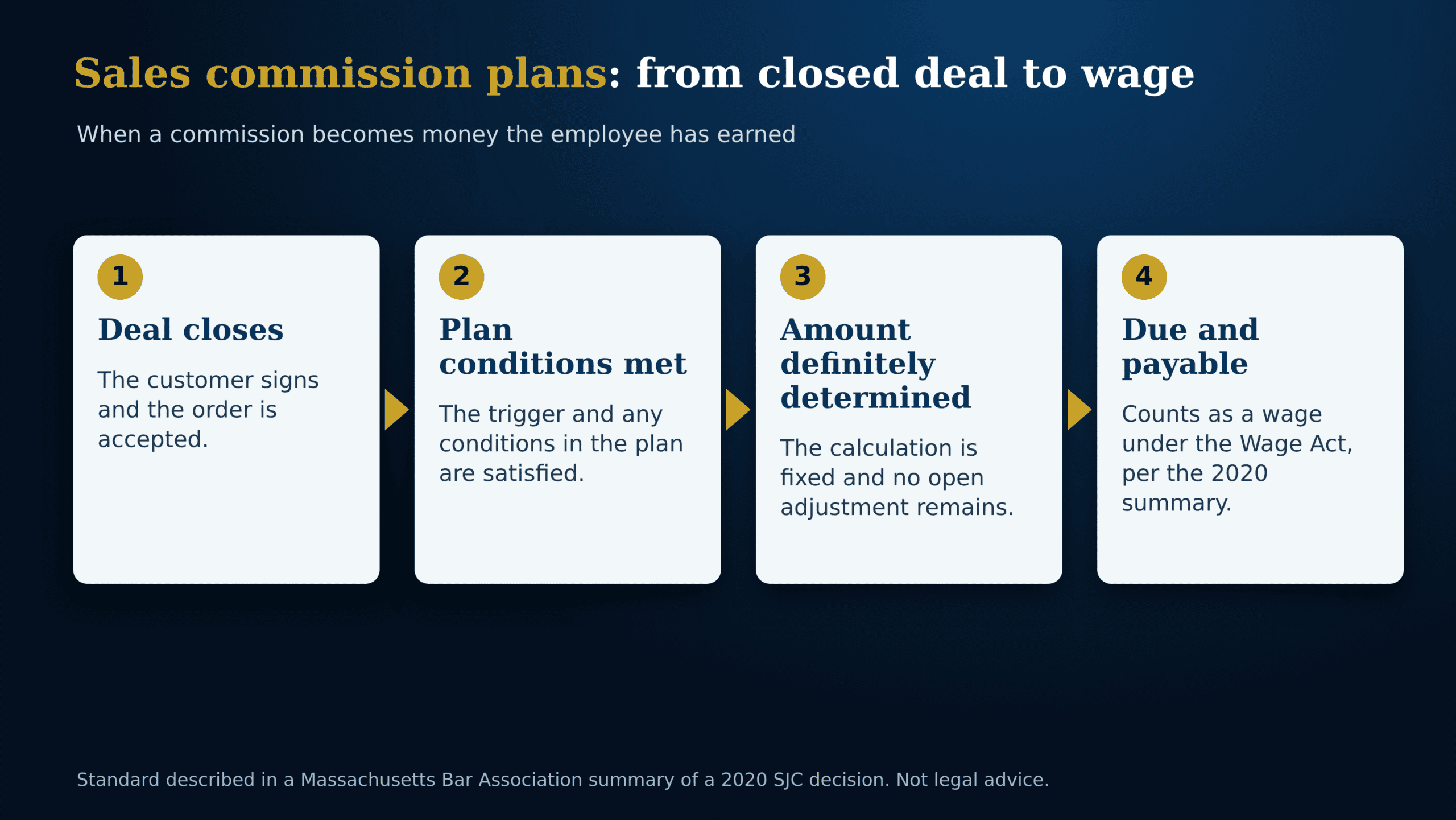
The flow below shows how a commission moves from a closed deal to a wage, following the summary’s description.
Four-step flow from a closed deal to a commission that counts as a wage under the Massachusetts Wage Act: plan conditions met, amount definitely determined, due and payable
How Sales Commission Plans Define When a Commission Is Due
A plan that works under the Wage Act answers four questions without ambiguity.
- What event makes the commission calculable? Name the trigger precisely. “When the deal closes” is too vague. “When the customer has signed the order form and the order has been accepted by the company” is clearer.
- What conditions must still be met? If payment depends on the customer paying, on the rep still being employed or on the deal not being cancelled within a period, say so.
- How is the amount calculated? State the rate, the base to which it applies and any adjustments such as returns, credits or discounts.
- When is it paid? Name the payroll date or the interval after the trigger.
If the plan is silent on any of these, the rep will assume the answer that favors them and the company will assume the opposite. The gap is where disputes start.
The role of definitions
Many commission disputes come from words that were never defined. A short definitions section can prevent them.
- Revenue: Does it mean bookings, billings, collected cash or recognized revenue?
- Deal: Is a renewal or expansion a new deal or part of an old one?
- Territory or account: Who owns an account that spans two territories?
- Cancellation: What happens if the customer cancels after payment?
- Termination: What happens to commissions on deals that closed before the rep left?
A plan that defines these terms plainly gives a court, an auditor or a departing employee less room to read it differently.
What Parker v. EnerNoc Teaches About Sales Commission Plans
The Massachusetts Bar Association summary describes Parker v. EnerNoc Inc., decided by the Massachusetts Supreme Judicial Court in February 2020. The summary is from March and April 2020 and reflects the law as of then. Two points from it matter for plan design.
Company practice can override the written plan
The summary says a commission can still be owed through company practice even when a written plan with an integration clause says otherwise. In that case, the jury had evidence of an unwritten “true-up” policy, including testimony and internal emails, and the court upheld the verdict.
For an employer, the lesson is that the written plan is not the only document that counts. If managers regularly pay amounts that the plan does not require, or describe a policy in emails, a court may treat that practice as part of the arrangement. The summary lists a practical takeaway: avoid paying commissions beyond what the written plan requires, since a course of conduct could be used to modify the plan.
Commissions not yet due at termination can still be at issue
The summary says commissions not yet due when an employee is terminated can still be treated as lost wages subject to trebling if the employer unlawfully terminated the employee to prevent payment. It ties that conclusion to the facts of the case: the employee had performed all the work and the deal had closed, so only the termination kept the commission from becoming payable.
The summary also says the decision should not be read to mean that every payment connected to a retaliatory termination is automatically trebled. It describes the court’s reasoning as tied to wages for work actually performed.
For an employer, the practical point is to take care with the timing and reasons for any termination of a salesperson who has a large commission about to become payable. Counsel should review that situation before it happens.
Fantasia does not treat these decisions as legal guidance. In his view, the useful message for a business leader is that a company’s habits are part of its plan, so a plan should describe the way the company actually pays, and the company should pay the way the plan describes.
Writing Sales Commission Plans That Match How the Company Pays
If practice can shape the obligation, the plan and the practice should agree. The following steps help.
- Audit what the company actually pays. Compare the last several periods of commission payments to what the written plan requires. Note every exception, true-up and one-time adjustment.
- Decide which exceptions to keep. If the company wants to continue a practice, write it into the plan. If it does not, stop it and explain the change to the sales team.
- Add discretionary-payment language with counsel. The summary lists, as a practical takeaway, plan language saying that each sale’s circumstances are unique and that discretionary payments are not binding precedent. Whether that language is appropriate for a particular plan is a question for counsel.
- Train managers. Sales managers are often the ones who promise payments or describe policy in emails. They need to know that informal assurances can matter.
- Keep records. Maintain commission calculations, approvals and the reasons for any adjustment.
Fantasia treats the audit as the step companies most often skip. In his view, a plan review that never looks at what managers have actually paid is a review of intentions rather than of the plan the company is running.
A short checklist for the plan document
A commission plan for a Massachusetts employee should state:
- who is covered and in what role;
- the quota or target and the period it covers;
- the commission rate and what it applies to;
- the trigger that makes a commission calculable;
- any conditions that must still be satisfied;
- how adjustments, cancellations and returns are handled;
- when commissions are paid;
- how disputes are raised and resolved;
- what happens to commissions at termination, drafted with counsel; and
- how and when the plan can be changed, and how the change is communicated.
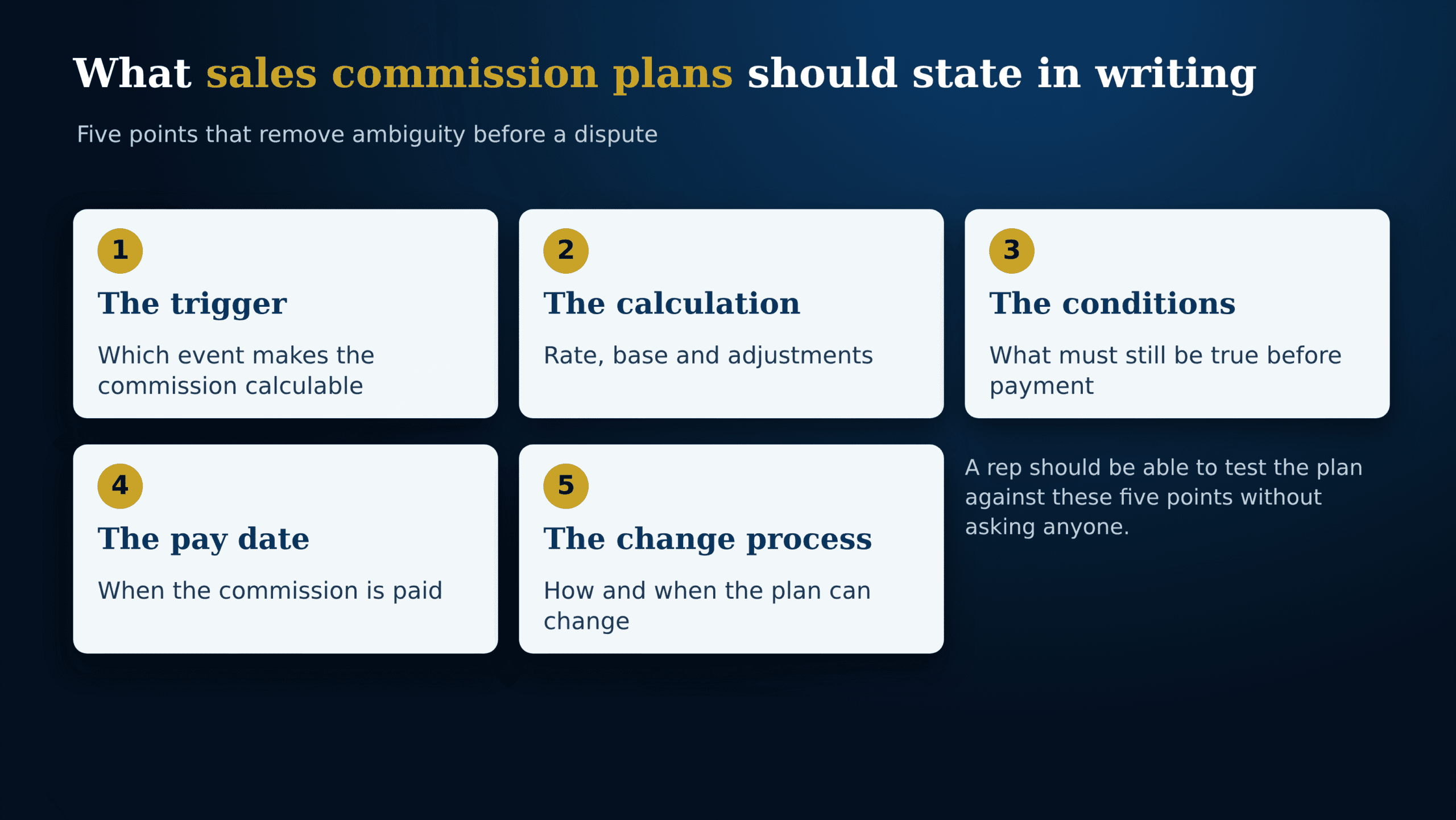
The graphic below groups the same items into the five questions a rep can use to test a plan.
Five things sales commission plans should state in writing: the trigger, the calculation, the conditions, the pay date and the change process
A Worked Example of Sales Commission Plans in Practice
The following is an illustration with made-up round numbers. It is not a statement of what the law requires, and counsel should decide how the Wage Act applies to any real plan.
A company’s plan pays a rep 8 percent of the first-year contract value, calculated when the customer has paid the first invoice and paid on the next regular payroll date. The rep closes a contract with a first-year value of $100,000. The customer signs on March 3 and pays the first invoice on April 20.
Under that plan, the commission of $8,000 is calculable only after April 20, because the plan ties it to the first payment. Before April 20 the amount depends on an event that has not yet happened. After April 20 the amount is fixed and the plan sets the pay date. The plan’s wording about the trigger, not the signature date, tells everyone when the question arises.
Now change one fact. Suppose managers have regularly paid commissions at signature, before the customer pays, whenever a rep asked. The written plan says one thing and the company’s practice says another. The summary of Parker describes how practice can matter even when a written plan says otherwise, so a company in that position needs to decide which version it wants and then make the plan and the practice agree.
The example shows why the plan should name the trigger, and why the company should check that its payroll behavior matches it.
Remote and Out-of-State Reps Under Sales Commission Plans
A Massachusetts company may have salespeople who work from other states. According to a Foley & Lardner analysis published in November 2025, the Wage Act can apply to employees who live and work outside Massachusetts where Massachusetts has the most significant relationship to the employment. The analysis describes a May 2025 Massachusetts Superior Court decision, Dubois v. Staples, and lists factors such as the employer’s headquarters, where the work is done, the employee’s contact with Massachusetts, the strength of another state’s connection and any choice-of-law clause. The analysis presents the choice-of-law clause as one factor among several. Because it describes a trial-court decision, it shows how one court reasoned and does not settle the question for every employer.
For a plan author, the practical consequence is that a Massachusetts company should not assume that a rep in another state falls outside the Massachusetts approach to commissions. Counsel can assess the facts of each rep, including where commission decisions are made and how often the rep works in or with the Massachusetts office.
Sales Commission Plans and Hiring: Why Clarity Helps Recruiting
A plan that is clear about when commissions are earned and paid is easier to recruit against. Experienced salespeople ask about it early, and a company that cannot describe its trigger, its calculation and its pay date from a written plan gives candidates a reason to be cautious.
Candidates commonly want to know:
- when a commission is considered earned;
- whether it depends on customer payment;
- what happens to deals in progress if they leave or the company changes the plan;
- how disputes are resolved; and
- whether the plan has changed in the past year.
Treeline’s guidance on determining sales compensation describes a sequence that starts with margin and budget and ends with the structure of variable pay. The structure of variable pay is where the trigger, the calculation and the timing live, so that step is the part of the sequence that connects most directly to the Wage Act questions in this article.
Fantasia sees a clear written plan as a recruiting asset as much as a legal one. From his perspective, a candidate who reads a plan and can calculate a commission on a sample deal without asking anyone has learned something useful about the company’s discipline.
Common Mistakes in Sales Commission Plans
Calling a commission discretionary when it is formulaic. If the plan calculates the amount by formula, a court is likely to look at the formula and the practice, not the label.
Leaving the trigger vague. “On closing” can mean signature, acceptance, invoice or payment.
Paying exceptions without writing them down. Repeated true-ups can become part of the arrangement.
Changing the plan without notice. A rep who learns of a change after the deal closes has a reasonable complaint.
Ignoring terminations. A plan that is silent on departures leaves the largest disputes to be decided after the relationship has ended.
Forgetting remote reps. A Massachusetts headquarters can matter even when the rep works elsewhere.
Letting managers improvise. An email promise from a manager can carry weight.
Fantasia also points to the cost of leaving these questions unwritten. From his perspective, the sales team reads every ambiguity as a signal about how the company will behave when a large commission is at stake.
Frequently Asked Questions About Sales Commission Plans and the Massachusetts Wage Act
When is a commission a wage under the Massachusetts Wage Act?
According to a Massachusetts Bar Association summary of a 2020 Supreme Judicial Court decision, commissions are contingent and generally count as wages once they are definitely determined and due and payable. Whether that standard is met depends on the facts.
Can company practice change what a written commission plan requires?
According to the same summary, a commission can be owed through company practice even when a written plan with an integration clause says otherwise. In the case it describes, the jury had evidence of an unwritten true-up policy, and the court upheld the verdict.
What does trebling mean for commissions?
Trebling means damages multiplied by three. The summary says commissions not yet due at termination can be treated as lost wages subject to trebling if the employer unlawfully terminated the employee to prevent payment, based on the facts of that case. Counsel should assess any specific situation.
What should a commission plan say about the trigger for payment?
It should name the event that makes the commission calculable, such as booking, invoicing or collection, and any conditions that must still be met. It should also define terms such as revenue, deal and cancellation so that the trigger is unambiguous.
Does the Wage Act apply to a rep who works outside Massachusetts?
It can. A Foley & Lardner analysis from November 2025 says the Wage Act can reach employees who live and work outside Massachusetts where Massachusetts has the most significant relationship to the employment. The analysis describes one trial-court decision, and counsel should review the facts for each rep.
Does a clear commission plan help recruit salespeople?
Yes. Candidates ask how a commission is earned, calculated and paid, and a company that can answer from a written plan is easier to trust than one that answers from memory.
Is this article legal advice?
No. It summarizes what published sources say about the law as of the dates of those sources. A company should ask employment counsel to review its commission plan and any termination involving unpaid commissions.
Share This Story, Choose Your Platform!
Related Posts


What our happy clients are saying
Treeline Inc. provided us with the most candidates that aligned with our needs and were of the highest quality.

Dr. Jeffrey Klein Head of North America Sales, Satchel Pulse
Treeline Inc.’s collaborative, flexible, and communicative approach resulted in a smooth partnership. Beyond their recruitment expertise, their unique sourcing model was efficient and effective.

Sera Holt Director of Operations, LNS Research
Their professionalism was outstanding. Treeline Inc. was extremely thorough and ensured that we were on the same page before they started looking for candidates. They listened to us and did a great job working with the candidate to close out the process.

Cate Grant AVP Customer Success, Nasdaq
Thanks to Treeline Inc.’s intricate and thorough screening process, the company is able to hire six high-quality candidates that fit perfectly in the company’s culture. The team is highly receptive to concerns, and internal stakeholders are impressed with their unique recruitment abilities.

Anna McKean Sales Recruiter, Insider Intelligence
Treeline Inc. has been qualified individuals throughout a five-year-long engagement. They’ve made numerous placements of talented and qualified individuals for our business.

Michele St Laurent VP of HR, The Institute for Applied Network Security

Let Us Help You Source the Sales Talent You Need
Whether you’re building a team or replacing a key role, our Candidate Sourcing Platform provides a fast, flexible, and employer-focused solution.
Tell us more about your business and how we can help.
Treeline Inc.
Your Award-Winning Sales Recruitment Partner
15 Lincoln Street, Suite 314, Wakefield, MA 01880