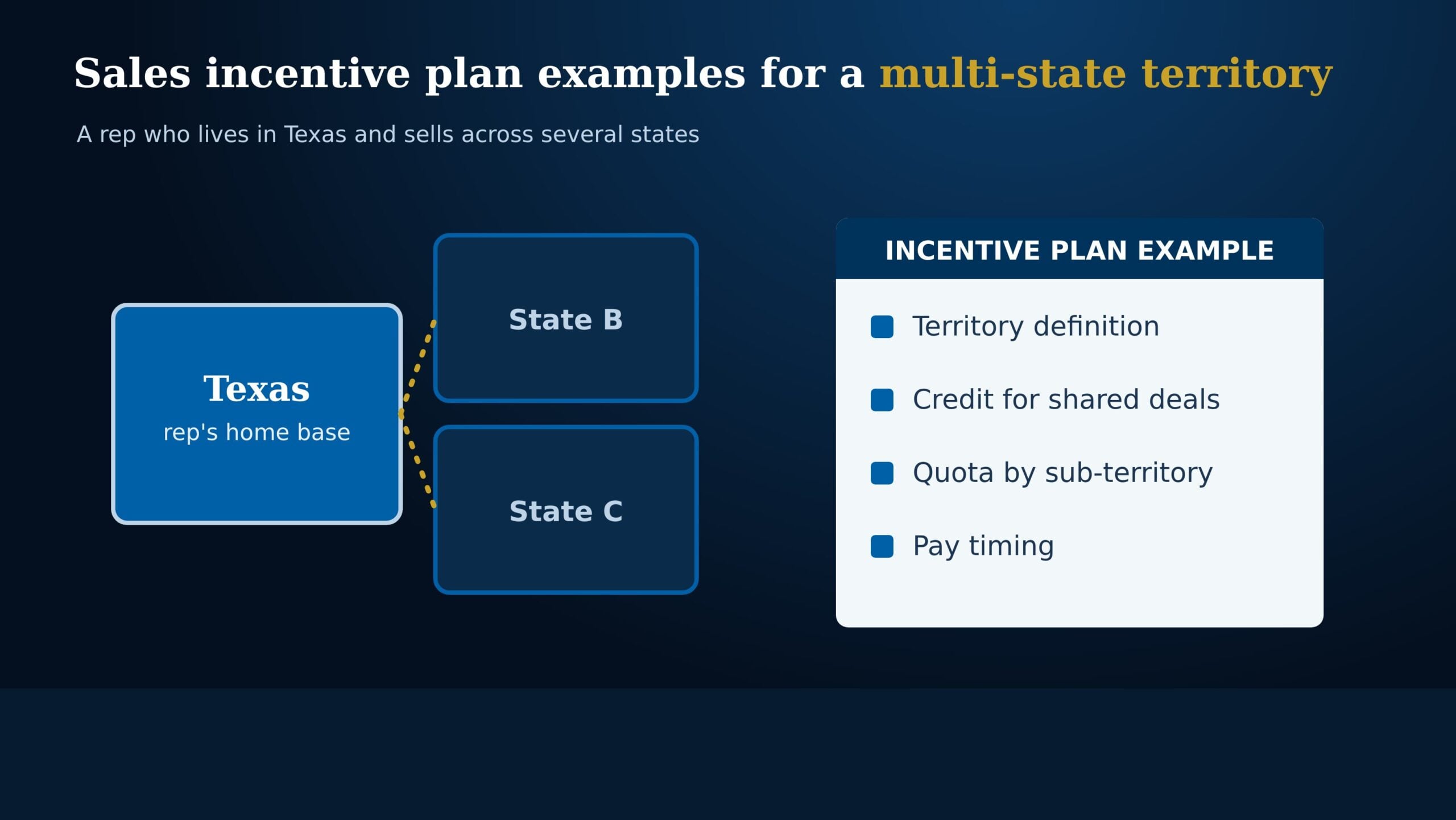
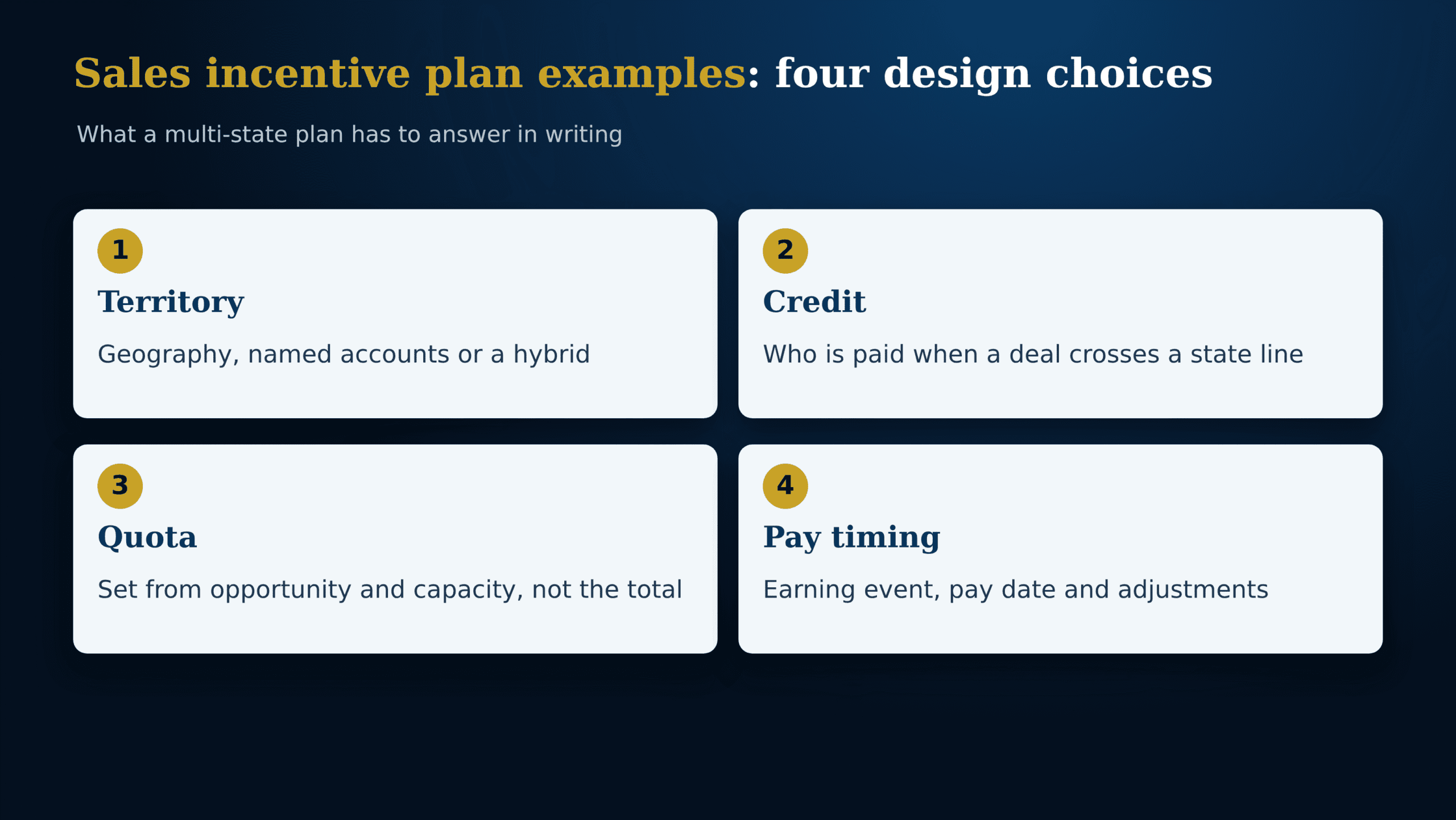
Sales incentive plan examples for a multi-state territory rest on four design choices: how the territory is defined, how deals that cross state lines are credited, how quota reflects the size of each part of the territory, and what the plan says about timing and pay. A rep who lives in Texas and sells in several states can be paid fairly under almost any structure, provided the plan answers those four questions in writing. This guide walks through each choice with illustrative examples. The examples use made-up round numbers and are not benchmarks.
A sales incentive plan is the part of a compensation arrangement that rewards results: commission, bonus, accelerators and any contest or spiff. It sits alongside base pay and the quota that governs it. Treeline’s Sales Compensation Assessment page describes the difference between a compensation plan and an incentive plan, and lists a seven-step plan review. Treeline, Inc. is a sales recruiting firm that places salespeople permanently, and its contingency recruiting service is the way it typically takes on a sales search.
Dan Fantasia, CEO of Treeline, Inc., views the multi-state territory as the place where an incentive plan stops being generic. From his perspective, a plan that is fair in a single office can feel arbitrary to a rep who covers several states alone, because the rep cannot see how the company resolves the questions that arise at the borders of the territory.
Why Multi-State Territories Strain Sales Incentive Plan Examples
Most published sales incentive plan examples assume a rep with one clearly defined territory, such as a city, a named list of accounts or a single state. A multi-state territory breaks several of those assumptions.
- Accounts straddle borders. A customer may be headquartered in one state, buy for a site in another and have its contract signed in a third.
- Territory potential varies. One state may hold most of the opportunity, and another may hold a few large accounts.
- Travel is part of the job. Time spent in the car or on a plane affects how many accounts a rep can cover.
- Different people support different states. An inside team, a sales engineer or a channel partner may serve some states and not others.
- Payroll and legal questions multiply. The rules that apply to pay can depend on where the rep lives and where the work is done.
None of this requires an exotic plan. It requires a plan that says, in advance, how each of those situations will be handled.
A Texas-based starting point
For a rep who lives in Texas, the home state matters for one reason: it is where the rep works when not traveling, and so it is where wage law and payroll are likely to be anchored. According to a guide published by the sales-compensation software company Everstage and updated in September 2026, Texas treats earned commissions as wages under the Texas Payday Law, and whether a commission is earned depends on the earning conditions in the written plan. That is a vendor’s summary, not a statute or a court opinion, and a company should ask employment counsel to confirm how Texas and any other relevant state apply to its plan.
The practical point is the one the guide itself makes: the written plan carries the weight. A multi-state plan that leaves the earning event vague invites a dispute in every state.
Sales Incentive Plan Examples for Defining the Territory
The first design choice is the territory definition. There are three common approaches, and each suits a different kind of business.
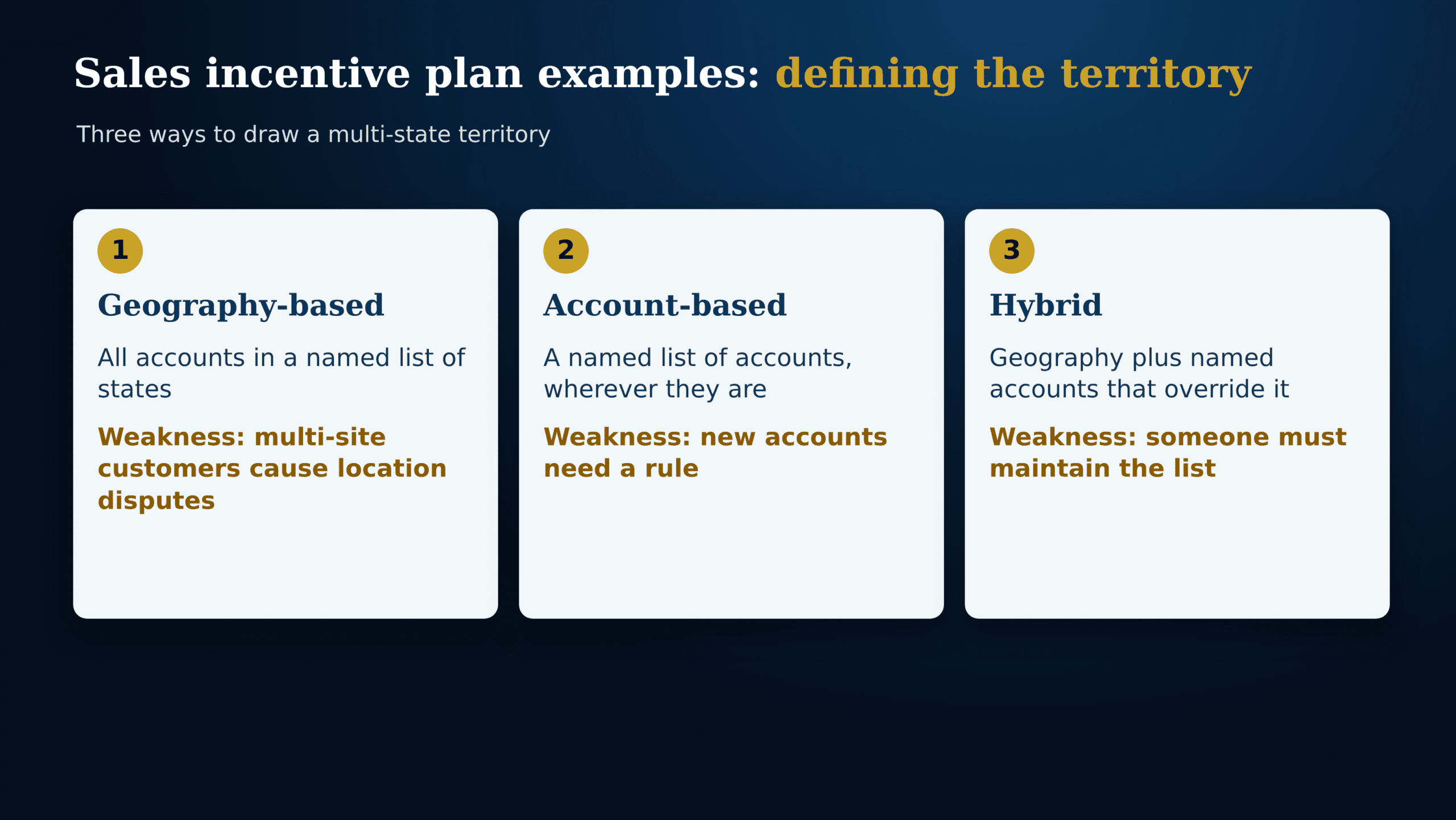
Example 1: Geography-based territory
The rep owns every account located in a named list of states. The plan lists the states and says how an account’s location is decided, for example by the customer’s headquarters address or by the address on the order.
- Strength: Simple to explain and administer.
- Weakness: Large customers with sites in several states create disputes about which location counts.
- Use when: Customers are mostly single-site and the sales effort is local.
Example 2: Account-based territory
The rep owns a named list of accounts, wherever they are. The list can include accounts in different states and can be updated at defined times.
- Strength: Removes location disputes for named accounts.
- Weakness: New accounts that are not on the list need a rule.
- Use when: The company sells to a defined set of larger customers.
Example 3: Hybrid territory
The rep owns a geography plus a short list of named accounts that cross borders. The plan lists the named accounts and says that they override the geographic rule.
- Strength: Handles the awkward cases without complicating the rest.
- Weakness: Someone has to maintain the list.
- Use when: Most customers are local and a few are not.
The graphic below sets the three approaches side by side.
Three sales incentive plan examples for defining a multi-state territory: geography-based, account-based and hybrid, each with a strength and a weakness
Whichever approach is chosen, the plan should say who decides when the rule is unclear and how quickly. A territory dispute that sits unresolved for a quarter is a morale problem even if the rep is eventually paid correctly.
Fantasia sees the hybrid approach as the most honest one. In his view, most companies have a few accounts that do not fit the geography, and a plan that names them is better than a plan that pretends they do not exist.
How Sales Incentive Plan Examples Credit Deals That Cross State Lines
Crediting is the second design choice, and the one that causes the most arguments. The plan has to say whose deal it is when more than one person touched it.
Common crediting rules include:
- Credit by customer headquarters. The rep who owns the state where the customer is headquartered gets the credit.
- Credit by ship-to or service location. The rep who owns the state where the product is delivered or used gets the credit.
- Credit by relationship. The rep who owns the relationship with the buyer gets the credit, regardless of where the buyer sits.
- Split credit. Two or more reps share the credit by a stated percentage.
- Primary and overlay. One rep receives full credit and a specialist or support role receives a smaller overlay credit.
An illustrative split
Suppose a customer is headquartered in a state owned by Rep A and has a site in a state owned by Rep B. The customer signs a contract worth $100,000 in first-year value. The plan could say:
- Rep A, who owns the relationship with the buyer, receives 70 percent of the credit.
- Rep B, who supports the site rollout, receives 30 percent.
Under a commission rate of 8 percent, Rep A would earn $5,600 and Rep B $2,400, totaling the same $8,000 the company would pay a single rep. The numbers are an illustration only. The point is that the split is stated before the deal, adds up to 100 percent and does not cost the company more than a single credit would.
Avoid double credit by accident
A frequent mistake is to give full credit to two reps. The plan can allow it deliberately, as an overlay, but the company should know what it costs. Treeline’s guidance on determining sales compensation describes setting a total compensation budget as a share of margin; double credit changes that share without anyone deciding to change it.
Setting Quota in Sales Incentive Plan Examples for Multiple States
The third design choice is quota. A rep who covers several states needs a quota that reflects the opportunity in each, not simply a total.
Example: Weighted quota by sub-territory
The company divides the multi-state territory into parts and sets a target for each based on the opportunity it sees there. The rep’s total quota is the sum. The plan may pay commission on the total, or it may pay on each part separately.
- Paid on the total: The rep can shift effort toward the best opportunities. A weak part of the territory does not reduce pay if another part overperforms.
- Paid on each part: The company can steer effort to a priority state, but the rep may feel penalized for a part of the territory they cannot control.
Example: One quota with a priority account list
The rep has a single quota and a short list of priority accounts that carry a higher commission rate. The structure steers effort without complicating the territory.
Quota and travel
A territory that requires heavy travel affects capacity. A company that sets a multi-state quota as if the rep were covering a single metro area is setting a target that the rep cannot reach without working a different job. The company should ask how many accounts a ramped rep can cover in a quarter and set quota from that capacity. Treeline’s seven-step sequence starts with margin and ends with the structure of variable pay, with quota set in the middle; capacity is the check on whether the quota is realistic.
Fantasia treats quota as the number that tells a rep whether the company understands the territory. From his perspective, a rep who receives a quota that ignores travel and market size concludes that the territory was drawn on a map rather than studied.
Pay Timing and Terms in Sales Incentive Plan Examples
The fourth design choice is when and how pay is calculated. For a multi-state rep, the plan should state:
- The earning event. Booking, invoicing, collection or another milestone.
- The payment date. The payroll date or interval after the event.
- Adjustments. How cancellations, returns and credits are handled.
- Accelerators. Whether rates rise after the quota is met, and whether the rise applies to the whole territory or to specific parts.
- Changes. When and how the plan can be altered, and how the rep is told.
- Departure. What happens to commissions on deals that closed or were in progress when the rep left.
A plan that names these terms clearly is easier for a rep in another state to rely on. Written terms also help a company manage a situation where several states’ rules may touch one rep.
Payroll and tax are separate questions
Pay design is not the same as payroll compliance. An Anders CPAs guide to multi-state payroll, published in 2025, says payroll taxes are generally based on where the employee works, not where the business is located, though state laws can create exceptions, and that withholding rules and reciprocity agreements vary by state. A rep who lives in Texas and works in other states for part of the year may create withholding and registration questions in those states. The company’s payroll provider or tax adviser should answer them, and the incentive plan should not try to.
A Worked Example: One Rep, Three States
The following illustration uses made-up round numbers. It is a teaching example, not a recommended structure or a benchmark.
A rep lives in Texas and covers Texas, and two neighboring states. The company uses a hybrid territory: all accounts headquartered in the three states, plus two named accounts headquartered elsewhere that the rep has managed for years.
- Quota: $1,200,000 for the year, set from a weighting of the opportunity in each state and the capacity of one rep.
- Commission: 8 percent on collected first-year revenue up to quota, rising to 12 percent above quota.
- Credit: Accounts credited by customer headquarters, with a 70/30 split to a second rep when a site rollout is supported by that rep’s territory.
- Payment: Commission is calculated after the customer pays the first invoice and is paid on the next regular payroll date.
If the rep collects $1,000,000 in the year, the commission is $80,000 at 8 percent. If the rep collects $1,400,000, the commission is $96,000 on the first $1,200,000, plus $24,000 at 12 percent on the $200,000 above quota, for a total of $120,000. Those figures are arithmetic on invented numbers, not a statement of what such a plan typically pays.
The example illustrates three points. First, the plan is short enough to state in a paragraph. Second, the territory, credit rule and timing are all written down. Third, a rep could calculate the commission on a hypothetical deal without asking anyone.
Common Mistakes in Multi-State Sales Incentive Plan Examples
Setting quota from the total, not the territory. A target that ignores the size of each part of the territory feels arbitrary.
Leaving credit rules for later. Disputes arise at the first cross-border deal.
Paying double credit without meaning to. The cost appears in the budget before anyone decides to accept it.
Ignoring travel. A territory that cannot be covered in the time available produces a missed quota that is not the rep’s fault.
Copying a plan from a different business. Published sales incentive plan examples show structures, not the numbers that suit a particular company.
Mixing pay design with payroll compliance. The plan should state the pay terms, and payroll and tax advisers should handle withholding.
Hiring a Multi-State Rep: How the Plan Affects Recruiting
A candidate considering a role that covers several states will ask questions about the plan before accepting. They will want to know how the territory is defined, how crediting works, how quota was set and whether the company has hired for this role before. A written plan that answers these questions in plain language makes the role easier to fill.
Treeline’s locations page presents the firm as recruiting across the United States, which matters for a company whose best candidate may live outside the territory’s center. Its Sourcing as a Service offering and its fractional CRO service are two other ways Treeline describes helping with sales hiring and sales leadership. The fractional CRO page describes an ongoing engagement that covers areas such as pipeline reviews, coaching and reporting.
Fantasia regards a clear plan as part of the recruiting offer. In his view, senior candidates read the plan as evidence of how the company thinks about its sellers, and a plan that anticipates the awkward cases signals a company that has thought about the job.
A Checklist for Multi-State Sales Incentive Plan Examples
Use this list when drafting or reviewing a plan for a rep who covers several states.
- Define the territory. Geography, named accounts or a hybrid. Say how a location is decided.
- Name the crediting rule. Headquarters, ship-to, relationship, split or overlay. Make the percentages add up to 100 percent unless an overlay is intended.
- Set quota from capacity and opportunity. Consider travel, the size of each part of the territory and the pipeline the rep inherits.
- Choose the commission structure. Rate, tiers and accelerators, and whether they apply to the total or to each part.
- State the earning event and pay date.
- Write down adjustments. Cancellations, returns and credits.
- Describe how the plan can change. Who decides, how much notice and from what date.
- Cover departure. What happens to deals in progress.
- Review with counsel and payroll. Ask which states’ rules apply and how withholding is handled.
- Reassess. Treeline’s assessment page suggests reviewing a new plan at 90 days.
The graphic below summarizes the four core choices.
Four design choices in multi-state sales incentive plan examples: territory, credit, quota and pay timing
Frequently Asked Questions About Sales Incentive Plan Examples
What are sales incentive plan examples?
They are sample structures that show how a company pays sellers for results, such as a commission on collected revenue, tiered rates, accelerators above quota or bonuses for specific goals. The examples in this guide use invented numbers and are for illustration only.
How should a plan define a territory that spans several states?
Choose geography, named accounts or a hybrid, and say how a customer’s location is decided. A hybrid, with a short list of named accounts that override the geographic rule, handles the awkward cases most simply.
How are deals credited when they cross state lines?
Common rules credit by customer headquarters, by ship-to location, by relationship, by a stated split or by a primary-and-overlay arrangement. The plan should state the rule in advance and make the percentages add up to the intended total.
Should quota be set for the whole territory or each state?
It should reflect the opportunity and the rep’s capacity in each part, whether it is paid on the total or on each part. A quota that ignores travel and market size is likely to feel arbitrary.
Does Texas treat commissions as wages?
A September 2026 guide from a sales-compensation software company says Texas treats earned commissions as wages under the Texas Payday Law, and that the written plan’s earning conditions matter. That is a vendor’s summary, and a company should confirm the position with employment counsel.
Who handles payroll and tax for a rep who sells in several states?
The company’s payroll provider or tax adviser. One 2025 guide says payroll taxes are generally based on where the employee works and that state rules and reciprocity agreements vary. The incentive plan should state the pay terms and leave withholding to payroll.
When should a new multi-state plan be reviewed?
Treeline’s assessment page suggests reassessing a new plan at 90 days. That gives time to see how the territory, credit rules and quota work in practice.
Share This Story, Choose Your Platform!
Related Posts

What our happy clients are saying
Treeline Inc. provided us with the most candidates that aligned with our needs and were of the highest quality.

Dr. Jeffrey Klein Head of North America Sales, Satchel Pulse
Treeline Inc.’s collaborative, flexible, and communicative approach resulted in a smooth partnership. Beyond their recruitment expertise, their unique sourcing model was efficient and effective.

Sera Holt Director of Operations, LNS Research
Their professionalism was outstanding. Treeline Inc. was extremely thorough and ensured that we were on the same page before they started looking for candidates. They listened to us and did a great job working with the candidate to close out the process.

Cate Grant AVP Customer Success, Nasdaq
Thanks to Treeline Inc.’s intricate and thorough screening process, the company is able to hire six high-quality candidates that fit perfectly in the company’s culture. The team is highly receptive to concerns, and internal stakeholders are impressed with their unique recruitment abilities.

Anna McKean Sales Recruiter, Insider Intelligence
Treeline Inc. has been qualified individuals throughout a five-year-long engagement. They’ve made numerous placements of talented and qualified individuals for our business.

Michele St Laurent VP of HR, The Institute for Applied Network Security

Let Us Help You Source the Sales Talent You Need
Whether you’re building a team or replacing a key role, our Candidate Sourcing Platform provides a fast, flexible, and employer-focused solution.
Tell us more about your business and how we can help.
Treeline Inc.
Your Award-Winning Sales Recruitment Partner
15 Lincoln Street, Suite 314, Wakefield, MA 01880