Sales compensation changes in a handful of specific places when a Boston company hires its first remote sales rep, and most of the plan stays exactly as it was. The commission structure, the quota method and the way deals are credited can all remain the company’s own. What has to be reconsidered is the pay level, the definition of the territory, the legal rules that apply to a person who lives and works somewhere else, and the written terms that tell the rep how all of it works. This guide walks through each of those decisions in the order a hiring manager meets them.
The question usually arrives at an awkward moment. A founder or sales leader has been selling from the Boston office, a strong candidate lives in another state, and the offer conversation reaches pay before anyone has decided how a remote hire fits the plan. Treeline’s Sales Compensation Assessment page describes a seven-step review of a plan, and the same logic applies here: decide what the plan is meant to reward before deciding what to change for one person. If the hire is a permanent sales role, Treeline’s contingency recruiting service is the way the firm sources and screens candidates for it.
Dan Fantasia, CEO of Treeline, Inc., views a first remote hire as a test of whether the plan was ever written down clearly. From his perspective, a plan that worked in the Boston office because everyone understood it informally will fail for a rep who cannot overhear the explanation, and the fix is to make the plan explicit before the offer is made rather than after the first disputed commission.
What Sales Compensation Means for a Remote Rep
Sales compensation is the full pay arrangement for a sales role: base salary, variable pay such as commission or bonus, the quota or target that governs the variable pay, and the rules that decide when a sale counts. For an in-office rep, many of those rules are carried by conversation. A new hire sits near a manager, hears how a disputed deal was resolved and absorbs the unwritten rules within a few weeks.
A remote rep has none of that. Every rule that was informal becomes a question the rep will ask over email or video, usually at the moment it matters most: when a deal closes and the rep wants to know what it is worth. This is the real change. The pay design may not need to be different, but the explanation has to be complete.
It helps to separate three layers before changing anything.
- The plan design. How commission is calculated, what the quota is, whether there are accelerators or a draw. This usually applies to every rep in the same role.
- The individual terms. Base salary, on-target earnings, the territory, the start date and any ramp period. These are set per person.
- The legal and administrative frame. Which state’s wage rules apply, how payroll handles a rep in another state, and how disputes are resolved. These are set by facts about where the rep lives and works.
A remote hire touches the second and third layers far more than the first. Companies that try to redesign the whole plan for one hire usually create a bigger problem than the one they set out to solve: the next rep, in the Boston office, asks why the remote rep has a different deal.
Which Sales Compensation Terms Stay Tied to the Boston Office
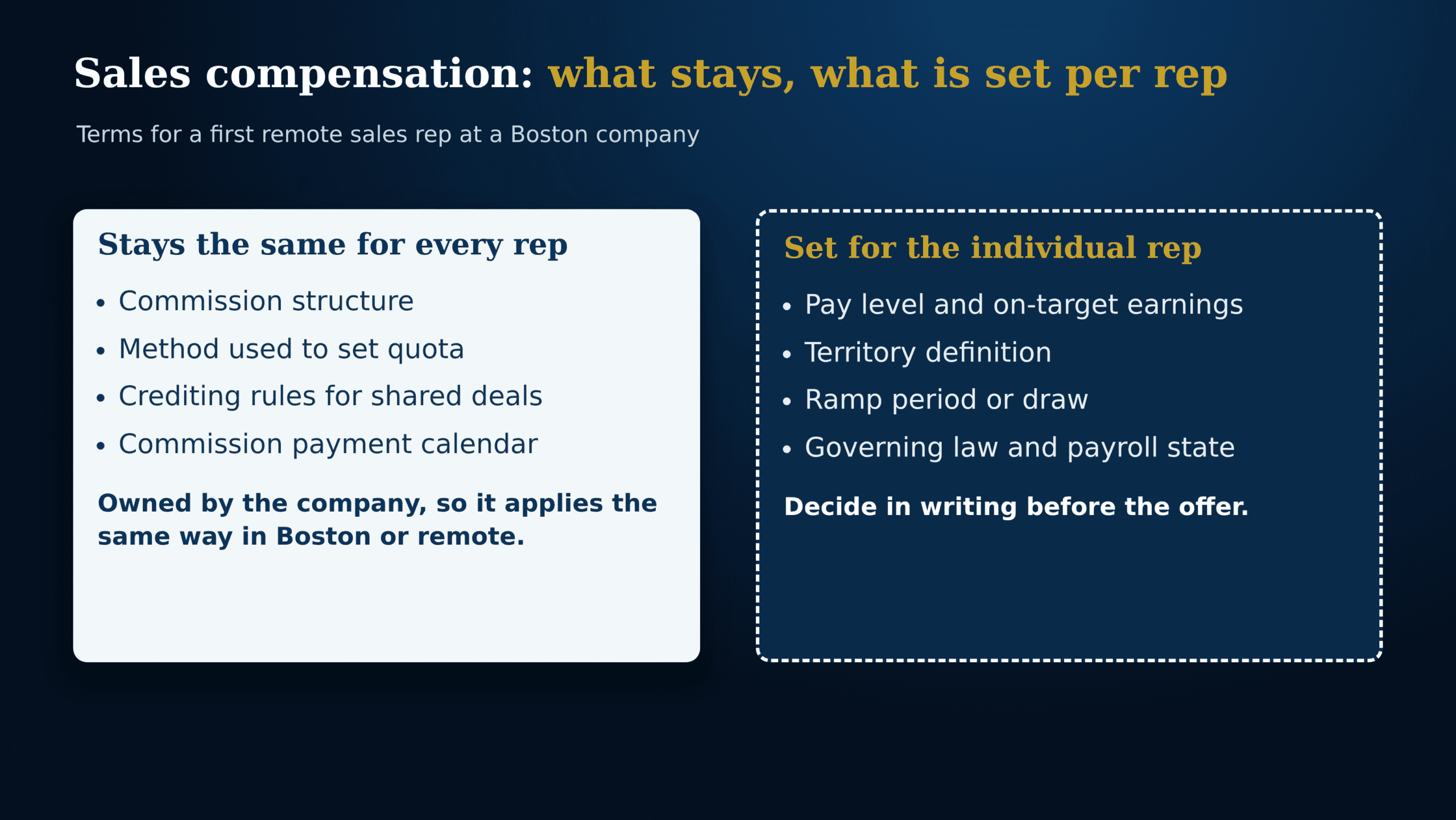
The simplest way to avoid redesigning the plan is to decide in advance what stays the same for every rep regardless of location. Some terms are tied to the business, not to where a person sits. The comparison below sorts the terms into those that stay with the company and those that are set for the individual rep.
Two-column comparison of sales compensation terms that stay the same for every rep and terms set for a remote rep
The commission structure
How commission is calculated, the rate or the tiers, whether there is a cap, and whether the rate rises after the quota is exceeded all describe how the company shares revenue with the people who produce it. A remote rep selling the same product to the same type of buyer should be paid on the same structure. Changing the structure for a remote hire sends the message that the plan is negotiable by location, and the negotiation starts again at every hire.
The quota method
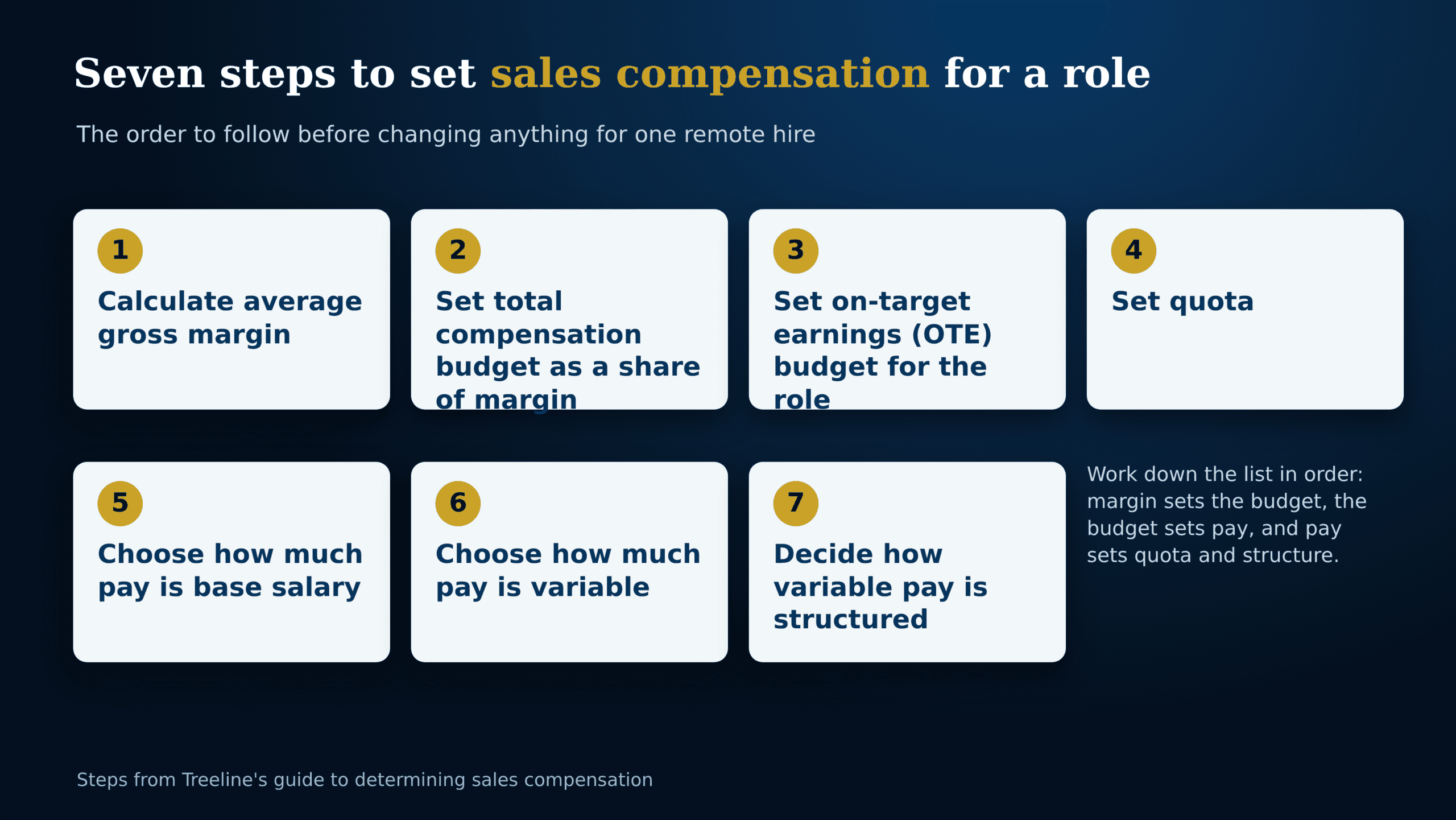
The method used to set quota belongs to the business, even if the quota number differs by territory. If the company sets quota by looking at territory potential and the capacity of a ramped rep, the remote rep’s quota should be built the same way. Treeline’s own guidance on determining sales compensation walks through setting a total compensation budget, the on-target earnings for a role, and then quota, in that order. A quota that is chosen first and fitted to the pay afterward is the most common reason a plan feels unfair to a new rep.
Crediting rules
The rules that decide who gets credit when a deal involves more than one person should be identical for remote and Boston-based reps. If a sales engineer, a Boston-based manager or an inside rep helps close a deal, the credit split should be in the plan, not decided case by case. A remote rep cannot see how those decisions are made and will assume the worst when a credit is reduced without explanation.
The company’s payment calendar
When commissions are calculated, approved and paid is a company process. A remote rep needs to know the dates, what triggers payment, and how a commission is treated if a customer pays late or cancels. The calendar should be written in the plan, not described in an onboarding call.
Fantasia sees these shared terms as the part of the plan that protects the company. In his view, the more the remote rep’s plan looks like everyone else’s plan, the less there is to defend later, and the easier it is to hire the second and third remote reps.
How Sales Compensation Is Set for a Rep Outside the Home Market
The pay level is the term most likely to change, and it is the one with the weakest rules of thumb. Whether a remote rep’s base salary and on-target earnings should be the same as a Boston-based rep’s, or should reflect the rep’s local market, is a company policy decision. There is no standard answer, and this guide does not supply a number.
What the company can do is choose a policy and apply it consistently. Three approaches are common in practice.
- One national pay level for the role. Every rep in the role has the same base and on-target earnings. This is the easiest to administer and explain, and it removes a negotiation, but it may cost more than a local market requires in some places and fall short in others.
- Pay set by the rep’s market. Base and on-target earnings are adjusted by a published formula tied to location. This can be fair, but it requires the company to maintain the formula and defend it when a rep moves.
- Pay set by the individual offer. Each hire is negotiated. This is the most flexible and the hardest to keep consistent over time.
The graphic below follows the seven steps in Treeline’s guidance on determining sales compensation, from average gross margin to the structure of variable pay.
Seven numbered steps for setting sales compensation, from average gross margin to the structure of variable pay
Whichever policy the company chooses, the part that matters most for a first remote hire is that the policy exists before the offer. A company that makes the first remote offer without a policy is in effect writing one, and the next candidate will ask what the first rep was paid.
Base salary versus variable pay
For a remote rep, the split between base and variable pay carries extra weight. Treeline’s guidance on determining sales compensation treats the base and variable split as a deliberate choice that depends on the type of sale. A rep who sells alone, with no local support and a long sales cycle, may need a higher base to be able to commit to the role than a rep who joins a busy office. This is a judgment about the sale, not about geography, and it applies whether the rep is remote or not. The remote hire simply forces the question into the open.
Ramp and draw
A remote rep takes longer to find out where to look for help. If the company normally gives a new rep a ramp period at reduced quota, or a draw against future commission, it should decide whether a remote rep gets the same ramp, and say so in the offer. Treat the draw as a term to define in writing rather than a default to assume.
Fantasia treats the pay-level policy as a decision about the next hire as much as the current one. From his perspective, a company that picks a policy it can explain to the second remote candidate has avoided the most common source of resentment in a distributed sales team.
Territory and Quota: Where Sales Compensation Gets Specific
A remote rep needs a territory, and the territory definition is where the plan stops being generic. A Boston-based rep may share accounts with a colleague down the hall and settle overlaps in conversation. A remote rep covering another region cannot.
The territory definition should answer four questions in writing.
- What accounts or geography are included? Name them. A list of states, a list of named accounts or a segment definition all work, but the definition has to be unambiguous.
- What happens to deals that cross the line? If a customer headquartered in the rep’s territory buys for a site in a Boston rep’s territory, say which rep is credited.
- Who can change the territory, and how? A territory that can be altered without notice is a pay cut waiting to be explained.
- What happens if the territory is reduced mid-year? The plan should say whether quota is adjusted and how.
A territory that moves the rep outside the Boston office’s usual market also raises a hiring question. The company is asking one person to build business in a place where it may have no existing relationships, so the quota should reflect that reality. Setting a Boston-sized quota for a territory with no pipeline is the fastest way to lose a first remote hire in the first year.
Legal Rules That Affect Sales Compensation for Out-of-State Reps
This section describes how a court has approached one legal question. It is not legal advice, and a company hiring its first rep in another state should speak to employment counsel before the offer is made.
The question is whether Massachusetts wage law reaches a rep who lives and works in another state. According to a Foley & Lardner analysis published in November 2025, the Massachusetts Wage Act can apply to employees who live and work outside Massachusetts where Massachusetts has the most significant relationship to the employment. The analysis describes a May 2025 Massachusetts Superior Court decision, Dubois v. Staples, which applied the Wage Act to a remote employee who lived, worked and was paid in Rhode Island and managed a New York territory.
The analysis lists the factors a court considers:
- where the employer is headquartered;
- where the employee performed the work;
- how often and in what way the employee interacted with the employer in Massachusetts;
- whether another state has a stronger connection to the work; and
- any choice-of-law clause in the employment agreement.
The analysis notes that the court in that case relied on Massachusetts connections such as a Massachusetts-headquartered employer, regular trips to the Massachusetts office, a period covering a Massachusetts territory, bonus decisions made in Massachusetts, and a Massachusetts choice-of-law clause. It also says that a choice-of-law clause is one factor among several rather than a controlling answer. Because it was a trial-court decision, it describes how one court reasoned; it does not settle the question for every remote employee.
For a Boston company, the practical meaning is limited but real. Having a headquarters in Massachusetts is one of the facts that points toward Massachusetts law, and the other factors depend on how the remote rep actually works. A company cannot assume that hiring in another state moves the rep’s pay disputes out of Massachusetts, and it cannot assume the opposite either. The rep’s home state may have its own rules on commission payment, final pay and written agreements, and those rules vary by state.
Three practical steps follow from this without needing a legal conclusion:
- Put the commission terms in a signed written agreement that states the rules of earning and payment clearly.
- Decide, with counsel, which state’s law the agreement should name, and understand that the choice is one factor, not the whole answer.
- Record where decisions about the rep’s commission are made, since the analysis lists that as a factor.
Writing the Sales Compensation Plan Down for a Remote Rep
A written plan is the single most useful thing a company can do for a first remote hire. The document should be complete enough that the rep can calculate their own commission on a hypothetical deal without asking anyone.
A remote rep’s plan document should cover:
- The role and reporting line. Title, manager, and how often they will meet.
- The pay components. Base salary, target variable pay, how on-target earnings are defined, and how often pay is issued.
- The quota. The number, the period it covers, and how it was set.
- The commission calculation. The rate or tiers, what counts as revenue, whether bookings or collected cash trigger the commission, and a worked example using a hypothetical deal.
- Crediting. Who gets credit when more than one person works a deal, and who decides disputes.
- Territory. The definition and the rules for changing it.
- Timing. When commissions are calculated, approved and paid.
- What happens at departure. How earned and unearned commission is handled if the rep leaves or is terminated.
- Governing law and dispute handling. Drafted with counsel.
A worked example is the part most plans leave out and the part reps value most. It forces the plan’s author to test the plan against a real deal, and it exposes ambiguities before they become disputes. The example should use a made-up deal with round numbers, clearly labeled as an illustration.
Restrictive covenants are a separate document
A non-compete or non-solicit agreement is not part of the plan. Massachusetts has a statute that governs non-competes for employees, and a remote rep who lives elsewhere may be covered by a different state’s rules. Keep the covenant in its own agreement, review it with counsel, and do not use the compensation plan to carry restrictions that the rep should be able to evaluate separately.
Sales Compensation Mistakes in a First Remote Hire
The same mistakes show up repeatedly when a company hires its first rep outside the office.
Copying the Boston plan without testing it. A plan that rewards the busy Boston pipeline may pay a remote rep very little in the first six months, because the remote rep is building a territory from nothing. The company then wonders why the rep is leaving, and the rep has an easy answer.
Overpaying to close the candidate. A large base or a guaranteed commission can win the offer and then set a precedent the company cannot afford to repeat. If the candidate needs more security, a time-limited draw with clear terms is easier to explain and unwind than a permanently higher base.
Leaving the territory vague. A territory that is described as “the Southeast” without naming accounts or states gives both sides room to disagree.
Treating the remote rep as a one-off. The company will probably hire more than one remote rep. A plan written only for the first becomes a pile of exceptions by the third.
Skipping the manager’s role. A remote rep needs a defined rhythm of contact with their manager. If the plan promises coaching or deal support that the Boston team cannot deliver at a distance, the rep will notice immediately.
Fantasia tends to frame these mistakes as the cost of treating a hire as an exception instead of a design decision. From his perspective, a first remote hire is the right moment to ask whether the plan can survive being applied to a second, a third and a fifth rep, because that is the question the next hire will force.
How Sales Compensation Shapes Recruiting a Remote Sales Rep
Senior and experienced sales candidates look at the plan before they look at almost anything else, and a remote candidate has fewer ways to judge a company than someone who visits the office. The plan is the main evidence of how the company treats its sellers.
A candidate considering a remote role will usually want to understand:
- how quota was set and whether other reps are meeting it;
- how commission is calculated and when it is paid;
- who decides disputes and how;
- what support the role gets from a manager and from the Boston team; and
- what happens to the territory and the commission if the company changes strategy.
A company that can answer these questions from a written plan is easier to hire for. A company that answers them from memory, or says the plan is “being worked out”, gives candidates a reason to keep looking. This is also why it is worth settling the plan before starting a search, rather than leaving it to be negotiated candidate by candidate.
Treeline’s work is permanent sales placement. Its Sourcing as a Service offering and its contingency service are two ways a company can find candidates, and the firm’s fractional CRO service is described on its site as an ongoing engagement that can support plan design and sales leadership. The firm’s locations page describes a nationwide recruiting reach, which matters for a Boston company whose best candidate may not live near Boston.
Fantasia notes that candidates read the plan as evidence of how a company treats sellers. In his view, a clear written plan is one of the few things a remote candidate can examine directly before accepting, which makes it part of the recruiting pitch.
A Checklist for Setting Sales Compensation for Your First Remote Rep
Use this sequence when the offer is still open.
- Decide the pay policy. National level, local market or individual offer. Write it down.
- Set the budget. Work out what the role can cost relative to the margin it produces, then set on-target earnings and quota in that order.
- Confirm the split. Decide the base and variable mix based on the type of sale, not on the rep’s location.
- Define the territory. Name the accounts or geography and the rules for overlap and change.
- Draft the plan document. Include a worked example and the payment calendar.
- Review with counsel. Ask which state’s rules apply, how the governing-law clause should read, and how the restrictive covenants should be handled.
- Agree the manager’s role. Set the meeting rhythm and what support the rep can expect.
- Plan the reassessment. Treeline’s assessment page suggests reviewing a new plan at 90 days. Put a date in the calendar for the same review.
Frequently Asked Questions About Sales Compensation for a First Remote Sales Rep
Should a remote sales rep be paid the same as a Boston-based rep?
There is no standard answer. The company needs a pay policy: one national level, pay set by the rep’s market, or pay set by the individual offer. The most important rule is to choose the policy before making the first remote offer and apply it to later hires.
Does Massachusetts law apply to a remote sales rep who lives in another state?
It can. A Foley & Lardner analysis published in November 2025 says the Massachusetts Wage Act can reach employees who live and work outside Massachusetts where Massachusetts has the most significant relationship to the employment, and it lists factors such as the employer’s headquarters, where the work is done and any choice-of-law clause. This is a description of one court’s approach, not legal advice, and employment counsel should review the facts.
What parts of the sales compensation plan should stay the same for a remote rep?
The commission structure, the method used to set quota, the crediting rules and the payment calendar should normally stay the same for every rep in the role. Pay level, territory and ramp terms are the parts most likely to change for an individual hire.
What should a remote rep’s sales compensation plan document include?
It should cover the role, base and variable pay, the quota, the commission calculation with a worked example, crediting rules, the territory, payment timing, what happens at departure and the governing law. The test is whether the rep can calculate their own commission on a hypothetical deal.
How should a company handle a draw for a first remote hire?
Define it in writing if it is offered. State the amount, how long it lasts, how it is recovered against commission and what happens if the rep does not earn enough to repay it. A time-limited draw with clear terms is easier to explain than a permanently higher base.
Is a non-compete part of the sales compensation plan?
No. A restrictive covenant should be a separate agreement reviewed with counsel, because a remote rep may be covered by a different state’s rules than a rep in the Boston office.
When should the plan be reviewed after the first remote rep starts?
Treeline’s assessment page suggests reassessing a new plan at 90 days. That gives the company time to see how the territory, quota and commission calculation work in practice and to correct problems before the next hire.
Share This Story, Choose Your Platform!
Related Posts



What our happy clients are saying
Treeline Inc. provided us with the most candidates that aligned with our needs and were of the highest quality.

Dr. Jeffrey Klein Head of North America Sales, Satchel Pulse
Treeline Inc.’s collaborative, flexible, and communicative approach resulted in a smooth partnership. Beyond their recruitment expertise, their unique sourcing model was efficient and effective.

Sera Holt Director of Operations, LNS Research
Their professionalism was outstanding. Treeline Inc. was extremely thorough and ensured that we were on the same page before they started looking for candidates. They listened to us and did a great job working with the candidate to close out the process.

Cate Grant AVP Customer Success, Nasdaq
Thanks to Treeline Inc.’s intricate and thorough screening process, the company is able to hire six high-quality candidates that fit perfectly in the company’s culture. The team is highly receptive to concerns, and internal stakeholders are impressed with their unique recruitment abilities.

Anna McKean Sales Recruiter, Insider Intelligence
Treeline Inc. has been qualified individuals throughout a five-year-long engagement. They’ve made numerous placements of talented and qualified individuals for our business.

Michele St Laurent VP of HR, The Institute for Applied Network Security

Let Us Help You Source the Sales Talent You Need
Whether you’re building a team or replacing a key role, our Candidate Sourcing Platform provides a fast, flexible, and employer-focused solution.
Tell us more about your business and how we can help.
Treeline Inc.
Your Award-Winning Sales Recruitment Partner
15 Lincoln Street, Suite 314, Wakefield, MA 01880