Remote SaaS Account Executive Sales Recruiting should help SaaS employers identify Account Executives, often called AEs, who can sell subscription products through long, complex, multi-stakeholder buying cycles. The goal is not simply to hire a remote salesperson. The goal is to hire a SaaS sales professional who can create qualified pipeline, manage business and technical stakeholders, build urgency around recurring value, protect forecast accuracy, and close subscription revenue without daily office-based oversight.
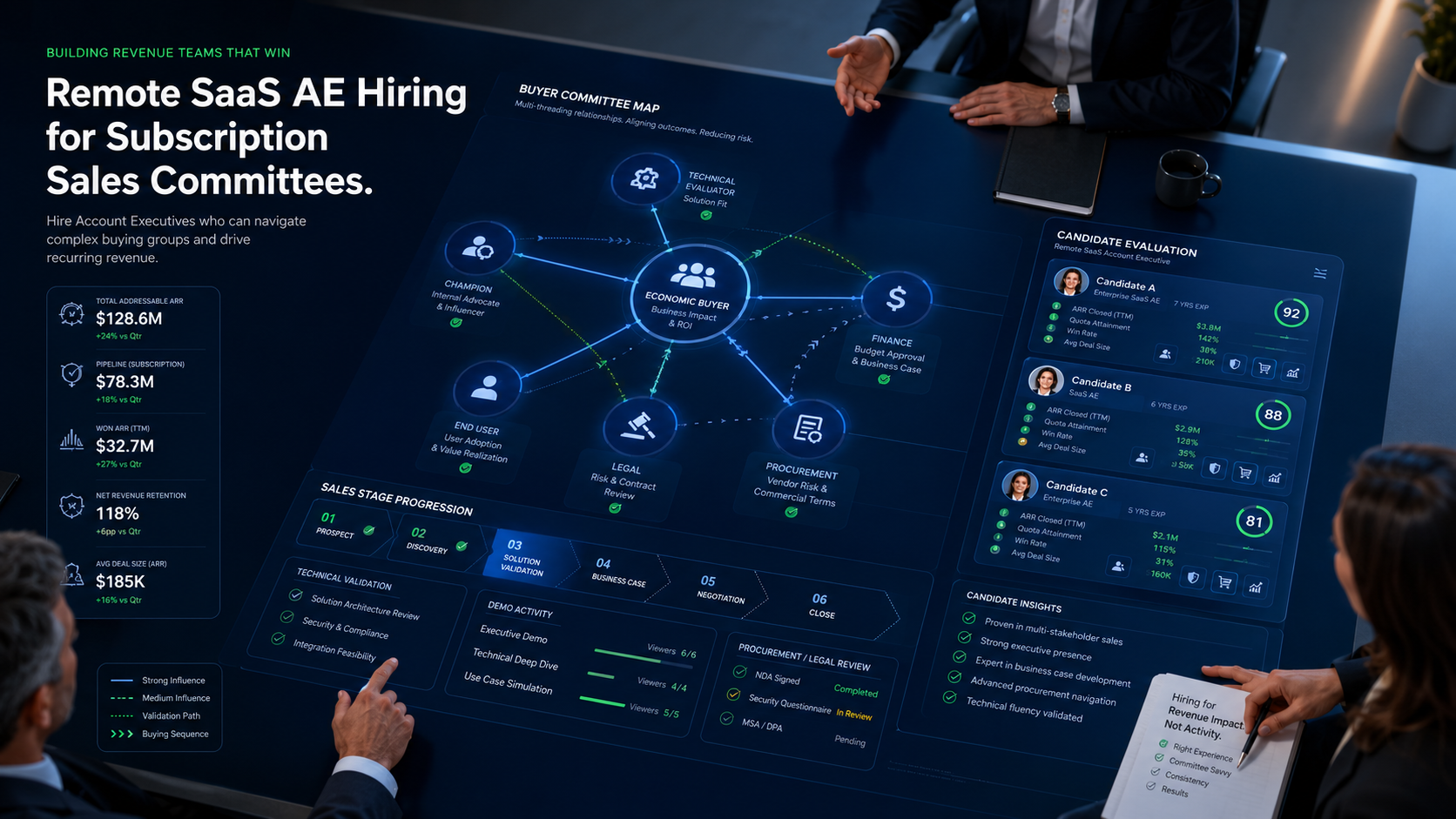
That distinction is critical for employers and sales recruiters. SaaS Account Executive hiring is different because the sale rarely depends on one buyer. A strong AE may need to work with a department leader, technical evaluator, finance stakeholder, procurement contact, legal reviewer, executive sponsor, and future end users before a contract is signed. Each stakeholder sees risk differently. Each needs a different version of the value story. Each can slow the deal if the AE does not manage the process correctly.
For SaaS employers, remote hiring adds another layer of complexity. The AE must sell through video meetings, digital demos, email follow-up, CRM updates, stakeholder maps, mutual action plans, and internal alignment — often without face-to-face access to buyers or daily in-person coaching from managers. That is why Remote SaaS Account Executive Sales Recruiting must evaluate the actual sales environment, not just the candidate’s title.
Why the Buyer Committee Defines the SaaS AE Profile
In SaaS sales, the buyer committee shapes the hiring profile more than the job title does. A company may say it needs a remote SaaS Account Executive, but that description is incomplete. The employer needs to define what kind of buying committee the AE must manage. A sales cycle involving one department head and a short contract review requires one profile. A sales cycle involving revenue leadership, IT, legal, finance, procurement, implementation, and executive approval requires a very different profile. Employers should define the buyer committee before they define the candidate profile. Key questions include:
- Who usually initiates the buying conversation?
- Who controls budget?
- Who evaluates technical fit?
- Who can block the deal?
- Who signs the contract?
- Who influences adoption after purchase?
- Who cares most about ROI?
- Who cares most about security, integration, or implementation risk?
- Who owns renewal success after the sale?
A SaaS AE who can sell to one enthusiastic user may not be able to win consensus across a full committee. That is why employers should avoid screening only for “SaaS experience.” They need to screen for buyer-committee experience. The strongest remote SaaS AEs know how to identify influence, authority, urgency, risk, and internal politics. They do not rely on one champion to carry the deal.
Why Remote SaaS Account Executive Sales Recruiting Should Start With the Revenue Motion
Remote SaaS Account Executive Sales Recruiting works best when employers define the revenue motion before evaluating candidates. A SaaS AE role can vary widely. Some roles are high-velocity and transactional. Others are consultative, technical, enterprise-oriented, or heavily expansion-driven. A candidate who performed well in one SaaS motion may struggle in another. Employers should define the revenue motion across seven areas.
1. Segment
Is the AE selling to SMB, mid-market, enterprise, or strategic accounts? Segment matters because buyer behavior changes by company size. SMB buyers may move quickly but have limited budget. Enterprise buyers may have larger contract values but require consensus, security review, procurement, and executive approval.
2. Contract Value
What is the average contract value? A candidate who has sold $5,000 annual subscriptions may not be ready for $150,000 enterprise deals. A candidate who has sold large enterprise contracts may not fit a high-volume SMB role requiring speed and volume.
3. Sales Cycle
How long does a normal deal take? Short cycles require quick qualification and rapid urgency. Longer cycles require patience, stakeholder management, business-case development, and disciplined follow-up.
4. Pipeline Source
Does the AE create pipeline, close inbound leads, work partner opportunities, or manage a blended motion? This affects the candidate profile. A closing-only AE may not fit a role requiring self-sourced pipeline.
5. Product Complexity
Is the SaaS product easy to understand, or does it require technical validation? The more technical the product, the more the AE must coordinate with solution engineers, product experts, implementation teams, and technical buyers.
6. Buying Committee
How many stakeholders are involved? A multi-stakeholder sale requires stronger discovery, mapping, and internal alignment than a single-buyer sale.
7. Post-Sale Impact
Does the AE’s sale affect onboarding, renewal, expansion, and long-term customer value? In SaaS, a bad-fit sale can create churn risk. The AE must understand that closing the wrong customer can damage revenue later. Without this revenue-motion clarity, employers may hire based on resume strength instead of actual fit.
Where Virtual SaaS Account Executive Sales Recruiting Fits in a Digital Sales Process
Virtual SaaS Account Executive Sales Recruiting focuses on how SaaS AEs sell when most buyer engagement happens through digital channels. This matters because remote work and virtual selling are related, but not identical. A remote AE works outside a traditional office. A virtual SaaS AE sells through digital buyer interactions. In many SaaS companies, the employer needs both skills in one candidate. A virtual SaaS AE must be able to:
- Run discovery through video calls
- Keep buyers engaged during virtual demos
- Communicate value without physical presence
- Write follow-up that moves the deal forward
- Manage multi-threaded relationships online
- Document stakeholder activity in CRM
- Coordinate internally through remote workflows
- Build trust with buyers they may never meet in person
Employers should not assume that a candidate is strong at virtual selling just because they have worked remotely. Remote work shows independence. Virtual selling shows digital revenue execution. The best SaaS AEs can do both.
The Subscription Revenue Competency Map
SaaS employers should evaluate remote AE candidates through a subscription revenue lens. The AE is not only selling a contract. The AE is selling a recurring relationship that must make sense for the customer and the company. A strong SaaS AE should understand six subscription revenue competencies. ARR and MRR awareness: the candidate should understand annual recurring revenue and monthly recurring revenue, and how contract size, billing structure, discounting, expansion, and renewal timing affect the business. Customer fit: the AE should know how to avoid poor-fit customers, because a deal that closes quickly but churns early may hurt long-term revenue. Adoption risk: the AE should understand whether the buyer can successfully implement and use the platform, since renewal risk begins before the contract is signed if adoption is unlikely. Expansion potential: the AE should know how to identify future expansion opportunities without overselling during the initial deal. Handoff quality: the AE should be able to transition the customer to onboarding, implementation, customer success, or account management with clear context. Renewal sensitivity: even if the AE is responsible only for new business, they should understand that renewal outcomes are shaped by what was promised during the sale. This subscription revenue mindset separates strong SaaS AEs from transactional closers.
Why Remote Account Executive Sales Recruiting Is Not Enough for SaaS Employers
Remote Account Executive Sales Recruiting can help employers identify AEs who work independently, manage pipeline remotely, and close deals without sitting in an office. But SaaS employers need an additional layer of evaluation. They need to know whether the candidate can sell subscription products in a SaaS environment. That requires screening for:
- SaaS sales motion fit
- Recurring revenue understanding
- Multi-stakeholder buying experience
- Product and implementation awareness
- Virtual demo discipline
- Buyer committee management
- Forecast accuracy across long sales cycles
- Customer fit judgment
- Handoff discipline after close
A general remote AE may have strong sales instincts but lack SaaS-specific judgment. A SaaS AE may understand subscription sales but lack remote work discipline. The right hire needs both. For employers, this means the search should not be framed as “find us a remote AE.” It should be framed as: Find us a remote SaaS AE who can sell this subscription product to this buyer committee, through this sales motion, at this contract value, with this level of autonomy.
How Remote SaaS Sales Recruiters Should Screen for Subscription Sales Judgment
Remote SaaS Sales Recruiters should screen for subscription sales judgment early in the process. Title matching is not enough. “SaaS Account Executive” can describe many different roles. A strong recruiter screen should clarify:
- What SaaS product did the candidate sell?
- Who was the target buyer?
- What was the average contract value?
- What was the typical sales cycle?
- How much pipeline did the candidate self-source?
- How many stakeholders were involved?
- Did the candidate run demos independently?
- Did the candidate work with solution engineers?
- What CRM process did they use?
- What was their quota?
- How did they forecast deals?
- How did they handle procurement, legal, or technical review?
- What happened after the customer signed?
Recruiters should listen for evidence, not broad confidence. A candidate who says, “I sold to enterprise buyers,” should be able to explain the buying process. A candidate who says, “I managed complex deals,” should be able to describe stakeholder roles, blockers, decision criteria, and close strategy. The stronger the evidence, the easier it is for employers to trust the shortlist.
The Multi-Stakeholder Deal Review Exercise
One of the best ways to evaluate a remote SaaS AE is to ask for a detailed deal review. This exercise is more useful than a generic mock pitch because it shows how the candidate thinks through real buyer complexity. Ask the candidate to walk through a SaaS deal they personally managed. The candidate should explain:
- How the opportunity started
- Whether the deal was inbound, outbound, partner-led, or referral-based
- Who the first contact was
- How they identified the economic buyer
- Which stakeholders were involved
- What each stakeholder cared about
- What business pain created urgency
- What technical or implementation concerns appeared
- What competitors were involved
- What caused friction
- How they built consensus
- How they forecasted the opportunity
- What happened after close
The goal is not to hear a polished success story. The goal is to understand the candidate’s operating system. Strong candidates explain the process clearly. They can describe why the deal moved, what risks existed, and how they controlled the next step. Weak candidates often focus only on the final outcome or use vague language like “built relationships” and “showed value” without explaining how.
How to Test Stakeholder Mapping Before Finalist Stage
Stakeholder mapping should be tested before a candidate reaches the final stage. Employers can use a simple scenario. Give the candidate a fictional SaaS opportunity: a mid-market company with 500 employees, where the VP of Sales is interested, RevOps needs integration details, the CFO wants ROI justification, procurement wants pricing control, legal needs contract review, end users are skeptical about adoption, and a competitor is already in the account. Then ask the candidate:
- Who do you speak with first?
- What do you need to learn from each stakeholder?
- How do you confirm the economic buyer?
- How do you determine whether the VP of Sales is a real champion?
- How do you involve RevOps without losing momentum?
- How do you address CFO concerns?
- How do you prevent procurement from reducing the deal to price?
- What would make this deal forecastable?
- What next step would you ask for?
This exercise reveals whether the AE can think beyond a single buyer. It also shows whether the candidate understands how SaaS buying committees make decisions.
Product Complexity: The SaaS AE Must Know What to Explain and What to Escalate
Remote SaaS AEs do not need to be product engineers. But they must know enough to manage product complexity without losing buyer trust. This is especially important when the SaaS platform involves integrations, data security, workflow change, automation, compliance, implementation timelines, user adoption, reporting, system migration, and technical validation. A strong AE knows when to answer directly, when to bring in a technical resource, and how to keep the deal moving without pretending to know what they do not know. Employers should test this judgment with questions such as:
- How technical was the product you sold?
- When did you involve a solution engineer?
- How did you prepare technical resources before buyer calls?
- How did you handle a technical objection you could not answer?
- How did you prevent technical review from slowing the deal?
- How did you translate technical value into business value?
- How did you communicate implementation expectations?
The strongest SaaS AEs can bridge business and technical conversations. They do not overpromise. They do not hide uncertainty. They know how to use internal expertise while still owning the commercial process.
Forecast Discipline in Remote SaaS AE Hiring
Forecast discipline is one of the most important evaluation areas in Remote SaaS Account Executive Sales Recruiting. Remote SaaS teams rely heavily on CRM and pipeline reviews because leadership cannot depend on informal office conversations to understand deal health. A candidate should be able to explain what makes a deal forecastable. Strong forecast logic includes confirmed business pain, identified economic buyer, clear decision criteria, documented stakeholders, defined next step, known timeline, budget visibility, technical validation path, procurement or legal awareness, close-date evidence, and a mutual action plan. Weak forecast logic sounds like:
- “They liked the demo.”
- “The champion said they are interested.”
- “They asked for pricing.”
- “They seemed excited.”
- “I think it will close.”
Interest is not forecast evidence. SaaS employers need AEs who know the difference.
The Candidate Signals SaaS Employers Should Prioritize
SaaS employers should prioritize candidates who show specific signals tied to remote subscription sales success. Signal 1 — Clear deal narratives: the candidate can explain deals from source to close with stakeholder detail, business context, objections, and next-step control. Signal 2 — Strong qualification discipline: the candidate knows how to separate real opportunities from curiosity, weak interest, or unqualified demand. Signal 3 — Multi-threading behavior: the candidate does not rely on one contact and proactively builds relationships across the buyer committee. Signal 4 — Commercial curiosity: the candidate asks about the buyer’s business model, revenue problem, cost impact, growth goals, and operational constraints. Signal 5 — CRM precision: the candidate views CRM as a revenue tool, not an administrative burden. Signal 6 — Remote accountability: the candidate can describe how they organize prospecting, follow-up, internal communication, and pipeline reviews without daily in-office oversight. Signal 7 — Subscription awareness: the candidate understands that SaaS revenue depends on fit, adoption, renewal, and expansion after the initial sale. These signals are more predictive than charisma alone.
The Hiring Scorecard for Multi-Stakeholder SaaS AEs
Employers should use a weighted scorecard for remote SaaS AE hiring. The scorecard should reflect the role’s actual revenue demands. A practical weighting model could include:
| Evaluation Area | Suggested Weight | What It Measures |
|---|---|---|
| SaaS sales motion fit | 20% | Segment, ACV, sales cycle, buyer type |
| Stakeholder management | 20% | Ability to manage multiple decision-makers |
| Pipeline ownership | 15% | Self-sourcing, qualification, pipeline creation |
| Subscription revenue judgment | 15% | ARR/MRR, fit, adoption, renewal awareness |
| Virtual selling execution | 10% | Video discovery, demos, written follow-up |
| Forecast discipline | 10% | CRM accuracy, close-date logic, risk visibility |
| Remote accountability | 10% | Self-management and communication habits |
This type of scorecard helps prevent overvaluing one area. For example, a candidate may be excellent in virtual presentation but weak in stakeholder mapping. Another may have strong SaaS experience but poor pipeline creation. The scorecard helps hiring teams compare tradeoffs clearly.
Candidate Evaluation Questions by Stakeholder Type
Because this article is about multi-stakeholder subscription sales, employers should ask questions that reveal how the candidate handles different buyer roles.
Economic Buyer
- How do you identify the economic buyer?
- How do you confirm that person has budget authority?
- How do you build a business case for executive approval?
Technical Evaluator
- How do you prepare for technical validation?
- How do you coordinate with solution engineers?
- How do you keep technical review connected to business value?
Finance
- How do you handle ROI scrutiny?
- How do you discuss cost justification?
- How do you prevent discounting from becoming the main conversation?
Procurement
- How do you manage procurement without losing deal control?
- How do you prepare before procurement enters the process?
- What contract terms have slowed your deals before?
End Users
- How do you uncover adoption concerns?
- How do you handle user resistance?
- How do you show value to people who will use the platform daily?
Executive Sponsor
- How do you earn executive access?
- What does an executive sponsor need to hear?
- How do you summarize the deal at an executive level?
These questions are more precise than asking, “Are you good with stakeholders?” They force the candidate to explain how they manage each part of the committee.
Common Hiring Mistakes SaaS Employers Should Avoid
SaaS employers often miss strong candidates or hire weak fits because the process is not specific enough. Mistake 1 — Treating all SaaS experience as equal: SaaS experience varies widely, so employers need to evaluate sales motion, deal size, buyer complexity, and pipeline ownership. Mistake 2 — Overvaluing logo history: a candidate from a well-known SaaS company may not be the right fit if their prior role had stronger brand demand, better inbound flow, or more support resources. Mistake 3 — Ignoring product complexity: if the product requires technical validation, employers should test whether the AE can manage business and technical conversations. Mistake 4 — Assuming remote experience means remote performance: a candidate may have worked remotely but still lack the discipline to build pipeline and forecast accurately without office oversight. Mistake 5 — Failing to test written communication: remote SaaS selling depends heavily on written follow-up. Mistake 6 — Hiring for closing confidence instead of deal control: a confident closer may still lose control of complex SaaS deals if they cannot map stakeholders, confirm decision criteria, and manage internal buying friction.
What Treeline Brings to Remote SaaS Account Executive Hiring
Treeline supports employers by narrowing the gap between title-based recruiting and true sales-role fit. For SaaS employers, that distinction matters. A generic recruiting process may produce candidates with SaaS titles. A sales-specialized recruiting process should help identify candidates whose sales motion, buyer experience, subscription judgment, and remote selling discipline match the employer’s revenue model. Treeline’s employer-focused approach is especially relevant for SaaS teams that need to move quickly without lowering hiring standards. The firm’s sales specialization, national candidate network, proprietary Treeline Resume® platform, and emphasis on qualified candidate delivery support a more precise search process for revenue-critical roles. For Remote SaaS Account Executive Sales Recruiting, that means the search should be built around the actual sales problem: the employer needs more qualified pipeline, the buyer committee is complex, the product requires value explanation, the sales cycle may involve technical and financial review, forecast accuracy matters, remote work requires accountability, and the hire must contribute to subscription revenue growth.
How SaaS Employers Should Brief Sales Recruiters
A strong recruiter brief can dramatically improve candidate quality. Before launching a search, SaaS employers should provide sales recruiters with a clear operating profile. The brief should include:
- Target customer segment
- Average contract value
- Sales cycle length
- Buyer personas
- Product complexity
- Pipeline source expectations
- Quota and ramp expectations
- Remote work expectations
- Demo ownership
- Sales engineering support
- CRM and forecasting process
- Compensation structure
- Reasons previous hires succeeded or failed
- Must-have experience
- Deal-breakers
This brief helps recruiters avoid broad searches and focus on candidates who match the revenue motion. A weak brief produces resume flow. A strong brief produces calibrated candidate evaluation.
Building a Better Final Interview for Remote SaaS AEs
The final interview should not repeat earlier conversations. It should test the highest-risk parts of the role. For a remote SaaS AE, the final interview should usually include three components.
1. Deal Strategy Walkthrough
The candidate explains how they would approach a realistic opportunity. The hiring team evaluates stakeholder thinking, qualification, sequencing, and risk awareness.
2. Written Buyer Follow-Up
The candidate writes a follow-up email after a hypothetical discovery call or demo. The hiring team evaluates clarity, business relevance, next steps, and professionalism.
3. Forecast Defense
The candidate explains whether an opportunity should be forecasted and why. The hiring team evaluates whether the candidate uses evidence or optimism. This structure gives employers a stronger view of how the candidate will actually operate in the role, and it makes the process more useful for sales recruiters because feedback becomes specific.
The Hiring Standard SaaS Employers Should Use
Remote SaaS Account Executive Sales Recruiting should not aim to find the most available candidate. It should aim to find the candidate most likely to create qualified pipeline and close subscription revenue in the employer’s actual sales motion. The standard should be specific:
- Can this candidate sell SaaS subscriptions, not just products?
- Can this candidate manage multiple stakeholders, not just one champion?
- Can this candidate build pipeline remotely, not just close warm leads?
- Can this candidate forecast with evidence, not enthusiasm?
- Can this candidate explain value to business and technical buyers?
- Can this candidate work independently without becoming disconnected?
- Can this candidate protect long-term customer fit, not just close the first contract?
When employers use that standard, remote hiring becomes more strategic. The search becomes narrower, but the candidate quality improves. SaaS employers do not need more remote applicants. They need better evidence of sales fit. That is what Remote SaaS Account Executive Sales Recruiting should deliver.
FAQ
What is Remote SaaS Account Executive Sales Recruiting?
Remote SaaS Account Executive Sales Recruiting is the process of identifying, evaluating, and hiring SaaS Account Executives who can build pipeline, manage multi-stakeholder subscription sales, and close recurring revenue while working remotely.
How is Virtual SaaS Account Executive Sales Recruiting different from remote SaaS AE recruiting?
Virtual SaaS Account Executive Sales Recruiting focuses on digital selling execution, including video discovery, virtual demos, CRM workflows, online stakeholder engagement, and written follow-up. Remote SaaS AE recruiting focuses more broadly on hiring Account Executives who can perform outside a traditional office environment.
What should SaaS employers evaluate when hiring remote SaaS AEs?
SaaS employers should evaluate sales motion fit, multi-stakeholder deal management, pipeline ownership, subscription revenue judgment, virtual selling execution, forecast discipline, and remote accountability.
How should Remote SaaS Sales Recruiters screen SaaS Account Executive candidates?
Remote SaaS Sales Recruiters should screen for SaaS sales segment, average contract value, sales cycle length, buyer committee experience, self-sourced pipeline history, CRM discipline, forecast accuracy, and evidence of subscription revenue understanding.
How does Remote Account Executive Sales Recruiting support SaaS hiring?
Remote Account Executive Sales Recruiting supports SaaS hiring by helping employers evaluate Account Executives who can work independently, manage pipeline remotely, communicate deal risk, and close revenue without being limited to one office location.
Share This Story, Choose Your Platform!
Related Posts
What our happy clients are saying
Treeline Inc. provided us with the most candidates that aligned with our needs and were of the highest quality.

Dr. Jeffrey Klein Head of North America Sales, Satchel Pulse
Treeline Inc.’s collaborative, flexible, and communicative approach resulted in a smooth partnership. Beyond their recruitment expertise, their unique sourcing model was efficient and effective.

Sera Holt Director of Operations, LNS Research
Their professionalism was outstanding. Treeline Inc. was extremely thorough and ensured that we were on the same page before they started looking for candidates. They listened to us and did a great job working with the candidate to close out the process.

Cate Grant AVP Customer Success, Nasdaq
Thanks to Treeline Inc.’s intricate and thorough screening process, the company is able to hire six high-quality candidates that fit perfectly in the company’s culture. The team is highly receptive to concerns, and internal stakeholders are impressed with their unique recruitment abilities.

Anna McKean Sales Recruiter, Insider Intelligence
Treeline Inc. has been qualified individuals throughout a five-year-long engagement. They’ve made numerous placements of talented and qualified individuals for our business.

Michele St Laurent VP of HR, The Institute for Applied Network Security

Let Us Help You Source the Sales Talent You Need
Whether you’re building a team or replacing a key role, our Candidate Sourcing Platform provides a fast, flexible, and employer-focused solution.
Tell us more about your business and how we can help.
Treeline Inc.
Your Award-Winning Sales Recruitment Partner
15 Lincoln Street, Suite 314, Wakefield, MA 01880