Virtual Account Executive Sales Recruiting is no longer just about finding sales professionals who can work from home. For employers and sales recruiters, the real priority is identifying Account Executives who can manage complex B2B sales cycles, build trust with multiple stakeholders, move deals forward virtually, and stay accountable to quota without daily in-office oversight.
That standard is much higher than simply hiring someone with Account Executive experience. A virtual AE must be able to run discovery, qualify opportunities, manage buyer committees, coordinate internal resources, document deal movement, communicate forecast risk, and close business through digital channels. In a complex B2B sales environment, those responsibilities become even more demanding because the sales cycle is rarely linear. Buyers may include executives, technical evaluators, finance leaders, procurement teams, end users, and legal stakeholders. Each person has a different concern, and the AE must manage the entire process without relying on hallway conversations, in-person meetings, or constant manager visibility.
For employers, the hiring process needs to test how the AE actually sells. A polished resume is not enough. A strong interview presence is not enough. The candidate must show evidence of structured selling, virtual communication discipline, complex deal management, and independent revenue ownership.
Treeline Inc. helps employers hire sales professionals by focusing on sales-specific recruiting, employer alignment, role clarity, candidate quality, and faster access to qualified sales talent. For Virtual Account Executive Sales Recruiting, that means helping companies evaluate whether a candidate can do more than present well. The candidate must be able to build pipeline, protect deal momentum, and close revenue in a virtual sales environment.
Why Virtual Account Executive Sales Recruiting Requires a More Specific Hiring Process
Virtual Account Executive Sales Recruiting requires a more specific hiring process because complex B2B selling exposes weak sales habits quickly. In a simpler sales motion, an AE may succeed with strong energy, fast follow-up, and a good product pitch. In complex B2B sales, the AE needs a deeper operating system. They must understand buyer pain, identify the decision process, map the buying committee, create urgency, manage objections, and coordinate next steps over weeks or months. That is difficult in any environment. It becomes harder when most interactions happen through video calls, email, CRM notes, digital demos, and asynchronous communication. Employers should not ask only: Has this candidate sold before? They should ask: Has this candidate managed a complex B2B sales cycle virtually, with enough structure to protect pipeline quality and forecast accuracy? A strong virtual AE hiring process should assess:
- Sales cycle experience
- Average contract value experience
- Pipeline source and ownership
- Discovery quality
- Stakeholder mapping ability
- Business-case development
- Written communication quality
- CRM discipline
- Forecast accuracy
- Video-call presence
- Follow-up structure
- Ability to work with sales engineers, customer success, leadership, and implementation teams
- Comfort selling without in-person buyer access
Employers who skip this level of evaluation often hire AEs who sound experienced but struggle once they enter a virtual, multi-stakeholder sales environment.
The Difference Between a Virtual AE and a General Remote Seller
A virtual Account Executive is not just a remote seller with a quota. The role is more specific. A general remote seller may handle transactional sales, inbound leads, renewals, or straightforward buyer conversations. A virtual Account Executive in complex B2B sales needs to control a more demanding process. The AE has to create buyer confidence, manage risk, and move stakeholders through a decision path without physical presence. A virtual AE should be able to:
- Run executive-level discovery through video calls
- Ask layered questions that uncover business pain
- Identify economic buyers and technical influencers
- Build consensus among stakeholders
- Handle stalled deals without waiting for manager intervention
- Use CRM data to manage next actions
- Communicate deal risk before the forecast slips
- Coordinate internal resources across departments
- Write follow-up emails that advance the deal
- Create urgency without pressuring the buyer incorrectly
The role requires discipline, structure, and business judgment. When employers confuse virtual AE hiring with generic remote sales hiring, they often under-screen for complexity. The result is a candidate who can perform basic sales activity but cannot manage a sophisticated buying process.
Where Remote Account Executive Sales Recruiting Fits Into the Strategy
Remote Account Executive Sales Recruiting and Virtual Account Executive Sales Recruiting are closely connected, but they are not identical. Remote Account Executive Sales Recruiting focuses on hiring Account Executives who can perform outside a traditional office environment. Virtual Account Executive Sales Recruiting focuses more specifically on the digital selling environment: video meetings, CRM workflows, virtual demos, asynchronous communication, distributed buying committees, and online relationship-building. For many employers, both concepts apply at the same time. A company may need an AE who works remotely, sells virtually, manages a national territory, and handles complex B2B opportunities. In that case, the hiring process should evaluate both remote-readiness and virtual-selling maturity. Remote-readiness tests whether the candidate can work independently. Virtual-selling maturity tests whether the candidate can sell effectively through digital channels. Employers need both.
What Employers Should Evaluate Before Hiring Virtual Account Executives
Virtual Hiring Account Executives should begin with a clear understanding of the role’s sales motion. Before interviewing candidates, employers should define the sales environment in detail. This prevents misalignment and helps recruiters identify candidates who match the actual business need. Employers should clarify:
- What market segment will the AE sell into?
- Is the role SMB, mid-market, enterprise, strategic, or channel-influenced?
- What is the average contract value?
- How long is the typical sales cycle?
- How many stakeholders are usually involved?
- Is the product technical, consultative, regulated, or highly competitive?
- Does the AE need to generate pipeline or close inbound demand?
- What percentage of quota should come from self-sourced opportunities?
- Will the AE run demos, or will sales engineers support technical validation?
- What CRM and sales tools are required?
- What does a qualified opportunity look like?
- What are the first 90-day expectations?
This is the foundation of effective Virtual Account Executive Sales Recruiting. Without role clarity, employers risk evaluating candidates against vague expectations. A candidate who is strong in a 30-day transactional sales cycle may not fit a 9-month enterprise sales cycle. A candidate who closed mostly inbound leads may not fit a role that requires outbound account development. Virtual hiring requires precision before sourcing starts.
Complex B2B Sales Cycles Require Evidence, Not Assumptions
Complex B2B sales cycles are full of hidden risk. A deal may look healthy because the main contact is responsive. But the economic buyer may not be engaged. Procurement may not be aligned. Legal may delay terms. Finance may challenge ROI. A technical evaluator may prefer another solution. A champion may lack internal influence. A strong virtual AE knows how to identify these risks early. Employers should evaluate whether candidates can explain how they manage deal complexity. A strong candidate can explain:
- How they identify the real decision-maker
- How they confirm decision criteria
- How they map each stakeholder’s role
- How they build a mutual action plan
- How they handle a deal that has gone quiet
- How they know whether a champion has influence
- How they create urgency without discounting too early
- How they coordinate technical, legal, and executive conversations
- How they forecast based on evidence rather than optimism
This is where structured interviewing becomes critical. Employers should ask candidates to walk through a real deal from first contact to close. The goal is not to hear a success story. The goal is to understand how the candidate thinks, communicates, documents, and manages complexity.
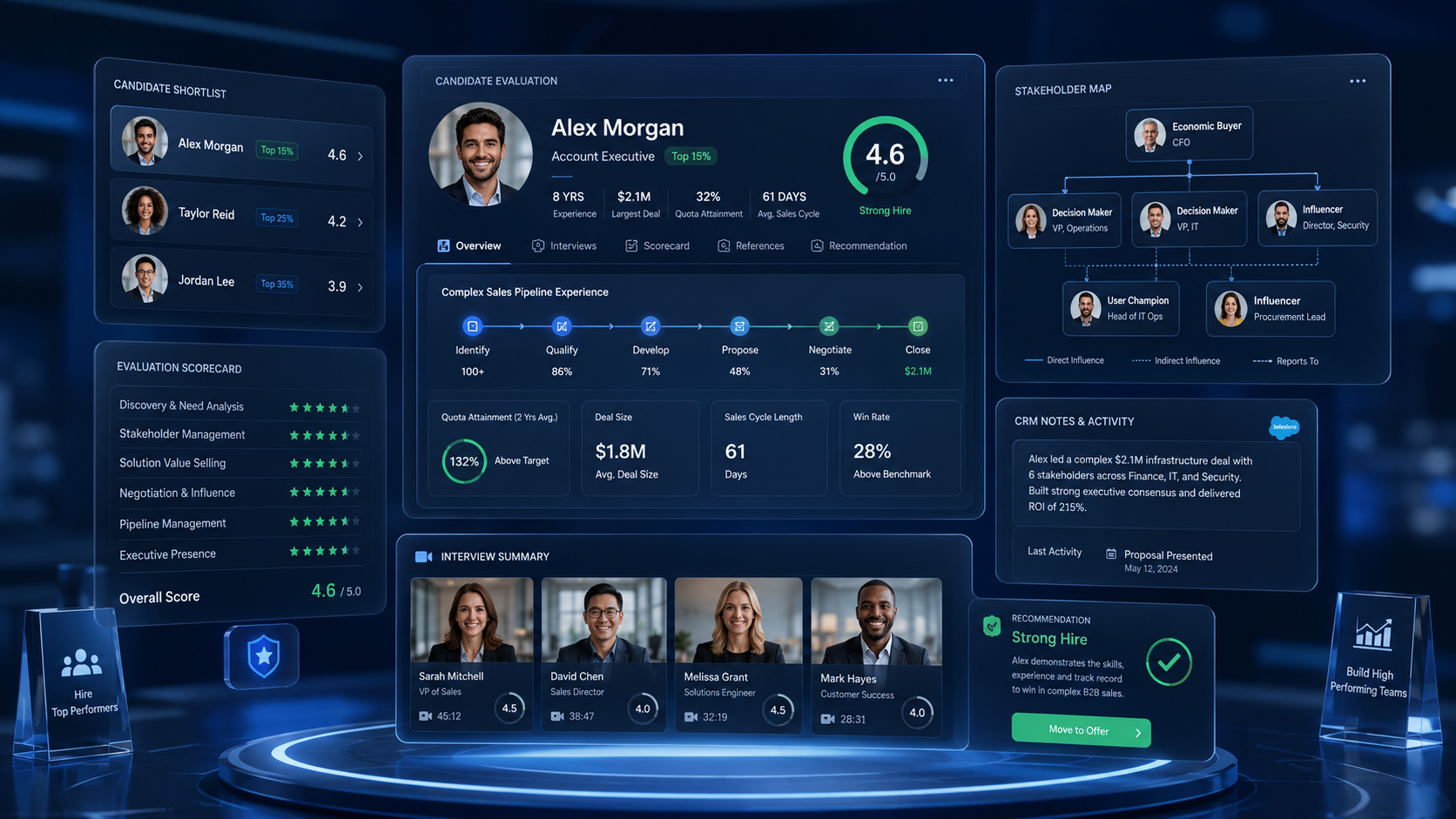
The Virtual AE Scorecard Employers Should Use
A scorecard makes Virtual Account Executive Sales Recruiting more objective. Instead of relying on general interview impressions, employers should evaluate each candidate across role-specific categories.
1. Sales Motion Fit
Sales motion fit measures whether the candidate has sold in an environment similar to the employer’s business. Evaluate segment experience, deal size, sales cycle length, buyer type, product complexity, new logo vs. expansion experience, inbound vs. outbound pipeline ownership, and consultative vs. transactional selling background. Sales success does not always transfer cleanly from one motion to another.
2. Discovery Quality
Discovery quality measures whether the candidate can uncover the buyer’s business problem, not just collect surface-level information. Evaluate whether the candidate can ask business-impact questions, identify pain, urgency, and consequence, understand current-state workflows, clarify decision criteria, separate interest from buying intent, connect product value to measurable outcomes, and summarize buyer pain clearly. In virtual selling, discovery quality is especially important because the AE may have fewer informal signals from the buyer.
3. Stakeholder Mapping
Stakeholder mapping measures whether the candidate can understand and manage the buying committee. Evaluate whether the candidate can identify the economic buyer, technical evaluator, user buyer, procurement contact, executive sponsor, internal champion, legal reviewer, and finance stakeholder. Complex B2B deals often fail because the AE engages one enthusiastic contact while ignoring the rest of the buying committee.
4. Virtual Communication
Virtual communication measures whether the candidate can build trust, maintain attention, and advance next steps without in-person interaction. Evaluate video presence, meeting structure, listening skills, clarity of explanation, follow-up writing, responsiveness, ability to summarize next steps, and ability to keep multiple stakeholders aligned. A virtual AE must be precise. Poor communication slows deals and weakens buyer confidence.
5. Pipeline Ownership
Pipeline ownership measures whether the candidate can create, manage, and advance opportunities independently. Evaluate self-sourced pipeline history, prospecting discipline, account targeting, qualification standards, opportunity progression, pipeline coverage, activity quality, and conversion from meeting to qualified opportunity. A virtual AE who depends entirely on marketing or inbound demand may not fit a role that requires proactive pipeline creation.
6. Forecast Discipline
Forecast discipline measures whether the candidate can provide accurate, evidence-based deal updates. Evaluate whether the candidate can explain why a deal is forecasted, what evidence supports the close date, what risks remain, what next action is required, who must approve the deal, what could delay the opportunity, and how they update CRM after buyer interaction. Virtual sales teams need clean forecasting because leadership cannot rely on informal office updates.
7. Coachability and Accountability
Coachability matters because even experienced AEs need to adapt to a company’s sales process, buyer profile, market position, and technology stack. Evaluate response to feedback, ownership of missed targets, willingness to use process, ability to improve after coaching, communication with managers, and adaptability in changing sales environments. A virtual AE must be independent, but not unmanageable.
Interview Questions for Evaluating Virtual AEs
Employers and sales recruiters should use interview questions that reveal how the candidate operates in complex B2B sales cycles.
Sales Cycle Experience
- Walk me through the most complex B2B deal you closed.
- How many stakeholders were involved?
- What was the sales cycle length?
- What made the deal difficult?
- How did you keep the deal moving?
- What almost caused it to stall?
- What did you do to regain momentum?
Virtual Discovery
- How do you run discovery when the buyer relationship is entirely virtual?
- What questions help you determine whether an opportunity is real?
- How do you confirm urgency?
- How do you identify business impact?
- How do you handle a buyer who is interested but not committed?
Stakeholder Management
- How do you identify the economic buyer?
- How do you confirm whether your champion has influence?
- What do you do when procurement enters late?
- How do you manage conflicting stakeholder priorities?
- How do you bring executives into the conversation without overstepping?
Pipeline and Prospecting
- What percentage of your pipeline was self-generated?
- How did you choose target accounts?
- What prospecting messages worked best?
- How did you measure account engagement?
- How did you balance prospecting with active deal management?
CRM and Forecasting
- What information must be in CRM before a deal enters forecast?
- How do you define next steps?
- How do you handle deals with no clear close date?
- What causes you to move a deal out of forecast?
- How do you communicate deal risk to leadership?
Virtual Work Discipline
- How do you structure your day as a virtual AE?
- How often do you communicate with your manager?
- How do you prepare for video meetings?
- How do you avoid losing momentum between calls?
- How do you stay accountable to activity and pipeline goals?
These questions help employers move beyond resume review and evaluate real selling behavior.
Red Flags in Virtual Account Executive Sales Recruiting
A weak virtual AE hire can create pipeline noise, inaccurate forecasts, and lost revenue opportunities. Vague deal stories: if a candidate cannot explain a complex deal clearly, they may not have owned the process as deeply as the resume suggests; listen for missing details around buyer roles, decision process, business pain, next steps, objections, competitive pressure, forecast risk, and final approval path. Overreliance on product demos: a candidate who focuses only on product features may struggle to connect the solution to business outcomes; look for candidates who can explain why the buyer needed change, what business problem the product solved, how the AE created urgency, how success was measured, and how the buyer justified the investment internally. Poor written follow-up: virtual selling depends heavily on writing, and email summaries, recap notes, mutual action plans, and stakeholder updates often shape the deal after the meeting ends, so employers can test this with a short written follow-up exercise. Weak forecast logic: a red flag appears when the candidate cannot explain what makes a deal commit, best case, pipeline, or closed-lost. No clear self-management system: if the candidate relies on general claims like “I am self-motivated” without explaining how they stay organized, employers should dig deeper.
How Virtual Account Executive Jobs Should Be Designed
Virtual Account Executive Jobs should be written for performance clarity, not just candidate attraction. A strong Virtual Account Executive Jobs page should define target market, sales motion, quota expectation, pipeline ownership, sales cycle length, average deal size, CRM expectations, video-based selling requirements, discovery expectations, stakeholder management requirements, internal collaboration expectations, ramp milestones, compensation structure, and travel expectations, if any. The language should be direct. Instead of saying, “We are looking for a motivated Account Executive to join our remote team,” a stronger employer-facing description would say: This virtual Account Executive role is built for a B2B seller who can manage multi-stakeholder opportunities, build qualified pipeline, run discovery through digital channels, maintain accurate CRM records, and communicate forecast risk before deals stall. That framing attracts stronger candidates and reduces misalignment.
Virtual Account Executive Hiring New York: Why Market Expectations Still Matter
Virtual Account Executive Hiring New York is not only about location flexibility. It is about access to a high-caliber sales talent market while maintaining the expectations associated with competitive B2B selling. New York sales environments often involve sophisticated buyers, competitive compensation, high urgency, and strong performance expectations. Employers may not need every AE physically located in New York, but they may still want candidates who understand that level of buyer pressure and market pace. Employers should evaluate:
- Experience selling into New York or similar competitive markets
- Comfort with executive buyers
- Ability to manage fast-moving deal cycles
- Compensation alignment
- Competitive selling experience
- Ability to travel for key meetings if needed
- Familiarity with sophisticated B2B buyer expectations
- Ability to operate virtually without reducing professionalism
The goal is not to make the role generic because it is virtual. The goal is to preserve market quality while removing unnecessary geographic constraints.
How Sales Recruiters Should Calibrate the Search
Sales recruiters play a critical role in Virtual Account Executive Sales Recruiting because they help translate employer needs into candidate evaluation criteria. Before sourcing begins, recruiters should align with the employer on must-have sales experience, acceptable industry adjacency, required sales motion, required quota history, required virtual selling experience, compensation range, ramp expectations, disqualifying factors, interview process, candidate scorecard, and offer timeline. A disciplined recruiter should ask what a successful AE accomplishes in the first six months, what types of candidates have failed in this role before, what sales behaviors matter most, what deal complexity the candidate must already understand, what coaching capacity the manager has, and what the company needs the AE to own independently. These questions make the search more precise.
How Employers Can Test Virtual Selling Skills Before the Offer
Employers should not wait until after hire to discover whether a candidate can sell virtually. The interview process can include practical exercises that simulate the real work.
Mock Discovery Call
Ask the candidate to run a discovery call based on a realistic buyer scenario. Evaluate question quality, listening, business pain identification, and next-step control.
Written Follow-Up Exercise
Give the candidate a short scenario and ask for a follow-up email to the buyer. Evaluate clarity, professionalism, business relevance, and whether the email advances the opportunity.
Deal Review Exercise
Ask the candidate to explain a past complex deal. Evaluate stakeholder mapping, forecast logic, objection handling, and deal progression.
Pipeline Prioritization Exercise
Provide a small list of accounts or opportunities and ask how the candidate would prioritize them. Evaluate judgment, segmentation, and strategic thinking.
Forecast Conversation
Ask the candidate to present a forecast update for a hypothetical pipeline. Evaluate whether they separate evidence from optimism. These exercises do not need to be overly long. They should be structured enough to reveal how the candidate thinks and operates.
The First 90 Days for a Virtual Account Executive
Virtual AE success depends heavily on the first 90 days. Employers should create a ramp plan that balances training, activity, pipeline generation, and deal quality.
First 30 Days: Sales Motion and Buyer Understanding
The AE should learn the product and buyer profile, understand the sales process, review win/loss patterns, study customer pain points, shadow discovery calls and demos, learn CRM requirements, build target account lists, begin low-risk prospecting, and establish a manager communication rhythm.
Days 31–60: Active Pipeline Development
The AE should run discovery calls, build qualified pipeline, send structured follow-up, document opportunities in CRM, practice forecast conversations, refine messaging, receive call coaching, and begin managing early-stage opportunities.
Days 61–90: Deal Progression and Forecast Discipline
The AE should advance qualified opportunities, identify stakeholders, build mutual action plans, communicate deal risk, maintain pipeline coverage, improve conversion rates, show buyer engagement quality, and demonstrate ownership of next steps. The 90-day plan should measure quality, not just activity. A virtual AE can generate many calls and emails without creating real pipeline, so employers need to evaluate whether activity is converting into qualified opportunities and revenue movement.
What Treeline Brings to Virtual Account Executive Sales Recruiting
Treeline’s role is to help employers reduce hiring uncertainty in sales-specific roles. Virtual AE hiring requires a recruiting partner that understands sales role design, candidate motivation, sales motion fit, quota history, complex B2B sales cycles, virtual selling behavior, pipeline expectations, compensation alignment, hiring speed, and long-term retention risk. Treeline’s employer-focused recruiting approach helps companies avoid generic candidate searches and focus on sales professionals who fit the role, the market, and the revenue goal. For employers, that matters because a missed Account Executive hire does not only affect headcount. It affects pipeline creation, territory coverage, revenue forecasts, manager bandwidth, and buyer relationships. That is why Virtual Account Executive Sales Recruiting should be structured, evidence-based, and tied directly to business outcomes.
Building a Repeatable Virtual AE Hiring System
Employers hiring one virtual AE should think beyond the immediate opening. The best companies build a repeatable system for hiring virtual sales professionals. That system includes clear role definitions, candidate scorecards, structured interview questions, practical sales exercises, compensation alignment, remote and virtual work expectations, CRM and forecast standards, 30-60-90 day ramp plans, manager coaching cadence, and retention checkpoints. When these pieces are documented, the hiring process becomes more consistent. Recruiters know what to screen for. Hiring managers know what to evaluate. Candidates understand expectations before accepting the role. Virtual Account Executive Sales Recruiting works best when employers stop treating virtual work as the main qualification and start treating it as the environment where high-performing sales behavior must be proven.
FAQ
What is Virtual Account Executive Sales Recruiting?
Virtual Account Executive Sales Recruiting is the process of identifying, evaluating, and hiring Account Executives who can manage pipeline, run discovery, engage stakeholders, and close B2B deals through virtual sales channels.
How is Remote Account Executive Sales Recruiting different from Virtual Account Executive Sales Recruiting?
Remote Account Executive Sales Recruiting focuses on hiring AEs who can work outside a traditional office. Virtual Account Executive Sales Recruiting focuses more specifically on evaluating AEs for digital selling, virtual discovery, CRM execution, video-based buyer engagement, and remote stakeholder management.
What should employers evaluate when Virtual Hiring Account Executives?
When Virtual Hiring Account Executives, employers should evaluate sales motion fit, complex B2B deal experience, stakeholder mapping, discovery quality, CRM discipline, forecast accuracy, pipeline ownership, and virtual communication skills.
How should employers structure Virtual Account Executive Jobs?
Employers should structure Virtual Account Executive Jobs around quota expectations, pipeline ownership, sales cycle complexity, digital selling requirements, CRM standards, ramp milestones, compensation, and manager communication cadence.
Why does Virtual Account Executive Hiring New York matter for employers?
Virtual Account Executive Hiring New York matters because employers may want access to NYC-caliber Account Executive talent and competitive-market sales experience without requiring every candidate to work from a New York office.
Share This Story, Choose Your Platform!
Related Posts
What our happy clients are saying
Treeline Inc. provided us with the most candidates that aligned with our needs and were of the highest quality.

Dr. Jeffrey Klein Head of North America Sales, Satchel Pulse
Treeline Inc.’s collaborative, flexible, and communicative approach resulted in a smooth partnership. Beyond their recruitment expertise, their unique sourcing model was efficient and effective.

Sera Holt Director of Operations, LNS Research
Their professionalism was outstanding. Treeline Inc. was extremely thorough and ensured that we were on the same page before they started looking for candidates. They listened to us and did a great job working with the candidate to close out the process.

Cate Grant AVP Customer Success, Nasdaq
Thanks to Treeline Inc.’s intricate and thorough screening process, the company is able to hire six high-quality candidates that fit perfectly in the company’s culture. The team is highly receptive to concerns, and internal stakeholders are impressed with their unique recruitment abilities.

Anna McKean Sales Recruiter, Insider Intelligence
Treeline Inc. has been qualified individuals throughout a five-year-long engagement. They’ve made numerous placements of talented and qualified individuals for our business.

Michele St Laurent VP of HR, The Institute for Applied Network Security

Let Us Help You Source the Sales Talent You Need
Whether you’re building a team or replacing a key role, our Candidate Sourcing Platform provides a fast, flexible, and employer-focused solution.
Tell us more about your business and how we can help.
Treeline Inc.
Your Award-Winning Sales Recruitment Partner
15 Lincoln Street, Suite 314, Wakefield, MA 01880