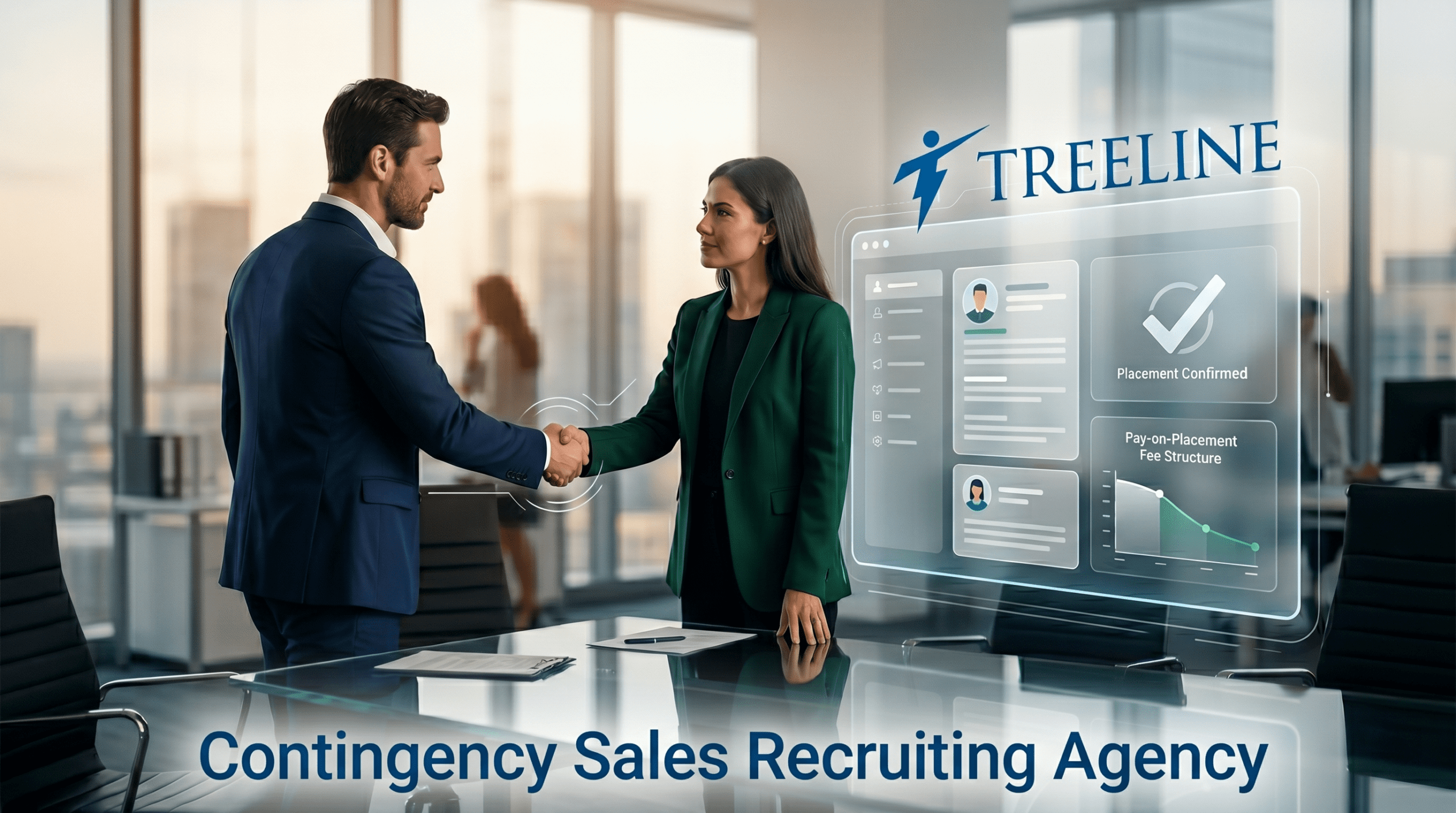
A Contingency Sales Recruiting Agency reduces hiring risk by charging fees only when a candidate is successfully hired, providing pre vetted sales talent, accelerating time to fill, and offering replacement guarantees, converting traditional fixed recruiting costs into a pay for performance investment that protects employers from sunk costs and bad hires.
Sales hiring is uniquely high stakes. A single mis hire on a quota carrying team can cost an employer between 1.5x and 3x the role’s annual salary once you factor in lost pipeline, ramp time, severance, management distraction, and rehiring costs. For a $200,000 OTE sales role, that’s a potential six figure loss per failed hire, and most companies make multiple sales hires every year.
This guide explains how a contingency based recruiting model directly addresses those risks. You’ll learn what contingency recruiting is, how it works, when to use it, how it compares to retained search, and how to evaluate the right partner for your hiring needs. The audience is twofold: employers weighing hiring strategies and internal sales recruiters considering when to bring in external support.
What Is a Contingency Sales Recruiting Agency?
A Contingency Sales Recruiting Agency is a specialized recruiting firm that sources, screens, and presents qualified sales candidates to employers, but only collects a fee when a candidate they introduced is hired and starts work. There is no retainer, no upfront engagement fee, and no payment for sourcing activity that does not result in a placement. This stands in contrast to retained search, where the employer pays a portion of the fee at engagement, a second installment mid search, and the balance on placement, regardless of outcome. Contingency models shift the financial risk of an unsuccessful search onto the agency.
In the sales recruiting market, contingency placement firms typically focus on:
- Individual contributor sales roles (SDRs, BDRs, AEs, account managers)
- Sales leadership (sales managers, directors of sales)
- Specialty sales roles (channel, partnerships, enterprise, technical sales)
- High volume hiring where multiple seats need to be filled quickly
Contingency sales recruiters generally maintain large, actively cultivated networks of passive and active sales candidates, allowing them to move faster than internal teams that build pipelines reactively. According to the Society for Human Resource Management (SHRM), the average corporate time to fill across roles is roughly 42 days, and sales roles often exceed that benchmark when handled internally.
How a Contingency Sales Recruiting Agency Mitigates Financial Risk
The most obvious risk reduction benefit of contingency recruiting is structural: you do not pay unless you hire. But the financial protection runs deeper than the pay on placement model alone.
1. Zero sunk cost on unsuccessful searches
Internal recruiting consumes salary, benefits, job board spend, applicant tracking system seats, and management time, whether or not a role is ultimately filled. With a contingency placement firm, that overhead lives on the agency’s books. If they don’t deliver, you owe nothing.
2. Replacement guarantees
Most reputable contingency search firms include a replacement guarantee period (typically 30 days). If the hired candidate leaves or is terminated within that window for performance reasons, the agency replaces the candidate at no additional fee, or refunds a prorated portion of the placement fee.
3. Reduced cost of vacancy
A vacant sales seat carries an opportunity cost equal to the revenue that seat would have generated. The Harvard Business Review has documented how prolonged vacancies in revenue producing roles compound across the year. Contingency sales recruiters, motivated by speed to placement, typically reduce time to fill significantly compared to internal only hiring processes.
4. Predictable, capped fees
Contingency fees are typically structured as a percentage of first year compensation (commonly 25%), with the fee capped and known in advance. This makes budgeting straightforward and removes the variable cost surprises that come with extended internal searches.
5. Reduced hiring manager fatigue
When internal teams sift through hundreds of unqualified applicants, hiring manager judgment erodes. Contingency executive recruiters pre screen and shortlist candidates, presenting only those who meet defined requirements, which preserves managerial bandwidth for actual hiring decisions and revenue work.
The Contingency Sales Recruiting Agency Process Explained
Understanding the operational flow helps employers set expectations and integrate effectively with their recruiting partner. Most contingency search firms follow a similar workflow:
Step 1: Intake and Role Definition
The agency interviews the hiring manager and talent acquisition lead to capture the role’s required skills, compensation structure, ideal candidate profile, sales methodology in use, territory or vertical, and culture markers. This step typically takes one to three business days.
Step 2: Sourcing and Outreach
Recruiters tap into their networks, candidate databases, LinkedIn Recruiter, referrals, and proprietary research to identify candidates. A well run contingency placement firm produces an initial slate of qualified candidates within five to ten business days.
Step 3: Screening and Qualification
Each candidate is interviewed by the recruiter against the role’s competencies. Strong agencies validate quota attainment, deal sizes, and sales cycles, not just titles on a resume.
Step 4: Candidate Presentation
The agency presents a shortlist (usually three to six candidates) with submission notes, comp expectations, and recruiter assessed fit. Employers review and select candidates for first round interviews.
Step 5: Interview Coordination
The agency manages scheduling, prep, debriefs, and feedback loops between candidate and employer. This is where strong contingency sales recruiters protect deals from falling apart due to delays.
Step 6: Offer and Close
Once an offer is extended, the agency helps negotiate, manage counter offers, and ensure the candidate signs and starts.
Step 7: Placement and Guarantee Period
The fee is invoiced upon the candidate’s start date. The guarantee period begins, providing protection against early departure. Throughout the process, employers retain full decision making authority, the agency advises, sources, and screens, but every hiring decision stays with the employer.
Comparing Contingency vs. Retained vs. Internal Hiring Models
Each hiring model carries trade offs. The table below summarizes how a Contingency Sales Recruiting Agency compares to the alternatives across the dimensions that matter most to employers and internal sales recruiters.
| Dimension | Contingency Model | Retained Search | Internal Recruiting Only |
|---|---|---|---|
| Upfront cost | $0 | 30–50% of fee | Salary + tooling overhead |
| Risk if no hire | Agency absorbs | Employer absorbs | Employer absorbs |
| Typical fees | 25% of first year comp | 25–35% of first year comp | Fully loaded internal cost |
| Best for | IC sales, sales leaders, volume hiring | C suite, confidential, niche | Always on pipeline roles |
| Speed | Fast (5–30 days) | Methodical (45–90 days) | Variable, often slow |
| Exclusivity | Often non exclusive | Always exclusive | N/A |
| Replacement guarantee | Standard | Standard | N/A |
| Best when budget is | Performance based | Confirmed and committed | Long term operating expense |
For most sales roles below the VP level, the contingency model offers the strongest blend of speed, cost protection, and outcome alignment. Retained search remains the right call for confidential C suite searches or highly niche roles where dedicated bandwidth is non negotiable.
Key Benefits of Partnering with a Contingency Sales Recruiting Agency
Beyond raw risk reduction, employers gain meaningful operational and strategic benefits from partnering with a contingency recruiting specialist. These benefits compound the longer the partnership runs.
Access to passive candidates
The strongest sales performers are typically employed and not actively job searching. They don’t read job boards. They do, however, return calls from recruiters they trust. Established contingency sales recruiters have spent years building those relationships. According to LinkedIn’s Global Talent Trends data, roughly 70% of the global workforce is made up of passive talent, a pool that internal recruiters often struggle to reach.
Market intelligence
Contingency executive recruiters who specialize in sales know what compensation packages, equity grants, ramp expectations, and sales cycles look like across your competitive set. This market intelligence helps employers craft offers that win, not stall.
Speed without sacrificing fit
Because contingency search firms are paid only on placement, their incentives align with quickly identifying genuinely qualified candidates, not flooding the pipeline with marginal resumes. The best agencies measure themselves on submit to hire ratios and time to first interview, not raw volume.
Specialization
Generalist agencies cover broad swaths of roles. A specialized Contingency Sales Recruiting Agency focuses exclusively on revenue producing roles, which means the recruiters understand sales methodologies (MEDDIC, Challenger, Sandler), comp structures (base/variable splits, accelerators, MBOs), and the cultural signals that predict success in a given sales environment. You can review how this kind of specialization shapes outcomes on Treeline’s sales recruiting services page.
Scalability
When a company needs to hire five SDRs in 60 days, internal teams struggle. A contingency placement firm with bench strength can absorb that demand and deliver candidates in parallel.
Confidentiality (when needed)
While contingency searches are typically not exclusive, the better firms handle sensitive replacement searches with discretion, sourcing externally without tipping off the incumbent or the market.
Common Sales Hiring Risks and How Contingency Models Address Them
To make the risk reduction case concrete, consider the most frequent and costly sales hiring failure modes, and how contingency recruiting maps to each.
Risk 1: Hiring on resume strength, not real performance
Contingency sales recruiters validate quota attainment, deal context, and references before submission. Resume inflation is filtered out before it reaches the hiring manager.
Risk 2: Slow time to fill costs revenue
Every month a sales seat sits empty costs the company the revenue that seat would have generated. Contingency search firms compress timelines aggressively because their fee depends on the close.
Risk 3: Wrong fit hires turn over within 12 months
The U.S. Bureau of Labor Statistics tracks turnover across industries, and sales roles consistently rank among the highest. Replacement guarantees from contingency placement firms provide a financial backstop when early turnover occurs.
Risk 4: Internal recruiters lack sales specific networks
Generalist internal recruiters often struggle to source senior or specialty sales talent. Specialized contingency executive recruiters bring pre-built networks that internal teams cannot replicate quickly.
Risk 5: Compensation misalignment kills offers at the finish line
Recruiters who specialize in sales hiring have real time visibility into market comp benchmarks. They flag offer gaps before they become deal breakers.
Risk 6: Hiring manager bandwidth is finite
Sales leaders need to be selling and coaching, not screening 200 LinkedIn profiles. Contingency recruiting offloads top of funnel work entirely.
When to Choose a Contingency Sales Recruiting Agency Over Other Models
Contingency recruiting is not the right answer for every hire. Use the framework below to decide when the model fits.
Choose contingency when:
- You need to fill one or more individual contributor or mid level sales roles within 30–60 days.
- You want to avoid upfront recruiting spend until a hire is confirmed.
- The role is not confidential and can be sourced openly.
- You have multiple sales seats to fill (volume hiring).
- Your internal recruiting team is at capacity or lacks sales specific networks.
- You want to engage two or three agencies in parallel for broader reach.
Choose retained search when:
- The role is a C level or strategic VP hire where dedicated, exclusive bandwidth is required.
- Confidentiality is critical (replacing an incumbent, stealth search, M&A context).
- The role is highly specialized and likely to take 90+ days.
- You want a fixed, exclusive partner accountable for the full search outcome.
Stay internal when:
- The role is always on (you hire SDRs continuously, for example) and you’ve built an internal sourcing engine.
- You have a strong employer brand and inbound application volume meets quality bar.
- You have available recruiter bandwidth and the role is straightforward.
For most growth stage and mid market companies, a hybrid approach works best: keep always on roles internal and use a Contingency Sales Recruiting Agency for surges, niche roles, and senior IC hires. You can read more about Treeline’s approach to partnering with internal teams on the About Treeline page.
How to Evaluate a Contingency Sales Recruiting Agency
Not every agency operates with the same rigor. Use these criteria to separate strong contingency search firms from order takers.
1. Specialization
Ask: What percentage of your placements are sales specific? A firm where 90%+ of placements are revenue roles will outperform a generalist agency on sales hires.
2. Track record and references
Request placement data: average time to fill, submit to hire ratio, and one year retention rate of placed candidates. Strong agencies track and share these.
3. Process transparency
Ask the agency to walk through their sourcing, screening, and submission process. Vague answers signal a weak process. Specific answers, with examples, signal a mature operation.
4. Candidate quality at the top of the funnel
The signal to noise ratio in their submissions is the most important quality marker. Three excellent candidates beat fifteen mediocre ones every time.
5. Replacement guarantee terms
Read the guarantee carefully. Look for:
- A guarantee period of at least 60–90 days
- Clear definitions of qualifying departure reasons
- Replacement vs. refund options
- Reasonable conditions for invoking the guarantee
6. Communication cadence
Will you get weekly updates? A dedicated recruiter or a rotating team? How quickly do they respond to candidate questions? Communication discipline predicts outcomes.
7. Cultural fit with your team
The agency will represent your brand to candidates. Make sure their tone and professionalism reflect how you want to be perceived in the market.
8. References from companies like yours
Ask for references from employers of similar size, stage, and industry. A firm that has placed sales talent at venture backed SaaS companies will operate differently than one focused on enterprise hardware sales.
If you’d like to discuss how to evaluate a fit for your specific hiring needs, book a meeting with Treeline to review your requirements.
Real World Example: How a Contingency Sales Recruiting Agency Reduces Risk in Practice
Consider a mid market SaaS company that needs to hire four mid market Account Executives within 90 days to support a new product launch. The internal recruiting team is fully occupied with engineering hires. The company has two options:
Option A: Internal only
The TA team posts the roles on three job boards, screens inbound applications, and runs LinkedIn outreach in spare cycles. After 60 days, two AEs are hired, one stays, one leaves within five months. Two roles remain open. Estimated cost: $15,000 in job board fees, recruiter time at 30% of capacity for 90 days (~$22,000 loaded), $200,000+ in lost pipeline from delayed seats.
Option B: Contingency Sales Recruiting Agency
The company engages two contingency sales recruiters in a non exclusive arrangement. Within 35 days, both agencies have collectively submitted 18 qualified candidates. Four are hired and start within 50 days. Total placement fees: ~$120,000 (25% of first year comp on $120K OTE × 4). Replacement guarantees cover any early departures. Estimated benefit: $400,000+ in pipeline preserved by hitting the 50 day target instead of the 120+ day internal only timeline.
In this scenario, the contingency model is more expensive on a line item basis, but dramatically cheaper on a total cost of hiring basis once vacancy cost is included.
Frequently Asked Questions
What does “contingency” mean in recruiting?
In recruiting, “contingency” means the agency only earns a fee if the placement is successful, that is, if the candidate they introduced is hired and starts work. There is no upfront fee, retainer, or charge for unsuccessful searches. The agency’s compensation is fully contingent on outcome.
How much does a Contingency Sales Recruiting Agency charge?
Typical contingency fees for sales placements range from 20% to 30% of the candidate’s first year total compensation (base + on target variable). For a $150,000 OTE role, that’s $30,000–$45,000, payable on the candidate’s start date. Some agencies offer reduced rates for volume engagements or repeat clients.
How long does a contingency sales search take?
Most contingency placements close within 30 to 60 days from engagement to start date. The fastest searches, when the role is well defined and decision makers move quickly, close in two to three weeks. Senior or specialized roles may take 60–90 days.
Is contingency recruiting better than retained search?
Neither model is universally better, they serve different needs. Contingency recruiting is generally better for individual contributor sales roles, volume hiring, and budget conscious employers. Retained search is generally better for confidential C level searches, highly specialized roles, and situations requiring guaranteed exclusive attention.
Can I work with multiple contingency search firms at once?
Yes. Because contingency engagements are typically non exclusive, employers often engage two or three agencies in parallel to maximize reach. The first agency to deliver the hired candidate earns the fee. Best practice is to limit it to two or three agencies to avoid duplicate submissions and candidate confusion.
What is the replacement guarantee on a contingency placement?
A replacement guarantee means that if the placed candidate leaves the role within a defined window, usually 60 to 120 days, the agency will replace the candidate at no additional fee, or refund a prorated portion of the original placement fee. Specific terms vary by firm and should be reviewed in the engagement agreement.
How is a contingency placement firm different from a staffing agency?
A staffing agency typically places temporary, contract, or contract to hire workers and remains the employer of record while the worker is on assignment. A Contingency Sales Recruiting Agency places direct hire (full time) candidates whose employment relationship is directly with the hiring company from day one.
Do contingency executive recruiters work for the employer or the candidate?
Contingency executive recruiters are paid by the employer, so the employer is the client. However, the best recruiters operate with high integrity toward candidates, providing honest market guidance, advocating for fair offers, and maintaining long term candidate relationships across multiple roles over time.
Final Thoughts
The case for a Contingency Sales Recruiting Agency comes down to a straightforward proposition: convert fixed, at risk recruiting spend into performance based investment, accelerate hiring, and shift the financial risk of an unsuccessful search to the agency. For employers facing budget constraints, internal capacity limits, or aggressive growth targets, the model is one of the cleanest risk reduction levers available in the hiring toolkit.
The keys to maximizing the value are partner selection (specialization, process transparency, track record), thoughtful engagement (clear role definition, responsive feedback loops), and integration with internal recruiting (knowing when to deploy contingency, when to retain, and when to stay internal). When done well, a contingency partnership doesn’t just fill open roles, it strengthens the long term hiring engine, surfaces market intelligence, and consistently delivers the quota carrying talent that drives revenue growth.
Share This Story, Choose Your Platform!
Related Posts



What our happy clients are saying
Treeline Inc. provided us with the most candidates that aligned with our needs and were of the highest quality.

Dr. Jeffrey Klein Head of North America Sales, Satchel Pulse
Treeline Inc.’s collaborative, flexible, and communicative approach resulted in a smooth partnership. Beyond their recruitment expertise, their unique sourcing model was efficient and effective.

Sera Holt Director of Operations, LNS Research
Their professionalism was outstanding. Treeline Inc. was extremely thorough and ensured that we were on the same page before they started looking for candidates. They listened to us and did a great job working with the candidate to close out the process.

Cate Grant AVP Customer Success, Nasdaq
Thanks to Treeline Inc.’s intricate and thorough screening process, the company is able to hire six high-quality candidates that fit perfectly in the company’s culture. The team is highly receptive to concerns, and internal stakeholders are impressed with their unique recruitment abilities.

Anna McKean Sales Recruiter, Insider Intelligence
Treeline Inc. has been qualified individuals throughout a five-year-long engagement. They’ve made numerous placements of talented and qualified individuals for our business.

Michele St Laurent VP of HR, The Institute for Applied Network Security

Let Us Help You Source the Sales Talent You Need
Whether you’re building a team or replacing a key role, our Candidate Sourcing Platform provides a fast, flexible, and employer-focused solution.
Tell us more about your business and how we can help.
Treeline Inc.
Your Award-Winning Sales Recruitment Partner
15 Lincoln Street, Suite 314, Wakefield, MA 01880