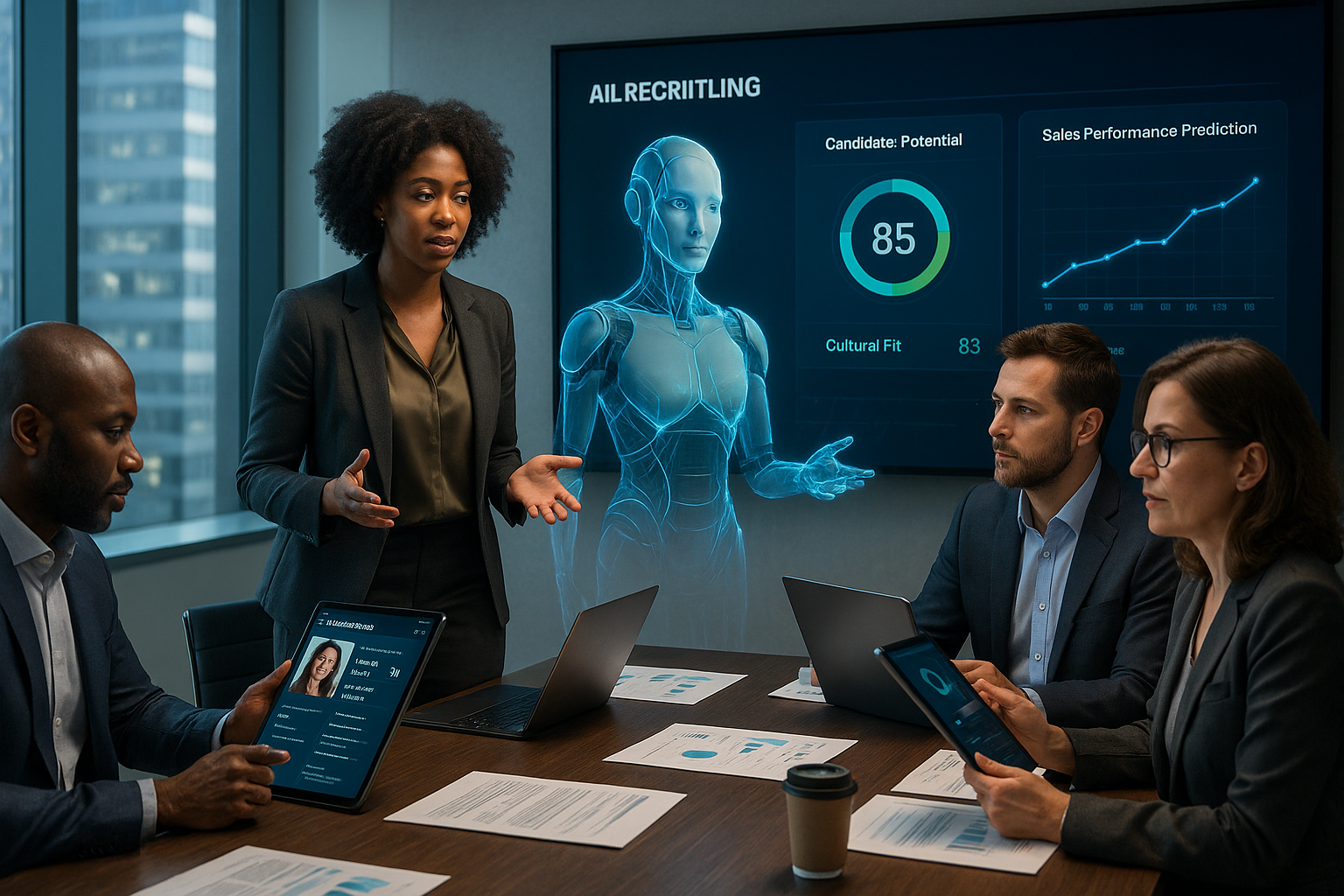
AI recruiting has rapidly become a defining force in modern talent acquisition, streamlining processes and offering competitive advantages for employers, especially those tasked with building outperforming sales organizations. Businesses that understand and implement AI recruiting not only shorten their time-to-hire but also improve the quality and fit of their sales hires. As the demand for skilled sales professionals remains steady amid market shifts, leveraging artificial intelligence in recruitment is less a matter of keeping up and more a means of gaining ground. Book an introductory meeting to explore AI recruiting solutions for your firm.
Understanding AI Recruiting: What It Is and Why It Matters
Artificial intelligence recruiting refers to the application of software and algorithms that help automate, analyze, and ultimately improve recruitment decisions. Unlike traditional approaches, which often require substantial manual screening, scheduling, and communication, AI recruiting tools can sift through thousands of resumes, assess candidate profiles, and identify the most promising sales talent in a fraction of the time.
Employers are often drawn to AI powered recruiting because it addresses inefficiencies endemic to sales hiring. A 2024 survey from HRTech News found that 82% of companies using AI in hiring report faster turnaround and a deeper candidate pool. This shift is particularly relevant to organizations scaling their sales teams, where the ability to quickly engage top talent can be decisive.
AI recruiting applications operate across multiple stages:
- Resume parsing: Scanning and extracting key details from large resume volumes, removing the need for hours of manual review.
- Predictive analysis: Using data to predict which applicants are more likely to succeed in sales roles based on historical performance indicators.
- Automated communication: AI-driven chatbots respond to candidate inquiries and nurture applicants, enhancing their experience while reducing recruiter workload.
- Bias filtering: Mitigating unconscious human biases by strictly adhering to required skills and experiences.
With the influx of AI recruiting tools on the market, differentiation lies in combining advanced algorithms with the nuanced judgment of experienced recruitment professionals. AI recruitment software does not replace the recruiter; instead, it arms them with insights and efficiencies that previously weren’t possible. According to a 2024 Gartner report, the most successful organizations strike a balance between automation and human expertise, a combination that not only accelerates hiring but also ensures a higher standard of candidate fit.
For employers responsible for growing sales teams, artificial intelligence recruitment is more than a technological upgrade. It represents a foundational change in talent acquisition philosophy: focusing on accuracy and speed without sacrificing relational and cultural alignment. Factors like rapid market entry, seasonal sales cycles, and aggressive revenue targets make these efficiencies not just attractive, but essential. As AI recruiting tools evolve, their ability to forecast performance, flag outliers, and streamline negotiation only becomes more valuable.
If your organization is seeking to reshape its hiring strategy with measurable results, Book an introductory meeting to discuss tailored AI recruiting strategies.
How AI Recruiting Tools Improve the Sales Hiring Pipeline
AI recruitment software fundamentally alters the sales hiring pipeline by introducing intelligence and automation into each step, from sourcing and screening to interviewing and onboarding. Employers tasked with scaling sales divisions often experience bottlenecks when relying on traditional methods, as manual processes can’t keep pace with business needs or the expectations of high-performing sales candidates.
Sourcing with AI begins long before job ads are posted. AI powered recruiting platforms mine talent databases, professional networks, and social channels to surface active and passive candidates who match specific criteria. These systems often tap into both public and proprietary datasets, rapidly mapping thousands of potential fits for roles such as SDR, Account Executive, or CRO.
Screening, historically the most time-consuming component of hiring, is where hr ai tools shine. Natural language processing and machine learning models assess candidate data, not just resumes, but also online profiles, work samples, and even recorded interviews. These models can score applicants for essential sales competencies, communication style, and historical quota achievement. Sales recruiters leveraging AI tools for recruitment can then move directly to the most promising candidates, instead of getting mired in unqualified applications.
Interview scheduling is also streamlined with AI tools. Automated calendar integrations allow candidates to self-select times, reducing back-and-forth and keeping the process moving swiftly. In later interview stages, AI recruitment platforms often provide structured interview questions informed by role requirements and team fit, helping minimize subjectivity and confirming alignment with organizational culture.
Onboarding is another area where artificial intelligence recruitment is having an impact. AI powered onboarding tools support documentation, early training, and even cultural assimilation. By automating background checks, benefits enrollment, and introductory materials, new sales hires can become productive sooner and with fewer administrative headaches.
Take, for example, a B2B technology firm that expanded its sales force by 40% in one quarter using a blend of AI recruiting tools and dedicated contingency sales recruiters. By automating resume screening and candidate scheduling, the hiring team saved over 100 hours in the first month alone, enabling them to focus on in-depth engagement with top candidates. The result was a faster, more efficient sales hiring pipeline, and fully staffed territory teams ahead of revenue-critical periods.
When organizations combine data-driven solutions with expert recruiter insights, they experience not just placement velocity but also lower turnover, as AI recruitment can flag mismatches early in the process. For those considering a strategic shift, reviewing the top Sales Recruitment Firms employing these tools may reveal new best practices for hiring.
The Advantages and Limitations of AI Recruiting for Employers
Adopting AI recruiting comes with considerable business upsides, especially for organizations seeking to scale high-performing sales teams. However, a nuanced view should also account for the system’s limits, ensuring leaders make informed decisions about where and how artificial intelligence recruitment delivers the most value.
Advantages
Efficiency and Speed: Automation slashes the time to shortlist candidates. According to SHRM’s 2024 HR Technology Survey, companies implementing AI powered recruiting solutions reported up to a 56% reduction in time-to-fill for sales roles.
Enriched Candidate Insights: AI recruiting tools analyze data points beyond basic credentials, such as historical quota achievement, career trajectory, and even behavioral indicators gleaned from digital footprints, providing a sharper lens for sales talent acquisition.
Consistency and Fairness: Removing subjective bias ensures every candidate is evaluated against the same standards. Algorithms flag only those with required qualifications for further review, keeping processes impartial and repeatable.
Wider Reach: AI recruitment software can analyze vast networks quickly, pulling in both active job seekers and passive candidates who may not be visible to traditional methods. For sales hiring, where the best candidates often aren’t actively applying, this reach is invaluable.
Cost Savings: By reducing labor-intensive tasks and bad hires, AI tools for recruitment can lower the total cost of hiring.
Limitations
Potential Data Bias: AI is only as unbiased as the datasets it learns from. If training data reflects existing biases, outcomes may reinforce them unless safeguards are in place.
Human Judgment Still Essential: Algorithms can narrow the field, but the nuances of cultural fit, motivation, and interpersonal skills require skilled human assessment, especially in sales, where personal connection drives results.
Integration Challenges: Not all AI recruitment software is compatible with legacy HR systems. Some require updates or significant training to realize full benefits.
Candidate Experience Risks: Overreliance on automation may lead to impersonal candidate journeys. Balancing efficiency with genuine communication is critical.
Upfront Costs and ROI Uncertainty: Investing in sophisticated ai recruitment can create budget pressures, and measuring ROI may take several hiring cycles.
A balanced approach, integrating artificial intelligence with seasoned recruitment professionals, is the strategy adopted by leading Contingency Sales Recruiters nationwide. When considering AI for recruitment, select tools that are transparent in decision-making, allow human oversight, and are customizable to reflect your unique hiring philosophy.
Book an introductory meeting to discover how the right blend of AI technology and specialized recruiter expertise can overcome common hiring challenges for your sales team.
Implementing AI Recruiting Tools in Your Hiring Workflow
Once an employer decides to embrace AI recruiting, the next step involves thoughtful planning, clear roles, and staged rollout to maximize results. Modern ai recruiting tools rarely require a complete overhaul; they are designed to complement and enhance existing practices.
Assessment and Buy-In: Begin with cross-team discussions to clarify why AI recruiting tools are being adopted. Secure buy-in from HR, sales leadership, and executive teams to ensure alignment of expectations and responsibilities.
Vendor Evaluation: Evaluate multiple ai recruitment software solutions with a practical lens. Consider integration with your current applicant tracking system (ATS), data privacy and security policies, reporting capabilities, user interface, scalability, and support. Look for platforms recognized in recent rankings, such as the Forbes list of best HR tech providers for 2024.
Customization and Pilot Testing: Most leading platforms allow you to set parameters, scoring models, and job-specific traits. Run a small pilot, perhaps for one sales region or a single high-priority vacancy, to measure workflow improvements and candidate quality.
Training and Rollout: Equip your team with the necessary training to interpret AI-generated insights and flag any discrepancies. Ensure recruiters know how to override or supplement automation when unique scenarios arise.
Monitoring Impact: Define metrics, like time-to-fill, candidate satisfaction scores, retention rates, and diversity statistics, that matter to your organization. Use these to regularly compare pre- and post-adoption results. Research from the Harvard Business Review in May 2024 suggests that transparent KPIs are key to sustaining momentum and organizational trust during tech-driven changes.
Continuous Improvement: AI recruiting tools are updated regularly as algorithms are refined and datasets grow. Work closely with your provider to leverage new features, retrain models, and incorporate feedback from recent hires. Encourage your sales and HR teams to share insights on candidate quality, onboarding, and team fit.
In practice, a medical technology company that layered AI analytics onto its sales recruitment pipeline experienced a 28% improvement in candidate acceptance rates, while reducing the cycle time from requisition to offer by nearly 40%. Real-world outcomes like these reflect not just process change, but also a cultural shift toward data-empowered decision-making.
For employers, the goal isn’t simply automating what already exists; it’s about enabling smarter, more strategic hiring. As you implement new solutions, remain open to feedback and stay engaged with your leading recruiters, technology combined with human insight fuels breakthroughs in talent acquisition.
Selecting the Right AI Recruitment Software and Tools
With a crowded market of ai recruitment software and ai tools for recruitment, employers face the challenge of separating providers offering genuine advantage from those simply repackaging old workflows with new buzzwords. Making the right choice depends on understanding your sales team’s unique needs and mapping those to platform capabilities.
Key Criteria When Evaluating AI Recruiting Tools:
- Integration with Existing Systems: Select tools that interlock with your ATS, HRIS, and CRM platforms. Disruption in workflow can undermine adoption.
- Data Security and Compliance: Look for evidence of rigorous data protocols, particularly with evolving U.S. and international data privacy regulations.
- Customizability: Successful sales recruitment demands tailored workflows. Choose solutions that support your company’s brand voice, cultural filters, and sales-specific assessments.
- Analytics and Reporting: Systems should make it easy to track and report on key recruitment metrics, predict future hiring needs, and identify areas for process refinement.
- Candidate Experience Support: Features like conversational chatbots, easy application processes, and status updates foster a positive impression, essential in competitive sales hiring landscapes.
- Vendor Reputation and Support: Favor companies with proven expertise in sales talent acquisition, available client case studies, and responsive support channels.
Notable players in the AI recruitment space include companies such as HireVue, Lever, Eightfold.ai, and Greenhouse, each offering robust solutions for high-volume and specialized hiring. However, employers seeking industry-specific expertise, especially in sales, should prioritize vendors and consultants who combine technical functionality with market depth. Visit authoritative sources like HR Technologist for up-to-date rankings and platform reviews.
For growing organizations, the right AI recruitment software acts as a force multiplier, accelerating screening, improving decision accuracy, and supporting better employer branding. Yet, the human element remains critical; tools are most powerful in the hands of recruiters attuned to your business model, culture, and long-term growth plans.
Consider scheduling a Book an introductory meeting to discuss which AI tools best suit your team’s evolving sales hiring needs.
Future Trends in AI Recruiting and Their Impact on Sales Talent Acquisition
The field of AI recruiting continues to advance at a remarkable pace, driving changes not only in how employers attract and assess sales talent, but also in the overall candidate experience and competitive landscape. As technology matures, new trends are emerging, further enhancing the ability of organizations to build elite sales teams with greater precision.
Predictive Analytics for Workforce Planning
One powerful trend reshaping talent acquisition is predictive analytics. AI platforms now offer modeling tools that analyze turnover rates, market dynamics, and business growth forecasts to anticipate future hiring needs. For sales organizations, this means moving from reactive recruiting to proactive workforce planning, empowering leaders to build talent pipelines before critical gaps occur and optimize territory coverage for ambitious revenue targets.
Contextual Matching and Skill Assessment
Beyond resume parsing, next-generation AI recruitment software incorporates contextual understanding, analyzing how previous roles, performance data, and industry changes align with your sales organization’s future needs. Some platforms even utilize AI-driven assessments and simulations to evaluate a candidate’s response to real sales scenarios. This granular approach gives employers a fuller view of candidate potential, helping predict ramp-up time and long-term success on the team.
Enhanced Diversity and Inclusion Initiatives
Sales success is driven by diverse thought and experience. AI recruiting tools are steadily being refined to mitigate bias, monitor for equitable outreach, and support structured interviews. Employers leveraging these advances benefit from a broader, more inclusive candidate pool, which is linked to higher team creativity and improved performance outcomes.
A McKinsey report from 2023 found that sales teams with above-average gender and ethnic diversity outperformed less diverse teams by 36% in revenue per sales rep, a finding that reinforces the importance of bias-resistant recruiting technology.
Deeper Integration with Sales Technology Stacks
Forward-thinking organizations are integrating AI recruitment with CRM, onboarding, and sales enablement tools. This end-to-end data flow makes it possible to monitor individual progress post-hire, providing feedback loops for refining the recruitment process. Sales talent acquisition becomes more closely tied to revenue analytics, with actionable insights for both hiring managers and executive leadership.
Personalized Candidate Journeys
As competition for sales talent intensifies, delivering a personalized candidate journey becomes a major differentiator. AI recruitment solutions increasingly support dynamic communication that adapts content and touchpoints to each individual’s career stage, interests, and aspirations. Employers creating positive, high-value interactions can attract top candidates, boost offer-acceptance rates, and strengthen their employer brand in crowded markets.
To stay ahead, organizations should continuously evaluate the latest AI recruiting advancements and seek out partners with both proven technology and deep expertise in sales talent acquisition. Book an introductory meeting to discuss how emerging trends can be leveraged for your next hiring cycle.
Frequently Asked Questions about AI Recruiting for Employers
What types of recruitment processes can AI improve for sales hiring?
AI can optimize resume screening, candidate outreach, interview scheduling, skill and cultural assessments, onboarding workflows, and overall talent pipeline analytics. For sales hiring, AI excels at identifying candidates with proven quota attainment, relevant industry experience, and the personality traits that align with high-performing sales cultures.
Is it safe to trust AI recruiting tools with sensitive candidate data?
Leading AI recruitment software providers follow strict data security and privacy guidelines, often exceeding industry standards. When evaluating platforms, look for transparent data use policies, options to anonymize sensitive information, and evidence of compliance with regulations such as GDPR and CCPA.
Will automating recruitment with AI result in a less personal candidate experience?
Not necessarily. When implemented thoughtfully, AI can handle repetitive tasks, such as scheduling or reminders, so human recruiters can spend more time on personal interactions and relationship-building. Successful organizations blend AI efficiency with the empathy and judgment of experienced HR teams.
Are there risks of bias with AI recruiting solutions?
Bias can enter AI systems if training data is incomplete or skewed. Many modern AI recruiting tools include features to identify and correct such patterns, but regular audits and human oversight are crucial to ensure fair and equitable processes.
How can I ensure my organization’s unique culture is reflected in AI-powered sales hiring?
Customization is key. Top-tier AI recruitment platforms allow employers to tailor evaluation criteria to emphasize attributes that match your organizational culture. Combining these custom algorithms with interviews and recruiter feedback ensures new hires are aligned with your values and performance standards.
Share This Story, Choose Your Platform!
Related Posts



What our happy clients are saying
Treeline Inc. provided us with the most candidates that aligned with our needs and were of the highest quality.

Dr. Jeffrey Klein Head of North America Sales, Satchel Pulse
Treeline Inc.’s collaborative, flexible, and communicative approach resulted in a smooth partnership. Beyond their recruitment expertise, their unique sourcing model was efficient and effective.

Sera Holt Director of Operations, LNS Research
Their professionalism was outstanding. Treeline Inc. was extremely thorough and ensured that we were on the same page before they started looking for candidates. They listened to us and did a great job working with the candidate to close out the process.

Cate Grant AVP Customer Success, Nasdaq
Thanks to Treeline Inc.’s intricate and thorough screening process, the company is able to hire six high-quality candidates that fit perfectly in the company’s culture. The team is highly receptive to concerns, and internal stakeholders are impressed with their unique recruitment abilities.

Anna McKean Sales Recruiter, Insider Intelligence
Treeline Inc. has been qualified individuals throughout a five-year-long engagement. They’ve made numerous placements of talented and qualified individuals for our business.

Michele St Laurent VP of HR, The Institute for Applied Network Security

Let Us Help You Source the Sales Talent You Need
Whether you’re building a team or replacing a key role, our Candidate Sourcing Platform provides a fast, flexible, and employer-focused solution.
Tell us more about your business and how we can help.
Treeline Inc.
Your Award-Winning Sales Recruitment Partner
15 Lincoln Street, Suite 314, Wakefield, MA 01880